

Introduction
The organic and low-input farming sector is rapidly developing in the EU. Utilized agricultural areas have increased by 6.5 percent per year on average in the period between 2000 and 2008 (EU, 2010). The number of organic pigs increased from 0.39 to 0.81 million heads from 2002 to 2007, which amounts to an average annual increase of 15.5 percent (EU, 2010). Despite this rapid growth, only 0.5 percent of the EU pig herd is raised organically. Based on the number of certified organic pigs produced in 2007, Germany is the largest producer with almost 0.2 million heads, followed by Denmark (0.08 million), France (0.07 million), Austria (0.07 million), Greece (0.06 million), The Netherlands (0.06 million) and Great Britain (0.05 million) (EU, 2010).
In comparison with intensive pig production systems, low-input systems are characterized by smaller herd size, more space per animal, lower capital investment, often outdoor management, provision of bedding, greater labour requirement and focus on animal welfare. Organic pig production systems are similar to low-input systems, but additionally operate according to EU regulations on organic livestock farming (834/2007), which prescribe low stocking densities and access to outdoor runs, restrict the level of non-organic feeds and prohibit the use of genetically modified feeds.
Owing to the national histories of organic pork production, diverse climatic conditions and national organic farming regulations, large variation exists in organic housing and management conditions between European countries (Edwards, Reference Edwards2011; Früh, Reference Früh, Forster and Weidmann2011). For example in Germany, The Netherlands and Sweden, the housing for organic pork production is mostly indoors with access to concrete outdoor runs. In Great Britain and Denmark, organic production stages are outside with individual paddocks with huts (Larsen and Jørgensen, Reference Larsen and Jørgensen2002). In Southern Europe (Italy, Spain), most of the organic pig herds are outdoors and are situated in hills and mountains. Both traditional and conventional pig breeds are used in low-input and organic production systems. Traditional breeds such as Saddleback, Large Black and Mangalitza are often used on smaller scale organic farms, both as purebred stock and as crosses with conventional sire line breeds such as Duroc and Piétrain. Conventional breeds typically include crosses of Landrace, Large White and Duroc, and specialized genetic lines developed by breeding companies (Martins et al., Reference Martins, Kelly, Day, Stopes, Browning, Edwards and Day2002).
For many years, there has been debate about the suitability of traditional and conventional breeds in low-input and organic production systems (DEFRA, 2002; Brandt et al., Reference Brandt, Werner, Baulain, Brade and Weissmann2010). Traditional breeds are recommended by the Soil Association (2011) to retain genetic diversity. Moreover, these breeds are presumed to have characteristics that make them well adapted to lower input, free-range and organic systems (Chambers, Reference Chambers2005). However, traditional breeds may be less prolific, grow slowly and have excess carcass fat at heavy slaughter weights (Blair, Reference Blair and Blair2007; Kelly et al., Reference Kelly, Browning, Day, Martins, Pearce, Stopes and Edwards2007). On the other hand, conventional breeds or specialized genetic lines have high prolificacy, efficient feed conversion, high growth rates and carcass leanness. However, these breeds are selected in conventional, confined environments and therefore may not be sufficiently adapted to a production environment that is characterized by more space and freedom of movement for the animals, use of diets with more fibrous feedstuffs and lower protein quality, restricted use of antibiotics and a higher influence of (possibly adverse) weather conditions (DEFRA, 2002; Kelly et al., Reference Kelly, Browning, Day, Martins, Pearce, Stopes and Edwards2007).
This review compiles reproductive and finishing performance of traditional and conventional breeds in low-input and organic production systems in various European countries, based on literature studies and farm surveys. This information will increase insight into the suitability of traditional versus conventional breeds for these production systems. Additionally, performance evaluation of traditional breeds may help in assessing the conservation value of these breeds and may reveal breed characteristics that can be used to increase economic value and consequently self-sustainability of the breeds (Pugliese et al., Reference Pugliese, Madonia, Chiofalo, Margiotta, Acciaioli and Gandini2003).
Suitability of breeds is closely linked to both environment, e.g. climatic conditions, and market requirements, e.g. specialized cured meat production or commodity pork production (Martins et al., Reference Martins, Kelly, Day, Stopes, Browning, Edwards and Day2002; Uremović et al., Reference Uremović, Uremović, Luković and Konjačić2003; Blair, Reference Blair and Blair2007). Therefore, breed comparisons will be made for three macroclimatic regions, i.e. North West Europe, Eastern Europe, and Southern Europe, while market requirements will be taken into account when evaluating breed suitability.
Materials and methods
Literature
Between June 2010 and July 2011, an online literature scan was performed in order to find data on reproductive and finishing performance of traditional and conventional breeds in organic and low-input pig production systems. Online sources that were used included the Scopus database (www.scopus.com), the Organic Eprints archive (www.orgprints.org), Google (www.google.com) and Google scholar (scholar.google.com). All references containing the terms ‘organic’, ‘pig’, ‘breed’, ‘genotype’, ‘line’, ‘low input’, ‘farm’, ‘performance’, ‘modern’, ‘conventional’, ‘traditional’, ‘local’, ‘native’, ‘reproduction’, ‘finishing’, ‘fattening’ in the title or abstract were collected. Search results included both peer-reviewed and non-peer-reviewed scientific publications, conference proceedings, reports from research projects, unpublished reports from relevant pig breeding projects, information on websites and book chapters. Literature sources originated from three macroclimatic regions: North West Europe, including the countries Great Britain, Germany, Denmark, and Sweden; Eastern Europe including Hungary, Poland, Austria, Croatia and Bulgaria; and Southern Europe including Italy and Spain. For reproductive and finishing performance of traditional breeds, in total 32 literature sources were used. These included 12 sources from North West Europe, 12 sources from Eastern Europe and 8 sources from Southern Europe. For reproductive and finishing performance of conventional breeds, in total 21 literature sources were used. These included 13 sources from North West Europe, 5 sources from Eastern Europe, and 3 sources from Southern Europe.
Survey data
For various European countries, relevant contact persons from breeding organizations, universities and research institutes were approached and were sent forms requesting information on the performance of traditional or conventional pig breeds in organic or low-input production systems between 2006 and 2010. Requested information included farm name and location, period of data collection, sow breed and terminal boar breed. The following sow reproductive performance parameters were requested: number of sows per farm, number of litters per sow per year, farrowing rate, total number piglets born per litter, number of liveborn piglets per litter, mortality until weaning and duration of lactation period. Finishing performance parameters that were requested included: number of finishing pigs per farm, start and end weight of the finishing period, daily weight gain, feed conversion ratio, mortality until slaughter, backfat thickness and lean meat percentage. If known, information was also provided on the feeding regime of the finisher pigs.
The survey included the following countries and respective organizations: Denmark: Aarhus University, Faculty of Agricultural Sciences, DJF; Germany: University of Kassel, Faculty of Organic Agricultural Sciences, Department of Animal Nutrition and Animal Health; Great Britain: BPEX (British Pig Executive); Italy: ANAS (Italian Association of Pig Breeders); The Netherlands: TOPIGS Breeding Company; Austria: BEP Bioschwein project no. 100188 BMLFUW*LE.1.3.2/0134-II/1/2006; Poland: POLSUS (Polish Association of Pig Breeders and Producers); Spain: TOPIGS Ibérica; Sweden: Quality Genetics, Swedish University of Agricultural Sciences; Hungary: National Association of Mangalitza Breeders; France: IFIP (French Institute for Pig and Pork Industry).
For reproductive and finishing performance of traditional breeds, surveys were used from North West Europe (West France, Mid France), Eastern Europe (Hungary, Poland) and Southern Europe (South West France, South France, Corsica, Italy, Spain). For reproductive and finishing performance of conventional breeds, surveys were used from North West Europe (Great Britain, Denmark, The Netherlands, Sweden, Germany).
Breed definitions
Traditional breeds were defined as breeds that were bred by farmers for many decades, before the drastic reduction of breed variety caused by the rise of industrial agriculture (Sustainable table, 2011). In the current review, traditional breeds included British Saddleback, German Saddleback, Angeln Saddleback, Swabian-Hall, Large Black, Middle White, German Saddleback, Basque, Bayeux, Gascon, Limousin, Nustrale, Porc Blanc de l'Ouest, Danish Black Spotted, Mangalitza, Turopolje, Black Slavonian, Pulawska, Zlotnicka, East Balkan Swine, Mora Romagnola, Sarda, Casertana, Nero Siciliano, Cinta Senese, Calabrese, Majorcan Black Pig and Ibérica.
Conventional pig breeds were defined as contemporary breeds that were developed, mostly based on local Landrace and/or Large White populations, to maximize production in large-scale confinement operations (Frick and Dening, Reference Frick and Dening2008). In this review, these breeds include purebred stock and crosses of Large White, Duroc, Landrace, Nero di Parma and German Edelschwein, and genetic lines which have been bred by breeding companies, including Camborough 12 (PIC, Great Britain), TOPIGS commercial cross (TOPIGS, The Netherlands), BHZP commercial cross (Bundeshybridzuchtprogramm, Germany).
Breed averages
Breed averages were calculated for the following reproductive and finishing traits: number of liveborn piglets per litter, preweaning mortality (%), number of weaned piglets per litter, average daily gain (g/day), feed conversion ratio and carcass lean meat (%). These breed averages are reported in Figures 1–6 of the Results section and were obtained by averaging values of respective traits of single literature references or surveys that are reported in Tables 1–4 of the Results section. If only one reference was available for a certain breed, this reference was used to represent a breed average.
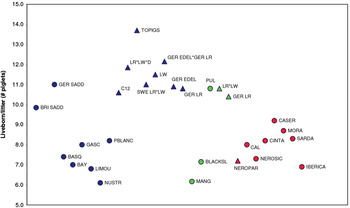
Average number of liveborn piglets for traditional (•) and conventional (▲) pig breeds kept in organic or low-input pig production systems. Data are pooled averages from literature and survey data for each of three European macroclimatic regions (blue: North West Europe; green: Eastern Europe; red: Southern Europe), as listed in Tables 1 and 2. GER SADD: German Saddleback; BRI SADD: British Saddleback; PBLANC: Porc Blanc de l'Ouest; BAY: Bayeux; LIMOU: Limousin; TOPIGS: TOPIGS commercial cross; GER EDEL: German Edelschwein; LR: Landrace; LW: Large White; D: Duroc; GER LR: German Landrace; SWE LR: Swedish Landrace; C12: Camborough 12; PUL: Pulawska; BLACKSL: Black Slavonian; MANG: Mangalitza; GASC: Gascon; BASQ: Basque; NUSTR: Nustrale; CASER: Casertana; MORA: Mora Romagnola; SARDA: Sarda; CINTA: Cinta Senese; CAL: Calabrese; NEROSIC: Nero Siciliano; NEROPAR: Nero di Parma; IBERICA: Ibérica.

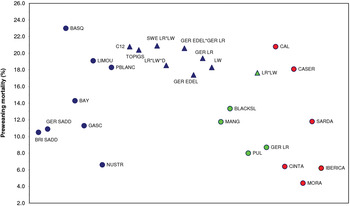
Average preweaning mortality for traditional (•) and conventional (▲) pig breeds kept in organic or low-input pig production systems. Data are pooled averages from literature and survey data for each of the three European macroclimatic regions (blue: North West Europe; green: Eastern Europe; red: Southern Europe), as listed in Tables 1 and 2. GER SADD: German Saddleback; BRI SADD: British Saddleback; PBLANC: Porc Blanc de l'Ouest; BAY: Bayeux; LIMOU: Limousin; TOPIGS: TOPIGS commercial cross; GER EDEL: German Edelschwein; LR: Landrace; LW: Large White; D: Duroc; GER LR: German Landrace; SWE LR: Swedish Landrace; C12: Camborough 12; PUL: Pulawska; BLACKSL: Black Slavonian; MANG: Mangalitza; GASC: Gascon; BASQ: Basque; NUSTR: Nustrale; CASER: Casertana; MORA: Mora Romagnola; SARDA: Sarda; CINTA: Cinta Senese; CAL: Calabrese; IBERICA: Ibérica.

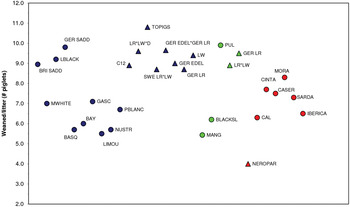
Average number of weaned piglets for traditional (•) and conventional (▲) pig breeds kept in organic or low-input pig production systems. Data are pooled averages from literature and survey data for each of three European macroclimatic regions (blue: North West Europe; green: Eastern Europe; red: Southern Europe), as listed in Tables 1 and 2. GER SADD: German Saddleback; LBLACK: Large Black; BRI SADD: British Saddleback; MWHITE: Middle White; PBLANC: Porc Blanc de l'Ouest; BAY: Bayeux; LIMOU: Limousin; TOPIGS: TOPIGS commercial cross; GER EDEL: German Edelschwein; LR: Landrace; LW: Large White; D: Duroc; GER LR: German Landrace; SWE LR: Swedish Landrace; C12: Camborough 12; PUL: Pulawska; BLACKSL: Black Slavonian; MANG: Mangalitza; GASC: Gascon; BASQ: Basque; NUSTR: Nustrale; CASER: Casertana; MORA: Mora Romagnola; SARDA: Sarda; CINTA: Cinta Senese; CAL: Calabrese; NEROPAR: Nero di Parma; IBERICA: Ibérica.

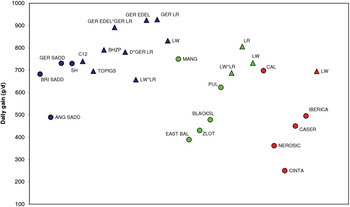
Average daily gain (g/day) for traditional (•) and conventional (▲) pig breeds kept in organic or low-input pig production systems. Data are pooled averages from literature and survey data for each of three European macroclimatic regions (blue: North West Europe; green: Eastern Europe; red: Southern Europe), as listed in Tables 3 and 4. ANG SADD: Angeln Saddleback; BRI SADD: British Saddleback; GER SADD: German Saddleback; SH: Swabian-Hall; C12: Camborough 12; TOPIGS: TOPIGS commercial cross; BHZP: Bundeshybridzuchtprogramm; D: Duroc; LR: Landrace; LW: Large White; GER EDEL: German Edelschwein; GER LR: German Landrace; MANG: Mangalitza; PUL: Pulawska; BLACKSL: Black Slavonian; ZLOT: Zlotnicka; EAST BAL: East Balkan Swine; CAL: Calabrese; CINTA: Cinta Senese; NEROSIC: Nero Siciliano; CASER: Casertana; IBERICA: Ibérica.

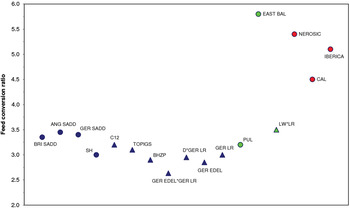
Average feed conversion ratio for traditional (•) and conventional (▲) pig breeds kept in organic or low-input pig production systems. Data are pooled averages from literature and survey data for each of three European macroclimatic regions (blue: North West Europe; green: Eastern Europe; red: Southern Europe), as listed in Tables 3 and 4. BRI SADD: British Saddleback; ANG SADD: Angeln Saddleback; GER SADD: German Saddleback; SH: Swabian-Hall; C12: Camborough 12; TOPIGS: TOPIGS commercial cross; BHZP: Bundeshybridzuchtprogramm; GER EDEL: German Edelschwein; GER LR: German Landrace; D: Duroc; LR: Landrace; PUL: Pulawska; LW: Large White; EAST BAL: East Balkan Swine; NEROSIC: Nero Siciliano; CAL: Calabrese; IBERICA: Ibérica.

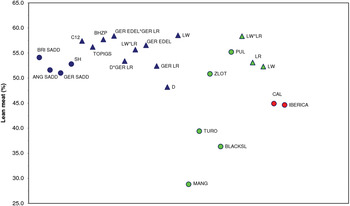
Average lean meat percentage for traditional (•) and conventional (▲) pig breeds kept in organic or low-input pig production systems. Data are pooled averages from literature and survey data for each of three European macroclimatic regions (blue: North West Europe; green: Eastern Europe; red: Southern Europe), as listed in Tables 3 and 4. BRI SADD: British Saddleback; ANG SADD: Angeln Saddleback; GER SADD: German Saddleback; SH: Swabian-Hall; C12: Camborough 12; TOPIGS: TOPIGS commercial cross; BHZP: Bundeshybridzuchtprogramm; GER EDEL: German Edelschwein; GER LR: German Landrace; LW: Large White; LR: Landrace; D: Duroc; PUL: Pulawska; ZLOT: Zlotnicka; TURO: Turopolje; BLACKSL: Black Slavonian; MANG: Mangalitza; CAL: Calabrese; IBERICA: Ibérica.

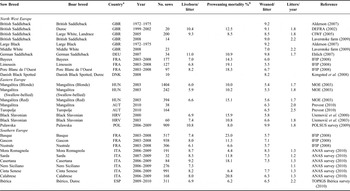
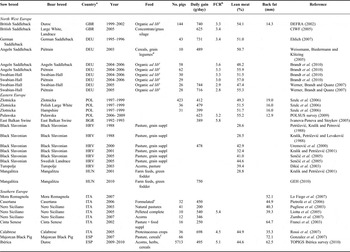
Reproductive performance of traditional pig breeds reared in organic and low-input systems, arranged by macroclimatic zone, breed and country.

aOfficial alpha-3 country codes of the ISO 3166-1 encoding list.
bExcluding stillborn piglets.
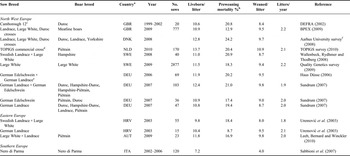
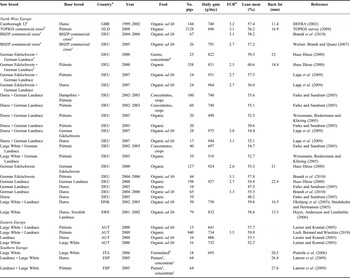
Reproductive performance of conventional pig breeds reared in organic and low-input systems, arranged by macroclimatic zone, breed and country.

aOfficial alpha-3 country codes of the ISO 3166-1 encoding list.
bExcluding stillborn piglets.
cPIC (Landrace × Large White) × Duroc cross.
dLandrace × Large White cross.
eWesthybrid.
fThe survey included 15 farms, but the number of sows was unknown.
Finishing performance of traditional pig breeds, reared in organic and low-input systems, arranged by macroclimatic zone, breed and country.

aOfficial alpha-3 country codes of the ISO 3166-1 encoding list.
bFeed conversion ratio.
cFeed: Organic standard (EC Regulation 1804/1999).
dSupplied in the form of coarse meal.
eTwo diets differing in energy content, supplied on a basis of 9 percent of metabolic weight.
fAlso included were legume seeds, figs, almonds, acorns and several Mediterranean shrubs.
Finishing performance of conventional pig breeds, reared in organic and low-input systems, arranged by macroclimatic zone, breed and country.

aOfficial alpha-3 country codes of the ISO 3166-1 encoding list.
bFeed conversion ratio.
cPIC (Landrace × Large White) × Duroc cross.
dLandrace × Large White cross.
eBundeshybridzuchtprogramm.
fWesthybrid.
gBarley, wheat and a protein concentrate in the form of a formulated diet.
hTwo diets differing in energy content, supplied on a basis of 9 percent of metabolic weight.
iFree availability of grass, shrubs, trees and a limited amount of acorns.
jFormulated, pelleted barley–corn–wheat–soybean meal concentrate.
Results
Reproductive and finishing performance data of individual literature studies and farm surveys of traditional and conventional breeds are shown in Tables 1 and 3 (traditional breeds) and Tables 2 and 4 (conventional breeds). Data are grouped according to macroclimatic region (North West Europe, Eastern Europe, Southern Europe). Data from Tables 1–4 were averaged per breed within each of the three macroclimatic regions and shown for various reproductive and finishing traits in Figures 1–6.
Reproductive performance of traditional and conventional breeds in organic and low-input pig production systems
For traditional breeds, the number of sows included in the various references ranged from 10 to 1404 animals (Table 1). For conventional breeds, the number of sows ranged from 15 to 2877 animals (Table 2).
In North West Europe, the number of liveborn piglets per litter ranged from 6.8 to 11.0 for traditional breeds, and from 10.6 to 13.7 piglets for conventional breeds (Tables 1 and 2). Figure 1 shows that the French traditional breeds have the lowest litter sizes, whereas the German Saddleback has a litter size within the same range as the conventional breeds. In Eastern Europe, the highest litter sizes were found for the traditional Polish Pulawska breed (10.8 piglets) and the conventional Austrian Large White × Landrace cross (11.8 piglets) (Tables 1 and 2). The traditional Croatian Black Slavonian and Hungarian Mangalitza breeds have the lowest litter sizes (5.9–7.4 piglets).
In Southern Europe, litter size ranged from 6.1 piglets (Nustrale) to 9.2 piglets (Casertana).
Preweaning mortality shows a large variation within all macroclimatic regions, especially for the traditional breeds (Tables 1 and 2; Figure 2). In North West Europe for example, the British Saddleback breed has an average preweaning mortality of around 10 percent (Figure 2), whereas the French Limousin breed has a mortality of 19 percent (Figure 2). All conventional North Western European breeds have preweaning mortalities above 16 percent, except for the Landrace, Large White and Duroc crosses used in Great Britain (12.9 percent; Table 2). In Eastern Europe, preweaning mortality was lowest for the traditional Pulawska (8.0 percent) and conventional German Landrace (8.7 percent) and highest for the Swedish Landrace × Large White cross (18.4 percent; Table 2). In Southern Europe, mortality ranged between 4.4 percent (Mora Romagnola) and 23.0 percent (Basque) (Table 1; Figure 2).
In North West Europe, the traditional breeds German and British Saddleback and Large Black show similar numbers of weaned piglets (9–10 piglets) as the conventional breeds (Figure 3). In Eastern Europe, the traditional Mangalitza and Black Slavonian have the lowest number of weaned piglets (5–6 piglets), whereas the traditional Pulawska and the conventional German Landrace and Large White × Landrace cross have the highest number of weaned piglets (9–10 piglets) (Figure 3). In Southern Europe, the number of weaned piglets ranged between 4.0 (Nero di Parma) and 8.3 (Mora Romagnola) (Table 1; Figure 3).
Finishing performance of traditional and conventional breeds in organic and low-input pig production systems
For traditional breeds, the number of pigs included in the various references ranged from 10 to 5713 animals (Table 3). For conventional breeds, the number of pigs ranged from 10 to 940 animals (Table 4).
In North West Europe, daily gains of traditional breeds ranged between 489 and 744 g/day, whereas for conventional breeds this range was 518 and 975 g/day (Tables 3 and 4). Growth rates of the traditional German and British Saddleback and Swabian-Hall were comparable to growth rates of conventional commercial genetic lines, such as the Camborough 12 and TOPIGS commercial cross (Figure 4). The conventional breeds German Edelschwein, Landrace and a cross between them achieved the highest growth rates of around 900 g/day. In Eastern Europe, the lowest growth rates were found for the traditional East Balkan Swine, Zlotnicka and Black Slavonian breeds (400–500 g/day), and the highest growth rate for the conventional Landrace breed (800 g/day). In Southern Europe, growth rates varied from 250 g/day for the traditional Italian Cinta Senese, to 700 g/day for the conventional Large White and traditional Italian Calabrese breeds.
In North West Europe, the lowest feed conversion ratios were achieved by conventional breeds (German Edelschwein × Landrace: 2.5–2.7) and the highest by traditional breeds (Angeln Saddleback: 3.3–3.6). In Eastern and Southern Europe, data on feed conversion ratios were limited. The Polish Pulawska breed had the lowest feed conversion ratio (3.2), whereas the Bulgarian East Balkan Swine had the highest (5.8).
Traditional breeds in North West Europe have lean meat percentages in the same range (50–55 percent) as conventional breeds (48–60 percent), but the majority of conventional breeds have lean meat percentages above 55 percent. In Eastern Europe, there is a large variation within the traditional breeds in lean meat percentage. The Hungarian Mangalitza achieved 28.8 percent, whereas the Pulawska breed achieved 55.2 percent. Conventional breeds had the highest lean meat percentages, with the Large White × Landrace cross achieving 57.7–59.9 percent (Table 4; Figure 6). Lean meat percentages of the Southern European Calabrese and Ibérica breeds were around 45 percent.
Discussion
The objective of this review was to compare the suitability of traditional and conventional pig breeds in low-input and organic production systems in Europe, based on reproductive and finishing performance derived from literature studies and farm surveys. Reproductive and finishing performance are indicative for the economic sustainability of a production system (Egerszegi et al., Reference Egerszegi, Rátky, Solti and Brüssow2003), albeit their usefulness for evaluating breed suitability also depends on market requirements (Martins et al., Reference Martins, Kelly, Day, Stopes, Browning, Edwards and Day2002). For example, for commodity organic pork production in The Netherlands, the carcass-value marketing system is based on high lean meat percentages, whereas for dry-cured meat production fat quality and quantity are important. Therefore, when discussing the suitability of traditional versus conventional breeds, distinction will be made between production for commodity pork production and specialized cured meat production. In this review, the breed performance is compared within macroclimatic regions, because the suitability of a breed is strongly related to environment and local climatic conditions (Blair, Reference Blair and Blair2007).
For evaluation of breed performance, data of individual literature studies and surveys were pooled and averaged per breed within a macroclimatic region. Statistical meta-analysis could not be used to evaluate differences in breed performance or potential genotype–environment interactions, because for many breeds, performance data were of different years and available only from a limited number of literature sources.
Pig farming conditions
In North West Europe, organic and low-input pig production in countries such as Germany, Sweden, Denmark and The Netherlands is characterized by the use of mainly conventional breeds in indoor housing systems with outdoor runs (Wallenbeck, Rydhmer and Thodberg, Reference Wallenbeck, Rydhmer and Thodberg2008; Edwards, Reference Edwards2011; Früh, Reference Früh, Forster and Weidmann2011). In Great Britain, sows live in paddocks and just before farrowing the sow is moved to a farrowing paddock with individual huts (Edwards, Reference Edwards2011). Finishing pigs are also kept in paddocks for most of the time and some farms have deep straw yards for the last 2–4 weeks before slaughter. Small farms (less than 20 sows) with direct sales usually have a wide range of traditional breeds, including Large Black, Middle White and Gloucester Old Spots (Martins et al., Reference Martins, Kelly, Day, Stopes, Browning, Edwards and Day2002). Larger herds of over 50 sows have sales through key wholesale outlets, mainly supplying multiple retailers (Martins et al., Reference Martins, Kelly, Day, Stopes, Browning, Edwards and Day2002). On these farms, mainly conventional breeds such as Large White, Duroc and Landrace crosses or commercial hybrids from breeding companies are used. Feeding on North West European organic farms is according to EU organic regulations.
In Eastern European countries such as Hungary, Croatia and Poland, pigs in organic and low-input systems are kept under extensive conditions in large pens or on pasture. They feed on natural resources of pasture and oak woodland supplemented with mixtures of cereals and green fodder (Egerszegi et al., Reference Egerszegi, Rátky, Solti and Brüssow2003; Karolyi, Luković and Salajpal, Reference Karolyi, Luković and Salajpal2007). Breeds used are mainly traditional, local breeds.
In Southern Europe, there are different rearing systems according to geographical location. In Italy, most of the organic pig herds are outdoors and situated in hills and mountains (Edwards, Reference Edwards2011). Farrowing and weaning are about 95 percent outdoors in huts. Fattening is about 60 percent outdoors, with the rest indoors with an outdoor run (Edwards, Reference Edwards2011). Animals are fed on locally available nutrients such as grass, crops, acorns, herbs, sometimes supplemented with cereals or concentrates. Organic feeds are allowed to contain a maximum of 5 percent of conventional components. Around 50 percent conventional breeds (Large White, Landrace and Duroc) and 50 percent traditional breeds (Nero Siciliano and Cinta Senese) are used (Früh, Reference Früh, Forster and Weidmann2011). In Spain, performance data were available of the Iberian pig and the Majorcan Black pig. Data on Iberian pigs included reproductive and finishing performance under free-range conditions. In the fattening period (i.e. ‘montanera’), pigs are fed on acorns and grass in Mediterranean forest (Daza et al., Reference Daza, Olivares, Rey, Ruiz and López-Bote2008). Majorcan Black pigs are reared similarly in extensive conditions (Gonzalez et al., Reference Gonzalez, Gispert, Rodríguez, Gil, Jaume, Tibau and Oliver2007).
Reproductive performance
The majority of data on reproductive performance of conventional breeds comes from North West Europe. In Eastern and Southern Europe, reproductive performance data of conventional breeds in organic and low-input production systems were scarcely available, because of the predominant use of traditional breeds in these regions.
In North West Europe, conventional breeds have relatively high reproductive performance compared with traditional breeds. The relatively large litter sizes at birth and high numbers of weaned piglets of conventional breeds are due to years of selection pressure on this trait in the breeding goal of conventional breeding programmes (Wallenbeck, Gustafson and Rydhmer, Reference Wallenbeck, Gustafson and Rydhmer2009). Preweaning mortality is relatively high (>16 percent) for conventional breeds compared with traditional breeds. Various factors explain these high mortality rates.
First, the high litter sizes at birth in conventional breeds are considered as a risk factor for stillbirth and mortality of liveborn piglets (Bille et al., Reference Bille, Nielsen, Larsen and Svendsen1974; Zaleski and Hacker, Reference Zaleski and Hacker1993). Problems with mortality related to high litter sizes are even exacerbated in low-input and organic production systems compared with conventional systems, owing to the structurally higher litter sizes in these environments (Leenhouwers et al., Reference Leenhouwers, Ten Napel, Hanenberg and Merks2011). In large litters, the farrowing process may be prolonged, which may lead to a larger proportion of piglets suffering from oxygen stress during birth. This may lead to stillbirth and reduced vitality of liveborn piglets (Zaleski and Hacker, Reference Zaleski and Hacker1993). Additionally, both absolute birth weight and within-litter uniformity in birth weight decrease with increasing litter size. Light piglets at birth have a higher risk of mortality owing to starvation or crushing, especially in litters with low birth weight uniformity (English and Smith, Reference English and Smith1975; Canario et al., Reference Canario, Lundgren, Haandlykken and Rydhmer2010).
Secondly, both piglet vitality and maternal behavioral characteristics have often been neglected in conventional breeds, because of the confined, controlled farrowing and lactation environments which are aimed at prevention of mortality, e.g. the use of heating areas for piglets and the use of farrowing crates that prevent mortality owing to crushing (DEFRA, 2002). Indeed, preweaning mortality rates are substantially lower in indoor systems compared with outdoor systems (Sabbioni et al., Reference Sabbioni, Beretti, Zanon, Superchi, Manini and Cervi2007; Wallenbeck, Gustafson and Rydhmer, Reference Wallenbeck, Gustafson and Rydhmer2009; Leenhouwers et al., Reference Leenhouwers, Ten Napel, Hanenberg and Merks2011). In organic and low-input systems, good maternal abilities and high piglet vitality are obviously crucial for piglet survival, because sows are housed loose in the farrowing pen, which makes piglets more at risk to be crushed by the sow (Honeyman and Roush, Reference Honeyman and Roush2002; Wallenbeck, Gustafson and Rydhmer, Reference Wallenbeck, Gustafson and Rydhmer2009) and less possibilities of herdsmen to supervise and care for piglets in a group-housed and outdoor lactation environment (Wallenbeck, Gustafson and Rydhmer, Reference Wallenbeck, Gustafson and Rydhmer2009).
Thirdly, in organic and low-input systems, lactation feeds of lower protein quality and higher roughage content are used. Conventional sows may be less adapted to these diets (Kelly et al., Reference Kelly, Browning, Day, Martins, Pearce, Stopes and Edwards2007), which may lead to problems with milk production and consequently mortality of liveborn piglets owing to starvation.
For traditional breeds, there was high between-breed variation in reproductive performance. In Great Britain and Germany, some prolific traditional breeds, such as German and British Saddlebacks, wean similar numbers of piglets (9–10) as conventional breeds, e.g. Landrace × Large White × Duroc crosses and German Edelschwein × Landrace crosses. British Saddlebacks originally are a hybrid cross of Essex and Wessex Saddleback breeds. Especially the Wessex was noted for its high prolificacy (Alderson, Reference Alderson2007). Saddlebacks often are mated with white conventional breeds to produce blue crossbred sows for outdoor systems and were selected by major breeding companies as one of the parents of commercial hybrid breeding sows (e.g. Camborough) because of their grazing ability, temperament, maternal qualities and the level of fatness which serves as a buffer against outdoor conditions (Alderson, Reference Alderson2007).
In Eastern Europe, the Polish Pulawska breed actually weans more piglets per litter than the Landrace and Landrace × Large White crosses used in this region. Pulawska is an indigenous breed from Eastern Poland and originally was a cross between primitive local pigs and Berkshire boars. Later on, English Large White has been used to upgrade the Pulawska breed. Pulawska has a spotted coat pattern and its utilization is between a meat and fat-meat pig (Elbarn, 2010). Traditional breeds used for special meat production, for example French breeds such as Nustrale, Basque and Gascon, the Hungarian Mangalitza, the Spanish Iberian pig and the local Italian breeds Mora Romagnola and Cinta Senese, typically have low reproductive performance because these breeds are generally unimproved in fertility traits (Egerszegi et al., Reference Egerszegi, Rátky, Solti and Brüssow2003).
Finishing performance
In general, conventional breeds such as German Edelschwein and German Landrace grew faster and more efficiently than traditional breeds. However, some traditional breeds such as German and British Saddleback and Swabian-Hall achieved similar growth rates than commercial hybrids developed by breeding companies. Additionally, carcasses of the majority of conventional breeds were leaner than carcasses of traditional breeds. These results confirm the effects of genetic selection in conventional breeds on daily gain, feed conversion ratio and lean meat percentage (Blair, Reference Blair and Blair2007; Brandt et al., Reference Brandt, Werner, Baulain, Brade and Weissmann2010). In contrast, in traditional breeds such as Ibérica, focus has been more on meat quality characteristics (e.g. drip loss, marbling, colour and structure). Extra added value is obtained through specific nutritional and taste characteristics of special meat products such as hams, salamis and other cured products. In this way, the low reproductive and finishing performance of these breeds is offset by price premiums of the pigs produced.
General suitability of breeds
Taken together, the suitability of traditional versus conventional breeds for low-input and organic production systems depends on finding a balance between productivity, suitability to outdoor conditions and market suitability (Compendium of Animal Health & Welfare in Organic Farming, 2000). The traits important for a good outdoor sow are: prolificacy, good maternal instincts, good fat reserves to provide both protection against weather and energy reserves for an active outdoor life, and independence combined with ease of handling (Blair, Reference Blair and Blair2007).
Results from this review show that conventional breeds wean many piglets, have efficient and fast growth and lean carcasses. These conventional breeds may thrive well in North West European climatic conditions where summers are warm, but not hot, and winters are cool instead of cold. Optimal housing may be indoors with outdoor runs, as currently predominantly used in countries such as Denmark, Germany, Sweden and The Netherlands. This provides a more controlled environment in which large litters are more easily managed and in combination with balanced formulated feeds, high lean growth rates can be sustained. The relatively lean meat of conventional breeds is suitable for sales through key wholesale outlets serving the commodity organic pork market. Together with the use of conventional breeds in organic and low-input systems, a suitable breeding strategy should be chosen to provide farmers with adequate replacement gilts. For the Dutch organic pig sector, Leenhouwers et al. (Reference Leenhouwers, Ten Napel, Hanenberg and Merks2011) proposed a two-breed rotation system where animals from conventional Yorkshire and Landrace sow lines with the highest genetic merit for desirable traits (e.g. mothering ability, piglet vitality, sow longevity) for organic pig production are selected. Conventional breeds may be less suitable in more free-range extensive environments as found in Eastern and Southern Europe, where large litter sizes pose a risk for piglet mortality. Also the climatic conditions in these regions may be unfavourable. In cold winters, their lack of carcass fat gives them poor protection against cold and in hot summers their white skin pigment makes them sensitive for sunburn.
Traditional breeds roughly fall into two categories: (1) a group of prolific breeds with good finishing performance such as Saddlebacks and Pulawska and (2) breeds kept for special meat production (e.g. Ibérico, Cinta Senese). The prolific and leaner traditional breeds belonging to the first group are suitable for commodity organic pork production, especially when crossed with conventional white boar breeds (e.g. Large White, Landrace or Duroc) to give some extra leanness to the carcass. Special meat breeds are unsuitable for commodity organic pork production because of their low fertility and high carcass fatness, but extra added value is obtained by their specific meat and fat quality. Moreover, their black skin pigment makes them well adapted to be reared outdoors in hot climates as found in Southern European regions.
Acknowledgements
We gratefully acknowledge the funding from the European Commission under LowInputBreeds, FP7- project No. KBBE 222 632. Special thanks to the following persons for providing survey data: Sandra Edwards, Kristian Knage Rasmussen, Friedrich Weissmann, Amke Göbel, Armelle Prunier, Herveline Lenoir, Maurizio Gallo, Christine Leeb, Katarzyna Skrzymowska, Antonio Muñoz, Anna Wallenbeck and the Dutch organic pig farmers.