



Introduction
The phenomenon of intentionally damaged metal artefacts deposited in burials and hoards is well known to archaeologists studying the Bronze and Iron Ages. The practice is documented over an extensive area, from the British Isles to the Caucasus, including part of the Eurasian steppe. Various interpretations are suggested, with context—hoard or burial (i.e. mortuary deposition)—arguably providing a dividing line: in most cases, the deliberate destruction of artefacts in burials is construed as a ritual act (Desborough Reference Desborough1972: 312; Brück Reference Brück2006; Zimmermann Reference Zimmermann2010; Boyd Reference Boyd, Harrell and Driessen2015; Lloyd Reference Lloyd, Lee, Whittaker and Wrightson2015), but similar destruction of artefacts in hoards potentially has both ritual (Maraszek Reference Maraszek and Pare2000: 210; Nebelsick Reference Nebelsick and Pare2000; Williams Reference Williams, Humphrey and Ormrod2001; Quilliec Reference Quilliec, Hamon and Quilliec2008; Hansen Reference Hansen and Baitinger2016) and more pragmatic explanations—such as the storage of scrap for later retrieval and recycling (Wiseman Reference Wiseman2018) or use for pre-monetary purposes (Primas Reference Primas and Lorenz1981; Sommerfeld Reference Sommerfeld1994: 37–61). Needham (Reference Needham2001) combines these ideas in a ‘ritual-utilitarian’ explanation of hoards, where damaged objects are considered to be sacrifices to deities but, at the same time, the potential for their later retrieval and reuse is not excluded. Another suggestion is that damaged artefacts placed in burials related to personal identity, while those in hoards had more communal significance (Needham Reference Needham2001: 275–91; Fontijn Reference Fontijn2002: 217–19; Reference Fontijn2020).
Despite these perceived distinctions, it is possible to discern links between intentionally damaged metal artefacts in hoards and burials. It has been suggested that hoard deposition mirrors the inclusion of bronze grave goods in burials (Kristiansen Reference Kristiansen, Kristiansen and Paludan-Müller1978). The concept of pars pro toto, where the deposition of a fragment of an artefact—as seen in both contexts—symbolises the deposition of the whole (Hansen Reference Hansen1994: 360; Dietrich Reference Dietrich2014), may apply to the deliberate destruction of artefacts in both burials and hoard depositions. Alternatively, inclusion of artefact fragments in burials may indicate the retention of a piece while the rest of the artefact was reused to form a new object. Such an act, possibly as part of the funeral process, may have symbolised rebirth and continuity (Harrell Reference Harrell, Harrell and Driessen2015: 143–53). Chapman's (Reference Chapman2000, Reference Chapman, David and Thomas2008) fragmentation and enchainment theory, based on Neolithic and Chalcolithic Balkan material from settlements, burials and hoards, is another approach, in which the unique biography of an object endures within its fragments and, if spread across different sites, these fragments create connections between places and people.
To date, the evidence of deliberate breakage and fragmentation found in Bronze and Early Iron Age burials and hoards in the territory of modern Georgia has not been fully examined. This article is a first synthesis and interpretation of that evidence, building on data previously presented in Georgian (Bedianashvili & Robinson Reference Bedianashvili and Robinson2022). Data from 70 sites are presented and similarities and differences relating to context (burial or hoard), geographical location and chronology are highlighted. We argue that, despite some variability, the evidence from Georgia supports a model for ritual deposition in most settings. Such rituals often centre on identity and our findings are consistent with a focus on the identity of the individual in burial contexts, while hoards reflect community or communal identity. Through analysis of the deliberately damaged objects from Georgia, we aim to contribute to knowledge about the phenomenon of the deposition of these artefacts across the wider ancient world, while also highlighting local peculiarities.
The artefacts
Many fragmented or otherwise damaged bronze artefacts have been found in burials and hoards from the Middle Bronze to Early Iron Age (c. 2000–550 BC) in the territory of modern Georgia. Targeted for study in this article are 70 sites where deliberate destruction was identified through the study of museum collections and published material. A summary of the results is presented here, with further detail provided in the accompanying maps (Figure 1) and catalogue (see online supplementary material (OSM)). Observations are grouped under ‘burials’ and ‘hoards’ to reflect contrasts between the artefacts in each context that will be further discussed below. Identification of intentional damage to metal artefacts was based on Matthew Knight's ‘Destruction Indicators’ and associated ‘Damage Ranking System’ (Knight Reference Knight2021: 50–59). Objects of interest fall into two damage-ranking system categories: ‘probably deliberate’ and ‘definitely deliberate’. The first group comprises broken objects with no associated plastic deformation, along with single incomplete objects or accumulations of broken pieces of the same or different types of objects, such as a hoard. The second (‘definitely deliberate’) category contains metal objects that have U-shape bending, are broken into more than two pieces, have a regular shape cut into the blade or show clear evidence of crushing. Selectiveness, whereby some artefacts are damaged more often than others (apparent in almost all cases outside of Georgia; e.g. Verlaeckt Reference Verlaeckt and Pare2000: 202; Rezi Reference Rezi, Berecki, Nemeth and Rezi2011; Webb & Frankel Reference Webb, Frankel, Harrell and Driessen2015), was also taken into account as an indicator of deliberate destruction.
Map of the study area: A) Distribution of sites by archaeological period; B) Distribution of sites by type, with number of damaged artefacts per site reflected by dot size. Numbers in brackets indicate the number of sites for each size category found across Georgia (basemap by Esri; figure by authors).

Burials
In Georgia, evidence of deliberate destruction of bronze artefacts in burials can be seen from as early as the Middle Bronze Age (c. 2000–1500 BC). In the central south Caucasus, this is the period of the Trialeti culture, which is characterised by large individual barrows (kurgans) and abundant, rich grave goods. Elaborately crafted weapons such as daggers, spearheads and axes appear in burials for the first time, together with swords. Only small fragments of human remains are found inside kurgans, or else they are completely absent, and this is taken to show that the bodies were cremated, presumably outside the graves as there are no traces of fire within them (Japaridze Reference Japaridze1969). In Trialeti kurgans, evidence of intentional damage is apparent on some swords and daggers. The swords are rapiers—long and narrow with prominent midribs, used for thrusting. In Georgia, seven rapiers of this kind have been found in burials, five of which are damaged and, upon close inspection, it is clear that the breakage was deliberate. The rapier from Saduga barrow—the shortest at 490mm—has been broken into four pieces, as has the 1m-long rapier from Tetri Kvebi barrow 3. Two other rapiers, both also approximately 1m long, from the Mravaltskali and Lilo kurgans, share a pattern of destruction: an even single break that shows no trace of pressure or percussion (Figure 2, no. 1). Daggers from Kvasatali burial 6 and Trialeti kurgans XV and XVII are similarly damaged. Breaks of this kind were probably made by hot-shorting, whereby application of heat to the blade can result in pressure fracturing past a certain temperature (see Knight Reference Knight2019: 252; Reference Knight2021: 55). The blade of the fifth rapier, from Samtavro kurgan 243, is notched and bent towards its lower part. Many daggers in Trialeti-culture barrows also have evidence of intentional destruction. Some were found fragmented or incomplete. Examples come from Kvasatali barrow 1, Natakhtari barrow 28, and Trialeti kurgans XIX and XXXVI (Figure 2, nos. 2–3) (Jorjikashvili & Gogadze Reference Jorjikashvili and Gogadze1974; Sadradze et al. Reference Sadradze, Khokhobashvili, Ghlighvashvili and Dzneladze2018: 25–29).
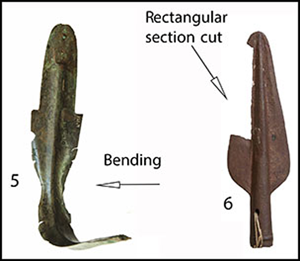
Examples of damaged weapons from burials. 1) Rapier, Lilo kurgan; 2) Dagger, Trialeti kurgan XV; 3) Dagger, Trialeti Kurgan XXIX; 4) Dagger, Berikldeebi burial; 5) Dagger, Beshtasheni burial 13; 6) Spearhead, Samtavro burial 47; 7) Bornigele burial 4; 8) Dagger, Bornigele burial 13; 9) Spearhead, Bornigele burial; 10) Spearhead, Varsimaantkari cemetery (figure by authors).

From the beginning of the Late Bronze Age, about 1500 BC, the Trialeti culture was replaced by the Lchashen-Tsitelgorebi material culture over the same geographical area. There was a shift from rich kurgans to more standardised burials with comparatively homogeneous grave goods. Nevertheless, weapons with what appears to be ritual breakage continue to be included within burials. Cremation is no longer practised; instead, inhumations predominate, with the deceased placed in a flexed position. Although rapiers are no longer present, an abundance of other types of weapons, including slashing swords, daggers, spearheads and axes, are found in graves. After the Trialeti period, various shifts can be observed in the types of damage inflicted on weapons. In a burial at Berikldeebi, in the Shida Kartli region of (eastern) central Georgia, one dagger is bent and broken into three pieces and another, smaller dagger has been shattered into many parts. At Irgan-chai burial 5 in the south of Georgia, the long bronze handle of a dagger has been broken off and a fragment of a dagger blade was also found (Figure 2, no. 4) (Kakhiani & Ghlighvashvili Reference Kakhiani, Ghlighvashvili, Sagona and Abramishvili2008). The Berikldeebi and Irgan-chai burials belong chronologically to the earliest phase of the Late Bronze Age. Beshtasheni burial 13, again in southern Georgia, is slightly later—from around the fourteenth century BC—and among the grave goods are a fragmented bronze spearhead and a bronze dagger with a U-shaped bend (Figure 2, no. 5). This is probably the earliest evidence of U-shaped bending, which becomes more popular in later periods.
In the later phase of the Late Bronze Age (around the end of the second millennium BC), deliberate destruction of artefacts occurs in burials over a wider area, in the territory of the Samtavro culture in the Shida Kartli and Borjomi regions of east and south-central Georgia. At Natsargora cemetery, located in Shida Kartli and broadly dated to the twelfth–seventh centuries BC (Ramishvili Reference Ramishvili and Lordkipanidze2001), it is mostly spearheads and daggers that are damaged. Aside from breaks, the main method of destruction is bending. Some daggers, including a bronze dagger in burial 435 (ninth century BC) and an iron dagger in burial 502 (eighth–seventh century BC), have U-shaped bends. An iron dagger from Samtavro burial 26 with a U-shaped bend also dates to the eighth–seventh century (Figure 2, no. 6). This type of damage is characteristic of the mountainous region north of Samtavro cemetery in the seventh–fifth centuries BC: at the cemeteries of Bazaleti (Ramishvili et al. Reference Ramishvili and Ramishvili2004: 97) and Varsimaant kari, iron swords and spearheads often exhibit U-shaped bending (Figure 2, no. 10). Similar damage is documented in western Georgia, in the Chkhorotsku burials of the Samegrelo region and in Abkhazia at Guadikhu burial 19 (Trapsh Reference Trapsh1969: 35–36).
Also during the Samtavro culture period (c. twelfth–sixth centuries BC), and again in Shida Kartli near the Natsargora cemetery, another interesting pattern of destruction of daggers is found. In Meghvrekisi burial 6, a bronze dagger blade has a rectangular section cut out of its edge. Similar damage is found on daggers from nearby Bredza, Brili and Bugauri (Ramishvili Reference Ramishvili1998: 147–50) and has also been found on a bronze spearhead from the Samtavro cemetery in Mtskheta. This type of breakage of daggers and spearheads appears to be specific to the Shida Kartli region at the end of the second to the beginning of the first millennia BC.
A different pattern of deliberate destruction of artefacts in burials can be found at the Bornigele and Chitakhevi cemeteries, located close together in the Borjomi region and dated to the eighth–sixth centuries BC (Gambashidze & Gambashidze Reference Gambashidze, Gambashidze and Lordkipanidze1986, Reference Gambashidze, Gambashidze and Lordkipanidze1995; Gambashidze et al. Reference Gambashidze, Kvijinadze, Gambashidze and Lordkipanidze1991). With their distinctive burial rites, these cemeteries stand apart from other contemporary sites in the region. Cremation, inhumation and mixed burials have been excavated at these sites. Cremation is characteristic of the Colchian culture of western Georgia in the Early Iron Age (eighth–sixth centuries BC), but almost unknown for the central Georgian Samtavro culture. At this time and in this region, some Colchian cultural elements coexist with Samtavro-culture material (Japaridze Reference Japaridze1982); but the placement of cremated human remains into ceramic vessels together with grave goods—as seen at Bornigele and Chitakhevi—is not typical for either culture.
The most frequently damaged artefact at Chitakhevi and Bornigele is the spearhead; in some burials there are several. In almost all cremation burials, bent or fragmented bronze and iron spearheads occur in vessels along with the cremated human remains. The second most commonly damaged artefact in the burials is daggers; like the spearheads, they are bent and placed in vessels. At Chitakhevi, a damaged axe with a broken socket was also found (inhumation burial 26), and at Bornigele a fragment of an axe blade was placed in a cremation urn (burial 32). Damaged iron swords have also been discovered, all folded and placed in cremation vessels together with spearheads and daggers; in Bornigele grave 8, for example, a broken bronze spearhead and a folded iron dagger with a bronze handle were placed inside the cremation vessel (Figure 2, no. 9). In the same grave, a bent dagger was left lying alongside the vessel in the burial pit, and at both cemeteries bent spearheads and daggers have been found alongside skeletons in inhumation burials. This evidence suggests that people from the Borjomi region practised ritual breakage of weapons, whereby swords were folded not only with the practical intention of fitting them into vessels, but also because the act had certain meaning.
Hoards
Hoards of the kind discussed in this article are part of a Bronze–Iron Age phenomenon that stretches from the modern territory of Georgia to as far away as Ireland (Reinhold Reference Reinhold, Horjes, Junge, Kaiser and Teržan2005: 346–71; Fontijn Reference Fontijn2020: 2). In Georgia, around 200 hoards have so far been documented (Lordkipanidze Reference Lordkipanidze2001; Reinhold Reference Reinhold, Horjes, Junge, Kaiser and Teržan2005: 346–71). Hundreds more bronze artefacts that were once deposited in rivers have been discovered by chance in modern times by prospectors panning for gold (Jibladze & Kvirkvaia Reference Jibladze and Kvirkvaia2019). Axes and spearheads dominate these finds from rivers. Most are incomplete, but since they have not yet been studied in detail, it is impossible to comment on the extent of deliberate damage. The earliest hoards yet identified in Georgia—from Saqasria and Zemo Ilemi in western Georgia (Apakidze & Hanssen Reference Apakidze and Hanssen2020: 39–52)—are believed to date to the first half of the third millennium BC. While largely associated with the western Georgian Colchian culture, hoards also occur in the central Shida Kartli region, where the Colchian and Samtavro material cultures coincide (see above). Hoards are found in both highland and lowland areas, sometimes close to waterways, but no difference has yet been observed between the locations of hoards with and without damaged artefacts.
Objects associated with individual identity, such as weapons and items of personal adornment, are less frequently found in hoards than in burials. Only axes are common inclusions, occurring in 94 of the 126 hoards we studied (74.6%), with the so-called Colchian axe predominating. Of these, 33 hoards (35.1%) included axes that were damaged. In 12 cases, all of the axes contained in the hoard were damaged, while the remaining 21 hoards included a combination of damaged and whole axes. Damage typically appears around the socket hole and may have been intended to render the axe unusable (Figure 3, nos. 1, 3–5), though in some cases, the blade is broken off. Daggers or swords have so far been found in only 10 hoards across western and central Georgia. Almost all of these items are either damaged or represented by only a fragment.
Examples of damaged artefacts recovered from hoards. 1) Axe, Gamdnistskaro hoard; 2) Segments, Tsikhisdziri hoard; 3–6) Axes, Akhalkalaki hoard; 7–9) Daggers, Zemo Sasireti hoard; 10) Bronze vessel, Zemo Sasireti hoard; 11) Sickles, Opshkviti hoard (figure by authors).

Items used in agriculture and metalworking (ingots) are more common. Among the agricultural implements found in hoards are hoes and segments (so called because of their shape; see Sakharova Reference Sakharova2003: 41–45 for their likely use in agricultural activities), as well as sickles and billhooks (used for cutting and chopping respectively). There is evidence of intentional damage to hoes, segments and billhooks, which are the three most common types of objects found in the hoards after axes. The ratio of damaged to undamaged artefacts for these items is approximately the same as for axes (Figure 4). Only seven hoards contain sickles, all of which are damaged (Figure 3, no. 11). Ingots appear in 41 of the 126 hoards, but their rounded or irregular shapes make it difficult to judge whether there has been intentional destruction. In several cases, such as the Zeniti and Gogoleisubani hoards, quarter-, half- and three-quarter-sized ingots were found alongside whole ones (Lordkipanidze Reference Lordkipanidze2001). The only items of personal adornment to appear in hoards more than 10 times are large metal rings (possibly anklets). These are present in 14 hoards, of which five contain examples that appear to have been deliberately damaged. Other adornments, figurines or vessels are sometimes damaged, but not often enough or to such a degree as to suggest these groups of artefacts were targeted deliberately.
Condition of objects in hoards (only types of objects that appear more than 10 times are included) (figure by authors).

Overall, 42 (33%) of the 126 hoards contained artefacts with indications of ‘probably deliberate’ or ‘definitely deliberate’ damage. The earliest clear evidence comes from Gali in Abkhazia. Although some artefacts from earlier hoards, such as the one from Saqasria, are broken or incomplete, it is difficult to determine whether the destruction was deliberate, therefore these hoards are not included in Figure 1 or the analyses presented here. The hoard from Gali dates from the first half of the second millennium BC (Trapsh Reference Trapsh1970: 169–74) and includes 10 axe fragments and eight axes with broken socket holes. Another early hoard is from Zemo Sasireti and dates to the middle of the second millennium BC (Akhvlediani Reference Akhvlediani2005). It contains three daggers with different patterns of destruction (Figure 3, nos. 7–9); two are broken into pieces and the third is bent on the lower part of the blade. A bronze tripod vessel with a lid ornamented with a bird figurine was also included in the hoard. The extent of the damage to this vessel, which was probably of ritual significance, suggests it was deliberately crushed rather than accidentally broken (Figure 3, no. 10).
Two further hoards from among the 42 with damaged objects are particularly relevant to the following discussion of ritual purpose. The first is from Gamdlistskaro in Shida Kartli and is distinguished by a complete bronze model of sheep, dogs and an anthromorphic figurine standing in front of a possible altar (Figure 5). It has been suggested that the model is a totem of sheep and fertility (Koridze Reference Koridze1968) or a representation of Colchian mortuary practices (Brileva Reference Brileva, Albegova, Bagaev and Mamaev2011). This object depicting a ritual scene was found alongside fragments of a bronze dagger blade, a broken bronze vessel, damaged axes (Figure 3, no. 1), sickles, hoes, segments and arrowheads, and fragments of bracelets, a billhook and a belt buckle. The second hoard was found at Akhalkalaki in central Georgia and contains 15 eastern Georgian and five Colchian axes. The eastern Georgian axes are notably all intact while the Colchian axes are represented only by fragments (Figure 3, nos. 3–6).
Bronze model, Gamdnistskaro hoard (photograph by Soso Meladze).

Discussion
The evidence from Georgia shows that, despite cultural shifts and changes in burial customs, the deliberate destruction of weapons was practised as part of burial rites over a period of more than 1500 years, from the Middle Bronze Age to the end of the Early Iron Age (c. 2000–550 BC) (Figure 6). Geographically, the practice was concentrated in the central part of Georgia, where it occurred at only certain sites and the type of damage varied over time. The earliest evidence for the deliberate damage of artefacts in Middle Bronze Age burials coincides with the first appearance of swords in south Caucasian burials. The introduction of swords is believed to signify the rise of warfare as a social and ideological activity (e.g. Fontijn Reference Fontijn2002: 223); thus, the Georgian rapiers—and deliberate damage to them—may be linked to the inception of elite warriors in the region (Abramishvili Reference Abramishvili, Hansen, Hauptmann, Motzenbäcker and Pernicka2010).
Comparison of the frequency of damaged objects in hoards and burials during the Middle Bronze–Early Iron Age (figure by authors).

The appearance of deliberately damaged artefacts in burials also coincides with a growing preference for cremation; a post-mortem treatment of the body that symbolises transformation from one state of being to the next in a manner similar to that of the destruction of grave goods (Brück Reference Brück2006; Boyd Reference Boyd, Harrell and Driessen2015). In the Middle Bronze Age, only swords and daggers are damaged and no clear evidence of destruction can be seen on other types of weapons. In contrast to other rich grave goods, such as personal adornments or vessels, swords and daggers are not only seen as indicative of an accomplished warrior and elevated social status but are associated with the owner's individual identity and name (Quilliec Reference Quilliec, Hamon and Quilliec2008: 75). When the owner died, the rapier was also symbolically ‘killed’ and the method of destruction may have mirrored the fragmentation, through cremation, of the owner's body. In later periods, as the prevalence of cremation burials decreases, weapons are seldom fragmented. Instead, they are found whole but distorted, like the body in inhumation burials. One of the most common types of destruction in the Late Bronze/Early Iron Age is bending, which may have mirrored the flexed position of the corpse. In the Early Iron Age, the only place in eastern Georgia where fragmented and bent weapons are found together is the Bornigele and Chitakhevi cemeteries described above, where (most unusually) cremation burials are found alongside inhumations. Artefact bending is never found on items in hoards, strengthening the association between deliberate deformation and the treatment of the body during burial. In sum, this evidence points to a close association between deliberately damaged weapons in burials and the identities of the individuals to whom they belonged in life.
As with burials, we argue that the destruction of artefacts in hoards was predominantly a ritual act. It is difficult, for example, to conceive of the Gamdlistskaro hoard, described above, as scrap intended for recycling; rather, the damaged artefacts are likely to have been a sacrifice, perhaps to the deity honoured by the accompanying model, which has—as yet—no analogue in the region. Even the inclusion of copper ingots in hoards, which might suggest recycling and later reuse, could be explained in ritual terms. Metallurgy was an integral part of the identity of Colchian communities and the ingots may have been sacrifices to deities of metalworking (Lordkipanidze Reference Lordkipanidze2001). Such a proposal does not exclude the possibility that some incomplete items in hoards also had utilitarian or economic (pre-monetary) significance. For example, fragmented agricultural segments and metal rings (anklets?) of different sizes are both candidates for fixed weight standards (see Kuijpers & Popa Reference Kuijpers and Popa2021: 1–16 for bronze rings employed in this way in hoards more generally). This is an area for future study, but it should be noted that no statistically significant evidence for a weight system has emerged from our dataset so far and no regularity in weight was observed among the large metal rings.
Despite first appearing in burials and hoards almost concurrently, destruction of artefacts as a ritual act in hoards was likely adapted from burial rites. This process may reflect intensified interactions between western and eastern Georgian cultures in Shida Kartli in central Georgia, where artefacts from both cultures are, unusually, found together in Late Bronze Age hoards. Burials with damaged artefacts were part of eastern Georgian culture and hoarding was a tradition in the west; in this central region, where the two cultures mingled, the merging of the two traditions can be seen in hoards with damaged artefacts. This hypothesis offers an explanation not only for why the earliest Georgian examples of damaged artefacts from hoards are seen in this central region but also for why, overall, the ‘ritual’ aspect seems to prevail.
Yet the nature of the symbolism of destruction in burials and hoards diverges in at least one important respect. Like Fontijn (Reference Fontijn2002: 217–19; Reference Fontijn2020), we believe that where intentionally damaged artefacts in burials connect primarily with individual identity, in hoards they are more usually representative of a group or community. Though axes of the kind found damaged in hoards were functional, their significance went beyond that of other weapons. Colchian axes, especially, were emblematic of Late Bronze Age communities occupying the western and central north Caucasus, the western and some central parts of the south Caucasus and the north-eastern part of modern-day Turkey. Within this territory, despite differences in settlement patterns, burial rites, ceramics and bronze items including personal adornments, Colchian axes were the unifying feature in what Boris Kuftin, decades ago, identified as the ‘Colchian-Koban bronze culture’ (Kuftin Reference Kuftin1949). More recently, the axes and other bronze artefacts have been termed a ‘cultural koine’ in this region (Reinhold Reference Reinhold2007: 332). The Colchian axe and hoarding are two defining features of this large and diverse geographical area during the Late Bronze/Early Iron Age and symbolise a common identity among the people who lived there.
The pattern of damage in the above-mentioned Akhalkalaki hoard reinforces the connection between deliberately damaged items in hoards and shared (versus individual) identity. Those axes left undamaged in the hoard were associated with a local, eastern Georgian, identity, while the broken Colchian axes belonged to an ‘other’ identity. This selectivity in the destruction of the Akhalkalaki axes recalls patterns of intentional damage to artefacts in European hoards, where Mörtz (Reference Mörtz, Horn and Kristiansen2018: 168–78) suggests that weapons taken from defeated enemies were damaged and sacrificed to deities in such a way that the victors were seen to be killing the spirit of their enemies.
Thus, while the damaged sword, dagger or spearhead from graves is a symbol of individual identity that represents the dead body of its owner, the (ceremonial) axe in hoards may stand in for a common enemy defeated. It should, however, be noted that axes of local types in Colchian hoards are also often damaged and that although deliberate breakage of bronze artefacts in hoards probably evolved from central south Caucasian burial practices, in the western Caucasus, where the Colchian-Kobanian Bronze culture prevailed, damaged bronze artefacts are not prevalent in burial contexts. This reflects what we believe to be a difference in social and religious organisation between western and eastern Caucasian societies more generally. In the east there was a greater emphasis on individuality than in the west, where a more communal culture was expressed in hoards or, occasionally, mass burials.
Conclusion
By observing the chronological and spatial distribution of deliberately damaged artefacts in burials and hoards from across Bronze and Iron Age Georgia, as well as analysing patterns of damage, this article casts light on the dual problems of purpose and meaning that arise in many studies on this topic. Firstly, regarding the question of whether hoard depositions primarily had a practical or a ritual purpose, we argue that the content of the Georgian hoards supports the latter view. Secondly, regarding the problem of the meaning of damaged artefacts in burials and hoards, we suggest that, although there are similarities between the two contexts, deliberately damaged artefacts in hoards appear to be more representative of communal identity, while artefacts in burial contexts are linked to the identity of elite individuals.
Future work will comprise the gathering and analysis of more comprehensive statistical data from hoards and burials in Georgia and the expansion of the geographic focus to the entire south Caucasus. These activities will make it possible to test our hypotheses further and better comprehend the character of deliberate damage to metal artefacts in this region and beyond.
Acknowledgements
We thank Mikheil Abramishvili for indicating the evidence of breakage on the Lilo rapier and Giorgi Gogochuri for providing access to the Varsimaant kari material, which is unpublished. We are grateful to Irine Gambashidze for access to the Bornigele and Chitakhevi material. Thanks also to the curators at the Tbilisi S. Janashia, Akhaltsikhe, Khashuri, Chkorotsku and Kutaisi museums for granting access to material. The authors are grateful to the anonymous reviewers and the editors, whose comments and suggestions greatly improved our work.
Funding statement
This article was supported by a Shota Rustaveli national scientific foundation grant (#YS 18-072).
Supplementary material
To view supplementary material for this article, please visit https://doi.org/10.15184/aqy.2023.202.



