Implications
Immunization against gonadotropin-releasing hormone (GnRH) at 10 weeks of age does not affect growth or reproduction in boars. Immunizations at 10 and 15 weeks of age, however, transiently affect testicular growth and function. Thus, boars may receive an immunization against GnRH and selection decisions made after growth is assessed. Boars selected as breeders would not receive a second immunization, with no negative reproductive effects induced by the first injection. Non-selected boars would receive a second immunization and be marketed 4 weeks later. Use of immunological castration in boar studs could increase profitability by eliminating the discounted prices received when marketing cull boars.
Introduction
On commercial farms in the United States, male piglets destined for traditional markets are surgically castrated to prevent pork quality issues (Rydhmer et al., Reference Rydhmer, Lundstrom and Andersson2010). Boar taint is the off odor and flavor produced when meat from intact males is heated (Xue and Dial, Reference Xue and Dial1997). Approximately 35% of consumers are hypersensitive to boar taint, describing it as offensive (Xue and Dial, Reference Xue and Dial1997). Compounds responsible for boar taint are androstenone, a steroid produced by the Leydig cells of the testes, and skatole, a product of microbial breakdown of tryptophan in the gut (Squires and Schenkel, Reference Squires and Schenkel2010). The breakdown of skatole is inhibited by testosterone and estradiol (Zamaratskaia and Squires, Reference Zamaratskaia and Squires2009).
Surgical castration is an emerging animal welfare issue as this procedure causes pain and stress, and is typically performed without anesthesia or analgesics (McGlone et al., Reference McGlone, Nicholson, Hellman and Herzog1993; Prunier et al., Reference Prunier, Mounier and Hay2005; Moya et al., Reference Moya, Boyle, Lynch and Arkins2008). Alternatives to surgical castration are therefore being researched. For example, boars may be functionally castrated by treatment with a substance that elicits an immune response and antibody production against hypothalamic GnRH (Fabrega et al., Reference Fabrega, Velarde, Cros, Gispert, Suarez, Tibau and Soler2010; Bilskis et al., Reference Bilskis, Sutkeviciene, Riskeviciene, Januskauskas and Zilinskas2012). Subsequent secretion of LH and FSH from the anterior pituitary gland is suppressed and without gonadotropic support, the testes are rendered non-functional, alleviating the need for surgical removal (Fabrega et al., Reference Fabrega, Velarde, Cros, Gispert, Suarez, Tibau and Soler2010; Bilskis et al., Reference Bilskis, Sutkeviciene, Riskeviciene, Januskauskas and Zilinskas2012). An immunological castration product consisting of a modified version of GnRH conjugated to diphtheria toxoid is commercially available (Improvest® or Improvac®; Zoetis Animal Health, Florham Park, NJ, USA). Boars receive a primary immunization at 9 to 12 weeks of age and a booster is administered a minimum of 4 weeks later. The boars can be marketed 3 to 10 weeks after the second immunization and are functionally considered barrows.
Although potential benefits of immunological castration are greatest for producers raising slaughter hogs, this technology could also be advantageous for farmers producing breeder boars. On typical breeding stock operations, growth during the grow-finish phase of production is assessed and boars displaying unacceptable performance are culled. These animals are sold at severely discounted prices because of the potential for boar taint. We hypothesize that immunological castration could be used in the following strategy: all boars receive a primary vaccination and growth is assessed. If a boar is classified as a cull based on growth performance, then a second immunization is administered and the boar is marketed 3 to 4 weeks later for non-discounted prices and without concern over boar taint. If boar growth performance is acceptable, however, then there is no second immunization, and the animal would be further evaluated for breeding. This system is contingent on there being no detrimental effects of the primary vaccination on future semen quality and libido. Thus, the objective of our study was to investigate the effects of a single immunization (SI) or double immunization (DI) against GnRH on growth, semen quality, reproductive hormone concentrations and libido in boars.
Material and methods
Animals and protocol
The experiment was conducted at the Virginia Tech-Tidewater Agricultural Research and Extension Center in Suffolk, VA, USA, and all procedures were reviewed and approved by the Virginia Tech Institutional Animal Care and Use Committee. A total of 72 Landrace×Yorkshire boars in two blocks were used (n=45 in block 1 and n=27 in block 2). Within each block, boars were randomly placed into one of three treatment groups: SI, DI and a control group that received no immunization (CNT). A trained representative from the product manufacturer (Zoetis Animal Health) administered all immunizations using a proprietary safety injector. Immunizations were administered subcutaneously immediately caudal to the ear at 10 (SI and DI) and 15 (DI only) weeks of age. During the grow-finish period, boars were housed in pens of nine boars each (n=3 boars/treatment group per pen) and were fed on an ad libitum basis, fortified corn and soybean meal diets that met the recommendations for the various nutrients (National Research Council (NRC), 2012). All boars were weighed at birth and at 10, 15, 20 and 25 weeks of age. Average daily gain (ADG) was calculated for the period before first treatment (birth to 10 weeks of age) and for each 5-week interval (i.e. 10 to 15, 15 to 20 and 20 to 25 weeks of age) during the grow-finish period.
Blood collection and hormone analyses
Blood was sampled from all boars at 10, 15, 20, and 25 weeks of age via jugular venipuncture using a 20 ga, 25.4 mm vacutainer needle (Kendall Monoject; Covidien, Mansfield, MA, USA). Samples were also collected from a subset of boars (n=10 boars/treatment group) at 40 weeks of age. Collected blood was allowed to clot for 24 h at 4°C and was then centrifuged at 4°C and 1800×g for 30 min. Sera were removed using transfer pipettes, placed into polypropylene tubes and stored at −20°C until hormone assays were performed. Testosterone and estradiol concentrations in serum were determined using commercially available radioimmunoassay kits (Siemens Medical Solutions Inc., Malvern, PA, USA) validated for porcine serum (Estienne et al., Reference Estienne, Harper, Knight, Barb and Rampacek2004). The intra-assay CV was 5.5% for the testosterone assay and 8.2% for the estradiol assay. Assay sensitivity was 0.04 ng/ml for the testosterone assay and 0.01 ng/ml for the estradiol assay.
Testicular measurements
Testicular measurements were performed after 18 boars (n=6 boars/treatment group) were sacrificed at 25 weeks of age (penetrating captive bolt followed by exsanguination). The testes were dissected out of the scrotum and the epididymides were removed. Each testicle was weighed (Acculab; Minitube of America Inc., Verona, WI, USA). Circumference was measured latitudinal around the midpoint of the testes using a cloth measuring tape. Testicular length and width were measured using a caliper.
Tissue sampling
Tissue samples were also collected from the 18 boars sacrificed at 25 weeks of age. After gross testicular measurements were obtained as described above, a sample of the testis parenchyma was dissected away and fixed in 10% neutral buffered formalin for histological preparation. The fixed parenchyma samples were embedded in paraffin, cut into thicknesses of 5 µm, mounted onto slides and stained with hematoxylin and eosin at a commercial laboratory (Histo-Scientific Research Laboratories, Woodstock, VA, USA). Cross-sections of 20 seminiferous tubules from each boar were examined under 400× magnification using an Olympus phase contrast trinocular microscope (Olympus America Inc., Melville, NY, USA) and scored using a previously reported system (Yoshida et al., Reference Yoshida, Miura and Shirai1997): 1, a total absence of cells within the seminiferous tubule; 2, Sertoli cells only; 3, a few spermatogonia; 4, many spermatogonia; 5, a few primary spermatocytes; 6, many primary spermatocytes; 7, a few secondary spermatocytes; 8, many secondary spermatocytes; 9, a few round spermatids; 10, many round spermatids; 11, a few late spermatids; and 12, many late spermatids and/or spermatozoa.
Fat samples (5×5×2 cm sections) were collected at the base of the neck from each animal. The fat samples were placed in whirl pak bags (Nasco, Modesto, CA, USA) and flash frozen in liquid nitrogen. The samples were then shipped to Iowa State University for boar taint aroma evaluation performed by two trained sensory panel members. Fat samples were thawed, cut in half, placed in Styrofoam cups and then heated for 20 s in a conventional microwave oven on high power. Samples were then distributed to the panelists and boar taint aroma was scored on a scale of 0 to 15, with a score of 0 representing no boar taint aroma detected and 15 representing strong boar taint aroma detected. Panel members were blind to animal identification and treatment group.
Semen collection and evaluation
At ~30 weeks of age, boars (n=30; 10 boars/treatment group) were placed in individual pens and began receiving daily 2.3 kg of a fortified corn and soybean meal diet (NRC, 2012). Beginning at 32 weeks of age, boars were individually moved twice weekly to a semen collection pen containing an artificial sow. Semen collection training sessions for each boar lasted a maximum of 15 min. At 32, 36, 47, 60 and 63 weeks of age, boars were evaluated and scored for libido on a five-point scale: 1=boars showed no interest in artificial sow; 2=slight interest in artificial sow but did not attempt to mount; 3=mounted the artificial sow but did not display an erection; 4=mounted artificial sow and displayed an erection, but did not allow semen collection; and 5=mounted the artificial sow and allowed semen collection (Kozink et al., Reference Kozink, Estienne, Harper and Knight2002). Beginning at 60 weeks of age, collected semen from a subset of nine boars (n=3 boars/treatment group) was evaluated over the course of 2 weeks (two collections/week per boar).
Semen was collected using the gloved hand technique. During collection, semen was filtered (US BAG; Minitube of America Inc.) to remove the gel. Gel-free volume and gel weight were determined gravimetrically using a top-loading balance (Acculab). Sperm concentration was determined using a photometer calibrated for boar semen (Spermacue; Minitube of America Inc.). The percentage of sperm displaying motility was subjectively determined by examining spermatozoa using an Olympus phase contrast trinocular microscope (100×) with a heated stage (37°C).
Statistical analyses
Statistical analyses were performed using the PROC MIXED function of SAS 9.3 (SAS Institute Inc., Cary, NC, USA). Individual boar was the experimental unit. Repeated measures ANOVA were performed on BWs, ADG, testosterone, estradiol, libido and semen characteristics. Compound symmetry, unstructured, autoregressive and heterogeneous autoregressive covariant structure were tested to minimize Akaike information criterion. Block (boar groups 1 and 2) was included as a random source of variation. For BWs, ADG and hormone concentrations in serum, the models included week (time), pen, treatment and the week by treatment interaction as possible sources of variation. BW at 10 weeks of age was used as a covariate for ADG from 10 to 15, 15 to 20 and 20 to 25 weeks of age. For testosterone and estradiol concentrations, log transformations of data were performed for normal distribution and data reported herein represent the actual mean and standard error. For libido and semen data, the models included treatment, week and the treatment by week interaction as possible sources of variation. Testicle measurements were analyzed using ANOVA with models that included pen and treatment as possible sources of variation. Boar taint aroma scores were analyzed by one-way ANOVA with a model including treatment as the main source of variation. When appropriate, Tukey–Kramer mean separation test was used to compare least square mean differences. Boar taint (present or not present) was also analyzed using χ 2 analysis. Differences were considered significant with a P value ⩽0.05 and were considered tendencies if the P value was between 0.12 and 0.05.
Results
BW and average daily gain
BW at 10 weeks of age did not differ among treatment groups (P=0.88). BWs were affected by week (P<0.01), tended to be affected by treatment (P=0.08) and were not affected by a treatment by week interaction (P=0.52). Across weeks (i.e. 15, 20 and 25 weeks of age) BW tended (P=0.08) to be greater for DI boars (87.5±1.4 kg) compared with CNT boars (83.4±1.4 kg) and SI boars had an intermediate value (85.3±1.4 kg) not different from the other two groups.
From birth to 10 weeks of age, ADG did not differ among treatment groups (P=0.92). Across time periods (i.e. 10 to 15, 15 to 20 and 20 to 25 weeks of age), ADG was affected by treatment (P=0.03) and was greater (P<0.05) in DI boars (0.58±0.05 kg) compared with controls (0.52±0.05 kg); The SI boars had an intermediate ADG (0.56±0.05 kg) not different (P>0.05) from the other two groups. ADG was also affected by time period (P<0.01), but not by a treatment by time period interaction (P=0.94).
Estradiol and testosterone concentrations in serum
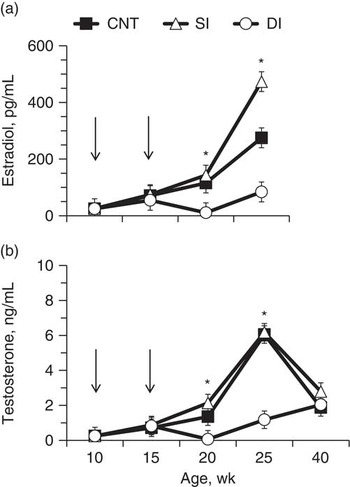
There was an interaction of treatment and week (P<0.01) for estradiol concentrations (Figure 1a). At 10 and 15 weeks of age, estradiol concentrations did not differ (P>0.05) among treatments. At 20 and 25 weeks of age, DI boars had a reduced (P<0.05) concentration of estradiol compared with the SI and CNT boars. Estradiol concentrations did not differ (P<0.05) between SI and CNT boars at any week.
Estradiol (a) and testosterone (b) concentrations in serum for boars receiving no (CNT), one (SI) or two (DI) vaccinations against gonadotropin-releasing hormone (n=24/treatment group for weeks 10, 15, 20 and 25, and n=10/treatment group for weeks 40). The single immunization (SI) boars received a SI at 10 weeks of age and double immunization (DI) boars received the first immunization at 10 weeks of age and the second immunization at 15 weeks of age. Intact control (CNT) boars did not receive an immunization. Vertical arrows indicate when immunizations were administered. Values are actual means and SEM. For both estradiol and testosterone concentrations there were interactions between treatment and time (P<0.01). Within specific times, concentrations for CNT or SI boars are greater (P<0.05) than DI boars, and are indicated with asterisks.

For testosterone concentrations determined at 10, 15, 20 and 25 weeks of age, there was an interaction of treatment and week (P<0.01) (Figure 1b). At 10 and 15 weeks of age, testosterone concentrations did not differ (P>0.05) among treatments. At 20 and 25 weeks of age, DI boars had a lesser (P<0.05) concentration of testosterone compared with CNT and SI boars and testosterone concentrations were not different (P>0.05) between SI and CNT boars. A subset of boars (n=10 boars/treatment group) was also sampled at 40 weeks of age and at that time, there was no difference (P=0.47) in testosterone concentrations among treatment groups. Testosterone concentrations at 40 weeks of age were 1.9±0.5, 2.79±0.5 and 2.0±0.5 for CNT, SI and DI boars, respectively.
Testicular measurements and seminiferous tubule scores
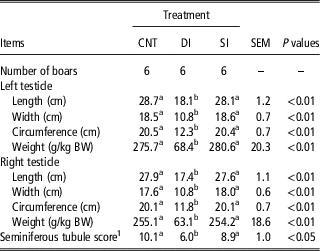
At 25 weeks of age, 18 boars (n=6/treatment group) were sacrificed and the testes of each boar were removed, weighed and measured (Table 1). Left and right testicle weights, lengths, widths and circumferences did not differ (P>0.12) between SI and CNT boars, but values in both groups were greater (P<0.01) compared with DI boars. Seminiferous tubule scores were similar (P>0.05) for SI (8.9±0.9) and CNT boars (10.1±1.0), and both were greater (P=0.05) than DI boars (6.0±1.0) (Table 1).
Testicular characteristics in control boars (CNT) and boars given single (SI) (10 weeks of age) or double (DI) (10 and 15 weeks of age) immunizations against gonadotropin-releasing hormone (Improvest®)

a,bWithin a row, means without common superscripts differ (P<0.05).
1 Scoring system employed: 1, a total absence of cells within the seminiferous tubule; 2, Sertoli cells only; 3, a few spermatogonia; 4, many spermatogonia; 5, a few primary spermatocytes; 6, many primary spermatocytes; 7, a few secondary spermatocytes; 8, many secondary spermatocytes; 9, a few round spermatids; 10, many round spermatids; 11, a few late spermatids; and 12, many late spermatids and/or spermatozoa (Yoshida et al., Reference Yoshida, Miura and Shirai1997).
Boar taint aroma
Neck fat tissue samples collected from boars at 25 weeks of age were evaluated for boar taint by a trained sensory panel. Boar taint was detected in 6 of the 18 samples evaluated, with three CNT and three SI boars having samples with taint aroma scores >0. χ 2 analysis of the data showed that CNT (50%) and SI (50%) boars had greater (P<0.05) proportions of animals with detectable boar taint aroma compared with DI boars (0%). Boar taint aroma values were 1.1±0.5, 0.7±0.5 and 0±0.5, for control, SI and DI boars, respectively (P=0.27).
Libido and semen characteristics
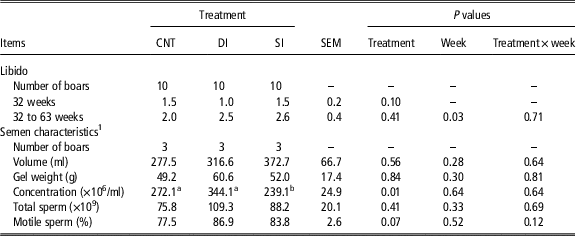
Libido was evaluated at 32, 36, 47, 60 and 63 weeks of age and data are summarized in Table 2. At 32 weeks of age, libido score was not different among treatments, although it was numerically greater for SI and CNT boars compared with DI boars (1.5, 1.5 and 1.0, respectively; P=0.15). For the period from 32 to 63 weeks of age, there was an effect of week (P=0.03) and libido scores increased with time across all treatment groups. There were no effects of treatment (P=0.41) or an interaction of treatment and week (P=0.71).
Libido and semen characteristics in control boars (CNT) and boars given single (SI) (10 weeks of age) or double (DI) (10 and 15 weeks of age) immunizations against gonadotropin-releasing hormone (Improvest®)

a,bWithin a row, means without common superscript differ (P<0.05).
1 A total of four ejaculates were collected from each boar during a 2-week evaluation period.
Semen characteristics at 60 weeks of age are summarized in Table 2. Semen volume, gel weight and total sperm cells did not differ among treatment groups (P=0.56, P=0.84, and P=0.41, respectively). Sperm concentration was greater for DI boars compared with SI boars (P=0.01), and tended to be greater for DI boars compared with CNT boars (P=0.12). Sperm concentration did not differ between SI and CNT boars (P=0.58). The percentage of sperm displaying motility tended to be greater for DI boars compared with CNT boars (P=0.07), and was not different for DI and SI boars or SI and CNT boars (P=0.54 and P=0.23, respectively).
Discussion
Across weeks of the study, the DI boars tended to have greater BWs than the intact controls. Other researchers have reported that DI boars have a significantly greater BW than control boars at market age (25 weeks of age; Dunshea et al., Reference Dunshea, Colantoni, Howard, McCauley, Jackson, Long, Lopaticki, Nugent, Simons, Walker and Hennessy2001; Rikard-Bell et al., Reference Rikard-Bell, Curtis, van Barneveld, Mullan, Edwards, Gannon, Henman, Hughes and Dunshea2009; Fabrega et al., Reference Fabrega, Velarde, Cros, Gispert, Suarez, Tibau and Soler2010). Other studies, however, showed no difference in BW at harvest between intact boars and immunological castrates (Bonneau et al., Reference Bonneau, Dufour, Chouvet, Roulet, Meadus and Squires1994; Wicks et al., Reference Wicks, Crouch and Pearl2013). The study by Wicks et al. (Reference Wicks, Crouch and Pearl2013) employed only six intact control boars compared with 20 immunologically castrated boars and is perhaps the reason no difference was detected in BW. In the Bonneau et al. (Reference Bonneau, Dufour, Chouvet, Roulet, Meadus and Squires1994) study, boars were immunized based on BW and not on age. Aside from the present report, Lealiifano et al. (Reference Lealiifano, Pluske, Nicholls, Dunshea, Campbell, Hennessy, Miller, Hansen and Mullan2011) are the only researchers to compare BW at slaughter and ADG in boars after single or double injections of Improvest® and they found no differences between SI and DI treatments.
In the present study, DI boars grew faster than CNT boars and this finding is consistent with previous research (Zeng et al., Reference Zeng, Turkstra, Jongbloed, van Diepen, Meloen, Oonk, Guo and van de Wiel2002; Oliver et al., Reference Oliver, McCauley, Harrell, Suster, Kerton and Dunshea2003; Fabrega et al., Reference Fabrega, Velarde, Cros, Gispert, Suarez, Tibau and Soler2010). The design of the experiment reported herein did not allow for a determination of the effects of immunological castration on feed consumption. However, Dunshea et al. (Reference Dunshea, Colantoni, Howard, McCauley, Jackson, Long, Lopaticki, Nugent, Simons, Walker and Hennessy2001) reported that daily feed intake in Improvac®-treated boars exceeded that of intact controls. Thus, our finding that DI boars exhibited greater growth rates than CNT could be a consequence of enhanced feed consumption. In addition, enhanced growth in DI boars could result from treatment-induced suppression of sexual and/or aggressive behaviors (Dunshea et al., Reference Dunshea, Colantoni, Howard, McCauley, Jackson, Long, Lopaticki, Nugent, Simons, Walker and Hennessy2001; Rydhmer et al., Reference Rydhmer, Lundstrom and Andersson2010). Turkstra et al. (Reference Turkstra, Zeng, van Diepen, Jongbloed, Oonk, van de Wiel and Meloen2002), however, reported that intact boars had a greater ADG than immunological castrates. In that study boars were not fed on an ad libitum basis, which is likely the reason for a greater ADG for intact boars than DI boars. Turkstra et al. (Reference Turkstra, Zeng, van Diepen, Jongbloed, Oonk, van de Wiel and Meloen2002) also reported that intact boars had greater feed conversion efficiency than immunological castrates. Therefore, by restricting feed, boars grew faster and more efficient than immunocastrates.
Circulating estradiol and testosterone concentrations have been used as indicators of testicular function in boars (Zamaratskaia and Squires, Reference Zamaratskaia and Squires2009). In the current study, secretion of both hormones was suppressed in DI boars. The results of the current investigation are in concurrence with other studies investigating the effects of immunological castration on estradiol production (Zamaratskaia et al., Reference Zamaratskaia, Rydhmer, Andersson, Chen, Lowagie, Andersson and Lundstrom2008; Kubale et al., Reference Kubale, Batorek, Skrlep, Prunier, Bonneau, Fazarinc and Candek-Potokar2013). For example, Kubale et al. (Reference Kubale, Batorek, Skrlep, Prunier, Bonneau, Fazarinc and Candek-Potokar2013) showed that estradiol concentrations in intact boars began increasing around 19 weeks of age and a second immunization against GnRH at that time blocked the increase with concentrations decreasing thereafter. Herein, we report that boars given two immunizations had significantly reduced concentrations of testosterone at 5 weeks after second injection compared with control boars, which agrees with results from previous studies (Falvo et al., Reference Falvo, Chandrashekar, Arthur, Kuenstler, Hasson, Awoniyi and Schanbacher1986; Bonneau et al., Reference Bonneau, Dufour, Chouvet, Roulet, Meadus and Squires1994; Dunshea et al., Reference Dunshea, Colantoni, Howard, McCauley, Jackson, Long, Lopaticki, Nugent, Simons, Walker and Hennessy2001; Turkstra et al., Reference Turkstra, Zeng, van Diepen, Jongbloed, Oonk, van de Wiel and Meloen2002; Zeng et al., Reference Zeng, Turkstra, Jongbloed, van Diepen, Meloen, Oonk, Guo and van de Wiel2002; Zamaratskaia et al., Reference Zamaratskaia, Rydhmer, Andersson, Chen, Lowagie, Andersson and Lundstrom2008; Kubale et al., Reference Kubale, Batorek, Skrlep, Prunier, Bonneau, Fazarinc and Candek-Potokar2013; Wicks et al., Reference Wicks, Crouch and Pearl2013). In general, testosterone concentrations are significantly reduced around 2 to 3 weeks after the second immunization (Falvo et al., Reference Falvo, Chandrashekar, Arthur, Kuenstler, Hasson, Awoniyi and Schanbacher1986; Dunshea et al., Reference Dunshea, Colantoni, Howard, McCauley, Jackson, Long, Lopaticki, Nugent, Simons, Walker and Hennessy2001; Zeng et al., Reference Zeng, Turkstra, Jongbloed, van Diepen, Meloen, Oonk, Guo and van de Wiel2002; Wicks et al., Reference Wicks, Crouch and Pearl2013). Lealiifano et al. (Reference Lealiifano, Pluske, Nicholls, Dunshea, Campbell, Hennessy, Miller, Hansen and Mullan2011) reported that boars receiving only one immunization had significantly greater concentrations of testosterone than boars receiving two immunizations. Moreover, that study showed that in blood collected at slaughter, boars given the second immunization 6 weeks prior had significantly greater concentrations of testosterone than boars given the second immunization 2 weeks before slaughter. These results indicate that the effects of immunization on testosterone secretion decrease with time after second immunization. The present study also showed elevated concentrations of testosterone at 25 weeks of age compared with 20 weeks of age in DI boars (1.18 and 0.06 ng/ml, respectively).
The present study is the first to show that testosterone concentrations at 40 weeks of age in DI boars are not different from intact or SI boars. The study by Lealiifano et al. (Reference Lealiifano, Pluske, Nicholls, Dunshea, Campbell, Hennessy, Miller, Hansen and Mullan2011) indicated that the effects of immunization decline with time, which is clearly shown in the results of the present study. Serum testosterone concentrations at 40 weeks of age (25 weeks after second immunization) indicate that testicular steroid production resumed to levels seen in intact boars.
In the present study, SIs had no effect on gross testicular characteristics and values were similar to intact controls. Double injections, however, caused significant reductions in testicular weights and measurements, in accordance with results from other studies (Falvo et al., Reference Falvo, Chandrashekar, Arthur, Kuenstler, Hasson, Awoniyi and Schanbacher1986; Bonneau et al., Reference Bonneau, Dufour, Chouvet, Roulet, Meadus and Squires1994; Dunshea et al., Reference Dunshea, Colantoni, Howard, McCauley, Jackson, Long, Lopaticki, Nugent, Simons, Walker and Hennessy2001; Turkstra et al., Reference Turkstra, Zeng, van Diepen, Jongbloed, Oonk, van de Wiel and Meloen2002; Zeng et al., Reference Zeng, Turkstra, Jongbloed, van Diepen, Meloen, Oonk, Guo and van de Wiel2002; Oliver et al., Reference Oliver, McCauley, Harrell, Suster, Kerton and Dunshea2003; Jaros et al., Reference Jaros, Burgi, Stark, Claus, Hennessy and Thun2005; Zamaratskaia et al., Reference Zamaratskaia, Rydhmer, Andersson, Chen, Lowagie, Andersson and Lundstrom2008; Einarsson et al., Reference Einarsson, Andersson, Wallgren, Lundstrom and Rodriguez-Martinez2009; Lealiifano et al., Reference Lealiifano, Pluske, Nicholls, Dunshea, Campbell, Hennessy, Miller, Hansen and Mullan2011; Kubale et al., Reference Kubale, Batorek, Skrlep, Prunier, Bonneau, Fazarinc and Candek-Potokar2013; Wicks et al., Reference Wicks, Crouch and Pearl2013). Lealiifano et al. (Reference Lealiifano, Pluske, Nicholls, Dunshea, Campbell, Hennessy, Miller, Hansen and Mullan2011) showed that testicular length, width and weight were significantly greater in SI boars than in boars given the second immunization at least 3 weeks before slaughter. In that study, an intact control group receiving no immunizations was not included. The data from the present study confirms data found in previous studies demonstrating a reduction in growth of the testes in DI boars and also confirms that SIs have no effects on testicular growth. Moreover, double, but not SI negatively impacted spermatogenesis as evidenced by lower seminiferous tubule scores in DI compared with SI and CNT boars at 25 weeks of age.
The results of the present study agree with previous studies that have investigated boar taint levels in DI boars compared with intact boars (Bonneau et al., Reference Bonneau, Dufour, Chouvet, Roulet, Meadus and Squires1994; Dunshea et al., Reference Dunshea, Colantoni, Howard, McCauley, Jackson, Long, Lopaticki, Nugent, Simons, Walker and Hennessy2001; Turkstra et al., Reference Turkstra, Zeng, van Diepen, Jongbloed, Oonk, van de Wiel and Meloen2002; Zeng et al., Reference Zeng, Turkstra, Jongbloed, van Diepen, Meloen, Oonk, Guo and van de Wiel2002; Jaros et al., Reference Jaros, Burgi, Stark, Claus, Hennessy and Thun2005; Zamaratskaia et al., Reference Zamaratskaia, Rydhmer, Andersson, Chen, Lowagie, Andersson and Lundstrom2008; Kubale et al., Reference Kubale, Batorek, Skrlep, Prunier, Bonneau, Fazarinc and Candek-Potokar2013). Moreover, Lealiifano et al. (Reference Lealiifano, Pluske, Nicholls, Dunshea, Campbell, Hennessy, Miller, Hansen and Mullan2011) reported that SI boars had concentrations of androstenone seven times greater than DI boars.
The results of the present study showed no significant difference in libido for DI, SI and CNT boars at 17 weeks after second injection (32 weeks of age), though DI boars had a numerically lower libido score. Nevertheless, the present study shows immunological castration does not have a permanent effect on libido. Zamaratskaia et al. (Reference Zamaratskaia, Rydhmer, Andersson, Chen, Lowagie, Andersson and Lundstrom2008) compared sexual behavior of intact boars and boars treated with two injections of Improvest in a 7 min mating test with sows or gilts in estrus. The majority of intact boars mounted a female in estrus quickly after initiation of the mating test, however, none of the immunologically castrated boars mounted. In that study, three of the immunological castrates had to be pulled from the test due to fighting with the sow or gilt (in two cases the sow or gilt attacked the male at initiation of the test). The study also showed that at 15 weeks after second immunization, two immunological castrates attempted to mount the female, but were unsuccessful.
Bilskis et al. (Reference Bilskis, Sutkeviciene, Riskeviciene, Januskauskas and Zilinskas2012) investigated the effects of immunological castration on mature, AI boars. Although that study did not contain true controls and the results were confounded with time, it did show a decrease in libido in boars after three immunizations. The researchers did not report how long the reduction lasted.
The results of the present study indicate that immunization against GnRH does not have long-term effects on indicators of semen quality. Indeed, there were no effects of SI or DI on semen volume, gel weight or total sperm cells in the ejaculate at ~45 weeks after the second injection. Moreover, sperm concentration and the percentage of sperm displaying motility were actually greatest in DI boars. For these findings, we have no explanation and these effects of immunization on semen characteristics await confirmation in trials employing a greater number of boars. Other studies have shown effects on sperm production and morphology for up to 22 weeks after the second immunization. Wicks et al. (Reference Wicks, Crouch and Pearl2013) reported that DI boars had decreased amounts of daily sperm production compared with CNT boars 10 weeks after second immunization, as determined from homogenized testicular samples. Einarsson et al. (Reference Einarsson, Andersson, Wallgren, Lundstrom and Rodriguez-Martinez2009) investigated the short- and long-term effects of immunocastration at 4, 16 and 22 weeks after second immunization. In that study, DI boars had a greater incidence of proximal droplets and head abnormalities, but fewer distal droplets than CNT boars at 4 weeks after second injection. At 16 and 22 weeks after second injection, DI boars also had greater numbers of acrosomal abnormalities and defects compared with CNT boars. Bilskis et al. (Reference Bilskis, Sutkeviciene, Riskeviciene, Januskauskas and Zilinskas2012) investigated the effects of immunological castration on mature AI boars and reported that animals receiving three vaccinations had decreased semen volume, and increased abnormal spermatozoa (proximal droplets, bent tails and head abnormalities) compared with pre-immunization evaluations. No differences in sperm motility or concentration after immunization were reported. This study did not utilize control boars and thus treatment was confounded with time. In conclusion, the current results show promise for potential use of immunological castration on farms raising breeder boars. However, semen characteristics were determined for a limited number of animals. Future studies should investigate the long-term effects of immunological castration on SI and DI boars in a commercial setting utilizing a large number of animals. Further research is also needed to investigate the length of time from second immunization until the negative effects of the immunization are no longer evident.
Acknowledgments
Funding for this work was provided in part, by the Virginia Agricultural Experiment Station and the Hatch Program of the National Institute of Food and Agriculture, US Department of Agriculture and a grant from the Virginia Agricultural Council (Richmond, VA, USA). Expert technical assistance provided by Lee Johnson, Terry Lee and Kim Williams is gratefully acknowledged. The authors thank Zoetis Animal Health, Florham Park, NJ, USA for donation and administration of the Improvest® used for this study.