1. Introduction
Plastic bag litter has become a common problem across continents and countries, waterways and oceans. Many countries and cities around the globe are now taking action against the use of plastic bags in an attempt to reduce litter and pollution. However, previous experience has shown that, unless the correct instruments are chosen and enforced effectively and persistently, plastic bag litter control will not be successful. China, the number one consumer of plastic bags in the world, has joined the list of countries that are taking action against the use of plastic bags by banning thin, free plastic shopping bags. In June 2008, a market-based regulation that forces shops to charge for the use of these bags was implemented. Accordingly, it is of interest to analyze to what extent the market-based environmental policy, intended to influence all citizens who use plastic bags, actually affects people's behavior and to analyze the factors affecting the influence of the policy.
This paper focuses on these issues by relying on individual-level data from surveys conducted with consumers both before and after the implementation of the regulation. In addition, we try to understand in more detail the impacts of the regulation on different groups of people and at different locations and shopping occasions. Since the regulation has failed to be perfectly enforced, i.e., some shops still provide the bags for free, it is also of interest to investigate the influence of enforcement variation on people's bag consumption behavior. The resulting information is intended to help policy makers better understand the role of the regulation for short-term plastic shopping bagFootnote 1 reduction and to suggest possible ways to further improve the regulation.
When pollution monitoring or measuring are difficult or costly, environmental taxes or fees may be levied on some inputs or outputs that are more readily able to be monitored or measured and a good proxy for the pollution to be regulated (see, e.g., OECD, 2001; Sterner, Reference Sterner2003). Excising product taxes on environmentally harmful consumer goods such as cigarettes, fuel or cars is relatively easy to be implemented and already accounts for a considerable share of the total tax money collected in many countries, especially in developing countries with few experiences in environmental control. Therefore product taxation is usually given higher priority by policy makers than other instruments such as tradable permits, market friction reductions and government subsidy reductions.
The Chinese plastic bag regulation can be seen as a modified output charge or taxation policy, while it has its obvious differences – that it is the shops rather than the government that charge for the bag provision. Similar plastic bag regulation has been implemented in countries such as Denmark, Ireland and South Africa, but has generated significantly different policy impacts. Therefore, some evidence from the country with the largest plastic bag consumption is important in order to deepen understanding of the impacts of commonly used charge or taxation policies on plastic bag reduction. In particular, allowing for charging different prices for the bags by the regulation and the existing substitutes for plastic bags enable us to further investigate the roles of price difference and of substitutes on consumers’ reaction behavior in detail. It is also worth noting that the previous studies on plastic bag regulation do not have individual-level information from both before and after the policy change, while it is widely recognized that policy impacts can be more adequately analyzed with detailed – both ex ante and ex post – socioeconomic and environmental data (see, e.g., Briassoulis, Reference Briassoulis2001). In the present paper, we use this regulation implementation as a naturally occurring opportunity to make a detailed analysis of the impacts of the regulation by conducting surveys both before and after the regulation implementation.
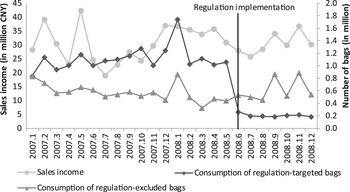
The ex-ante survey was conducted one month before the implementation date, when most citizens were well aware of the news of the forthcoming regulation.Footnote 2 Hence, the questions in our questionnaire could be easily understood by the respondents. We interviewed both consumers and shop managers about whether they had noticed any changes in plastic bag use behavior that could be linked to the news of the forthcoming regulation. No change was reported, which is consistent with evidence from supermarkets’ formal records that bag consumption did not change until the regulation had been implemented (figure 1). In the ex-ante survey, we collected information about consumer characteristics and plastic bag use situations.
The sales income and the number of consumed plastic bags at the sampled supermarkets in Guiyang

The ex-post survey was conducted about four months after the regulation was implemented so that citizens had time to adjust to the regulation. Both the ex-ante and ex-post surveys were conducted in the same shops at the same time of day and with the same questionnaire, but some complementary questions about the enforcement of the regulation in the respondent's home community were asked in the ex-post survey. During the period in which the two surveys were conducted, there was no other major economic change or any relevant action or campaign with respect to the use of plastic bags in China. It is therefore reasonable to assume that any change in behavior regarding plastic bag use was clearly due to the implementation of the regulation.Footnote 3 Furthermore, the same two surveys were conducted in different regions in order to identify possible regional differences in the behavior change due to the regulation. By analyzing and comparing the results from the surveys, we are able to analyze whether there were any clear effects of the regulation.
Regarding litter control, consumers’ environmental-friendly intentions and behaviors are affected by individual demographics as well as by internal and external motivators. The primary incentive for individuals to use plastic bags is simply that they are the cheapest alternative for carrying goods home from stores. Market-based policies have the potential to provide incentives for consumers to adopt better technologies into their daily lives since, by using product-charging instruments (also called ‘advanced disposal fees’) such as charging for plastic bags, it always pays off for consumers to use a bit less if another sufficiently low-cost method of doing so is available.Footnote 4 Moreover, along with the policy implementation, a clear signal that plastic bag litter is environmentally harmful was sent out via information campaigns with the charging of the bags (Convery et al., Reference Convery, McDonnell and Ferreira2007). This signal and the bag pricing per se could shift consumers’ external environments and reference points of plastic bag consumption. Therefore, the information, together with a small price added to the bags, has the potential to generate a considerable reduction in bag consumption.
The remainder of the paper proceeds as follows: section 2 presents the background of the regulation and section 3 introduces the survey design. Section 4 discusses the methodology used and section 5 describes the data. The results are reported in section 6 and section 7 concludes the paper.
2. Background of international actions and China's regulation
2.1. International actions against the use of plastic bags
Many countries and cities around the globe (e.g., Bangladesh, California, China, Denmark, Hong Kong, Ireland, Kenya, Rwanda, South Africa, Tanzania and the UK) are taking actions and/or implementing policies against the use of plastic bags with the motivation of reducing litter and pollution. For example, the Bangladesh government banned the use of plastic bags in its capital Dhaka in 2002 and Rwanda prohibited the use of plastic bags by shoppers in 2006. Denmark imposed a tax of DKK 22 per kilogram of plastic bags on retailers in 1994, which has since cut plastic bag usage by 66 per cent (Danish Environmental Protection Agency, 1999).
In contrast to imposing an upstream tax on retailers as in the case of Denmark, in March 2002 Ireland introduced a downstream product tax of €0.15 per plastic bag levied on consumers, which led to a 94 per cent reduction in per capita yearly bag use from 328 to 21. However, surveys provided by the Irish Central Statistics Office indicate that plastic bag usage rose to 30 bags per capita in 2006. In July 2007, the Irish government further increased the environmental levy on plastic bags to €0.22 per bag in order to maintain its impact (Irish Department of the Environment, Heritage and Local Government, 2007). The success in terms of substantially reducing the use and the associated gains in the form of reduced litter and a more attractive landscape in Ireland has attracted considerable international interest (Convery et al., Reference Convery, McDonnell and Ferreira2007). However, the seemingly similar legislation of a downstream product charge implemented in South Africa in 2003 witnessed a gradual rebound in plastic bag consumption after showing an initially significant reduction (Hasson et al., Reference Hasson, Leiman and Visser2007; Dikgang et al., Reference Dikgang, Leiman and Visser2012).
2.2. China's regulation of plastic bags
Plastic bags, with their advantages of being lightweight, strong, waterproof and seemingly free of charge, have been ubiquitous for several decades in China, ever since they were introduced as a way of promoting sales in the early 1980s. Although plastic bags have been provided for free, they have not been without costs. Before the regulation, retailers in China spent more than 24 billion Chinese Yuan (CNY) per year on plastic bags (Zhang, Reference Zhang2008). This was passed on to consumers through higher prices of other goods. While supermarkets have consumed 25 per cent of all plastic bags, open markets, roadside stores, department stores and all other retailers have consumed the remaining 75 per cent (Wang, Reference Wang2008). As a result of mass usage, plastic litter composed of plastic bags constitutes 3–5 per cent of the total landfill solid waste (Chinese National Development and Reform Commission, 2008b). These buried plastic bags may last for 500–1,000 years in landfills (Friends of the Earth Scotland, 2005).
Since the late 1990s, local governments in a few cities and provinces have introduced policies with the intention of limiting or even eradicating the use of plastic bags. However, most regional policies aimed at reducing plastic bag use have become useless paperwork after implementation or have not even reached practical enforcement. It was not until early 2008 that, as an effort to host a ‘Green’ Olympic Games, the Ministry of Commerce, the National Development and Reform Commission, and the State Administration for Industry and Commerce jointly published the nationwide byelaw The Administrative Byelaw for Non-free Use of Plastic Shopping Bags in Retailer Situations. The administrative byelaw (the regulation) has been in effect since 1 June 2008. The key feature of the regulation is that free provision of plastic bags is prohibited in all supermarkets, stores and all other retailers across the country (excluding plastic bags used for separating foods and other products for hygiene and food safety purposes). All shops are instructed to mark the price of the plastic bags clearly and not to attach the cost to that of other items. The price of the plastic bags can be set by individual shops, yet at a level no less than the acquisition cost (Chinese Ministry of Commerce et al., 2008; Chinese National Development and Reform Commission, 2008a).
Consumption of a bag has two costs: the first is the cost of acquisition, including production and transportation costs; and the second is the negative external effect on the environment due to disposal of the bag. The regulation, however, only requires charging for the acquisition cost but excludes the social cost. This is partially because, before enacting the formal regulation, a draft was announced in early 2008 for the purpose of collecting public opinions and comments. A considerable number of complaints were made that charging for plastic bags was a disguised form of price markup, increasing shopping costs and therefore hurting all citizens. Therefore, a compromise from the original environment-protection purpose of the regulation had to be made while still leaving space for its further adjustment. For instance, despite the advantages of taxing plastic bags, the Chinese government mandated a retailing charge for the bags.
Given the extremely broad effects of the regulation on citizens, it is common for the government to apply gradual policy reform in order to reduce citizens’ resistance, thereby lowering the political risk of the reform. Requiring shops to charge for the bags and only requiring charging for the acquisition cost could be a first step towards levying tax on the bags and further including its environmental cost in the future. It is also noteworthy that, due to the fierce competition Chinese retail trade faces, a substantial fraction of shops have enforced the regulation incompletely, i.e., only charging for some of the provided bags, or even none. For example, while all surveyed supermarkets have perfectly implemented the regulation, only 26 per cent of shops in our surveyed open markets have enforced the regulation completely. Therefore, consumers still obtain a considerable proportion of the total number of bags for free.
The actual price of a new plastic bag turns out to vary from CNY 0.2 to 0.5 depending on region, residential area and type of shop. In general, the average price is higher in some cities than in others, and higher in supermarkets than in open markets. The variation in the actual price could have a significant effect on bag consumption behavior. Since bag expenditure is tiny compared to consumers’ daily shopping bills, it is unlikely that the charge for bags and the price differences between shops have any impacts on consumers’ choices about which shops to go to.
3. Survey design
The policy change on 1 June 2008 is used in order to compare plastic bag use behaviors obtained by the two surveys ex ante and ex post. The ex-ante survey was conducted from late April to early May of 2008, and the ex-ante survey was conducted from October to November of 2008. In China, supermarkets and open markets are located in every residential area and are the main clusters of food and grocery stores. For both surveys, the two most frequently visited types of shops were chosen since these shops account for a considerable fraction of citizens’ daily plastic bag consumption (Wang, Reference Wang2008). Intercept surveys were conducted when consumers exited the shops and a between-subject design was used. The enumerators stopped the targeted shoppers and invited them to participate in a 10-minute survey about consumers’ needs concerning plastic bag provision by shops.
The advantage of using an intercept survey with a between-subjects design is that it avoids the ‘recall effect’ that would follow from using the same respondents in both surveys. Therefore, both surveys needed to be conducted ex ante and ex post in the same shops at the same time of day in order to receive responses from comparable respondents from the same sample pool. The two surveys investigated individual consumers’ current plastic bag use behaviors before and after the implementation, respectively. Since the regulation was not perfectly enforced, the ex-post survey also collected information about the percentage of individual consumers’ paid-for bags out of their total bags as an index of regulation enforcement in their community after the implementation.
Since we are interested in analyzing the impacts of the regulation on the use of plastic bags, we designed a series of questions to capture the different aspects of the use.Footnote 5 In order to obtain measures of the consumption of new plastic bagsFootnote 6 at the individual level, we investigated the number of new bags used in a one-week period since it is expected to be relatively stable across weeks, and we also recorded the number of new bags used during the surveyed shopping trip since it is easily observed. We further investigated three other aspects of bag use that could also be affected by the regulation: new bag use efficiency; bag reuse frequency; and use of substitutes. Regarding the general bag reuse situation, we recorded respondents’ average proportion of bags being reused and their average number of reuse times.
Moreover, we designed a systematic way to find out the information about how consumers use new plastic bags and substitutes during the surveyed shopping trip. First, we collected information about the number of new plastic bags used and the weight of the goods in the new plastic bags during the current shopping trip. We then calculated each respondent's average weight of goods per new bag as a measure of new bag use efficiency. Second, we recorded each respondent's total expenditure for all goods and the expenditure for goods carried in containers other than new and used plastic bags during the same shopping trip. Substitute use is then quantified by the proportion of the two expenditures. This proportion of expenditure is a more neutral measure of substitute use level than the proportion of weight because the expenditure for goods is much less correlated with the means of carrying them than the weight of goods is.
In this study, we are also interested in the factors, excluding the regulation per se, that could affect the use of plastic bags and the impacts of the regulation on different groups of people. The first group of factors includes what people think about the regulation and how difficult it is for them to reduce or to stop their use of the plastic bags. The second group of factors concerns respondents’ socioeconomic characteristics, since bag use behavior might be influenced by respondents’ lifestyles and other specific conditions. Last but not least, in order to obtain a representative sample and to detect potential differences in bag consumption behavior, we conducted the surveys at different times of day, on different shopping occasions, and in different regions.
We conducted two parallel surveys in the cities of Beijing and Guiyang in order to detect any possible regional discrepancy. Beijing is the capital and one of the most developed metropolitan areas in China, while Guiyang is a medium-sized city located in one of the most undeveloped provinces. We conducted surveys in the two most frequently visited types of shops, namely supermarkets and open markets, in order to see whether there are differences between people shopping in different types of shops. Consumers who shop in supermarkets are generally considered to have a higher income and a higher standard of living than those who shop in open markets.
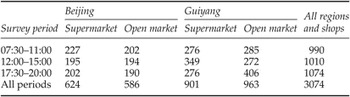
We chose three main residential areas in each city and included one large supermarket and one large open market from each of these areas. Furthermore, since shopping behavior may differ depending on the day of the week and on the time of day, our surveys cover both regular weekdays and weekends/public holidays as well as the three main shopping rush hours, namely early morning, noon/early afternoon and late afternoon/early evening. As presented in table 1, we attempted to distribute our samples evenly in each of the dimensions so that we could detect possible behavioral effects among these situations and obtain a sample representing urban consumers in China.
The time and spatial distribution of the observations in both surveys

Note: The three periods are the main shopping hours of the shops.
The sampling procedure of interviews was exactly the same: every third shopper who exited the shop was approached by the enumerators and asked if s/he would like to participate in a survey that would last a few minutes. If the selected customer refused to participate, the enumerator approached the very next shopper. If this person agreed to participate, then the enumerator would complete the survey and proceed to the next third shopper. We ended up with 3,074 interviewed respondents.Footnote 7 The most commonly stated reason for refusing to participate was lack of time.
4. Methodology
In order to analyze the impact of the regulation on the use of plastic bags for different groups of people, we use econometric models. The dependent variable in the first model is the individual consumer's number of new bags used per week, while the independent variable vector X has several components, i.e., X = (X0, Xi, Xj, Xm, Xn, Xr). Xi is the key variable, ‘implementation of regulation’, while all the other variables take the role of controls in this study: Xj denotes consumers’ self-reported percentage of paid-for plastic bags out of their total bag consumption to capture the enforcement of the regulation, and the percentage of paid-for bags is set at zero for all observations from the ex-ante survey since no shops charged for plastic bags then; Xm expresses the variables regarding consumers’ knowledge of the policy and inconvenience of not using plastic bags provided by shops, etc.; Xn denotes the socioeconomic variables of the respondents and their families; Xr denotes variables controlling for bag use behavior shifts due to regional discrepancy, market type difference, weekday or weekend, and time of day. We take the first element X0 as a constant. All variables are explained in detail in the next sub-section.
The dependent variable, number of new plastic bags used, has a count data structure with over-dispersion, i.e., it takes only non-negative integral value and the variance exceeds the mean. Therefore, we apply negative binomial regression models (Cameron and Trivedi, Reference Cameron and Trivedi1986; Greene, Reference Greene2003) to deal with the structure.Footnote 8 In the second model, we take the number of new bags used during the surveyed shopping trip instead of the number of new bags used per week as the dependent variable and estimate using the same model specifications and the same independent variables as in the first model. Since the overall effects of the regulation unconditional on the prices set by individual shops are the primary interest of the policy makers and it is straightforward to make the cross-country comparisons based on the overall effects, the variable of bag price at the current surveyed shops is not included in some models to investigate the overall effects. Yet, it is also important to understand the effects of the regulation implementation per se and of the induced bag price change on bag consumption respectively. We thus decompose the overall effects into the two effects. That is, we further control bag price in the models regarding bag consumption during the surveyed shopping trip given that we only have reliable data on bag price for the surveyed shops.
Since the regulation increased the cost of using plastic bags, it is expected to have decreased bag consumption. Experiences from other countries show that the extent to which the regulation can succeed in ensuring a reduction in plastic bag consumption depends on people's environmental protection consciousness which maintains their attitude as positive toward the reduction and on the support of its enforcement from all relevant administrative departments (Convery et al., Reference Convery, McDonnell and Ferreira2007). That is to say, the reduction in plastic bag use is likely to be positively correlated with positive attitudes toward the regulation and with regulation enforcement. We note that the effects of some influencing variables on plastic bag use could differ between before and after the regulation implementation. For example, older people may be more sensitive to the price change, thereby reducing their plastic bags more than younger people following regulation implementation. Therefore, in some of our models, we add interaction variables, i.e., variables interacted with the regulation implementation dummy. The coefficients of the interaction variables enable us to analyze the differences in the impacts of the regulation on different groups of people with different characteristics as well as in different regions and different types of shops. As shown by Ai and Norton (Reference Ai and Norton2003) and Karaca-Mandic et al. (Reference Karaca-Mandic, Norton and Dowd2011), we need to correctly calculate the partial effects of the interaction variables (i.e., interaction effects) in the negative binomial models rather than using the incorrect marginal effects of the interaction variables mechanically computed by the statistical softwares (e.g., Stata).Footnote 9
Moreover, since we are interested in understanding the extra effects of the regulation on bag consumption reduction if enforced perfectly, we make comparisons between the true value of bag consumption under imperfect regulation enforcement and the predicted values of bag consumption from a negative binomial model under perfect enforcement. The comparisons were conducted in the following steps: first, we estimated a negative binomial regression model of weekly bag consumption using only the ex-post survey data. Hence, we did not include the dummy variable ‘implementation of regulation’ and its interaction variables in this model. Second, based on the estimation results, we calculated the predicted value of the dependent variable using parameters estimated from the model yet conditional on the regulation being enforced perfectly, i.e., the enforcement variable ‘percentage of paid-for bags’ for every observation is equal to 100 per cent. Third, we performed non-parametric tests to compare the predicted value of the number of new bags used per week under perfect enforcement with the true value of number of new bags used under imperfect enforcement. If the test results suggest that the predicted value of bag consumption is larger than the true value, then tighter enforcement will reduce more bag consumption.
5. The data
5.1. Reduction in plastic bag consumption
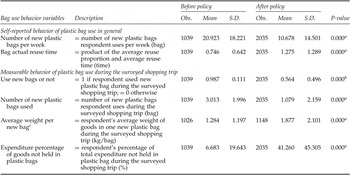
As previously discussed, we included several measures of the use of plastic bags in order to capture different aspects of the response to the regulation. Table 2 summarizes the situation both ex ante and ex post the implementation.
Descriptive statistics of variables defining the relevant plastic bag use behaviors

Notes: aindicates it is from a t-test; bindicates it is from a proportional test; cthis variable is only for the respondents who use new plastic bags at the time of shopping. SD, standard deviation.
At the time of the surveys, CNY 6.98=USD 1 (May 2008) and CNY 6.85=USD 1 (November 2008).
Regarding the general use of plastic bags, it can be observed that before the regulation was implemented, respondents, on average, used 21 plastic bags per week with each bag being reused about 0.7 times. After the regulation, nearly half of all new bags were saved with the sizeable increase in reuse frequency by 0.6 times to 1.3 times. As for the bag use behavior during the surveyed shopping trip, the probability that respondents used at least one new plastic bag when shopping decreases dramatically from 99 per cent to 56 per cent. The average number of new bags used decreases by 64 per cent, from 3.0 to 1.1 bags. The average weight of goods per new plastic bag increases by about 50 per cent, from 1.3 to 1.9 kg. The proportion of total goods (measured in terms of expenditure) not held in plastic bags increases from less than 7 per cent to more than 41 per cent. According to the observation during the survey, after the regulation implementation, many consumers started returning to the use of cloth bags, school bags, baskets, etc., and some of them even preferred holding things in their hands or putting goods directly into the baskets or onto the luggage carriers of their bicycles to using plastic shopping bags. The values of all the aforementioned variables differ largely between the ex-ante survey and the ex-post survey, and the differences in the mean of all variables are highly significant in terms of the t-test or the proportional test as the corresponding p-values show in table 2. A clear tendency of a reduction in the consumption of new plastic bags due to implementation is seen. In addition, the regulation also affects the way consumers use plastic bags: first, the new bags are used to hold more goods than before; second, the bags are reused more frequently than before; third, more substitutes are used, meaning that more goods are placed in containers other than plastic bags.
Furthermore, we collected information about shops’ monthly sales income and consumption of two types of plastic bagsFootnote 10 in 2007 and 2008 from all surveyed supermarkets in Guiyang. The results are shown in figure 1. No seasonal effects can be detected from the trends of both regulation-targeted and regulation-excluded plastic bags, although the trend of sales income reflects weak seasonal variation, i.e., the sales income seems to be higher in the winter than in the summer and nearly the same in the spring and the autumn. We conducted the two surveys in the spring and in the autumn, respectively. Across the two-year period, the trend of sales income remains nearly flat, although apparent variances appear with sales income peaks occurring in the months that include main festivals. For example, a sales explosion occurred in January 2008 simply because, due to tradition, people bought lots of goods to prepare for the celebration of China's most important Spring Festival. The consumption trend of the regulation-excluded plastic bags also remained stable across the 24 months, although with some variation. Nevertheless, the consumption of the regulation-targeted plastic bags experienced a drastic decrease directly after the regulation implementation in June 2008. The average number of regulation-targeted bags consumed monthly fell from around one million to 0.2 million, while it stayed stable during the separate periods of both before and after the implementation. Compared to the bag consumption in April 2008, regulation-targeted bag use decreased by 79 per cent in the Guiyang supermarkets in November and December 2008. It is worth noting that the counterpart data from our survey reflects that the reduction in the use of new regulation-targeted plastic bags equals 75 per cent, which corresponds well with the percentage reduction indicated by the sales records of the surveyed supermarkets in Guiyang.
5.2. Descriptive statistics
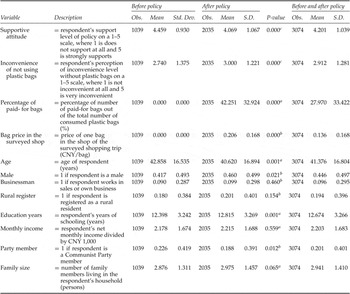
Factors other than the implementation of the regulation may also influence plastic bag use. These potential influential factors are presented in table 3.
Definitions and descriptive statistics of variables used in econometric analyses

Notes: aindicates it is from a t-test; bindicates it is from a proportional test; cindicates it is from a Wilcoxon–Mann–Whitney test. SD, standard deviation.
At the time of the surveys, CNY 6.98=USD 1 (May 2008) and CNY 6.85=USD 1 (November 2008).
The first set of variables reflects individuals’ support of the regulation and the inconvenience of not using plastic bags provided by shops. In the survey, we measured the first two variables on a five-level scale from ‘low’ to ‘high’. As shown in table 3, more than 80 per cent of the respondents present a positive attitude toward the regulation, although the supportive attitude generally went down after experiencing the impacts of the implementation. The stated actual inconvenience caused by no longer using plastic bags provided by shops is greater than the respondents thought beforehand. Four months after the regulation was implemented, the percentage of new plastic bags consumed that were actually paid for, rather than obtained for free, is only 42 per cent on average, reflecting that the enforcement effort is far from satisfying. After the regulation, the average bag price weighted by the surveyed respondents is CNY 0.21 in all surveyed shops and CNY 0.33 if only the surveyed shops that charged for bags are included. The respondent-weighted average bag price is CNY 0.37 and CNY 0.30 in the Beijing and Guiyang surveyed shops that charged for bags, respectively.
The socioeconomic characteristics of the respondents and their families constitute the second set of variables that affect the use of plastic bags. Considering the pooled data of both surveys, the mean age of all respondents is 41, and about 45 per cent are male. A ‘businessman’ dummy is created to control for the effect of this particular profession on weekly bag use: respondents running their own businesses, such as a restaurant or a grocery store, may shop not only for themselves or their own families but also for all their customers, thereby consuming many more plastic bags than the average. About 10 per cent of respondents belong to this profession, nearly 20 per cent are registered as rural residents, and one-fifth are members of the Communist Party.Footnote 11 The average years of schooling and the average monthly income of the sample are 12.7 years and CNY 2,200, respectively, while the average family size is nearly three persons. It is worth noting that the differences in mean of these characteristics between the sample from the ex-ante survey and from the ex-post survey are small in a quantitative sense. However, the differences in the mean or the distribution of some of the characteristics are significant in terms of the t-test, the proportional test or the Wilcoxon–Mann–Whitney testFootnote 12 partially due to the large sample.
6. Econometric results
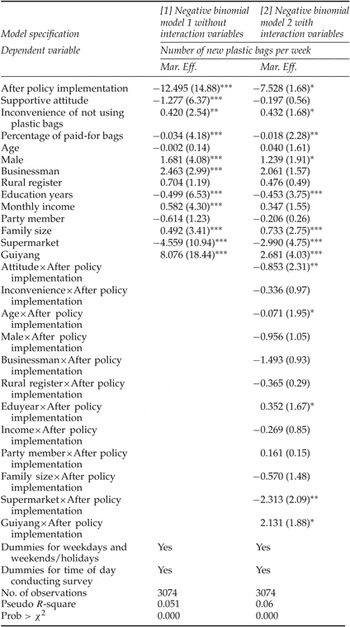
Econometric analysis is applied to estimate the effects of the aforementioned factors on the number of new plastic bags used per week and during the surveyed shopping trip, especially the effects of the regulation implementation. As mentioned before, interaction variables are included in some of the models. Table 4 reports regression results from two different specifications of negative binomial regression models, with and without interaction variables, concentrating on the effects on the number of the bags used per week. In both models, the dummies are included to control for weekdays and weekends/holidays and the time of day when the survey was conducted. We begin by looking at the models without interaction variables.
Regression results from negative binomial models regarding weekly bag consumption

Notes: Absolute value of z-statistics in parentheses.
*significant at 10%; **significant at 5%; ***significant at 1%.
The results of the first negative binomial model are presented in column [1]. Only the main variables per se are included in this model. The results show that, controlling for other socioeconomic characteristics, regulation implementation has a strong impact on the use of new plastic bags: people on average use 12.5 fewer new bags per week following the regulation implementation. The results from this model also suggest that several control variables significantly influence the number of new plastic bags consumed per week. Nevertheless, the regulation has a quantitatively much larger influence than any other single factor.
Since consumers with various socioeconomic characteristics might respond differently to the regulation, the impacts of the characteristics on bag consumption could differ. Our analysis thus focuses mainly on the results of the second negative binomial model in column [2]. This model further incorporates interaction variables that are the regulation implementation dummy interacted with all the variables of interestFootnote 13 respectively, in order to capture the impacts of the regulation on different groups of people and on different places and shopping occasions.
Before the implementation, respondents with a one-level-higher feeling of inconvenience on average consume 0.4 more new plastic bags per week. Males on average consume 1.2 more new bags per week, mainly because they lack substitutes in which to carry goods more often than females, while people with one more year of education use 0.5 fewer new bags weekly, probably because higher education yields more environmental consciousness. One additional family member increases by 0.7 new bags consumed weekly. As for the bag consumption of shoppers surveyed in different types of shops and in different regions, the shoppers surveyed in supermarkets use three fewer new plastic bags per week than those in open markets. Respondents from the less developed regional city Guiyang consume 2.7 more new bags weekly than respondents from the most developed capital, Beijing.
After the implementation, for every 10 percentage points more paid-for plastic bags out of their total bag consumption, respondents use 0.2 fewer new bags weekly. It can be seen that the interaction variables interacting with attitude, age, years of education, supermarket dummy and Guiyang dummy are significant, which indicates different reactions to the regulation. Specifically, respondents with a one-level-higher supportive attitude toward the regulation and those with a one year increase in age consume 0.9 and 0.1 fewer new bags per week, respectively, after regulation implementation, although neither of these factors plays a role in bag consumption before implementation. The role of education in reducing bag consumption diminishes from before to after the regulation implementation. In addition to the three fewer bags used by people surveyed in supermarkets than by those surveyed in open markets before the regulation implementation, the former group further use 2.3 fewer new bags per week than the latter group after implementation. Moreover, people in Guiyang consume 2.7 more new bags than those in Beijing ex ante, while this consumption difference increases to 4.8 new bags ex post. All of the abovementioned marginal effects are significant at the conventional levels. From the models shown above, the sizes of the marginal effects reflect that the regulation exerts a large impact on reduction of weekly plastic bag use.Footnote 14
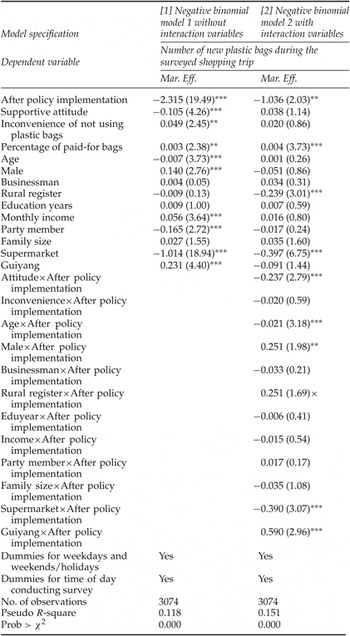
As for the effects of the regulation implementation and other factors on the number of new bags used during the surveyed shopping trip, table 5 reports the results from negative binomial regression models. The same independent variables as before are included in the models. The results demonstrate that the regulation has similar effects on per shopping trip bag consumption as compared to the effects on weekly bag consumption. Consumers on average use 2.3 fewer new bags during one shopping trip following the regulation implementation.Footnote 15 Many interaction variables are significant, indicating that the effects of the regulation on per shopping trip bag consumption differ among different groups of people. Consumers with a stronger supportive attitude, older consumers, and people surveyed in supermarkets are more affected by the regulation, while males, consumers registered as rural residents, and consumers in Guiyang are more likely to stick to their previous bag use habit.
Regression results from negative binomial models regarding bag consumption during the surveyed shopping trip

Notes: Absolute value of z-statistics in parentheses.
*significant at 10%; **significant at 5%; ***significant at 1%.
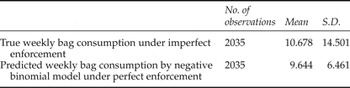
Using the comparison approach introduced at the end of section 4, table 6 displays the descriptive statistics of the true and the predicted values of the number of new bags used per week after regulation implementation, under imperfect and perfect regulation enforcement, respectively.Footnote 16 It can be seen that consumers would further reduce their consumption by more than one new bag per week if the regulation was enforced perfectly, and this further reduction is highly significant in terms of t-test and Wilcoxon–Mann–Whitney test results.
Descriptive statistics of the true value and predicted value of the number of new plastic bags per week after regulation implementation

7. Conclusions and lessons
In recent years, an increasing number of countries have enacted various regulations to limit the use of plastic bags. Similar plastic bag control policies that appear successful in some countries, e.g., Denmark and Ireland, have turned out to be far from successful in others, e.g., South Africa and Kenya (Hasson et al., Reference Hasson, Leiman and Visser2007; Clean Up the World, 2008; Dikgang et al., Reference Dikgang, Leiman and Visser2012). Hence, when China implemented a regulation requiring shops to charge consumers for plastic bags, we took the opportunity to conduct surveys both ex ante and ex post regulation implementation. Our findings show that Chinese consumers in the two surveyed cities reduced their overall plastic bag consumption by 49 per cent and their bag consumption during the surveyed single shopping trip in supermarkets or open markets by 64 per cent from the first to the second survey. This indicates that a potential success in plastic bag litter control measures is occurring in China – the country with the largest consumption of plastic bags in the world. Apart from bag consumption, the plastic bag regulation also shifted various other aspects of bag use behavior toward more efficient use, more frequent reuse of plastic bags and more use of substitutes. The influence of the regulation differs substantially across different groups of people and different locations. This information can be used to further improve the regulation.
Citizens’ attitudes toward the policy indeed play a significant role in reducing the number of bags used after regulation implementation, which is consistent with the experience from Ireland (Convery et al., Reference Convery, McDonnell and Ferreira2007). Since plastic bags are still easily affordable following the new regulation, it is important to strengthen and maintain people's supportive attitudes toward the regulation in order to maintain the degree of reduction in bag use. People surveyed in open markets and people in Guiyang consumed more bags than those in supermarkets and those in Beijing before the regulation implementation, and the differences were further enlarged after the regulation. Two main factors may contribute to the behavioral difference between supermarkets and open markets. First, due to the better prepackaging of goods sold in supermarkets, consumers’ demand for plastic bags is lower. Second, given that the stores in open markets were confronted with a more direct and fiercely competitive environment than supermarkets, the stores have stronger incentives to still supply regulation-targeted bags for free to please their customers.
As for the regional behavioral difference, apart from the fact that people living in Beijing could be more environmentally conscious, the better dissemination of information and enforcement of the regulation in Beijing could be the main driving forces behind the difference. Our results further suggest that the regulation would reduce bag consumption to an even higher degree if it was enforced more effectively and if a higher price was charged for the bags. Generally speaking, the improvements such as better enforcement and nationwide information dissemination would be more easily achieved if the government were to take over the charging duty from the shops by levying a higher plastic bag tax directly on consumers and requiring the shops to collect the levy. Moreover, the regulation implementation not only reduced the bag consumption but also altered other bag use relevant behaviors such as bag use efficiency and bag reuse frequency. In particular, the availability and cost of substitutes for the bags can also be a crucial factor that affects the persistence of bag reduction. Thus, interaction relationships among various bag use relevant behaviors and their policy implications are interesting for future research.
It is noteworthy that the results of the paper reveal only the short-term effects of the regulation and cannot simply be generalized to conclude anything about the long-term effects. Using monetary incentive tools alone to achieve a long-run impact on pollution control could be unreliable: the effects of increases in shopping costs at the margin become weaker for consumers as time passes. After the first feelings of resistance, which are provoked by the additional expenditure, consumers become accustomed to what they were initially upset about (East and Hogg, Reference East and Hogg2000). This may be found to be particularly true with goods, such as plastic bags, which can be classified as daily consumption commodities and add only marginally to the total shopping bill. The changed pattern of consumption following plastic bag legislation in South Africa shows that the initially significant consumption reduction in plastic bags gradually rebounded (Hasson et al., Reference Hasson, Leiman and Visser2007; Dikgang et al., Reference Dikgang, Leiman and Visser2012). Therefore, the current success in terms of bag use reduction should only be considered a trigger; any future reduction depends on the long-run regulation enforcement strength and the efforts to deal with the potential rebound of bag consumption. Further adjustments, such as adding the negative environmental cost of the bags into the price, persistent information campaigns to maintain people's environmental concerns, and enhancing enforcement at various locations and shopping occasions, may need to be adopted.
Supplementary materials and methods
The supplementary material refered to in this paper can be found online at journals.cambridge.org/EDE.