

Introduction
The African tropical lowland forest is the second largest rainforest block on the planet and home to many species of global conservation concern (Myers et al. Reference Myers, Mittermeier, Mittermeier, Mittermeier and Kent2000). Forest cover throughout the region is being lost due to logging, agricultural expansion, and human settlement (IPBES Reference Archer, Dziba, Mulongoy, Maoela and Walters2018). Accurately quantifying the distribution and habitat preferences of rare, cryptic, and elusive species in tropical forests can be extremely challenging and population declines can go unnoticed (Préau et al. Reference Préau, Audrey, Romain and Francis2018). For many species, even basic information (such as population size and distribution) is lacking, making it difficult to know which geographical areas should be prioritised for monitoring and protection.
The Grey-necked Picathartes Picathartes oreas is one of only two species in the enigmatic and poorly known family Picathartidae (Bian et al. Reference Bian, Awa, Ndang’ang’a, Fotso, Hoffmann and Sande2006). This species is endemic to forested Central Africa (McKelvey et al. Reference McKelvey, Aubry and Schwartz2008), and its known distribution is restricted to six countries: Cameroon, the Central African Republic, Republic of Congo, Equatorial Guinea, Gabon, and Nigeria (Birdlife International 2022). Grey-necked Picathartes prefers closed-canopy forest, access to fresh water, and large overhanging rock faces (Awa et al. Reference Awa, Dzikouk and Norris2009), and occasionally tree trunks or buttresses (Waltert and Mühlenberg Reference Waltert and Mühlenberg2000), where it builds nests from mud and fine plant material, often in colonies (Bian et al. Reference Bian, Awa, Ndang’ang’a, Fotso, Hoffmann and Sande2006, Awa et al. Reference Awa, Dzikouk and Norris2009). These habitat requirements and unusual nesting behaviour mean that colonies are often relatively remote and inaccessible (Awa et al. Reference Awa, Dzikouk and Norris2009), although in central Gabon they have been observed on the undersides of bridges and it has been suggested that use of such structures may be more widespread than previously thought (Christy and Maisels Reference Christy and Maisels2007). The Grey-necked Picathartes is thought to be naturally rare across its range and since year 2000, its global population is considered to be declining with certainly fewer than 10,000 mature individuals (BirdLife International 2022). It is currently listed as “Near Threatened” on the International Union for Conservation of Nature (IUCN) Red List (Birdlife International 2022), and in Appendix I of the Convention on International Trade in Endangered Species of Wild Fauna and Flora (CITES 2021). The main threats to Grey-necked Picathartes are habitat loss and degradation, as well as hunting by humans (BirdLife International 2022).
Nest counts are the standard method for estimating Grey-necked Picathartes populations (Bian et al. Reference Bian, Awa, Ndang’ang’a, Fotso, Hoffmann and Sande2006), and a large number of colonies are known from Cameroon, which is considered to be the species’ stronghold (BirdLife International 2022). In Nigeria, a study in the forest blocks of Cross River (the western limit of the species’ range) found 164 breeding individuals (Atuo et al. Reference Atuo, Akunke, Ivande, Shiiwa and Timothy2016). Colony size can vary from >100 nests (Mont Mbam Minkom: Thompson and Fotso Reference Thompson and Fotso1995), >50 nests (Dja Faunal Reserve: Christy Reference Christy1994), and >30 nests (Korup National Park and Mount Nlonako: Bian et al. Reference Bian, Awa, Ndang’ang’a, Fotso, Hoffmann and Sande2006, Dowsett-Lemaire and Dowsett unpublished report). However, most colonies are thought to contain only 10–15 individuals (Fotso 1999 in BirdLife International 2022). The most detailed studies of the species’ ecology to date have been in Mont Mbam Minkom forest (Awa Reference Awa2008, Awa et al. Reference Awa, Dzikouk and Norris2009), an unprotected Important Bird Area (IBA) in the central region of Cameroon (Fotso et al. Reference Fotso, Dowsett-Lemaire, Dowsett, Scholte, Languy, Bowden, Fishpool and Evans2001), and in the Cross River region of south-east Nigeria (Atuo et al. Reference Atuo, Ivande, Wala and Timothy2014, Reference Atuo, Akunke, Ivande, Shiiwa and Timothy2016).
The limited geographical scope of studies of Grey-necked Picathartes means that there is a lack of baseline data from which to evaluate trends and population status. A few colonies are relatively well-known, but little is known about the species’ wider distribution, with only a few published records from some range states (e.g. Equatorial Guinea, Gabon, and the Republic of Congo). The current Grey-necked Picathartes distribution map was adopted by IUCN/BirdLife International from the Grey-necked Picathartes action plan and is based on ad hoc location reports of the species’ nests (Bian et al. Reference Bian, Awa, Ndang’ang’a, Fotso, Hoffmann and Sande2006) and does not include two known sites in the Republic of Congo (Mamonekene and Bokandza-Paco Reference Mamonekene and Bokandza-Paco2006: Gear Reference Gear2013), or more recent records such as those of Cassidy et al. (Reference Cassidy, Watkins and Cassidy2010) in the Central African Republic. No attempt has been made to date to estimate the species’ potential range. However, we know that since 2001, suitable habitat (closed-canopy forest) is declining across its range, especially in Cameroon (Global Forest Watch 2022, Hansen et al. Reference Hansen, Potapov, Moore, Hancher, Turubanova, Tyukavina and Thau2013).
Species distribution models (SDMs) are used to estimate the actual and potential distribution of poorly known species (Préau et al. Reference Préau, Audrey, Romain and Francis2018). SDMs integrate known occurrences of species with environmental variables (e.g. temperature, precipitation, forest cover) to create spatially continuous projections of potentially suitable habitat (Pearson and Dawson Reference Pearson and Dawson2003, Peterson et al. Reference Peterson, Soberón, Pearson, Anderson, Nakamura, Martínez-Meyer and Araújo2011). SDMs typically use machine-learning algorithms to characterise the distribution of a species in geographical and environmental space, and have been adopted widely in ecology and conservation (Jennings and Veron Reference Jennings and Veron2015, Peterson et al. Reference Peterson, Campbell, Moo-Llanes, Travi, González, Ferro and Ferreira2017, DeMatteo et al. Reference DeMatteo, Miguel, Rinas, Nicole, Rosio and Argüelles2017, Freeman et al. Reference Freeman, Sunnarborg and Peterson2019). These tools can be used by conservation practitioners to estimate the most suitable areas for a species, infer the probability of presence in regions where no systematic surveys are available/possible, and identify previously unknown areas of habitat that should be investigated further for the species’ presence (Elith et al. Reference Elith, Phillips, Hastie, Dudík, Chee and Yates2011, Freeman et al. Reference Freeman, Sunnarborg and Peterson2019, Bradfer-Lawrence et al. Reference Bradfer-Lawrence, Beresford, Anderson, Aung, Chang, Chowdhury and Clark2021).
In this study, we compiled the largest known database of Grey-necked Picathartes nest-site locations from its six known range states (Cameroon, Nigeria, Central African Republic, Equatorial Guinea [Bioko], Gabon, Republic of Congo), and used Maximum Entropy (MaxEnt) models to predict the potential distribution of the species across its entire range. The main objectives of this study were to: (1) identify the most important areas that should be prioritised for monitoring and protection; (2) identify potential suitable areas that have not been surveyed; (3) better inform conservation strategies and actions for the species’ long-term survival.
Methods
Study area
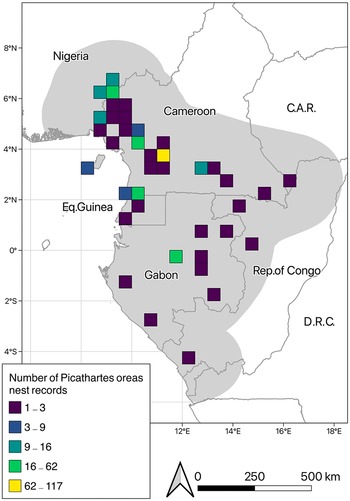
The study region lies between 8°S–7°N and 8°E–18°E within the western half of the Guineo-Congolian regional centre of endemism (White Reference White1983) (Figure 1). This area includes three of the BirdLife International-designated Endemic Bird Areas: the Cameroon and Gabon lowlands, the Gabon-Cabinda Coast, and the Cameroon Mountains (Stattersfield et al. Reference Stattersfield, Crosby, Long and Wege1998, http://datazone.birdlife.org/eba/results?reg=14&cty=0). The study region covers the entire published range for the Grey-necked Picathartes (BirdLife International 2022), buffered by 200 km (total area = 100,860 km2). This is considered large enough to extend well beyond the range of likely suitable habitat for the Grey-necked Picathartes (e.g., beyond the forest–savannah transition zone in Cameroon, and well beyond the range of known colonies).
Map showing the study region in grey, with numbers of the Grey-necked Picathartes nest records from between 2000 and 2021 shown in 0.5 degree squares.

Nest-site locations
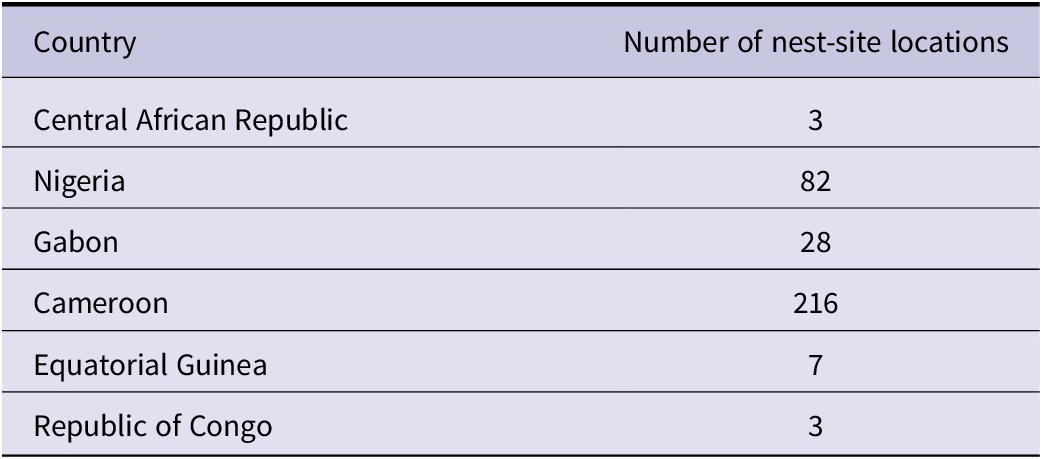
Nest-site locations for Grey-necked Picathartes were obtained from three sources. First, we searched the Global Biodiversity Information Facility (GBIF) database for all nest records of the species since 2000 (www.gbif.org). Second, we reviewed published and unpublished reports to identify and contact researchers likely to have GPS coordinates of nest sites. Third, we conducted ad hoc field surveys with the assistance of local ecoguards and field assistants in Cameroon to identify new nest locations (Campo Ma’an National Park, Nkom National Park, and the proposed Ebo Forest National Park). The combined number of nest-site locations obtained from GBIF, responses from researchers, and field surveys in Cameroon totalled 339 (Table 1).
Total number of nest-site locations between 2000 and 2021 for each country in the study region.

Spatial sampling bias layer
Species occurrence data, such as our nest-site records, are frequently spatially biased, as surveys are often focused on known sites and/or readily accessible locations (Phillips et al. Reference Phillips, Dudík, Elith, Graham, Lehmann, Leathwick and Ferrier2009). This leads to a bias in environmental values, and hence a mismatch with the background points randomly selected from the wider study region (Barber et al. Reference Barber, Ball, Morris and Gilbert2022). To control for the effect of spatial bias, we created a proxy for survey effort using a Target Group Sampling approach whereby records for other birds are used to estimate sampling effort under the assumption that the Grey-necked Picathartes would also have been recorded if it were detected (Ponder et al. Reference Ponder, Carter, Flemons and Chapman2001, Phillips et al. Reference Phillips, Aneja, Kang and Arya2006, Rinnan Reference Rinnan2015). We created a species list for all birds with ranges that overlap our study region (BirdLife International 2022). We used this species list to download all records between 2000 and 2021 from GBIF, which gave 200,105 individual records from 814 species within our study region. From these data, we generated a Gaussian kernel density estimate with the kde2d function from the R package MASS, using the default bandwidth (v7.3.54;Venables and Ripley Reference Venables and Ripley2002). We used this layer to differentially weight known presences and background points based on sampling effort, where locations in areas of low sampling effort were weighted more heavily than locations in areas where sampling effort was high.
Environmental predictors
Environmental predictors came from five sources. The distribution of most species is constrained by climate, so we used 30 arc second Worldclim bioclimatic data (v2.1;Fick and Hijmans Reference Fick and Hijmans2017). We did not include the Worldclim variables that combine temperature and precipitation (i.e. bio08, bio09, bio18, and bio19), as these have sampling artefacts (Escobar et al. Reference Escobar, Lira-Noriega, Medina-Vogel and Peterson2014). We also created a forest cover layer from the 30 m resolution Hansen Global Forest Change data (v1.9;Hansen et al. Reference Hansen, Potapov, Moore, Hancher, Turubanova, Tyukavina and Thau2013). Using the year 2000 base layer, we then subtracted all pixels where forest has since been lost, to give a “Forest Cover in 2021” layer. To account for the potential influence of anthropogenic pressures on forest habitat, we included the 30 m resolution Forest Landscape Integrity Index (Grantham et al. Reference Grantham, Duncan, Evans, Jones, Beyer, Schuster and Walston2020). This combines both observed and inferred human pressures on extant forest (e.g. from infrastructure, agriculture, etc.), as habitat quality may be severely impaired even if the forest canopy is relatively intact. As a measure of vegetation health, we extracted both the Normalised Difference Vegetation Index (NDVI) and Enhanced Vegetation Index (EVI) from 250 m resolution MODIS (Didan Reference Didan2015). For both layers we generated mean values for the year 2021. We used both NDVI and EVI because the latter does not saturate as rapidly at higher levels of vegetation chlorophyll, a potential issue in tropical regions (Huete et al. Reference Huete, Liu and van Leeuwen1997). Finally, we used 3 arc second Shuttle Radar Topography Mission (SRTM)-derived elevation data (Farr et al. Reference Farr, Rosen, Caro, Crippen, Duren, Hensley and Kobrick2007), from which we also calculated slope using the Terrain Analysis plugin in QGIS (v2.14). Prior to modeling, we resampled all layers to a resolution of 30 arc seconds to match the Worldclim variables. In all resampling, we used mean values, except the slope layer where we used the maximum value. This gave us a total of 21 potential predictor layers: 15 bioclimatic, two forest status, two vegetation indices, elevation, and slope (Table S1). We used variance inflation factors to remove highly correlated variables with the “vifstep” function (default threshold = 10) from the R package usdm (v1.1.18;Naimi et al. Reference Naimi, Hamm, Groen, Skidmore and Toxopeus2014). This left us with 11 input variables prior to modeling: “Bio02 – Diurnal temperature”, “Bio03 – Isothermality”, “Bio11 – Temperature during coldest quarter”, “Bio14 – Minimum precipitation”, “Bio15 – Precipitation seasonality”, “Bio16 – Precipitation in wettest quarter”, “Enhanced Vegetation Index”, “Forest Cover in 2021”, “Forest Landscape Integrity”, “Altitude”, and “Maximum Slope” (Table S1).
Species distribution modelling
To avoid inflating parameter estimates, we reduced the 339 nest-site locations to only one observation in each 30 arc second pixel, matching the resolution of the environmental predictors. The 195 occupied pixels were combined with 5,000 randomly selected pixels as background points. Probability of selecting a background point was weighted by the kernel density estimate (see above), but with points at least 20 km from known presences (Geue and Thomassen Reference Geue and Thomassen2020). We checked the level of spatial autocorrelation in the predictor layers using the R package blockCV (v2.1.1;Valavi et al. Reference Valavi, Elith, Lahoz‐Monfort and Guillera‐Arroita2019), finding a median range of 514.9 km. This distance was used to divide the combined presence and background points into five spatial cross-validation folds with the blockCV function “spatialBlock”, with each point appearing in only a single cross-validation fold. During model refinement, each cross-validation fold is held out in turn as a test set to assess model performance (see below). We attempted to find an even split of Picathartes presence records among the five folds, but due to the clustered nature of the data and relatively high level of spatial autocorrelation in the predictor layers, the best we could achieve was 94, 32, 27, 23, and 19 records per fold.
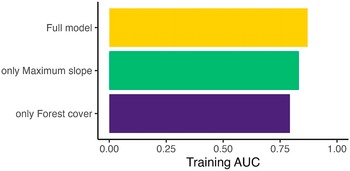
We used maximum entropy to model the potential global distribution of Grey-necked Picathartes using MaxEnt (v3.4.3; Phillips et al. Reference Phillips, Dudík and Schapire2018), implemented via the R package SDMtune (v1.1.4;Vignali et al. Reference Vignali, Barras, Arlettaz and Braunish2020). A single-method model, such as we used here, is not necessarily inferior to ensemble methods as the models are tuned to obtain the optimal parameter settings (Hao et al. Reference Hao, Elith, Lahoz-Monfort and Guillera-Arroita2020). Best practice is considered to retain a completely unseen testing dataset for final model assessment, however we had too few and unevenly distributed presence records to conduct a robust test in this way. Therefore, we adopted a two-pronged approach: we built a full model using all data in order to maximise predictive power (i.e. without a truly independent testing set), but we also ran sub-models with only four of the folds as defined above, retaining the fifth fold as the unseen testing set. This allowed us to assess the robustness of the dataset; if the sub-models corresponded to each other and to the final full model, it implies consistent associations between Picathartes presence and environmental predictors. Each initial model used the remaining 11 predictor layers. We tuned the models using the SDMtune function “optimiseModel”, which finds the combination of hyperparameters and maximises the Area Under the receiver-operator Curve (AUC) value (Swets Reference Swets1988). For the final model, the highest AUC was obtained with linear and quadratic feature classes, a regularisation multiplier of 0.7 and 500 iterations. With the tuned models we assessed predictor importance using leave-one-out Jackknife tests, using a contribution threshold of 20%. Predictor layers were removed from the model if their exclusion did not reduce the AUC value (Vignali et al. Reference Vignali, Barras, Arlettaz and Braunish2020). In the final full model this left only “Maximum Slope” and “Forest Cover in 2021” (Figure 3).
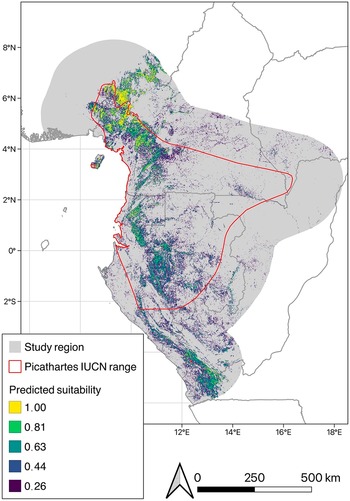
Areas predicted as potentially most suitable for Grey-necked Picathartes nests using the Maximum training sensitivity plus specificity value as the minimum threshold.

Output of the jackknife test showing training Area Under the receiver-operator Curve (AUC) for the final full model with both predictor variables, and for separate models constructed with only one variable each.

Model fit was assessed using three metrics: the Boyce Index (Hirzel et al. Reference Hirzel, Le Lay, Helfer, Randin and Guisan2006), which is considered the most appropriate measure of model performance with presence-only data; the True Skill Statistic (TSS; Allouche et al. Reference Allouche, Tsoar and Kadmon2006); and the AUC (Swets Reference Swets1988). For both the Boyce Index and the TSS, values of close to 1 indicate good model fit and 0 indicates models no better than random, for the AUC, values of >0.9 indicate a good fit and 0.5 indicates the model is no better than random. We generated response curves for the predictors in the final full model to visually examine associations between environmental variables and probability of habitat suitability. Finally, we used Moran’s I to check for spatial autocorrelation in the probability of occurrence values, using the R package “lctools” (v0.2.8; Kalogiru Reference Kalogirou2020). All analyses were conducted in R (v3.6.0;R Core Team 2019).
To quantify the total area of potentially suitable habitat, we calculated the area in the study region where the predicted suitability exceeded the final full model’s Maximum training sensitivity plus specificity value. We then determined the proportion of this area inside protected areas, using data from the World Database of Protected Areas (UNEP-WCMC/IUCN 2022), considering reserves where protection is strictly enforced (i.e. National Parks, Wildlife Reserves, and Wildlife Sanctuaries; full list in Supplementary material).
Results
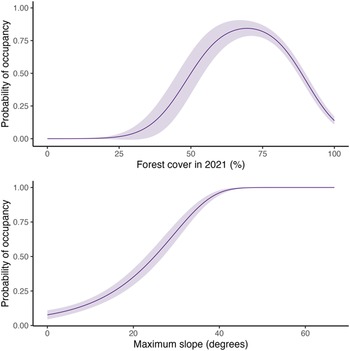
Model performance was high; the final full MaxEnt model had a Boyce Index value of 0.973, an AUC value of 0.871, and a TSS value of 0.568. The sub-models had a mean Boyce Index value of 0.943, mean AUC of 0.842, and mean TSS of 0.632 (Table S2). Jackknife variable importance of the predictor layers in the final full model are shown in Figure 3 and response curves in Figure 4. The two layers retained were: “Maximum Slope”, the most important predictor with probability of occupancy peaking at 40 degrees; and “Forest Cover in 2021”, with highest occupancy probability at around 70% canopy cover. Despite correcting for sampling bias, spatial autocorrelation was present in the predicted occurrences (Moran’s I = 0.59, expected I = −0.0002, resampling z = 63.48, resampling P <0.001, randomisation z = 63.52, and randomisation P <0.001). Based on visual comparison of spatial patterns in the predictors and final predictive map, it seems likely that spatial dependence in the slope layer is driving this result rather than sampling bias.
Response curves +/- 1 standard deviation showing change in occupancy probability over the ranges of the environmental predictors included in the final model. These changes in predicted occupancy are to one environmental predictor while the other is allowed to co-vary.

Areas predicted as potentially most suitable for Grey-necked Picathartes are shown in Figure 2 (a full resolution raster is available in Supplementary material). Four key areas are highlighted by the model. (1) Most of the submontane and montane forest of the south-west and north-west regions of Cameroon, and south-eastern Nigeria, especially above 1,000 m (the “Cameroon-Nigerian Afromontane highlands” of White et al. 1983). This includes, in Cameroon, the higher altitude parts of the Mount Cameroon, Takamanda, and Bakossi National Parks and several forest reserves and wildlife reserves (e.g. Banyambo Wildlife Sanctuary). In Nigeria, important protected areas include the south of the Gashaka-Gumti and Cross River National Parks. (2) The highlands north-east of Douala in Cameroon’s Littoral Region, including the proposed Ebo forest National Park. (3) Most of the area above 600 m in southern coastal Cameroon, and a transboundary mountain chain that runs from the Monte Alan and Monte Mitra region (Equatorial Guinea) through the Monts de Cristal to the Monts du Chaillu (central and south-east Gabon) and into the Batéké Plateau (Republic of Congo). Important protected areas included east of the Campo Ma’an National Park (Cameroon), Monte Alen and Pico Basile National Parks and La Caldera de San Carlos Scientific Reserve (Equatorial Guinea), and Monts de Cristal, Lope, and Birougou National Parks (Gabon). (4) The Mont Doudou and Mayombe forest ecosystem transboundary area above about 500–600 m, consisting of a mountain ridge running along the coast of Gabon, Congo, Cabinda, and the Democratic Republic of the Congo, running parallel to the Atlantic coast. Important protected areas include Moukalaba-Doudou National Park and the Mayombe highlands (Gabon), Conkouati-Douli National Park and the Dimonika Biosphere Reserve (Republic of Congo), and the eastern end of the Mayumba National Park (Cabinda, Angola). Based on the threshold used, the model did not predict high probability of presence in other areas known to be occupied and used as data points in our model, including the Dja Faunal Reserve in Cameroon, Ivindo National Park in Gabon, and Dzanga-Sangha National Park in the Central African Republic. Based on our survey of the literature and from contacting local experts, these sites have only a single record or (sometimes large) colony each. Likewise, several sites which had no records included in our analysis were predicted to have high probability of presence, including Monts de Cristal and Mayumba National Parks in Gabon, most likely due to the lack of surveys. However, an area just to the north of the Congo–Cameroon border overlapping with the Nki National Park in Cameroon and the proposed Messok-Dja protected area in Congo is highlighted as suitable for Grey-necked Picathartes.
We also present a weighted map derived from the five sub-models in Figure S2. Each potentially suitable pixel was weighted by the model’s AUC value. General patterns follow those outlined above for the final full model, implying consistent associations between Picathartes presence records and environmental predictors. Our final model suggested there is a total of 17,327 km2 of potentially suitable habitat for the Grey-necked Picathartes in the study region. However, only 2,490 km2 (14.4%) of this is within protected areas where conservation designations are strictly enforced.
Discussion
Little is known about the ecology and distribution of the Grey-necked Picathartes. This study is the first to model its potential global distribution. Results from our final model showed that the species’ predicted suitable habitat within its known range (Figure 2) is best explained by maximum slope and forest cover.
Important predictors influencing Grey-necked Picathartes distribution
The most important predictor in the model was maximum slope. According to our results, potential suitability increases as the slope increases above 40 degrees, meaning Grey-necked Picathartes prefers moderately steep terrain. The high significance is likely due to the specialised nesting requirements of Picathartes species, in caves, cliffs, and overhanging rocks in rugged, often steep and less easily cleared areas of forest (Thompson and Fotso Reference Thompson and Fotso1995, Awa et al. Reference Awa, Dzikouk and Norris2009, Monticelli et al. Reference Monticelli, Siaka, Buchanan, Wotton, Morris, Wardill and Lindsell2011, Burgess et al. Reference Burgess, Annika, Denis, Sullay, Mohamed, Brima and Juliet2016). This suggests that nest-site availability is a strong limiting factor to the distribution of the species. Interestingly, some of the largest colonies (e.g. in the Dja Forest Reserve, Cameroon, where we had a record of a single large colony with >50 nests) occur in relatively flat areas, whereas in rugged terrain, colonies generally comprise much fewer nests, often just one or two (GT, RCW, FM, MHS, pers. obs, Harter and Shirley Reference Harter and Shirley2007). This suggests that colonial nesting by Grey-necked Picathartes in relatively flat areas may be an adaptation to low nest-site availability. The two nest sites located under concrete bridges in Lope National Park (Gabon) were both single nests, and both were re-located in 2018 at the same sites (Van Giersbergen and Ngonga Ndjibadi Reference Van Giersbergen and Ngonga Ndjibadi2018), suggesting long nest-site fidelity.
The second important contributor in our model was forest cover, which is not surprising given the nesting habitat requirements of the species (Bian et al. Reference Bian, Awa, Ndang’ang’a, Fotso, Hoffmann and Sande2006, Awa et al. Reference Awa, Dzikouk and Norris2009). We found that potential suitability increased with forest cover between 50% and 75% and then declines above 75%. This means that medium-high forest cover is most important for Grey-necked Picathartes nest sites, although they may well use closed-canopy forest for their foraging and non-breeding requirements. According to Atuo et al. (Reference Atuo, Akunke, Ivande, Shiiwa and Timothy2016), Grey-necked Picathartes nest-site occurrence is positively correlated with the number of emergent trees, highlighting the importance of canopy forest for the species.
Forest cover is thought to be important for supporting insects, earthworms, millipedes, centipedes, and small vertebrates, constituting the main food sources for the ground-dwelling Grey-necked Picathartes (Awa Reference Awa2008). In addition, closed-canopy forest likely reduces the otherwise direct impact that a rainstorm may have on mud nests (Atuo et al. Reference Atuo, Akunke, Ivande, Shiiwa and Timothy2016). The two sites under bridges in Lope, Gabon, were in a savannah–forest mosaic where only narrow gallery forests cross the landscape close to the nests.
The predicted suitability map suggests a smaller area may be suitable for Grey-necked Picathartes than the current published distribution map, largely where there is steep ground. This confirms that the species is more range restricted than previously suggested. Greater consideration should be given to Grey-necked Picathartes protection: the species has a small, fragmented population size which is continuing to decline (BirdLife International 2022), has highly specific nesting habitat requirements (Awa et al. Reference Awa, Dzikouk and Norris2009), and there are increasing anthropogenic activities in its narrow range. We therefore propose a revision of the IUCN Red List status, as our results may warrant upgrading the species’ status from “Near Threatened” to “Vulnerable”.
Priority regions for monitoring and protection
The mountainous (or hilly) regions of west Central Africa above about 500–1,000 m are the most suitable predicted habitat for Grey-necked Picathartes. The largest proportion of suitable area by far is in Cameroon and Gabon. Much of the small country of Equatorial Guinea (including the island of Bioko) is suitable for the species, as the continental part of that nation lies at the north-western end of Monts du Chaillu mountain chain, and Bioko is an island at the southern end of the “Cameroon Line” mountain chain. A small area of eastern Nigeria is also suitable.
Most reports of Grey-necked Picathartes are from Cameroon (estimated population around 4,000), followed by Nigeria and Gabon (estimated population around 1,000 individuals in each country), and Equatorial Guinea (estimated population around 500 individuals) (Bian et al. Reference Bian, Awa, Ndang’ang’a, Fotso, Hoffmann and Sande2006, Awa et al. Reference Awa, Dzikouk and Norris2009, Birdlife International 2022). This present study suggests that there may be larger populations of Grey-necked Picathartes in Cameroon and Gabon than anywhere else, if they occupy the modelled suitable habitats, and flags the need for more intensive surveys of potential nesting sites, including the central mountain chain of Gabon, and la Caldera de San Carlos in Equatorial Guinea, and man-made locations such as under bridges.
We identified 17,327 km2 of suitable habitat for Grey-necked Picathartes, but only 14.4% of this is within protected areas where conservation designations are strictly enforced. Protection is likely critical for Grey-necked Picathartes. In Sierra Leone, Picathartes gymnocephalus colony activity declined in unprotected forest, while colonies inside protected areas remained stable, suggesting that P. gymnocephalus colony occupancy and the number of active nests are influenced by human disturbance levels (Burgess et al. Reference Burgess, Annika, Denis, Sullay, Mohamed, Brima and Juliet2016). Assuming similar factors influence Grey-necked Picathartes, then unprotected areas known to be occupied should be protected as a matter of urgency. In Cameroon for instance, some predicted areas of suitability where the species has been found fall within existing IBAs, but these are unprotected with no legal status. These include Mount Mbam Minkom forest in the central region of Cameroon, Mount Kupe in the south-west region of Cameroon, the Mount Nlonako forest and Ebo forest, north-east of the Douala Littoral region of Cameroon in Yabassi Keys Biodiversity Area (Fotso et al. Reference Fotso, Dowsett-Lemaire, Dowsett, Scholte, Languy, Bowden, Fishpool and Evans2001). We recently found over 100 nests in the Ebo forest, underscoring its importance for this species. It is critical that other unsurveyed areas are also visited, as confirmed occupancy would aid protection efforts; in Cameroon, Grey-necked Picathartes is listed as a fully protected species by the Ministry of Forests and Wildlife (Awa et al. Reference Awa, Dzikouk and Norris2009).
Conservation implications
Grey-necked Picathartes is listed as “Near Threatened” according to the IUCN/BirdLife criteria largely because of its population size, estimated at 2,500–9,999 individuals (BirdLife International 2022). The regional conservation action plan for the species was drafted in 2006 but has not yet been implemented (Bian et al. Reference Bian, Awa, Ndang’ang’a, Fotso, Hoffmann and Sande2006). This study shows that the area for suitability of the species is small compared with the existing predicted distribution of the species. Forest loss is a major threat for this and many other species in the region. Conservation action should be then undertaken in the area for the survival of these species found there, using the Grey-necked Picathartes as a flagship/umbrella species to enable conservation of these areas (Awa et al. Reference Awa, Dzikouk and Norris2009). To ensure conservation of Grey-necked Picathartes, we recommend: (1) an assessment of the population status and distribution of the Grey-necked Picathartes in predicted suitable areas found in this study, with unprotected areas as the main survey targets; (2) the development of a strategic conservation awareness campaign to improve awareness of the threats facing biodiversity in these potential suitable areas, using Grey-necked Picathartes as a flagship species; (3) an assessment of the level of tolerance of the species to human activities; (4) ecological research into the dispersal pattern of the species to understand how resilient populations are to habitat fragmentation.
Study limitations
This study did not explore how predictor variables might change over time (such as with climate change) to affect the future distribution of Grey-necked Picathartes (Araujo and Guisan Reference Araujo and Guisan2006, Andriamasimanana and Alison Reference Andriamasimanana and Alison2013). Other environmental variables (e.g. soil type or additional measures of human activities) as well as species ecology (e.g. dependency on fine-scale habitat resources, competition, and reproductive rates) should also be considered in the future (Andriamasimanana and Alison Reference Andriamasimanana and Alison2013). We were unable to include at least one variable (distance from nest site to water) previously found to be important for Grey-necked Picathartes. This variable often drives the distribution of terrestrial species (Bradie and Leung Reference Bradie and Leung2017), including, specifically, the congeneric P. gymnocephalus (Burgess et al. Reference Burgess, Annika, Denis, Sullay, Mohamed, Brima and Juliet2016, Monticelli et al. Reference Monticelli, Siaka, Buchanan, Wotton, Morris, Wardill and Lindsell2011), and could account for some of the unexplained variation in our model (Bian et al. Reference Bian, Awa, Ndang’ang’a, Fotso, Hoffmann and Sande2006, Awa et al. Reference Awa2008). Unfortunately, distance to water was not available at sufficiently fine resolutions in publicly accessible datasets to use in an analysis of this scale, and we recommend that this information is collected in future when monitoring nests of Grey-necked Picathartes.
Conclusions
We estimated the global distribution of Grey-necked Picathartes using MaxEnt modeling, finding that slope and forest cover are the most important predictors of its occurrence. The predicted distribution suggests that less habitat is suitable for the species than previously thought. Given the species’ restricted range and very specific habitat requirements, we suggest that surveys are carried out across all range states, prioritising potentially suitable unprotected areas identified by our model, in order to better estimate the global population, and that future work investigates the dispersal ability of fragmented populations.
Acknowledgements
The study was funded by National Geographic Small Grant (EC-350C-18). We sincerely thank the San Diego Zoo Wildlife Alliance-Ebo Forest Research Project for assistance during fieldwork, Club des Amis des Gorilles (CAG) for their collaboration, as well as our field guides. We also gratefully acknowledge Jacob C. Cooper for providing some species occurrence points, and finally to the reviewers for their valuable comments and suggestions.
Supplementary material
The supplementary material for this article can be found at http://doi.org/10.1017/S0959270923000175.