Introduction
Common ragweed (Ambrosia artemisiifolia L.) is an outcrossing wind-pollinated annual in the Asteraceae family. The species is monoecious and exhibits phenotypic plasticity that includes habitat-driven variation in size, weight, and reproductive capacity (Molina-Montenegro et al. Reference Molina-Montenegro, Peñuelas, Munné-Bosch and Sardans2011). It is native to North America (Basset and Crompton Reference Basset and Crompton1975) and is widespread in eastern Canada, especially in southern Québec and Ontario (Basset and Crompton Reference Basset and Crompton1975; Lavoie Reference Lavoie2019). Ambrosia artemisiifolia is an important weed of field and horticultural crops such as corn (Zea mays L.), soybean [Glycine max (L.) Merr.], onions (Allium cepa L.), and carrots (Daucus carota L.) (Bouchard Reference Bouchard2006; Delabays et al. Reference Delabays, Bohren and Mermillod2005; Simard and Benoit Reference Simard and Benoit2010; Tyr et al. Reference Tyr, Veres and Lacko-Bartosova2009).
Many herbicides that inhibit photosynthesis at photosystem II (PSII) provide good control of A. artemisiifolia in many crops. Linuron is a substituted urea that inhibits photosynthesis by binding to the D1 protein of the PSII complex in the chloroplast at Site A (QB) (WSSA/HRAC group 5 [HRAC 2020], formerly group 7 [C2]) (Battaglino et al. Reference Battaglino, Grinzato and Pagliano2021; Shaner 2014) and is registered in both Canada and the United States for use in a range of crops such as field corn, soybeans, carrots, potatoes (Solanum tuberosum L.), asparagus (Asparagus officinalis L.), and parsnips (Pastinaca sativa L.) (Anonymous 2019; Ministry of Agriculture and Rural Affairs 2021a, 2021b). Metribuzin, a triazinone herbicide, also inhibits photosynthesis by binding on the D1 protein at Site A (WSSA/HRAC Group 5, formerly C1) but occupies a different region of the receptor (Gardner Reference Gardner1989). Substituted urea and triazinone herbicides were historically classified in different groups based on the frequent lack of cross-resistance between the two groups (Shaner 2014). Metribuzin is registered for use in soybean, potatoes, field corn, transplanted tomatoes (Solanum lycopersicum L.), processing carrots, asparagus, lupins (Lupinus angustifolius L.), and fruit trees (Ministry of Agriculture and Rural Affairs 2021a, 2021b) as well as wheat (Triticum aestivum L.), barley (Hordeum vulgare L.), lentils (Lens culinaris Medik.), peas (Pisum sativum L.), chick peas (Cicer arietinum L.), and faba beans (Vicia faba L.) in North America (Anonymous 2016). The application of either herbicide to actively growing plant tissue results in excess photo-oxidation and plant death (Caverzan et al. Reference Caverzan, Piasecki, Chavarria, Stewart and Vargas2019).
In Canada, A. artemisiifolia resistant to linuron was first reported in carrots in 1999 in the province of Québec (Saint-Louis et al. Reference Saint-Louis, DiTommaso and Watson2005). A recent survey of carrot fields in southern Quebec documented the widespread occurrence of linuron-resistant A. artemisiifolia and the genetic analysis of these populations revealed the presence of both target site (TSR) and non–target site resistant (NTSR) biotypes (Simard et al. Reference Simard, Laforest, Soufiane, Benoit and Tardif2017). Target-site resistance to PSII inhibitors is conferred by mutations encoded in chloroplast DNA and are maternally inherited (Gronwald 1994). The mutation located in the psbA gene that confers resistance to linuron in A. artemisiifolia is Val-219-Ile (Simard et al. Reference Simard, Laforest, Soufiane, Benoit and Tardif2017). Non–target site resistance to PSII inhibitors has been associated with detoxification of herbicides by cytochrome P450 monooxygenases (Ma et al. Reference Ma, Lu, Han, Yu and Powles2020) or glutathione S-transferases (Beckie and Tardif Reference Beckie and Tardif2012). In addition to linuron, both TSR and NTSR biotypes can be cross-resistant to other PSII inhibitors (Beckie and Tardif Reference Beckie and Tardif2012; Dumont et al. Reference Dumont, Letarte and Tardif2016). The TSR linuron-resistant Powell’s amaranth (Amaranthus powellii S. Watson) and common purslane (Portulaca oleracea L.) biotypes are cross-resistant to metribuzin and the triazine herbicide atrazine, respectively (Dumont et al. Reference Dumont, Letarte and Tardif2016; Masabni and Zandstra Reference Masabni and Zandstra1999). Moreover, depending on which psbA mutation they have, various linuron-selected resistant biotypes of redroot pigweed (Amaranthus retroflexus L.) may also be cross-resistant to other PSII inhibitors such as metribuzin, atrazine, and prometryn (Davis Reference Davis2014). In addition, a biotype of linuron-resistant A. powellii, with the Val-219-Ile D1 substitution is cross-resistant to basically all other PSII inhibitors (Dumont et al. Reference Dumont, Letarte and Tardif2016). These observations would therefore suggest that a linuron-selected A. artemisiifolia biotype with the same mutation (Val-219-Ile) would also be cross-resistant to metribuzin. Many studies (Battaglino et al. Reference Battaglino, Grinzato and Pagliano2021; Gardner Reference Gardner1989; Huppatz Reference Huppatz1996; Shipman Reference Shipman1981; Zharmukhamedov and Allakhverdiev Reference Zharmukhamedov and Allakhverdiev2021) have been and are still being done to better understand the binding nature of the different PSII inhibitors and how they compete with plastoquinone. It is currently still difficult to predict cross-resistance among various chemically unrelated PSII inhibitors, because it would be strongly dependent on particular resistance mechanisms occurring in each biotype. Predictions could be confounded by the presence of uncharacterized non–target site resistance mechanisms in addition to identified target-site mutations causing resistance. Appropriate crosses, segregating populations, and the creation of near-isogenic inbred lines can be used to separate and characterize various resistance mechanisms.
The goal of the present study was to generate inbred lines of A. artemisiifolia biotypes with target–site and non–target site resistance to linuron and evaluate resistance levels as well as cross-resistance to metribuzin in both parental and backcrossed lines. We hypothesized that TSR biotypes would be cross-resistant to other PSII inhibitors. Non–target site resistance mechanisms are considered more prone to cross-resistance, because it is a more generalist process thought to involve multiple genes (Yu and Powles Reference Yu and Powles2014). To test these hypotheses, we characterized both TSR and NTSR biotypes for resistance to linuron and tested for cross-resistance to another PSII inhibitor from group 5, metribuzin.
Materials and Methods
Seed Collection and Storage
Ambrosia artemisiifolia involucral achenes (hereafter referred to as “seeds”) of biotypes known to be resistant to linuron were collected in southern Québec, Canada, as a part of a previous study (Simard et al. Reference Simard, Laforest, Soufiane, Benoit and Tardif2017). These resistant biotypes were previously characterized using Lorox® L (Tessenderlo Kerley, Phoenix, AZ, USA) as TSR and NTSR as described by Simard et al. (Reference Simard, Laforest, Soufiane, Benoit and Tardif2017). The TSR biotype contains a valine to isoleucine substitution at position 219. A linuron-susceptible biotype was collected in September 2013 from a soybean field in Ridgetown, ON, Canada (42.27°N, 81.52°W). The susceptibility of this biotype was confirmed by screening with a discrimination dose of linuron of 1,000 g ai ha−1 (Lorox®, Tessenderlo Kerley). Collectively, these biotypes were considered the parental germplasm for this study and were referred to as the parental susceptible (PS), parental TSR (PRTSR) and parental NTSR (PRNTSR) biotypes. Before the start of the experiment, a greenhouse seed increase was performed on the PS, PRTSR, and PRNTSR biotypes. In brief, seedlings of resistant biotypes (i.e., PRTSR, PRNTSR) were screened with 1,000 g ai ha−1 of linuron, and 4 to 6 surviving individuals of each biotype were selected for a seed increase; a similar number of individuals were also selected for the increase of the PS biotype. Biotypes were placed in separate greenhouse compartments, and all individuals of each biotype were genotyped before anthesis for the presence or absence of Val-219-Ile, as described in the following section. The seeds produced from these increases were stored dry in a controlled seed storage room at 5 C and 50% relative humidity (RH) until needed.
Plant Propagation and Introgression of Linuron-Resistance Traits
Seeds of PS, PRTSR, and PRNTSR were cold stratified to break dormancy and facilitate germination. One hundred seeds of each biotype were placed in a petri dish lined with blotter paper (steel-blue germination blotters, Anchor Paper, St Paul, MN, USA) and moistened with 10 ml of deionized water. Petri dishes were then stored within an aluminum canister at 4 C for 6 wk. Following stratification, 25 seeds of each biotype were transferred to new petri dishes lined with blotter paper moistened with 10 ml of deionized water. The dishes were then placed into a germination cabinet (model G1000, Conviron, Controlled Environment Canada, Winnipeg, MB, Canada) with a 14-h photoperiod, 60% RH, and an alternating temperature of 25/15 C (day/night).
Germinated seeds of the parental biotypes were planted in 4-cm-diameter by 6-cm-tall pots filled with high-porosity potting media (BM6, Berger, Saint-Modeste, QC, Canada). The pots were placed on a bench in a growth cabinet (model TPC-15, Biochambers, Winnipeg, MB, Canada) with a thermoperiod of 25/15 C and a photoperiod of 14 h. The plants were watered daily and fertilized twice a week with 250 ml of a fertilizer blend previously described by Page et al. (Reference Page, Liu, Cerrudo, Lee and Swanton2011). When plants reached the 2- to 3-node stage (∼10-cm tall), the PRTSR and PRNTSR seedlings were treated with linuron at a dose of 1,080 g ai ha−1. Linuron was applied to the plants using an automated spray chamber (DeVries Manufacturing, Hollandale, MN, USA) equipped with an even-spray nozzle (TeeJet® TP8002E-SS, TeeJet Technologies, Wheaton, IL, USA) set to apply a water volume of 333.3 L ha−1 at a pressure of 207 kPA.
Three weeks after linuron application, three surviving PRTSR and PRNTSR plants and six similarly staged PS plants were randomly selected for crossing (i.e., three plants to pair up with each parental resistant biotype) and transplanted into medium-sized 1.4-L plastic pots (16.5-cm diameter) filled with BM6 potting mix. The PS plants were used as pollen donors, whereas PRTSR and PRNTSR biotypes were pollen recipients and were emasculated daily. No other A. artemisiifolia plants were in the growth chambers at the time crosses were made. Plants were grown under the previously described conditions. Before each cross, leaf tissue was sampled from each individual for genotyping. Lyophilized tissue was ground in a commercial bead mill (SpeedMILL Plus, Analytik Jena AG, Jena, Germany) and genomic DNA was extracted using the NucleoSpin Plant II kit (Machery-Nagel, Düren, Germany) following the supplied protocol. Eluted DNA was amplified by polymerase chain reaction (PCR) for sequencing. A 767-bp fragment was amplified using the following primers: forward 5′-AGCTGCGACTGCTGTTT-3′, and reverse 5′- ACACGCAAATCGAACCAAAC-3′. Reaction conditions were as follows: an initial denaturation at 95 C for 1 min, 35 cycles of 95 C for 15 s, 56 C for 15 s for annealing, 72 C for 30 s, followed by a final extension at 72 C for 7 min. Following PCR, the samples were cleaned for sequencing using GenepHlow Gel/PCR kit (FroggaBio, Concord, ON, Canada) according to the provided protocol. Sanger sequencing of the PCR products was carried out by the London Regional Genomics Centre (Robarts Research Institute, London, ON, Canada) using the same primers from the PCR amplification. Alignment to the A. artemisiifolia psbA reference sequence (GenBank accession number: AB427162.1) was performed using Sequencher software (Gene Codes, Ann Arbor, MI, USA) and analyzed for the presence of the Val-219-Ile target-site mutation. When combined, results from Sanger sequencing and the initial screening with linuron ensured that the individuals used in all crosses were representative of their initial parental biotypes (e.g., lack of Val-219-Ile in PRNTSR but survival at discriminating dose).
This screening, genotyping, and crossing procedure was repeated for both the TSR and NTSR lines during the creation of each generation. For example, following the original cross of the PS and PRTSR and PRNTSR biotypes, seeds of the progeny lines (i.e., the F1TSR and F1NTSR, respectively) were germinated, grown, and screened with linuron as described earlier. Six individual of PS were once again propagated and matched up with three individuals of each of the F1TSR and F1NTSR, and all were genotyped for the presence or absence of Val-219-Ile using Sanger sequencing. As psbA is maternally inherited, the PS individuals were used as pollen donors, and crosses were carried out to generate the BC1TSR and BC1NTSR progeny, respectively. This process was repeated with the BC1TSR and BC1NTSR and the PS to create the BC2TSR and BC2NTSR, and similarly repeated again to create the BC3TSR and BC3NTSR lines, which were used in the dose–response assays described in the following section.
Dose–Response Curves
The initial experiment started in October 2020. Seeds from the five lines (PS, PRTSR, BC3TSR, PRNTSR, and BC3NTSR) generated earlier were placed in moist potting media in trays in a refrigerator under constant darkness for 6 wk at a temperature of 5 C to break dormancy. On December 2, seeds were planted in multicelled trays and placed in a growth chamber under a 14-h day at 25 C and a 10-h night at 10 C for 2 wk, with RH kept at 75% and no fertilizer added before being transferred to the greenhouse. The experiment included the five lines, two herbicides (linuron and metribuzin), seven doses (0X, 0.25X, 0,5, 1X, 2X, 4X, and 12X) and four replicates of five plants. The 1X dose was set at 1,080 g ai ha−1 of linuron based on postemergence single doses in carrots, and 375 g ai ha−1 of metribuzin (TriCor 75 DF, United Phosphorus, King of Prussia, PA, USA) based on the early postemergent dose in carrots and compared with the untreated control. Based on the results of the initial experiment, a second trial was done to generate data at lower doses allowing an improved evaluation of the resistance factor. This second trial started in April 2021. Plants from only three lines (PS, BC3TSR, and BC3NTSR) were grown, as there were not enough seeds from the resistant parental lines left. The second experiment included three biotypes with the same herbicides (linuron and metribuzin), six doses (0X, 0.0625X, 0.125X, 0.25X, 0.5X, and 1X), and four replicates of five plants.
For both experiments, seedlings were grown in the greenhouse under a 14-h day at 22 C and a 10-h night at 12 C. Plants were watered daily and were fertilized with a solution of 150 ppm of 20:8:20 (N:P:K) (4 d wk−1) and 14:0:14 (N:P:K) (1 d wk−1). Trays were distributed in a completely randomized design and re-randomized every week to eliminate positional bias. At the 1- to 2-node stage, control plants (0X) were left unsprayed, while the other plants were sprayed with one of six rates of linuron or metribuzin. Herbicide applications were done using a track sprayer (DeVries Manufacturing) calibrated to deliver 280 L ha−1 of herbicide solution at 207 kPa using the building’s air-pressure system (for laboratories) and a TeeJet® TP8001E spray tip. Visual assessments were made 14 and 28 d after application, and the percentage of visible damage was based on a scale of 0 (identical to untreated control plants) to 100 (completely dead) (Brown and Farmer Reference Brown and Farmer1991). The aboveground biomass of all plants was collected at 28 d after application, dried for 5 d at 70 C, and weighed.
Statistical Analysis
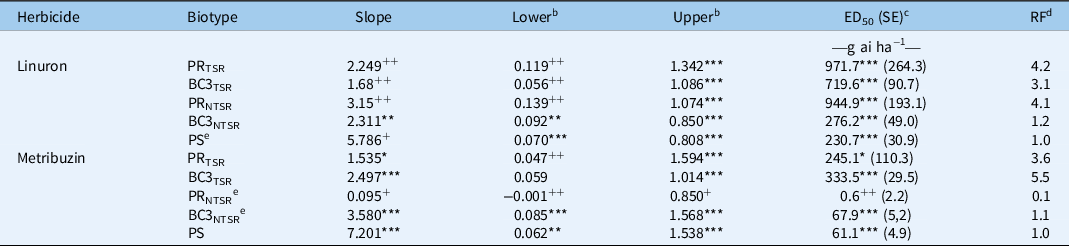
Dry biomass weight relative to the mass of untreated controls was used to create dose–response curves with drc (Ritz et al. Reference Ritz, Baty, Streibig and Gerhard2015) in R (R Core Team 2020). The four-parameter log-logistic model [f(x) = c + (d – c)/(1 + exp{b[log(x) − log(e)]})]was used, except when the data could not be fit. In these cases, the four-parameter Weibull [type 1 (W1.4); f(x) = c + (d − c)exp(−exp{b[log(x) − log(e)]})] was used (indicated in Table 1). In these equations, c and d are the upper and lower asymptotes, respectively; b is the slope; and e is the effective dose (ED50). Resistance factors were calculated as the ratio of the ED50 (dose that generates a 50% reduction in biomass) of resistant over susceptible biotypes (R/S) (Knezevic et al. Reference Knezevic, Streibig and Ritz2007).
Parameters of the dose–response curves for target site–resistant (TSR) and non–target site resistant (NTSR) parental lines (PR), backcrossed lines (BC3), and susceptible (PS) Ambrosia artemisiifolia biotypes sprayed with linuron and metribuzin. a

a P-value significance codes: ***, P ≤ .001; **, .001 < P ≤ .01; *, .01 < P ≤ .05; +, .05 < P ≤ .1; ++, .1 < P ≤ 1.
b “Lower” and “upper” refer to calculated concentrations (g ai ha−1) for the high and low asymptotes, respectively.
c ED50, dose that generates a 50% reduction in biomass.
d RF, resistance factor.
e Type 1 Weibull (W1.4) model fit; log-logistic (LL.4) model fit when not indicated.
Results and Discussion
Resistance in the Parental Lines
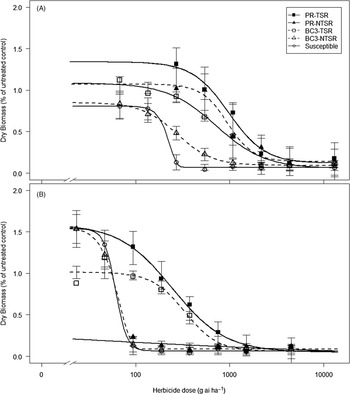
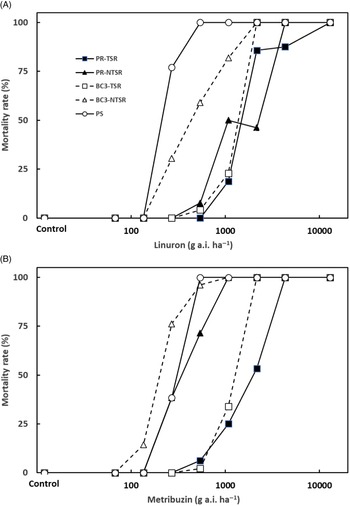
Based on the dose–response curves and the resistance factors (RFs), both parental resistant lines were resistant to linuron (Figure 1A), as expected, and the percent survival (damage rating ≥80%) at the labeled rate in carrots was close to 100% and 92.31% for TSR and NTSR biotypes, respectively (Figure 2A). These two biotypes were initially selected on the basis of their resistance to this herbicide, which was determined using a single labeled rate and molecular markers (for the TSR biotype) (Simard et al. Reference Simard, Laforest, Soufiane, Benoit and Tardif2017). Levels of resistance were low, as defined by Beckie and Tardif (Reference Beckie and Tardif2012), and equivalent (PRTSR: 4.2; PRNTSR: 4.1) between both parental biotypes (Table 1). It is generally assumed that target-site resistance confers higher levels of resistance (Sammons and Gaines Reference Sammons and Gaines2014; Yu and Powles Reference Yu and Powles2014), but this is not always the case, and as more NTSR biotypes are discovered, equal or even higher levels of resistance are being observed (Deng et al. Reference Deng, Yang, Li, Xia, Chen, Yuan and Yang2021).
Dose–response curves for the susceptible and four biotypes of original and backcrossed progeny of Ambrosia artemisiifolia treated with different doses of linuron (A) and metribuzin (B). Each point is the average of four replicates and two runs. Bars represent 95% confidence intervals. PR-TSR, parental target site–resistant biotype; PR-NTSR, parental non–target site resistant biotype; BC3-TSR, target site–resistant backcrossed line; BC3-NTSR, non–target site resistant backcrossed line.

Herbicide-induced mortality rate (visible injury ≥80%) for the five biotypes after treatment with linuron (A) and metribuzin (B). Each point is the average of four replicates and two runs. PR-TSR, parental target site–resistant biotype; PR-NTSR, parental non–target site resistant biotype; BC3-TSR, target site–resistant backcrossed line; BC3-NTSR, non–target site resistant backcrossed line; PS, parental susceptible.

In the present study, PRTSR was observed to possess cross-resistance to metribuzin (RF = 3.6; Table 1) and survival at the labeled dose was equivalent to that observed for linuron (93.75%) (Table 1; Figure 2A). In contrast, the NTSR parental line (PRNTSR) was susceptible to metribuzin, with an ED50 value similar to PS and no survival at the labeled dose (0% for both) (Figures 1B and 2B). These results are not unexpected, as the same mutation (Val-219-Ile) confers cross-resistance to multiple PSII inhibitors in A. powellii (Dumont et al. Reference Dumont, Letarte and Tardif2016), A. retroflexus (Davis Reference Davis2014), kochia [Bassia scoparia (L.) A.J. Scott] (Mengistu et al. Reference Mengistu, Christoffers and Lym2005), and annual bluegrass (Poa annua L.) (Mengistu et al. Reference Mengistu, Mueller-Warrant, Liston and Barker2000). Until the most recent HRAC update (HRAC 2020), metribuzin and linuron were classified into separate groups (e.g., Groups 5 and 7, or C1 and C2, respectively). Our results support this reclassification based on the cross-resistance conferred by the Val-219-Ile mutation. Interestingly, cross-resistance could also have been expected for PRNTSR biotype, because this type of resistance is usually conferred by a more generalist mechanism, such as enhanced herbicide metabolisms that can provide resistance to multiple herbicides with very different sites of action (Dimaano et al. Reference Dimaano, Yamaguchi, Fukunishi, Tominaga and Iwakami2020; Yu and Powles Reference Yu and Powles2014). The A. artemisiifolia case reported herein does not display cross-resistance to metribuzin, suggesting that cross-resistance can equally be endowed by target site– or non–target site resistance mechanisms and that it is the nature of the interaction between the active ingredient and the conformation of the protein providing resistance, either the target site or proteins involved in other detoxifying mechanisms, that will determine cross-resistance. The observed cross-resistance in this case is related to the Val-219-Ile mutation. The unknown mechanism involved in the non–target site resistance of the PRNTSR biotype appears to be specific to linuron, though it should be acknowledged that we tested only two herbicides. It would be interesting to evaluate whether the mechanism confers resistance to other Ser-264 binders (Group 5: ureas, amides, triazines, triazinones, phenylcarbamates, pyridazinones, and uracils) and the His-215 binders (Group 6: benzothiadiazinones, nitriles, and phenyl-pyridazines) (Battaglino et al. Reference Battaglino, Grinzato and Pagliano2021).
Resistance in the Third Generation of Backcrosses
Results of our study indicate that resistance to linuron was relatively stable over generations for TSR biotypes but not for NTSR biotypes. For TSR biotypes, the RF declined slightly from 4.2 in PRTSR to 3.1 in the BC3TSR biotype (Table 1). This result was expected, as the mutation conferring linuron resistance is maternally inherited and was tracked through Sanger sequencing during the creation of each generation. In contrast, the RF of 1.2 for the BC3NTSR was notably less than the 4.1 observed for the PRNTSR. Such a result could be explained by a multigenic resistance mechanism, as observed in multiple studies (Preston Reference Preston2004; Preston et al. Reference Preston, Tardif, Christopher and Powles1996; Yuan et al. Reference Yuan, Tranel and Stewart2007). At each generation and depending on the herbicide dose used for discriminating susceptible from resistant offspring, alleles from genes contributing to the full extent of resistance of the parental line may be lost. This observation stresses the importance of using the appropriate dose for selection of resistant plants during the several generations of backcrossing, running the risk of losing genes responsible for minor effects if selection is not strong enough. Depending on the number of genes responsible for resistance, an exponential number of offspring may also need to be screened to find candidates with the optimal combination of alleles that results in the maximum level of resistance, keeping in mind that contributing alleles could also come from the susceptible parent. These results suggest that a similar decline in the level of resistance could occur over time in natural populations in which resistance is multigenic and susceptible alleles are present at high frequency, but the speed of this potential decline is likely to depend on other factors.
Cross-resistance to metribuzin and linuron is conferred by a target-site mechanism for the A. artemisiifolia biotype reported herein. A second biotype, also resistant to linuron but with no mutations in the target site and with an undefined non–target site resistance mechanism, is not cross-resistant to metribuzin. In both cases, the resistance level is rather low, requiring below a fifth of the label rate to reduce biomass by 50%. Interestingly, both mechanisms initially share approximately the same level of resistance. While resistance development depends on the number of individuals in the population and its genetic diversity, the level of resistance gained in such a process could also be in part attributed to the intensity of selection pressure in addition to chance.
Acknowledgments
We thank Audrey-Kim Minville for their assistance in the project. This study was financed by AAFC project no. J-001751. The authors declare no conflict of interest.