L'image de Nice cosmopolite, Nice, lieu de villégiature et de plaisir,
constitue déjà un cliché à la Belle Epoque.Footnote 1
Schwartz's comment would have surprised Louis Aubin Millin, who visited Nice at the end of the Napoleonic Wars. Although he was not immune to the beauty of the setting or the attractions of the climate, he found Nice unimpressive – a small, poor, dusty Mediterranean port town that lacked outstanding buildings, fountains and any statues worthy of note. Nor was it even a thriving manufacturing, commercial or cultural centre. He especially disliked the Italianate Old Town. Dark and dirty, its narrow streets wound insalubriously between high houses. The smell, upon entering the houses, was nauseating and the flies so numerous that windows had to be kept curtained, or washed daily, to remove the fly droppings that obscured the light. The only parts of Nice that won his grudging approval, architecturally and aesthetically, were the new streets bordering the River Paillon and the suburb of Croix-de-Marbre that was taking shape on the right bank of the river along the Route-de-France. The over-wintering étrangers – overwhelmingly English families attracted to Nice for their health by the mild winter climate – clustered in these more fashionable areas.Footnote 2 There was little for them to do during the winter Season, however. The Niçois nobility was too poor, he noted, to host grand entertainments and the town itself only provided the visitors with two promenades, a small theatre, a few shops, hotels and cafés. Evening entertainments therefore amounted to little more than gossiping and gambling at the conversazioni held in certain private homes, or grouping together to put on subscription balls.Footnote 3
The Nice that Marie de Solms (later Madame Rattazzi) described in books reissued in various guises between 1854 and c. 1870 was remarkably different.Footnote 4 While she too complained of the dustFootnote 5 and echoed Millin's criticism of the Old Town – the streets were still narrow, tortuous, dirty and dark – they agreed on little else.Footnote 6 Her Nice was that of the New Town: une ville de plaisirs, perfumed by exotic winter-flowering plants, a place of perpetual springtime, where the climate and the way of life attracted an international elite. Here, étrangers benefited from fashionable housing, luxury goods, home comforts and all sorts of conveniences. Excellent hotels, libraries, bookstores and cercles (societies/clubs), as well as the theatre and the casino, catered to their interests. Life was easy and visitors could choose to be as social or retired as they wished. The mondain could fill their days with balls, dances, concerts, riding parties and the like, while even the invalids and convalescents were often tempted into Society by Nice's ever-popular matinées-dansants, which allowed them to socialize without risking late nights in overheated rooms.Footnote 7
These depictions, though highly coloured, reflect the extent of Nice's urban transformation in the first half of the nineteenth century. They also call attention to the growing importance of cosmopolitanism in the creation of Nice's public image.Footnote 8 By 1860, Nice had become one of Europe's leading health and leisure resorts, annually playing host to an international wintering population of several thousand. While it had not yet become the glittering capitale d'hiver that would make it the playground of royalty and millionaires during the Belle Époque – that would follow the coming of the railway in 1864Footnote 9 – the ‘fusion annuelle’ of the winter Season that Louis Roubadi had remarked upon as early as 1843, when elite étrangers mixed socially with each other and the Niçois nobility to create a cosmopolitan society, was already firmly established.Footnote 10 Writers proclaimed Nice ‘une ville cosmopolite’Footnote 11 and were proud to list it alongside Naples, Rome and Florence as one of the ‘salons d'hiver de la grande société européene’.Footnote 12 Solms Rattazzi, a republican as well as a salonnière, took this claim one step further. She too rooted Nice's cosmopolitanism firmly in the social arena, but saw it in Enlightenment terms as an implicitly political experiment:
Les villes comme Nice jouent un peu, dans le monde, le rôle des creusets dans le laboratoire: – les éléments les plus divers s'y rencontrent, les opinions les plus variées s'y coudoient. – Tout cela se mêle, réagit, se combine, et les angles disparaissent, les lignes de séparations s'effacent. – Entre le commencement et la fin d'une saison, la différence est immense: – le mot étrangers ne se retrouve plus qu'en tête de la list officielle: le même souffle de bienveillance a pénétré toutes les nationalités – on se recherche, on s'estime, on s'aime.Footnote 13
Nice, for her, was a laboratory where sociability transcended national differences, creating something new, an evanescent, hybrid society that was animated by a spirit of transnational benevolence, and pointed the way to a better future.
Map of Nice, 1856 (Archives municipales de la Ville de Nice), 1. Promenade des Anglais, 2. Croix-de-Marbre, 3. The Old Town, 4. The Terraces

Introduction
This equation of cosmopolitanism with a positive version of urban modernity for a mobile international public provides a useful starting point for the study of the image and identity of Nice, a town that has attracted thousands of British hivernants for more than 250 years.Footnote 14 As a concept, cosmopolitanism's notion of the world citizen blends universalism and utopianism to create a seductive ideal that has attracted thinkers since the Victorian period. Most recently, it has been the subject of serious discussion by philosophers, political and social scientists, literary theorists, geographers and economists alike, as they have grappled with contemporary issues around globalization, migration, multiculturalism, religious tolerance and cultural change. To a lesser extent, it has also attracted historians’ interest.Footnote 15 Its connection with the urban can be traced back to its orgins in antiquity: Diogenes identified himself as a citizen of the world, favouring the cosmopolis over the polis, or city-state; Zeno envisioned the Cosmopolis, the world as super-city. Kant, the leading Enlightenment thinker on cosmopolitanism, argued in Idea for a Universal History with a Cosmopolitan Purpose (1784) and Perpetual Peace (1795) that the use of Reason would eventually lead humanity to the construction of a cosmopolitan civil society marked by a federation of nations and the establishment of global justice and international peace.Footnote 16 As Judith Walkowitz has noted, current interpretations tend to fall into two camps, seeing cosmopolitanism either as ‘a privileged, aesthetic, and ethical form of thinking beyond the nation or as a form of material knowledge gained by transnational migrants through adverse daily routines’.Footnote 17 Implicit in these is, as Ulf Hannerz has described:
a willingness to engage with the Other . . . an intellectual and aesthetic stance of openness toward divergent cultural experiences . . . a state of readiness, a personal ability to make one's way into other cultures, through listening, looking, intuiting and reflecting . . . cultural competence in the stricter sense of the term, a built-up skill in manoeuvring more or less expertly with a particular system of meanings and meaningful forms.Footnote 18
Rosemary Sweet has argued recently when exploring changing British engagement with the Italian cities of the Grand Tour between c. 1690 and 1820, that British travellers by the early nineteenth century were likely to view themselves as critical ‘moderns’. Their responses to the cities they visited were shaped by a variety of factors, including pride in Britain's own cities and the British place in the world, as well as wider European changes that saw ‘a general rejection of the classically informed cosmopolitanism of the earlier period in favour of a clearer expression of national sentiment’.Footnote 19 The development of Nice as a peculiarly cosmopolitan place in the first half of the nineteenth century seems, therefore, to run counter to prevailing historical trends. The presumed binary opposition between cosmopolitanism and nationalism can be overstated, however.Footnote 20 Cosmopolitanism, as Mitchell Cohen notably asserted in 1992, can be rooted as well rootless. His dialectical ‘rooted cosmopolitanism’ presumes complexity and ‘rests on the legitimacy of plural loyalties, of standing in many circles but with common ground’.Footnote 21 This allows for a complicated and shifting array of simultaneously held but differently weighted personal, regional, national and transnational loyalties, and it emphasizes the relational as well as the cognitive aspects of cosmopolitanism. This is particularly applicable when considering the nature of cosmopolitanism among highly mobile nineteenth-century elites. Moreover, if cosmopolitan identities, like political identities, are the result of intertwined social relations where, as James March and Johan Olson have argued, ‘[i]nterdependence, interaction, and communication lead to shared experiences and hence to shared meaning, to a convergence of expectations and policies’,Footnote 22 then both the place and the spaces where sociability occur matter.Footnote 23
Nineteenth-century urban cosmopolitanism tended to be simultaneously forward- and backward-looking. It found its common ground in shared notions of the modern, or modernizing, town and in the conscious construction of transnational society through time-honoured traditions of international elite sociability, often though not always directed by women as hostesses and social facilitators. Nice, which was predisposed to cosmopolitanism geographically, historically and economically, saw substantial improvements in urban infrastructure, architecture and the provision of fashionable urban amenities in the first half of the nineteenth century. All of these catered to the tastes and demands of a growing international visiting elite and all contributed to the development of a cosmopolitan sociability which was largely shaped by the experiences and expectations of Nice's hostesses.
Creating the cosmopolitan town
According to contemporaries, local residents and étrangers alike, Nice's geographical, historical and economic circumstances predisposed the Niçois to cosmopolitan openness, toleration and the acceptance of cultural differences. Situated between the Alps and the Mediterranean, with the River Var forming a natural barrier to the west and a precipitous coastline to the east, Nice was geographically ‘between’, a marchland that was physically set apart from both France and Italy, and militarily caught between two great early modern European powers, France and Austria. Moreover, while historically aligned with the Piedmont and Savoy, Nice had been a pawn in European power politics. The Peace of Paris brought the county decades of stability under Sardinian control, but the effects of shifting historical allegiances were reflected in an indeterminate sense of identity that was frequently remarked upon by both étrangers and local writers. Italian was the language of government and bureaucracy, but French was the language of Society; Niçois was the dialect of the peasants. Other identifying markers were yet more mixed. Nathaniel Carter, a young American who visited Nice briefly in the 1820s, remarked upon this immediately: ‘The inhabitants upon the frontiers are so assimilated in manners, customs, and language, that few discriminating marks of distinct nations are observable.’Footnote 24 By the time that Revd William Dunbar was writing in 1860, this had become a commonplace, explained by Nice's historical experience: ‘One can scarce wonder that after passing through such endless political revolutions and social vicissitudes, its inhabitants should be, at this day, in language, character, and physical features, a mixed and motley race, with little distinct nationality left.’Footnote 25 He was quick to add, citing an unnamed French source, that the county's poverty and the annual influx of visitors only exacerbated this, resulting in a local population, ‘without any marked type . . . which desires simply to live on the best terms with those who bring them money’.Footnote 26 Countess Drohojowska, writing at the same time, noted this mélange of nationalities as well, commenting that Nice had become ‘une ville cosmopolite’, a place with an identity that transcended both French and Italian to become Provençale.Footnote 27
Dunbar was correct in suggesting that there was a strong economic imperative underlying Nice's eagerness to welcome étrangers. Prior to its development as a health and leisure resort, Nice had been poor: a Mediterranean port blessed with beautiful scenery but a limited agricultural hinterland and dubious economic prospects.Footnote 28 While it was an old, established freeport – a status granted by the dukes of Savoy in 1612/13 which would remain in place until 1851 – and had been welcoming a heteroglot, multinational population of diplomats, sailors and traders for more than a hundred years by the time that it became a popular winter resort, trade had not brought wealth. The freeport had, however, fulfilled one of the dukes of Savoy's aims; it had forged strong commercial, diplomatic and military/naval ties with England. English merchants had benefited from advantageous trading conditions and certain other privileges in Nice since the seventeenth century.Footnote 29 These included the socio-legal presence of an English consul and, more importantly for many future English hivernants, freedom of conscience in a Catholic country. The English alone had been granted the right to worship privately as Protestants in letters patent of 22 January 1612/13 and 26 March 1626/27.Footnote 30
If these geographical, historical and economic factors predisposed the Niçois to cultural openness and honed their commercial appetites, then the ‘discovery’ of Nice by the English in the eighteenth century provided the catalyst for the dialogic development that would result in the cosmopolitan town.Footnote 31 While Nice had long been a stopping-off place for young English gentlemen en route to Italy on the Grand Tour,Footnote 32 and its winter weather had attracted a few rich (usually consumptive) English prior to 1750,Footnote 33 it was only after Tobias Smollett's two-year residence (1763–65) and the publication of his Travels through France and Italy (1766), with its glowing praise for Nice's healthy climate and natural beauty, that it became an increasingly popular destination for the English elite.Footnote 34 By 1857, Burnel could reflect complacently that Nice had generated enough prose and verse from writers ‘en italien, en français, en allemand, en anglais’ to fill volumes. All paid their ‘tribut d'admiration à cette patrie des fleurs et du soleil’.Footnote 35
While no British monarch sojourned in Nice before Queen Victoria in 1882, Nice attracted royal and aristocratic patronage early. George III's brother, the duke of York, visited in 1764 and 1767; another brother, the duke of Gloucester, spent the winter of 1783–84 in Nice with his wife, children and members of his household.Footnote 36 Other notable eighteenth-century visitors included Mary Lady Harcourt and Penelope Lady Rivers.Footnote 37 Lady Harcourt's paintings were engraved in the 1770s and disseminated a fashionably sentimental image of Nice and the surrounding countryside to the English at home.Footnote 38 Penelope Lady Rivers, on the other hand, served as the unofficial font of knowledge Niçois, as well as the leading English hostess in Nice, in the years leading up to the Revolution. She was also the first English hivernant to buy property at Nice in 1786 and build her own villa.Footnote 39
Although Boyer has recently questioned Émile Négrin's oft-quoted statistic of 115 English families residing in Nice on the eve of the French Revolution, there is no question that the overwhelming majority of the étrangers in Nice were English.Footnote 40 With Napoleon's abdication, English families once again flooded to the Continent; while many went to France or Italy, Nice quickly exceeded its pre-Revolutionary popularity.Footnote 41 By 1815, Nice was already by far the largest urban centre in the county with a population of 23,538; by 1858, it had climbed to 44,091.Footnote 42 According to the registers of the English consul at Nice, Pierre Lacroix, the town attracted on average 80–100 English families a year between 1815 and 1829. With each family averaging eight members, this translated into a predominantly wealthy, well-travelled, Seasonal population of c. 640–800.Footnote 43 These numbers rose sharply during the next two decades. By the mid-nineteenth century, the phrase les anglais had become a synecdoche among the Niçois for all the big-spending winter visitors, notwithstanding their actual nationalities.Footnote 44
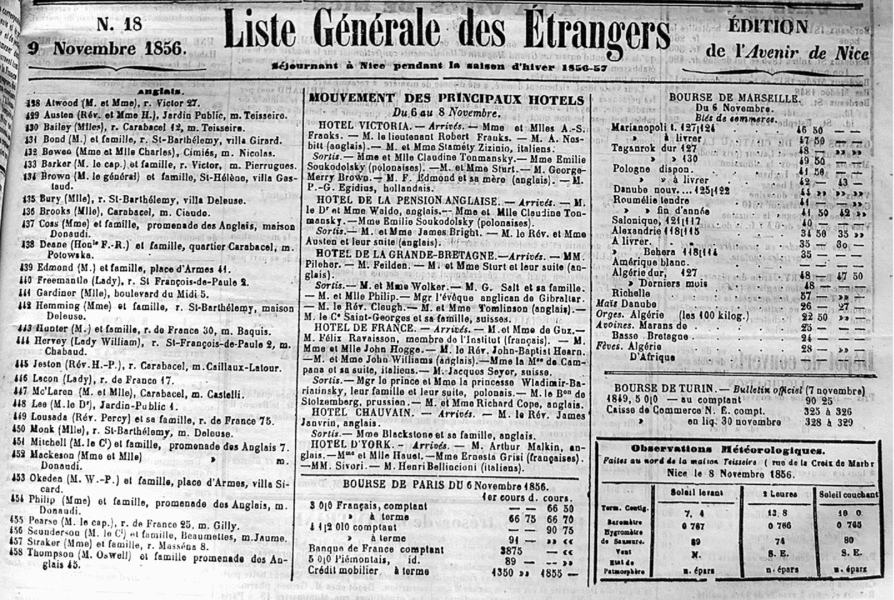
Although the English continued to be the largest single national group in Nice up to 1860, their overall predominance gradually declined. The 743 families that spent the winter of 1855–56 in Nice represented 15 nationalities: 302 were English (41 per cent), 216 French (29 per cent) and 62 each German and Italian (8 per cent, respectively).Footnote 45 The Russians, even when grouped together with the Poles, comprised only 15 families (2 per cent) – the same as the wintering Americans.Footnote 46 They only became a significant presence in Nice in their own right after the 1856–57 visit of the Dowager-Empress Alexandra Féodorovna and her sister-in-law, the Grand Duchess Hélène.Footnote 47 By 1860, Russians made up 18 per cent of the visiting families.Footnote 48 More important to the construction of Society in Nice in the first half of the century was the presence of women. Most women came to Nice as part of mixed-sex family units, but there were also significant numbers of female-headed households. The Liste Générale des Étrangers for 1855–56 reveals that 53 per cent of the Polish/Russian familes were female-headed, as were 33 per cent of the Dutch, 30 per cent of the English (35 per cent if those names listed only by initial are also included), 29 per cent of the German, 27 per cent of the American, 20 per cent of the French, 17 per cent of the Swiss and 13 per cent of the Italian.Footnote 49
‘Liste générale des étrangers séjournant à Nice pendant l'hiver 1855–56’, L'avenir de Nice, no. 18, 9 Nov. 1856 (Archives municipales de la Ville de Nice): the list notes the arrival of Lady Fremantle and her household (here misspelled Freemantle) and that of her daughter Lady William Hervey
As the number of étrangers rose, so too did their importance to the local economy. During the 1825–26 Season, l'abbé Bonifassi calculated that the étrangers spent 600,000 livres (on average 26 livres a day) in Nice – the equivalent of a good olive-oil harvest – double what they had spent when he started keeping his journal in 1792.Footnote 50 For Tourtoulon, in 1839, they had become the county's principal harvest.Footnote 51 Burnel, writing in the early 1850s, was yet more explicit: ‘L'étranger, pour eux [the Niçois], remplace les ateliers et les usines. C'est la poule aux oeufs d'or, c'est la richesse du pays.’Footnote 52
Attracting the geese that laid the golden eggs was one thing: meeting their expectations in terms of accommodation, amenities and entertainments was quite another.Footnote 53 Nice, like other health and resort towns, had to cater to two critical audiences: the ill, who primarily sought sunshine, comfortable lodgings, good doctors and medical treatments; and the healthy, wealthy and active, who wanted stylish housing, good shops, fashionable society, a range of cultural activities and plenty of diversions. The latter understandably placed the greatest demand on the town and, between 1815 and 1860, the balance tipped significantly in their favour. The first half of the nineteenth century saw Nice adapt quickly to meet the expectations of a discriminating visiting public that wanted modern home comforts, as well as commercial and cultural sophistication, in a foreign urban setting. The practice of villeggiatura, which saw étrangers take up residence for extended periods – in the case of Nice, for the winter Season (November to March) – by hiring entire villas, or floors in villas, increased the demands on the town, but it also provided significant opportunities for speculative investors, commercial entrepreneurs and the providers of domestic and specialty services.
Being able to offer the étrangers good housing was vital. The English preference for wide, straight streets and sunny suburban villas was reflected in Nice's urban development. The étrangers abjured the tightly packed houses of the Italianate Old Town and flocked instead to the new streets bordering the river Paillon (now St-François-de-Paule and Alexandre Mari) and, on the Right Bank, to the purpose-built elegant villas along the Route-de-France. As the town began to expand and modernize between 1820 and 1824, graceful tree-lined boulevards were constructed along the Left Bank of the Paillon, the Pont Neuf was built to improve access to the Old Town, and the new planned suburbs of St-Jean-Baptiste and Croix-de-Marbre were designed.Footnote 54Croix-de-Marbre, which centred on the Route-de-France, where the English had long tended to congregate, became the most fashionable location in Nice. Although so closely associated with the English that it was nicknamed New Borough, Petite Londres or la Cité Anglaise, it soon attracted other hivernants as well.Footnote 55 By 1839, it had come to embody the luxury, activity and variety of modern elite cosmopolitanism:
une colonie de différentes nations. C'est le quartier de prédilection des étrangers. Là, tout est varié: langage, moeurs, costumes, manières; le luxe, la livrée, l'équipage sont à toutes les portes. Pendant l'hiver, c'est un mouvement continuel, une vie d'agitation et de plaisir, dans des jardins parfumés de citronniers et d'oranges, ou dans des salons chauds et resplenissants de lumières.Footnote 56
Nice's success in ensuring that its new developments would be marked by ‘l'élégance, la régularité et la richesse’ that appealed to hivernants was due in large part to involvement of the municipality and the oversight of the Consiglio d'Ornato.Footnote 57 Officially constituted by King Charles-Albert in 1832 but dating back to a municipal commitment to expand and embellish the town in 1825, this council of nine worthies represented the state and municipality, and included the provincial engineer, town architect and two specialists in the beaux arts. It was charged with modernizing the city, upgrading the sewerage system and creating the sorts of wide, airy streets and public places, stylish suburbs and convenient walks and quays that were sought out by the étrangers. By settling on the regularity and refined good taste of neoclassicism, the Consiglio ensured that the new town simultaneously cast back to a shared European classical heritage and spoke to emerging contemporary urban internationalism.Footnote 58
By 1860, the municipality had also taken a number of steps to improve experience of the town for the étrangers. Given the medical emphasis placed on taking the air and walking for invalids and convalescents, it had begun to water the streets to keep the dust down and had made walking safer and more pleasurable by installing sidewalks (1840s) and gas lighting (1850s).Footnote 59 It had ensured that the town's eighteenth-century promenade, the Corso (modern Cours Saleya), had been replanted soon after the depredations of the French Revolution and, by 1848, had extended and twinned the town's famed elevated Terrace overlooking the sea (between Cours Saleya and the modern Quai-aux-États-Unis).Footnote 60 The municipality had also lengthened and widened (1844, 1856) the ‘Beach Road’ paralleling the Croix-de-Marbre that had originally been funded by the English étrangers in 1822–24.Footnote 61 The resulting Promenade des Anglais, with its patterned sidewalks, was by mid-century the most fashionable place for invalids, promeneurs and flaneurs to see and be seen, to meet friends and swap gossip while taking the air.
Promenade des Anglais, Ponchettes, Barques de pêche, 1855–60, Louis Crette, papier salé albuminé (Archives municipales de la Ville de Nice)
Nice, December 2012 (photo: jonryanphotography.co.uk), 1 Promenade des Anglais, 2 The Terraces, 3 The Corso (modern Cours Saleya)
Of course, other factors also contributed to Nice's growing popularity. By the 1850s, getting to and around Nice was faster and easier than it had ever been. There were improved coach roads from Paris; the railway went as far as Marseilles; and there were regular steamers plying the coast between France and Italy.Footnote 62 Once in Nice, those étrangers who could not walk far, or came to Nice without their own transportation, could hire according to their needs. Guidebooks claimed that few places double the size of Nice had horses, carriages and donkeys as good:Footnote 63 ‘Here there are carriages, with one and two horses, in stands on the streets, as well as better ones in the remises. The street carriages, with one horse, cost 2 francs an hour – with two horses, two francs and a half; there are also saddle-donkeys in the streets, at a moderate charge.’Footnote 64 All were also carefully regulated and licensed by the municipality. Tariffs were set centrally and drivers were required to post them where they could be seen; they were also disseminated via numerous guidebooks.Footnote 65
These improvements were aspects of a thorough urban renaissance of the sort seen in Bath in the eighteenth century.Footnote 66 Over the first half of the nineteenth century Nice developed a strong infrastructure, with ‘every resource necessary’ for the comfort and convenience of the hivernants.Footnote 67 In terms of housing, the 30–40 furnished houses and 50–60 furnished apartments available for let in 1823 had climbed to 600 by 1841. Of these, Farr asserted that 120 were suitable for large families (10 persons), 240 for ‘moderate’ families (5 persons) and the rest for small families or individuals. Thus, he calculated that Nice could accommodate 2,880 people in houses and apartments alone.Footnote 68 The most desirable (and expensive) of these were elegantly decorated south-facing villas with large windows.Footnote 69 Lady Fremantle secured exactly such a villa after two days of house-hunting in October 1855. For the eye-watering sum of 3,400 fr. (c. £850) for the Season, she rented Maison Ghiz, with its seven south-facing front windows, situated along the Route-de-France in Croix-de-Marbre: ‘all newly done up, the rooms carpetted all over & very good furniture’.Footnote 70 The Brewsters, whose budget was more limited, found a small house near Cimiez in February 1857 for 80 fr. per month. This gave them a dining room, drawing-room, one ‘good-sized’ bedroom and two very small ones, a kitchen and large pantry and a pleasant, small garden.Footnote 71
Quais du Paillon, Hôtel de France (ou Plaza), Place des Phocéens, Anonyme, 1855 (mars), tirage papier salé, droits reservé Serge Kakou (Archives municipales de la Ville de Nice)
By mid-century Nice also bristled with large fashionable hotels and smaller pensions. Guidebooks assured étrangers that ‘there is a good hotel in every convenient and healthy locality’.Footnote 72 These establishments jostled for business, eagerly advertising, often in both English and French, the freshness of their decor, the taste and/or magnificence of their furnishings, the excellence of their cuisine, the beauties of their locations, the delights of their gardens or public rooms, and the reasonableness of their rates.Footnote 73 Space might be limited – ‘a small, narrow slip of a room’ – but rooms had to meet expectations of the étrangers for cleanliness and accoutrements; thus, Margaret Maria Brewster would comment approvingly on her ‘white bed and mosquito curtains’ at Hôtel Chauvain, one of Nice's oldest grand hotels, noting that her room was ‘quite an English one, even to a toilette and glass’.Footnote 74
In addition to ‘many good shops, & English things’,Footnote 75 Nice provided étrangers with plenty of amenities by mid-century: there were high-quality restaurants, cafés, traiteurs and pâtisseries; good banking facilities; public gardens and walks; three theatres and a casino; and a variety of clubs, music societies, reading rooms and literary establishments, some of European renown.Footnote 76 Dedicated agencies existed to help étrangers secure housing, servants and household goods; music stores hired out instruments (especially pianos) for the Season; and the town swarmed with specialist medics, tutors, masters and clerics – many of whom were multilingual and/or English.Footnote 77 Nice also teemed with laundresses. In their ‘gay petticoats and yellow or crimson handkerchiefs’, they added a scenic splash of colour all along the riverside and reinforced Nice's reputation for modern cleanliness. ‘Nice is’, wrote Margaret Maria Brewster, jocularly, ‘one of the most washingest places that I ever seed!’Footnote 78
Sociability and the Season
These factors all contributed to the creation of mid-nineteenth-century Nice's reputation as a progressive, cosmopolitan town. While Nice lacked the sort of dedicated civic buildings, the Assembly Rooms and/or Pump Rooms that functioned in some health and resort towns as focal points for the visiting company, it did have several well-established commercial institutions which targeted the étrangers and offered opportunities for exclusive international sociability.Footnote 79 Of these, the Cercle Philharmonique and Visconti's were the most important. The Cercle, described to English visitors as ‘a kind of a club’, dated to 1838. For 50 fr. per person per Season (admission dependent upon the recommendation of a current member) subscribers had access to reading-, card- and billiards-rooms, as well as a library. It also sponsored regular concerts and two or three balls a Season.Footnote 80 Benoît Visconti's stylish literary establishment on the Corso was reputedly one of the largest in Europe. It dated to 1839 and advertised elegant reading-rooms, including a separate reading-room for the ladies. Visconti, who was multilingual himself, subscribed to ‘all the leading journals of Europe’ and his circulating library of 12,000 volumes included books in English, French, German and Italian. Subscribers paid 25 fr. per person per Season and also gained access to a private garden, a music room for concerts and an exhibition space.Footnote 81 Nice's Opera, theatres, hotels and casino supplied additional entertainments and cultural fare for the étrangers; in Season, they featured popular Italian operas and French comedies, occasional balls, concerts by leading European musicians, games of chance, and fashionable lectures. As Louis Roubadi remarked as early as 1843, Nice in the winter took on ‘la physionomie d'une petite capitale’:Footnote 82
Alors les marchés, les magasins de modes, les hôtels, les restaurants s'animent; tout prend un nouvelle vie; l'activité, l'abondance règnent de toutes partes . . . Des cercles, des soirées, des concerts, des bals se succèdent tout l'hiver dans les hôtels des étrangers, dans le palais du gouvernement, dans la salle du cercle philarmonique [sic] et dans les salons de quelques habitants, parmi lesquels nous devons citer en première ligne madame la comtessse de S.te [sic] Agathe, qui à toute l'amabilité de son sexe, joint cette grace exquise, cette habitude du monde qui font le charme des réunions de Paris.Footnote 83
Roubadi may, of course, have exaggerated his claims in order to bolster Nice's appeal to his readers, but his identification of commerce, culture and elite sociability as characteristics of a capital city are worth noting.Footnote 84 So too is the emphasis that he placed on sociability and salons, for it was in the social arena and, particularly in the homes of Nice's hostesses, through their astute use of invitations, introductions and entertainments, that the social networks that underpinned cosmopolitan society were established.
The Season in Nice started slowly. November and December saw the gradual arrival of étrangers and the return of elite Niçois from their country houses or summer travels. Society coalesced as houses opened and visits were paid, laying the foundations for the Season's social networks. Leading Niçois hostesses such as Madame de Ste Agathe, the pre-eminent local hostess from the Napoleonic period through the 1840s, or, in the 1850s, noblewomen like her daughter Madame de Céssole and moneyed women such as Madame de Ricordi, the wife of the director of Carlone's bank, shared the social arena with an ever-changing number of high-status and often vastly experienced hostesses from the étranger communities.Footnote 85 By mid-November, the first ‘at homes’ or conversazioni were taking place and invitations to select matinées-dansants, receptions and dinners were being issued. These events, where French was mostly likely to be the language of choice, drew together an international cross-section of elite society in Nice and served to establish or revive social networks: social clusters formed that included members of the English and European nobility and gentry, representatives of military, naval and diplomatic families, and outstanding members of the cultural or scientific worlds.
Thus, Lady Fremantle, a 77-year-old vice-admiral's widow whose experience of international elite sociability dated back to the French Revolution, was quick to introduce her daughter Lady William Hervey, a diplomat's widow, and Lady William's marriageable stepdaughter, Mina, into Nice Society within days of their arrival in November 1855. This was Lady Fremantle's third trip to Nice and while her friendship with Nice's most important noble family, the Céssoles, dated back to 1835–36, Lady William had not been in Nice as an adult. Consequently, after convivial visits with the Céssoles, Lady Fremantle first introduced the younger women into Niçois Society at Madame de Ricordi's weekly Thursday reception and then took them to ostentatious Villa Gastâud, two miles down the Var road, the home of Frances Lady Shelley, one of the most important English hostesses at Nice in 1855–57.Footnote 86 Lady Shelley was a well-off widow of 68, someone with whom Lady Fremantle had been acquainted for decades, though not a close friend. Her fashionable matinées dansantes gathered together an elite mixture of young and old, male and female, British, Niçois and Continental Europeans, every Thursday during the Season. At Lady Shelley's, Lady Fremantle found ‘a sociable little party’: ‘Monr: de Cessole played beautifully on the violin accompanied by his daughter Mathilde. Blumenthal the famous pianiste [Queen Victoria's court pianist] was there but did not play.’Footnote 87 After having attended Lady Shelley's for two weeks in a row, however, Lady Fremantle was able to retire, her task complete. She had introduced Lady William and Mina into the best Society in Nice and was therefore able to step back and take up her own role as a hostess on a much smaller scale, opening up her house to a steady stream of international visitors of all ages and both sexes for conversation and music.
More research remains to be done on the ways that hostesses in Nice operated in the creation of social networks and as social arbiters in the construction of cosmopolitanism. What is apparent, however, is that this was a social role dominated by middle-aged and older women, married and widowed alike. Widows like Ladies Fremantle and Shelley, the duchesse de Sagan and the Grand Duchess Stéphanie of Baden (Napoleon's adopted daughter, née de Beauharnais) were all over 60 in 1855. Their social expertise dated back to the turn of the century and their networks extended across the royal, political, naval, diplomatic and cultural elite of Europe. While they may not have been as active as their younger counterparts – women like 46-year-old Madame de Céssole or the Grand Duchess's 38-year-old daughter, the German-born duchess of Hamilton – their contributions to the formation and shape of Society in Nice cannot be dismissed.
The Season in Nice sprang to glittering life in the New Year once the ‘grand monde cosmopolite’ was assembled.Footnote 88 The elite social clusters that had formed in private homes became increasingly interlinked and, arguably, international as the grand events of the Season drew people into a wider public social arena where they shared activities and pleasures. For Lady William Hervey, who had slipped effortlessly into the best social set in Nice in 1855–56, a set that revolved around the Grand Duchess Stéphanie and the duke and duchess of Hamilton, this meant becoming part of a largely aristocratic network made up of Niçois, French, Italians, Sardinians, Germans, English and Scots.Footnote 89 The men tended to be influential landowners and/or significant in civic, political or diplomatic spheres; the women were uniformly well connnected.
During Carnival, at the height of the Season, Lady William's social calendar was layered with sophisticated soirées, balls, various concerts, plays and operas. In addition, the richest and/or most high-status étrangers – in this case the grand duchess, the duke of Hamilton and the duc de Dino (son of the duchesse de Sagan) – vied to give the most extravagant entertainments. The duc de Dino's sumptuous costume ball in honour of his mother's birthday was the culmination of the 1855–56 Season. For Lady William, it was the culmination of preparations and rehearsals that had begun at the start of January. She appeared as the marquise de Lafayette, partnered by Mr Cavendish as the duc de Nemour, in a Ladies quadrille of 12 couples representing the court of Louis XIII.Footnote 90 Her stepdaughter, Mina, dressed as a star, danced a quadrille with other English and European youngsters. Even all three of Lady William's children – George (ten), Augusta (nine) and Francis (six) – had parts as pages.Footnote 91
This frenetic socializing came to a sudden halt with Lent, when it was replaced by more intimate, exclusive, often family-orientated diversions, once again primarily organized by women.Footnote 92 The cosmopolitan links which had been forged throughout the Season were reflected in the international guest lists for children's parties, teas and musical evenings; charades, tableaux and private theatricals. Lady William's son Frankey's seventh birthday party, for instance, which took place just outside Nice at the Céssole's country house at St Barthélemy, attracted a jolly international crowd:
our three [children], Constance Cochrane & her Governess, & Edd. Edgecumbe composed the Cavalcade. Lord Douglas, & his Brother met them there, the Duke of Hamilton came himself with Major Harrington, we had also Mrs Hamilton Cte. & Mde. D'Aglié, her mother Csse. de Boül, Prince de Tarenti, Cte. de Céssole & his daughters came later . . . the children & grown-up people played at all sorts of Games & were very happy & merry – they had a Tea with Cakes & Jam in the dining room.Footnote 93
Conclusion
Society in Nice gradually dispersed from Easter onwards, as families moved on to popular locations for the summer, such as the Italian Lakes, or returned home. Of course, not everyone who spent the Season in Nice in the first half of the nineteenth century was actively involved in the creation of elite cosmopolitanism. Some étrangers remained aloof due to illness, personal disinterest or religious/moral quibbles, while others simply lacked the language, social skills and/or class connections necessary to integrate effectively. Nice therefore always contained various social networks, some of which were national, which functioned under, alongside, or overlapped with, hegemonic cosmopolitan society. Unsurprisingly, the English, as the largest hivernant community, were the most likely to be charged with standoffishness;Footnote 94 however, it is easy to overestimate English parochialism. One need only read contemporary correspondence, or glance through the reports of social events in the local newspapers, to realize that there was always a group of elite English who, like the Fremantles and their acquaintances, were an integral part of Nice's social scene.
While the preconditions for cosmopolitanism in Nice may be traced back to the county's geography, history and economy, Nice's emergence as a peculiarly cosmopolitan town in the first half of the nineteenth century owes much to a combination of forward-looking urban developments and long-established traditions of elite sociability. In particular, the combined efforts of municipal authorities, such as the Consiglio d'Ornato, and commercial or speculative investors brought about improvements in urban infrastructure and amenities that catered to the desires and expectations of an elite, moneyed visiting public – predominantly English, but increasingly international. These developments, which drove Nice's transformation into a modern health and resort town, created the ‘laboratory’ where face-to-face elite sociability, directed and shaped largely by women, created a location-specific, evanescent, cosmopolitanism that came to be seen as unique to Nice.