Upon arriving to work on New Year's Day of 1884, Frank Wigeman found that his employer, Godcharles & Company, had posted new work rules that effectively lowered wages for Wigeman and his fellow puddlers who operated furnaces at the rolling mill.Footnote 2 Founded in 1875, the Godcharles company, located in Milton, Pennsylvania, maintained the traditional practice of posting shop rules rather than entering into individual contracts with workers. The new rules reduced wages both directly and by manipulating the way each ton was measured. Wigeman, who had worked at the nail mill for almost a year, walked out, joined a strike, and sued the company for back wages that had been paid in company store scrip.Footnote 3 According to an 1881 Pennsylvania law, employers were forbidden to pay workers in company store orders (as opposed to cash wages). Even so, Godcharles had continued scrip payments through 1883. In addition to demanding reinstatement of the original terms of his contract, Wigeman argued that the company could not post rules contrary to statutory law. The 1881 law, unique in the United States at the time, explicitly forbade any private contracts that circumvented the legislative mandate to pay workingmen in cash wages.Footnote 4
The “truck system,” whereby employers paid wages in store orders for commodities or a currency substitute (that is, scrip), already existed in many parts of the Northeast in the eighteenth century. Early nineteenth-century industrialization encouraged its spread through remote Pennsylvania mining regions.Footnote 5 The labor movement saw this as an example of “wage slavery,” a practice exploitative of poor, unskilled workers and their families.Footnote 6 The isolation of mining towns and the inflated prices of goods at company stores belied employers' claims that workers could negotiate better contract terms.Footnote 7 Labor cohesion, strikes, mining disasters, state investigations, and political compromises created moments of political possibility for regulatory action. Still, legal doctrine and language played a fundamental role in limiting the anti-truck movement and shaping the contours of labor reform more generally. Indeed, the law acted as “a restrictive, yet dynamic, force within the workers' world.” Within the highly individualistic structure of private law, it was not clear how a collective movement might enhance the legal rights and bargaining powers of a particular class of workingmen. This article focuses on the legal dialogue that defined the decades-long struggle to end the company store system. The essay seeks to explain why that system persisted despite widespread agreement that it degraded free labor.Footnote 8
Ultimately, Wigeman lost his case against the Godcharles Company. In 1886, the Pennsylvania Supreme Court struck down the 1881 anti-truck law as an unconstitutional limitation on workingmen's freedom to make private employment contracts. During legislative debate, miners and their advocates had successfully argued that unequal bargaining power between employer and employee constituted a form of duress, whereby miners' weakened position made them powerless to negotiate fair contracts. Thus, they argued, the company store system violated principles of equity and operated outside of the boundaries of legitimate employment contracts.Footnote 9 Judge Isaac Gordon, writing for the court, disagreed and held that the law prevented “persons who are sui juris from making their own contracts.”Footnote 10 The commonwealth's police powers could not extend to protect these workingmen.Footnote 11 He proclaimed that the law amounted to “an infringement alike of the rights of the employer and the employe[e]; more than this, it is an insulting attempt to put the laborer under legislative tutelage, which is not only degrading to his manhood, but subversive to his rights as a citizen.”Footnote 12
Duress could not describe workingmen's position; instead, it applied to dependents who by law had limited but protected contract power. As a result, the Godcharles ruling enshrined a specialness of private labor contracts by suspending the presumption of constitutionality, striking down a legislative act, and curtailing the expansion of state police powers into the private realm of workingmen's contracts. The case became infamous as a precursor to the “liberty of contract” era.Footnote 13
Increasingly, scrip wage payments appeared antithetical to the wage labor ethos of the Reconstruction years but proved difficult to eliminate by statutory action.Footnote 14 This essay examines the political and legal tactics employed by workingmen's trade groups to extend the principles of law and equity to include sui juris men and to regulate working conditions within the so-called “ordinary trades.”Footnote 15 Conventional histories of Gilded Age constitutionalism tend to present “liberty of contract” as a monolithic, rigid, and inflexible doctrine intended to suppress labor activism.Footnote 16 The anti-truck debate of the 1870s and 1880s, however, demonstrates the ambiguities and tensions within that system. Advocates of protective labor legislation put forth principles of equity and fairness that cut against the emergent vision of formalistic “liberty of contract.” Reformers had greatest success expanding state police powers to protect workingmen's health and safety in dangerous trades, such as mining.Footnote 17 While workers made strong political and sociological arguments against the truck system, they faced roadblocks in their efforts to secure cash payments of wages. Equally strong legal precedent regarded certain types of protective laws as “class legislation” that benefited private individuals through the use of public laws.Footnote 18 By fitting the Godcharles ruling within the context of late nineteenth-century disputes regarding the limits to state police powers, it may be reconciled with other cases in which the courts upheld police powers regulations affecting “reasonable rates” for certain workersFootnote 19 and industries.Footnote 20
This essay argues that the Godcharles ruling did not result solely from the machinations of the bench, but rather rested on evolving notions of liberty espoused by both sides of the anti-truck debate: the rise of “liberty of contract,” antipathy to “class legislation,” and the demise of equity jurisprudence. The Godcharles ruling does not reflect the attempt to impose allegedly immutable laissez-faire economic rules on the law, as Justice Oliver Wendell Holmes later charged.Footnote 21 The case instead demonstrates limits imposed by legal and political culture upon legislative action intended to enhance workingmen's private rights in the post-Civil War era. The case represents the failure of late nineteenth-century public use and police power doctrines to extend their guidance to labor-strife management.Footnote 22 The case also demonstrates the blurred distinction between protective social legislation and emancipatory negative rights during the “liberty of contract” era. The inadequacies of the “liberty of contract” doctrine became more evident when labor advocates began to attack the company store system using equity jurisprudence, which liberty of contract could not readily accommodate.
The Pennsylvania court declared that the great danger to individual liberty remained the arbitrary use of government power to favor one class at the expense of another; that is, unequal bargaining power could not legitimize taking from A to give to B within an ordinary trade not touched by the public interest.Footnote 23 Formal legal equality seemed to cut both ways, leaving workingmen's private rights intact but not positively enhanced. Although a long tradition of public interest regulation and rules of equity existed in Pennsylvania, the ideological and legal preference for abstract general laws limited liberal-democratic policy solutions to laborers' demands.Footnote 24 The truck system was no longer consonant with the predominant economic and social context, but the accepted legal norms of formal equal rights stymied political remedies.
The truck system controversy involved the reconsideration of the parameters and underlying rationale of government intervention over ordinary workingmen's labor contracts. The essay first explores the contradictions between the truck system and the free labor wage system in practice. Identifying this system as a violation of equity principles inspired social legislation to curb these “evils” that “made men unfree.”Footnote 25 As I then explain, proponents of anti-truck legislation worked within the overlapping spheres of private rights and public interest in order to reconsider and extend the reach of police powers.Footnote 26 By deploying principles of equity to define truck contracts as contrary to the wage labor system, nearly two decades of anti-truck legislative debate and the resulting 1881 law expanded public regulation of workingmen's employment contracts. Perhaps most significantly, the final anti-truck law sought to equalize bargaining power between employer and employee by forbidding any private contract to circumvent the law. Thus it applied to all workingmen in mining and manufacturing regardless of individual agreements to the contrary.Footnote 27 Still, in the end, the failure of this novel legislation to pass constitutional muster informed future legal strategies of social and political protest.Footnote 28 As the events of the anti-truck controversy unfolded, two predominant intellectual traditions emerged on either side of the debate. “New Liberals” favored voluntary action by private organizations and a highly formalized legal structure to govern all individual labor contracts, whereas progressive advocates of the anti-truck law supported an industrial democracy that harnessed state power to protect politically or economically marginalized groups.Footnote 29
Petitions sent to the 1863 legislative session protested against the unequal bargaining power that “render[ed workingmen] almost entirely dependent upon the will of their employers for the amount of their wages and the mode of their payment.”Footnote 30 The petitions claimed that the truck system reduced workingmen to a dependent status, to “wage slavery.” Laborers' independence could only be achieved through more equitable contract terms, namely regular cash payments.Footnote 31 Proponents of regulatory action against the truck system did not seek emancipation from wage labor per se. Instead, these petitioners demanded equal rights and strengthened bargaining power. Over time laborers and labor activists involved in building the foundations of protective labor legislation came to define equal rights in terms of established equitable legal norms.
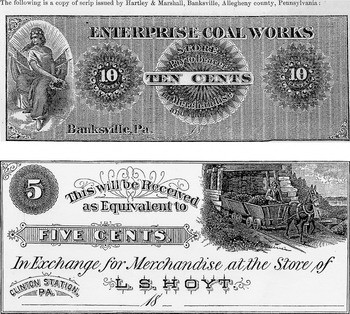
Examples of scrip from Pennsylvania coal mines, reprinted in “Report of the Bureau of Industrial Statistics,” Legislative Documents (Harrisburg, 1879–1880), 2:369–72.

As was the tradition in many isolated mining communities throughout Pennsylvania, employers posted advertisements for workers that stipulated the terms of the labor contract. Payday at the Godcharles mill, for example, occurred regularly, and laborers received an envelope of cash less the advances taken from the company store. Company stores were not always owned or operated by the mine operator or boss. Still, issuing scrip to a particular store generally denoted a partnership between the employer and the store owner or lessee. Scrip redeemable only in one store ensured an automatic customer base and usually signaled a profit-sharing agreement if a single entity did not already own both the mine and store.Footnote 32
Company store scrip was supposed to be non-transferable. Holders who sought to purchase goods outside of the company store might still exchange the scrip for cash, but exchange carried a discount that was onerous for already hard-pressed workers. Company stores were known to carry high-quality merchandise but largely at inflated prices compared to cash-only stores.Footnote 33
In 1879, the Pennsylvania Bureau of Labor Statistics delivered a report to the General Assembly on the company store system. The interviews and mailed questionnaires illustrated the workingmen's frustrations:
As denominated by many workmen, the “pluck-me” system, is one that has caused considerable complaint throughout the State for years. It is the payment of wages in store goods, or, as many workingmen say, in “calico and molasses.” This system, when arbitrarily enforced, is, to say the least, very unjust, or especially when work is scarce, for then workmen's necessities are taken advantage of, and his wages paid in part or in whole in store goods, at exorbitant prices.Footnote 34
The goods available in the company store and the pricing structure of those goods demonstrated the inequities of the truck system. Not only did the truck system sell merchandise at inflated prices, company stores often operated a dual price system—one for scrip payments and another price for cash-paying customers.Footnote 35 The price discrepancy underscored the increased transaction cost imposed on workers to the benefit of employers.Footnote 36
Nevertheless, the truck system retained some vocal supporters. Facing a dearth of capital, especially during coal price slumps or widespread economic downturns, the company store allowed employers to provide for workingmen and their families. In 1863, Senator John P. Penney of Allegheny County stated, “There are hundreds of cases in which the families of laborers are better protected by the system which gives to the wife an order for her flour, meat and groceries, than they would be by that which gives to an improvident husband the hard cash at the end of the week.”Footnote 37 Some storeowners and mine operators defended it as necessary, if not beneficial to workers.Footnote 38 Moreover, when interviewed by a state official, mine owners and operators insisted that workers did not complain and, if requested, cash could be made available.Footnote 39 Finally, if laborers wanted a better bargain, they were free to leave, if they did not carry debt with the company store. Of course, the geographic isolation of some mining communities that made the company store a necessity would have impeded laborers' free movement as well.Footnote 40
Despite the handful of people who supported the company store system, political opinion turned decisively against the institution during the labor unrest of the Civil War years. Defending the truck system as a benign, even paternalistic institution appeared increasingly anachronistic within the postbellum wage labor system. In January of 1863, Republican governor Andrew Gregg Curtin made the first gubernatorial request for legislation to bring an end to the truck system.Footnote 41 He called attention to the unfreedoms of the truck system: “a system most unwise and unjust, and it affects classes of useful citizens who, as they live by the proceeds of their daily labor, have not adequate means to resist it.”Footnote 42 Answering his call for protective legislation, Senator John Reilly introduced legislation to “prevent the payment of workmen and laborers in orders upon store-keepers.”Footnote 43 Reilly, who represented one of the largest mining districts in the commonwealth (Schuylkill County), identified the problem as fairly limited and confined the bill's application to only certain types of workingmen.
In April, both houses of the Pennsylvania General Assembly passed the anti-truck bill with only one day of discussion each, but Governor Curtin vetoed the act, even though he had called for the legislation.Footnote 44 While proponents focused on laborers' petitions and assertions of economic coercion, a critical handful of opponents denied the constitutionality of a compulsory labor law and lambasted the bill as detrimental to the mining trade. No one mentioned the problem of curtailing private contract freedom; that was not the issue. The act could not pass constitutional muster because it failed to incorporate all Pennsylvanian workingmen, focusing too narrowly on particular industries.Footnote 45 The bill counted as special legislation, too imperfect and ambiguous. Thus the first anti-truck act failed.
Similar to special-interest legislation in later periods, in the late nineteenth century “class legislation” referred to partial or unequal restraints or subsidies allocated to a certain group of people.Footnote 46 Curtin's 1863 veto foreshadowed a continuous problem in the formulation of an anti-truck law. In order to extend the public-interest rationale to eliminate the truck system, it proved necessary to create a law general in its reach and application, not specific to particular occupations or localities. Historian Louis Hartz, writing in the mid-twentieth century, along with revisionist legal historians more recently, traced the legal tradition of general laws and popular political antipathy toward “class legislation” to the Jacksonian equal rights movement of the 1830s.Footnote 47 In Pennsylvania, adherents to the Jacksonian equal rights tradition co-opted language of democratic “equal rights” and constructed a “classical” legal idiom that emphasized limited legislative intervention into the economy as an end in and of itself. Similar to the rejection of special legislation as anti-democratic, a peculiar legislative preference for non-mandatory labor laws aggravated policy solutions.Footnote 48
In 1868, the Pennsylvania General Assembly passed a non-compulsory, eight-hour law applicable to all wage earners.Footnote 49 Because this was a default rule—that is, the law applied only to workers who did not agree to “set-off” contracts that legally defined terms of an individual's employment—workingmen found it largely unenforceable. In this era, binding labor contracts at common law were generally unwritten agreements, sometimes constituting nothing more than “governing rules” posted on the shop floor or customary workplace relationships.Footnote 50 Not long after the passage of the eight-hour rule, mine workers in Schuylkill County attempted to quit work after the legal workday. Mine operators, however, felt no legal obligation to honor the law. In June, laborers in the Schuylkill mines responded by walking off the job and strikes spread quickly to neighboring mines and counties.Footnote 51
The mining strikes lasted several months and ended in compromise, with only moderate gains in wages. Significant organizational gains, however, promised future success. The Workingmen's Benevolent Association (W.B.A.), established at the time of the strike, coordinated an industry-wide craft union, which proved most successful in the lower anthracite region where small and independent mines predominated.Footnote 52 The eight-hour default rule remained a dead letter, utterly failing to reorder the bargaining power between employer and employee. Still, the W.B.A. expanded its efforts to protect skilled laborers through a variety of legislative measures, such as lien laws and safety regulations, as well as hours laws.Footnote 53 This marked a turning point in laborers' strategy to garner legislative support, rather than only bargain with employers for control of the workplace.
The 1868 eight-hour law demonstrated the limitations of legislative power to proscribe certain contractual relations. Although newspaper articles and workingmen's associations called for more effective laws regarding the length of workdays and other grievances, many Pennsylvanians doubted the constitutionality of compulsory protective laws. Most who commented on the issue did not offer precise legal reasoning, but they accepted the limitation of police powers when confronted with preserving workingmen's contract freedom.Footnote 54 Non-mandatory contract regulations failed to explicitly confront the economic and social inequalities at issue; instead they allowed private contracts to determine employment relations.Footnote 55
Despite the difficulties of policing private contracts, the passage and enforcement of workplace safety and health regulations expanded state police power regulations into the realm of workingmen's ordinary trades. In 1870, the Pennsylvania legislature passed the commonwealth's first general health and safety law stipulating mandatory mine ventilation practices and equipment. The law extended over all counties and provided a system of inspections to insure compliance with air quality in the mines.Footnote 56 One leading scholar of trade unionism in coal-mining Pennsylvania has remarked that the Mine Safety Act of 1870 “was distinctly double-edged.” While a victory for labor activists, it also bolstered the power of mine owners and operators to control the workplace, as opposed to strengthening union control. Legally, however, the expansion of police powers into the mining industry represented an important step toward an anti-truck law.Footnote 57
The following year, a mine owner challenged the safety law's constitutionality, complaining of the “great pecuniary loss to which [owners] will be subjected in the use of their own property, if the provisions of the act of assembly in question be strictly enforced.”Footnote 58 Nevertheless, state Judge Garrick M. Harding upheld the law as a valid expansion of the commonwealth's police power over certain property rights:
If the Commonwealth of Pennsylvania, through her Legislature, can police our towns and cities, why may she not police the coal mines within her border? If, through her Legislature, she can attach conditions, rules and regulations, which are to be observed by her citizens in the use of their own peculiar property, what is there about coal mines, or the owners thereof that should specially exempt them from her supervision and control? If she recognizes as part of her organic law, applicable to the property of her citizens, the rule, long ago grew into maxim, sic utere tuo ut alienum non laedas, why may she not make it equally applicable to the lives of her own citizens?Footnote 59
Harding's interpretation of an “organic law” of police powers easily extended over mining safety regulations.
In 1872, Harding again enforced the 1870 mine safety law against constitutional challenges and expanded his defense of the legislature's use of police powers.Footnote 60 It would be, he continued, “an exercise of unblushing presumption on our part to set at naught a statute thus originated, and which was passed for the special and declared purpose of protecting the health and the lives of a very large class of citizens.…In effect it would be making, and not expounding the law.”Footnote 61 Moreover, Harding reiterated the court's position of deference to “legislative wisdom” and a duty to presume an act constitutional.Footnote 62 Thus, Harding's rulings encouraged the extension of police powers via progressive labor legislation when legitimated by protecting the public interest in miners' health and safety.
The ongoing debate over anti-truck legislation began to build upon police power arguments, such as those articulated by Judge Harding. Proponents extended this reasoning to regulations intended to safeguard and perhaps strengthen the economic welfare of mine laborers. Beginning in 1873, the “long depression” of the late nineteenth century deflated coal prices and laborers' wages.Footnote 63 Between 1870 and 1873, laborers' wages had already declined by an estimated 33 percent,Footnote 64 in part due to a series of unfavorable arbitration agreements between the W.B.A. and the mine owners' Arbitration Board of Trade, which Franklin Gowen had effectively captured by 1871.Footnote 65 These economic and organizational setbacks for the W.B.A. diminished its control and coordination of laborers in the commonwealth. The economic downturn exacerbated political discontent, culminating in the establishment of a new third party intent to redistribute economic wealth and power.
As a direct response to the Panic of 1873, the Greenback Party formed in 1874 and appealed to agrarian and debtor interests that favored cheap money policies; the party also campaigned to expand protective labor laws.Footnote 66 In Pennsylvania, the most zealous defenders of anti-truck regulations hailed from this party and considered it the foremost duty of the state to provide cheap money and protective social legislation for laborers.
In 1874, “Honest Mike” M'Cullough, a self-proclaimed advocate for workingmen, brought an anti-truck bill before the Pennsylvania House of Representatives.Footnote 67 The bill mandated that all laborers in the commonwealth receive biweekly wage payments in cash. Failing this, companies would be penalized at 6 percent interest per annum on wages in arrears.Footnote 68 Representative M'Cullough defended his bill as a necessary protection of workingmen's right to wages and a measure to end labor unrest. “Honest Mike” and other proponents peppered floor speeches with direct quotes from laborers' demands for legislative action. The Eagle, a newspaper produced by the W.B.A. and edited by M'Cullough, published a lengthy defense of the proposed legislation. “Weekly payments are the poor man's right. If he spends it, it is his own, and no one has a right to dictate to him in regard to it. He can buy cheaper for cash, and where and what he thinks proper to buy, and there is not so much of a temptation to dishonesty.”Footnote 69 The argument to alleviate the truck system's economic coercion and enhance workingmen's freedom remained the paramount issue to laborers.Footnote 70
Representative Henry H. McCormick, a Pittsburgh Democrat who opposed the anti-truck law, succinctly stated the impasse provoked by M'Cullough's bill: workingmen's contract rights could not be reconciled with an immutable prohibition of certain labor contracts. “The gentlemen all know as well as I do,” McCormick insisted, “that they cannot take away the right of the manufacturers to make whatever contract they see fit with their employees. They understand it. We all understand it, on both sides of the House.” The notion of endowing positive rights onto workingmen, as many opponents of anti-truck reform described it, offended the classical legal principles of economic autonomy and equal rights.
McCormick continued, “What I object to in this bill, is this provision holding out the belief to the working classes that they have a right to go and demand their wages every two weeks—that any contract that they may make to the contrary is against the law.”Footnote 71 An immutable rule, opponents argued, substantially changed the rights and obligations of workingmen's contracts in such a way irreconcilable with free labor employment contracts. Lacking a clear demonstration of individual duress, vested wage labor contracts remained irreducible, and prohibiting future truck contracts seemed implausible. “So long as the contract is not against public policy or against good morals, every citizen has the right to make it. I take it that this is not a contract against either.” Legislators seemed to consider the balance between individual rights and state intervention as a zero-sum game, that is, the increase of public power necessarily diminished private rights. The impasse could not be resolved via police powers to limit individual's contract and property rights; alternatively, proponents searched for other pathways to prohibit company stores and scrip wage payments.
In lieu of a direct prohibition of company stores, labor advocates sought to curtail the creation of additional company stores by prohibiting any state charters to sanction such stores. By definition corporations existed as artificial constructions of the state; thus, the terms of a corporate charter could be manipulated by the legislature, especially if deemed in the public interest.Footnote 72 In 1874, Senator Miles S. Humphreys, a labor reformer and radical Republican, amended a general incorporation act to prohibit any future incorporated charters from owning or operating a company store. “My object,” Humphreys explained, “was to confine corporations strictly to one line of business, and forbid them from supplying their employees with calico and molasses in lieu of money for wages, and thus secure them better opportunities to live prosperous lives, instead of dragging along an existence under the bondage of debt.”Footnote 73 The prospective corporation law, however, could not affect existing company stores. Thus, the problem of the truck system persisted.
In 1876, legislators continued to focus on the problem of “class legislation” as the preeminent hurdle to passage. The 1874 constitutional convention had produced a new prohibition of “special” or “class” legislation.Footnote 74 Debate increasingly focused on what constituted a general law. Senator William H. Stanton of Luzerne County admitted that his proposed anti-truck bill qualified as class legislation but no more than any number of pro-capital bills. He added that “enslaved” workers existed in a context that incapacitated their ability to bargain fairly with employers.Footnote 75 Any anti-truck law that functioned merely as a default rule would fail to mitigate the coercion prevalent in the system.
In response to Stanton, Senator Andrew Jackson Herr, a prominent lawyer from Dauphin County, initiated what would become his annual harangue regarding the unconstitutionality of special laws to prohibit truck system contracts, especially those that prohibited set-off contracts. Herr, who frequently sat as the Senate's president pro tempore, staged the most consistent legal attack against any anti-truck proposals. Herr quoted Thomas Cooley's Constitutional Limitations to emphasize the necessity of general rules to protect individual liberty and equality.Footnote 76 He stated, “First, this bill is a local one because it is confined to a particular locality. Secondly, it is a special one because it refers to a particular class. Thirdly, it is local and special because it related to a particular class in a particular locality.”Footnote 77 For Herr, the anti-truck proposals required a set-off provision. Otherwise there was little to debate.
The labor unrest that continued to afflict the coal mines of Pennsylvania reached new heights in 1877, when a nationwide railroad workers' strike centered in Pennsylvania. Laborers had continued to organize against falling wages and onerous piece-rate systems in the late 1860s and early 1870s. Again, Gowen spearheaded the movement against trade unions. He catalyzed the famous Molly Maguire episode by hiring a detective to infiltrate the W.B.A., which eventually led to labor conspiracy charges against several union members.Footnote 78 The widespread labor unrest of 1877 coupled with the conviction and execution of nineteen W.B.A. members in the Molly Maguire unrest contributed to heightened urgency about the “labor question” in legislative debates.
The elimination of the causes of strikes and riots became as central to the anti-truck defense as the arguments of systemic economic coercion. Senator Thomas B. Schnatterly, who became the leading proponent of labor reform, declared that the company store system “has encouraged disobedience to law, has aggravated these people into associations and combinations, and there is no telling, sir, unless these causes are removed, where it will end.”Footnote 79 Representative W.H. Hines of Luzerne County, a former miner and labor leader, partnered with Schnatterly to sponsor the bill. Both advocates called legislators' attention to the testimonies gathered through Bureau of Labor Statistics inquiries into the “labor question.” In January 1879, Gowen provided key testimony, stating that miners in his employment demanded “payment in lawful wages of the United States, of each month's wages on or before the fifteenth day of the month succeeding.” Laborers vowed to “refuse to work thereafter until such payment shall have been made.”Footnote 80 Schnatterly and Hines interpreted this to mean that ending the truck system might mollify laborers on strike.
With greater ubiquity and force, labor organizations published resolutions calling for the end to the truck system as a prerequisite to reconciliation.Footnote 81 Pennsylvania's Bureau of Labor Statistics reinforced this conclusion and drew from investigations in other states that also faced the issue. By 1879, Ohio, New Jersey, and Massachusetts had passed prospective anti-truck measures, which their respective state courts had upheld.Footnote 82 Hines declared that the 1877 strikes were “indeed caused by that revolt against oppression, which will come sooner or later, both to the people and the individuals who are guilty of injustice.”Footnote 83 The legislature must fulfill its duty to protect not only the workingmen in Pennsylvania's mines, Hines argued, but also the public in general, whose welfare was threatened by strikes and riots.
Throughout legislative debates, advocates of the anti-truck proposals returned to equity jurisprudence to prove the necessity and precedent for such interventions into contract and property rights. With significant sociological and legal evidence compiled by various state and academic sources, labor activists in the Pennsylvania legislature redoubled their efforts to demonstrate that the company store system constituted economic coercion. According to Pennsylvania case law raised during legislative debate, principles of equity allowed judicial intervention into the terms of private contracts, including labor contracts, if inequity or fraud could be demonstrated.Footnote 84 In 1817 the Pennsylvania Supreme Court, in the case Perkins v. Gay, held that under principles of equity, evidence of fraud, unconscionability, or “unfair dealing” would render a private contract unenforceable.Footnote 85
Equity jurisdiction, however, did not provide a straightforward path to striking down labor contracts that paid workingmen in company store scrip. First, Pennsylvania courts enforced private contracts that waived one's rights granted by statutory law. In Billmeyer v. Evans & Rodenbaugh, the state supreme court struck down an 1861 “stay law” that prohibited “contracting out” of the law.Footnote 86 Thus, legal restraints remained even if the legislature reached consensus on the evils of the truck system. Courts could nullify contractual rights and obligations if fraud or unconscionable action was shown, but a tradition of default rules and “set-off” contracts limited the scope of legislative and judicial action. Moreover, equity jurisdiction could cut against labor organizations as well. The doctrine of criminal conspiracy allowed judges to declare labor activities unlawful if they were unlawful in purpose or lawful in purpose but unlawful by means.Footnote 87 Aware of this problem, proponents of an anti-truck law phrased regulations in terms of individualized contracts made under duress.
In 1879, Hines and Schnatterly solicited the help of lawyers to craft an anti-truck bill grounded in legal precedent.Footnote 88 Drawing from cases employing principles of equity to overturn vested contracts, Hines affirmed the judiciary's duty to hold private contracts unenforceable if found to be unduly influenced by the “weakness of parties, infringement on the civil rights of the citizen, [or] oppressive and against public policy.”Footnote 89 Clearly, they argued, unequal bargaining power constituted evidence of coercion that made truck contracts unconscionable and, therefore, unenforceable under principles of equity. If such contracts should not be honored in Pennsylvanian courts, Hines considered it the duty of legislature to negate that wrong: “Contracts which take away the free rights of citizens are oppressive and should be prohibited by law … such a contract is not just and should not be protected by law.”Footnote 90
Representative Hines concluded his 1879 remarks with a litany of equity cases supporting his position. He gave special attention to Bishop v. Reed, an 1843 case that involved a contract to build two locks on the Erie Canal. William Bishop had promised work on the locks to William Reed and Reed's partners on the condition that they provide collateral in the form of a mortgage on the Reed home in Millersburg, Pennsylvania. When the work stipulated in the contract with the state of New York was not carried out in a timely manner, the Board of Canal Commissioners canceled the contract. Having already invested time and money into the venture, Bishop sued to recover the Reed homestead. He argued that Reed knew of the risk involved when he entered the contract. The attorney general, however, insisted that “common mistake of the parties” rendered the contract void. Though they had both entered into the agreement as sui juris equals, the unfair outcome of the agreement rendered it inadequate and void.
In the Bishop decision, Judge Charles Huston provided a brief lesson in principles of equity. At law a sealed contract proved adequate consideration of both parties, but chancery courts operated differently. In England, chancery courts could declare a contract void “on making out a case of fraud, [or] want of consideration [and plaintiffs] could obtain a perpetual injunction against any execution of the judgment at law.” Judge Huston continued that these principles of equity persisted in America, paraphrasing Justice Joseph Story's influential Commentaries on Equity Jurisprudence (1835–36), wherein Story held that contracts could be dissolved in cases “where there is an admixture of ingredients going to establish misrepresentation, imposition, undue confidence, undue influence, mental imbecility, or that sort of surprise which equity uniformly regards as a just foundation for relief.”Footnote 91 Judge Huston built on Story's argument for equitable constraints on contract legitimacy when he wrote:
Where parties have presupposed some facts or rights to exist as the basis of their proceeding, which in truth did not exist, such contracts made in mutual error, under circumstances material to their character and consequences, seem on general principles invalid and notes Lord Hardwicke, in Chesterfield v. Jan[s]sen, arranges [sic] among contracts which will be relieved against, such bargains as no man in his senses and not under delusion, would make on one hand, and no honest and fair man would accept on the other hand.Footnote 92
Hines, then, borrowed from these nineteenth-century equity principles to demonstrate a persistent legal tradition that would not accept truck contracts as legitimate.
Incontrovertible evidence of economic coercion and inadequate consideration remained elusive, while what counted as evidence of duress also generated debate. Nevertheless, the reframing of the truck system as illegitimate due to the absence of voluntary consent implied the authority to restrict such private labor contracts. Hines began his argument with the uncontroversial statement that the legislature had the power to pass statutes that altered contractual arrangements. Hines pushed the legislature to consider company store scrip as illegitimate compensation for wage labor contracts, though he found the entire company store system as offensive to the common law in itself:
But does any man surrender any right to his wages and to his pay in lawful money by his voluntary assent, when his assent in such cases has been obtained by an enforced condition of employment or of terms of payment? May not the legislature provide that such conditions, unconscionable because not voluntary, shall not be competent and admissible evidence in a course of action in which the simple elements of the contract are the primary facts to considered?Footnote 93
Advocates of an anti-truck law needed a consensus to accept that these labor contracts constituted an unconscionable or coercive violation of equity principles and therefore violated contract rules at common law.
Senators W. C. A. Lawrence and Andrew Jackson Herr, who led the opposition to anti-truck legislation, denied that such contracts intrinsically involved economic coercion. They further focused on the 1876 constitution's prohibition of special or local legislation. Despite Herr's condemnation of the bill as a violation of the legislature's circumscribed power to regulate certain contracts, a voice vote in the Senate held that the bill's intent did not violate contract freedom.Footnote 94 Undaunted, Senators Herr and Lawrence cited prominent case law and legal treatises that defined special legislation as isolating a group of citizens within a particular class, whether by intent of the legislature or direct statutory language.Footnote 95
Proponents of the bill insisted that “a statute which relates to persons or things, as a class, [is] general law, while a statute which relates to a particular person or things of a class, is special, and comes within the constitutional prohibition.”Footnote 96 They contended, for example, that the legislature already possessed the ability to classify cities for the purpose of specific regulations and tax purposes, which the Pennsylvania Supreme Court affirmed in Wheeler v. Philadelphia.Footnote 97 In that case, an 1874 law classified cities into three categories based on population size and regulated the passage of ordinances regarding municipal indebtedness, criminal punishments, and future incorporations. Opponents of Philadelphia's sewage extension plans had charged that the act comprised an unconstitutional local law.Footnote 98 The state supreme court upheld the law as a necessary and time-honored device to govern cities of different sizes, “and its exercise was necessary for the promotion of the public welfare.” The court's opinion sustained legislation that classed cities for a variety of matters, such as taxing real estate, drawing judicial districts, and protecting disenfranchised women.Footnote 99
The anti-truck act passed the House and Senate in 1879 but met Governor John F. Hartranft's veto later that summer. Although his annual messages to the General Assembly often called for greater attention to the “labor question,” the former union general tended to embrace a self-help attitude that closely mirrored the free-labor principles of Jacksonian equal rights and individual autonomy. In his January 1879 annual message, Hartranft recognized the problem of labor unrest in the commonwealth. Still, he called only for voluntary arbitration agreements between employers and employees.Footnote 100 Holding the 1879 anti-truck act special and therefore unconstitutional under Article 3, Section 7 of the 1874 Pennsylvania constitution, the governor vetoed it. Similar to Curtin's 1863 veto, Hartranft proclaimed the act too great an extension of “protective and paternal government.”Footnote 101 Although he came to support recognition of labor unions and arbitration agreements, the governor implied that workingmen's private labor contracts had distinctive qualities. In contrast to the circumstances that led to the Wheeler v. Philadelphia decision, the case of workingmen's labor contracts did not concern municipal contracts, bonds, or exclusive privileges that the General Assembly might affect with general legislation.
Later that year, the election of Governor Henry Martin Hoyt, a Republican who campaigned to alleviate the strains of the truck system, renewed the possibility of the anti-truck law's passage. During Hoyt's campaign, the Republican Party feared a possible coalition between Greenbackers and a resurgent Democratic Party. Concessions to the Greenbackers—Schnatterly and Hines were the most notable Greenbackers in the General Assembly—allowed Hoyt to capture the governorship by 22,000 votes over his Democratic opponent, Andrew H. Dill.Footnote 102 In his first address to the General Assembly, Hoyt called for legislative action to end the problem of the truck system. The new governor suggested that the legislature note the information gathered by the Bureau of Labor Statistics concerning the truck system's detrimental impact on the wage system.Footnote 103 Hoyt made sure to warn the legislature against passing any overtly special laws, which he would be constitutionally bound to veto. With that, the 1881 legislature reconsidered the 1879 Schnatterly-Hines anti-truck proposal.
Schnatterly focused his energies on proving the necessity and constitutionality of the anti-truck bill.Footnote 104 In the House, Representative John F. Welsh, a former miner and W.B.A. organizer from Schuylkill, sponsored the bill.Footnote 105 The 1881 anti-truck bill expanded the permissible methods of wage payment to incorporate not only cash, but cash orders as well.Footnote 106 Also, the bill did not prohibit owning or operating company stores, but rather mandated the lawful payments of wage at monthly intervals. Perhaps most controversial, labor reformers maintained that no contracts contrary to the law could be legitimate.
Schnatterly and Welsh began by clarifying the supposed problems with the previous act and distinguishing it from their current bill. Hartranft, they argued, had not vetoed the bill because it violated a “freedom of contract” per se; he objected to “class legislation” that identified one group of male constituents as incapable of making legitimate contracts.Footnote 107 Finally, Hartranft had concluded that it “tended too much to set up a protective and paternal government.”Footnote 108 Similar objections had arisen from Representative Elisha W. Davis, a long-time opponent of anti-truck regulation. Yet when Schnatterly and Welsh called for a vote in the House regarding whether or not the new bill interfered with the making of private contracts, an overwhelming majority voted that the bill was not a violation of “freedom of contract.”Footnote 109
Nevertheless, opponents in the Senate continued to argue that the bill removed rights from workers, that it relegated them to a status of dependency reliant on legislative protection. Senator John C. Newmyer, for example, stated:
I am in favor of allowing men to make their contracts upon the best terms that can be obtained … of allowing men to act as free men and not in favor of the State interposing and attempting to act as guardians for them. … By such legislation we in effect say to them, ‘You do not know what is best for yourself, but we in our superior wisdom will make your contracts for you, notwithstanding you may be satisfied to trust your own judgment.’Footnote 110
Likewise, Senator George V. Lawrence agreed that a prohibition on overcharging in company stores seemed reasonable, but the Schnatterly-Welsh bill went too far, and he predicted a gubernatorial veto.Footnote 111
Opponents ridiculed the legislation by drawing an analogy between workingmen and other groups of persons whose employment contracts the state regulated. Senator Norris stated his unyielding objections in a way that captured the contemporary defense of workingmen's contract freedom:
I for one am not ready to assume this responsibility, nor am I ready in this chamber to pronounce them a lot of imbeciles that need our aid. I think this discussion is an insult to the intelligence and character of the workingmen of Pennsylvania and I for one resent it upon them. I believe they are just as capable of taking care of their rights as we are.Footnote 112
These notions of contract freedom and individual liberty resonated with the postbellum tradition that assumed all pre-contractual conditions of the laborer adequately ensured the freedom of will required for meaningful volition and equitable exchange. According to this reasoning, protective legislation should be reserved to protect people deemed disenfranchised or marginalized. Examples included the married women's property and earnings acts.Footnote 113 Opponents argued that if workingmen were to be subsumed into the category of those protected by equity principles, they would be shrouded with paternal protection by the State.Footnote 114 It was that fear of relegating white workingmen to a status of dependency comparable to that of a woman, lunatic, or child that became the oppositions' most powerful and oft-cited argument against regulations to abolish the company store system, even though some opponents may have personally agreed that the company store system indeed made men unfree.
On June 29, 1881, Governor Hoyt signed the Schnatterly-Welsh anti-truck act, but the problem of the truck system did not disappear.Footnote 115 Five years later, when Frank Wigeman sued Godcharles & Company for payment of wages in company store scrip, he had reason to believe he would receive his $87.67 in arrears. The law had already been enforced in local courts.Footnote 116 Indeed, Wigeman won his first trial in the Northumberland Court of Common Pleas.Footnote 117 On appeal, however, Godcharles challenged the constitutionality of the law, and the Pennsylvania Supreme Court reopened the debate on the meaning of workingmen's freedom.
William H. Hackenberg, a Republican officeholder from Milton and legal defense for Godcharles, attacked the constitutionality of the 1881 law on two grounds. First, he contended that the law violated Pennsylvania's 1874 constitutional prohibition on special or local legislation because it affected only mining and manufacturing workers. Further, he insisted that the mandatory law restricting workingmen's contract freedom also violated the free labor principle of equal rights. All workingmen, he argued, should be free to make their own labor contracts. Quoting the 1873 constitutional convention debates, he stated, “‘Equal privileges for all, exclusive privileges for none, should be the sentiment of every citizen of this Commonwealth.'”Footnote 118 This notion of formal legal equality left little room for the legislature to positively enhance the bargaining power of workingmen in the so-called ordinary trades, particularly with regard to wage contracts. Accordingly, only private contracts could rewrite these customary employment relations.
In Godcharles v. Wigeman, the Pennsylvania Supreme Court affirmed Hackenberg's attack. For the court, the meaning of freedom for ordinary workingmen was not contested—it was defined by one's ability to make private labor contracts free from legislative interference. Justice Gordon wrote:
An attempt has been made by the legislature to do what, in this country, cannot be done; that is, prevent persons who are sui juris from making their own contracts. The Act is an infringement alike of the right of the employer and the employe[e]; more than this, it is an insulting attempt to put the laborer under a legislative tutelage, which is not only degrading to his manhood, but subversive of his rights as a citizen of the United States.Footnote 119
The Court enforced the set-off contracts made by the private parties and struck down the legislative mandate that wage payments be made in cash or cash orders. A legally competent workingman, Gordon proclaimed,
may sell his labor for what he thinks best, whether money or goods, just as his employer may sell his iron or coal, and any and every law that proposes to prevent him from so doing is an infringement of his constitutional privileges, and consequently vicious and void.Footnote 120
Thus, Gordon enforced private employment contracts as the sole legal mechanism by which to determine the obligations of employer and employee.Footnote 121
Gordon did not mention the constitutional prohibition of special legislation; his brief 335-word opinion provided scant legal reasoning. He did not explicitly refer back to legislative debates, nor did he honor the customary presumption of constitutionality of legislative acts. The ruling's rhetoric suggested that nearly all labor legislation would be found unconstitutional. The decision, therefore, had substantial long-term effects on the “liberty of contract” regime, as well as on historical and legal understandings of it. A charitable reading might explain the brevity and imprecision of Gordon's opinion on the grounds that Gordon believed that the bench and bar already knew that the sanctity of workingmen's contracts forbade wage regulations. The ruling, however, encouraged progressive historians to seek extra-legal interpretations of the justices' motives. The case thus gained notoriety as a thinly veiled effort to constitutionalize laissez-faire economic principles, which became the bedrock of the “liberty of contract” doctrine that lasted until the New Deal era.
This paper has suggested that that explanation is too simple, though it is still true that the Godcharles ruling substantially shaped the judiciary's response to the labor movement. Although the case was not explicitly about “due process,” it aided the rise of “substantive due process” by contributing to a series of similar state rulings striking down labor laws as class legislation that unconstitutionally abridged workingmen's contract freedom.Footnote 122 In his now-infamous decision, Justice Gordon cited only one case, Millet v. Illinois, which relied on the Illinois state constitution's due process clause.Footnote 123 In that case, the Illinois Supreme Court struck down a law that required coal mines to furnish standardized scales and a check-weigh-man and to determine wages based on a prescribed system of weighing coal.Footnote 124 Similar to Godcharles, the Millet decision hinged on
whether it is competent for the General Assembly to single out owners and operators of coal mines as a distinct class, and provide that they shall bear burdens not imposed on other owners of property or employers of laborers, and prohibit them from making contracts which it is competent for other owners of property or employers of laborers to make.Footnote 125
The Illinois court found the regulation did not meet the acceptable “definition of police regulations” because it did “not have reference to the comfort, the safety or the welfare of society” as a whole and thus violated the state constitution's due process clause.Footnote 126 When West Virginia enacted a similar law regarding the payment of miners' wages, the West Virginia Supreme Court held that it violated both the state's due process clause as well as the U.S. Constitution's Fourteenth Amendment.Footnote 127 Then, in Lochner v. New York, the U.S. Supreme Court infamously adopted this interpretation of the due process clause as protecting workingmen's “liberty of contract” against state police power regulations deemed to affect only a particular trade. Women were included in this category after they gained the right to vote.Footnote 128 That precedent lasted into the New Deal era, until it was overturned in 1937, when the Court upheld Washington state's minimum wage law and abandoned the courts' protection of “freedom of contract” as established in Godcharles.Footnote 129
Ultimately, the Godcharles precedent irrevocably contributed to the ascendancy of the “liberty of contract” doctrine and the decay of equity principles in workingmen's employment relations.Footnote 130 In the 1880s, unequal bargaining power between employer and employee, which reformers argued reduced men to the status of dependency, failed to justify the extension of police powers over workingmen's private contract freedom. Thus, the umbrella of equity protection for disenfranchised or marginalized groups did not reach workers in mining, industry, and many other places. The company store system operated under the auspices of an “ordinary trade,” meaning that it did not enjoy special privileges granted by the state, such as eminent domain privileges, municipal bonds, or exclusive contracts from the state. Neither equitable remedies nor the legal categories of public interest offered guidance to labor-strife management in the so-called “ordinary trades.” Arguments over economic coercion and resultant “wage slavery” had given rise to a politically salient labor reform movement. Still, legislators floundered in their search for solutions within the increasingly crystallized parameters of law and equity.
How could the state not improve working conditions so as to protect and perhaps positively enhance those negative rights that made men free? Even if freedom of contract defined individual workingmen's private liberty, the state still retained police powers to protect public health, safety, and morals. Although in some parts of the United States, the company store system persisted into the mid-twentieth century,Footnote 131 the Pennsylvania anti-truck movement had successfully challenged classical law and ideology that constrained liberal-democratic solutions to protect laborers against unconscionable contracts. The Godcharles ruling was a blow to the labor movement. It affected labor's legal strategy and tactics, but it did not deter the labor movement.
The case signaled two important changes in Gilded Age constitutionalism and labor activism: the delineation of equity principles in wage labor disputes in favor of formal legal rules of contract, as well as the incipient unraveling of class legislation in labor law that accompanied the gradual expansion of police powers. As other scholars have noted, the courts' rejection of protective labor laws for workingmen caused a reaction in the labor movement, encouraging groups like the American Federation of Labor, founded in 1886, to adopt the language of “liberty of contract” to protect their collective bargaining goals. “Collective laissez faire,” as opposed to a strictly individualistic “liberty of contract,” envisioned a new system of industrial pluralism, wherein labor unions could bargain as equals with corporate employers.Footnote 132 Moreover, while Gilded Age courts limited police power regulations to the protection of women and children—those dependents who were not deemed sui juris to make their own contracts—Progressive Era reforms pushed harder at these boundaries. Louis Brandeis and Josephine Goldmark, for example, built on the labor studies pioneered by Francis Amasa Walker and other reformers and popularized the field of sociological jurisprudence, which expanded police power categories for groups of marginalized workers. Workingmen still had to prove their trade to be unsafe or unhealthy or in the public interest in order to pass constitutional muster, but by the early twentieth century, progressive reformers possessed more legal resources to do so. Ultimately, the Godcharles decision played a critical role in creating Gilded Age trends in law and legislation that fragmented the labor movement into separate classes of workers and occupations and diminished the likelihood of a nationwide, class-oriented labor movement. Similar to the anti-truck movement, the progressive advocates of protective labor legislation continued to complicate these existing categories of contract freedom and class legislation.