Introduction
Chlamydia psittaci, currently has 15 known genotypes, and is able to infect avian species, mammals, reptiles, and humans (Sachse et al., Reference SACHSE, LAROUCAU and VANROMPAY2015). The highest infection rates are found in psittacines and pigeons. Turkeys, ducks, and all other domestic poultry are also susceptible; however, manifestation of clinical disease differs between poultry species and the serovar and genotype present (Andersen and Vanrompay, Reference ANDERSEN and VANROMPAY2000). C. psittaci has a great impact on poultry health and economics as well as human health. The asymptomatic status of infected poultry species that are in close contact with humans gives even higher risk for psittacosis especially to those working closely or having contact with birds such as farmers, veterinarians, breeders, pet shop personnel, and abattoir workers. It has been reported that the recent human cases were associated with domestic poultry, to a higher extent with the infected ones, rather than with psittacines. The infection in humans (psittacosis) may result in asymptomatic to severe disease condition and even death (Gaede et al., Reference GAEDE, RECKLING, DRESENKAMP, KENKLIES, SCHUBERT, NOACK, IRMSCHER, LUDWIG, HOTZEL and SACHSE2008; Beeckman and Vanrompay, Reference BEECKMAN and VANROMPAY2009).
The impact of the disease, especially being zoonotic, needs effective control and preventive measures such as all-in-all-out confinement, implementation of biosecurity measures, and use of antimicrobials. However, indiscriminate antimicrobial use in some countries may lead to the development of drug-resistant strains. To minimise the use of antibiotics and possible development of resistant strains, vaccination was one of the practical recommended measures (Vanrompay et al., Reference VANROMPAY, HARKINEZHAD, VAN DE WALLE, BEECKMAN, van DROOGENBROECK, VERMINNEN, LETEN, MARTEL and CAUWERTS2007), combined with preventive measures (Longbottom, Reference LONGBOTTOM2003). Several vaccination protocols against C. psittaci in poultry have been studied, but the results showed variable quality of protection.
This paper aims to assess the progress of C. psittaci vaccine development for domestic poultry and discuss the prospects of improving efficiency of existing but not-yet-approved vaccine and vaccination protocols for avian species. The review is based on investigations published in peer-reviewed journals from 1999 to present related to C. psittaci vaccination regimen for domestic poultry such as chickens, ducks, and turkeys.
Pathogenesis of and immunity against Chlamydia psittaci
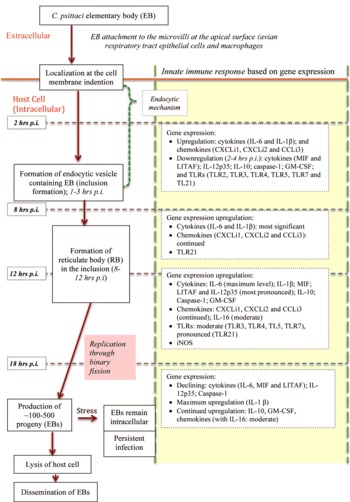
C. psittaci is a Gram-negative, obligate intracellular pathogen with a biphasic developmental cycle consisting of an infectious elementary body (EB) and a non-infectious reticulate body (RB) (Wyrick, Reference WYRICK2000). Figure 1 shows the pathogenesis of C. psittaci infection based on the work of Andersen and Vanrompay (Reference ANDERSEN and VANROMPAY2000) and the corresponding innate immune response base on gene expression of cytokines (IL-1β, IL-6, MIF-macrophage inhibitory factor, LITAF (lipopolysaccharide-induced TNF factor), IL-12p35 and IL-10), caspase-1, GSM-CSF (granulocyte macrophage colony-stimulating factor), iNOS (inducible nitric oxide synthase), chemokines (CXCLi1, CXCLi2, CCLi3, IL-16) and TLRs (toll-like receptors; TLR2, TLR3, TLR4, TLR5, TLR7, TL21) (Lagae and Vanrompay, Reference LAGAE and VANROMPAY2015).
During the entry of C. psittaci and formation of EBs, cytokines (MIF, LITAF, IL-12p35 and IL-10), caspase-1, GM-CSF, iNOS, chemokine (IL-16), and TLRs (TLR2, TL3, TLR4, TLR5, TLR7 and TLR21) are down-regulated. In the mid-cycle period, there is an increased gene expression of NF-κB-regulated pro-inflammatory cytokines (IL-6, IL-1β, MIF, LITAF, IL12p35 and IL10), and chemokines (IL-16, CXCLi1, CXCLi2 and CCLi30 and iNOS are up-regulated. However, among the TLRs, TLR2 gene expression is absent even up to mid-cycle when C. psittaci forms the RBs. The up-regulation and down-regulation of genes associated with the innate immune system contribute to the survival of the organism by enhancing spread to predilection site of infection while evading phagocytosis and the immune system (Lagae and Vanrompay, Reference LAGAE and VANROMPAY2015).
Protective immunity against C. psittaci is established by the coordination of neutrophils, macrophages, CD4+ cells, CD8+ cells, and dendritic cells (DCs, which are specific antigen-presenting cells or APCs) and the involvement of major histocompatibility complex (I and II). Infected cells release IL-8 to mobilise and activate neutrophils to destroy the cell. The EBs also stimulate the cleavage of C3-complement system into C3a and C3b. C3a stimulates CD4+ (Th1 and Th2) cells, CD8+ cells, and dendritic cells (DCs). DCs, which are APCs in the context of major histocompatibility I (MHC I) presents antigen to CD8+ cells; while in MHC II, antigens are presented to CD4+ cells. C3a also down-regulates regulatory T cells (Tregs) to minimise its inhibitory effect on T cells and DCs. Stimulation of CD4+ cells with IL-4 (Th1 stimulation) and C3b results in the production of antibodies, while Th1 stimulation triggers the release of interferon-γ (IFN-γ) to the direction towards the infected cell. CD8+ cell stimulation results in IFN-γ release for the lysis of infected cells (Kaiser, Reference KAISER2010; Knittler and Sachse, Reference KNITTLER and SACHSE2015; Radomski et al., Reference RADOMSKI, EINENKEL, MÜLLER and KNITTLER2016).
C. psittaci pathogenesis and innate immune response.
Pathogenesis of C. psittaci infection (left side) and the corresponding innate immune response base on gene expression of cytokines (IL-1β, IL-6, MIF-macrophage inhibitory factor, LITAF-lipopolysaccharide-induced TNF factor), IL-12p35 and IL-10), caspase-1, GSM-CSF (granulocyte macrophage colony stimulating factor), iNOS (inducible nitric oxide synthase), chemokines (CXCLi1, CXCLi2, CCLi3, IL-16) and TLRs-toll like receptors (TLR2, TLR3, TLR4, TLR5, TLR7, TL21) (Andersen and Vanrompay, Reference ANDERSEN and VANROMPAY2000; Lagae and Vanrompay, Reference LAGAE and VANROMPAY2015).

Research on vaccination against Chlamydia psittaci in poultry
Reverse vaccinology produces vaccines based on genomic information for antigenic proteins and does not require the culture of microorganisms (Serruto and Rappuoli, Reference SERRUTO and RAPPUOLI2006; Rappuoli et al., Reference RAPPUOLI, BLACK and LAMBERT2011). DNA vaccines can elicit humoral and cell-mediated immunity, and are easy to produce especially when organisms are difficult or dangerous to culture in the laboratory. Other advantages of using DNA vaccines include genetic and temperature (heat) stability, being free of contaminants, the possibility of combining with several protective components from multiple pathogens in one vaccine, the possibility of adding adjuvant and/or immunostimulatory properties such as CpG motifs and safety and efficacy despite the presence of maternal antibodies upon administration. In the case of C. psittaci, it is disadvantageous to use whole chlamydial agents for vaccination because of the possibility of the presence of immunopathogenic components (Eko et al., Reference EKO, HE, BROWN, MCMILLAN, IFERE, ANANABA, LYN, LUBITZ, KELLAR, BLACK and IGIETSEME2004), which can result in the production of lesions in target organs. However, DNA subunit vaccines produce weak cell-mediated immunity, require adjuvants that can result in unwanted reactions at the injection site and leave residues that can affect meat quality and safety (van Drunen Littel-van den Hurk et al., Reference VAN DRUNEN LITTEL-VAN DEN HURK, GERDTS, LOEHR, PONTAROLLO, RANKIN, UWIERA and BABIUK2000; Dunham, Reference DUNHAM2002).
The major outer membrane protein (MOMP) of C. psittaci, representing most of the surface exposed protein, has been identified as an important entity in infecting mucosal epithelial cells. As such, it became the target vaccine candidate because of its capability of eliciting a strong antibody response (Longbottom, Reference LONGBOTTOM2003). The protective antigens are expected to induce strong CD4+ T cell-motivated Th1 response and, thus, produce antibody response for fast and strong memory response to reinfections (Igietseme and Black, Reference IGIETSEME and BLACK2013).
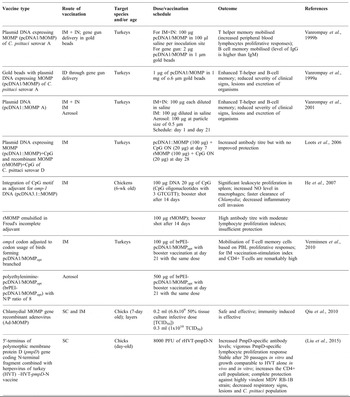
Research on C. psittaci vaccine ( Table 1 ) demonstrated the potential in developing a vaccination protocol that can be applied to poultry.
Different vaccines studied in poultry species, their route of administration, target species, vaccine dose and schedule, and outcomes.

IM, intramuscular; IN, intranasal; SC, subcutaneous; ID, intradermal.
Vanrompay et al. (Reference VANROMPAY, COX, VOLCKAERT and GODDEERIS1999b; Reference VANROMPAY, COX, VANDENBUSSCHE, VOLCKAERT and GODDEERIS1999a; Reference VANROMPAY, COX, KAISER, LAWSON, VAN LOOCK, VOLCKAERT and GODDEERIS2001) utilised plasmid DNA expressing MOMP (pcDNA1/MOMP) as vaccine type with different routes of administration - IM+IN, IM, aerosol - and gene gun delivery. The combination of IM+IN takes advantage of the formers efficient transfection and the latter delivering high amounts of MOMP to activate CD4+ and CD8+ cells. Gene gun on one hand requires a smaller amount of DNA component and favours efficient transfection, that is, more cells are transfected especially when administered with smaller bead size. Furthermore, smaller beads tend to stay at the epidermal layer of the skin that is abundant in antigen presenting cells. Aerosol administration produces comparable results and is cost effective when applying in a huge flock; however, there was a need to increase the particle size to reduce evaporation, thus improving vaccination outcome.
Vaccination of MOMP in addition of CpG motif or branched polyethyleneimine polyplexes was conducted by He et al. (Reference HE, LI, YANG, HE, LIU and YAO2007) and Verminnen et al. (Reference VERMINNEN, BEECKMAN, SANDERS, DE SMEDT and VANROMPAY2010). The addition of CpG motif increases the immune reaction of vaccinated chickens while branched pcDNA1/MOMP was not easily destroyed when given through aerosol. Lastly, Qiu et al. (Reference QIU, ZHOU, CAO, LIN, ZHENG and GONG2010) and Liu et al. (Reference LIU, SUN, CHU, HUANG, WU, YAN, ZHANG, ZHAO, IGIETSEME, BLACK, HE and LI2015) worked on making MOMP stable against inactivation by combining with other viral pathogens vaccinated to poultry and achieved promising results. This method will reduce stress in birds, due to handling and cost incurred on vaccine production, as well as minimise the conduct of vaccination for separate pathogens.
The process of stimulating the immune system with DNA vaccines is similar to that produced by natural infection in which the proteins, in their original form, are presented to the immune system (Oshop et al., Reference OSHOP, ELANKUMARAN and HECKERT2002). Specific antigens are identified, isolated, and used to produce subunit vaccines (Brunham et al., Reference BRUNHAM, ZHANG, YANG and MCCLARTY2000; van Drunen Littel-van den Hurk et al., Reference VAN DRUNEN LITTEL-VAN DEN HURK, GERDTS, LOEHR, PONTAROLLO, RANKIN, UWIERA and BABIUK2000). Antigens present on bacterial surface are identified by mass spectrometry, and the functions are made known through technologies such as in vivo expression technology (IVET), recombination-based in vivo expression (RIVET), in vivo induced antigen technology (IVIAT), serological proteome analysis, and DNA microarray protocols (Grandi, Reference GRANDI2001; Scarselli et al., Reference SCARSELLI, GIULIANI, ADU-BOBIE, PIZZA and RAPPUOLI2005). Reverse vaccinology involves high throughput analysis of all proteins; thus, the best antigenic protein is being identified for vaccine production. Furthermore, this technique is of advantage because the sequence of all antigens regardless of immunogenic properties is available, the most conserved immunogenic proteins can be identified, and the presence of operons coding for the formation of polysaccharides can be identified (Sette and Rappuoli, Reference SETTE and RAPPUOLI2010).
Van Drunen Littel-van den Hurk et al. (2002) outlined the factors that influence the quality of immune response stimulated by DNA vaccines. These factors include route of administration in relation to animal species, type of eukaryotic promoter or enhancer, type and location of the plasmid encoded antigen in the cell, presence of unmethylated CpG motifs within the vector, additional plasmids in a multivalent DNA vaccine, cytokine-encoding plasmid in the vaccine, vaccination regimen (dose and interval of vaccination), and presence of maternal antibodies and cytokines.
The route of administration influences the induction of mucosal, cellular, and/or humoral immune system. The most common route in birds is intramuscular. Other routes of administration include incorporation into cationic liposomes, use of gene gun, intravenous, intradermal, intranasal, intraocular, mucosal (tracheal), oral, topical, intraperitoneal, intrabursal, in utero, subcutaneous, epidermal and in ovo (Oshop et al., Reference OSHOP, ELANKUMARAN and HECKERT2002; Dunham, Reference DUNHAM2002).
The intramuscular route is commonly used because it is simple and effective, and promotes Th1 response that is characterised by the production of IFN-γ by T-helper cells and of immumoglobulins of the IgG2a isotype. On the other hand, the gene gun method makes use of gold particles coated with DNA that are being fired into the skin. This procedure prevents degradation of DNA and enables delivery to target cells such as somatic cells and antigen-presenting cells, making vaccination more effective (van Drunen Littel-van den Hurk et al., Reference VAN DRUNEN LITTEL-VAN DEN HURK, GERDTS, LOEHR, PONTAROLLO, RANKIN, UWIERA and BABIUK2000; Singh and O'Hagan, Reference SINGH and O'HAGAN2003). In addition to unmethylated CpG motifs, according to Singh and O'Hagan (Reference SINGH and O'HAGAN2003), other possible adjuvants include monophosphoryl lipid A from lipopolysaccharide of Salmonella enterica serovar Minnesota and tripenoid glycosides or saponins that are cytokine inducers, from Chilean tree (Quillaja saponiria) bark. Furthermore, particulate antigen delivery systems (emulsions, microparticles, immune stimulating complexes (ISCOMS), liposomes, virosomes and virus-like particles) were considered as an addition or substitute to immunostimulatory adjuvants to stimulate the Th1 pathway.
The amount of DNA to be administered will differ based on delivery method and the size of the animal to be vaccinated. Gene gun technique requires less DNA than intramuscular vaccination (Dunham, Reference DUNHAM2002; Oshop et al., Reference OSHOP, ELANKUMARAN and HECKERT2002). The vaccination schedule is another aspect to be considered. In some instances, prime-boost vaccines are being combined with a different immunogen, which is not DNA-based. Another regime is the so-called co-stimulation or the administration of cytokines as secondary signal after the injection of DNA antigen (primary signal). Other genetic adjuvants can also be used as co-stimulator such as genes encoding cytokines (granulocyte macrophage colony-stimulating factor-GM-CSF, interferon-γ and interleukins), chemokines, and co-stimulatory molecules (B7.1 and B7.2) (Dunham, Reference DUNHAM2002).
Conclusions
A combination of routes for first and booster shots need to be further investigated to explore which combination achieves the best result coupled with modifications on the vaccine type and adjuvants added. The utilisation of other viral pathogens of poultry as DNA vectors (Kaiser, Reference KAISER2010) should be explored, especially those that have the same point of entry into susceptible hosts and predilection site of infection as C. psittaci. The unique pathogenesis of C. psittaci, especially its ability to penetrate target cells and survive intracellularly by evading cellular reactions, and the existence of several genotypes pose a challenge in controlling the infection especially through vaccination. On one hand, the influence of polymorphisms of immune system gene(s) of the host can be evaluated according to the vaccine type given. Genetic variations on the host immune system such as single-nucleotide polymorphisms (SNPs) may influence the efficacy of avian chlamydial vaccines. Nonetheless, the work of Qiu et al. (Reference QIU, ZHOU, CAO, LIN, ZHENG and GONG2010) and Liu et al. (Reference LIU, SUN, CHU, HUANG, WU, YAN, ZHANG, ZHAO, IGIETSEME, BLACK, HE and LI2015) need to be refined and validated to be ready for the next steps in vaccine development and implementation.
Experiments conducted in domestic poultry showed potential in developing an applicable vaccination protocol against C. psittaci. In this genomic era, much can be done to optimise the best combination of vaccine form, adjuvant, codon optimisation, vector design, and route and frequency of administration. The production of a cost-effective vaccination protocol is vital to the prevention and control of chlamydia infection in birds and humans.