

I. Introduction
Private financial investors in general, and more specifically those corporations holding sovereign debt, are not exempt from complying with human rights obligations, including those systematized in the United Nations Guiding Principles on Business and Human Rights (UNGPs).
Yet, while to most people, this would sound like a basic, common-sense legal statement, the Thun Group of BanksFootnote 1 made the point in its second report in 2017Footnote 2 noting (echoing the International Monetary Fund’s (IMF) and World Bank’s argumentsFootnote 3) that, at its discretion, banks could never be held accountable for the adverse effects their clients’ transactions may have on human rights, as this impact is not part of bank operations. This interpretation has been widely criticized by the international system for the protection of human rights, including by the United Nations (UN) Working Group on Business and Human RightsFootnote 4 and the UN Independent Expert on Foreign Debt and Human Rights,Footnote 5 in line with the interpretation of the Office of the UN High Commissioner for Human Rights (OHCHR) on this specific issue.Footnote 6 The main point made in these critical views is that lenders can be held accountable if, without their lending, a number of violations would not haven take place.
In any case, the state of this debate shows a remarkable under-development of legal theory addressing the links between finance and human rights, with, to some extent, the exception of the financing of infrastructure projects.Footnote 7 Nonetheless, when focusing on due diligence by corporate lenders and the insolvency of sovereign borrowers from a human rights perspective, the backwardness is even more evident.Footnote 8
The causes of this phenomenon are twofold: (a) there are interdisciplinary methodological challenges posed by linking sovereign debt to human rights; and (b) these links do not attract the attention from the finance industry, because international human rights law imposes limits on what is financially possible.Footnote 9 Notably, most developed countries systematically reject initiatives of the UN General Assembly and the Human Rights Council that elaborate the relationship between finance and human rights.Footnote 10
We know that, based on the UNGPs,Footnote 11 human rights due diligence (HRDD) ‘refers to the processes that all business enterprises should undertake to identify, prevent, mitigate and account for how they address potential and actual impacts on human rights caused by or contributed to through their own activities, or directly linked to their operations, products or services by their business relationships’.Footnote 12 This definition considers due diligence as a process to manage business risks and also, implicitly, as a standard of conduct required to discharge an obligationFootnote 13 in order to avoid infringing on the human rights of others.Footnote 14 This due diligence corporate standard reflects a basic, defensive conception of human rights accountability.Footnote 15 As seen, advancing the discussion on HRDD by lenders is ultimately about setting standards and ensuring that holding corporations and business people to account if violations occur.Footnote 16
This article addresses the following questions: What are the legal bases and the main contents of corporate creditors’ HRDD in the context of sovereign insolvency? Do creditors undertake HRDD when dealing with insolvent sovereign debtors so that there is at least some fiscal space left to ensure the minimum core human rights obligations of borrower populations? If so, how do creditors fulfil this due diligence? If not, how should they do it?
There are two important caveats. This article focuses on the private lenders’ HRDD when negotiating and deciding on haircuts, but official (multilateral and bilateral creditors) are also bound by international human rights law,Footnote 17 which includes their obligation to conduct due diligence and correlatively grant debt relief when necessary in order to not deteriorate the sovereign debtor populations’ human rights situation.Footnote 18 Yet, official creditors do not regularly grant debt reliefs but only reprofile their credits, even when this is an option established in their own statutes.Footnote 19 The second caveat is that lenders’ HRDD does not absolve sovereign borrowers from their duty to do human rights due diligence in regard to any restructuring, as a specific implication of the obligation to demonstrate that every effort has been made to mobilize all available resources, even in times of economic crises.Footnote 20
This article is structured as follows. Section II restates and systematizes the scattered UN developments regarding creditors’ due diligence standards in the context of debtor states’ insolvency. Section III then provides empirical historical aggregated evidence to analyse whether haircutsFootnote 21 applied by creditors regularly consider the social and human rights implications of debt agreements. Section IV explains the main characteristics of bond markets that illustrate the asymmetric power relationship between private lenders and sovereign borrowers, which, in turn, highlights the importance of focusing on lenders’ due diligence. Section V describes and delves into the last two debt restructurings (2005 and 2020) carried out by the Argentine government with its private creditors, with the aim of determining whether human rights obligations and the social situation of the debtor state were part of the negotiations and decisions around these debt agreements. Section VI offers some concluding remarks.
II. Corporate Creditors’ Due Diligence in the Context of Sovereign Insolvency
What are the forms and components of private creditors’ HRDD towards debtor States and their populations? What are the main questions to be addressed if they were to undertake human rights impact assessments of their decisions, particularly in the context of debt agreements and restructurings? Neither scholars nor civil society organizations have thoroughly approached these fundamental issues.Footnote 22 In turn, a number of UN initiatives have briefly referred to creditors’ due diligence in the context of states’ insolvency, distilled from international law sources.Footnote 23 In the following paragraphs, we attempt to restate and systematize these UN developments in order to better understand (and demand) what creditors (and their representatives, such as bond trusteesFootnote 24) should do in the context of debt restructurings.
It is worth mentioning that States have also their own human HRDD obligations in terms of debt policies, including in the context of debt restructurings. Yet, HRDD creditors’ and debtors’ obligations are both autonomous and not mutually exclusive. In this article we focus on the creditors’ obligations.Footnote 25
The 2019 UN Guiding Principles on Human Rights Impact Assessments (HRIA) for Economic Reform PoliciesFootnote 26 establish that:
Private creditors, when negotiating transactions with States or other public entities, including taking decisions in the context of economic reforms, should not undermine the State’s ability to respect, protect and fulfil its human rights obligations. Among other things, these creditors should assess the human rights impacts of their own actions as well as those of the activities financed by them, unless they have ascertained that debtor States or international and regional financial institutions have carried out effective assessments, including with regard to gender equality and the environmental impact. (Principle 16)
The obligations mentioned in the previous paragraph include, for example, participating in debt relief programmes and restructuring negotiations in good faith through a formal process of deliberative policy engagement and social dialogue. They also include actively seeking debt agreements that are financially sustainable and respect human rights. Creditors should refrain from predatory or obstructive behaviour that could compel States to act in contravention of their human rights obligations in order to repay debts or directly impact States’ capacity to meet these obligations. (Principle 15.2 and Principle 16.2 establishing that good faith requirements apply to both public and private creditors)
In addition, the UN Basic Principles on Sovereign Debt Restructuring Processes, approved by the General Assembly in 2015,Footnote 27 explain that:
Good faith by both the sovereign debtor and all its creditors would entail their engagement in constructive sovereign debt restructuring workout negotiations and other stages of the process with the aim of a prompt and durable re-establishment of debt sustainability and debt servicing, as well as achieving the support of a critical mass of creditors through a constructive dialogue regarding the restructuring terms. (para 2)
Sustainability implies that sovereign debt restructuring workouts are completed in a timely and efficient manner and lead to a stable debt situation in the debtor State, preserving at the outset creditors’ rights while promoting sustained and inclusive economic growth and sustainable development, minimizing economic and social costs, warranting the stability of the international financial system and respecting human rights. (para 8)
The Principles on Promoting Responsible Sovereign Lending and Borrowing of the UN Conference on Trade and Development (UNCTAD), published in 2012,Footnote 28 set out the essential responsibilities of both lenders and borrowers of sovereign debt, specifying that:
A lender is responsible to make a realistic assessment of the sovereign borrower’s capacity to service a loan based on the best available information and following objective and agreed technical rules on due diligence and national accounts … Lending beyond a borrower’s reasonable capacity to repay not only risks a default on the loan in question, it adversely affects the position of all other creditors of that sovereign debtor. (Principle 4)
‘In circumstances where a sovereign is manifestly unable to service its debts, all lenders have a duty to behave in good faith and with cooperative spirit to reach a consensual re- arrangement of those obligations. Creditors should seek a speedy and orderly resolution to the problem’. (Principle 7)
The 2011 UN Guiding Principles on Foreign Debt and Human RightsFootnote 29 provide that
All lenders should conduct due diligence to ensure that the proposed loan will not increase the Borrower State’s external debt stock to an unsustainable level that will make debt repayment difficult and impede the creation of conditions for the realization of human rights. Lenders should satisfy themselves that, even with the new loan, the Borrower State is still capable of servicing its external debt without compromising its ability to perform its international human rights obligations as mentioned in section II. (para 39)
From all these legal provisions, a key content of creditors’ due diligence can be distilled: they should assess how their decisions (translated into financial contractual terms) would impact the borrowing states’ fiscal capacity to meet their own human rights obligations towards their populations.Footnote 30 Conceptually speaking, there is a human rights debt tolerance threshold that should not be exceeded. For instance, consider Sri Lanka, whose servicing costs on public and publicly guaranteed external debt as a percentage of government revenues reached 58.8 in 2020, while in Somalia this figure was 96.8 (in the same year).Footnote 31
This due diligence may go further as contractual terms might need to be adjusted in order to prevent human rights violations. This means, in more technical terms, that debt relief (‘haircut’) has to be proportionally granted/agreed to ensure that debt becomes sustainable from financial and human rights perspectives. In relation to impact assessments, analyses on debt sustainability – as a principle of international lawFootnote 32 – should be based on a comprehensive understanding of debt sustainability, incorporating human rights and the social and environmental dimensions of sustainability.Footnote 33 This is based on the fact that an absolutist view of the pacta sunt servanda principle is neither part of positive law nor of customary international law. Debt contracts exist in a broader legal and economic universe,Footnote 34 in which human rights law, the agency relationship between states and their populations, and economic constraints interact with the rights of creditors.Footnote 35
More specific regulation on HRDD at the national level is, obviously, desirableFootnote 36 and feasible.Footnote 37 Yet, as known, effectiveness of the protection of human rights should not depend on the existence of national laws incorporating/regulating international human rights obligations. Hence, corporate creditors have HRDD obligations that should guide debt restructuring as a general rule, and this should not depend on the existence of national laws regulation of debt restructurings. The opposite would mean that HRDD can variate among countries, with creditors having to fulfil their HRDD depending on the State that owes the debt. This would further intensify power imbalances effects (Section III).
In this regard, the role of official creditors is relevant, as they can guide restructuring process to meet HRDD. More specifically, debt sustainability analyses (DSA) undertaken by the IMF and World Bank indicate ‘how much’ debtor States can repay and private investors usually take this evaluation as an important indicator – jointly with those provided by credit rating agencies – to take decisions regarding their debt portfolios. Criteria used by the IMF-World Bank to perform DSA have been criticized by scholars and civil society organizations as this framework blatantly side-lines the human rights implications of the IMF-World Bank’s fiscal estimations and policy recommendations made to back its debt sustainability evaluations.Footnote 38 Moreover, these official creditors have actually been reluctant to provide diligent debt relief to countries facing crisis, limiting their initiatives – such as HIPC – to a few severe-impoverish countries. In this context, creditors cannot take IMF-World Bank’s criteria as a revealed truth, being responsible to collect reliable information and make informed decisions to perform their own HRDD.
Are creditors’ due diligence duties, as described in the previous paragraphs, taken into account when concretely restructuring sovereign debts? What are the concrete and specific questions that creditors should pose as key parts of their due diligence? These aspects are discussed in the next section.
III. Haircuts Through History. Have Human Rights Mattered?
As seen in the previous section, creditors should seek debt agreements that are financially sustainable and respect human rights. This is why studying how haircuts have worked through history refers to the resources left to sovereign debtors to guarantee the human rights of their populations. It is key to understand whether decisions on the size of haircuts are regularly sensitive to the social (human rights) situation of debtor countries.
Even when private creditors exercise their power over debtor countries in various ways (e.g., delaying negotiations, settling debt disputes in foreign courts or arbitration panels, etc.), by comparing haircuts (debt relief ultimate volumes) resulting from debt restructurings, we can better reflect how compliance or non-compliance with due diligence by private creditors can affect human rights of sovereign debtor populations.
Let us begin this exercise by explaining that the number and volume of sovereign debt restructuring processes with private creditors have increased in recent decades. This evidences the structural changes undergone in the global economy since the 1980s,Footnote 39 of which four are worth mentioning: (1) the increase in the participation of investment funds as creditors – decreasing the importance of bank loans and official credits;Footnote 40 (2) the reduction of default events as a negotiation tool;Footnote 41 (3) the growth of global indebtedness, including sovereign debt;Footnote 42 and (4) the prolonged absence of a regulatory framework or an effective multilateral mechanism for the resolution of creditor-debt disputes.Footnote 43 In this context, sovereign debt restructuring processes with private creditors have become increasingly important: debt is higher, private funds are more relevant, and, without a resolution mechanism, debtor countries aim to restructure before having a default or debt crisis.
The selection and use of indicators for debt sustainability analysis might at first appear to be a very technical issue, but it is highly political. Therefore, it is of paramount importance to bear in mind that certain principles should be upheld, such as sustainability and its relationship with human rights.Footnote 44 However, negotiations focus only on capital, interest, terms, currency and legal clauses, and, more contextually, on fiscal projections to ensure the repayment flow. Human rights do not appear as a relevant element in the negotiations and evaluations of sovereign debt restructuring processes, as shown in the paragraphs below.
In the specialised literature,Footnote 45 there are different methodological approaches to calculate haircuts through the history of debt restructurings, which lead to a variety of results.Footnote 46 Contemporary external debt restructurings (2013–2020)Footnote 47 were made as ‘preventive measures’ (i.e., before a defaultFootnote 48); they had a shorter average duration (1.2 years, less than the average of 3.5 years for restructurings in 1978–2010) and a higher average creditor participation than in previous periods. The absence of a default means that creditors continue to charge for services while negotiating, which is particularly costly for debtors, as they follow paying while not receiving any fresh resources. As countries facing a debt crisis need resources, they intend to remedy the situation as soon as possible. This gives creditors a huge advantage.
Higher overall haircuts are in fact associated with a lower probability of serial restructurings, as opposed to low debt reliefs, which lead to difficulties in servicing sovereign debt, forcing new events of distressFootnote 49. Guzmán understands that these results show the insufficiency of sovereign restructurings, as they are not sufficient to ‘restore sustainability,’ and, in a short time, countries default or undertake new restructuringsFootnote 50. Despite more haircuts avoid the need for an immediate new restructuring process —and free resources to protect human rights—, this goes against creditors’ participation (it increases the holdout rate, the percentage of creditors who do not engage). Fang, Schumacher and TrebeschFootnote 51 found that greater haircuts have the highest holdout rates (i.e., lower participation of creditors). Private creditors intend to limit haircuts to cash their bonds as quickly as possible and avoid increasingly resorting to legal litigation against debtor countries. An ECB document states that more than half of recent sovereign debt restructurings involved creditor litigation, a way of leveraging the bargaining position of creditors by increasing the costs of delaying to debtor countries – litigation involves costs, and delays the potential return of debtor to credit markets.Footnote 52 Finally, it is worth mentioning that, as Ams, Baqir, Gelpern and Trebesch stressed, ‘private creditors generally face a higher risk of default and steeper haircuts than official bilateral creditors’,Footnote 53 as bilateral and multilateral creditors usually simply refuse to participate in debt restructurings or are able to impose better conditions (lower haircuts).
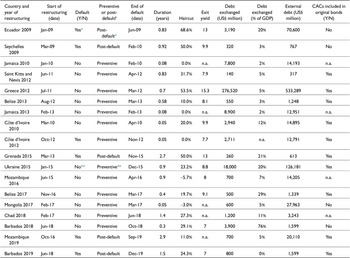
Notably, the above referred specialized literature does not incorporate ‘human rights’ as a relevant variable to measure and understand the implications of debt restructurings. We depart from there and will now study empirical data to verify whether human rights and the social situation in debtor countries are regularly considered in debt restructurings. We take as a benchmark the debt restructurings undertaken between the outbreak of the Global Crisis (2007–2008) and that of the COVID‑19 pandemic (March 2020). These account for the restructuring processes of recent times, with a common legal framework and an international financial architecture, so they can give a general and comparative picture of our argument. Our presentation is an exploratory description of the matter, not a full statistical approach. Through a review of specialized literature, we have identified all the restructuring processes in the period.Footnote 54 These include 19 sovereign debt restructurings by 13 countries: Barbados in 2018 and 2019, Belize in 2013 and 2017, Chad in 2019, Côte d’Ivoire in 2010 and 2012, Ecuador in 2009, Grenada in 2015, Greece in 2012, Jamaica in 2010 and 2013, Mongolia in 2017, Mozambique in 2016 and 2019, St Kitts and Nevis in 2012, Seychelles in 2009, and Ukraine in 2015.
These 19 events can be characterized in relation to literature usual features. Only five out of these 19 events included a default declaration as part of the negotiation. In this regard, it should be noted that the countries that defaulted on their sovereign debt are the countries with the largest haircut sizes in this period.Footnote 55 In this context, the Ecuadorian case stands out, where the government unilaterally declared sovereign default, undertook a citizen audit of the external debt and finally repurchased the bonds. The negotiations lasted on average 10 months before an agreement was reached, with only four cases exceeding one year. On average the haircut was 22.76 per cent of the debt’s present value, but this shows great variation: starting from five cases of reprofiling (which only modifies the maturity of bonds) to four cases with more than half of debt haircuts. Three of the latter had previously defaulted their debts. The amounts of debt negotiated ranged from US$140 million to US$276.5 billion, weighting from 0.2 to 76 per cent of GDP.
To verify whether lenders’ due diligence – as understood in this article – in debt sustainability restructurings has been fulfilled,Footnote 56 haircuts were compared with a range of indicators. All referred cases were assessed using the available data to show the economic and social situation of human rights. The lack of comparable data is a severe problem that limited the selection of indicators. Nevertheless, some general pictures can be shown.Footnote 57
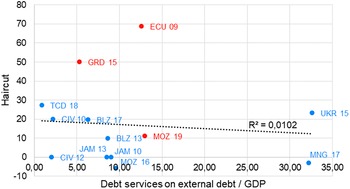
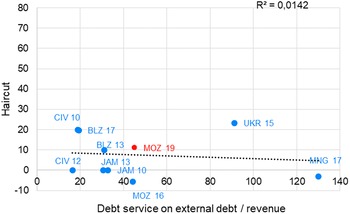
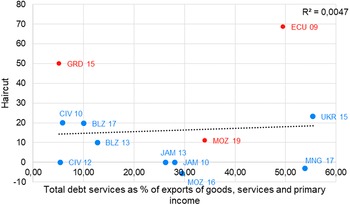
In the first place, we present three indicators centred on debt weight on the countries’ economies: (a) external debt service as a percentage of GDP (Fig. 1); (b) external debt service as a percentage of revenue, excluding grants (Fig. 2); and (c) total debt service (percentage of exports of goods, services, and primary income) (Fig. 3). These comparisons evidence the situation of the countries when restructuring their sovereign debt with private creditors. If creditors take into account the weight of debt on the country’s economy (the so-called ‘debt (in)tolerance’), there should be a relationship: the heavier the burden for the country, the bigger the sacrifice requested from creditors, in order to prevent further human rights deprivation. This would be represented by a positive relationship between the variables considered in the following graphs: the heavier the burden is, the higher the discount from the original principal or the total loan sum should be.
Haircut vs Debt services on external debt / GDP.

Haircut vs debt services on external debt / revenue.

Haircut vs Total debt services as % of exports of goods, services and primary income.
Source: Based on World Bank data.

However, as expected, in none of the three figures it is possible to establish a significant correlation between the variables. These graphs show that the weight of public debt on the national economy – therefore, on the resources available to finance the realization of human rights, in particular economic and social ones – is not regularly relevant when agreeing on debt restructurings. This is observed in the dispersion of the dots in the graph, showing no particular relationship with haircuts. This means that there is no general rule that can be identified; each case is a matter of specific negotiation. Cases with similar weight of debt services got different levels of haircuts, while other cases with lower debt weights got higher haircuts. R2 is a common statistical measure of a correlation (in this exploratory exercise, linear correlation), with a higher value implying a stronger association between variables. Estimated R2 for selected variables show an insignificant low value.
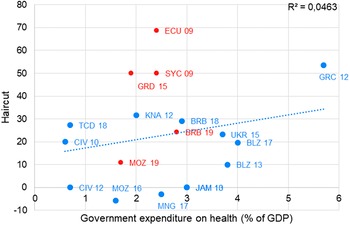
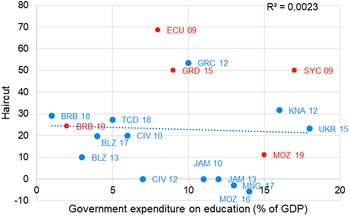
Second, we compared haircuts to the fiscal effort to respect, protect and promote economic and social human rights. The selected available indicators are government expenditure on health (Fig. 4) and government expenditure on education (Fig. 5), both as a percentage of GDP. Although there is no specific value considered universally enough to guarantee human rights (as it depends on concrete situations and trajectories), as all cases are developing countries, the expected relationship should be that greater haircuts must be applied at lower levels of fiscal expenditures for budgetary lines deeply linked to economic and social rights. This is due to the fact that freeing fiscal resources could then be channelled to these uses (e.g., to increase government expenditures on health and education). From Figs 4 and 5, no relationship can be found, which means that these variables are not taken into account in debt restructuring processes.
Haircut vs Government expenditure on health (% of GDP).

Haircut vs Government expenditure on education (% of GDP).
Source: Based on World Bank data.

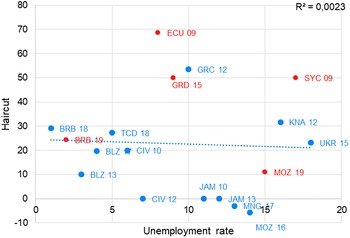
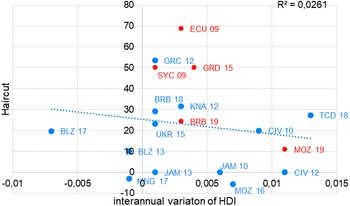
Third, haircuts can be compared with some indicators explicitly related to the human rights situations in debtor countries. These indicators were selected based on the availability of proper data and their sensitivity to annual changes. Greater haircuts should be applied in the context of more acute situations reflected by these indicators. Figure 6 shows the unemployment rate, where higher levels of unemployment would be expected to result in greater haircuts, in order to release resources to boost the economy or to finance employment programs. Meanwhile, Fig. 7 evidences the variation of the Human Development Index (HDI, built on growth, health and education variables) between the year of restructuring and the preceding year. Here, it would be expected that negative variations (i.e., worsening HDI situations) should be associated with greater haircuts, so that levels of realization of human rights are considered.
Haircut vs Unemployment rate.

Haircut vs interannual variaton of HDI.
Source: Elaborated with World Bank and UN Development Programme data.

None of the figures shows clear relationships. In all cases, correlation seems low, and the low values of R2 confirm this. All in all, the data presented here do not evidence any relationship between the economic and social situation of human rights in debtor countries in distress and substantive outcomes – measured in haircut size – as a result of debt restructuring agreements. This is a general picture that requires further empirical investigation. Given the lack of enough available data to conduct such research, Section IV provides an in-depth study of a specific and recent case: Argentina.
IV. Why Focusing on Lenders’ Due Diligence Matters, A Lot
Why don’t private lenders include due diligence on the economic and social human rights of the borrower’s population in the negotiations for sovereign debt restructuring? The restructuring process, as explained in the previous section, focuses on debt sustainability. Therefore, old bonds are replaced by new ones with allegedly better repaying conditions. States tend to commit to trim fiscal deficit, which compromises human rights-related fiscal allocation, to engage with repayments and reduce the need for new debt issuance. Hence, sustainability centres only on the debt repayment capacity, not on the country’s growth oneFootnote 58 or, even less, the state’s ability to realize (finance) economic and social human rights.
The main cause of this phenomenon is not only related to the above-mentioned under-development of legal theory addressing the links between finance and human rights, but also to the negotiation conducted in a deeply asymmetrical relationship. In the last decade, worldwide a huge concentration of financial capital has taken place. Due to deregulation in the main financial markets, some investment funds have grown to reach a critical influence in the capital markets. This elite of investors comprises a limited number of related firms, which operate in different jurisdictions and specific financial markets. Several approaches – in methodology and scope – have identified the existence of this elite. Vitali, Glattfelder and Battiston (2011) observed that 147 companies controlled around 40 per cent of global wealth.Footnote 59 In addition, Haberly and Wojcik (2017) evidenced that 158 of the world’s 205 largest sales firms share at least 5 per cent of their equities.Footnote 60 In turn, Phillips (2018) estimated that the total capital managed by the 17 largest financial firms exceeded US$41.1 trillion.Footnote 61 Moreover, the Boston Consulting Group publishes an annual evaluation of capital markets. In its Global Asset Management 2021,Footnote 62 they found that total assets under management in 2020 reached US$103 trillion, exceeding total world’s GDP; the referred firms control most of these assets.Footnote 63
Available data suggest that US firms own most of peripheral countries’ bonds. In fact, the majority of bonds are issued in US dollars, with jurisdiction in New York courts. In this market, Citigroup is traditionally one of the largest investors, and a new giant has emerged in the last decade: Blackrock. This investment fund acquired Barclays in 2009 and holds shares in two-thirds of the 200 biggest US firms.Footnote 64 This concentration is under-estimated because of indirect participations and the use of underwriters, which builds a complex network of investors connected to each other. This can even reach rating agencies: Blackrock and Vanguard hold shares in Moody’s and Standard & Poor’s. This leads to a significant capacity not only to have information, but also to generate data on countries in debt distress. A possible conflict of interest arises from this fact. For debtor countries, it makes it easier to hire these firms that can rate and issue bonds and even buy them after that. However, this creates an automatic concentration mechanism, which increases the power of the largest investors.
On the other hand, this elite meets the growing demand for credit from developing countries. Besides poor countries, which mainly rely on official credits and aid, peripheral ones resort to private capital markets as an important source of funding. In past decades, they have issued bonds, which can reach a wider range of possible creditors than bank loans, but bonds also imply higher degrees of exposure to volatility in creditors’ moods.
Permanent market negotiation can take advantage of liquidity, but it also increases the influence of creditors on public policies, given that the government is interested in attracting capital to its economy. This is an important fact not evident to public opinion: the growing capacity of potential creditors to influence domestic policies, even without the need to do anything explicit. Rating agencies and the financial press can express their view on which policies to follow (or which to prevent), manufacturing consent by which financial interests are presented as the solely universal. International Financial Institutions can also translate these demands and interpretations, in the form of reports or even conditionalities, to their credits that supposedly work to attract private funding.
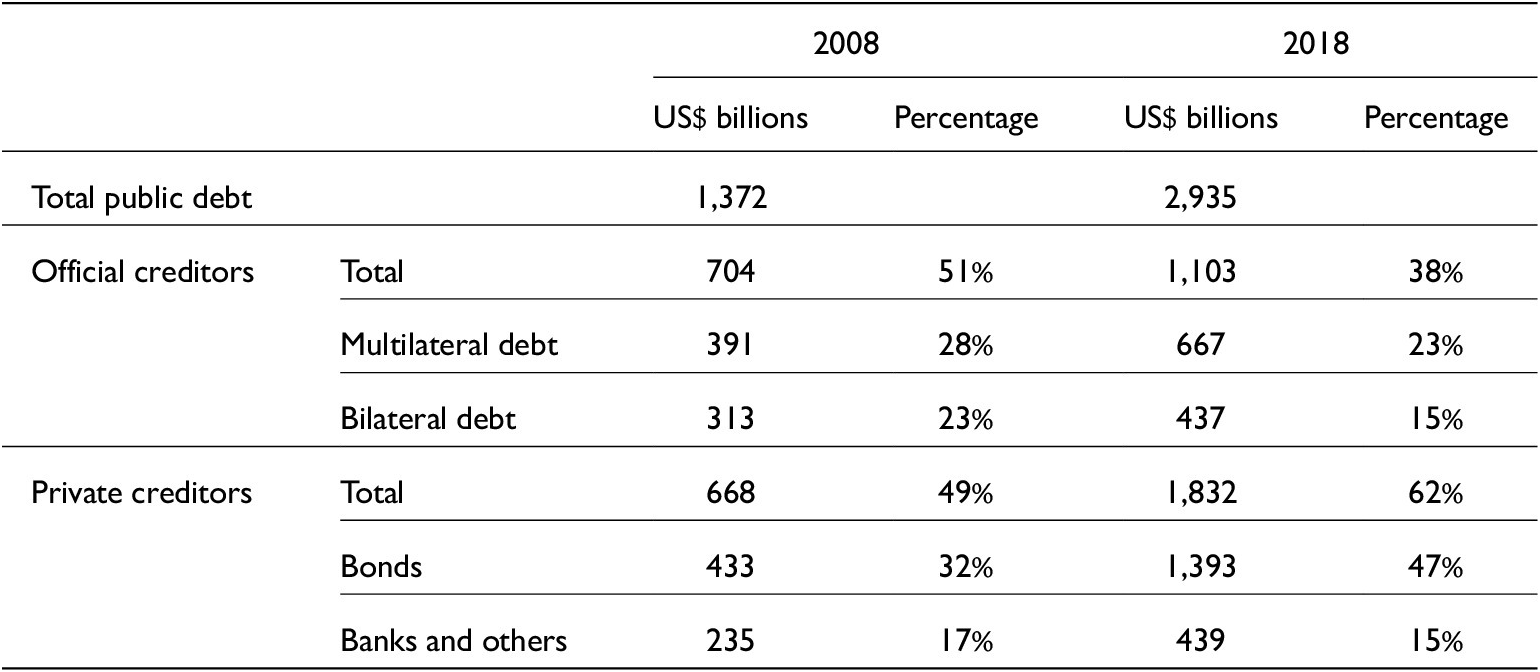
A World Bank report on the debt of 122 low- and middle-income countries examines the financial situation of what could be considered the global periphery.Footnote 65 The total debt of these countries went from US$3.46 trillion in 2008 to US$7.81 trillion a decade later. The biggest jump was observed from 2008 to 2014, when it duplicated in value. Both public and private debt more than doubled between 2008 and 2018. The public (or state-guaranteed) debt incurred with private creditors grew faster (174 per cent between the two years) than that with official creditors (57 per cent in that period). Private debt, especially that taken on through bonds, is the one that expands the most, increasing by 222 per cent. Thus, while in 2008 this last type of debt represented a third of the total public external debt, in 2018 it was almost half.
In this matter, the European Network on Debt and Development (Eurodad) published a report showing that the annual issuance of bonds by the national governments of peripheral countries more than doubled (from less than US$1 trillion in 2000 to around US$2.5 trillion in 2019).Footnote 66 In this period, foreign currency bonds have grown in importance. This report analyses 549 sovereign bonds, issued in foreign currency and government law, from a group of 62 countries with a total public external debt of US$2.1 trillion in 2019. The average rate on these bonds was about 5.7 per cent in 2021, which is particularly high compared with near 0.25 per cent that Federal Reserve Bank (Fed) bonds were paying at the same time. It has been pointed that this vast difference between interest rates can be a powerful mechanism leading to defaults and debt distress situations.Footnote 67 This means that the terms of the negotiated bond create the need for new restructuring processes.
This is a rather unusual report, given the lack of transparency in this matter, despite the fact that creditor and investor associations handle specific information.Footnote 68 Bond issuance implies the presence of secondary markets, which can hinder identifying who owns the credits. Unregistered secondary market or off-market transactions, the existence of custodians and nominee accounts, and securities sold under repurchase agreements are some of the problems in reaching real bondholders,Footnote 69 amid the general lack of regulations that force investors to reveal their positions. As shown in negotiations preceded by defaults, stop paying and waiting for legal claims seem to be the most straightforward ways to know who owns debt.
All in all, the Eurodad report shows a significant asymmetry between the needs of debtor countries and the high capacity of creditors to stand a negotiation. The top 25 institutional creditors had US$42.7 trillion in assets under management, a figure that was equivalent to four times the GDP of the countries considered. These firms held a total of US$113 billion in sovereign bonds, which represented only about 0.4 per cent of their asset portfolio. This allows capturing a highly asymmetric relationship: debtors need investors for issuing bonds, which are mainly held by a small number of firms, but those sovereign bonds do not weigh much in their asset portfolio. As explained in the report:Footnote 70
At times of debt distress, the power imbalance becomes even more significant … While debtors cannot coordinate their positions, as negotiations are arranged on a case-by-case basis, lenders can organize themselves into creditor committees. These are then responsible for conducting discussions with debtors and thereby allow lenders to establish a common negotiating position. While such committees can help to address creditor coordination problems, they also increase creditors’ leverage over a country. This leads to an outsized disparity in the availability of financial, legal and technical resources that favour creditors to the detriment of sovereign debtors. Consequently, the latter are at a structural disadvantage with respect to their creditors in the context of a debt restructuring.
All those puzzle pieces result in a picture of an asymmetrical relationship where creditors gain power over debtor countries. This results in sequential events of restructuring with very low haircuts, followed by new debt distress episodes and restructurings.Footnote 71 If private creditors are not forced to comply with human rights obligations (such as due diligence in the context of debt restructurings), debtors are constrained in their capacity to meet their own ones. This is even more true in extreme situations, as it was with the COVID‑19 pandemic. In March 2020, the World Health Organization declared this pandemic, which threatened human rights throughout the world – not only in health-related matters, but also in terms of education, decent work, food, social protection, or housing, according to the case.Footnote 72 The pandemic triggered the worst economic crisis in a century.Footnote 73 States reacted with different policies under stimulus packages, which raised their fiscal needs.
The pre-existing situation and the growing fiscal needs posed a threat of a generalized debt crisis, which was quickly recognized by the IMF, the World Bank, and the G20. In April 2020, these institutions launched the Debt Services Suspension Initiative (DSSI) and the Common Framework for debt negotiations. Both were focused on multilateral lending agencies and the Paris Club creditor states, excluding private creditors. This proved to be a problem. Countries avoided entering DSSI because it would show that they were facing problems to fulfil their debt obligations, inducing a downgrade of their debt ratings, thus making new funding more expensive. As shown in Table 1, private credit grew to become the main source of resources. As the Common Framework excluded corporate creditors, they could expect official ones to bear the cost of debt relief and cash their credits without significant haircuts. Of course, official creditors did not find this to be fair. Indeed, these initiatives did not provide enough relief to debtors; 41 out of 46 countries participating in DSSI were in debt distress by April 2022.Footnote 74 The reluctance of official creditors to make rapid and significant relief does not contribute to HRDD or tempt corporate creditors to do so. In fact, many calls were made for private creditors to join the Common Framework, but none of them had concrete enforcement measures.Footnote 75 How did private creditors behave in the pandemic-global crisis situation? We lack thorough and updated information on the matter, but we can focus on a particular case: Argentina. The next section provides this analysis.
Peripheral countries’ debt, by creditor and instrument

Source: elaborated with World Bank (2020) data.
V. The Argentine Case in the Spotlight
We now study the Argentine case in depth to verify if and to what extent the social and human rights situation of the debtor country has been considered when agreeing debt restructurings in past years.
During neo-developmentalist administrations (2002–2015), public debt went from a default (December 2001) to an improved sustainability, due to a major restructuring in 2005 and full repayment to the IMF in 2006,Footnote 76 which leads to the idea of a debt relief process.Footnote 77 In the first decade of the twenty-first century, Argentina, as well as other Latin American countries, benefited from better terms of trade (increased international prices for its exportations). Argentina took advantage of that scenario with the implementation of national economic policies, which boosted its trade balance (and fiscal surplus).Footnote 78 This abundance of commercial foreign currency made it possible to accelerate economic growth.
After four years in default, and 22 months of negotiations since the first formal proposal, Argentina managed to restructure 76 per cent of the bonds in distress (US$81.8 billion, equivalent to half of its total public debt), reducing the number of currencies and jurisdictions agreed, as well as interest rates. By that time, GDP was growing fast (more than 8 per cent annually), but poverty and extreme poverty still affected 38.9 and 13.8 per cent of the adult population, respectively, with an unemployment rate at 13 per cent of the active population. The new bonds included a nominal haircut of 75 per cent on the original principal, but the interests generated during the default were added to it, then lowering this haircut. The novelty was a bonus linked to GDP growth, which induced creditors to accept this haircut, given they would recoup some earnings while the economy recovered. Despite the magnitude of this haircut, it must be considered that the defaulted bonds were valued in the capital markets at 22 per cent of their nominal value; hence, in fact, buyers even made some capital gains. The total haircut was calculated to be between 21 and 36 per cent of the total value involved.Footnote 79
Nonetheless, a small group of creditors refused to participate in the process, demanding full repayment. Some of these initiated an early strategy of legal and political harassment, for which they are known as ‘vulture funds’. Given that these defaulted bonds did not have collective action clauses (CACs), the restructuring process was not mandatory for the hold-outs. This meant that the interpretation of the pari passu principle was left to the intervening court. In fact, a New York judge – Thomas Griesa – accepted the claims of the vulture funds for full repayment, rejecting Argentina’s proposal, which had been accepted by almost 93 per cent of the creditors. This judicial ruling criterion allowed resolving the debt restructuring, as, by definition, in a situation of insolvency, creditors cannot be fully repaid. It lasted until 2016, when the Cambiemos administration (2015–2019) applied a profound change in economic policies that included the total repayment of vulture funds demands (for which more debt was taken).
The Cambiemos administration’s debt management was quite different. The liberalization of the economy included freeing capital movements and paying temptingly high interest rates. In fact, the bias towards deregulation and the intensified use of external private borrowing exposed the economy to external shocks. In April 2018, the announcement of possible increases in Federal Reserve interest rates caused such a sudden stop, inducing a ‘flow to quality’ movement of capitals, leaving peripheral economies. This led to a currency and financial crisis in Argentina, which triggered the IMF’s biggest loan in history (US$57.1 billion approved, US$44.5 billion disbursed). The Stand-By Agreement’s objective was to rebuild Argentina’s access to private capital markets, but, in fact, it only provided resources to finance a large and sustained outflow of capital – compared with the IMF agreement, article VI. Capital controls were later reintroduced, but the economy was already in a spiral of devaluation, inflation and recession. By September 2019, the IMF interrupted disbursements and the government rescheduled the national denominated bonds in a mandatory way. Public debt rose to US$323.07 billion, an increase of 34 per cent in just four years. The proportion of bonds denominated in foreign currency also expanded to 77.7 per cent of the total. Debt services grew to 4.3 per cent of GDP or 18 per cent of total public expenditure. At the same time, poverty and extreme poverty intensified considerably, affecting 35.5 and 8 per cent of the adult population, respectively. Argentina’s economy was already trapped in a crisis with adverse human rights implications by the time the pandemic crisis broke out.Footnote 80
When the new administration of Alberto Fernández took office in December 2019, debt restructuring was a top priority. Thanks to an official international tour, Argentina obtained the support of Paris Club members in February 2020. Given that those same countries control the IMF, its support came in hand. In a technical note associated with this support,Footnote 81 the IMF staff urged a debt restructuring process that needed to achieve debt relief of US$50–85 billion by 2030 in the form of face value haircuts, maturity extensions, grace periods, and interest rate cuts. The summary of that report states, ‘Restoring public debt sustainability with high probability will require a decisive debt operation, with a meaningful contribution from private creditors’.Footnote 82 Being a middle-income country, Argentina was not eligible for the DSSI. As explained, the Common Framework did not summon private creditors. Official creditors had no rush to restructure, because the main maturities of their debts were from 2022 onwards. Hence, there was no debt relief of any kind from official creditors. Instead, the IMF explicitly appealed to private investors to engage with the restructuring of Argentina’s debt and reduce their assets, but did not intervene itself.
The Argentine government launched its first offer to private creditors under foreign law in April. It proposed exchanging 21 bonds for 10 new ones, for a total of about US$66.7 billion. Unlike the situation in 2005, bond holdings appeared to be highly concentrated in the hands of a few funds (notably Blackrock, Fidelity, Gramercy, Greylock, Pimco and Templeton). This allowed a more fluid negotiation with better defined interlocutors. In addition, unlike at that time, the new bonds included CACs. This limited the blocking power of vulture funds, while consolidating the bargaining power of the majority holders. In fact, because of both elements, there was a rapid convergence among creditor funds, which were organized around three groups.Footnote 83 This shows that the concentration of creditors facilitates their coordination, which finds on the other side a single country in great and urgent need for resources. The field of negotiation was asymmetrical from the beginning.
The initial proposal presented sought to extend the maturity terms, with a three-year grace period and a low payment burden until 2026. The reduction on the principal averaged 5.4 per cent, although in some bonds it was null, and the interest decrease was around 62 per cent. All things considered, the total discount was far from being aggressive, even in the financial market itself: once the offer was published, it rose the price of defaulted bonds. Despite this, it was almost unanimously rejected by the creditors, initiating a period of offers and counter-offers that would last until August 2020, when an agreement was reached.
Behind this rejection, several aspects converged. First, Argentina took 15 years to solve its last default declaration to regain access to capital markets. Highly concentrated creditors can paralyse restructurings. Second, surely, any government facing a pandemic crisis would not want to face such a long-standing controversy. Private creditors knew that time was on their side in this matter.Footnote 84 Third, Argentina’s creditors included major players in global finance, with credit exposure to third countries. The negotiation with Argentina served as a potential example of the course to follow in the face of the imminent risk of widespread defaults. Any deal accepted would be a precursor to negotiations to come. Fourth, despite the existence of limits on vulture funds’ behaviour, the main creditors had veto power in particular series, which strengthened their negotiating position. All this helps to understand the creditors’ rejection, even considering it as a friendly offer.
In fact, this forced the government to present four successive offers, extending the maximum term to close the swap eight times. In this period of time, US$503 million of maturities were not paid in May, which led the country to a default rating. However, by keeping the channels of dialogue open and the negotiation ongoing, this did not result in litigation by the creditors. Argentina submitted each proposal to the US securities authorities, as well as to the courts involved, in order to demonstrate ‘good faith’ in the negotiations and seeking to act under criteria of reasonableness by showing its interest in reaching a repayment agreement.
Finally, the minister of Economy announced in early August that an understanding has been achieved with the three groups of creditors, an agreement that was terminated one month later. Similar conditions were extended to bondholders under national law, for US$41.4 billion. This was a five-month negotiation (nine since reprofiling), half the time involved in the average previous ones reviewed in Section III, and certainly shorter than the 22-month process that led to the 2005 restructuring. It was the second largest one in the world, behind Greece. This same proposal was extended to foreign currency bonds under national legislation.
As in previous restructuring processes, the focus was not on debt relief, but on an extension of maturities: to delay the problem. The proposal contained relief in terms of immediate disbursements, as payments were strongly reduced during Fernández’s presidency (2019–2023). According to calculations by the Institute for Fiscal and Economic Studies, between 2020 and 2023, US$56,686 million were saved, plus another US$15,656 million for the following presidential term.Footnote 85 However, during 2029 and 2035, the burden is reversed, as US$51,693 million more than expected are charged. In aggregate terms, nominal savings were US$34,555 million, far below the value estimated as sustainable by the IMF report in March, which stated that relief should be around US$50–85 billion. The haircut centred on reducing interest and the longer maturity of the bonds was around 18.3 per cent. As can be compared with the figures in Section III, this is below precedent restructuring haircuts, despite being carried out during a worldwide crisis.
Thus, in the context of the pandemic, private creditors were not forced to coordinate with other creditors to meet common objectives. Instead, they agreed among themselves to obligate a single country to negotiate in the context of increased fiscal needs. Creditors did not deal with a cease of payments, and therefore had no risk of facing default on their own. The process took less time than previous cases, but pursued the same objective: to extend maturities, not to grant debt relief. The high interest rates charged on the original bonds (7 per cent), which was a cause of default, were more than halved (3 per cent). However, this was still a lot: fed funds paid between 0 and 0.25 per cent at the same time, which is less than a twelfth part. All in all, the relief was insufficient in the view of IMF estimations (US$34.5 compared with the US$50–85 billion suggested), and the haircut was lower than pre-pandemic ones (22.76 per cent). Creditors made no evident effort in the face of a severe crisis and the vital state obligation to protect lives in the context of the pandemic and related-economic recession. By the time of the agreement, poverty and extreme poverty affected 42 and 10.5 per cent of the adult population, respectively, and GDP was falling at a rate of 9.9 per cent. The public health emergency due to the pandemic, the acute social and economic situation, and the recommendations made by international official financial institutions were not taken into consideration for the purposes of calculating the haircuts needed to restore debt sustainability. In that sense, the lengthy negotiations of 2005, with a default involved, seem to have worked more efficiently as a way to pressure corporate creditors into accepting greater haircuts in line with the fiscal and human-rights needs of the state.
VI. Concluding Remarks
Private lenders are bound by international human rights law, as the rest of corporate mortals in the world. When dealing with sovereign borrowers, these creditors should follow the HRDD standards – which have been crystallized and systematized in official documents of UN bodies and agencies – to ensure that, at the very least, they do not harm debtor populations. More specifically, this means that, when dealing with States in debt distress and having to take financial decisions that will have profound fiscal (therefore, human rights) implications for these populations, lenders should undertake due diligence in order to determine and agree to a haircut (debt relief) that is sensitive to the socio-economic situation of the country in question. The size of the haircut applied must meet fiscal needs of the social and economic human rights.
Yet, reality shows that social variables, intrinsically linked to economic and social human rights, have not been regularly considered when negotiating and deciding on haircuts for borrowing countries in debt distress. More specifically, the debt weight of the economies of countries in general, the volume of government expenditures on health and education, and the more specific indicators directly reflecting the economic and social human rights situations (such as unemployment) have not been relevant variables in determining the haircut size in debtor countries in distress.Footnote 86 This conclusion is based on aggregated evidence of sovereign debt restructurings that took place between 2007 and 2020, and by the specific case of Argentina’s 2005–2006 and 2020 debt restructurings.
Both the increasing financialization of the world and the hyper-concentration of sovereign bonds in a few funds of wealthy corporate investors help to understand the neglected role that HRDD has been playing in debt restructurings. In turn, this asymmetric power relationship between lenders and borrowers highlights the paramount importance of creditors’ due diligence.
In the search of creating incentives and disincentives to encourage businesses to respect human rights and remediate adverse impacts,Footnote 87 courts can play a key role in determining the contents of hold-out creditor claimants’ property rights in cases where debtor States defend themselves arguing that minimum fiscal resources are vital to ensure the realization of core human rights. Indeed, exogenous and enforceable standards are needed to maximize cooperative behaviours among creditors and minimize free-riders’ expectations as all should base their decisions regarding haircuts, to some extent, on the social and economic situation of the concerned debtor countries.
With this article, we attempted to put this topic on the radar of academic and policy debates about the human rights obligations of financial corporations, as well as sovereign debt. Further research is needed in, for example, extending the historical data series of debt restructurings and cross-country comparative socioeconomic indicators (yet, this proved to be a real challenge during the statistical research for this article), and studying the legal and institutional implications of the conclusions proposed here for credit rating agencies.
Acknowledgements
The authors wish to extend their gratitude for the insights received from Ilias Bantekas, Daniel Bradlow, Barry Herman, Oliver Pahnecke and Kunibert Raffer.
Competing interest
The authors declare none.
APPENDIX 1
Sovereign debt restructurings with private creditors in the inter-crisis period, 2007–2020

Source: Elaborated with data from ECB (2020), IMF (2020), IMF (2013), Cruces and Trebesch (2013); Sturzenneger and Zettelmeyer (2008).