INTRODUCTION
The family Comesomatidae is represented by more than 150 species (Fonseca & Bezerra, Reference Fonseca, Bezerra and Schmidt-Rhaesa2014). It is documented worldwide and is among the most common and abundant components of muddy or silty sediments (Heip et al., Reference Heip, Vincx and Vranken1985). The phylogenetic position of Comesomatidae has long been debated (see Fonseca & Bezerra, Reference Fonseca, Bezerra and Schmidt-Rhaesa2014 for details). However, current molecular data support the family Comesomatidae as a member of the order Monhysterida (Meldal et al., Reference Meldal, Debenham, De Ley, De Ley, Vanfleteren, Vierstraete, Bert, Borgonie, Moens, Tyler, Austen, Blaxter, Rogers and Lambshead2007).
Comesomatidae are currently divided into three sub-families: Comesomatinae, Dorylaimopsinae and Sabatieriinae. Comesomatinae are characterized by elongate spicules and buccal cavities cylindrical, dilated or collapsed, provided with projections at the border to the anterior portion. Dorylaimopsinae are characterized by the posterior part of the buccal cavity structurally expanded, with tooth-like structures present, while Sabatieriinae are characterized by the lack of these two features (Platt, Reference Platt1985).
The Comesomatinae sub-family consists of four genera: Comesoma, Paracomesoma, Metacomesoma and Comesomoides, for a total of 28 species. The Paracomesoma genus is the most species-rich genus of Comesomatinae, comprising itself 14 species (Tu et al., Reference Tu, Vanreusel, Smol, Long and Thanh2013). The genus Paracomesoma was established by Stekhoven (Reference Stekhoven1950) for systematizing the new species Paracomesoma coronata. He also transferred Comesoma dubium Filipjev, Reference Filipjev1918 to the genus Paracomesoma because of the structure of the buccal cavity. Subsequently, Wieser (Reference Wieser1954) synonimized P. coronata with Paracomesoma dubium. The genus Paracomesoma was considered invalid by Hopper (Reference Hopper1967), because no type species had been designated. However, Hopper reinstated the genus in order to accommodate two species of the genus Laimella: Laimella hexasetosa Chitwood, Reference Chitwood1937 and L. quadrisetosa Chitwood, Reference Chitwood1937, since the characteristic structure of their male apparatus did not fit that of the genus Laimella. Hopper also moved Vasostoma longispiculum Timm, Reference Timm1961 in the Paracomesoma genus for the small buccal cavity, the presence of elongated spicules and the absence of caudally directed apophyses on gubernaculum. Later, Hope & Murphy (Reference Hope and Murphy1972) designated Comesoma dubium (Filipjev, Reference Filipjev1918) as the type species of the genus Paracomesoma.
Jensen & Gerlach (Reference Jensen and Gerlach1977) described P. inaequale and assigned Comesa sipho Gerlach, Reference Gerlach1956 to this genus, on the basis of the structure of the buccal cavity and the copulatory apparatus. For the same reason Jensen (Reference Jensen1979) also transferred Sabatieria curvispiculum Allgén, Reference Allgén1959 to the genus. The last species included in the genus were: P. curvatum Gagarin & Thanh, Reference Gagarin and Thanh2006; P. elegans Gagarin & Thanh, Reference Gagarin and Thanh2009; P. heterosetosum Zhang, Reference Zhang1991; P. lissum Gagarin & Thanh, Reference Gagarin and Thanh2009; P. paralongispiculum Tu et al., Reference Tu, Vanreusel, Smol, Long and Thanh2013; P. sigmoidalis Riera et al., Reference Riera, Nunez and Brito2006; and P. xiamenense Zou, Reference Zou2001.
In samples recently collected from back-reef platforms of the Maldivian archipelago, some specimens belonging to the Paracomesoma genus were found. In this type of habitat, Comesomatidae represented less than 1% of the total community (Semprucci et al., Reference Semprucci, Colantoni, Baldelli, Rocchi and Balsamo2010, Reference Semprucci, Colantoni, Sbrocca, Baldelli, Rocchi and Balsamo2011), but their importance appeared to increase in coral sediments of the deeper subtidal habitats in relation to the greater mud fraction (Semprucci et al., Reference Semprucci, Colantoni, Baldelli, Sbrocca, Rocchi and Balsamo2013, Reference Semprucci, Colantoni, Sbrocca, Baldelli and Balsamo2014). No Comesomatidae species had been documented so far for the Maldivian archipelago.
Here, a new species of Paracomesoma is described and its systematic position is discussed. This is also an occasion to emend the diagnosis of a species of the genus recently described and to propose a modified, updated identification key to the species of Paracomesoma.
MATERIALS AND METHODS
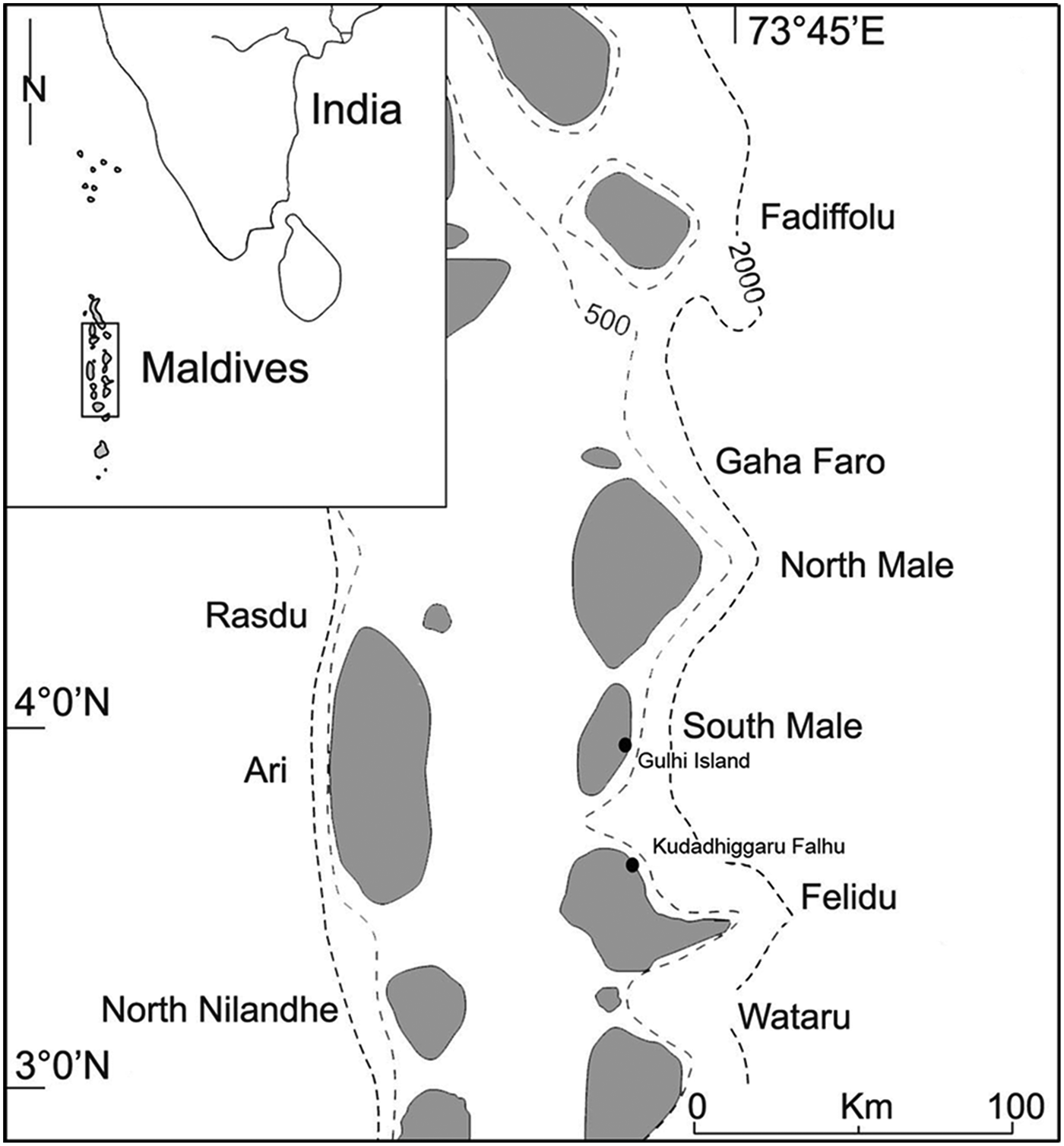
Samples of sediment were collected from the atolls of South Malé and North Felidu in May 2005 and 2007 (Figure 1). The studied habitats were back-reefs platforms entirely characterized by coral sediments (Semprucci et al., Reference Semprucci, Colantoni, Baldelli, Rocchi and Balsamo2010, Reference Semprucci, Colantoni, Sbrocca, Baldelli, Rocchi and Balsamo2011). The samples were collected by a diver using a Plexiglass corer tube (diameter 2 cm) which was pushed 5 cm into the sediment. The sediment was immediately treated with 7% MgCl2 to relax the fauna, fixed with a 4% formaldehyde solution (in buffered seawater), meiofauna were obtained by sieving the samples through a 42 µm mesh net and animal extraction was performed by flotation and multiple decantation. When a high amount of fine fraction was present, samples were centrifuged using a silica gel gradient (Ludox HS 30, density 1.18 g cm−3) (Pfannkuche & Thiel, Reference Pfannkuche, Thiel, Higgins and Thiel1988). Nematode specimens were isolated under a stereomicroscope, transferred in glycerine and mounted as permanent slides (Seinhorst, Reference Seinhorst1959). The specimens were identified under a 100× oil immersion objective with DIC Nomarski illumination (Optiphot-2 Nikon). Drawings were made using a camera lucida mounted on a Zeiss Universal microscope. All measurements are in micrometres and curved structures were measured along the arc.
Map of the Maldivian archipelago showing the type localities.

Abbreviations
- a:
total body length divided by maximum body diameter
- abd:
anal body diameter
- b:
total body length divided by pharyngeal length
- c:
total body length divided by tail length
- cbd:
corresponding body diameter
- hd:
head diameter
- L:
body length
- Mbd:
maximum body diameter
- s′:
spicule length divided by abd
- spic:
spicule
- PL:
pharynx length
- TL:
tail length.
RESULTS
SYSTEMATICS
Order MONHYSTERIDA Filipjev, Reference Filipjev1929
Superfamily AXONOLAIMOIDEA Filipjev, Reference Filipjev1918sensu Chitwood & Chitwood, Reference Filipjev1950
Family COMESOMATIDAE Filipjev, Reference Filipjev1918
Subfamily COMESOMATINAE Filipjev, Reference Filipjev1918
Genus Paracomesoma Hope & Murphy, Reference Hope and Murphy1972
Genus Paracomesoma Hope & Murphy, Reference Hope and Murphy1972 (emended from Jensen, Reference Jensen1979; Platt, Reference Platt1985)
DIAGNOSIS
Cuticle with transverse annules or puntuactions, sometimes difficult to discern. Lateral differentiation present or absent. Anterior sensilla in three distinctly separated crowns. Posterior portion of the buccal cavity cylindrical, with strongly sclerotized walls and provided with three or six thorn-like projections at the border of the anterior portion. Spicules long and slender. Gubernaculum plate-like without dorsal apophysis.
Number of species: 14
TYPE SPECIES
P. dubium (Filipjev, Reference Filipjev1918).
LIST OF VALID SPECIES
The present list of valid species is accord with Tu et al. (Reference Tu, Vanreusel, Smol, Long and Thanh2013). For each species taxonomic notes and geographical distribution are specified.
Paracomesoma curvispiculum (Allgén, Reference Allgén1959); Allgén, Reference Allgén1959: 154, fig. 155a, b [Sabatieria curvispiculum]; Jensen, Reference Jensen1979: 93 (Paracomesoma curvispiculum comb. nov.); South Georgia.
Paracomesoma curvatum (Gagarin & Thanh, Reference Gagarin and Thanh2006); Gagarin & Thanh, Reference Gagarin and Thanh2006: 226–228, figures 16–22; Tu et al., Reference Tu, Vanreusel, Smol, Long and Thanh2013: 146 (erroneously reported as P. curvitatus); Vietnam.
Paracomesoma dubium (Filipjev, Reference Filipjev1918); Filipjev, Reference Filipjev1918: 335–336, figure 77a–c [Comesoma dubium]; Kreis, Reference Kreis1929: 82–83, figure 36a–f (Comesoma dubia); Stekhoven, Reference Stekhoven1950: 148–150, figure 89a–f (syn. Paracomesoma coronata) op Wieser (Reference Wieser1954): 140; Gerlach, Reference Gerlach1964: 20 (Laimella dubia); Zhou & Zhang, Reference Zhou and Zhang2003: 179–180, figure 3; Black Sea, English Channel, Mediterranean Sea, Red Sea, Hong Kong.
Paracomesoma elegans (Gagarin & Thanh, Reference Gagarin and Thanh2009); Gagarin & Thanh, Reference Gagarin and Thanh2009: 7–10, figure 1; Vietnam.
Paracomesoma heterosetosum Zhang, Reference Zhang1991; Zhang, Reference Zhang1991: 54–56, figures 5–10; Bohai Sea.
Paracomesoma hexasetosum (Chitwood, Reference Chitwood1937); Chitwood, Reference Chitwood1937: 59, figure 21f–h [Laimella hexasetosa]; Hopper, Reference Hopper1967: 140 (Paracomesoma hexasetosum comb. nov.); Pearse et al., Reference Pearse, Humm and Wharton1942: 182; North Carolina.
Paracomesoma inaequale (Jensen & Gerlach, Reference Jensen and Gerlach1977); Jensen & Gerlach, Reference Jensen and Gerlach1977: 61–63, figures 1, 2; Bermuda.
Paracomesoma lissum (Gagarin & Thanh, Reference Gagarin and Thanh2009); Gagarin & Thanh, Reference Gagarin and Thanh2009: 10–11, figure 2; Vietnam.
Paracomesoma longispiculum (Timm, Reference Timm1961); Timm, Reference Timm1961: 53–54, figure 38a–c [Vasostoma longispiculum]; Hopper, Reference Hopper1967: 140 (Paracomesoma longispiculum comb. nov.); Bay of Bengal.
Paracomesoma quadrisetosum (Chitwood, Reference Chitwood1937); Chitwood, Reference Chitwood1937: 58–59, figure 21d, e [Laimella quadrisetosum]; Chitwood & Chitwood, Reference Chitwood and Chitwood1937 (1938): figure 60y; Pearse et al., Reference Pearse, Humm and Wharton1942: 182; Wieser, Reference Wieser1960: 126; Hopper, Reference Hopper1967: 140 (Paracomesoma quadrisetosa comb. nov.); North Carolina, Massachusetts, USA.
Paracomesoma paralongispiculum (Tu et al., Reference Tu, Vanreusel, Smol, Long and Thanh2013); Tu et al., Reference Tu, Vanreusel, Smol, Long and Thanh2013: 144–147, figures 1, 2; Vietnam.
Paracomesoma sigmoidalis (Riera et al., Reference Riera, Nunez and Brito2006); Riera et al., Reference Riera, Nunez and Brito2006: 55–58, figures 1, 2, Canary Islands, North Atlantic Ocean.
Paracomesoma sipho (Gerlach, Reference Gerlach1956); Gerlach, Reference Gerlach1956: 212–214, figure 27c–e [Comesoma sipho]; Jensen & Gerlach, Reference Jensen and Gerlach1977: 62 (Paracomesoma sipho comb. nov.); Tu et al., Reference Tu, Vanreusel, Smol, Long and Thanh2013: 146 (erroneously reported as P. siphon); Pernambuco, Brazil.
Paracomesoma xiamenense (Zou, Reference Zou2001); Zou, Reference Zou2001: 50–52, figures 1, 9–13; Tu et al., Reference Tu, Vanreusel, Smol, Long and Thanh2013: 146 (erroneously reported as P. xiamenese); Xiamen Islands, China (Figures 2, 3 and Table 1).
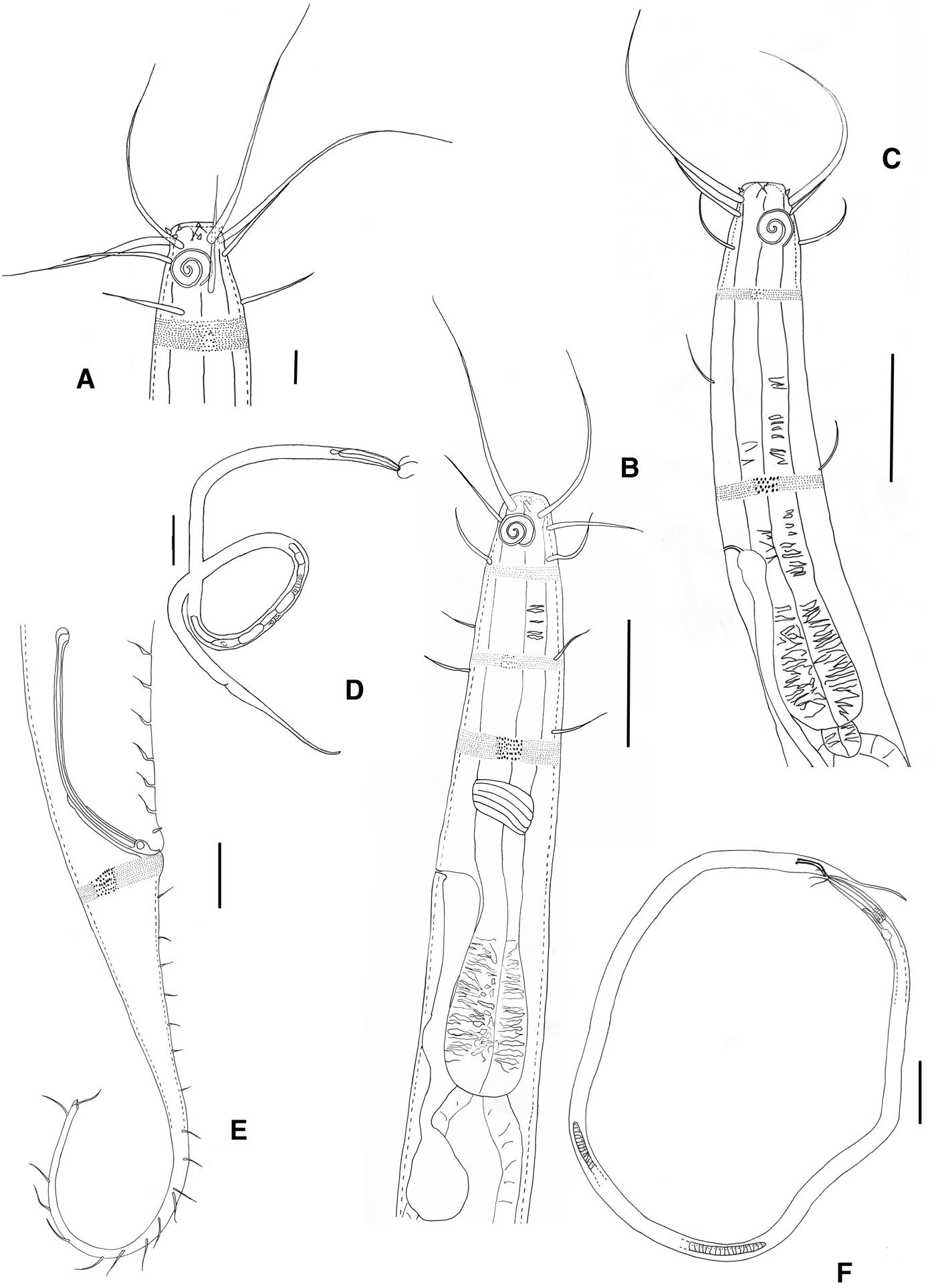
Paracomesoma susannae sp. nov.: (A) detail of the cephalic region of a male paratype; (B) pharyngeal region of the holotype; (C) pharyngeal region of the allotype; (D) female paratype habitus; (E) tail view of holotype; (F) holotype habitus. Scale bars: A, 10 µm; B, C, 50 µm; D, F, 200 µm; E, 40 µm.
Paracomesoma susannae sp. nov.: (A) lateral view of amphid; (B) buccal cavity of holotype; (C) lateral differentiation in the pharyngeal region; (D) detail of the hook-like structure in the distal part of the gubernaculum; (E) detail of the precloacal supplements; (F) ejaculatory glands in the precloacal region of the holotype; (G) detail of the spinneret in the holotype; (H) mid-body region showing vulva of a paratype female. Scale bars: A–E, G, H, 10 µm; F, 50 µm.
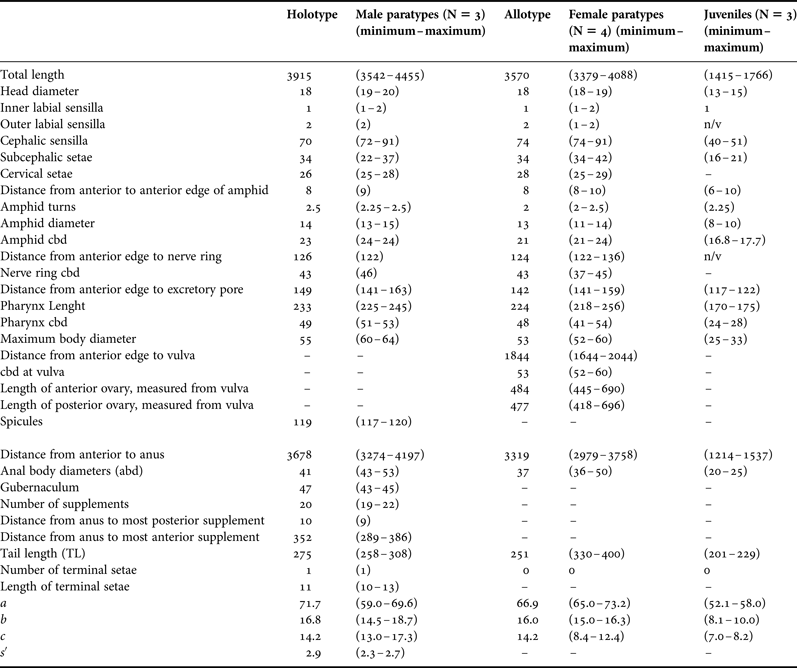
Morphometric measurements for Paracomesoma susannae sp. nov. (all measurements in μm, except ratios values; for paratypes minimum and maximum values are provided).
Paracomesoma susannae sp. nov.
SPECIMENS
Four males; five females; three juveniles.
TYPE MATERIAL
The holotype, allotype and paratypes (3♂ and 4♀) are deposited at the Department of Earth, Life and Environmental Sciences (DiSTeVA), University of Urbino, Italy. The material was collected by Maria Balsamo, Paolo Colantoni and Giuseppe Baldelli.
TYPE LOCALITY
The new species has been found in back-reef platforms characterized by coral sediments (Maldive Islands, Indian Ocean). The holotype was found in Gulhi Island (South Malé Atoll) at 0.60 m (Figure 1).
ADDITIONAL LOCALITIES
Male paratypes were found in Kudadhiggaru Falhu (Felidu Atoll) and Gulhi Island from 0.60 to 1.10 m (Figure 1). Female paratypes were found in Gulhi Island, Kudadhiggaru Falhu from 0.30 to 1.10 m. Juveniles were found in the same localities at a depth of 1.10 m.
TYPE HABITAT
The holotype was collected by poorly sorted medium sands at a depth of 0.60 m. The sediments were composed of 7.6% of gravel, 90% of sand and 2.6% of clay with a sorting of 1.31. Overall, the new species has been recorded at depths between 0.30 and 1.10 m. The coral sediments were characterized from poorly sorted medium to very coarse sands (gravel: 7.6–16.4%, sand: 81–90%, clay: 1.4–2.9%).
ETYMOLOGY
The species is named in honour of Professor Susanna De Zio-Grimaldi (University of Bari, Italy), in recognition of her contribution to the field of marine meiobenthology.
DESCRIPTION
Male
Body slender with a conical–cylindrical tail. Small and regular punctuations at ventral and dorsal body sides. Lateral body fields with large dots in few transversal rows and irregularly arranged from the first third of the pharynx. Size of larger dots increasing gradually up to the end of the pharynx. Buccal cavity small, armed at the base with three teeth. Multispiral amphideal fovea with 2.5 turns, located closely behind the sub-cephalic setae. Anterior border of fovea at 7.8 µm from anterior body end. Diameter of amphidial fovea 0.6 of the c.b.d.. Inner and outer labial sensilla in form of setiform papillae. Cephalic sensilla very long (3.88 hd long) located 0.52 hd from the anterior body end. Sub-cephalic setae (1.90 hd long) very close to cephalic sensilla, at 0.66 hd from anterior extremity. A ring of cervical setae (26 µm long) immediately behind the amphid. Somatic setae (about 0.28 cbd long) scattered and numerous. Pharynx cylindrical that anteriorly surrounds the entire buccal cavity and posteriorly gradually enlarges into a bulb (26% of the PL). Pharynx with evident granulations for most of its length and striations in the bulb region. Nerve ring at about 54% of the PL. Secretory–excretory pore just anterior to pharyngeal bulb (64% of PL) with a prominent excretory cell just posterior to the bulb. Cardia cells not visible. Reproductive system diorchic. Testes opposite and outstretched with visible spermatozoa irregularly oviform. Male spicules paired and elongate (118.5 µm, 2.9 abd) with a cephalate capitulum. Tubular gubernaculum covering almost one-third of the spicule length (46.6 µm). Presence of a hook-like structure in the distal part of the gubernaculum. Numerous ejaculatory lateral glands situated anteriorly to cloaca, 8 left, 10 right. Minute pre-cloacal supplements (20 in the holotype and 19–22 in the paratypes). Caudal glands not observed. Tail is conical–cylindrical, 275 µm long, without an evident spinneret; a single terminal seta, 11.1 µm long.
Female
General appearance similar to the male's one. Cuticle with irregular punctations and lateral differentiation. Buccal cavity small, armed at the base with three teeth. Multispiral amphideal fovea with two turns (diameter 0.6 cbd) close behind sub-cephalic setae (8 µm from anterior body end). Inner and outer labial sensilla in form of setiform papillae. Cephalic sensilla very long (4 hd long) located 0.5 hd from anterior body end. Sub-cephalic setae (2 hd long) very close the cephalic setae, located on 0.7 hd from anterior extremity. A ring of cervical setae 28 µm long. Somatic setae numerous and 0.2 cbd long. Pharynx gradually enlarging posteriorly into a bulb (25% of the PL). Nerve ring at 55% PL from anterior, while the secretory–excretory pore at 63% of PL. Genital system didelphic, amphidelphic with outstretched ovaries (anterior branch: 484 µm; posterior branch: 477 µm). Eggs observed in the uterus with a spermatheca for each branch containing oval sperm cells. Vulva located at 52% of the body length. Vagina surrounded by constrictor muscles, granular vaginal glands present. Tail 251 µm long, no terminal setae observed.
Juveniles
Similar to adults in most morphological aspects.
DIAGNOSIS
Paracomesoma susannae sp. nov. is characterized by a comparatively slender and large-sized body (L = 3541–4455 µm, a = 59–71), very long cephalic setae (72–91 µm long), lateral differentiation of punctuations, and in the males 19–22 minute precloacal supplements, relatively short spicules (117–120 µm corresponding to 2.3–2.9 abd) and a hook-like structure in the distal part of the gubernaculum. Furthermore, P. susannae sp. nov. is unique within this genus, for the especially low ratio between the length of the outer labial and the cephalic sensilla, respectively (about 0.02).
DIFFERENTIAL DIAGNOSIS
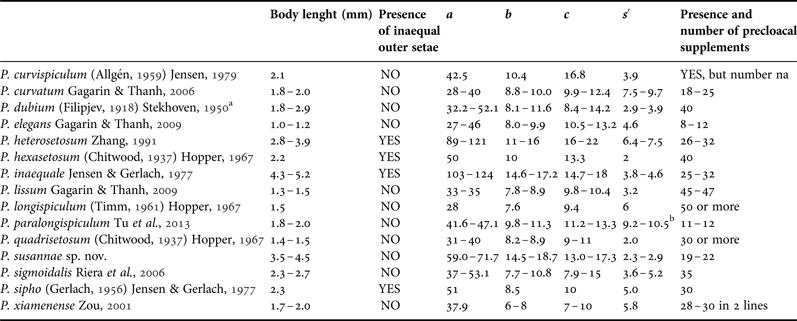
Paracomesoma susannae sp. nov. is especially similar to P. dubium, P. quadrisetosum, P. hexasetosum and P. lissum for the low s′ value. However, the new species differs in the largest de Man's ratios a and b, the presence of a lateral differentiation of the cuticle and the more anterior location of the sub-cephalic setae. The latter character was also described in P. sigmoidalis in which, however, they are 28 µm vs 12 µm far from the anterior end. Furthermore, P. susannae sp. nov. has a larger de Man's ratio (a, b, c) and a shorter spicule (2.3–2.9 vs 3.6–5.2). In addition, the number of precloacal supplements is lower with respect to all the above cited species (19–22 in P. susannae sp. nov. vs more than 40 in P. hexasetosum, 45–47 in P. lissum, more than 30 in P. quadrisetosum, 35 in P. sigmoidalis) (Table 2).
Morphometrics of males of valid species of the genus Paracomesoma.
na, not available; a, the measurements of the original description have been integrated with Zhou & Zhang (Reference Zhou and Zhang2003); b, the ratio is refered to the new measurements taken by the author.
REMARKS
Tu et al. (Reference Tu, Vanreusel, Smol, Long and Thanh2013) stated that P. curvatum and P. longispiculum are the closest species to P. paralongispiculum, and reported the notable length of the spicule apparatus as the main distinctive character of the latter species.
Re-examination of the holotype and paratypes of P. paralongispiculum revealed a shorter spicule length compared to that reported in the original description: 9.8 abd and 310 µm of length in the holotype (309–342 µm corresponding to 9.2–10.5 abd in the paratypes). In particular, the comparison of this species with P. curvatum clearly shows that there is no sharp distinction between the respective ranges of the s′ ratio (9.2–10.5 vs 7.5–9.7 abd). However, the two species also differ in the number and distribution of the papillae supplements: 11–12 restricted to the spicular region in P. paralongispiculum vs 18–25 (5–8 supplements in the spicular region) in P. curvatum. Furthermore, only the latter species has two distal sclerotized drop-shaped pieces of the gubernaculum.
Paracomesoma longispiculum differs from P. paralongispiculum in having longer cephalic setae (8 µm vs 5 µm), shorter spicules (only 225 µm long) and more precloacal supplements (50 cuticular ‘bumps’.
According to these new observations the diagnosis of P. paralongispiculum is emended as follows.
According to these new observations the diagnosis of P. paralongispiculum is emended as follows.
Paracomesoma paralongispiculum Tu et al., Reference Tu, Vanreusel, Smol, Long and Thanh2013
Diagnosis (emended from Tu et al., Reference Tu, Vanreusel, Smol, Long and Thanh2013)
Male
Body 1.8 mm long. Cuticular ornamentation characterized by punctuations at ventral and dorsal sides of the body. Lateral differentiations consisting of larger dots rather than punctuations. Width of lateral fields about 30–35% of the cbd. Labial region with six inner labial papillae; six outer short labial setae 4 µm long. Four slender cephalic setae, 5 µm long (50% of the cbd). Four cervical setae, 6 µm long, at 25 µm from anterior body end. Somatic setae, 6 µm long, arranged into regularly scattered, sublateral rows. Multispiral amphideal fovea with 2.5 turns, situated at the cephalic setae region (diameter 79%). Buccal cavity composed of two parts, the anterior cup-shaped, with three small teeth, the posterior in form of a cuticularized tube ~1.5 times as long as the labial region width. Pharynx gradually enlarging towards the posterior end, 179 µm long. Nerve ring at 102 µm from the anterior end (57% of the PL). Secretory–excretory system consisting of unicellular gland located at anterior intestine; duct with distinct ampulla and pore at 110 µm from anterior end. Reproductive system diorchic, testes opposite and outstretched. Male spicules 310 µm long, thin and bent (9.8 abd); proximal part open, weakly developed. Gubernaculum small, 5 µm long. Precloacal ventromedian supplements, 11 in number; small, indistinct papillae in the spicular region. Tail short (157 µm long), with conical anterior portion and narrow cylindrical posterior portion. Caudal setae short and numerous. Tail tip with three terminal setae 7 µm long. Caudal glands present within the tail region; spinneret short, conical.
Female
Similar to the male in general morphology. Body 1.9 mm long. Cuticle striated and marked by fine irregular punctuations, larger at lateral body sides than at ventral and dorsal ones. Somatic setae short, 6 µm long, and numerous. Cephalic end set off from the rest of body by a slight narrowing. Internal labial papillae small. Outer labial setae 4 µm long, and four cephalic setae, 5 µm long. Multispiral amphideal fovea with 2.5 turns, situated at the posterior cephalic setae region (diameter 71 % of cbd). Pharynx swollen posteriorly, 185 µm long. Cardia small, embedded within the intestine. Length of rectum approximately equal to 1/3 of abd. Ventral gland compact, situated at cardia level; secretory–excretory pore at distance 117 µm from anterior body end. Reproductive system didelphic, amphidelphic with ovaries outstretched. Uterus filled with mass of round spermatozoa. Vagina short, with muscular walls, opening into a vulva at middle body, at 44% of body length. Tail with conical anterior portion, and cylindrical posterior portion, the former 0.7 times as long as the latter. Tail provided with short caudal setae. Tail tip enlarged, with three terminal setae 6–7 µm long, spinneret short, conical.
KEY OF THE GENUS PARACOMESOMA
Previous keys of the genus have been proposed by Jensen (Reference Jensen1979), Zhang (Reference Zhang1991), Zou (Reference Zou2001) and finally Tu et al. (Reference Tu, Vanreusel, Smol, Long and Thanh2013). With the addition of the new Maldivian species, the present list of Paracomesoma species includes 15 valid species. A modified, updated key for identification of the species of the genus is reported.
1. All the six setae of outer labial setae ring similar .............. 2
— Lateral setae of outer labial setae ring longer than the others .............. 12
2. Spicules >7.0 times abd .............. 3
— Spicules <7.0 times abd .............. 4
3. Spicules 7.5–9.7 times abd with distal sclerotized drop-shaped pieces; 5–8 supplements restricted to the spicular region .............. P. curvatum
— Spicules 9.2–10.5 times abd; distal sclerotized drop-shaped pieces absent; 11–12 supplements restricted to the spicular region ............... P. paralongispiculum
4. Spicules long 6.0 times abd; >50 supplements; male body length 1.5 mm .............. P. longispiculum
— Spicules <6.0 times abd; <50 supplements .............. 5
5. Spicules unequal in length; on average 5.8 times abd; 28–30 supplements in 2 rows; male body length 1.7–2.0 mm .............. P. xiamenense
— Spicules equal in length <5.8 times abd .............. 6
6. Body length <1.9 mm .............. 7
— Body length >1.9 mm .............. 9
7. Spicules 2.0 times abd; male body length 1.4–1.5 mm .............. P. quadrisetosum
— Spicules >2.0 times abd .............. 8
8. Spicules 4.6 times abd; 8–12 supplements; cuticle with laterally differentiated punctuations; male body length 1.0–1.2 mm .............. P. elegans
— Spicules 3.2 times abd; 45–47 supplements; cuticle smooth; male body length 1.3–1.5 mm .............. P. lissum
9. Spicules 3.9 times abd; male body length 2.1 mm .............. P. curvispiculum
— Male body length >2.3 mm .............. 10
10. Spicules 2.3–2.9 times abd; a hook-like structure in gubernaculum distal part; 19–22 supplements; male body length 3.5–4.5 mm .............. Paracomesoma susannae sp. nov.
— Spicule >2.9 times abd; hook-like structure in gubernaculum distal part absent .............. 11
11. Spicules 2.9–3.9 times abd; 40 supplements; amphideal fovea with 2.5–3.0 turns, male body length 2.8–2.9 mm .............. P. dubium
— Spicules 3.6–5.2 times abd; 35 supplements; amphideal fovea with 3.5 turns; male body length 2.3–2.7 mm P. sigmoidalis
12. Lateral outer labial setae 2 times as long as the other four cephalic setae; spicules equal or >5 times abd .............. 13
— Lateral outer labial setae >2 times as long as other four setae .............. 14
13. Spicules 5 times abd; male body length 2.3 mm .............. P. sipho
— Spicules 6.4–7.5 times abd; paired cervical setae just posterior to the amphideal fovea; gubernaculum with a small directly dorsally projection; male body length 2.8–3.9 mm .............. P. heterosetosum
14. Lateral setae of outer labial sensilla 5 times as long as other four setae; spicules 2 times abd; >40 supplements; male body length 2.2 mm .............. P. hexasetosum
— Lateral setae of outer labial sensilla 4 times as long as four setae; 6 sclerotized, double-hooked projections in anterior buccal cavity; spicules 3.8–4.6 times abd; 25–32 supplements; male body length 4.3–5.2 mm .............. P. inaequale
DISCUSSION
The key characters most useful in differentiating the species of this genus are the body size, relative lengths of the outer labial setae, the relative size of the male spicules and the number and arrangement of the precloacal supplements. Although the differences in the number of supplements may be important to distinguish species in this genus and in other genera of the Comesomatidae family, they are often minute and difficult to observe. Accordingly, Barnes et al. (Reference Barnes, Kim and Lee2012) suggested the use of a scanning electrom microscope (SEM) to determine the exact number of supplements in some representatives of this family. However, the opening of these supplements is so minute that sometimes is difficult to detect even by SEM (personal observations) and thus their use as one of the main characters for a diagnostic key becomes problematic. This issue and the problems concerned with the spicule length of P. paralongispiculum, highlight the need to increase the number of characters usable for the identification key of the genus. Additional informative characters may be the number of turns and relative diameters of the amphid, the number and shape of teeth, and the shape and relative size of the gubernaculum. The cuticle arrangement is very variable from unornamented to striated cuticle or with transverse punctuation. Also lateral differentiation may occur with larger regular or irregular punctuations.
Noteworthy is that the new species of Paracomesoma has pre-cloacal ejaculatory glands. They had been previously recorded in other Comesomatidae such as Cervonema, Hopperia, Laimella (Hope & Zhang, Reference Hope and Zhang1995; Barnes et al., Reference Barnes, Kim and Lee2012), but this is the first report in a species of Paracomesoma. As also suggested by Barnes et al. (Reference Barnes, Kim and Lee2012), it is possible that their presence is rather frequent in the family, but overlooked.
ACKNOWLEDGEMENTS
The author is greatly thankful to both anonymous referees who improved considerably the manuscript with their valuable comments. A special thank you is due to Professor Aldo Zullini (University of Milano-Bicocca, Italy) and Professor Maria Balsamo (University of Urbino, Italy) for their support in these years. Furthermore, I warmly thank Professor Ann Vanreusel for providing the type material deposited at the Museum of Zoology, University of Ghent, Belgium and Professor Nguyen Vu Thanh for fruitful discussion.