Notwithstanding considerable gains in recent decades, women continue to be vastly underrepresented in national and provincial legislatures in Canada. As of 2014, for instance, women constituted only 26% of provincial legislators, 25% of federal legislators, and 26% of city councilors (Equal Voice 2015). This remarkable gender disparity, of course, is not confined to Canada. The lack of women in national legislatures around the world is widespread, as women account for less than one-quarter (22.2%) of elected representatives as of 2014 (Inter-Parliamentary Union 2014). The underrepresentation of women becomes even more apparent when examining leadership roles such as cabinet ministers (Krook and O'Brien Reference Krook and O'Brien2012), party leaders (Wauters and Pilet Reference Wauters, Pilet, Cross and Pilet2016.), and mayors (Rinehart Reference Rinehart and Dodson1991).
Before women can run in the general election and be elected to the legislature, they first need to be nominated by a political party. Parties can therefore act as an important gatekeeper to candidacy (Caul Reference Caul1999, Reference Caul2001; Davidson-Schmich Reference Davidson-Schmich2006; Krook Reference Krook2010; Norris and Lovenduski Reference Norris and Lovenduski1995; Tremblay Reference Tremblay2007), shaping the options from which voters can choose from on Election Day. Although an important potential barrier to women's political candidacy and electoral success, we are particularly interested in the step prior to actually contesting a party nomination: the initial decision to run for office (i.e., political ambition).Footnote 1
There is a long history of empirical research demonstrating the gender gap in political ambition (Bledsoe and Herring Reference Bledsoe and Herring1990; Carroll Reference Carroll1985; Constantini Reference Constantini1990; Elder Reference Elder2004; Fox, Lawless, and Feeley Reference Fox, Lawless and Feeley2001). The most recent scholarship on the subject, which utilizes large-scale survey data from the United States to assess potential gender differences, has been conducted by Lawless and Fox (Reference Lawless and Fox2005) and Fox and Lawless (Reference Fox and Lawless2004; Reference Fox and Lawless2005). Across all of these studies there is a consistent and enduring finding that men exhibit more political ambition than women. Fox and Lawless (Reference Fox and Lawless2011), for example, find a 15% gender gap between those men and women who have considered political candidacy. Moreover, Lawless and Fox (Reference Lawless and Fox2005) show that women in their candidate eligibility pool, those with the same qualifications as the men in the sample, are significantly less likely to view themselves as being qualified to run for political office.
While gender gaps relating to political ambition have been well documented, little progress has been made in accounting for these gender differences. Why do women have lower levels of political ambition compared to their male counterparts, and why are so few women interested in being elected officials? One of the most prominent explanations for why there are so few women seeking political candidacy is the “pipeline theory.” Due to their marginalization, women have been, historically speaking, excluded from the occupations from which candidates are typically chosen: lawyers, doctors, business executives, managers, and so forth (Clark Reference Clark, Githens, Norris and Lovenduski1994). Without adequate numbers of women in these professions, the “eligibility pool” of women candidates is limited.
Other explanations focus on media portrayals of women in politics. Indeed, there is no shortage of evidence demonstrating gendered news coverage with female candidates subject to considerably more attention on their appearance, marital status, and sex than their male counterparts (Anderson Reference Anderson2011; Bashevkin Reference Bashevkin2009; Lawless Reference Lawless2009). Examining the 2004 Conservative leadership election in Canada, for example, Trimble (Reference Trimble2007) finds that fully one-in-three news stories mentioned Belinda Stronach's appearance compared to 2% for Stephen Harper. Similarly, Lawless (Reference Lawless2009) argues that the overt sexism and bias experienced by Hilary Clinton in the 2008 Democratic primary (e.g., news stories about her neckline and overall appearance) may result in fewer women wanting to put themselves in similar situations. Media coverage may therefore act as a significant barrier, preventing women from cultivating a sense of political ambition.
One potential explanation that has been largely unexplored is the role of negative stereotypes about women.Footnote 2 Given that many gender gaps in political behavior such as political knowledge and efficacy have not been explained by economic, educational, or social capital resources (Gidengil, Giles, and Thomas Reference Gidengil, Giles and Thomas2008; Thomas Reference Thomas2012), it is worth considering whether negative stereotypes about women's political ability can begin to account for the gaps. In particular, can exposure to negative stereotypes suppress political ambition among women?
In order to test this possibility, we employed an experimental design whereby we randomly assigned 501 undergraduate students into threat (exposure to negative stereotypes) and nonthreat (stereotype deactivated) conditions. While men exhibited higher levels of political ambition in both conditions, women in the nonthreat condition expressed significantly higher levels of political ambition than those women who were exposed to negative stereotypes. The results of this study therefore suggest that the gender gap in political ambition is at least partly explained by exposure to negative stereotypes about women in politics.
GENDER STEREOTYPES AND VOTER BIAS
There is a well-established body of literature attesting to the potentially harmful and disruptive consequences of stereotypes. The concept of stereotype threat was established by Steele and Aronson (Reference Steele and Aronson1995), who demonstrated that African-American college students performed significantly worse on standardized tests than their white counterparts when the task was framed as a “diagnosis of their intellectual ability” rather than a “problem solving” task. In other words, when primed to consider stereotypes about African American intellectual inferiority, these students performed worse. By contrast, when the stereotypes were not activated, African American students tended to perform on par with their white classmates.
At the core of this phenomenon is the finding that when confronted with a negative stereotype pertaining to identity, individuals in the stereotyped group tend to suffer cognitive burdens and disruptions. Not wanting to confirm the stereotype or be judged poorly, these individuals become anxious, stressed, distracted, and experience difficulty with information recall. As a result, when exposed to negative stereotypes prior to a test, individuals of the stereotyped group typically suffer from poor test performance. When the stereotype is deactivated, however, these individuals tend to perform just as well as their nonstereotyped counterparts. Stereotype threat has been applied to socioeconomic status (Croizet and Claire Reference Croizet and Claire1998), age (Levy Reference Levy1996), race (Steele and Aronson Reference Steele and Aronson1995), and gender (Spencer, Steele, and Quinn Reference Spencer, Steele and Quinn1999) to study math ability, standardized test performance, memory recall, and even athletic ability. More recently, stereotype threat has also been applied to the gender gap in political knowledge, although the results are somewhat mixed in this regard (McGlone, Aronson, and Kobrynowicz Reference McGlone, Aronson and Kobrynowicz2006; Pruysers and Blais Reference Pruysers and Blais2014).
Despite gains in their numerical representation, there is evidence suggesting widespread misconceptions and stereotypes about female candidates and women in politics more generally. Male politicians, for example, are often viewed as more knowledgeable, trustworthy, and convincing than their female counterparts (Aalberg and Jenssen Reference Aalberg and Jenssen2007). Stereotypes about women remain in terms of candidate traits and issue competency as well (Huddy and Terkildsen Reference Huddy and Terkildsen1993; Sanbonmatsu and Dolan Reference Sanbonmatsu and Dolan2009). Additionally, traditional gender socialization depicts women as caregivers, perpetuating the notion that politics is a man's world. As Fox and Lawless (Reference Fox and Lawless2011, 60) suggest, while “men are taught to be confident, assertive, and self-promoting, cultural attitudes toward women as political leaders continue to leave an imprint suggesting to women—if even only subtly—that it is often inappropriate or undesirable to possess these characteristics.” Finally, contrary to the evidence, there are still widespread misconceptions about women performing poorly at the ballot box, a view that is held by the public and many party elites (Sanbonmatsu Reference Sanbonmatsu2006). These, and similar views, promote the notion that women are less suitable for politics than men.
Recent scholarship on the subject of gender stereotypes by Brooks (Reference Brooks2011, Reference Brooks2013), however, challenges the narrative provided above. Based on a number of survey experiments, Brooks (Reference Brooks2013) concludes that women do not face double standards regarding the display of emotion during elections. Exploring anger and crying, Brooks (Reference Brooks2011) finds that voters do not punish women more than men for displaying these emotions on the campaign trail. Likewise, while knowledge gaffes can be damaging to candidates, such mistakes are not disproportionately harmful to women (Brooks Reference Brooks2013). Overall, Brooks (Reference Brooks2013, 4) concludes that there is no evidence that the public makes “less favorable underlying assumptions about female candidates,” nor is there evidence to suggest that voters establish “more challenging rules for the behavior of women.”
The extent of voter bias against women in politics is somewhat contested as well. The conventional wisdom is that men and women perform equally well at the ballot box. Anzia and Berry (Reference Anzia and Berry2011, 479) capture this when they write that “one of the most well-known findings in the literature on women in politics is that female candidates win general elections at the same rate as male candidates.” In terms of electoral support and campaign fundraising ability, a number of studies have found no significant bias against women (Black and Erickson Reference Black and Erickson2003; Lawless and Pearson Reference Lawless and Pearson2008; Smith and Fox Reference Smith and Fox2001; Tremblay Reference Tremblay2007). Dolan (Reference Dolan2004, 50), for instance, argues that “levels of bias are low enough to no longer provide significant impediments to women's chances of election.” Seltzer, Newman, and Leighton (Reference Seltzer, Newman and Leighton1997, 79) have gone further, stating that “winning elections has nothing to do with the sex of the candidate.”
Recently, however, a growing body of evidence has begun to cast doubt on the universality of these claims. As Pearson and McGee (Reference Pearson and McGhee2013, 440–41) write, “gender-neutral election outcomes are not the result of gender-neutral election inputs.” While men and women perform equally well at the ballot box, this does not rule out the possibility of voter bias. A number of studies demonstrate that when candidate quality and legislative performance are taken into account, women actually face a small disadvantage at the polls (Anzia and Berry Reference Anzia and Berry2011; Fulton Reference Fulton2012, Reference Fulton2014; Volden, Wiseman, and Wittmer Reference Volden, Wiseman and Wittmer2013). Controlling for candidate quality, Fulton (Reference Fulton2012, Reference Fulton2014) finds that female candidates encounter a 3% vote disadvantage in comparison to their male counterparts. Women not only have to be more qualified and perform better once elected, they also have to defeat more challengers to secure their position. Palmer and Simon (Reference Palmer and Simon2006), for example, find that female incumbents are significantly more likely to face a challenger in their primary. Similarly, Lawless and Pearson (Reference Lawless and Pearson2008) report that primaries tend to have more contenders when a woman is in the race. Thus, while men and women are elected at similar rates, a “performance premium is demanded of female politicians” (Anzia and Berry Reference Anzia and Berry2011, 480), as women face a number of additional obstacles to perform as well as men.
A review of the literature demonstrates that there is no clear consensus regarding voter bias against women or negative stereotypes about female candidates. Whether or not bias and stereotypes exist, however, there is a clear perception that they do. An overwhelming majority of potential candidates, for example, believe that it is more difficult for a woman to be elected in the United States (Lawless and Fox Reference Lawless and Fox2010, 124). Likewise, despite attempting to dispel stereotypes about women in politics, Brooks (Reference Brooks2013, 162) acknowledges the widespread and pervasive nature of these views when she notes that they have “permeated the views of high-powered women.” Given the powerful ability of stereotypes to shape attitudes and manipulate behavior coupled with widespread perceptions of bias against women, we hypothesize that exposure to negative views about women in politics will reduce women's political ambition. Our hypotheses are as follows:
H1:
When exposed to negative stereotypes about women's political ability, we expect women to express less political ambition than men (i.e., threat condition).
H2:
When the negative stereotypes are deactivated, we expect women to express similar levels of political ambition as men (i.e., nonthreat condition).
METHODS
The sample comprised 501 undergraduate students (376 women, 120 men, three participants identified as other gender, and two declined to provide information on gender) from a large Canadian university (similar programs and enrollment to other large postsecondary institutions), enrolled in first- and second-year psychology courses.Footnote 3 Although 614 students began the study, 5 students did not consent to complete the study upon reading the informed consent form, 15 students failed to answer a question indicating that they had read the manipulation statement, and 93 did not provide their consent to have their data used after reading the debriefing form that explained the study deception (15 did not consent; 78 failed to answer the question); these 113 participants were removed from all analyses. The mean age of the remaining sample was 21.4 (SD = 5.2; range 17 – 58; 34 responses missing), and the majority of participants were white (58.4%; 8 missing).
The data were collected between May and November 2014. All participants completed the study through the online survey tool Qualtrics. Participants first read an informed consent form that indicated that the study purpose was to learn more about undergraduates' degree of political knowledge and ambition. For those who consented to participate, a series of demographic questions followed (i.e., age, gender, and racial/ethnic background). Two control questions were also included: whether they had ever taken (or were currently taking) a political science class and whether they belonged to a political party. Participants were then randomly assigned to receive one of two manipulations, threat versus nonthreat.
In the threat condition, participants read the following statement: “As you may be aware, existing research has demonstrated that women know considerably less about politics than men. Psychology research has also shown that women lack the qualities and qualifications needed to be successful political candidates and perform poorly during elections.” In the nonthreat condition, the statement was as follows: “As you may be aware, existing research has demonstrated that women know as much about politics as men. Psychology research has also shown that both men and women have the qualities and qualifications needed to be successful political candidates and that women perform equally well during elections.” Prior to continuing the study, participants were prompted to answer a question indicating that they had indeed read the above statements. (Anyone failing to answer this question was subsequently removed from all analyses.)Footnote 4
There were no significant differences between the participants in the threat and nonthreat condition in terms of the distribution of gender and ethnicity; however, participants in the threat condition were slightly older (M = 22.2, SD = 6.0) compared to participants in the nonthreat condition (M = 20.7, SD = 4.6, p = .002). Therefore, age and both of the aforementioned control questions (i.e., having taken a political science class or been a member of a political party) were controlled for in all subsequent analyses.
The political ambition questionnaire consisted of five questions (three multiple choice, one rank order, one short-answer; see online supplementary materials) and was designed to assess the participant's overall ambition and preference toward a career in politics and was adapted from Lawless and Fox's (Reference Lawless and Fox2013) study of political ambition among college students in the United States. The first question asked how often participants have thought about running for political office in the future (i.e., thought about it many times, has crossed my mind, never thought about it). The participants were then asked to rank the following jobs in the order of their preferences: teacher, member of Parliament, doctor, prime minister, nurse, secretary, business owner, scientist, mayor of a city or town, and lawyer.
To be sure, we are working with a very narrow definition of political ambition: the desire to hold elected office. A more encompassing definition of political ambition might include a wide range of political positions beyond elected office such as participation in an advocacy group, local or national charity, or nongovernmental organization. This is especially true given that women have historically practiced their politics at a more grassroots level (Vickers Reference Vickers1997). However, our focus on the national legislature and understanding why so few women seek political candidacy requires us to engage with this particular form of political ambition, despite its obvious shortcomings.
Participants were also asked to list qualifications and personal attributes they believe would make them a successful candidate for elected office in an open-ended question format. The list of attributes from each respondent was then summed to create a comparable measure. Finally, participants were asked two multiple-choice questions concerning how qualified they thought they would be to run for elected office once their degree was completed (four-point scale from very qualified to not at all qualified) and how likely it would be that they would win their campaign for elected office (four-point scale from very likely to very unlikely). Participants were then given the debriefing form, which indicated that the true purpose of the study was to assess the degree to which stereotype threat could explain differences between men and women on political knowledge and ambition. It is important to note that participants could withdraw from the study at any time without penalty. The entire session took approximately 30 minutes and participants received 0.25 credits for their participation.
RESULTS
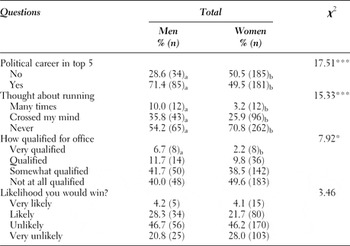
Table 1 presents univariate analyses comparing men and women's responses to the categorical political ambition questions, regardless of threat condition. Significant gender gaps in political ambition were evident for three of the four ambition questions. First, men were significantly more likely to place a career in politics (i.e., member of Parliament, prime minister, or mayor of city or town) anywhere in their top five choices (71.4%) compared to women (49.5%), χ2(1, 485) = 17.51, p < .001. Men were also significantly more likely to say that they had thought about running for political office many times (10.0%) compared to women (3.2%), while women (70.8%) were significantly more likely to say that they had never thought about running for office compared to men (54.2%), χ2(2, 490) = 15.33, p < .001. Finally, men were significantly more likely to rate themselves as very qualified for a job in elected office (6.7%) compared to women (2.2%), χ2(3, 489) = 7.92, p = .048. There were no significant differences in how likely men (4.2% very likely, 28.3% likely) and women (4.1% very likely, 21.7% likely) thought they would win in an election, χ2(3, 488) = 3.46, p = .326.Footnote 5 These results are largely consistent with the existing literature (see, for example, Lawless and Fox Reference Lawless and Fox2010).
Participants' responses to political ambition questions by gender

Note: Percentages with a different subscript are statistically different at α = .05.
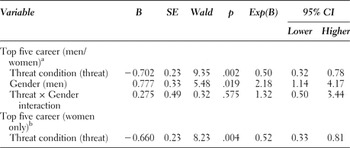
While Table 1 demonstrates clear gender gaps in political ambition, it is necessary to consider whether stereotype threat can account for these gaps through multivariate analyses. All multivariate analyses controlled for age of the participant, having taken (or currently taking) a political science class, and belonging to a political party. For the first ambition question logistic regression analysis revealed main effects for both threat and gender on placing a political career in the top five choices. As Table 2 demonstrates, across all participants, those in the threat condition were half as likely (OR = 0.50) to place a career in politics in their top five compared to those in the nonthreat condition. This finding suggests that exposure to negativity has a general dampening effect on political ambition across participants. Furthermore, regardless of threat condition, men were twice as likely (OR = 2.18) to place a career in politics anywhere in their top five choices compared to women. If stereotype threat were to fully explain this gender gap in political ambition, we would expect the interaction term between gender and threat condition to be significant, which it was not (i.e., women never reached comparable levels to men even in the nonthreat condition; p = .575).
Logistic regression results for predicting rankings of preference for future jobs by stereotype threat condition and gender

Note: All analyses control for age, having taken (or are currently taking) a political science course, and belonging to a political party.
aNagelkerke R2 = .124; bNagelkerke R2 = .079.
Although this analysis demonstrates that stereotype threat does not appear to explain the gender gap in political ambition, it is possible that women were affected by the threat manipulation. In order to test this possibility, we isolated the data for women and compared across threat condition. Doing so demonstrated that women in the threat condition were half as likely (OR = 0.52) to place a career in politics in their top five compared to women in the nonthreat condition (Table 2). Therefore, stereotype threat is having a clear and significant effect on women's political ambition despite the fact that women never achieve comparable levels of ambition as the men in our sample.
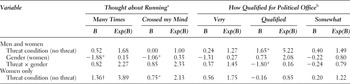
For the remaining two categorical political ambition questions (thought about running for political office; how qualified for office) multinomial logistic regression analyses were conducted (controlling for age, taking a political science class, and belonging to a political party; see Table 3). In terms of “thought about running for political office,” the analyses confirmed significant gender gaps. Women were significantly less likely than men to say that they had thought about running many times or that the thought had crossed their minds compared to saying that they had never thought about running for political office (OR = 0.15 and 0.35, respectively). The interaction between gender and threat condition was not significant, indicating that stereotype threat does not fully explain these gender gaps. When isolating the data for women, however, we do find that stereotype threat once again partly explains women's lower ambition. More specifically, in the nonthreat condition women were twice as likely (OR = 2.13) to say that they had thought about running for political office (crossed their mind) versus never thought about it compared to women in the threat condition. The comparison between thought about it many times versus never thought about it also approached statistical significance (p = .06).
Multinomial logistic regression results predicting having thought about running and degree of qualifications by stereotype threat condition and gender

*p < .05. † = approached statistical significance (p = .06).
Note: All analyses control for age, having taken (or are currently taking) a political science course, and belonging to a political party. Reference category for thought about running = never; Reference category for qualified for political office = not at all.
aNagelkerke R2 = .162; bNagelkerke R2 = .121.
For the qualification question, we find a significant main effect of threat condition with participants in the nonthreat condition being five times more likely (OR = 5.22) to say that they were qualified for political office (versus not at all qualified) compared to participants in the threat condition. Once again, it appears that simply exposing participants to negativity in politics can result in decreased political ambition, regardless of whether that negative information is targeted to one group versus the other. There was also a significant interaction effect between gender and threat condition; however, it was not in the expected direction. The interaction indicated that going from the women category (0) to men (1) and from the nonthreat condition (0) to threat (1) resulted in a decrease in the odds of participants saying that they were qualified versus not at all qualified for political office (OR = 0.16). In other words, the threat condition had a significantly larger effect on men compared to women. We suspect that since women's perception of their own qualifications was already so low (approximately 50% of women selected the “not at all qualified” option in both threat conditions), the exposure to negativity only impacted the men whose baseline sense of qualifications was higher compared to women (i.e., men's ratings of “qualified” decreased from 16% in the nonthreat condition to 6% in the threat condition).Footnote 6
Finally, participants were asked to list the actual qualifications and personal attributes that would make them a successful political candidate; the number of items listed was summed for each participant. A 2 (gender: men versus women) x 2 (stereotype condition: threat versus nonthreat) ANOVA with control variables was completed on mean qualifications listed by participants. There were no significant differences of mean qualifications and attributes listed for gender, F(1, 451) = 2.04, p = .154, d = 0.13, threat condition, F(1, 451) = 1.60, p = .206, d = 0.01, or the interaction effect, F(1, 451) = 0.64, p = .426, d = 0.12. Overall, men and women listed a mean number of three traits/qualifications. Isolating the data for women only also did not change these results.
What is important here is not what qualifications were listed but how many. Recall that Table 1 demonstrated that men were significantly more likely to view themselves as very qualified for political office compared to women. The fact that men and women listed the same number of qualifications suggests that women are undervaluing (or men are overvaluing) their own qualifications. Evidence from other fields suggests that this is not an uncommon occurrence. Despite no objective differences in math performance, for example, adolescent males rate their math ability higher than women (Wigfield, Eccles, and Pintrich Reference Wigfield, Eccles, Pintrich, Berliner and Calfee1996). Similar findings are evident in language and arts as well. Whether men are overvaluing their qualifications or women are undervaluing theirs, it is clear that the difference here is more about gendered perceptions than actual qualifications.
DISCUSSION
This experiment diverged from earlier work on the subject of stereotype threat and gender gaps in political behavior in two crucial ways. First, it was the first of its kind to explore the impact of negative stereotypes on political ambition. Second, the two previous studies in this area (primarily focused on stereotype threat and political knowledge) used implicit threat conditions in their experimental design, simply noting that there were gender differences in political knowledge without specifically stating the direction of the relationship (McGlone, Aronson, and Kobrynowicz Reference McGlone, Aronson and Kobrynowicz2006; Pruysers and Blais Reference Pruysers and Blais2014). Working on the assumption that negative stereotypes about women's political ability are widespread and pervasive, these experiments utilized a very subtle manipulation in which respondents were assumed to know the direction without being explicitly told. This study, however, made the threat condition far more explicit, stating that there are gender differences but also providing the direction: women know less about politics and are unqualified for political candidacy. While less subtle, this manipulation should quickly prime the threat condition and force participants to consider negative stereotypes about women in politics.
Despite an explicit threat and deactivation, we found that women never reached comparable levels of ambition to the men in our sample. While our hypotheses suggested that the ambition gap would close in the nonthreat condition, this was not the case: men expressed higher levels of political ambition than women regardless of threat condition.Footnote 7 Men were significantly more likely to have thought about running for office many times and to say that the thought had crossed their mind compared to women who were significantly more likely to have never thought about running for political office. Beyond merely thinking about running for political office, Table 2 revealed that men were twice as likely to put member of Parliament, prime minister, or mayor in their top five jobs when ranking a list of 10 possible careers compared to women.
While the main effect of gender was significant, we did find compelling evidence of stereotype threat when we isolated the data for women. The results demonstrated that exposure to negative stereotypes had a significant effect on political ambition among women. After being exposed to negative stereotypes about women's political ability, the women in the threat condition were half as likely to place a political job in their top five preferred careers while those in the nonthreat condition were 2.1 times more likely to express having thought about running for political office in the past compared to women in the threat condition. While somewhat different from our initial hypothesis, which posited that the gap would close completely, we find very clear evidence of stereotype threat nonetheless. Interestingly, the effect of stereotype threat on women appeared to be isolated to political ambition questions indicative of interest (i.e., placing a career in top five choice and thoughts about running for political office) rather than those indicative of efficacy (i.e., perceived qualification and actual qualifications listed). However, future studies on the subject would need to include additional items pertaining to both interest and efficacy to fully explore whether stereotype threat has a unique impact on different aspects of political ambition.
It is also worth briefly discussing the general influence of the threat condition. There appeared to be an overall dampening effect of stereotype threat that impacted participants in the threat condition, regardless of gender. This was evident for the questions relating to a career in politics and for self-perceived qualifications. We suspect that this is linked to perceptions that politics is already too negative and a general sense of distrust and dissatisfaction with political parties and democracy (Hartman Reference Hartman2012; Pew 2008; Samara 2012). If citizens view politics as being too negative, exposure to more negativity about electoral politics (in this case stereotypes about women's political ability) may turn people off of politics further, even when the direct target of the negativity is another group. Thus, while the effect is greatest among women (not surprising given the target of the stereotypes), it does appear that inducing more negativity about politics has a more general dampening effect when considering political ambition.
Although concerns about external validity are warranted when considering experimental research, the prevalence and widespread nature of negative attitudes about women in politics should alleviate any concerns that the underlying mechanism of stereotype threat is not applicable outside of the conditions specified in this experiment. Indeed, there is no shortage of exposure to negative attitudes about women in politics that are transmitted on a daily basis. Newspaper stories, for example, have headlines such as “Women know less about politics than men” (Daugherty Reference Daugherty2013) or “Men outpace women in quiz about candidates and the issues” (Thomma Reference Thomma2000). Moreover, despite a recent study concluding that candidate sex does not affect coverage (Hayes and Lawless Reference Hayes and Lawless2015), there is a long history of studies demonstrating overt sexism and bias against women seeking political office in the media (see, for example, Anderson Reference Anderson2011; Lawless Reference Lawless2009; Trimble Reference Trimble2007), as women are often sexualized, trivialized, and ultimately undermined as candidates (Bashevkin Reference Bashevkin2009).
Reminders of these stereotypes, however, extend far beyond the media and permeate every day life as large numbers of ordinary citizens hold negative views about women in politics. Using a simple and elegant experimental design that is not subject to social desirability, Streb et al. (Reference Streb, Burrell, Frederick and Genovese2008) report that one-quarter of the American public is “angry or upset” about the prospect of having a female president. Likewise, the World Values Survey reveals that a considerable minority of citizens around the world, one in five Americans, Australians, and Germans, for example, believe that men make better political leaders than women (World Values Survey 2010–2014). Closer to home, fathers implicitly reproduce this view with their children from a young age, as they are more likely to discuss politics with their sons than daughters (Mayer and Schmidt Reference Mayer and Schmidt2004), and both young boys and girls view their fathers as more knowledgeable about politics than their mothers (Sigel Reference Sigel and Ichilov1990).
All of this is to say that women do not need to be part of an experiment to be exposed to this kind of negativity. Whether it is from the media, parents, neighbors, or elsewhere, women are frequently subjected to negative views of women in politics. In fact, the results may be stronger in the real world, as women are confronted in person by these views as opposed to merely reading them online in a controlled setting. Moreover, while stereotypes may be culturally constructed, the fact that these negative views are diffused around the world suggests that the findings presented here extend far beyond the North American case.
CONCLUSION
Persistent gender gaps in political behavior, such as political knowledge, efficacy, and ambition, have implications for the inclusiveness, representativeness, and responsiveness of the political system. Without sufficient levels of ambitious women seeking political candidacy, legislatures around the world will continue to be male-dominated institutions, lacking in meaningful diversity. Increasing women's representation in the legislature can result in an enhanced focus on issues of relevance to women (Tremblay Reference Tremblay1998), it can produce a more civil tone and tenor of debate (Young Reference Young, Bickerton and Gagnon2009), and it can challenge existing gender stereotypes (Bashevkin Reference Bashevkin2009). Uncovering solutions to these gender gaps is therefore more than a mere scholarly exercise and has implications for how we practice our democracy. To gain a better understanding of the causes of these gender gaps, this article has applied the concept of stereotype threat, a long-established theory from the field of psychology. Using an experimental design and a multidisciplinary approach, we were able to make a number of contributions to the literature on both gender and political behavior.
First, this study demonstrated a political ambition gap between young, university aged men and women. Consistent with Lawless and Fox (Reference Lawless and Fox2013, ii), and despite the possibility of young Canadian women being more ambitious than their older counterparts, the data revealed that young women were less politically ambitious than men of a similar age. What this suggests is that the factors leading to lower levels of political ambition among women occur early on in life—pointing to socialization at home and in school. Given what we know about how boys and girls are socialized differently (see, for example, Mayer and Schmidt Reference Mayer and Schmidt2004), a gender gap in political ambition among young adults is perhaps unsurprising.
Our second contribution concerns our hypothesized explanation for these gender gaps: that exposure to negative stereotypes about women's political ability would suppress ambition. At first glance, stereotype threat did not appear to explain the gender gap in political ambition, as men expressed greater levels of ambition regardless of condition. That is, even the women in the nonthreat condition never reached comparable levels of ambition to the men. The data did reveal, however, that women who were exposed to the threat condition expressed significantly less ambition than women in the nonthreat condition. The partial confirmation of our hypothesis suggests that negative stereotypes are only part of the answer.
Political life is complex, and as such our explanations for political phenomenon are likely to be equally complex and multifaceted. While exposure to negative stereotypes begins to explain why the ambition gap between men and women is so large, other factors such as socialization, gendered media portrayals, masculine political institutions, and the additional barriers women face in electoral politics are likely contributors as well. Only when this entire constellation of factors is taken together are we likely to fully account for and explain gender differences in political ambition.
Given that this was the first study examining stereotype threat as an explanation for gender gaps in political ambition, the results must be replicated before firm conclusions can be made. Additionally, the main limitation of the current research is that it was conducted online while past stereotype threat research has been conducted in person or over the telephone. Despite this limitation, our findings open up a variety of avenues for future research. Dispelling myths and deactivating stereotypes, as this study demonstrates, is not enough to fully close the ambition gap between men and women. However, this raises an interesting question: if negative views about women in politics can reduce political ambition among young women, what kind of stimuli or encouragement is required to foster ambition? Based on these findings, future research can begin to move beyond trying to account for the gender gap in political ambition and instead attempt to uncover ways of closing the gap fully.
SUPPLEMENTARY MATERIAL
To view supplementary material for this article, please visit https://doi.org/10.1017/S1743923X16000544.