INTRODUCTION
Reports of category specificity typically describe patients with impaired identification and recognition of living things (e.g., animals, fruit) relative to nonliving things (e.g., tools, furniture), with much less frequent reports of the converse pattern (for reviews, see Capitani et al., 2003; Laws, 2005). Category-specific impairments have been pivotal in the development of models describing the structure and organization of lexical–semantic memory. Such cases highlight issues concerning the extent to which such disorders provide evidence for the fractionation of cognitive domains (along categorical or other lines).
Theories of category specificity may be divided roughly into those that assume category knowledge is organized in functionally and neuroanatomically distinct subsystems and those that propose the neural organization of conceptual knowledge reflects the statistical co-occurrence of object properties (see Capitani et al., 2003). The former theories emphasize that knowledge is organized categorically and that each domain has a separate neural substrate (e.g., Caramazza & Mahon, 2003). A related proposal is that knowledge organization occurs as a by-product of the modality of acquisition (e.g., Warrington & McCarthy, 1987; Warrington & Shallice, 1984). For example, living and nonliving things may be distinguished on the basis that the former are primarily encoded in a sensory manner, while the latter are primarily encoded in terms of functional knowledge. By contrast, the statistical co-occurrence models argue that some features are highly correlated and so support each other, while others are more distinctive and, therefore, more prone to loss following brain injury and these attribute types vary across living and nonliving things. Within this framework, contradictory models have been proposed, suggesting either that lower levels of neural damage produce nonliving thing deficits because they have more distinctive features and so, are more easily lost (Gonnerman et al., 1997) or will be less susceptible than living things because the former have very distinctive form–function relationships (Moss et al., 1998).
One of the earliest markers of Alzheimer's disease (AD) is anomia (Gainotti et al., 1989). Although the relationship between anomia and semantic deficit in AD is well documented (e.g., Daum et al., 1996; Hodges et al., 1992), some doubt remains as to whether the naming deficit differentially affects items from different categories. Category effects were first documented in AD by Silveri and colleagues (1991) who found that overall naming accuracy in AD patients was impaired relative to matched controls; however, this pattern was significantly more marked for living things. Nonetheless, in subsequent studies, the incidence and pattern of category specificity across AD patients as a group and for individual AD patients has been inconsistent. Most have reported living deficits, a minority has reported nonliving deficits, some report both, and still others find no category-specific effects at all in AD patients (see review by Laws et al., 2005). Several questions remain unanswered, including what factors influence whether: studies do or do not find category effects?; living or nonliving category effects are reported; and finally, why are so many more living cases reported?
After AD, Lewy body dementia (DLB) accounts for 10–25% of dementia cases (Campbell et al., 2001) and, on some estimates, is believed to be the second most common dementia pathology (McKeith et al., 1995). The current diagnostic criteria for DLB require the presence of a triad of symptoms that include extrapyramidal signs, persistent visual hallucinations, and fluctuating cognitive impairment (McKeith et al., 2004). Nonetheless, a continuing debate persists about whether DLB is a variant form of AD (or Parkinson's disease with dementia) or a separate individual condition. Hansen et al. (1990) reported that as many as a third of patients given a clinical diagnosis of Alzheimer disease had Lewy bodies at autopsy; and Alzheimer type changes (e.g., plaques) are present in the majority of DLB patients (McKenzie et al., 1996). Neither the profile of cognitive change in DLB nor the features that distinguish it from the cognitive impairment of AD have been identified. Hence, studies attempting to refine the profiles, therefore, may prove beneficial in improving diagnostic sensitivity. A recent meta-analytic study by Collerton et al. (2003) systematically reviewed 21 studies comparing the cognitive performance of DLB patients; they found that the effect size (Cohen's d: averaged across multiple cognitive domains) was, in fact, larger for DLB (2.0–2.2) than AD (1.4–1.6) patients. Studies comparing AD and DLB patients have pinpointed some differences in cognitive performance: memory impairment is less severe in DLB than AD (e.g., Calderon et al., 2001; Salmon et al., 1996; Shimomura et al., 1998), while visual–perceptual and spatial abilities are more impaired (e.g., Ala et al., 2001; Calderon et al., 2001; Gnanalingham et al., 1997; Salmon et al., 1996). Consistent with the neuropsychological profile, functional imaging studies show that patients with DLB more commonly have reduced perfusion in the occipital lobes than AD patients (Ishii et al., 1999; Lobotesis et al., 2001).
By contrast with AD, very little is known about semantic memory functioning in patients with DLB. Only one previous study has examined semantic memory functioning in DLB patients (Lambon Ralph et al., 2001). They compared the performance of 10 DLB patients, 10 AD patients, and 15 age-matched healthy controls on a semantic battery. Both patient groups exhibited impaired semantic memory performance; however, while AD patients showed comparable impairment for words and picture stimuli, DLB patients showed greater semantic impairment for processing pictures than words. The authors did not report any data on category specificity in this study. Examination of category effects in DLB patients might throw some interesting light on the role of pathology in the emergence of eventual category effects and cast new light on the characteristics of the semantic impairment in DLB. The vast majority of single cases reported with living thing deficits have suffered anterior temporal lobe damage (Gainotti, 2005). Although temporal lobe pathology is relevant to AD pathology (Braak & Braak, 1991, 1996), the degree of temporal lobe atrophy in DLB is thought to be substantially less than in AD, so we might not expect category effects to emerge to the same extent or at all (e.g., Ballmaier et al., 2004).
Some debate also exists about the use of group versus single case studies when investigating the question of category effects. In particular, the failure to find a category effect at the group level may sometimes reflect individual variability, that is, the presence of living and nonliving deficits at the individual level (Gonnerman et al., 1997). The current study, therefore, uses both group and individual analyses, but concentrates on the incidence and types of dissociation that occur at the level of individual patients. Using picture naming and naming-to-description tasks, we compare closely matched AD and DLB patients and healthy matched controls.
METHODS
Participants
A total of 44 participants were tested (11 with probable Lewy body dementia, 11 with probable Alzheimer's disease, and 22 healthy elderly controls). The three groups were matched for estimated premorbid IQ, age, and education; and the two patient groups were also matched for mean Mini-Mental State Examination (MMSE; Folstein et al., 1975) scores. The means and standard deviations for the background variables in the three groups are presented in Table 1. The patients with probable DLB met diagnostic criteria for probable and possible DLB following consensus guidelines as outlined by McKeith et al. (1995, 2004). The Alzheimer's patients met the National Institute of Neurological and Communicative Disorders and Stroke/Alzheimer's Disease and Related Disorders Association (NINCDS/ADRDA) criteria for probable AD (McKhann et al., 1984). All patients underwent computed tomography or magnetic resonance imaging scanning together with a screening battery to exclude treatable causes of dementia. Patients with major depression, a history of stroke or transient ischemic attack (TIA), alcoholism, head injury, or major medical illnesses were excluded. The healthy controls were also screened for the presence of major depression, a history of stroke or TIA, alcoholism, head injury, or major medical illnesses. All participants were native Italian speakers and were tested in compliance with the ethics procedures at the University of Padua.
Mean [standard deviation] demographic variables for healthy controls and patients with Lewy body dementia and Alzheimer's disease

Tasks
Picture naming
Line drawings of 32 Living (22 animals and 10 fruits and vegetables) and 32 Nonliving items were taken from the Snodgrass and Vanderwart corpus (1980); see Appendix for items. The stimuli were matched across category for visual complexity, familiarity, and name frequency (see Sartori et al., 2002).
Naming-to-description
For this task, 16 Living (16 animals) and 12 Nonliving (tools and implements) things were used; see Appendix for items. Each item was described by a perceptual and a functional/associative description, thus yielding a total of 32 descriptions of Living and 24 descriptions of Nonliving. This task, originally published as a feature verification task by Lambon Ralph et al. (1998), was adapted to Italian as a naming-to-description task. The living and nonliving target names were matched for name frequency and age of acquisition. Examples of the materials include the following: “It is a four-legged animal with a tail and whiskers that meows and purrs” (perceptual description for CAT); “It is an animal that lives in the home, catches mice, and likes being stroked” (nonperceptual description for CAT); “It is a tool that is a shallow bowl on a handle” (perceptual description for SPOON); “It is something that you use to drink soup and eat dessert” (nonperceptual description for SPOON).
RESULTS
Group Analysis
The data were analyzed within a 3 (Group: DLB, AD, and control) × 2 (Modality: picture naming, naming-to-description) × 2 (Category: living, nonliving) mixed design. To ensure that the control data were not adversely affected by ceiling effects, we examined the normality of the distributions of their data. Skewness and kurtosis statistics (g1 and g2) were computed for the healthy control data. Skewness was −0.53 and −1.03 for living and nonliving picture naming, respectively. The D'Agostino et al. (1990) test for skewness failed to reject the null hypothesis that the distributions were symmetrical: zg1 = −1.13 for living and zg1 = −2.05 for nonliving. Furthermore, D'Agostino-Pearson omnibus test for normality, which uses both g1 and g2 as input, revealed that the distributions did not differ significantly from normality for living or nonliving things; K2 = 1.8; p = .4 and K2 = 4.7; p = .10 respectively. Skewness for living stimuli (descriptions) was −0.69 and −0.40 for nonliving stimuli (descriptions). D'Agostino et al. (1990) test for skewness failed to reject the null hypothesis that the distributions were symmetrical: zg1 = −1.43 for living, and zg1 = −0.86 for nonliving. Furthermore, the D'Agostino–Pearson omnibus test for normality revealed that the distributions did not differ significantly from normality; for living or nonliving things K2 = 2.17, p = .34; K2 = 1.32, p = .52, respectively. Hence, the control data did not deviate significantly from normality.
A significant main effect for Group [F(2,41) = 44.27, p < .001] emerged, and post hoc Least Squares Difference tests confirmed that controls named more items than the DLB and AD patients (both p < .001), but also that DLB patients named more items than the AD patients (p = .026). Category had a significant impact [F(2,41) = 11.05, p = .002], with better naming of nonliving than living things (73 vs. 69%, average across all three groups); however, this finding was modified by a Group × Category interaction [F(2,41) = 4.44, p = .018], indicating that this advantage occurred in patients, but not controls. Finally, Modality was significant [F(2,41) = 49.61, p < .001], with better naming to picture than description (76 vs. 65%); again, however, this finding was modified by a Group × Modality interaction [F(2,41) = 4.91, p = .012], showing that the effect emerged in patients, but not controls.
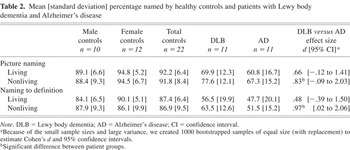
The group analyses revealed the expected better performance of controls than the AD and DLB patients and level of semantic impairment that was greater in AD than DLB patients. Table 2 shows that the DLB group named more items than the AD group (with effect sizes ranging from medium to large); these differences reached significance for naming nonliving things to picture and to description (p = .04 and p = .03, respectively). The better performance of DLB patients is interesting insofar as the two patient groups were so closely matched in terms of age, education, MMSE, and estimated premorbid IQ. The analysis also revealed the predicted category effect, that is, better naming of nonliving than living things in both the DLB [d = 1.71; 95% confidence interval (CI), 3.12 to .65] and AD (d = 1.85; 95% CI, 3.76 to .19) groups. Because the controls showed no modality or category effect, differences in patient performance cannot be readily attributed to task difficulty.
Mean [standard deviation] percentage named by healthy controls and patients with Lewy body dementia and Alzheimer's disease

Individual Case Analyses
Group analyses revealed impaired living thing naming in the two patient groups and significantly greater impairment in AD than DLB patients. Nonetheless, analysis at the level of groups may hide a degree of individual variability, that is, with some patients showing living and some showing nonliving deficits or even the possibility that the group trend does not translate into deficits at the individual case level (Gonnerman et al., 1997). Hence, we examined patients to determine the incidence and types of deficits at the level of individual patients.
Individual patients were classified as exhibiting a dissociation between tasks (in this case, living vs. nonliving) using criteria developed by Crawford and Garthwaite (2005a). Crawford and Garthwaite's (2005a) criteria for classical (and strong) dissociations are designed to be used when a patient is compared with a control sample. These criteria are based on the pattern of results obtained from the application of three inferential tests. A modified independent samples t test (Crawford & Howell, 1998) tests for whether the patient has a deficit on task X (e.g., living) and a deficit on task Y (e.g., nonliving). Of course, patients may be impaired at naming living or nonliving things, while the difference between the two scores does not reach significance; conversely, a patient may be severely impaired on both categories and still show a differentially greater impairment for one domain over the other. Therefore, for those patients showing impaired naming of living and/or nonliving things, we compared their living/nonliving discrepancy score with the mean discrepancy of the normative sample using the Revised Standardized Difference Test (RSDT; Crawford & Garthwaite, 2005a; Garthwaite & Crawford, 2004). The RSDT is used to test the difference between the patient's performance on tasks X and Y (the standardized difference for the patient is compared with the distribution of standardized differences obtained from the controls).
A patient was classified as exhibiting a classical dissociation if their performance on one (and only one) of the two tasks was significantly poorer than that of the control group (using the modified t test) and if the standardized difference between their performance on the two tasks differed significantly from the standardized differences observed for the control group (using the RSDT). The same criteria were used to test for a strong dissociation, with the difference being that the patient had to perform significantly more poorly than the control group on both tasks.
These methods are to be preferred over the use of z (to test for a deficit) and zD (to test for a standardized difference), as they treat the statistics of the control sample as statistics rather than as population parameters. Monte Carlo simulations indicate that the criteria for dissociations have a low Type I error rate regardless of the N for the control sample, the correlation between tasks, and the distributional characteristics of the control data (i.e., they are robust to departures from normality; Crawford & Garthwaite, 2005b; Crawford et al., 2006). Several studies of healthy controls and neurological patients (including AD patients) have revealed that men perform better with man-made items and women better with natural items (especially fruit and vegetables; see Capitani et al., 1999, 2005; Laiacona et al., 1998; Laws, 1999, 2000; see Gainotti, 2005 and Laiacona et al., 2006, for reviews). Given the evidence of a Category × Sex interaction in healthy controls and patients, each individual patient was compared with a sex-matched group of controls (consisting of either 10 male or 12 female controls).
The results are presented in Table 3. In the case of the individual living and nonliving tasks, an asterisk denotes that the patient was recorded as exhibiting a deficit on the task using the test of Crawford & Howell (1998; p < .05, one-tailed). In the case of the difference between living and nonliving scores, an asterisk denotes that a patient exhibited a significant difference between their scores (p < .001, two-tailed) on the RSDT. The pattern of results on these tests determines whether the criteria for a classical or strong dissociation are met. Table 3 highlights 25 significant dissociations (7 classical and 18 strong) in the patients, all of which were for living things. In terms of pathology, the distribution was comparable for picture naming (7 AD and 6 DLB) and naming-to-description (7 AD and 5 DLB).
Category naming in Lewy body dementia (DLB) and Alzheimer's (AD) patients

DISCUSSION
This study confirms that the well-established lexical–semantic impairment in AD also extends to DLB patients in a significantly milder form (cf. Lambon Ralph et al., 2001). As with most previous group studies of AD patients, we found worse naming of living than nonliving things, and again that this finding also extends to DLB patients. As with individual AD patients, some DLB patients displayed category-specific deficits. Indeed, category dissociations were found in two thirds of all patients, and most surprisingly, all significant dissociations were for the living thing category.
As noted above, anomia was significantly greater in the AD than DLB patients. The differences were robust insofar as the DLB patents outperformed the AD patients on all four measures (naming pictures and descriptions of living and nonliving things), producing moderate to large effect sizes. This group difference is notable because the two patient groups were so closely matched (for age, education, premorbid IQ, and MMSE scores). Although quite a crude measure of dementia severity, the MMSE scores of the AD and DLB groups were indistinguishable. By contrast, some studies comparing lexical semantics in DLB and AD on picture naming tasks have revealed no significant group differences (Calderon et al., 2001; Galasko et al., 1996; Hansen et al., 1990; Preobrazhenskaya et al., 2006; Salmon et al., 1996). Nonetheless, three recent studies have documented significantly better naming by DLB than AD patients (Ferman et al., 2006; Johnson et al., 2005; Kraybill et al., 2005), and one has reported significantly better naming by AD than DLB on one naming task and no difference on another (Lambon Ralph et al., 2001). The variability is apparent from the effect sizes in these studies, which range from a large effect size in favor of DLB patients (d = −1.02; Johnson et al., 2005) through to a large effect size in favor of AD patients (d = 0.96; Lambon Ralph et al., 2001). A quick examination of these past studies reveals worse overall naming in AD patients, with a small mean effect size and confidence intervals that pass through zero (d = .13; 95% CI, −.16 to .44). These inconsistencies may partly reflect the problems associated with determining diagnosis and the pathological overlap associated with AD and DLB (Hansen et al., 1990; McKenzie et al., 1996). Indeed, DLB patients had mixed AD–DLB neuropathology in some studies (e.g., Galasko et al., 1996; Hansen et al., 1990), while others have used large samples of “pure” autopsy-confirmed diagnoses (Johnson et al., 2005).
Of the 25 significant category dissociations, remarkably, all were for living things and, in 9 cases (6 AD and 3 DLB), the dissociations were significant across both modalities. Furthermore, the vast majority (18) occurred in female patients. Previous studies of AD patients have documented a Sex × Category interaction in patients (with women naming fewer nonliving things and men fewer living things); however, the current study found no evidence of such an interaction. Unfortunately, the numbers of male and female patients in the AD and DLB groups was not matched or sufficiently balanced to separate the relative effects of sex and pathology. Post hoc analyses revealed that the male and female patients did not differ in terms of age, IQ, education, or overall dementia, at least as rated by their MMSE scores (all F < 1), but the female patients (regardless of pathology) did show a nonsignificant trend toward greater anomia. The previous studies showing a Sex × Category interaction have not examined the role of overall naming ability, and future studies might, therefore, address this possible confound.
Uncontrolled cognitive and psycholinguistic variables (such as familiarity, visual complexity, and name frequency) do typically prove advantageous for recognizing nonliving things (Funnell & Sheridan, 1992); however, as with most recent studies, our stimuli were matched across category on the most common relevant confounds. Another possible confound concerns the problems associated with ceiling level performance in controls (Laws, 2005; Laws et al., 2005). Although our controls performed well on the picture naming task, they were not quite at ceiling and their data were normally distributed on all four measures. Furthermore, control performance on the naming to definition task was clearly below ceiling in controls, so patient profiles are unlikely to have resulted from any ceiling effect in the control data (e.g., hiding a category effect for living things). Finally, the individual case analyses revealed that nine cases of dissociation on the picture naming task were confirmed on the below ceiling naming-to-definition task (only three cases were not confirmed); the confirmation of dissociation on the latter task is harder to reconcile with a ceiling effect in controls. The low incidence of nonliving dissociations accords with the wider category-specific literature (revealing a ratio of approximately 5:1; Laws, 2005) and recent sudies of larger samples of AD patients, which reveal a very low incidence of nonliving deficits: Garrard et al. (1998) found just 3 in 58 (5%), while Whatmough et al. (2003) found 4 in 72 (5.5%). Our failure to find this elusive 5% may simply reflect the smaller AD sample size used in the current study.
Is it likely that AD and DLB pathologies impact more on the neurological systems underpinning the representations for living than nonliving things? The vast majority of single cases reported with living thing deficits have suffered anterior temporal lobe damage (Gainotti, 2005), and this finding is perhaps exemplified by the association of the temporal lobe pathology in herpes simplex encephalitis and the presence of category effects (e.g., Laws & Sartori, 2005). Indeed, a specific role has been proposed for the medial temporal structures (hippocampus and amygdala) in the greater biological significance of living than nonliving things for humans, although frontal regions may be more important for the latter (Gainotti, 2005; Silveri et al., 1991). While temporal lobe pathology is an early and prominent pathological feature of AD (Braak & Braak, 1991, 1996), we might expect living deficits to appear in the least impaired patients. In terms of overall naming ability, however, our data revealed living deficits in both the least (AD2) and most (e.g., AD1, AD5, AD6, and AD7) impaired of the AD patients. [The same was true for DLB patients (e.g., DLB 4 versus DLB 5).]
Typically, the category deficits demonstrated in demented patients here (and previously) are not absolute. In other words, the patients tend to be impaired at naming living and nonliving things, but differentially worse with living; that is, they have strong dissociations. We might regard the pervasive presence of strong dissociations as being more consistent with the diffuse neurological impact of dementia than the ostensibly more selective deficits seen with pathologies such as herpes simplex encephalitis (Laws & Sartori, 2005). Nevertheless, almost one quarter of the patients did show classical dissociations, and one Lewy body patient (DLB4) showed a classical dissociation on both naming tasks (see Table 3). The finding of classical dissociations has implications for those models of category specificity proposing that the direction of category deficit varies according to severity. The deficits for living things reported here occurred both in patients whose nonliving naming was within the normal range, that is, exhibited by our healthy matched controls; and in others, whose nonliving naming was impaired (but less than for living things). These findings provide no support for the notion that the overall degree of lexical–semantic impairment affects the direction of the category effect as suggested by statistical co-occurrence models (Gonnerman et al., 1997; Moss et al., 1998). It remains possible that, at some critical point of further knowledge loss, a deficit for nonliving things might emerge; however, such a dissociation could only be strong rather than classical in character.
Finally, we note that our study did contain limitations that require consideration. First, the AD and DLB sample sizes were quite small. Although this limitation may be moderated, to some extent, by the very close matching used, it could have contributed to the lack of nonliving dissociations reported. Second, given the documented problems with discriminating DLB and AD, our patients were diagnosed clinically and not pathologically at postmortem. Hence, we cannot eliminate the possibility of some pathological overlap between the groups. Although this is the first study to document category effects in DLB patients, future studies with larger samples (and postmortem confirmation of diagnosis) are required to confirm the low incidence of nonliving category deficits in both AD and DLB patients.
ACKNOWLEDGMENTS
We thank Dr. Haaland and the four anonymous reviewers for their thoughtful and detailed comments on earlier drafts of this paper. There were no sources of financial support for this research and no conflict of interests. The program, and further details, for running RSDT analyses can be downloaded from: http://www.abdn.ac.uk/∼psy086/dept/SingleCaseMethodsComputerPro grams.HTM
Appendix
Items for Picture Naming Task

Items for Naming to Definition test