1. Introduction
Bill Fontana’s Sound Sculptures are often presented in the context of German literature on Klangkunst that seeks to provide knowledge of the different genres and influential artists in this field. Delving deeper into his project Distant Trains, trying to comprehend his methods and the technical and theoretical aspects of his Sound Sculptures, I was confronted with the problem that there is hardly any documentation of his work beyond what one can find on the artist’s website, in his essays or in published articles. Moreover, the articles that do exist only scrape the surface of what his projects entail (e.g. see Drees Reference Drees2009). By systematically looking at his application documents, preparatory work and the processes of recording, editing, composing and installing his Sound Sculpture, this article aims to produce a detailed documentation allowing in-depth insight into Bill Fontana’s project Distant Trains. Aspects mentioned above will be analysed in relation to the practice of relocation and Sound Sculptures as a form of art in the public space.
2. Distant Trains: The Research Findings
In 1980, Bill Fontana exhibited his Recycling Sculpture at the exhibition Für Augen und Ohren (For Eyes and Ears) in West Berlin (Barthelmes Reference Barthelmes1984). Three years later, while residing in West Berlin on a DAAD (Deutscher Akademischer Austausch Dienst) scholarship, he worked on the sound installation Sound Surroundings. When his scholarship was extended, he began work on the site-specific Sound Sculpture Distant Trains, which was exhibited from 14 September 1984 to 14 October 1984, during the Internationale Bauausstellung (IBA) on the grounds of what was once Anhalter Bahnhof (Fontana Reference Fontana2008). The German discourse on Klangkunst offers a clear differentiation between the terms ‘installation’ and ‘sculpture’. A sound installation is understood as a fixed setup, which is specific to the place in which it is exhibited and cannot be moved without losing its initial qualities. It encompasses the recipient with sound emitted from visible or hidden technical devices, without necessarily offering them a specific focal point (Straebel Reference Straebel2008). A Sound Sculpture, on the other hand, is described as a physical object that is mobile, in the sense that it can be moved from one (exhibition) place to another. It can also function as the central point of attention. By emitting sound, it centrifugally expands its presence in the room, surrounding the recipients while still providing a central point of attention, thus creating spatially defined circumstances (Gertich Reference Gertich1999). In the case of Bill Fontana’s Sound Sculptures it becomes apparent that he chose a hybrid form of installation and sculpture, which he creates by relocating sounds from one place to another.
After a celebration at the DAAD, an employee of the IBA gave Bill Fontana a tour of historic sites in West Berlin, including the Berlin Social Science Centre, the 17th of June Street, Oranienplatz and Anhalter Bahnhof.Footnote 1 Fontana emphasised that the site of Anhalter Bahnhof was the only one that evoked acoustical memories, and therefore named it as a first choice for his installation in the public space of Berlin (Fontana Reference Fontana1983).Footnote 2 The area of Anhalter Bahnhof was located very close to the Berlin Wall. The building itself had been heavily damaged during the bombing of Berlin and was demolished in 1961, leaving an urban wasteland. All that remained of what was once one of the biggest and busiest German train stations was a small part of the entrance gate at Stresemannstrasse (Barthelmes Reference Barthelmes1984). Imagining the acoustic presence of a lively urban train station, Fontana was fascinated by the vast open space that now lay in desolate silence. Since Anhalter Bahnhof was a key symbol of the metropolis Berlin had once been, many citizens remembered the building very well. Younger Berliners, on the other hand, only knew the place as a field of rubble and were potentially unaware of its historic implications. Fontana recognised the aesthetic potential of the area that had no function in the daily routine anymore and developed the idea to revive the place by creating an acoustic representation of a train station, thereby making the identity of the place tangible for different generations of Berliners. The main theme of the IBA in 1984 was the reconstruction of Berlin and the search for new plans of city development. With his installation, Fontana reversed that idea and redeveloped the space following the motif of its past, creating an acoustic-architectural construct in the form of a Sound Sculpture.Footnote 3
The title Sound Sculpture with Distant Trains was later shortened to Distant Trains (Entfernte Züge) and contains an interesting double entendre in German that reveals the idea driving his project: ‘Entfernt’ can mean distant, as in long distance, but it can also mean removed, as in something that has been taken away. By relocating sounds from far away and placing them in a specific site, Fontana recreated a situation that evoked memories of specific sounds of the site. Furthermore, the combination of site and sound created an interesting contrast that evoked an audiovisual discrepancy in the perception of the recipients. Being confronted with an empty field without visible action but hearing the sonic environment of what sounds like a busy train station at the same time forms an ambivalent space for experience in which visitors can find traces of the site’s past through art.
2.1. Technical realisation
Distant Trains was Bill Fontana’s first elaborate project in Europe and marks a milestone in his creative career, as it was a Sound Sculpture on a large scale. His previous works had required moderate logistic efforts, but with Distant Trains he engaged in a much more comprehensive project, relocating an environment of high acoustic complexity to a sizable site, in West Berlin, which was, at the time, separated from West Germany by the GDR.Footnote 4
Previously, in 1983, Bill Fontana had exhibited his Sound Sculpture Oscillating Steel Grids along the Brooklyn Bridge in New York. Eight microphones picked up the humming sound that cars made on the steel grids that paved the road of the Brooklyn Bridge crossing the East River. This drone sound was relocated to the World Trade Center, a distance of about 1,000 metres, via telephone wires. There the sounds were emitted from eight loudspeakers, mounted behind the facade of one of the towers, onto the adjacent Austin J. Tobin Plaza. For this Sound Sculpture, Fontana relocated sounds in between two significant urban landmarks, by taking them out of their original, coherent context and placing them in a new surrounding. He thus created a new sonic environment that consisted of the compound of the plaza’s natural urban sounds and the temporally synchronised but topologically distorted sounds added to this site. Through relocating sounds to a place where their origin is not visually, and thus not logically, perceivable, Fontana composed a situation in which the sounds from the Brooklyn Bridge would form an abstract sonic gestalt, becoming an artificial part of the exhibition site’s sonic environment and being perceived as an acoustic element, detached from its original cause (Fontana Reference Fontana2008). Concentrating on city landmarks as a source for and exhibition site of his Sound Sculptures, the use of sonic relocation to create an acoustically paradoxical situation and the ensuing discrepant topochronological qualities of his public art are elements also to be found in the project Distant Trains.
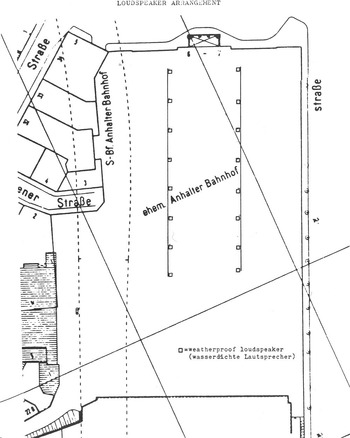
For the Sound Sculpture Distant Trains, his initial idea had been to relocate the sounds of Cologne Central Station (CCS) to Anhalter Bahnhof in real-time via live broadcast using phone lines. As in New York, eight microphones were supposed to pick up the sounds in Cologne then transmit them live to Berlin, to be played back over sixteen loudspeakers (Figure 1; he later changed the number of speakers to eight) (Fontana Reference Fontana1983). Fontana used eight channels in Distant Trains because he personally preferred to use this setup when he had been working on field recordings, utilising eight-channel tape recorders (Fontana and Schöning Reference Fontana and Schöning1994).Footnote 5
Technical drawing with sixteen speakers. Source: Bill Fontana’s exposé for Distant Trains.

Due to the topographic position of Anhalter Bahnhof, Fontana had to give up his idea of a real-time relocation via live transmission, since it was impossible for technical and political reasons to get permanent phone lines from West Germany through the GDR to West Berlin. He therefore decided to produce eight-channel recordings instead of a relocation in real-time. The plan was to make five recordings on eight-channel tapes that were not to be edited (Fontana Reference Fontana2008). For that reason the tapes were each recorded in an uninterrupted, one hour-long take at the CCS.Footnote 6 By doing so, he eliminated the option of cutting and editing the material and retained the real-time characteristic of concurrent sonic events, while still having the chance to select the best aesthetic result out of the five recorded tapes to be used at the exhibition site.Footnote 7
He needed to have a partner in Cologne who could be of help with the logistics and organisation as well as technical issues. He found a fitting partner in the WDR – more specifically, the department for radio drama production. This connection came about when Bill Fontana contacted John Cage, whom he had met in New York and who had previously worked in Cologne. Cage got him in contact with Klaus Schöning, the editor-in-chief of the radio drama department at the time, who had worked with Cage on Roaratorio, among other pieces, in 1979 (Cage and Schöning Reference Cage and Schöning1985).
Together with his technical assistant Rolf Langebartels, a Berlin-based sculptor and musician, and further technical and organisational help from the WDR, Fontana recorded the sounds for Distant Trains at CCS, which the broadcasting station had made possible by obtaining the necessary authorisations from the German Federal Railways. The partnership with Klaus Schöning proved to be very fruitful, since he and Fontana continued collaborating after Distant Trains and realised Fontana’s most well-known and elaborate relocation projects Metropolis Köln and Sound Bridge San Francisco – Cologne in later years, for further information (Fontana and Schöning Reference Fontana and Schöning1994).
Fontana decided not to use recordings from the archive in his Sound Sculpture due to the connotation of Anhalter Bahnhof’s historical importance during the time of National Socialism, which would negatively affect the visitors’ relation to the site itself.Footnote 8 He chose to create an optimistic atmosphere a fortiori, given the destruction of the train station during the Second World War and the still desolate quality of the space in the 1980s. In doing so, his artistic interpretation of the space renounced the historical factors of the past to a certain degree, focusing instead on the central subject that Anhalter Bahnhof was once Germany’s biggest train station. He then sought to bring the qualities of this subject back to life acoustically by relocating sounds from a big, busy and contemporary train station, namely the CCS, which is located in the very centre of Cologne. The tracks run from the north-western part of the city through the train station and, after a few hundred metres that lie parallel to a pedestrian walkway, behind which are a museum and the Cologne Cathedral, onto the Hohenzollern Bridge that crosses the Rhine River. Due to the diverse and rich sonic environment and its appealing acoustic traits, Fontana chose this station as the sound source for his relocation.Footnote 9
2.2. The recordings
In Cologne, Fontana chose an area of 800 metres in length that was located on a platform in between two tracks, which was used for maintenance purposes only. The area lay inside and outside the main hall of the CCS and was divided into three zones, which were recorded with eight omnidirectional condenser microphones. Each microphone picked up sounds from all directions equally, ensuring that those positioned outside the train station would receive sounds from ships on the Rhine River, the bells of the Cologne Cathedral from above, the sounds of pedestrians walking by the tracks, warning signals and squealing of train wheels on the tracks from below (Fontana Reference Fontana1983). Inside the CCS, the microphones allowed that announcements from above, reverberation from the ceiling, trains’ screeching brakes from below, sounds from passengers on the platform and announcements from other loudspeakers in station would be received without being influenced by any insensitivity of the microphone’s directionality. By using omnidirectional microphones, Fontana didn’t focus on certain sounds exclusively, but all sounds that would act upon the microphones centripetally from all directions.
The microphones were arranged in a row in between two tracks, ranging from the north-western part of the station to the middle of the adjacent Hohenzollern Bridge crossing the Rhine River (Fontana Reference Fontana1986). The positions of the microphones entailed diverging aspects of the sonic environment, resulting in a contrasting emphasis of the sounds captured, between the microphones positioned outside the train station and those inside the main hall. This setup makes Fontana’s approach, that in every moment there is something meaningful to hear, quite apparent. By aligning the microphones in a long row, the spatial aspects of the environment and the main hall are, at least to a certain degree, represented, but Fontana was neither recreating a topographically realistic version, nor a differentiated temporal succession of movements. The centring of the sonic environment as a whole onto eight microphones that do not seem to have been setup to work as a system with an intrinsic technical logic, such as AB stereophony, resulted in an abstracted multichannel representation of the real situation. A single sound event must have caused a propagating delay between two or more microphones, since its position of emergence must have had different distances to two or more of the eight receiving microphones. This means that, considering the synchronisation of the eight-channel recording, one single sound might have been recorded at eight different moments in time. Given that the distance of the two microphones on each end of the recording area was 800 metres and sound travels with a speed of 343 m/s, the maximum delay to occur was 2.33 seconds, which would have been clearly audible.Footnote 10 Additionally, the distance of the sounds’ position to the different microphones must also have had an impact on the volume, frequency and diffusion of the sound events.
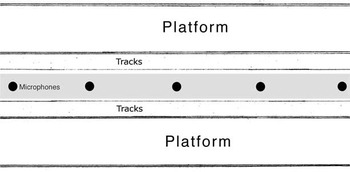
Fontana was hence operating with a system of microphones that would record a wide range of differentiated sounds within a complex sonic environment, yet he relinquished any form of realistic perspective. This becomes more apparent in the distribution of microphones in different zones (Figure 2). The first zone was located inside the big main hall, with its concave glass and steel roof, in between the tracks and platforms with five microphones in total. The stretch between the end of the main hall and the bridge was the second zone, recorded with two microphones. The third and last zone was recorded with one microphone in the middle of the Hohenzollern Bridge.
Sketch depicting the microphones’ position in between the platforms and tracks at CCS. Source: the author.

The distribution of the microphones indicates that Fontana wanted to create an imbalance between the zones mentioned, emphasising the main hall. The main hall holds a richer sonic environment compared to the zones near to and on the bridge, which might also be a reason for the distribution of the microphones. The sounds of an approaching train crossing the bridge towards the CCS were first picked up by a single microphone, it then entered the zone with two microphones, before entering the main hall where its sounds were captured with the most emphasis in this recording setup. By arranging the speakers, which will be mentioned later in this text, at an equal distance to each other at the exhibition site, Fontana distorts the proportions of the real topography with the positions of the microphones. By putting only three microphones in two zones in total and five in the third, the space of the main hall is extended while the zones outside the main hall and the bridge are reduced, resulting in the appearance of a faster approach and departure of trains. The different emphasis of the three zones shows that Fontana put special focus on the train station itself, while still including its sonic environment. An approaching train would cross the bridge and successively enter the three zones, with an increasing number of microphones receiving its sound. The approaching train sounds mask the environmental sounds at first and then merge with a growing number of sound sources within the main hall, resulting in an increasingly complex composition with a variety of influential sound sources.
The representation of the train station within the Sound Sculpture still possesses sonic elements of the urban environment, but these surroundings are thinned out and give more significance to the single sound itself. Simultaneously the main hall becomes the core part of the Sound Sculpture and its spatial and sonic qualities are represented in greater detail. Even though the microphones must have been closer together, creating a higher topochronological accuracy, the propagating delay works as a counteracting element. Fontana’s method of recording must have led to an intended cubistic representation of the train station that distorts the environmental proportions in favour of an abstract multiperspectivity that conveys a sonic entity not as a precisely locatable point in space and time but as an indistinct area that still contains characteristic qualities. With the help of WDR sound engineers, Bill Fontana made five eight-channel recordings, each on a different tape, which had a length of one hour, from which he then wanted to choose one to be played at Anhalter Bahnhof.
2.3. The Sound Sculpture
From the five tapes mentioned, Bill Fontana chose one for aesthetic reasons,Footnote 11 to be played continuously on an eight-track tape player during the opening hours of Distant Trains between 9:30am and 7:30pm (Block 1984). Furthermore, he decided to conceal the entire technical equipment from the eyes of the recipients to emphasise the discrepancy of visual and auditive perception, heightening the acoustic essence of the virtual re-creation of a train station in this historic place. Moreover, this was a volitional choice to induce confusion among the recipients, since the sound’s source was hidden yet perceivable (Fontana Reference Fontana2008).
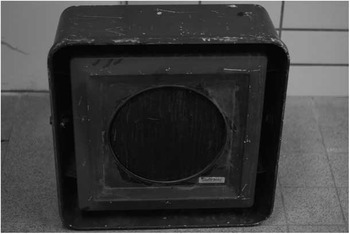
The tape player and the control unit of the sound installation were placed in a construction trailer that was stationed near a bomb shelter in the north-western part of the area, at some distance to the installation ground and not directly detectable as a functional part of the installation. Excavators dug out trenches to lay electricity and audio cables underground. These cables led to a system of eight loudspeakers hidden below ground level.Footnote 12 During my research, I was able to locate the speakers used for Distant Trains at the archive of the Electronic Studio of the Technical University of Berlin, which had cooperated with Bill Fontana for this exhibition (Figure 3).
One of eight Musicaster IIA-speakers used by Bill Fontana for Distant Trains. Source: author’s photograph at the archives of the Electronic Studio, TU Berlin.

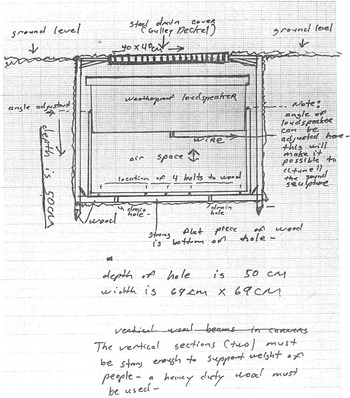
The Musicaster IIA speakers were placed in wooden cases of 69 centimetres in length and width and 50 centimetres in height. Holes were dug that fit the cases so that their tops were aligned with the ground surface. Instead of lids, metal grids were used to let the sound emit from the weatherproofed membranes of the speakers, which were placed horizontally in the cases, facing upwards. These speakers were suitable for the sonic irradiation of the premises, and created eight sound areas, each for one recording of one microphone. Together, these speakers merged into one coherent Sound Sculpture.
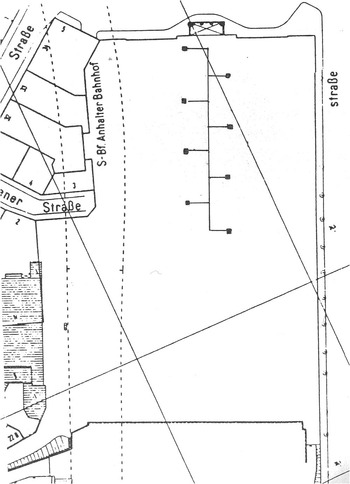
A sketch drawn by Fontana found in the DAAD archive reveals details about the position of the speakers (Figure 4). He had planned to position them in two parallel lines of four speakers on each side, with the longitudinal axis parallel to the partially still existing entrance gate of the facade, starting at a distance of 30 metres. The speakers had a distance of 15 metres to the centre line and were about 30 metres apart from each other. The speakers were shifted so that they were not paired up parallel to each other but rather interleaved. One side – containing four speakers – was shifted about 15 metres further away from the gate, so that one speaker was positioned between two speakers of the other side (Figure 5).
Technical sketch depicting the position of the speakers in wooden cubes dug in at Anhalter Bahnhof. Source: Bill Fontana’s exposé for Distant Trains.

Technical drawing of the final positions of the eight speakers. Source: Bill Fontana’s exposé for Distant Trains.

Keeping in mind the position of the microphones during the recording (a line of eight microphones over 800 metres), Fontana compressed the length of the sound field to 100 metres while also elongating its width to 30 metres (for further details see Fontana Reference Fontana1983). The composition of the relocated sound sources shows that Fontana did not intend to achieve a realistic sonic structure, which he could have done by accurately positioning the speakers according to the positions of the microphones. Instead he distorted the spatial and temporal proportions of the original sources. The line of microphones was transformed into an elongated field, so that the trains would not virtually ride in a straight line, but follow the zigzag course of the positioned loudspeakers. The sonic movements of trains within this field of speakers would also seem inaccurate, since the original distance of the recording microphones was changed in relation to the distance of the speakers at Anhalter Bahnhof. The result was an abstracted sonic gestalt that Fontana calls Sound Sculpture, which can be compared to the style of cubism (Lewallen Reference Lewallen1985).
The realistic proportions of the sonic environment of the CCS, as it was, were not sought to be depicted in a realistic manner; a logical sonic succession regarding the spatial allocation was discarded in favour of a more abstract multiperspective composition that relativised the natural balance of the found sonic environment. Furthermore, Fontana used the practice of relocation, from Cologne to Berlin via tape recordings, to detach his Sound Sculpture from any realistic relation to its origin.
The result was an accessible large-scale sonic environment of an imaginary train station, created solely by the dispersion of hidden speakers. The volume of the Sound Sculpture as a whole was adjusted so that the sounds of the train station would not mask but rather mix with the sound environment of Berlin (De La Motte Reference De La Motte1984). Standing at the entrance gate, visitors could look out on the abandoned field in this urban environment and experience the effect of the Sound Sculpture, creating an idea of an imaginary train station as a reference to the place’s history. Pedestrians and visitors walked onto the empty field, actively using and sensing it as an urban space worth noticing. Walking through the installation, recipients could accentuate certain recording positions while the spatial effect of the installation as a whole – more specifically the arriving and departing trains – was still noticeable. Thus, his installation offered an acoustic multiperspectivity that motivated visitors to actively use the space and by doing so, not only explore the Sound Sculpture but also the site itself.
Extracting all traces of technical equipment from the eyes of the visitors, a strategy he used again in later projects, such as Metropolis Köln, amongst others, was a very important factor of this exhibition. The absence of all visible and locatable sound sources or technical setup culminated in confusion, which had been a conscious aim for Fontana. This confusion was intended to prompt the realisation among recipients that they had to trust their sense of hearing in order to explore the Sound Sculpture and what it entailed. In addition, he used the potentiality of the extraordinary nature of perceptive discrepancies to reveal the lost identity of the place, therewith creating an opportunity to find it.Footnote 13
Fontana’s contribution to the IBA 1984 was an interesting approach to how people perceived their urban surroundings and their related potentiality. By applying art to a neglected urban site, he highlighted it and rediscovered it acoustically, while the attracted attention of the passers-by and visitors enlivened the space itself, making it a space that was perceived and explored by Berliners.
2.4. The radio piece
In addition to the exhibited Sound Sculpture, Bill Fontana also worked on a variation of Distant Trains that resulted in a stereo, non-narrative radio piece. The aptly titled radio piece Entfernte Züge. Köln-Berlin (a direct translation of the original English title) had a length of 43 minutes and was first aired in the programme WDR3 on 1 January 1985. The broadcast of the radio piece was preceded by an interview with Schöning and Fontana, giving an introduction to the project itself and elaborating on specific details that would help listeners understand the context of the radio piece.Footnote 14 In order to make his Sound Sculpture fit the radio format, Fontana created a mix that merged the original eight channels into two for further use at the WDR studios. This mix-down was done at the Electronic Studio of the Technical University Berlin.Footnote 15 At the studios of the WDR, Fontana edited and mixed the stereo version of the original files with the editorial support of Klaus Schöning.
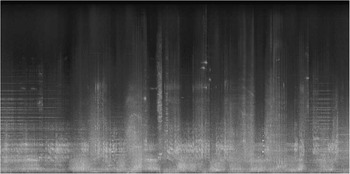
The radio piece consists of four topochronological layers that come together: the recordings of the CCS that were played at Anhalter Bahnhof in Berlin, recordings that were made during the exhibition of Distant Trains, which also contain interviews that Klaus Schöning conducted with pedestrians and visitors, as well as historic audio material. Bill Fontana chose to mix and edit the material that was used in the radio piece. Starting and ending with a recording of a commentated live recording of the controlled demolition from 1961, Fontana establishes the state of Anhalter Bahnhof as it was in 1984. This introduction is followed by the original recordings of the church bells of the Cologne Cathedral and urban city sounds, which must have been taken from the zone between the bridge and the main hall of the central station. Having introduced the sound environment of Cologne, Fontana slowly adds elements of warning signals, screeching trains and announcements, first from microphone positions afar but steadily adding recordings from microphone positions that increase in volume and directness, lessening the audible urban environment. Beginning with a wide scope, Fontana reduces it, guiding the listener from the surrounding environment of the CCS into the main hall, thus revealing the sounds of a train station as the main theme of his Sound Sculpture, and hence, his radio piece. The composition culminates in a dense, yet differentiated structure that features sounds and reverberation from inside the main hall, revealing the interesting acoustics and auditive depth one can perceive (Figure 6).
Excerpt of a spectral analysis of the radio piece. Source: the author.

Fontana abruptly fades from the recordings made in Cologne to the recordings made at Anhalter Bahnhof, which are most recognisable by the change in ambient noise level, the sound of cars passing by, as well as a certain amount of phase shifting. He introduces a second topochronological layer to the original recordings and fades back and forth between them, which can be understood as a clarification of the relocation of sounds. Having presented both places, relevant to the relocation of his Sound Sculpture, he adds a third layer that consists of six interviews that Klaus Schöning conducted with visitors and pedestrians, asking them about their experiences and opinions, and explaining the details of the Sound Sculpture. These elements are combined and alternated, illuminating different aspects of his project, going back and forth from the original recordings from Cologne to Berlin as to underline a pseudo-synchronous relation of time in Bill Fontana’s Sound Sculptures, which was not possible to be created within this project. In the last third of the radio piece he also includes an historic propaganda recording of Hitler’s arrival at Anhalter Bahnhof in the 1940s, adding to the exhibition site’s historical content, which was excluded in the actual Sound Sculpture.Footnote 16
The chosen form of composition and arrangement of the radio piece can be understood as an attempt to combine not only compositional characteristics that arose from the Distant Trains Sound Sculpture, but also documentary elements of his Sound Sculpture, which display its context and its effects on the public. Therefore, the radio piece can be understood as a Sound Sculpture in itself, using the medium of radio as a digital public space. By introducing all layers and elements relevant for Distant Trains, Fontana creates a representation of his work showing his characteristic techniques: the cubist composition of relocated sounds, a synchronicity and connection of two places that share sonic elements one’s environment. Entfernte Züge. Köln-Berlin could be called a Sound Sculpture of a Sound Sculpture, hence a second-degree cubist abstraction in reference to the initial reality of the sonic environment at CCS. Taking into account that these techniques were then used during Bill Fontana and the WDR’s collaborative project, Sound Bridge San Francisco – Cologne in 1987, one can fathom that this radio piece is a connecting link between Fontana’s Sound Sculptures done in Germany in the 1980s and his extensive later projects on a global level.
3. Conclusion
The research findings presented in this article are intended to supplement the existing, but insufficient, information in the literature on Klangkunst (or Sound Art) (Engström and Stjerna Reference Engström and Stjerna2009), offering the reader a full scope of details regarding Bill Fontana’s Sound Sculpture Distant Trains. Taking these findings into account allows for a deeper understanding of the development of Fontana’s artistic work over the decades. Distant Trains marks a significant milestone in his sonic relocations, from his earlier works, operating on a smaller scale, to international, large-scale live projects, such as Sound Bridge San Francisco – Cologne. Fontana, being a sound artist of the first generation, is also of particular interest when it comes to the historicity of Klangkunst. His works make up a main part of the discourse about the relocation of sound in public spaces and his cubist approach to reality in his Sound Sculpture as a subgenre. Offering an in-depth investigation into the interrelation of (artistic) techniques and characterising elements, deriving from both sound installation and sculptural display which come together in Bill Fontana’s Sound Sculptures, helps to illuminate and comprehend his work, and thus functions as a fruitful source of information for artistic research.
Acknowledgements
The author would like to thank: Bill Fontana, Marcus Gammel (Deutschlandradio Kultur), Julia Gerlach (Berlin Artist Programme of the DAAD), Ursula Moffitt, Andreas Pysiewicz (Department of Audio Communication at the Electronic Studio of the Technical University of Berlin), Volker Straebel (Sound Studies at the University Of Art Berlin) and the WDR-Archive.