Introduction
Violent behaviour occurs in up to 30% of those who attend or are bought to psychiatric services for the first time (Dean et al. Reference Dean, Walsh, Morgan, Demjaha, Dazzan, Morgan, Lloyd, Fearon, Jones and Murray2007). These violent or agitated patients present a critical risk to themselves, other patients and staff (Simon, Reference Simon1992; Fisher, Reference Fisher1994). Effective, humane and safe intervention is necessary to prevent injury to everyone involved. After failure of de-escalation techniques, such as talk-down methods, non-verbal calming procedures and confident use of ward environment (Lowe, Reference Lowe1992; Maier, Reference Maier1996; Cowin et al. Reference Cowin, Davies, Estall, Berlin, Fitzgerald and Hoot2003), restraints, seclusion and/or rapid tranquillization may be used. Mechanical restraints are often cotton or leather belts tied to the bedside. Seclusion refers to an involuntary confinement of a patient in a special room (locked or unlocked).
Mechanical restraints are widely used. Survey rates vary (3–50%) (Huf et al. Reference Huf, Coutinho, Ferreira, Ferreira, Mello and Adams2011) but even the limited epidemiology (Omori, Reference Omori2009) suggests that, worldwide, hundreds of thousands of people with serious mental illness are in restraints every day. We have not identified literature describing the prevalence of use of seclusion rooms (Binder & McCoy, Reference Binder and McCoy1983; Hammill, Reference Hammill1987). Where the use of restraints is less prevalent, doses of medication may be greater and physical restraining by staff over a period of time more common (Pilowsky et al. Reference Pilowsky, Ring, Shine, Battersby and Lader1992), but the best evidence is outdated and would benefit from repetition.
The safety and clinical effects of mechanical restraints or seclusion in a psychiatric setting are questionable (National Institute for Health and Clinical Excellence, 2010). A Cochrane systematic review focusing on care of people with schizophrenia or similar illnesses found no randomized controlled studies (Sailas & Fenton, Reference Sailas and Fenton2000). Different types of restraint have been evaluated in other areas of health care (Nawaz et al. Reference Nawaz, Abbas, Sarfraz, Slade, Calvocoressi, Wild and Tessier-Sherman2007) but other authoritative reviews in the area of management of psychosis failed to identify relevant objective evaluations (Fisher, Reference Fisher1994). Certainly people are harmed or die in both restraints and seclusion (Fisher, Reference Fisher1994; Paterson et al. Reference Paterson, Bradley, Stark, Saddler, Leadbetter and Allen2003) but also if they are not used. In addition to reports of physical injury and death, qualitative studies illustrate the negative psychological impact of being restrained (Anon, 1998; Zun & Downey, Reference Zun and Downey2005). Guidelines encourage minimal use and strict regulation of restraint/seclusion, but, in practice, this may not occur.
This most coercive part of health care has avoided any high-grade evaluation and therefore the safety of a very large group of patients, and their fellow patients as well as health care staff, has been neglected.
The aim of this study is to compare the effects of physical restraints with seclusion.
Method
Full details of the method have been published elsewhere (Huf et al. Reference Huf, Coutinho, Ferreira, Ferreira, Mello and Adams2011).
Study design and participants
Research into the evaluation of emergency treatment has been a central part of the activity of the psychiatric emergency rooms of Instituto Philippe Pinel, Rio de Janeiro, Brazil, since 2003 (TREC Collaborative Group, 2003; Alexander et al. Reference Alexander, Tharyan, Adams, John, Mol and Philip2004; Huf et al. Reference Huf, Coutinho and Adams2007; Raveendran et al. Reference Raveendran, Tharyan, Alexander and Adams2007). Instigation of new procedures for restraint and seclusion was seen as an opportunity for research once it had been established that the new procedures were not supported by high-grade evidence.
TREC-SAVEFootnote 1 Footnote † was a randomized, open-label, two-arm trial, with 14 days of follow-up. The trial itself was preceded by a pilot (involving 10 people) during which systems were tested. Recruitment took place in the latter half of 2010 at Instituto Philippe Pinel which provides a service for 25% of a city of approximately 7 million people and runs a 24 h psychiatric emergency room, two acute wards and two longer-stay wards (70 in-patients, 30 emergencies per day) (Huf et al. Reference Huf, da Silva Freire Coutinho, Fagundes, Oliveira, Lopez, Gewandszajder, da Luz Carvalho, Keusen and Adams2002).
Inclusion criteria were anyone thought to have a serious mental illness admitted to the hospital who: (a) had a degree or risk of aggression or violent behaviour that endangered themselves or others; and (b) was thought by medical and nursing staff to need some form of physical restriction; and (c) for whom the medical and nursing staff had doubt as to whether one form of restriction (restraints) would be better than the other (seclusion room). We did not operationalize definitions of doubt, as we wanted to interfere minimally in routine practice. These skilled practitioners, however, were confident of their ability to manage people in these extreme situations – so their decision as to whether to enter someone into the trial was based on considerable experience. Their doubt was well informed. People were excluded if: (a) either or both packages of care were contraindicated by either medical or nursing staff; or (b) the accompanying relative did not give informed consent; or (c) the person was already randomized in this trial; or (d) a seclusion room was not available.
Participants were not asked for informed consent. Standard care for such situations in Instituto Philippe Pinel is use of a seclusion room, restraints, or medication or combinations of all three. This hospital has a track record of ensuring care for this group of people based on best evidence. TREC-SAVE did not deviate care from routinely administered procedures, meets all requirements of studies feasible without informed consent (Anon, 2008) and the protocol was approved by the appropriate institutional review boards and ethics committees.
Randomization and masking
Randomization was undertaken in blocks of four and six in random order, within which random sequences of treatments were generated using the ‘List Randomizer’ option from http://www.random.org/ inputting blocks of four and six numbers. Allocation was fully concealed and undertaken by personnel not involved in the clinical interface. Consecutively, numbered sealed, fully opaque envelopes, identical in every way to the outside observer, were prepared and each contained information regarding trial conduct and directions to either seclude or restrain as per normal care. These envelopes were held in TREC-SAVE drawers on the wards and their order of opening was checked by the trial researcher.
Evaluation of the severity of a person's general or overall disturbance (Clinical Global Impression; Lima et al. Reference Lima, Soares, Paoliello, Machado Vieira, Martins, Mota Neto, Ferrão, Schirmer and Volpe2007) and the first impression of the possible cause for the disturbed behaviour were recorded before the envelope was opened before treatment allocation was known.
Procedures
All procedures were tested during the month before the start of the trial with 10 people who were in need of seclusion or restraint.
After this period, eligible participants were randomly allocated to a seclusion room or physical restraints. Both procedures were, out of necessity, often preceded by physical restraining by nurses. This lasted, at most, a matter of minutes. Both procedures were also combined with the standard levels of observations (nursing observations every 30 min, medical observations every hour) and use of medications as prescribed within routine care. In the case of Instituto Philippe Pinel, seclusion rooms are sparsely furnished with just bed and toilet, but are airy, and well lit by daylight and an unglazed barred window opening to the nursing station. Seclusion was a restricted experience but not isolated. Restraints are with strong cotton bands to both arms and both legs and attached to the bedside to allow some restricted movement in the prone position. The patient is then supervised in an area adjacent to the nursing station. The tranquilizing drug regimen in these wards has been the focus of careful research and is largely the combination of haloperidol with promethazine (Huf et al. Reference Huf, da Silva Freire Coutinho, Fagundes, Oliveira, Lopez, Gewandszajder, da Luz Carvalho, Keusen and Adams2002). The ethos of the hospital is to use the least restrictive option for the shortest time possible.
The primary outcomes were: (a) compliance with allocated procedure (no need to change intervention early – within 1 h) and (b) not restrained or secluded by 4 h. We do not wish to impose a value judgement (good versus bad) on ability to comply with the allocated procedure and wished to identify which group shows the larger proportion of possibly incorrect decisions as the first approach. If, after a period, the direction is from physical restraints to seclusion, it could mean that the first procedure was unnecessarily tough (overestimated). On the other hand, if the direction is from seclusion to physical restraints, it could mean that the first procedure was not adequate to deal with the episode (underestimated).
Secondary outcomes were time restrained, needing to end treatment of allocation, not restrained or secluded by 8, 12, 24 h, no need to call doctor again, accepting oral medication, no need of additional tranquilization medication, discharged from psychiatric hospital by 14 days, satisfaction with management of the episode (patient and primary nurse, but not relative – as we knew from previous work that few people are accompanied by family members) (Likert scale), and adverse events.
Deviations from protocol
We had hoped to record whether the index episode was the first psychiatric attendance of participants. These data were not reliably recorded in the routine notes. We had also hoped to retrieve total antipsychotic drug load over 2 weeks from routine notes. This is possible but was not feasible with the limited resources available to us.
Statistical analysis
We had no data at all from trials to estimate adequate sample size (Sailas & Fenton, Reference Sailas and Fenton2000). TREC-SAVE was a proof-of-concept study. We aimed to pilot methods, generate data relevant for sample size calculations and, if possible, clinically useful data regarding whether either procedure is better in terms of measures of restriction and perceived treatment success. We recruited 10 people as a very preliminary test of methods and, thereafter, aimed to randomize 100 in total. Concerning the primary outcomes, 100 patients were needed to give 80% power at a two-sided 5% significance level to detect a difference in an assumed value of 50% to 30% or of 25% to 10%.
Analysis was by intention to treat, and followed a detailed, pre-specified plan (Huf et al. Reference Huf, Coutinho, Ferreira, Ferreira, Mello and Adams2011).
For dichotomous outcomes we calculated the proportions for both groups and estimated the relative risks (RRs) and 95% confidence intervals (CIs). For continuous outcomes, means, standard deviations and medians were calculated. In addition, we compared the two groups concerning the time to change the allocated intervention and the total time to the end of restriction using Kaplan–Meier curves and the log-rank test. All analyses were performed using Stata software (version 10, StataCorp LP, USA).
The protocol was approved by the Instituto Philippe Pinel Research Ethics Committee on 24 February 2010. This study is registered under ISRCTN (International Standard Randomized Controlled Trial Number) 49454276.
Role of the funding source
The intra-mural funders of the study had no role in study design, data collection, data analysis, data interpretation, or writing of the report.
Results
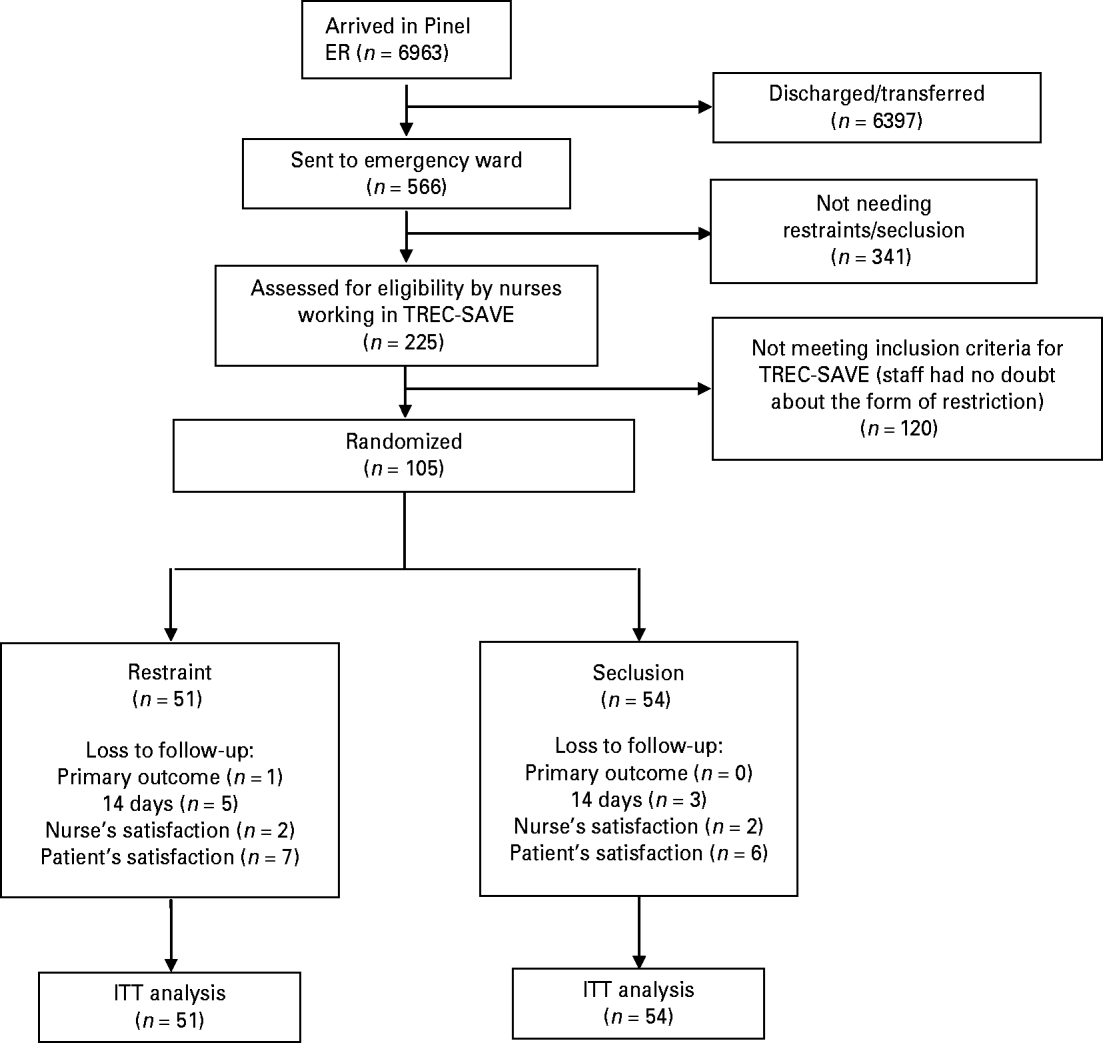
Recruitment procedures and data acquisition were tested in 10 people before the trial started. These 10 people are not included in the analyses. Thereafter, from the 225 people needing some form of restriction between 7 July 2010 and 24 January 2011, 105 (47%) people were considered eligible and were randomly allocated (Fig. 1). One patient allocated to restraints was lost to primary outcome because a psychologist arrived at the point of randomization and stayed with her to avoid the use of coercive methods.
Consolidated Standards of Reporting Trials (CONSORT) diagram. ER, Emergency room; ITT, intention to treat. For an explanation of the acronym TREC-SAVE, see the Notes section.

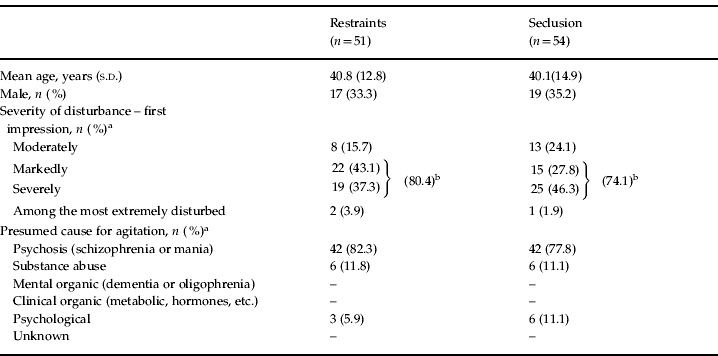
Participant characteristics at randomization were similar between groups (Table 1). There were more women than men – probably reflecting that doubt is more prevalent about which pathway of care is best for this group, although those entering the trial were clearly very disturbed and often with a considerable history of illness. Psychosis was attributed to be the cause of the aggression or agitation in the great majority. These broad diagnostic labels, given by the nurse or doctor attending the emergency are, for the great majority of people in this hospital, stable throughout the person's admission (TREC Collaborative Group, 2003).
Characteristics of patients at trial entry

s.d., Standard deviation.
a Rated blind to treatment of allocation.
b With the Portuguese version of the Clinical Global Impression scale it is linguistically difficult to discern between ‘markedly’ and ‘severely’.
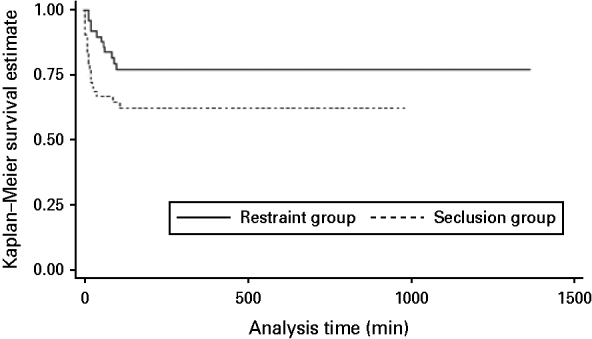
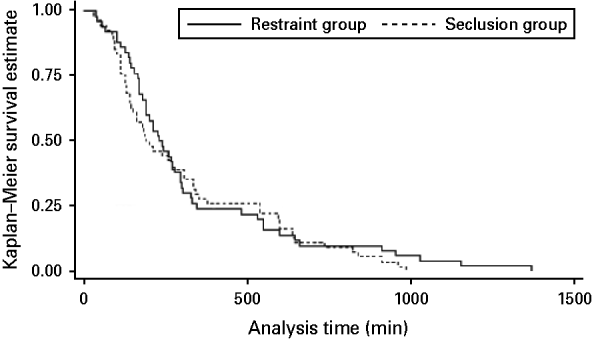
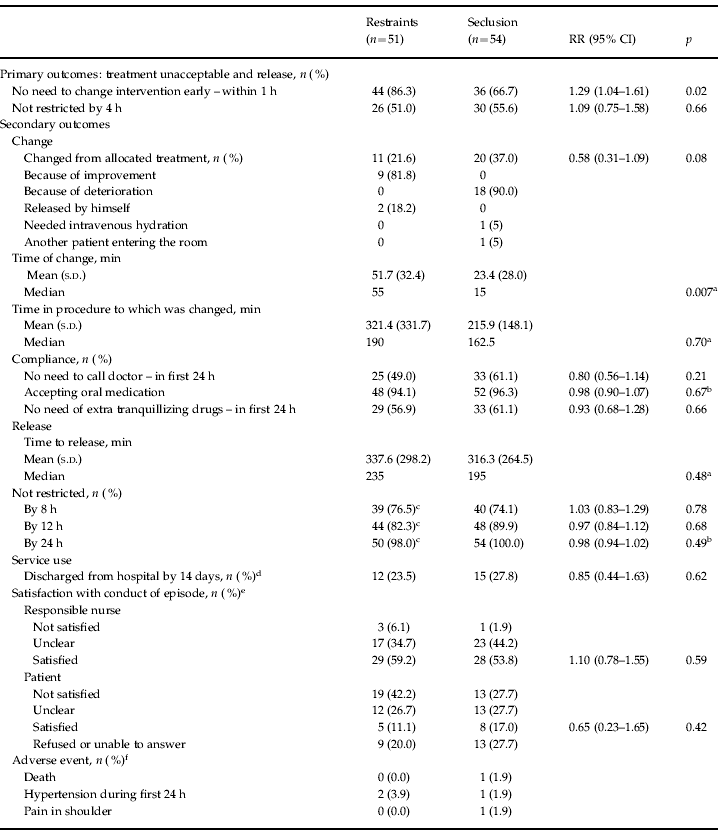
Aggressive or agitated psychotic people for whom the nurses were doubtful regarding which of the two approaches would be best, if allocated to the most restrictive option (restraints), were more likely to stay in this form of restriction (restraints) than those allocated to seclusion (RR 1.29, 95% CI 1.04–1.61; Table 2). One-third of people from the seclusion group had to be transferred into the more coercive form of restriction, the great majority because of swiftly observed deterioration in behaviour. The log-rank test for difference between the two curves identified a statistically significant difference between groups (χ2=0.0515) (Fig. 2). This transfer tended to occur early, and therefore the patient had to undergo two confrontations – one to instigate seclusion, the next to start restraints. However, two-thirds of the seclusion group were able to be managed in the least restrictive option, and by no measure of time available to us was their total time constrained either lengthened or shortened (Table 2). Even accounting for the one-third transferred ‘out’ of seclusion to restraints, total time constrained was not different between groups (mean time to release=337 v. 316 min). There were no injuries to staff. Fig. 3 shows that the pattern of patients' release was very similar in both groups (log-rank test for difference χ2=0.5160). No patient stayed longer than 23 h under any form of restriction.
Kaplan–Meier survival estimates of the time to change the allocated intervention for restraints group and seclusion group.

Kaplan–Meier survival estimates of the total time to the end of restriction for restraints group and seclusion group.

Primary and secondary outcomes

RR, Relative risk; CI, confidence interval; s.d., standard deviation; ITT, intention to treat.
a Mann–Whitney test.
b Fisher exact test.
c One patient lost to follow-up (because she did not get intervention – as psychologist arrived and decided to stay with her all the time) was attributed the worst outcome (not released).
d Three in restraints and five people in seclusion (information on this outcome could not be obtained) were excluded from this analysis.
e Nurses, two missing data in each group; patients, six missing in restraints group and seven in seclusion (not analysed by ITT).
f One male patient, aged 42 years, randomized to seclusion but changed to restraints died 11 days after randomization trying to escape from a window in another hospital; hypertension managed with medication and resolved within 24 h; one patient initially randomized to seclusion (changed to restraints) complained of pain in her shoulder, X-rayed, nothing found, resolved with pain killers in 48 h.
There was no suggestion that the initial form of restriction affected the need for higher levels of observation or need to call the doctor, subsequent refusal of medication or need for rapid tranquilization. About half of the nurses in both groups felt satisfied with how the aggressive episode was managed. This fell to about 15% in both groups of patients, but the difference did not reach conventional levels of statistical significance.
Serious adverse events occurred in one person before the trial started and five after randomization. There were no differences between groups. The one death before randomization, during the pilot study, was of a 66-year-old woman, given restraints, who died 8 days after the index episode and after transfer to another hospital. It was noted that she was very obese and hypertensive and at high risk of a cardiovascular event. The Monitoring Committee was made aware of this death and saw no reason to halt the trial. The second death, a 42-year-old man initially randomized to seclusion but changed early to restraints, occurred at another hospital, 10 days after the index episode. He fell from a high window when trying to escape from hospital, and we have no evidence of its link to the treatment of allocation. The hypertension of three participants was quickly resolved by use of appropriate medication. One person complained of pain in her shoulder. This could have been the result of being restrained. Although she was randomized to seclusion she had been changed to restraints. There were no bone injuries and the discomfort quickly resolved with conservative management. There were no injuries to the staff during the trial.
Discussion
This is one small trial of short duration. It records limited outcomes on a proportion of people who are restrained or secluded even within this institution. This proportion, however, represents a sizable proportion of the whole and, as such, a very great number of people worldwide who are coerced and restricted every day. We do acknowledge that the seclusion room of this trial may be less isolated than is common elsewhere but some form of seclusion or restraints are very widely used. However, should the nature of the seclusion room differ across the globe, we think that it would, nevertheless, be considered the less restrictive option of the two interventions. Although more outcomes would have been possible to record with more support, such as antipsychotic load, the design of the study took into account most outcomes of importance to experienced staff. Every effort was made not to complicate care but to record routine data of wide clinical importance. Losses of follow-up were minimal. One person was ‘lost’ to the study by being withdrawn by the psychologist who was, by coincidence, available to make considerable efforts to help avoid the overt coercive methods of treatment. This small episode does generate the hypothesis that additional staff, whether psychologists or not, may offset the need for overt restrictive management. Such less physically restrictive management could also be coercive and we are not clear if the person was given the choice of being managed in this way or how the usual staff and patient reacted to this approach.
In total, two people died across the time of this evaluation; one person in our pre-trial test period and the second during the trial itself. Both deaths were a long time after the index episode of restriction but suggest, and reconfirm (Prince et al. Reference Prince, Patel, Saxena, Maj, Maselko, Phillips and Rahman2007), the considerable all-cause mortality in this group and their vulnerability during care around this time in their illness. We could surmise that one death may have been related to coercive treatment with the experience of coercion affecting their wish to leave the hospital so desperately that jumping from a high-storey window was seen as desirable. One such death is a clinical disaster but not one that results in a statistically significant difference between groups. Until we have larger trials in this area we have to continue to merely surmise, and basing practice on suppositions does not seem to be serving this group of people well.
For this group of people, for whom there is doubt regarding which restriction to use, the least restrictive option of the seclusion room is now more based on evidence than before. Although attempts to use this less restrictive option fail one-third of the time and restraints have to be employed, the remaining proportion can be fully managed with a seclusion room of the sort described above. Even taking into account the use of restraints within the seclusion group, people allocated to seclusion do not spend more time in restrictions overall. Giving people the benefit of the clinical doubt and opting then for seclusion does not increase the risk of a prolonged stay. It is possible that the group allocated to seclusion received different levels of medication than those in restraints. We think this unlikely from past experience (Migon et al. Reference Migon, Coutinho, Huf, Adams, Cunha and Allen2008) but cannot disprove an association in this study, and, certainly, with additional resources, this is one variable that should be recorded.
There is a suggestion, not reaching statistical significance, that patients feel less satisfied with restraints compared with use of the seclusion room (Table 2; 42% v. 28%, RR 1.55, 95% CI 0.86–2.80). With a study of greater power this difference may well have been statistically significant and clinically highly relevant to those wishing to develop more patient-centred care.
Perhaps with more favourable levels of staff, particularly trained in techniques of non-restraint, many more episodes of use of restraints could be avoided. This may involve a shift in local cultures of care but, certainly, to proceed in moving skills towards ever-less physically restricting options we should have this not only acceptable to all involved but firmly based on clear applicable evidence.
This finding should be replicated. TREC-SAVE has shown that evaluative studies in the area of overtly coercive care are possible. Some hospitals have done away with restraints and seclusion entirely, others may have seclusion rooms but do not employ restraints, and in others the opposite policy is in place. In the acute clinical situation, however, often choices between different management paths have to be made. This also applies to the nature of restraints. Ambulatory restraints (e.g. wrist–waist and ankle) can be employed in preference to the techniques used in this study. Questions regarding when to use restraints, what type to use, duration of restriction, level of observation, nurse-handling techniques and different de-escalation techniques have still not been evaluated in trials (Sailas & Fenton, Reference Sailas and Fenton2000). These under-evaluated techniques are widely used on vulnerable, albeit aggressive, people and people die in this form of care. Real-world randomized studies evaluating all techniques are badly overdue and such studies can and should be part of routine care. At the very least, outcomes should be those routinely recorded. With additional support, however, more details concerning patient/nursing/relative satisfaction could be acquired, and observational analyses could be undertaken to allow identification of predictors of successful outcomes.
Appendix. TREC-SAVE investigators and collaborators
Writing Committee – Gisele Huf, Evandro S. F. Coutinho and Clive E. Adams.
Trial Steering Committee – Evandro S. F. Coutinho (Chair), Gisele Huf, Clive E. Adams, Marco A. V. Ferreira, José Lincoln Souza Cruz, Fernando Ramos and Silvana Ferreira.
Data Monitoring Committee – Claudio Jose Struchiner (Chair), Luiz Antonio Bastos Camacho and Jose Ramón Rodrigues Arras Lopez.
Trial Management Group – Gisele Huf and Marco Antônio de Vilhena Ferreira.
TREC-SAVE Collaborative Group – Marco Antônio de Vilhena Ferreira, Maria Conceição da Silva, Flavia Mello, José Lincoln Souza Cruz, Ilson de Souza Brito, Ângela Cristina de Souza Amorim, Luana Laurito, Priscila do Carmo Bessa Lopes, Fernanda Abrantes, Margarida Maria Tavares Cavalcanti, Anna Maria Gomes Simões, Aline Machado Samouoi and Michele Marelli.
Acknowledgements
We thank the participants and the clinical and administrative staff in Instituto Philippe Pinel, Rio de Janeiro, Brazil. The Ethics Committee was exacting and protective of the highest standards of patient care and staff conduct, but thoughtful and supportive of the research staff. TREC-SAVE was supported by intra-mural funding of the National Institute of Quality Control in Health – Oswaldo Cruz Foundation, University Hospital Clementino Fraga Filho – Federal University of Rio de Janeiro, and Instituto Philippe Pinel, institutions that saw the importance of this work. E.S.F.C. was partially supported by CNPq, process no. 302269/2008-8. We are also grateful to Professor Maritta Välimäki, of the University of Turku, Finland, for help with consideration of the findings.
Declaration of Interest
None.