Introduction
The Islamic Republic of Afghanistan, commonly known as Afghanistan (which literally means Land of the Afghan), is a landlocked and mountainous country in south-central Asia. It is bordered by Pakistan in the south and east, Iran in the west, Turkmenistan, Uzbekistan and Tajikistan in the north, and China in the far north-east. It has a history and culture that goes back over 5000 years. Throughout its long, splendid, and sometimes chaotic history, this area has been known by various names. In ancient times, its inhabitants called the land Aryana. In the medieval era, it was called Khorasan, and in modern times, its people have decided to call it Afghanistan. The exact population of Afghanistan is unknown, but it is estimated to be somewhere close to 32 million. Afghanistan is a heterogeneous nation, in which there are four major ethnic groups: Pashtuns, Tajiks, Hazaras and Uzbeks. Numerous other minor ethnic groups (Nuristanis, Baluchis, Turkmens, etc.) also call Afghanistan their home. The majority of Afghans (99%) belong to the Islamic faith.
Consanguineous marriage is defined as the union of individuals having at least one common ancestor. It is suggested that this type of marriage has been a long-standing social habit among populations (Saadat, Reference Saadat2007, Reference Saadat2008). Level of inbreeding depends on several factors, including demographic, religious, cultural and socioeconomic factors (Bittles, Reference Bittles2001, Reference Bittles2003; Saadat, Reference Saadat2007).
Consanguineous marriage has declined markedly in many parts of the Western world (Bittles, Reference Bittles2003). However, it is still very common among countries in Africa and Asia (Khoury & Massad, Reference Khoury and Massad1992; Al-Gazali et al., Reference Al-Gazali, Bener, Abdulrazzaq, Micallef, Al-Khayat and Gaber1997; Al-Abdulkareem & Ballal, Reference Al-Abdulkareem and Ballal1998; Bittles, Reference Bittles2001; Mokhtar & Abdel-Fattah, Reference Mokhtar and Abdel-Fattah2001; Saadat et al., Reference Saadat, Ansari-Lari and Farhud2004; Othman & Saadat, Reference Othman and Saadat2009; Rafiee & Saadat, Reference Rafiee and Saadat2011). Although several studies on the prevalence of consanguinity in Islamic countries have been published (Saha & El Sheikh, Reference Saha and El Sheikh1988; Al-Awadi & Amin, Reference Al-Awadi and Amin1992; Khoury & Massad, Reference Khoury and Massad1992; Al-Gazali et al., Reference Al-Gazali, Bener, Abdulrazzaq, Micallef, Al-Khayat and Gaber1997; Al-Abdulkareem & Ballal, Reference Al-Abdulkareem and Ballal1998; Durkin et al., Reference Durkin, Khan, Davidson, Huq, Munir, Rasul and Zaman2000; Rajab & Patton, Reference Rajab and Patton2000; Gunaid et al., Reference Gunaid, Hummad and Tamim2004; COSIT, 2005; Kerkeni et al., Reference Kerkeni, Monastiri, Saket, Guediche and Ben Cheikh2007), there is only one report concerning consanguinity in Afghanistan (Wahab et al., Reference Wahab, Ahmad and Shah2006) using a small sample size (168 couples) from Nangarhar and Kunard provinces. For this reason, the present study was conducted to determine the prevalence and patterns of consanguineous marriages in other provinces of Afghanistan.
Methods
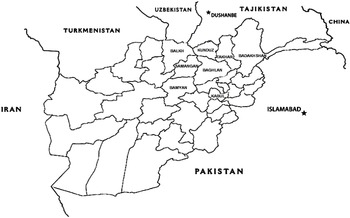
The present cross-sectional study was carried out in 2010. For sampling a multistage design was used. Afghanistan is divided into 34 provinces; eight (Badakhshan, Baghlan, Balkh, Bamyan, Kabul, Kunduz, Samangan and Takhar) were included in the survey (Fig. 1). The selected provinces (clusters) were stratified into urban and rural areas. A total of 7140 couples (urban areas: 3304 couples; rural areas: 3836 couples) were included in the study. Data on consanguineous marriages and ethnicity (Pashtuns, Tajiks, Hazaras, Turkmens and Uzbeks) were collected using a simple questionnaire by interview. The questionnaires were completed by trained interviewers.
Geographical distribution of study provinces in the Islamic Republic of Afghanistan.

The coefficient of inbreeding (F) is the probability that an individual has received both alleles of a pair from an identical ancestral source, or the proportion of loci at which he/she is homozygous. Consanguineous marriages were classified by the degree of relatedness between couples: double first cousins (F=1/8), first cousins (F=1/16), first cousins once removed (F=1/32), second cousins (F=1/64) and beyond second cousins (F<1/64). The mean inbreeding coefficient (α) was calculated for the population.
For a given degree of relatedness, a second level of classification was noted, according to the sex of the individuals occupying the different points in the pedigree. That is, first cousins may be either the children of two brothers (patrilateral parallel cousins), of two sisters (matrilateral parallel cousins) or of a brother and sister (cross-cousins).
Chi-squared contingency tests were used to compare mating pattern frequencies between populations. A probability of less than 0.05 was considered statistically significant.
Results
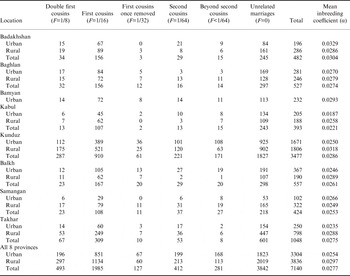
Table 1 shows the prevalence of the various types of consanguineous marriages in Afghanistan according to geographical location. There were significant differences between provinces for frequencies of different types of marriages (χ2=141.2, df=35, p<0.001). The proportion of consanguineous marriages in the country was 46.2%, ranging from 38.2% in Kabul province to 51.2% in Bamyan province. The equivalent mean inbreeding coefficient (α) was 0.0277, and ranged from 0.0221 to 0.0293 in these two regions.
Prevalence of various types of consanguineous marriages in Afghanistan

Prevalence of various types of consanguineous marriages among different ethnic groups of Afghanistan
There were significant differences between urban and rural areas for the types of marriages (χ2=43.26, df=5, p<0.001). The present data show that the overall frequency of consanguinity was 44.8% in urban and 47.3% in rural areas. The equivalent α values were 0.0254 and 0.0297 in urban and rural areas, respectively.
First cousin marriages (27.8%) were the most common type of consanguineous marriages, followed by double first cousin (6.9%), second cousin (5.8%), beyond second cousin (3.9%) and first cousin once removed (1.8%). First cousins may be either the children of two brothers (patrilateral parallel cousins), of two sisters (matrilateral parallel cousins) or of a brother and sister (cross-cousins). Of first cousin marriages, patrilateral parallel cousin marriages were the most common type of consanguineous marriages (12.5%), followed by matrilateral parallel cousin (7.8%) and cross-cousin type marriages (7.5%). The observed difference was statistically significant (χ2=123.7, df=2, p<0.0001).
There were significant differences between ethnic groups for the types of marriages (χ2=177.6, df=25, p<0.001). Tajiks (Soni) and Turkmens (also Pashtuns) showed the lowest (α=0.0250) and highest (α=0.0297) α values, respectively, among the ethnic groups in Afghanistan.
Discussion
The results of the present study show that the prevalence of consanguineous marriages in Afghanistan is high. It is well established that consanguineous unions are strongly preferred in many Asian and African countries (Saha & El Sheikh, Reference Saha and El Sheikh1988; Khoury & Massad, Reference Khoury and Massad1992; Bittles et al., Reference Bittles, Grant and Shami1993; Tuncbilek & Koc, Reference Tuncbilek and Koc1994; Rajab & Patton, Reference Rajab and Patton2000; Gunaid et al., Reference Gunaid, Hummad and Tamim2004; Saadat et al., Reference Saadat, Ansari-Lari and Farhud2004; Bener & Hussain, Reference Bener and Hussain2006; Kerkeni et al., Reference Kerkeni, Monastiri, Saket, Guediche and Ben Cheikh2007). It should be noted that the prevalence of consanguinity in Afghanistan is higher than that reported from many parts of its neighbouring Islamic countries such as Iran and Pakistan (Bittles et al., Reference Bittles, Grant and Shami1993; Saadat et al., Reference Saadat, Ansari-Lari and Farhud2004). Based on a report by Paradeeva & Revazov (Reference Paradeeva and Revazov1987), there is a high frequency of consanguineous marriages in the Uzbek population (71.2%, α=0.028), which is comparable with the prevalence of consanguinity among the Uzbek population of Afghanistan. Considering that there are no published data from Tajikistan and Turkmenistan on the prevalence of consanguinity, comparison between ethnic groups of Afghanistan and the same ethnic groups from the above-mentioned countries is impossible.
The specific types of consanguineous marriage that are favoured can vary quite widely between and within different countries. Among Afghanistan's populations, marriages between first cousins accounted for about 28% of marriages. In Islamic countries, the most common form of consanguineous marriage contracted is between first cousins (Tuncbilek & Koc, Reference Tuncbilek and Koc1994; Saadat et al., Reference Saadat, Ansari-Lari and Farhud2004; Othman & Saadat, Reference Othman and Saadat2009; Rafiee & Saadat, Reference Rafiee and Saadat2011).
The present data show that there is a statistically significant difference between ethnic groups for prevalence of consanguineous marriages. It is well established that consanguinity has been a long-standing social habit among populations (Bittles, Reference Bittles2001; Akrami & Ostai, Reference Akrami and Osati2007; Saadat, Reference Saadat2008; Tadmouri et al., Reference Tadmouri, Nair, Obeid, Al Ali, Al Khaja and Hamamy2009). Attitude and practice toward consanguinity is deeply correlated with historical background of the populations (Bittles, Reference Bittles2001, Reference Bittles2003; Saadat, Reference Saadat2007, Reference Saadat2008). Taken together the difference between ethnic groups may be interpreted by differences in several factors, including demographic, cultural and socioeconomic factors.
The present study shows that there is a difference between rural and urban areas for prevalence of consanguinity, which is in agreement with reports from several countries (Khoury & Massad, Reference Khoury and Massad1992; Alper et al., Reference Alper, Erengin, Manguoglu, Bilgen, Cetin, Dedeoglu and Luleci2004; COSIT, 2005; Othman & Saadat, Reference Othman and Saadat2009).
Here, the prevalence of consanguinity in eight provinces of north and north-east of Afghanistan has been studied. Previously two other provinces (Nangarhar and Kunard), located in the east of Afghanistan, were studied (Wahab et al., Reference Wahab, Ahmad and Shah2006). Although there are no data on other parts of Afghanistan, it is probable that in the west and south of Afghanistan the frequency of consanguinity was as high as in the study provinces.
Considering that parental consanguineous marriages are associated with both recessive Mendelian inheritance traits and many multifactorial diseases (Tuncbilek & Koc, Reference Tuncbilek and Koc1994; Al-Abdulkareem & Ballal, Reference Al-Abdulkareem and Ballal1998; Bittles, Reference Bittles2001; Becker et al., Reference Becker, Al-Halees, Molina and Paterson2001; Saadat, Reference Saadat2005; Bener & Hussain, Reference Bener and Hussain2006; Saadat & Zendeh-Boodi, Reference Saadat and Zendeh-Boodi2006; Tadmouri et al., Reference Tadmouri, Nair, Obeid, Al Ali, Al Khaja and Hamamy2009; Nafissi et al., Reference Nafissi, Ansari-Lari and Saadat2010; Saadat, Reference Saadat2011), there is an urgent need for public education programmes and more facilities for genetic counselling and reproductive risk assessment.
Acknowledgments
The authors are indebted to the participants for their close cooperation. They would like to acknowledge the trained interviewers for their assistance during the course of the study. The authors are indebted to Dr Maryam Ansari-Lari for critical reading of the manuscript. The study was supported by Shiraz University.