Introduction
Ovarian cancer is the leading cause of death from gynecologic cancer in the United States (American Cancer Society, 2020). Treatment for newly diagnosed ovarian cancer typically entails surgical cytoreduction plus systemic chemotherapy (Armstrong et al., Reference Armstrong, Alvarez and Bakkum-Gamez2019). Despite aggressive treatment, the majority of individuals with ovarian cancer develop recurrent disease within 18 months of diagnosis (Colombo et al., Reference Colombo, Lorusso and Scollo2017). As such, a diagnosis of ovarian cancer often entails a high burden of physical (Huang et al., Reference Huang, Gu and Zhang2016) and psychological (Norton et al., Reference Norton, Manne and Rubin2004) symptoms that are associated with decrements in health-related quality of life (Zhou et al., Reference Zhou, Irwin and Ferrucci2016). In the context of these challenges, individuals with ovarian cancer are likely to experience frequent and prolonged contact with the healthcare system (Yabroff et al., Reference Yabroff, Davis and Lamont2007).
Patient–clinician communication is an essential component of ovarian cancer diagnosis and surveillance (Jordens et al., Reference Jordens, Morrell and Harnett2010; Jelicic et al., Reference Jelicic, Brooker and Shand2019), symptom management (Donovan et al., Reference Donovan, Hartenbach and Method2005), and treatment decision-making (Pozzar and Berry, Reference Pozzar and Berry2019). A seminal review of studies in the broader medical literature established that effective patient–clinician communication is associated with improved emotional well-being, symptom management, and physical functioning (Stewart, Reference Stewart1995). In the cancer care setting, improved patient–clinician communication has been associated with decreased anxiety (Zwingmann et al., Reference Zwingmann, Baile and Schmier2017); increased trust in the clinician (Gordon et al., Reference Gordon, Street and Sharf2006; Arora et al., Reference Arora, Weaver and Clayman2009; Zwingmann et al., Reference Zwingmann, Baile and Schmier2017); increased discussion of prognosis, treatment alternatives, and patient concerns (Ishikawa et al., Reference Ishikawa, Takayama and Yamazaki2002; Eide et al., Reference Eide, Quera and Graugaard2004; Shields et al., Reference Shields, Coker and Poulsen2009; Sohl et al., Reference Sohl, Borowski and Smith2015); and increased satisfaction with care (Siminoff et al., Reference Siminoff, Ravdin and Colabianchi2000; Leighl et al., Reference Leighl, Gattellari and Butow2001; Liang et al., Reference Liang, Burnett and Rowland2002; Eide et al., Reference Eide, Graugaard and Holgersen2003; Venetis et al., Reference Venetis, Robinson and Turkiewicz2009; Thind et al., Reference Thind, Liu and Maly2011; Robinson et al., Reference Robinson, Hoover and Venetis2013). Research findings similarly indicate that the quality of patient–clinician communication predicts health-related quality of life and symptom burden among individuals with ovarian cancer (Pozzar et al., Reference Pozzar, Xiong and Hong2021b).
Improved understanding of the patient–clinician communication experiences of individuals with ovarian cancer may have far-reaching applications. Studies that explore how communication may relate to health outcomes are needed to generate research hypotheses and identify potential mechanisms for future communication interventions. Nevertheless, studies that explicitly aim to describe the patient–clinician communication experiences of individuals with ovarian cancer are limited. Therefore, the aim of this study was to systematically review and synthesize the patient–clinician communication experiences of individuals with ovarian cancer that have been described in the broader ovarian cancer literature.
Materials and methods
Search strategy
Using the methods described by Thomas and Harden (Reference Thomas and Harden2008), we conducted a systematic review and thematic synthesis of English-language articles published in peer-reviewed journals between January 1990 and July 2021. We selected this broad time frame to maximize our search results. Given the paucity of studies that focus explicitly on patient–clinician communication in ovarian cancer care, we first sought to identify all available articles describing qualitative studies of the experiences of individuals with ovarian cancer. In February 2020, we searched the MEDLINE, EMBASE, CINAHL, PsycINFO, and Web of Science databases for potentially eligible articles using the search terms in Table 1. Articles were eligible for inclusion in the review and synthesis if they described (a) original qualitative or mixed methods research, (b) the experiences of individuals with ovarian cancer, and (c) findings related to patient–clinician communication. Author RAP reviewed article titles and abstracts to identify potentially eligible articles, and then assessed full-text articles for eligibility criteria. In July 2021, we updated our database search results and added eligible articles identified via citation searching to the dataset.
Database search strategy and results

Quality appraisal
We appraised the quality of the synthesized articles using the Consolidated Criteria for Reporting Qualitative Research (COREQ) checklist (Tong et al., Reference Tong, Sainsbury and Craig2007). Author RAP completed the initial appraisal and author DLB reviewed and verified RAP's assessments. When items on the COREQ checklist were not explicitly stated, we considered these items to be present if they could be readily inferred (e.g., a researcher's occupation may be apparent from their credentials or affiliation). We summarized the overall quality of the synthesized articles by calculating the mean percent of applicable items reported in the three COREQ checklist domains (i.e., research team and reflexivity, study design, and analysis and findings). When a COREQ checklist item was not applicable to the research described in the published report, we assigned a score of “not applicable.” Scores of “not applicable” were not included in calculations of the percent of items reported. We did not weight or exclude articles from the review or synthesis based on article quality because there is insufficient evidence to support this practice in qualitative syntheses (Thomas and Harden, Reference Thomas and Harden2008). Consistent with the recommendation of the Enhancing Transparency in Reporting the Synthesis of Qualitative Research (ENTREQ) statement (Tong et al., Reference Tong, Flemming and McInnes2012), we assessed the relative utility of each article to the purpose of the review and synthesis by calculating the percent of all coded data derived from each article.
Data extraction and analysis
We began our analysis by reading each full-text article and taking notes on the context of each study. Next, we imported each article into NVivo Pro (QSR International, March 2020). Author RAP coded all direct participant quotes as primary data and the remainder of the results sections as secondary data. We then performed inductive, line-by-line coding on all primary and secondary data that pertained to patient–clinician communication. Author RAP coded pertinent data from every article, while author DLB coded pertinent data from a randomly selected set of articles comprising 15% of the data. We met weekly during the coding process to discuss, compare, and refine our codes and code definitions. Our initial codes described the key communication experiences that we identified in the data. We reviewed our application of these codes across studies to ensure consistency, in turn completing the process of translating findings across studies (Thomas and Harden, Reference Thomas and Harden2008). Next, we grouped similar codes together under several descriptive themes. To synthesize our findings, we first considered the abstract concepts represented by the descriptive themes. We then generated a set of analytical themes by returning to the data and identifying the antecedents and consequents of each identified concept. With this approach, we aimed to ensure that our findings would expand upon (rather than simply summarize) the findings of the original studies (Thomas and Harden, Reference Thomas and Harden2008). Our final set of analytical themes represents the relationships between concepts that were consistent across studies.
Results
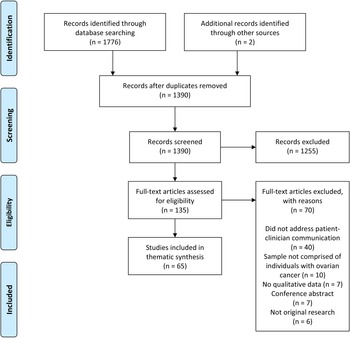
The search strategy yielded 1,390 unique records. A PRISMA flow diagram is provided in Figure 1. After screening titles and abstracts, we assessed 135 full-text articles, 65 of which met inclusion criteria. From these articles, we extracted approximately 26,000 words of relevant primary data and 21,000 words of relevant secondary data. Each individual article contributed between 0.04% and 5.93% of all coded data. The characteristics of the studies described in each article are provided in Table 2.
PRISMA flow diagram. Source: Moher et al. (Reference Moher, Liberati and Tetzlaff2009).

Characteristics and relative contributions of synthesized research reports

The COREQ checklist for the synthesized articles is provided in Supplementary File 1. On average, articles reported 69.58% of applicable items in the research team and reflexivity domain, 68.91% of applicable items in the study design domain, and 79.66% of applicable items in the analysis and findings domain. The least-often reported items included the presence of non-participants at focus groups and interviews (4/57 articles, 7.02%); the use of member checking to confirm researchers’ interpretations of findings (10/65 articles, 15.38%); and the existence of a pre-existing relationship between the researcher and the participants (12/59 articles, 20.34%).
Descriptive themes
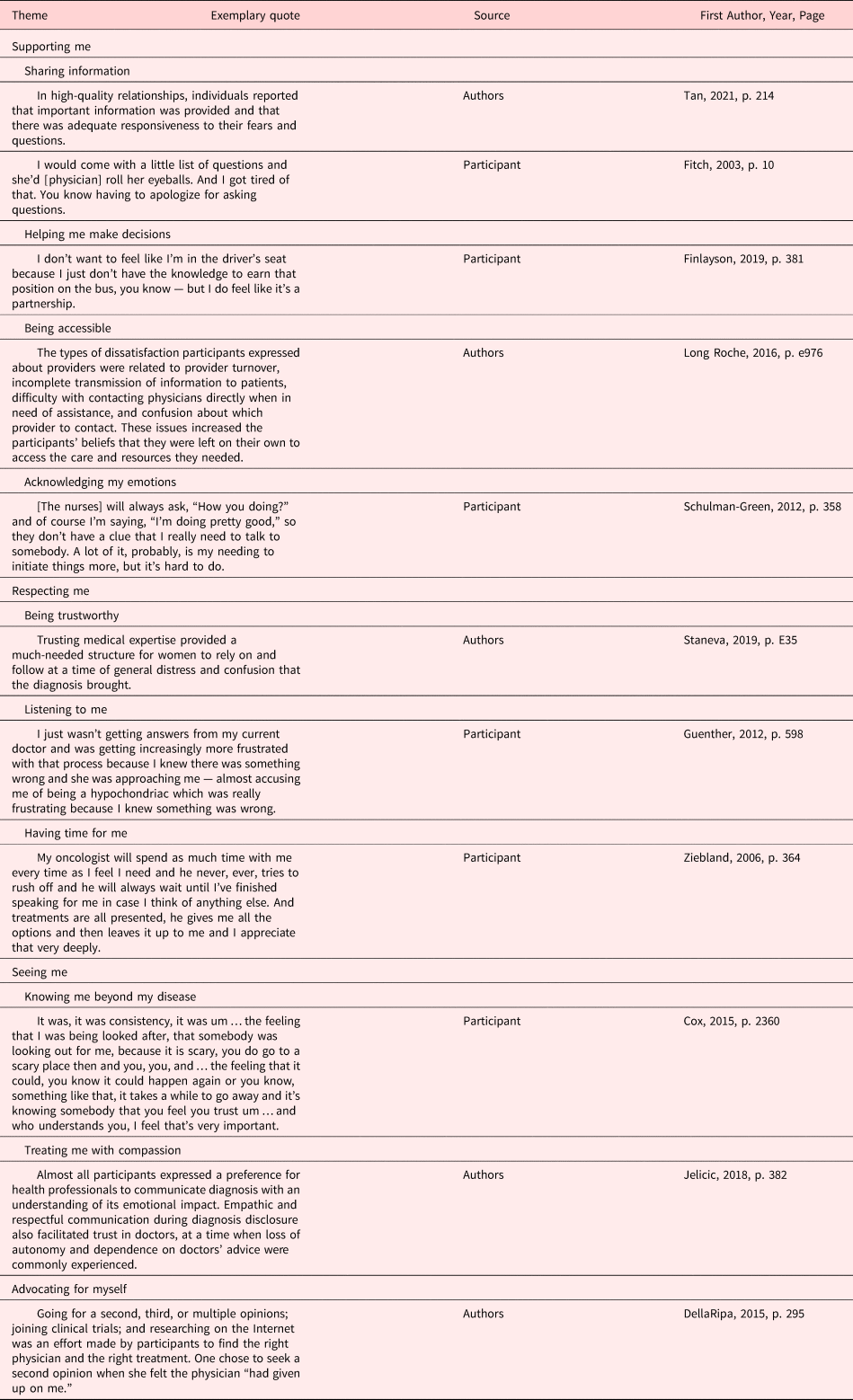
Across studies, participants described their communication encounters with clinicians in terms of the extent to which they felt supported, respected, and seen. When participants’ communication encounters with clinicians did not meet their expectations, participants engaged in self-advocacy to preserve their physical or psychological well-being. Exemplary quotes for each descriptive theme are provided in Table 3.
Exemplary quotes of descriptive themes and subthemes

Supporting me
Participants in several studies explicitly described clinicians as part of their support system (Jefferies, Reference Jefferies2002; Lydon et al., Reference Lydon, Beaver and Newbery2009; Seibaek et al., Reference Seibaek, Petersen and Blaakaer2012; Cox and Faithfull, Reference Cox and Faithfull2015; Alimujiang et al., Reference Alimujiang, Khoja and Wiensch2019; Chou and Lu, Reference Chou and Lu2019; Jelicic et al., Reference Jelicic, Brooker and Shand2019; Staneva et al., Reference Staneva, Beesley and Niranjan2019). Clinicians provided practical and emotional support by sharing information, helping patients make decisions, being accessible, and acknowledging patients’ emotions.
Sharing information
Participants appreciated when clinicians provided anticipatory guidance related to their disease course and the potential effects of treatment (Dennison, Reference Dennison1995; Ekwall et al., Reference Ekwall, Ternestedt and Sorbe2011; Seibaek et al., Reference Seibaek, Delmar and Hounsgaard2018; Jelicic et al., Reference Jelicic, Brooker and Shand2019; Pozzar and Berry, Reference Pozzar and Berry2019; Galica et al., Reference Galica, Giroux and Francis2020). Participants especially valued personally relevant information (Ekwall et al., Reference Ekwall, Ternestedt and Sorbe2011; Jelicic et al., Reference Jelicic, Brooker and Shand2019) that was tailored to their information preferences (Schaefer et al., Reference Schaefer, Ladd and Lammers1999; Bowes et al., Reference Bowes, Tamlyn and Butler2002; Jefferies, Reference Jefferies2002; Howell et al., Reference Howell, Fitch and Deane2003; Ferrell et al., Reference Ferrell, Smith and Ervin2003b; Reb, Reference Reb2007; Power et al., Reference Power, Brown and Ritvo2008; Elit et al., Reference Elit, Charles and Dimitry2010; Schulman-Green et al., Reference Schulman-Green, Bradley and Nicholson2012; Seibaek et al., Reference Seibaek, Hounsgaard and Hvidt2013; DellaRipa et al., Reference DellaRipa, Conlon and Lyon2015; Alimujiang et al., Reference Alimujiang, Khoja and Wiensch2019; Finlayson et al., Reference Finlayson, Fu and Squires2019; Han et al., Reference Han, Gutheil and Hutchinson2021). Information preferences were characterized as fluid over time (Bowes et al., Reference Bowes, Tamlyn and Butler2002) and ranged from wanting detailed information about potential treatment outcomes (Jelicic et al., Reference Jelicic, Brooker and Shand2019) to preferring not to know one's tumor stage (Han et al., Reference Han, Gutheil and Hutchinson2021). Regardless of a participant's information preferences, unmet needs for information were common (Elit et al., Reference Elit, Charles and Gold2003; Fitch et al., Reference Fitch, Deane and Howell2003; Thompson, Reference Thompson2007; Power et al., Reference Power, Brown and Ritvo2008; Long Roche et al., Reference Long Roche, Angarita and Cristello2016; Jelicic et al., Reference Jelicic, Brooker and Shand2019; Galica et al., Reference Galica, Giroux and Francis2020; Dumas et al., Reference Dumas, Lidington and Appadu2021; Mallen et al., Reference Mallen, Conley and Fuzzell2021) and fostered heightened uncertainty (Jelicic et al., Reference Jelicic, Brooker and Shand2019; Pozzar and Berry, Reference Pozzar and Berry2019). Participants especially desired more information about available resources (Power et al., Reference Power, Brown and Ritvo2008; Lydon et al., Reference Lydon, Beaver and Newbery2009; Long Roche et al., Reference Long Roche, Angarita and Cristello2016; Hagan et al., Reference Hagan, Arida and Hughes2017; Boban et al., Reference Boban, Downs and Codde2021; Polen-De et al., Reference Polen-De, Langstraat and Asiedu2021), intimacy (Fitch et al., Reference Fitch, Deane and Howell2002; Stead et al., Reference Stead, Brown and Fallowfield2003; Ekwall et al., Reference Ekwall, Ternestedt and Sorbe2011; Wilmoth et al., Reference Wilmoth, Hatmaker-Flanigan and LaLoggia2011; Fischer et al., Reference Fischer, Marguerie and Brotto2019; Jelicic et al., Reference Jelicic, Brooker and Shand2019), and prognosis (Elit et al., Reference Elit, Charles and Gold2003; Thomas et al., Reference Thomas, Nauth-Shelley and Thompson2018). Participants wanted clinicians to communicate information clearly; avoid jargon; and provide written materials to reinforce their explanations (Fitch et al., Reference Fitch, Deane and Howell2002, Reference Fitch, Deane and Howell2003; Elit et al., Reference Elit, Charles and Gold2003; Reb, Reference Reb2007; Ekwall et al., Reference Ekwall, Ternestedt and Sorbe2011, Reference Ekwall, Ternestedt and Sorbe2014; Chou and Lu, Reference Chou and Lu2019; Finlayson et al., Reference Finlayson, Fu and Squires2019; Tsai et al., Reference Tsai, Tsai and Tsay2020).
Helping me make decisions
Participants in many studies valued the opportunity to engage in treatment decision-making (Elit et al., Reference Elit, Charles and Gold2003, Reference Elit, Charles and Dimitry2010; Fitch et al., Reference Fitch, Deane and Howell2003; Howell et al., Reference Howell, Fitch and Deane2003; Ziebland et al., Reference Ziebland, Evans and McPherson2006; Ekwall et al., Reference Ekwall, Ternestedt and Sorbe2011, Reference Ekwall, Ternestedt and Sorbe2014; Alimujiang et al., Reference Alimujiang, Khoja and Wiensch2019; Arida et al., Reference Arida, Bressler and Moran2019; Pozzar and Berry, Reference Pozzar and Berry2019). Some participants perceived engagement in treatment decision-making as a way to maintain autonomy (Howell et al., Reference Howell, Fitch and Deane2003; Jelicic et al., Reference Jelicic, Brooker and Shand2019). Participants who did not engage in treatment decisions often cited their lack of medical training or knowledge about treatment options as a barrier to engagement (Fitch et al., Reference Fitch, Deane and Howell2003; Ziebland et al., Reference Ziebland, Evans and McPherson2006; Power et al., Reference Power, Brown and Ritvo2008; Elit et al., Reference Elit, Charles and Dimitry2010; Ekwall et al., Reference Ekwall, Ternestedt and Sorbe2011; Finlayson et al., Reference Finlayson, Fu and Squires2019; Pozzar and Berry, Reference Pozzar and Berry2019). While participants appreciated treatment recommendations from trusted clinicians (Elit et al., Reference Elit, Charles and Gold2003; Fitch et al., Reference Fitch, Deane and Howell2003; Asiedu et al., Reference Asiedu, Ridgeway and Carroll2018; Finlayson et al., Reference Finlayson, Fu and Squires2019; Pozzar and Berry, Reference Pozzar and Berry2019), the need to urgently begin treatment precluded some participants from engaging in treatment decisions to the extent that they preferred (Elit et al., Reference Elit, Charles and Gold2003; Fitch et al., Reference Fitch, Deane and Howell2003; DellaRipa et al., Reference DellaRipa, Conlon and Lyon2015; Asiedu et al., Reference Asiedu, Ridgeway and Carroll2018; Dumas et al., Reference Dumas, Lidington and Appadu2021). Participants in several studies perceived that there were no treatment decisions to make (Elit et al., Reference Elit, Charles and Gold2003, Reference Elit, Charles and Dimitry2010; Fitch et al., Reference Fitch, Deane and Howell2003; Meiser et al., Reference Meiser, Gleeson and Kasparian2012; Finlayson et al., Reference Finlayson, Fu and Squires2019; Han et al., Reference Han, Gutheil and Hutchinson2021). In one study, participants described challenges communicating their treatment goals and preferences to clinicians (Frey et al., Reference Frey, Philips and Jeffries2014).
Being accessible
Participants felt reassured and supported when clinicians were accessible outside of clinic visits or regular business hours (Power et al., Reference Power, Brown and Ritvo2008; Lydon et al., Reference Lydon, Beaver and Newbery2009; Ekwall et al., Reference Ekwall, Ternestedt and Sorbe2011; Cox and Faithfull, Reference Cox and Faithfull2015; Long Roche et al., Reference Long Roche, Angarita and Cristello2016; Alimujiang et al., Reference Alimujiang, Khoja and Wiensch2019; Jelicic et al., Reference Jelicic, Brooker and Shand2019; Pozzar and Berry, Reference Pozzar and Berry2019; Cusimano et al., Reference Cusimano, Sajewycz and Nelson2020; Galica et al., Reference Galica, Giroux and Francis2020). However, some participants were uncertain who to call with questions or concerns (Schulman-Green et al., Reference Schulman-Green, Bradley and Nicholson2012; Cox and Faithfull, Reference Cox and Faithfull2015; Long Roche et al., Reference Long Roche, Angarita and Cristello2016; Cusimano et al., Reference Cusimano, Sajewycz and Nelson2020). Other participants did not want to inconvenience clinicians by contacting them between clinic visits (Lydon et al., Reference Lydon, Beaver and Newbery2009; Schulman-Green et al., Reference Schulman-Green, Bradley and Nicholson2012; Seibaek et al., Reference Seibaek, Petersen and Blaakaer2012). Participants who experienced challenges navigating the healthcare system (Bowes et al., Reference Bowes, Tamlyn and Butler2002; Schulman-Green et al., Reference Schulman-Green, Bradley and Nicholson2012; Cox and Faithfull, Reference Cox and Faithfull2015; Long Roche et al., Reference Long Roche, Angarita and Cristello2016; Cowan et al., Reference Cowan, Shuk and Byrne2019; Dumas et al., Reference Dumas, Lidington and Appadu2021) felt burdened by the amount of effort it required to schedule appointments or access resources. When clinicians reached out to participants without prompting, participants felt cared for and cared about (Cusimano et al., Reference Cusimano, Sajewycz and Nelson2020).
Acknowledging my emotions
Participants felt confident expressing their needs and concerns to clinicians who acknowledged and validated their emotions (Dennison, Reference Dennison1995; Schaefer et al., Reference Schaefer, Ladd and Lammers1999; Jefferies, Reference Jefferies2002; Howell et al., Reference Howell, Fitch and Deane2003; Schulman-Green et al., Reference Schulman-Green, Bradley and Nicholson2012; Seibaek et al., Reference Seibaek, Petersen and Blaakaer2012; Cox and Faithfull, Reference Cox and Faithfull2015; Chou and Lu, Reference Chou and Lu2019; Jelicic et al., Reference Jelicic, Brooker and Shand2019; Staneva et al., Reference Staneva, Beesley and Niranjan2019; Cusimano et al., Reference Cusimano, Sajewycz and Nelson2020; Tan et al., Reference Tan, Sharpe and Russell2021; Pozzar et al., Reference Pozzar, Hong and Xiong2021a). Throughout the cancer care trajectory, participants described feeling anxious (Dennison, Reference Dennison1995; Fitch et al., Reference Fitch, Deane and Howell2002, Reference Fitch, Deane and Howell2003; Elit et al., Reference Elit, Charles and Gold2003; Reb, Reference Reb2007; Power et al., Reference Power, Brown and Ritvo2008; Finlayson et al., Reference Finlayson, Fu and Squires2019; Galica et al., Reference Galica, Giroux and Francis2020; Pozzar et al., Reference Pozzar, Hong and Xiong2021a), angry (Bowes et al., Reference Bowes, Tamlyn and Butler2002; Ferrell et al., Reference Ferrell, Smith and Cullinane2003a, Reference Ferrell, Smith and Juarez2003c; Thompson, Reference Thompson2007; Chou and Lu, Reference Chou and Lu2019), isolated (Lydon et al., Reference Lydon, Beaver and Newbery2009), fearful (Dennison, Reference Dennison1995; Mangone et al., Reference Mangone, Mandato and Gandolfi2014; Cox and Faithfull, Reference Cox and Faithfull2015; Long Roche et al., Reference Long Roche, Angarita and Cristello2016; Cusimano et al., Reference Cusimano, Sajewycz and Nelson2020; Galica et al., Reference Galica, Giroux and Francis2020; Tan et al., Reference Tan, Sharpe and Russell2021), and sad (Seibaek et al., Reference Seibaek, Petersen and Blaakaer2012). Clinicians supported participants to manage these emotions by providing information (Lydon et al., Reference Lydon, Beaver and Newbery2009; Jelicic et al., Reference Jelicic, Brooker and Shand2019; Tan et al., Reference Tan, Sharpe and Russell2021), expressing their commitment to caring for them (Cox and Faithfull, Reference Cox and Faithfull2015; Galica et al., Reference Galica, Giroux and Francis2020; Han et al., Reference Han, Gutheil and Hutchinson2021), encouraging them (Alimujiang et al., Reference Alimujiang, Khoja and Wiensch2019), and offering hope (Elit et al., Reference Elit, Charles and Gold2003; Ferrell et al., Reference Ferrell, Smith and Juarez2003c; Reb, Reference Reb2007; Power et al., Reference Power, Brown and Ritvo2008; Gleeson et al., Reference Gleeson, Meiser and Barlow-Stewart2013; Seibaek et al., Reference Seibaek, Hounsgaard and Hvidt2013; DellaRipa et al., Reference DellaRipa, Conlon and Lyon2015; Long Roche et al., Reference Long Roche, Angarita and Cristello2016; Breistig and Huser, Reference Breistig and Huser2019; Jelicic et al., Reference Jelicic, Brooker and Shand2019; Han et al., Reference Han, Gutheil and Hutchinson2021). When participants’ emotions were not acknowledged by clinicians, participants described feeling “written off” (Thompson, Reference Thompson2007) and experiencing greater distress (Reb, Reference Reb2007; Tan et al., Reference Tan, Sharpe and Russell2021).
Respecting me
Participants felt respected by clinicians they perceived as trustworthy, willing to listen, and willing to take the time to meet their needs (Fitch et al., Reference Fitch, Deane and Howell2002; Frey et al., Reference Frey, Philips and Jeffries2014; Jelicic et al., Reference Jelicic, Brooker and Shand2019).
Being trustworthy
When clinicians were not perceived as genuine or forthright, participants felt patronized and experienced increased uncertainty (Fitch et al., Reference Fitch, Deane and Howell2002; Breistig and Huser, Reference Breistig and Huser2019; Jelicic et al., Reference Jelicic, Brooker and Shand2019). Clinicians’ verbal and nonverbal cues could convey respect and care; conversely, they could convey disinterest or evoke patients’ concerns (Fitch et al., Reference Fitch, Deane and Howell2002; Reb, Reference Reb2007; Ekwall et al., Reference Ekwall, Ternestedt and Sorbe2011; Rose et al., Reference Rose, Spencer and Rausch2013; DellaRipa et al., Reference DellaRipa, Conlon and Lyon2015). Participants described trusting clinicians to use their knowledge to identify potential problems and make clinical judgments in the participant's best interest (Ziebland et al., Reference Ziebland, Evans and McPherson2006; Power et al., Reference Power, Brown and Ritvo2008; Elit et al., Reference Elit, Charles and Dimitry2010; Pozzar et al., Reference Pozzar, Baldwin and Goff2018; Alimujiang et al., Reference Alimujiang, Khoja and Wiensch2019; Finlayson et al., Reference Finlayson, Fu and Squires2019). In turn, this alleviated some of the distress associated with diagnosis (Cox and Faithfull, Reference Cox and Faithfull2015; Long Roche et al., Reference Long Roche, Angarita and Cristello2016; Pozzar and Berry, Reference Pozzar and Berry2019; Staneva et al., Reference Staneva, Beesley and Niranjan2019; Tan et al., Reference Tan, Sharpe and Russell2021).
Listening to me
Participants described the importance of having a clinician who listens to them and takes their concerns seriously (Ferrell et al., Reference Ferrell, Smith and Cullinane2003a; Smith, Reference Smith2008; Ekwall et al., Reference Ekwall, Ternestedt and Sorbe2011; Alimujiang et al., Reference Alimujiang, Khoja and Wiensch2019; Arida et al., Reference Arida, Bressler and Moran2019; Pozzar and Berry, Reference Pozzar and Berry2019; Staneva et al., Reference Staneva, Beesley and Niranjan2019). Participants especially valued clinicians who responded to their stated treatment preferences (Pozzar and Berry, Reference Pozzar and Berry2019) and symptom-related concerns (Ferrell et al., Reference Ferrell, Smith and Cullinane2003a; Staneva et al., Reference Staneva, Beesley and Niranjan2019). Many participants perceived that their ovarian cancer diagnosis had been delayed by clinicians who did not take their concerns seriously (Schaefer et al., Reference Schaefer, Ladd and Lammers1999; Bowes et al., Reference Bowes, Tamlyn and Butler2002; Fitch et al., Reference Fitch, Deane and Howell2002; Howell et al., Reference Howell, Fitch and Deane2003; Ferrell et al., Reference Ferrell, Smith and Cullinane2003a; Evans et al., Reference Evans, Ziebland and McPherson2007; Reb, Reference Reb2007; Smith, Reference Smith2008; Jordens et al., Reference Jordens, Morrell and Harnett2010; Walker et al., Reference Walker, Bischoff and Robinson2010; Guenther et al., Reference Guenther, Stiles and Champion2012; Seibaek et al., Reference Seibaek, Hounsgaard and Hvidt2013; Mangone et al., Reference Mangone, Mandato and Gandolfi2014; DellaRipa et al., Reference DellaRipa, Conlon and Lyon2015; Jelicic et al., Reference Jelicic, Brooker and Shand2019; Pozzar and Berry, Reference Pozzar and Berry2019; Boban et al., Reference Boban, Downs and Codde2021; Dumas et al., Reference Dumas, Lidington and Appadu2021). Some participants who received a delayed diagnosis described a period during which they wondered if they were imagining their symptoms (Schaefer et al., Reference Schaefer, Ladd and Lammers1999; Evans et al., Reference Evans, Ziebland and McPherson2007). Following diagnosis, participants who feared that clinicians would doubt the legitimacy of their concerns delayed seeking care and avoided asking questions (Schaefer et al., Reference Schaefer, Ladd and Lammers1999; Guenther et al., Reference Guenther, Stiles and Champion2012; Frey et al., Reference Frey, Philips and Jeffries2014; Cox and Faithfull, Reference Cox and Faithfull2015; Brandner et al., Reference Brandner, Stritter and Muller-Nordhorn2017).
Having time for me
Participants appreciated interactions with clinicians who did not appear rushed during appointments and who had time to address participants’ questions and concerns (Ziebland et al., Reference Ziebland, Evans and McPherson2006; Elit et al., Reference Elit, Charles and Dimitry2010; Ekwall et al., Reference Ekwall, Ternestedt and Sorbe2011; Cox and Faithfull, Reference Cox and Faithfull2015). When clinicians did not devote sufficient time to responding to participants’ questions, participants struggled to make sense of information discussed during the visit (Schulman-Green et al., Reference Schulman-Green, Bradley and Nicholson2012).
Seeing me
Knowing me beyond my disease
Many participants valued clinicians who acknowledged them as unique individuals (Lydon et al., Reference Lydon, Beaver and Newbery2009; Ekwall et al., Reference Ekwall, Ternestedt and Sorbe2011; Seibaek et al., Reference Seibaek, Hounsgaard and Hvidt2013; Cox and Faithfull, Reference Cox and Faithfull2015; DellaRipa et al., Reference DellaRipa, Conlon and Lyon2015; Long Roche et al., Reference Long Roche, Angarita and Cristello2016; Arida et al., Reference Arida, Bressler and Moran2019; Breistig and Huser, Reference Breistig and Huser2019; Staneva et al., Reference Staneva, Beesley and Niranjan2019; Tan et al., Reference Tan, Sharpe and Russell2021). When participants felt known by their clinicians, they were able to move beyond their identity as a patient (Cox and Faithfull, Reference Cox and Faithfull2015) and trust that their clinicians were invested in their care (Seibaek et al., Reference Seibaek, Hounsgaard and Hvidt2013; Arida et al., Reference Arida, Bressler and Moran2019; Breistig and Huser, Reference Breistig and Huser2019). Participants who had a consistent team of clinicians described the benefits of this continuity (Howell et al., Reference Howell, Fitch and Deane2003; Lydon et al., Reference Lydon, Beaver and Newbery2009; Elit et al., Reference Elit, Charles and Dimitry2010; Ekwall et al., Reference Ekwall, Ternestedt and Sorbe2011; Cox and Faithfull, Reference Cox and Faithfull2015; Long Roche et al., Reference Long Roche, Angarita and Cristello2016; Alimujiang et al., Reference Alimujiang, Khoja and Wiensch2019; Arida et al., Reference Arida, Bressler and Moran2019; Breistig and Huser, Reference Breistig and Huser2019). According to participants, these benefits include personalized care and greater ease discussing sensitive topics or emotions. Receiving care from multiple clinicians was perceived as disruptive to the process of being known beyond one's disease (Elit et al., Reference Elit, Charles and Gold2003, Reference Elit, Charles and Dimitry2010; Ekwall et al., Reference Ekwall, Ternestedt and Sorbe2011; Frey et al., Reference Frey, Philips and Jeffries2014; Cox and Faithfull, Reference Cox and Faithfull2015; Long Roche et al., Reference Long Roche, Angarita and Cristello2016; Shipman et al., Reference Shipman, Flynn and MacDonald-Smith2017). Participants described challenges related to building rapport, having to repeat their medical history, and miscommunication between members of the treatment team. Some participants explicitly stated that they did not want to be treated as a “statistic” or “number” (Alimujiang et al., Reference Alimujiang, Khoja and Wiensch2019; Breistig and Huser, Reference Breistig and Huser2019; Pozzar and Berry, Reference Pozzar and Berry2019; Cusimano et al., Reference Cusimano, Sajewycz and Nelson2020). Rather, these participants desired personalized care.
Treating me with compassion
Participants who interacted with compassionate clinicians described feeling comforted and supported (Schaefer et al., Reference Schaefer, Ladd and Lammers1999; Ferrell et al., Reference Ferrell, Smith and Cullinane2003a; Power et al., Reference Power, Brown and Ritvo2008; Frey et al., Reference Frey, Philips and Jeffries2014; Alimujiang et al., Reference Alimujiang, Khoja and Wiensch2019; Breistig and Huser, Reference Breistig and Huser2019; Pozzar and Berry, Reference Pozzar and Berry2019; Staneva et al., Reference Staneva, Beesley and Niranjan2019; Cusimano et al., Reference Cusimano, Sajewycz and Nelson2020). Compassion engendered participants’ trust in clinicians (Jelicic et al., Reference Jelicic, Brooker and Shand2019). Conversely, some participants described conversations in which their clinicians made insensitive or dismissive comments (Schaefer et al., Reference Schaefer, Ladd and Lammers1999; Fitch et al., Reference Fitch, Deane and Howell2002, Reference Fitch, Deane and Howell2003; Elit et al., Reference Elit, Charles and Gold2003; Howell et al., Reference Howell, Fitch and Deane2003; Ferrell et al., Reference Ferrell, Smith and Juarez2003c; Alimujiang et al., Reference Alimujiang, Khoja and Wiensch2019; Jelicic et al., Reference Jelicic, Brooker and Shand2019; Pozzar and Berry, Reference Pozzar and Berry2019). Participants described feeling shocked, sad, or angry in the wake of these interactions, and some sought care from another clinician (Pozzar et al., Reference Pozzar, Baldwin and Goff2018; Pozzar and Berry, Reference Pozzar and Berry2019).
Advocating for myself
Participants advocated for themselves when the healthcare system was difficult to navigate (Cowan et al., Reference Cowan, Shuk and Byrne2019); when clinicians did not adequately respond to their questions or concerns (Fitch et al., Reference Fitch, Deane and Howell2003; Smith, Reference Smith2008; Guenther et al., Reference Guenther, Stiles and Champion2012; Kyriacou et al., Reference Kyriacou, Black and Drummond2017; Alimujiang et al., Reference Alimujiang, Khoja and Wiensch2019; Finlayson et al., Reference Finlayson, Fu and Squires2019; Jelicic et al., Reference Jelicic, Brooker and Shand2019; Cusimano et al., Reference Cusimano, Sajewycz and Nelson2020); and when they perceived that their clinicians had “given up” on them (Howell et al., Reference Howell, Fitch and Deane2003; DellaRipa et al., Reference DellaRipa, Conlon and Lyon2015). Participants engaged in self-advocacy by seeking appointments, second opinions, and information; requesting diagnostic testing and treatments; and “staying on top of” their care (Schaefer et al., Reference Schaefer, Ladd and Lammers1999; Howell et al., Reference Howell, Fitch and Deane2003; Thompson, Reference Thompson2007; Smith, Reference Smith2008; Ekwall et al., Reference Ekwall, Ternestedt and Sorbe2011; Guenther et al., Reference Guenther, Stiles and Champion2012; Long Roche et al., Reference Long Roche, Angarita and Cristello2016; Kyriacou et al., Reference Kyriacou, Black and Drummond2017; Arida et al., Reference Arida, Bressler and Moran2019; Cowan et al., Reference Cowan, Shuk and Byrne2019; Jelicic et al., Reference Jelicic, Brooker and Shand2019; Cusimano et al., Reference Cusimano, Sajewycz and Nelson2020; Galica et al., Reference Galica, Giroux and Francis2020).
Analytical themes
Communicating is analogous to caring
Communication is the lens through which individuals with ovarian cancer appraise clinicians’ commitment to their well-being. Clinicians communicate their care for and compassion toward patients verbally as direct expressions of empathy and concern; nonverbally as an attentive and patient demeanor; and through actions such as following up with patients or making themselves available to address patients’ concerns. Conversely, patients who perceive a deficit in the extent to which clinicians engage in these communication behaviors may question whether they can count on clinicians to act in their best interests.
Communication is essential to personalized care
A diagnosis of ovarian cancer entails a threat to one's identity, particularly in the context of an impersonal healthcare system. When clinicians elicit and respond to patients’ preferences, remember details about patients’ personal or medical histories, or tailor explanations to the patients’ level of understanding, they tacitly recognize patients as unique individuals. Patients who do not perceive that clinicians engage in these communication behaviors may perceive that they are being treated “like a number.” In turn, patients may question whether their care has been optimized to meet their unique needs.
Communication may mitigate or exacerbate the burden of illness
Being diagnosed with and receiving care for ovarian cancer entails navigating a complex healthcare system. When clinicians provide patients with anticipatory guidance, respond to their questions, and refer them to available resources, patients feel supported in their pursuit of well-being. Conversely, when patients perceive that they have been left to pursue information and resources on their own, they may feel the need to devote more time and energy to advocating for their needs.
Discussion
The findings of this systematic review and thematic synthesis suggest that patient–clinician communication is a priority concern for individuals with ovarian cancer. Although few studies have explicitly aimed to describe patient–clinician communication in the ovarian cancer care setting, this review illustrates that references to patient–clinician communication in studies of other phenomena are plentiful. While references to communication did not predominate any of the articles we reviewed, this finding is unsurprising given that few articles described studies in which communication was the chief phenomenon of interest.
Regardless of the study context, participants described their patient–clinician communication experiences in terms of whether these experiences left them feeling supported, respected, and seen. These descriptive themes closely parallel the characteristics of patient-centered communication, which has been described as that which offers patients transparency, individualization, recognition, respect, dignity, and choice (Berwick, Reference Berwick2009). According to the National Cancer Institute Framework for Patient-Centered Communication in Cancer Care, patient-centered communication entails responding to emotions, exchanging information, making decisions, fostering healing relationships, enabling patient self-management, and managing uncertainty (Epstein and Street, Reference Epstein and Street2007). In turn, the analytical theme communicating is analogous to caring expands upon this framework by suggesting individuals with ovarian cancer may gauge clinicians’ care and commitment to their well-being by the extent to which clinicians’ communication behaviors are patient-centered. Sinclair and colleagues (Reference Sinclair, McClement and Raffin-Bouchal2016) similarly proposed that “relational communicating” is a core element of compassionate caregiving. Compassion is distinct from sympathy and empathy in that it entails proactively knowing, relating to, and actively engaging with the suffering of another person (Sinclair et al., Reference Sinclair, Beamer and Hack2017). In our findings, communication that performed these functions was perceived as an act of caring.
Compared to individuals without cancer, individuals with cancer have higher odds of receiving fragmented healthcare (Pinheiro et al., Reference Pinheiro, Reshetnyak and Safford2020). The analytical theme communication is essential to personalized care suggests patient-centered communication may serve to mitigate some of the challenges associated with receiving care in what is often a fragmented and impersonal healthcare system. Widespread adoption of integrated medical record systems is one promising system-level approach. On an interpersonal level, prior research suggests individuals with cancer perceive a need for clinicians to consider the patient's perspective and to tailor their communication strategy accordingly (Street et al., Reference Street, Spears and Madrid2019). A limited number of strategies exist to elicit the preferences and concerns of individuals with ovarian cancer (Frey et al., Reference Frey, Ellis and Shyne2020). Nevertheless, an abundance of tools have been developed to elicit patients’ values, beliefs, and preferences (Stacey et al., Reference Stacey, Légaré and Lewis2017). Coupled with interventions that aim to facilitate patient-centered communication, routine assessment and documentation of patient preferences has the potential to personalize ovarian cancer care.
Participants across studies described engaging in self-advocacy when they perceived that their health-related needs were not being met. The phenomenon of self-advocacy among individuals with ovarian cancer has been previously described (Hagan and Donovan, Reference Hagan and Donovan2013). This review and synthesis adds that self-advocacy may be performed in response to suboptimal patient–clinician communication. While participants largely perceived that unmet communication needs increased the cognitive and emotional burden of illness, higher levels of patient activation are generally associated with better health-related quality of life (Kanu et al., Reference Kanu, Brown and Rascati2021). Interventions that aim to improve health outcomes by modifying patient–clinician communication should therefore incorporate strategies to facilitate patient self-advocacy and increase clinician responsiveness to patients’ needs, preferences, and concerns (Epstein and Street, Reference Epstein and Street2007).
Effective patient–clinician communication is associated with better physical and psychological well-being (Stewart, Reference Stewart1995; Epstein and Street, Reference Epstein and Street2007; Pozzar et al., Reference Pozzar, Xiong and Hong2021b). The analytical themes identified as part of this thematic synthesis provide insight into possible mediators of these associations. For example, individuals with ovarian cancer who perceive that clinicians are accessible and compassionate may perceive higher levels of emotional and informational social support. Similarly, those with greater self-efficacy may perceive fewer communication-related needs. Among individuals with cancer, greater social support and greater self-efficacy are associated with better health-related quality of life (Leung et al., Reference Leung, Pachana and McLaughlin2014; Papadopoulou et al., Reference Papadopoulou, Kotronoulas and Schneider2017). Future studies should aim to describe and identify associations between patient–clinician communication, social support, self-efficacy, and health-related quality of life.
To our knowledge, this is the first systematic review and thematic synthesis of patent–clinician communication in the ovarian cancer care setting. A strength of this study is its inclusion of findings from across healthcare contexts. Findings from individual qualitative studies become more broadly applicable when they are synthesized with those from studies completed in heterogeneous contexts (Finfgeld-Connett, Reference Finfgeld-Connett2010). The principal limitation of this study is that few of the included articles explicitly aimed to describe patient–clinician communication. Accordingly, the communication-related findings included in this review and synthesis may lack the thick description necessary to produce a comprehensive and nuanced understanding of participants’ experiences. Research that aims to provide a rich description of the patient–clinician communication experiences of individuals with ovarian cancer is warranted. In addition, research that explores clinicians’ experiences of patient–clinician communication and informal caregivers’ experiences of caregiver–clinician communication is needed to fully characterize this dyadic phenomenon. Another limitation of this study is that most of the articles we reviewed described studies conducted in Western nations. As such, our findings may not accurately reflect the patient–clinician communication experiences of individuals with ovarian cancer who identify with non-Western cultures. Finally, despite our efforts to ensure trustworthiness during data extraction and analysis, our interpretation of the data is likely to have been influenced by our experiences as oncology nurse scientists who engage in patient-reported outcomes research.
Conclusion
Patient–clinician communication is a process by which individuals with ovarian cancer may engage in self-advocacy and appraise the extent to which they are seen, respected, and supported by clinicians. In turn, patient-centered communication conveys care and commitment, recognizes the patient as a unique individual, and has the potential to mitigate the cognitive and emotional burden of illness.
Individuals with ovarian cancer wish to feel supported, respected, and seen during patient–clinician communication encounters. Patient-centered communication is one means by which clinicians may convey their commitment to and support of patients as unique individuals. Administrators can facilitate effective patient–clinician communication by offering evidence-based communication skills training in the workplace, ensuring patients have easy access to a trusted clinician, and ensuring clinicians are given enough time to address patients’ needs and concerns during clinic visits.
Supplementary material
The supplementary material for this article can be found at https://doi.org/10.1017/S1478951522000621.
Acknowledgments
During the conduct of this work, author RAP was supported by a National Palliative Care Research Center Kornfeld Scholars Award, an American Cancer Society post-doctoral fellowship award [133063-PF-19-102-01-CPPB] and a Gordon and Betty Moore Foundation Society for Medical Decision Making fellowship in medical decision-making award [GBMF7853]. The funding sources had no role in the study design; in the collection, analysis, and interpretation of data; in the writing of the report; or in the decision to submit the article for publication.
Conflict of interest
Authors RAP and DLB have no competing interests to declare.