Termites have been heralded as ecosystem engineers because they move and enrich soils (Dangerfield et al. Reference DANGERFIELD, MCCARTHY and ELLERY1998). The extent to which different categories of termite and termitaria promote the availability of nutrients to plants and animals is, however, unclear. We hypothesized that fungus-growing termites, such as Macrotermes and Odontotermes, enrich soils to a far greater degree than non-fungus-growing termites. Our reasoning was that the fungus-growing termites fertilize and air-condition their mutualistic Termitomyces fungus with nutrient-rich clay particles (Mills et al. Reference MILLS, MILEWSKI, FEY, GROENGROEFT and PETERSON2009) and groundwater (Turner Reference TURNER, D'Odorico and Porporato2006), respectively.
The depths that Macrotermes termites have been recorded at – 52 m (Lepage Reference LEPAGE1984), 70 m (Lock Reference LOCK and Davis1985) and 84 m (Marais & Irish Reference MARAIS and IRISH1989) – are astonishing. Although the retrieval of water has not been well documented, West (Reference WEST1970) did observe within a cross-cut from an exploratory mining shaft in Zimbabwe at a depth of 24 m, water-carrying, greatly swollen termites moving upwards and non-swollen termites moving downwards. The termites were only evident in the portion of the cross-cut underlain by a water-bearing fissure. Cloud et al. (Reference CLOUD, GUSTAFSON and WATSON1980) also linked termite behaviour with groundwater, observing that after extreme droughts in the Sahel during the 1970s, a lowering of the water table had resulted in termites burrowing to depths of 45–55 m.
The retrieval of groundwater would, in particular, potentially result in considerable nutrient enrichment as a result of solutes being left in the termitaria after evaporation. By contrast, non-fungus-growing termites do not have the requirement to maintain a fungus and consequently would not accumulate groundwater solutes in their termitaria. It is also conceivable that non-fungus-growing termites do not have the energetic capacity to descend tens of metres to retrieve nutrient-rich clays and/or groundwater whereas fungus-growing termites do.
A positive feedback system can be envisaged whereby fungus-growing provides enough energy for termites to descend to unweathered, nutrient-rich rock and to groundwater. The considerable fecundity of Macrotermes compared with non-fungus-growing termites may reflect such a positive feedback; Macrotermes has been recorded as reproducing and growing at five to six times the rate of comparable termites in other non-fungus-growing subfamilies (Rouland-Lefèvre & Bignell Reference ROULAND-LEFÈVRE, BIGNELL and Seckbach2001).
To test the prediction that termitaria of fungus-growing, deep-tunnelling termites are more enriched in elements than even the largest termitaria built by non-fungus-growing, ostensibly shallow-tunnelling termites, we compared the concentration of 23 chemical elements in topsoils and adjacent above-ground termitaria of Macrotermes, Trinervitermes and Nasutitermes species. All three genera have similar foraging tactics in that they cut and collect dry grass. Only Macrotermes species are fungus-growing and deep-tunnelling.
In southern Africa, eight termitaria (at least 1 m tall and 1 m wide at the base) of Macrotermes michaelseni (Macrotermitinae) and 10 termitaria (0.5–1 m tall and 0.5–0.75 m wide at the base) of Trinervitermes trinervoides (Nasutitermitinae) were sampled at eight different sites in northern Namibian savannas/woodlands, and 10 different sites in the South African Highveld, respectively. The geographic details of these Namibian and South African termitaria are reported in Mills et al. (Reference MILLS, MILEWSKI, FEY, GROENGROEFT and PETERSON2009). In Australia, termitaria (0.5–2 m tall and 0.5–0.75 m wide) of Nasutitermes triodiae (Nasutitermitinae) were sampled across Boodjamulla National Park and adjacent to the hiking path known as Tegoora Rock Track in Townsville Town Common Conservation Park in northern Queensland, Australia. Samples were taken from the termitaria, and from adjacent topsoils (at least 10 m from the termitarium) to a depth of 10 cm.
Boodjamulla National Park, situated in the Constance Range, is hilly, underlain by siltstones, shales, sandstones and ironstones and vegetated with dry savanna. Tegoora Rock Track in Townsville Town Common Conservation Park is underlain mainly by lavas including rhyolite and andesite. The vegetation along this hiking path is mainly open woodland. Seven termitaria were sampled in Boodjamulla National Park at three different sites (Inner Gorge, Doherty's track, Edith Springs) and five termitaria in Townsville Town Common Conservation Park at one site (Tegoora Rock Track). The topsoils of the Australian sites were expected to be relatively nutrient-rich given their derivation from fine-grained sedimentary rocks in Boodjamulla National Park and volcanic rocks in Townsville Town Common Conservation Park.
All termitaria samples and topsoils were air-dried and sieved to <2 mm. They were then analysed using US EPA method 3051A for nitric acid-extractable Be, B, Na, Mg, Al, Si, K, Ca, Ti, V, Cr, Mn, Fe, Co, Ni, Cu, Zn, As, Se, Sr, Mo, Ba and Pb by inductively coupled plasma atomic emission spectrometry and inductively coupled plasma mass spectrometry.
The samples from each termitarium and its adjacent topsoil are not independent with regards to element concentration. To correct for possible bias owing to pseudoreplication, we fitted a linear mixed-effect model to our data to compare element concentrations between termitaria and topsoils. This was done using the function ‘lmer’ implemented in the R package lme4 (R package version 0.999375-41). In this analysis, we considered sampling location (termitarium versus topsoil) as a fixed effect and site as a random effect. We used a Box-Cox transformation to normalize the data prior to analysis. Post hoc pairwise comparisons were performed using Tukey's test. All statistical analyses were undertaken in R.
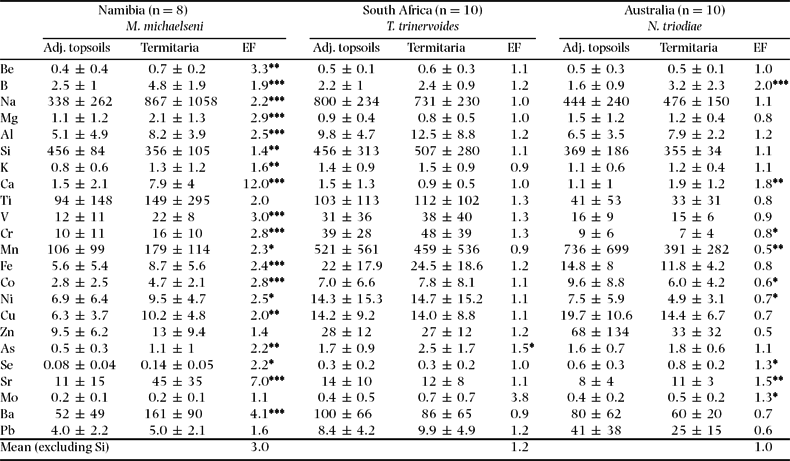
The samples taken from M. michaelseni termitaria in Namibia showed (relative to adjacent topsoils) considerable enrichment across a wide range of elements (Table 1). Eighteen elements in total were significantly enriched in the termitaria of M. michaelseni relative to adjacent topsoils. Their enrichment factors ranged from 1.6 to 12, with a mean of 3.0 for all sampled elements (excluding Si). Nutrients showing enrichment included B (an enrichment factor of 1.9), Mg (2.9), K (1.6), Ca (12), Mn (2.3), Fe (2.4), Co (2.8), Cu (2.0), Zn (1.4) and Se (2.2).
Concentrations of elements (mean ± SD) in termitaria and adjacent topsoils in Namibia (Macrotermes michaelseni), South Africa (Trinervitermes trinervoides) and Australia (Nasutitermes triodiae). Units are mg kg−1, except for Mg, Al, K, Ca and Fe which are presented in g kg−1. EF = enrichment factor. The EF of all elements except Si is the ratio of termitaria to topsoil. For Si, the inverse of this ratio is presented because impoverishment of Si is likely to reflect an enrichment of clay (a substrate considerably more fertile than large-grained, Si-rich particles). ***P < 0.001, **P < 0.01 and *P < 0.05 indicate significant differences from a mixed model analysis.

In contrast to the M. michaelseni termitaria, samples taken from the termitaria of T. trinervoides and N. triodiae showed little enrichment (Table 1). Only one element (As) was significantly enriched in T. trinervoides termitaria, with a mean enrichment factor across all elements (excluding Si) of 1.2. Results from the N. triodiae termitaria showed significant enrichment in five elements and significant impoverishment in four elements relative to adjacent topsoils (Table 1). Enriched elements included B (an enrichment factor of 2.0), Ca (1.8), Se (1.3), Sr (1.5) and Mo (1.3). Impoverished elements included Cr (0.8), Mn (0.5), Co (0.6) and Ni (0.7). On average, no enrichment was recorded for N. triodiae termitaria, the mean enrichment factor across all elements (excluding Si) being 1.0.
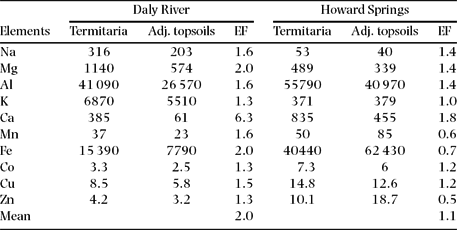
Topsoils in the South African and Australian sampling sites were more fertile than those in the Namibian sampling sites (e.g. Mn, Co, Cu, Zn and Se in Table 1). Consequently, the same quantum increase in the concentration of a particular nutrient would produce a disproportionately greater enrichment in the Namibian nutrient-poor soil than on the South African and Australian nutrient-rich soils. Notwithstanding this complexity, two additional lines of evidence suggest that Nasutitermitinae termites enrich soils to a far lesser degree than M. michaelseni. The first is that Foti (Reference FOTI1994), working in nutrient-poor landscapes at Daly River and Howard Springs in the Northern Territory of Australia, found similar results to our study in that enrichment of N. triodiae termitaria relative to topsoils was minor. The nutrient-poverty of topsoils at both Daly River and Howard Springs (Table 2) was similar to that in our Namibian sampling sites. At Daly River, the mean enrichment factor for termitaria across all 10 elements was 2.0, with 6.3 for Ca and <2 for all other elements. At Howard Springs, the mean enrichment factor was 1.1, with Ca most enriched at 1.8. The second line of evidence is that the impoverishment of Si in M. michaelseni termitaria, but not in Nasutitermitinae termitaria, indicates that at our study sites M. michaelseni imports relatively greater amounts of clay (which tend to be nutrient-rich materials relative to large-grained, Si-rich particles) into their termitaria than Nasutitermitinae termites.
Concentrations of elements (means; mg kg−1) of Nasutitermes triodiae termitaria and adjacent topsoils in Daly River Site 4 and Howard Springs (reproduced from Foti Reference FOTI1994).

Although commonly reported in the literature, enrichment of M. michaelseni termitaria relative to adjacent topsoils is not a consistent phenomenon (Maduakor et al. Reference MADUAKOR, OKERE and ONYEANUFORO1995). We suggest that this unpredictability results from variation in the geochemical composition of topsoils, subsoils, bedrock and groundwater. Termitaria on nutrient-rich soils, for example, may not require fertilization of the fungal culture. An additional factor likely to be influencing the extent of enrichment of termitaria is the chemistry of groundwater. If groundwater is indeed the major source of enrichment in Macrotermes termitaria, then the degree of enrichment of various elements would vary greatly across landscapes, correlating strongly with the composition of solutes in the groundwater. There is some corroborating evidence of this effect. Extreme concentration of nitrate (>6 g kg−1; unpubl. data) in termitaria of Macrotermes michaelseni in northern Namibia have, for example, been recorded by Petersen (Reference PETERSEN2008). It is reasonable to assume that these concentrations occur as a result of the importation of nitrate-rich groundwaters – which have been recorded frequently in arid southern Africa (Adams et al. Reference ADAMS, TITUS, PIETERSEN, TREDOUX and HARRIS2001).
Remaining to be discovered in the case of N. triodiae include: the mechanisms behind the minor enrichment of certain elements in its termitaria; whether it consumes the clay with which it builds these termitaria; whether it mines for nutrients to support its fixation of atmospheric N (Sylvester-Bradley et al. Reference SYLVESTER-BRADLEY, BANDEIRA and DE OLIVEIRA1978); and how deeply it and other Australian termites can tunnel. If N. triodiae collects clay from shallow sources and then extracts nutrients from this via its gut, this might explain why the concentrations of Mn and Co in the termitaria we studied were impoverished relative to adjacent topsoils.
The enrichment of B, Co, Cu and Se recorded in the Macrotermes termitaria in our study is likely to be of particular ecological significance given that these elements control the fecundity and health of large herbivores in many regions (Milewski & Diamond Reference MILEWSKI and DIAMOND2000). The transfer of trace elements to herbivores from the Macrotermes termitaria is thought to occur directly via geophagy (Ruggiero & Fay Reference RUGGIERO and FAY1994) as well as indirectly via consumption of plants growing on mounds (Loveridge & Moe Reference LOVERIDGE and MOE2004). Importantly, for such nutritional enhancement of herbivory, not all the termitaria need to be enriched to the point of supplementing any particular nutrient; a small percentage of these structures in a given landscape might suffice (Seymour et al. Reference SEYMOUR, MILEWSKI, MILLS, JOSEPH, CUMMING, CUMMING and MAHLANGU2014). Mills et al. (Reference MILLS, MILEWSKI, FEY, GROENGROEFT and PETERSON2009) note, for example, that the richness of Co, Cu and Se in certain termitaria of Macrotermes in Namibia was such that consumption of their earth would probably provide valuable supplementation for herbivores. Nutrient-enriched Macrotermes termitaria may function – particularly in nutrient-poor landscapes – as ‘nutrient fountains’ (Mills et al. Reference MILLS, MILEWSKI, FEY, GROENGROEFT and PETERSON2009) supplementing large mammals with trace elements (Ruggiero & Fay Reference RUGGIERO and FAY1994). By contrast, the lack of this supplementary mechanism in Australia and New Guinea may help to explain why it is on this landmass alone that all the largest herbivores became extinct long before the Holocene (Milewski & Diamond Reference MILEWSKI and DIAMOND2000).
The lack of any termite species known to descend to great depths for water in Australia suggests that groundwater on this continent is unsuitable or nutritionally unrewarding for termites. We predict that intercontinental comparisons of groundwater will bear out the relative salinity, poverty of trace elements (e.g. of Se) and natural contamination of toxic elements (e.g. of As) in Australia, none of which is conducive for growth of termites or their symbiotic fungi.
ACKNOWLEDGEMENTS
We thank: Antoni Milewski for discussions on concepts presented; Alan Andersen for identification of termites; Julia Baum, Mohammed Kajee, Selina Mochrie, Zurelda Le Roux, M-J Stowe and Jessica Allen for preparing the manuscript for submission; and Leanne Ezzy for sampling termitaria and topsoils at the Australian sampling sites.