INTRODUCTION
The term “specific language impairment” (LI) has been used to describe children who have impaired language acquisition for unknown reasons (Tallal & Benasich, 2002; Tomblin et al., 1997). Children with LI have proportionally greater deficits in language skills than in nonverbal skills, and are selected on the basis of having nonverbal IQ scores that fall within the average range. However, studies have demonstrated that deficits in some nonverbal abilities, such as mental imagery and rule induction, are also associated with this disorder (Johnston & Ramstad, 1983; Johnston & Weismer, 1983; Leonard, 1998; Restrepo et al., 1992; Swisher et al., 1994). Our research group recently conducted a study of the speed and efficiency of visuospatial attentional orienting and speed of visual processing and motor response in children with LI (Schul et al., 2004). The children with LI had normal visuospatial attentional orienting on a simple visual discrimination reaction time task but exhibited slower visual and motor processing than typically developing children. A recent small study suggested that young children with LI may have difficulty with visuospatial processing tasks, particularly those involving immediate memory (Hick et al., 2005). Weismer (Weismer, 1991, 2002) has proposed that children with LI use less efficient processing strategies across both verbal and nonverbal tasks.
While it appears that deficits across a range of nonverbal skills are present in children with LI, there have been limited theoretically driven investigations of the nature of the underlying impairment. We sought to determine whether deficits on nonverbal tasks are related to specific visuospatial deficits or related to more general deficits in processing strategies. In this study, we employed two visuospatial tasks that we have demonstrated to be sensitive to developmental change in processing strategy among typically developing children and that provide an index of specific deficits of visuospatial processing among children with early unilateral brain injury: the Hierarchical Forms task and the Rey-Osterrieth Complex Figure (ROCF) task.
Hierarchical forms have been used to assess configural and analytic processing in both adults and children (Dukette & Stiles, 2001; Kinchla & Wolfe, 1979; Navon, 1977). Hierarchical forms have a large “global” structure composed of small “local” elements (e.g., a large letter “Y” composed of appropriately arrange “B”s). One version of the Hierarchical Forms task employs a memory reproduction task in which both adult and child participants are asked to produce from memory a series of well-controlled hierarchical forms. Typically developing 4- to 8-year old children show significant and comparable improvement with age in reproducing both the global and local level of hierarchical patterns. Improvement is observed in accuracy and precision of their drawing of both the global configuration and the local elements (Dukette & Stiles, 2001). By contrast, both adults and children with focal brain injury show a dissociation in performance that is dependent on the side of their injury. Adult patients with injury to right posterior brain areas have difficulty reproducing the global form from memory, while patients with left-sided injury are impaired in reproduction of local elements (Delis et al., 1986). Five- to 12-year old children with prenatal unilateral brain injury show very similar patterns of performance on a pediatric version of this task (Stiles et al., submitted). However, it is also important to note that while the basic dissociation in global-local performance is maintained across the 5- to 12-year age period, overall performance improves for both right- and left-hemisphere lesion groups. These findings suggest that this task is sensitive to persistent, specific deficits in visuospatial processing in children with early developmental brain damage within the context of considerable functional and behavioral compensation (Stiles et al., submitted).
A second task that has proven useful in assessing both typical patterns of development and specific deficit is the ROCF. Studies of typically developing children have demonstrated that by age 9 years, most children can reliably reproduce all of the parts of the ROCF, and by age 12 years most children use a systematic approach to copying the design and are able to recall many of the parts of the design from memory (Akshoomoff & Stiles, 1995a, 1995b; Osterrieth, 1944; Waber & Holmes, 1985). In our longitudinal study of children with early unilateral brain injury, we demonstrated that while overall accuracy in copying the ROCF improved between 6 and 12 years of age, children with both right- and left-hemisphere injury persisted in their use of the most immature and piecemeal strategy. Interestingly, when these same children were asked to reproduce the ROCF from memory, a dissociation was observed. Specifically, while the memory reproductions of children with right-sided injury were as fragmented as their copies, the reproductions of children with left-sided injury were organized around the core central rectangle (Akshoomoff et al., 2002; Akshoomoff & Stiles, 2003). In a study of children referred for learning problems, performance on the ROCF was poor initially but improved for most children when they were instructed to copy the figure using a structural approach (Kirkwood et al., 2001). The authors concluded that poor initial performance on the ROCF task results from a failure to spontaneously apprehend and utilize the organizing framework inherent in the figure, and may reflect metacognitive rather than basic perceptual or spatial processing deficits in children with learning difficulties.
The Hierarchical Forms and ROCF tasks were administered to children with LI because these tasks provide the opportunity to determine if children with LI manifest specific visuospatial processing deficits, or if their performance on visuospatial tasks reflect more generalized developmental delay. Studies using the Hierarchical Forms task with typically developing children have demonstrated that by age 8 years, performance is similar to that of adults (Dukette & Stiles, 2001), but that performance continues to improve to later ages for children with deficits on this task (Stiles et al., submitted).
In Study 1, a group of children with LI between 6 and 12 years of age were divided into two age groups to determine if any deficits in performance were age-related. Because typically developing children have comparable performance in recalling the figures at the global and local level, a dissociation in performance at the two levels would be evidence for a selective deficit of visuospatial processing. Specifically, significantly lower scores on global compared to local level reproduction accuracy would suggest specific impairment of global or configural processing, while lower local, compared to global, level reproduction accuracy would suggest a local or feature processing deficit. As discussed earlier, this pattern of results was observed among children with prenatal focal brain injury, where performance of children with right-sided lesions was significantly worse at the global than the local level, and performance of children with left-sided lesions was worse at the local than the global, thus documenting two distinct patterns of visuospatial processing deficit for the two groups. Previous studies of nonverbal skills in children with LI have not included visuospatial tasks of this type. The structure of this task allowed us to determine whether children with LI perform comparably to typical controls, show specific deficits of visuospatial processing (either global or local), or present with a more uniform pattern of impairment that may be indicative of a more general processing deficit.
STUDY 1: MEMORY FOR HIERARCHICAL FORMS
Methods
Research participants
The participants were 29 children with LI and 26 typically developing (TD) participants. The children were divided into two age subgroups: 6- to 8-year-olds and 9- to 12-year-olds. Participant characteristics are listed in Table 1.
Mean Study 1 characteristics for younger and older subgroups of children in the Language Impaired (LI) and Typically Developing (TD) groups: Age at testing, verbal IQ (VIQ), performance IQ (PIQ), CELF-R Expressive Language (ELS) and Receptive Language (RLS) scores

Children with LI were tested as part of the University of California–San Diego (UCSD) Project in Cognitive and Neural Development (Stiles et al., 1998). They were recruited from local speech-language pathologists, psychologists, and physicians, and were referred to the study with a documented language impairment. Based on further testing at our center, potential participants were inducted into the study if they met the following selection criteria: (1) nonverbal IQ of 80 or higher as measured by Performance IQ on the Wechsler Preschool and Primary Scale of Intelligence–Revised (WPPSI-R; Wechsler, 1989), the Wechsler Intelligence Scale for Children–Revised (WISC-R; Wechsler, 1974), or the Wechsler Intelligence Scale for Children–Third Edition (WISC-III; Wechsler, 1991); (2) no major neurological abnormalities (determined by a neurological examination); (3) expressive language composite score 1.5 or more standard deviations below the mean using the Clinical Evaluation of Language Fundamentals–Revised (CELF-R; Semel et al., 1987); (4) absence of other known developmental disorders, such as autism. Standardized test results are shown in Table 1. Two of the 13 younger participants were administered the WPPSI-R, 7 the WISC-R, and 4 the WISC-III. Eleven of the 16 older participants were administered the WISC-R and 5 the WISC-III. All but one of the children were right-handed.
TD participants were tested as part of the UCSD Project in Cognitive and Neural Development (Table 1). The parents of the TD children completed questionnaires confirming normal developmental and educational histories and grade-level performance in school. In addition, children underwent testing to insure normal level performance on language and cognitive testing. Two of the 9 younger participants were administered the WPPSI-R, 1 the WISC-III, and 6 the WISC-R. Seven of the 17 older participants were administered the WISC-R and 2 the WISC-III. Estimated Full Scale IQ scores (using subtests from the WISC-III) were available for an additional 6 participants in the older age group. Although IQ scores were not available for 2 participants from the older age group, their developmental history and status at the time of testing was consistent with that of the other TD children.
One-way analyses of variance (ANOVAs) revealed that verbal IQ (VIQ) was significantly lower for the younger LI participants than for the younger TD participants [F(1,19) = 6.94, p = .02, Cohen's d = 1.0]. These groups did not differ significantly in terms of performance IQ (PIQ), Full Scale Intelligence Quotient (FSIQ), or age. Among the older participants, VIQ was significantly lower for the LI group (N = 16) than for the TD group (N = 9) [F(1,23) = 19, p = .0001, Cohen's d = 1.6]. The LI group (N = 16) also had significantly lower FSIQ scores than the TD group (N = 15) [F(1,29) = 13.3, p = .001, Cohen's d = 1.1]. The latter two groups did not differ significantly in PIQ or age.
Stimuli
The stimuli used in this study were developed as part of a separate, larger study of typically developing 4- and 8-year-olds (see Dukette & Stiles, 2001, for a detailed description of stimulus development and the results of the study with TD children). Children were tested with the four hierarchical stimuli shown in Figure 1. For each, local level elements (0.4 cm × 0.3 cm) were positioned in a 5 × 7 matrix to form the larger, global level form (3.7 cm × 2.5 cm). Two of the stimuli were constructed of letters, the Y of B's and the D of L's; two were constructed of geometric forms, the Square of +'s and the Pi of triangles.

Hierarchical Forms task stimuli.
Procedure
During the testing session, children were presented with a model hierarchical form stimulus and encouraged to study it for 10 seconds before it was removed. A 30-second distractor task was then introduced. Following the distractor task, the child was given a felt-tipped pen and an 8 1/2″ × 5 1/2″ blank sheet of white paper, and asked to reproduce the model form from memory. Children were given unlimited time to complete their drawings. The procedure was repeated for the four test items.
Scoring
Two independent raters scored the overall accuracy of all drawings, and evaluated the drawing for specific error types. Raters were unaware of the age, gender, or group assignment of the subjects. Inter-rater reliability was above 90% and any disagreements were resolved by consensus of the two raters.
The overall accuracy of the global and local level of each drawing was scored separately using two different but comparable six-point (0 to 5) ordinal scales, such that each drawing received two scores, one for the global level accuracy and one for the local level accuracy (see Dukette & Stiles, 2001, Appendix B for a detailed description of the scoring categories for both the global and local level scales). For the global scale, a low score was assigned for a configural form of the wrong shape. A mid-range score would be given for a correct but nonconfigural global shape. A higher score would require both a correct and configured global shape. For the local scale, a low score was assigned for a reproduction of multiple but incorrect or unrecognizable elements. A mid-range score would be given for a few, correct elements, and a higher score for many correct elements.
Results
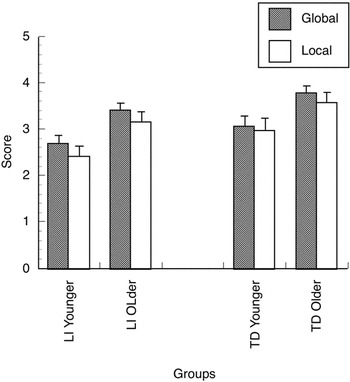
Group data from the memory task were analyzed using a repeated measures ANOVA (Group × Age Group × Hierarchical Level). Results are shown in Figure 2. There was a significant difference between scores for the LI group (M = 2.9, SD = .6) and TD group (M = 3.4, SD = .7) [F(1,51) = 5.75 p = .02; Cohen's d = .63], as well as between the younger (M = 2.8, SD = .6) and older (M = 3.5, SD = .6) age subgroups [F(1,51) = 15.38 p = .0001; Cohen's d = 1.1]. There was also a small but significant effect for Hierarchical Level [F(1,51) = 8.67 p = .005], with children performing better at the global (M = 3.2, SD = .6) than local (M = 3.0, SD =. 8) level (Cohen's d = .26). This difference was not predicted, given that the global and local level forms were matched for level of difficulty among TD participants in a previous study that included many of these same TD participants (Stiles et al., submitted). The Group by Level interaction was not significant [F(1,51) = .68, p < .1], although there was limited power to detect a significant effect (partial eta squared = .01).

Results from the Hierarchical Forms memory task. Error bars represent standard error of the mean.
To explore the possibility that the effect of stimulus level was primarily due to differences within the LI group, we conducted a repeated measures ANOVA on scores for each of the two groups separately. For the LI group, scores for the global forms (M = 3.1, SD = .75) were significantly higher than scores for the local forms (M = 2.8, SD = .94) [F(1,28) = 6.9, p = .014], although this was a small effect size (Cohen's d = .4). In contrast, comparison of scores for the global forms (M = 3.5, SD =. 57) and local forms (M = 3.4, SD = .69) failed to reveal a significant difference for the TD group [F(1,25) = 3.4, p = .08; Cohen's d = .1].
Discussion
The performance of the LI group on the Hierarchical Forms reproduction task was significantly below that of the TD group. However, the magnitude of the difference was not great, and scores improved with age for both LI and TD participants. Importantly, the groups did not differ in the accuracy of their performance at the global versus local level. There was a small difference in favor of greater accuracy in global than local level processing, an effect that accounted for only a small proportion of the variance in the full sample. However, the finding contrasts with earlier studies in which no difference was found in global and local processing for TD participants. When data from the TD group were analyzed separately, the effect of level neither reached significance nor accounted for a substantial proportion of the variance (p = .10). While the effect did reach significance in the separate analysis of the LI data, it accounted for only .20 of the variance, suggesting at best a weak dissociation between global and local processing for the LI group.
These results differ from the findings of a study of children with early unilateral brain injury, where robust and distinctive spatial deficits were associated with right- or left-hemisphere unilateral brain injury (Stiles et al., submitted). The results of the current study fail to provide substantial evidence for a comparable, specific visuospatial processing deficit in the LI group (i.e., prominent deficits in global or local level processing). Rather, the data suggest a nonspecific weakness in spatial processing.
This finding may reflect a subtle inefficiency of visuospatial processing among children with LI. Alternatively, the effect may be secondary to broader attentional or planning deficits. If the finding reflects a more generalized deficit, one would expect that tasks that increase cognitive demands would result in decreased overall performance on visuospatial tasks. That is, children may adopt simpler or more immature processing strategies when confronted with a more demanding spatial task, but global or local processing would not be selectively affected.
Among typically developing children, the manipulation of task demands induces them to adopt different processing strategies on visuospatial tasks (Stiles & Stern, 2001). The strategies the child can employ change with development, but the strategy the child employs at a particular time on a specific task is also affected by the information load presented in the array (Stiles & Stern, 2001; Tada & Stiles, 1996). For example, 3-year-olds typically copy a plus sign by producing four short lines that radiate from a central point (Tada & Stiles, 1996). In this simple approach, all of the parts are spatially independent and each is incorporated into the larger pattern using the same simple combinatorial rule, extend from the center. By contrast, 4-year-olds typically copy both a plus sign and an X using the drawing strategy that is typical of adults; they produce two long lines that cross at a central point. In this more complex approach, the parts are not spatially independent and the combinatorial rules involve both crossing and embedding. Importantly, when the same 4-year-olds are asked to copy a slightly more complex figure, an asterisk, they produce six short lines that radiate from a central point. The complexity of the target form modulates the drawing strategy they employ.
Study 2 tested this hypothesis further by introducing a more demanding spatial reproduction task, the ROCF. The ROCF is a much more cognitively demanding task than the Hierarchical Forms task. While the copy version of the task does not tax memory, the complexity of the form places greater demands on planning and analytic function than do the simpler hierarchical forms. The addition of the memory condition places further demands on processing.
STUDY 2: PROCESSING A COMPLEX FIGURE
Methods
Research participants
The participants were 15 children with LI (12 males, 3 females). Twelve of these participants (80%) also participated in Study 1. Testing was conducted when the children were between 11 and 12 years of age (M = 11.87).
Recruitment and inclusion criteria were the same as described for Study 1. As part of a battery of standardized tests, each child was administered an intelligence test (11 were administered the WISC-R and 4 were administered the WISC-III). The mean level of verbal IQ was 86.9 (SD = 12.3) and mean performance IQ was 102 (SD = 10.6). Scores on the CELF-R Expressive Language (M = 67.3, SD = 6.6) and Receptive Language (M = 71.7, SD = 12.4) were below expectations. The Visual-Motor Integration Test (VMI; Beery, 1997) was also administered as part of the standard battery. Performance on the VMI (M = 84.4, SD = 11.0) was generally in the low average range. All children were right-handed.
Stimuli
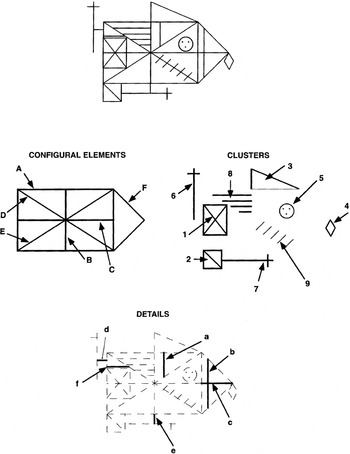
The stimulus (see top of Figure 3) measured approximately 4.25″ × 5.5″ and was printed on a laminated 8 1/2″ × 11″ white piece of paper. Each child was given a white piece of paper of the same dimensions, as well as colored felt-tipped pens for drawing.

Reproduction of the Rey-Osterrieth Complex Figure. Separate figures show the Configural Elements, Clusters, and Details from the Boston Qualitative Scoring System.
Procedure
Each child was instructed to copy the figure as exactly as possible and was told that at specific intervals, he or she would be given a different colored pen to continue his or her drawing. Pens were switched approximately every minute, or when the child began to draw a new part of the figure. Switching pens allowed for an easily visualized record of the order in which the figure was drawn. The child was not allowed to rotate the model or the blank sheet of paper. When the child stated that s/he had completed her/his copy, the stimulus and the child's sheet was taken away. The child was provided with a blank sheet of paper and was immediately asked to draw the figure again from memory. Each child was tested individually and all sessions were videotaped. All children used their preferred (dominant) hand for drawing. No motor or visual difficulties were present in the participants that impacted their performance.
Scoring procedures
The drawings were scored using the same methods utilized in our previous studies. Trained scorers, who were unaware of each participant's status or the hypotheses of the study, scored each of the drawings. The product measures were scored using a subset of the measures from the Boston Qualitative Scoring System (BQSS; Stern et al., 1994). As shown in Figure 3, this system divides the figure into three sets of features (6 Configural Elements, 9 Clusters, and 7 Details) that are scored according to their Presence, Accuracy, and Placement. The Presence scores indicate that a feature is present in the drawing, regardless of the quality of the representation. The Accuracy score reflects the quality of the features in the drawing (i.e., completeness, size, proportion, correctness of angles, straightness of lines, and accuracy of intersections with other features). Details are not scored for Accuracy. The Placement score indicates whether the feature is placed in the proper region of the figure (Clusters and Details only). The final scores for each child were determined by using the BQSS conversion tables that place all measures on a scale ranging from 5 to 1. A score of 5 indicates that 90–100% of the scoring criteria were met (best score), while a score of 1 indicates that none of the scoring criteria were met (worst score).
The planning and organizational approach employed by the child was scored using the Progression strategy score. This is a process score based on the previously identified four distinct categories that best described data from typically developing children ages 6 through 12 (Akshoomoff & Stiles, 1995a). These categories were: (1) the rectangle is complete (even if fragmented) and Configural Elements B and C were drawn as continuous lines; (2) the figure was broken into two major units and constructed unit-by-unit; (3) the figure was broken into three or more major units and constructed unit-by-unit; and (4) inconsistent placement of remaining items.
In addition, the data from both the copy and immediate memory conditions were scored to assess for the integrity of the core rectangle following the method used in our previous study (Akshoomoff et al., 2002). Each drawing was examined to determine if it contained a rectangle that was present, accurate, and fragmented no more than once using the BQSS criteria for presence, accuracy, and fragmentation of Rectangle A.
Analyses
Using the data from 40 TD 11- and 12-year-old children (M = 11.9 years, SD = .57), including 20 males and 20 females from a previously published study (Akshoomoff & Stiles, 1995b) as a “normative” group, the product measures for the children with LI were compared to those of the TD group using t tests. Chi square tests were employed to compare the groups on process measures.
Results
Product measures
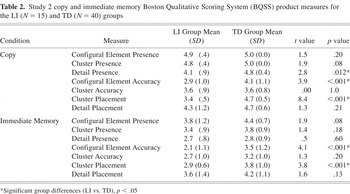
Table 2 shows the results for the BQSS measures from the copy and immediate memory conditions. Variances across the groups were found to be significantly different for 6 of the measures, therefore t tests for unequal variances were computed for all measures. The children in the LI group obtained significantly lower Detail Presence, Configural Element Accuracy, and Cluster Placement scores than the TD group. In the immediate memory condition, the children in the LI group again obtained significantly lower Configural Element Accuracy and Cluster Placement scores than the TD group.
Study 2 copy and immediate memory Boston Qualitative Scoring System (BQSS) product measures for the LI (N = 15) and TD (N = 40) groups

Process measures
As shown in Table 3, the two groups differed significantly in their use of Progression strategies (χ2(1, N = 55) = 18.56, p = .001). The majority of the TD participants produced a drawing that contained a complete rectangle with continuous horizontal and vertical bisectors. In contrast, only one of the children in the LI group used this strategy. Instead, the majority of them used the most immature approach (the “Inconsistent Placement” strategy).
Distribution of progression strategy scores on the Rey-Osterrieth copy condition (Study 2) for the Language Impaired (LI) and Typically Developing (TD) groups

The data from the copy and immediate memory conditions were scored to assess for the integrity of the core rectangle. The proportion of participants in the LI group (6.7%) and the TD group (32.5%) who included the core rectangle (accurate and fragmented no more than once) in their drawings did not differ significantly for the copy condition (χ2(1, N = 55) = 3.84). However, the corresponding difference for the immediate memory condition was significant (χ2(1, N = 55) = 5.48, p = .025). Among the drawings from the LI group, 13.3% included the core rectangle, while 50% of the drawings from the TD group included the core rectangle. This represents an increase of 17.5% in the number of drawings that included the core rectangle in the immediate memory condition compared to the copy condition for the TD group compared to an increase of 6.6% for the LI group.
Figure 4 shows drawings from the copy and immediate memory conditions for three children with LI. The drawings in the first two panels were drawn by children who were representative of the LI group in terms of verbal and performance IQ and CELF-R language scores. The drawings from the one child who drew the core rectangle in both the copy and immediate memory conditions are shown in the third panel.

Top panels show drawings from two representative children in the LI group. Note the fragmentation of the rectangle in both copy and immediate memory. Bottom panel shows drawings from the only child in the LI group to include a complete rectangle in both the copy and immediate memory conditions.
GENERAL DISCUSSION
The results of the studies presented here provide an interesting and complex portrait of visuospatial processing weaknesses in children with LI. At one level, the children in this study clearly presented with subtle processing deficits on these visuospatial tasks. Their performance on the Hierarchical Forms task was consistently below that of typical peers, they lagged behind on a range of product measures on the ROCF, and their strategies in reproducing the ROCF were markedly immature. However, unlike children with unilateral brain injury, the children in the LI group did not manifest clear, specific deficits in visuospatial processing (i.e., in global vs. local level processing) on the Hierarchical Forms task. Rather, their overall performance and processing strategy suggested an immature and less efficient approach to the visuospatial processing tasks.
Statistically significant group differences were noted for certain product measures of performance on the ROCF, particularly accuracy in reproducing the larger elements of the figure and placement of the clusters. Group differences were also observed in the approach used during the ROCF copy task and “consolidation” of the core rectangle from copy to immediate recall. Despite generally good performance in terms of production of this complex figure, children with LI tended to use a less accurate, fairly piecemeal (immature) strategy when copying the figure. This approach had an impact on their recall of the figure because they were less likely to draw the core rectangle in a more integrated fashion during the immediate memory condition compared with the observed shift toward consolidation of the main rectangle in the immediate memory condition among typically developing children (Akshoomoff et al., 2002). This pattern of performance is similar to that observed among children with early right-hemisphere stroke and thus could suggest subtle specific deficits in processing configural information. However, the performance is also consistent with that of younger typically developing children (Akshoomoff & Stiles, 1995a, 1995b). Specifically, under the demanding ROCF task conditions, young children fail to recognize the core rectangle as a central organizer of the overall configuration and instead adopt a more piecemeal approach to reproducing the form. Given that no evidence of selective deficit in configural processing was observed in the less taxing Hierarchical Forms task, it is likely that the performance of the children with LI on the ROCF indicates an immature response profile that may reflect a more general attentional or planning deficit.
A large body of research has demonstrated that children with LI experience persistent and significant difficulties with language early on, and that these problems continue through adolescence. Work by our group (Reilly & Wulfeck, 2004) compared the performance of school-age children with LI with the performance of children who suffered early unilateral brain injury (prenatal or perinatal unilateral stroke). Across a range of language tasks, we observed that the LI group performed consistently below that of the stroke group. Indeed, the school-age stroke group showed remarkably good language abilities. Together, these findings suggest that the underlying mechanisms responsible for language impairment may be more pervasive and less flexible compared to the more plastic and resilient systems that operate in children with early brain injury. In addition, results from the present study demonstrating that children with LI also experience difficulties in nonverbal domains serve to remind us that studies of language alone may not tell the whole story. Indeed, if we are to make further gains regarding the nature and causes of developmental language impairment, we must move beyond studies of language and consider the degree to which nonlinguistic deficits may have consequences for language development early on or on a more protracted basis.
ACKNOWLEDGMENTS
Special thanks are given to the participants in this study, Janet Shin, and the staff of the Project in Cognitive and Neural Development. This study was supported by National Institute of Neurological Disorders and Stroke, grant P50-NS22343 and the National Institute of Child Health and Human Development, grant R01-HD25077.