Introduction
The basement rocks of New Caledonia are made up of four distinct tectonostratigraphic terranes that developed along the eastern margin of Gondwana during Carboniferous to Jurassic time (Aitchison et al., Reference Aitchison, Ireland, Clarke, Cluzel, Davis and Meffre1998, Davies et al., Reference Davies, Bani, Black, Smith, Garaebiti and Rodda2004). The Téremba Terrane occurs on the west coast in the Baie de St-Vincent – Moindou region and consists of Permian arc-related volcanics and volcaniclastics in its basal portion, overlain by a thick, somewhat deformed and diagenetically altered marine sequence of fossiliferous volcaniclastics with frequent but minor tuffs. This sequence has often been likened to the Murihiku Terrane of New Zealand (Paris, Reference Paris1981; Campbell and Grant-Mackie, Reference Campbell and Grant-Mackie2000) because of near-identity of Permian – Jurassic faunas of the two and comparable lithologies, structural complexities, and geotectonic setting. The Téremba rocks are, however, more extensively faulted, and, in addition, they are generally of shallower water origin and include more unconformities and, possibly, other depositional hiatuses (e.g., Paris, Reference Paris1981; Campbell et al., Reference Campbell, Grant-Mackie and Paris1985).
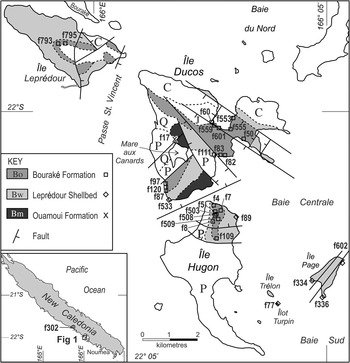
Strata of the Téremba Terrane are well exposed in the Moindou area and on the islands in the Baie de St-Vincent (Fig. 1) (see Pharo, Reference Pharo1967; Paris, Reference Paris1981; Faure and Paris, Reference Faure and Paris1982; Campbell et al., Reference Campbell, Grant-Mackie and Paris1985) and have yielded a rich and diverse macrofauna of molluscs, brachiopods, crinoids, conulariids, and corals, and rare vertebrates. Bryozoa prove to be abundantly present at a few Triassic horizons, rarer at some others, and absent from most. This report documents this bryozoan fauna for the first time, all members of which come from units included in the Baie de St-Vincent Group (Campbell et al., Reference Campbell, Grant-Mackie and Paris1985).
Simplified geological map of part of the Baie de St-Vincent, showing localities yielding Triassic Bryozoa. C=Tertiary strata; J=Jurassic; P=Permian; Q=Quaternary. An inset figure of the whole island shows the area covered by this and the general location of NC/f302. Sites on îles Leprédour, Page, and Trélon and ilot Turpin are not included in the stratigraphic columns (Figs. 4, 6) because of difficulty in determining accurate levels.

Paleobiogeographically, New Caledonian Triassic faunas, i.e. those of the Téremba Terrane, form a small Triassic-Early Jurassic Maorian Province with Murihiku faunas, with a benthic fauna having very little in common with the Tethyan Realm nearby to the northwest and including a significant level of generic endemism. To reinforce the point made above, benthic faunas of the Murihiku and Téremba Terranes are nearly identical, the Téremba Terrane lacking a few of the elements of the Murihiku fauna, perhaps only because of the smaller size of the available sampling area.
Bryozoan faunas of the New Zealand Triassic proved similarly to have little in common with those of the Tethys and showed a closer relationship with the Permian fauna of eastern Australia (Schäfer and Grant-Mackie, Reference Schäfer and Grant-Mackie1994) (that of the New Zealand Permian has still not yet been fully documented, so direct comparisons cannot be made). From this evidence, it may be supposed that the New Caledonian Triassic Bryozoa should hold much in common with that of the Murihiku Terrane.
Age and correlation
Early in their study, the lower Mesozoic faunas of New Zealand were seen to be so different from those of Europe and with a paucity of ammonoids to make correlation difficult, despite it being aided by the presence of a few members of cosmopolitan groups with short time-ranges, such as the bivalves Monotis and Halobia in the Triassic. Internal correlation, however, was much more readily achieved, and eventually a local scheme of series and stages was introduced (Marwick, Reference Marwick1953). This was extended to New Caledonia as correspondence between the two was realized (Avias, Reference Avias1953; Paris, Reference Paris1981).
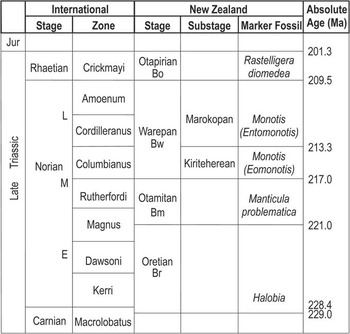
This local correlation scheme (Fig. 2) has been refined as further paleontological data have become available and is well established in local usage (Cooper, Reference Cooper2004).
Correlation of the New Zealand local chronostratigraphic scheme with the international scheme (after Cooper, Reference Cooper2004; and GNS Science, 2012), with the taxa on which each local stage/substage is based. Included are the map symbol for each local stage (e.g. Br=Oretian) and dates for stage and zone boundaries; Ma=millions of years (after Cooper, Reference Cooper2004). As noted in the text, the local scheme is applied also in New Caledonia.

Each local stage is defined by the incoming of an index species, its top being coincident with the base of the next younger defined stage. The strata involved in this study are essentially Norian and Rhaetian, at the top of the Triassic, and are included within the local Oretian, Otamitan, Warepan, and Otapirian stages, in upward sequence. Each has recently been redefined in modern terms, with the base located in a type section (Cooper, Reference Cooper2004).
The Oretian stage is defined by the incoming of the genus Halobia and includes the following species amongst those confined to strata included in the stage from the one bryozoan-bearing locality (see Appendix 1 for a list of New Caledonian localities containing bryozoa and species associated with them at each locality): Sakawairhynchia aparimaensis MacFarlan, Maoritrigonia waddicki Fleming, and M. pirouteti (Avias).
The Otamitan Stage is defined by the incoming of the endemic bivalve Manticula problematica (Zittel) and is correlated with the early and middle Norian. The one bryozoan-bearing sample from rocks of this age comes from the lower part of the stage, with Manticula problematica.
The Warepan stage is defined by the incoming of members of the bivalve genus Monotis, and is correlated with the Rutherfordi, Columbianus, and Amoenum Zones of the Late Norian. The only other Warepan-confined species present in the five collections with Bryozoa (Appendix 1) is Rastelligera mackayi Campbell.
The Otapirian stage is essentially Rhaetian, but without clear location of the upper or lower boundaries of the latter in the New Zealand sequence. It has yielded 19 collections, which include Bryozoa. A recent revision (GNS Science 2012) of the Cooper (Reference Cooper2004) ages shows the base of the Otapirian coincident with the base of the Rhaetian. It was earlier suggested (Zhang and Grant-Mackie, Reference Zhang and Grant-Mackie2001) from palynological evidence that the Triassic-Jurassic boundary lay within the upper part of the Otapirian stage, but it is now recognized that the turnover in terrestrial flora from Triassic to Jurassic occurred a little earlier than that in the marine realm (Palfy et al., Reference Palfy, Mortensen, Carter, Smith, Friedman and Tipper2000; Hesselbo et al., Reference Hesselbo, Robinson, Surlyk and Piasecki2002), and the top of the Otapirian is now regarded as equating with the top of the Triassic in New Zealand (Cooper, Reference Cooper2004; GNS Science, 2012).
Materials and methods
Since the mid-1960s, members of the Department of Geology (now included in the School of Environment), University of Auckland, New Zealand, have worked in New Caledonia in collaboration with the Bureau de Recherches Géologiques et Minières, Orléans, France, among other projects, mapping the Téremba Terrane and studying its biota. Extensive paleontological collections were built up in Auckland as a result and these form the basis for the present study. Bryozoan specimens have been selected from these collections and sent initially to PS in Kiel, where many have been cut and glass-mounted slides or acetate peels made for microscope analysis and photography.
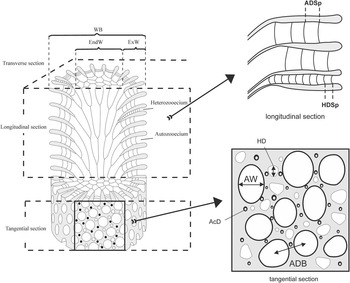
Bryozoans were investigated in thin sections using binocular transmitted light microscopy. Morphologic character terminology is partly adopted from Anstey and Perry (Reference Anstey and Perry1970). The following morphologic characters were measured and used for statistics in the studied material (Fig. 3).
Measurements of the most important morphological characters of bryozoans recorded here: Branch diameter (WB), exozone (ExW) and endozone (EndW) width, autozooecial aperture width (AW), aperture spacing (ADB), acanthostyle diameter (AcD), heterozooecia diameter (HD), autozooecial (heterozooecial) diaphragm spacing (ADSp/HDSp).

Branch diameter, exo- (endo-) zone width, autozooecial aperture width and spacing, acanthostyle diameter, heterozooecia diameter, autozooecial diaphragm spacing, number of heterozooecia and acanthostyles surrounding each autozooecial aperture, and wall thickness in the exozone were determined.
The spacing of structures is measured as the distance between their centers. Statistics were summarized using arithmetic mean, sample standard deviation, coefficient of variation, and minimum and maximum values.
The Geosciences Society of New Zealand operates a national database of fossil localities, the New Zealand Fossil Record File, and a similar file has been established, based in the School of Environment, University of Auckland, for New Caledonian fossil collections held in New Zealand institutions. The New Caledonian Fossil Record File uses a running number prefixed by ‘NC’ and ‘f,’ as in ‘NC/f302,’ and this system, often with the ‘NC’ omitted, will be used in this report.
Additional catalog systems are used to denote collections and for individual specimens, especially type and figured material. These are usually alphanumerics, as follows: ‘AU’ and a running number denotes a collection held in the School of Environment, University of Auckland; ‘J’ and a running number is for individual specimens in the catalogue of type and figured bryozoans of that same institution; ‘GS’ and a running number denotes a collection held by GNS Science, Wellington. Where specimens are now represented by multiple fragments (slides, peels, off-cuts), the specimen number is extended with a lowercase letter (a, b, c, …) as a suffix.
Bryozoans come from three parts of the outcrop area of the Téremba Terrane: from the Moindou-Téremba area in the northwest (Campbell and Grant-Mackie, Reference Campbell and Grant-Mackie1984; Campbell et al., Reference Campbell, Grant-Mackie and Paris1985), from Ile Leprédour in northwestern Baie de St-Vincent (Pharo, Reference Pharo1967), and from Iles Ducos, Hugon, and Page, and Ilot Turpin in central Baie de St-Vincent. This is not to say that they may not be found in other parts of this terrane; it only indicates their absence from collections.
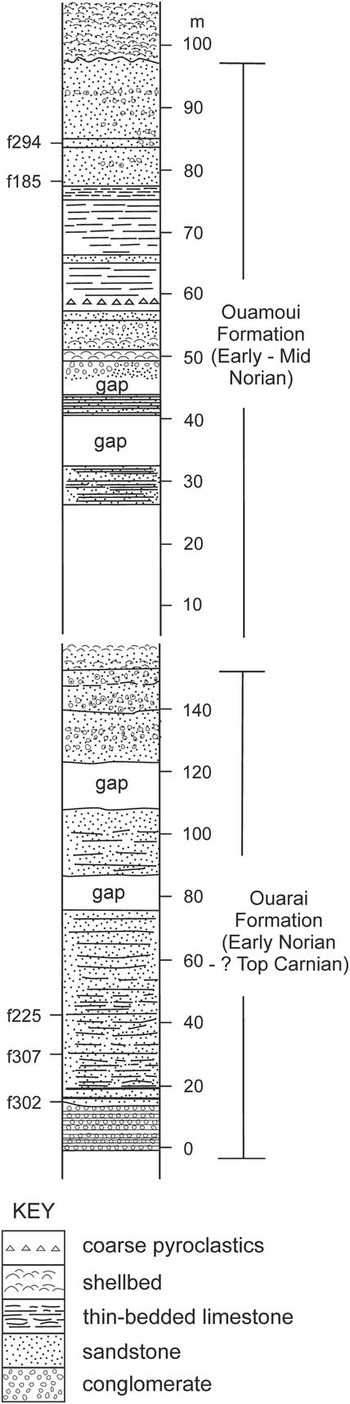
The oldest bryozoan-bearing strata occur in the Moindou-Téremba area. The Ouarai Formation consists of 140–180 m of dark volcaniclastic rudites, arenites, and minor tuffs lying unconformably on Early Triassic Moindou Formation and overlain unconformably by Ouamoui Formation (Campbell et al., Reference Campbell, Grant-Mackie and Paris1985). Rare bryozoans are found in argillites within a 30-m-thick sequence dominated by coarse sandstones and fine rudites in the lower quarter of the formation on the Téremba coast about 2 km south of an old wharf (Fig. 4). They occur as small cylindrical branch fragments up to 6 mm long.
Stratigraphic columns for the Ouarai and Ouamoui Formations in the Téremba area (after Campbell et al., Reference Campbell, Grant-Mackie and Paris1985).

The Ouamoui Formation is approximately 90 m thick in the vicinity of Mé Ouamoui, where it contains Bryozoa (it reaches 395 m thick within the Moindou-Téremba area) and consists of well-bedded fossiliferous coarse to fine volcaniclastic arenites fining upward to more common lutites, and includes minor rudites in the lower part and tuffs throughout (Campbell et al., Reference Campbell, Grant-Mackie and Paris1985). This sequence is unconformably overlain by the Leprédour Shellbeds. Rare bryozoans have been collected from one level in medium to coarse sandstones 15–20 m from the top and consist of small fragments of delicate branching type. The small collection was unfortunately misplaced in transit and is not included in this report.
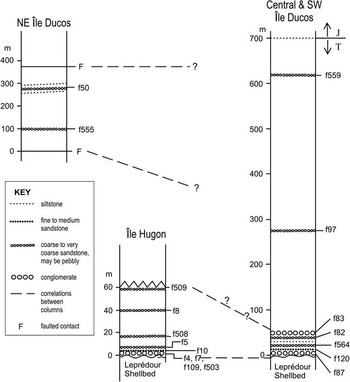
The Leprédour Shellbeds are a sequence of well-bedded fine to coarse volcarenite shellbeds with minor rudites and lutite units, coquina limestones, and tuffs all dominated by the highly gregarious bivalve Monotis. On Ile Leprédour they reach a thickness of 470 m, with an unknown relationship with underlying strata and pass gradationally into the overlying Bouraké Formation (Pharo, Reference Pharo1967). In the Moindou-Téremba area they reach perhaps 500 m, unconformable upon the Ouamoui Formation and with no upper contact seen (Campbell et al., Reference Campbell, Grant-Mackie and Paris1985). In the central Baie de St-Vincent no top or bottom of the unit is seen on Ile Page or Ilot Turpin, it lies unconformably on Permian rocks on Ile Hugon, and on Ile Ducos it is conformable on Ouamoui Formation in the southwest, northeast, and probably the west, unconformable on the Permian on the southeast coast, and isolated by faults elsewhere. Furthermore, accurate thicknesses in this part of Baie de St-Vincent are very difficult to measure and can only be calculated for short segments of the total because of pervasive faulting.
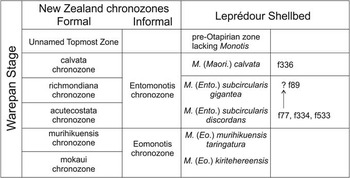
Despite the structural complexities, however, location of collections within the sequence can be estimated from the zonation that may be obtained from the species distribution pattern within Monotis (Campbell and Grant-Mackie, Reference Campbell and Grant-Mackie1984) (Fig. 5). Thus relative stratigraphic positions within the Shellbeds can be deduced from any co-occurring Monotis.
Chronostratigraphic scheme proposed by Grant-Mackie (1985) for New Zealand Warepan strata, with the New Caledonian zonal scheme of Campbell and Grant-Mackie (Reference Campbell and Grant-Mackie1984), showing the zones to which bryozoan-bearing localities are allocated. Note that f77 could belong in either the Gigantea or Discordans zone.

No bryozoans are known from Leprédour Shellbeds on Ile Leprédour or in the Moindou-Téremba area. A single locality on Ile Ducos (f533) lies in the Discordans Zone. Another, on Ilot Turpin (f77), is in either the Discordans or Gigantea Zone. Three localities are known on Ile Page, two, in the west (f334) and south (f336), belonging to the Discordans and Calvata Zones, are separated from each other by a fault, so that they are not in direct stratigraphic continuity. Collections from these localities consist of only one or two specimens. The third locality, f602, is in the same fault block as f336 and indicates the Discordans Zone. On Ile Hugon, however, at f89, a richer bryozoan fauna was found in strata of the Gigantea Zone.
The youngest unit with bryozoans concerning us here is the Bouraké Formation. This has yielded the most abundant and largest bryozoan specimens. The unit is approximately 380 m thick, composed of well-bedded to massive, generally medium volcarenites, with lesser numbers of thick lutites and coarse conglomeratic sandstones, the latter containing the bryozoans. On Iles Hugon and Ducos these bryozoan-bearing units generally constitute the basal 50–60 m of the formation, and generally rest unconformably upon Leprédour Shellbeds, although there is stratigraphic continuity at least on southwestern Ducos, as on Ile Leprédour, with the shellbeds (Fig. 6). Bryozoan specimens here are often abundant and include delicate branching forms, more sturdy branching masses up to 35×20 mm, and irregular masses, rolled and abraded, up to 85×45×20 mm.
Stratigraphic columns for the Bouraké Formation on Iles Ducos and Hugon.

The molluscan and brachiopod fauna and stratigraphic position allow firm correlation of the Ouarai Formation with the Oretian Stage of the New Zealand Triassic System, as confirmed by the presence of Halobia and the brachiopods Psioidea australis (Trechmann), Psioidiella nelsonensis (Trechmann), and Retzia aff. reticulata Wilckens within the formation, coupled with stratigraphic location below the bivalve Manticula problematica (Campbell and Grant-Mackie, Reference Campbell and Grant-Mackie1984). No internal zonation has been established for the Oretian Stage so it is not possible at present to be sure how much of Oretian time is represented by this formation or at what level within the stage the bryozoan-bearing locality lies.
The Ouamoui Formation has Manticula problematica in its basal beds, underlies strata with the Warepan Stage indicator Monotis, and includes a variety of taxa restricted to the Otamitan Stage.
The Leprédour Shellbeds constitute essentially the range-zone of Monotis and are thus of Warepan age, with no indicators of younger strata present. As noted above, bryozoan-bearing Warepan localities can be allocated to the Discordans, Gigantea, and Calvata Zones of Campbell and Grant-Mackie (Reference Campbell and Grant-Mackie1984) (Fig. 5).
The Bouraké Formation has been shown by both Pharo (Reference Pharo1967) and Campbell and Grant-Mackie (Reference Campbell and Grant-Mackie1984) to cross the Triassic-Jurassic boundary. The bryozoans discussed here have all been recovered from the Triassic portion, below strata containing the Early Jurassic indicators Otapiria marshalli Trechmann and Mentzelia ongleyi Marwick. On Ile Leprédour Pharo (Reference Pharo1967) reported Monotis (Maorimonotis) calvata Marwick and other forms of Monotis in the lowest 20 m of the formation and regarded it as therefore being Warepan in its lower part. Subsequent fieldwork has demonstrated for Iles Hugon and Ducos that specimens of this species from above the angular unconformity at the base of the Bouraké Formation have been derived from the underlying Leprédour Shellbeds and that the formation is Otapirian at its base.
Some specimens of M. calvata retain matrix within the umbo that is different from that of the enclosing rock. A specimen from f795 on île Leprédour shows a 5-mm-thick mudstone apical filling in an enclosing matrix of coarse sand and shell debris. Another, from f109 on île Hugon, has mud between two nested valves that is darker brown than that of the host rock. Other examples are much less clear-cut in their evidence: many valves contain matrix indistinguishable from the rest of the rock, and, if reworked, have been fully disinterred without significant breakage, but the matrix does contain much fragmented shell material that could be interpreted, although not unequivocally, as being from valves that were broken during disinterment. Derivation is also demonstrated by the partial steinkern of a moderate-sized (>30 mm diameter) gastropod (?pleurotomariid) in f7, île Hugon, which consists of buff-colored lutite quite distinct from the enclosing medium brown coarse sandstone, but similar to the matrix of some strata of the Leprédour Shellbed and to that of the above valve from f795.
Careful re-examination of Pharo’s other specimens indicates that they also were probably derived from the underlying beds and that the base of the Bouraké Formation on Ile Leprédour is of Otapirian age. Despite there being depositional continuity here, no collection from the Bouraké Formation includes any indication of an older age. On Ile Ducos, where there are also sections showing conformity between the Leprédour Shellbeds and Bouraké Formation (Fig. 1), no collection from the base of the Bouraké Formation in these sections contains either derived Monotis specimens or any indicators of Warepan age. An Otapirian age is further indicated by the presence in the bryozoan-bearing strata on all three main islands of the bivalve Torastarte bensoni Marwick, which in New Zealand is confined to rocks of the Otapirian Stage (Marwick, Reference Marwick1953).
Within the Otapirian Stage Campbell (Reference Campbell1956) recognized a basal Otapirian fauna, without any formal designation of a basal zone. Members of that fauna include the stage marker Rastelligera diomedea, the additional brachiopods Sakawairhynchia hugonensis MacFarlan and Fissirhynchia pacifica MacFarlan, and the bivalves Antiquilima sp. and Minetrigonia otapiriensis Fleming, most of which also occur in many of those bryozoan-bearing faunas of the Bouraké Formation. MacFarlan (Reference MacFarlan1992) noted also that Sakairhynchia harihariensis Macfarlan, which is recorded in f503, is confined to the early Otapirian, although not being known from the basal beds of that stage. Campbell (Reference Campbell1956) also recognized an upper Otapirian fauna characterized by Otapiria dissimilis (Cox) and Mentzelia kawhiana Trechmann, which have been found in association with the Bouraké Bryozoa in f111. We can confidently assert that bryozoans from the Bouraké Formation are therefore of early Otapirian age, with the exception of that in f111, which is late Otapirian.
Thus we conclude that Bryozoa have been recovered from the New Caledonian Triassic in rocks of Oretian, possibly Middle Otamitan, Middle and Late Warepan and Otapirian ages, i.e., in rocks correlated with four levels in the Norian and two in the Rhaetian.
Previous work
Bryozoans have previously been recorded without further identification in many earlier field reports (e.g., Avias, Reference Avias1953; Pharo, Reference Pharo1967; Paris, Reference Paris1981; Campbell et al., Reference Campbell, Grant-Mackie and Paris1985). Some of these records refer to “Monotrypella maorica” Wilckens (Reference Wilckens1927), which was originally described from the New Zealand Triassic and thought to be a bryozoan, but has since been interpreted by Schäfer and Grant-Mackie (Reference Schäfer and Grant-Mackie1998) as a tabulate coral and transferred to the genus Eoheteropora Morozova in Morozova and Zharnikova, Reference Morozova and Zharnikova1984. Until now, no other attempt has been made to taxonomically determine these bryozoan remains.
Systematic paleontology
Phylum Bryozoa Ehrenberg, Reference Ehrenberg1831
Class Stenolaemata Borg, Reference Borg1926
Order Trepostomata Ulrich, Reference Ulrich1882
Family Stenoporidae Waagen and Wentzel, Reference Waagen and Wentzel1886
Genus Metastenodiscus new genus
Type species
Stenodiscus zealandicus Schäfer and Grant-Mackie, Reference Schäfer and Grant-Mackie1994. Upper Triassic; New Zealand.
Diagnosis
Massive or encrusting colonies with short endozones. Apertures rounded or oval. Autozooecial walls thin in the endozone; laminated, fused without autozooecial boundaries, irregularly (monilaeform) thickened in the exozone. Diaphragms thin, complete, usually abundant. Cystiphragms present. Heterozooecia usually rare, sometimes common, with diaphragms. Acanthostyles abundant, usually varying in size.
Occurrence
Two species are known: M. zealandicus and M. kawhiae (Schäfer and Grant-Mackie, Reference Schäfer and Grant-Mackie1994) from the Upper Triassic (Norian) of New Zealand. M. zealandicus is recorded from the Upper Triassic (Norian) of New Caledonia.
Etymology
The genus is named from the genus Stenodiscus Crockford, 1947 because of its similarity (prefix meta- comes from Greek (μετά) and means “after,” “post-“).
Remarks
The new genus is similar to Stenodiscus Crockford, Reference Crockford1945 because of monilae-shaped walls in the exozone, abundant autozooecial diaphragms and acanthostyles of two sizes. However, the new genus differs in the presence of cystiphragms. Typically, Stenodiscus has two distinct sizes of acanthostyles: large acanthostyles and much smaller “microacanthostyles” between them. Acanthostyles in Metastenodiscus show a large range of size within the same colony. Metastenodiscus is also similar to Dyscritellopsis Schäfer and Grant-Mackie, Reference Schäfer and Grant-Mackie1994, but differs by its irregularly thickened walls and the presence of cystiphragms.
Metastenodiscus zealandicus (Schäfer and Grant-Mackie, Reference Schäfer and Grant-Mackie1994)
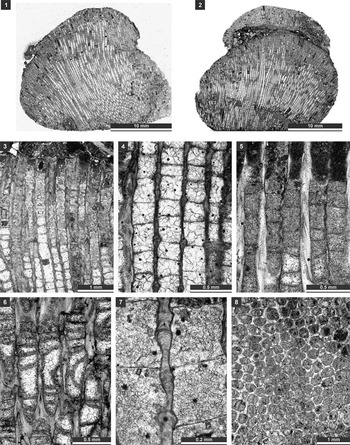
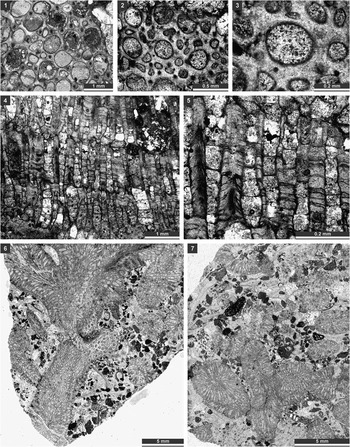
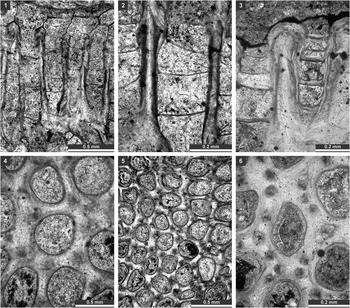
Figures 7.1–7.8, 8.1–8.3; Table 1
Metastenodiscus zealandicus (Schäfer and Grant-Mackie, Reference Schäfer and Grant-Mackie1994). (1) J49, NC/f7, colony longitudinal section. (2) J50, NC/f7, colony longitudinal section. (3, 4) J48, NC/f7, longitudinal section showing beaded walls and autozooecial diaphragms. (5) J54b, NC/ f509, longitudinal section showing beaded walls and thickenings in place of acanthostyles. (6) J55b, NC/ f509, longitudinal section showing beaded walls and autozooecial diaphragms and cystiphragms. (7) J54, NC/f7, longitudinal section showing beaded walls and autozooecial diaphragms. (8) J53, NC/ f509, tangential section showing autozooecial apertures, abundant acanthostyles and rare heterozooecia.

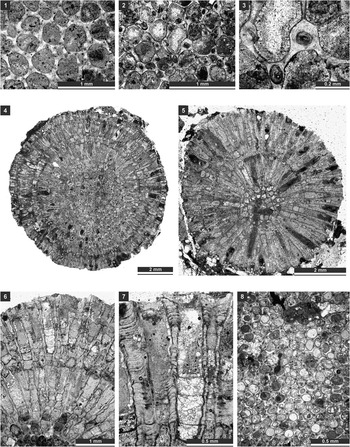
(1–3)Metastenodiscus zealandicus (Schäfer and Grant-Mackie, Reference Schäfer and Grant-Mackie1994). (1) J53, NC/ f509, tangential section showing autozooecial apertures and acanthostyles. (2, 3) J54b, NC/ f509, tangential section showing autozooecial apertures, acanthostyles and macroacanthostyles. (4–8)Dyscritellopsis isoseptatus Schäfer & Grant-Mackie, Reference Schäfer and Grant-Mackie1994. (4) J47c, NC/f89, colony transverse section. (5) J46a, NC/f89,colony transverse section. (6, 7) J47c, NC/f89, colony transverse section. (8) J46b, NC/f89, tangential section showing autozooecial apertures, acanthostyles, and heterozooecia.

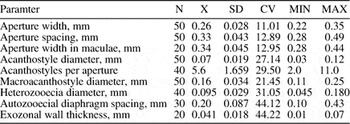
Descriptive statistics of Metastenodiscus zealandicus (Schäfer and Grant-Mackie, Reference Schäfer and Grant-Mackie1994)

CV=coefficient of variation; MAX=maximal value; MIN=minimal value; N=number of measurements; SD=sample standard deviation; X=mean.
1994 Stenodiscus zealandicus Schäfer and Grant-Mackie, p. 9, figs. 5–8.
Holotype
OU17942a. Otago University, Dunedin, New Zealand.
Diagnosis
Massive and encrusting colonies. Massive colonies up to 35 mm in thickness. Secondary overgrowths common, individual sheets 1.9–8.0 mm thick. Exozone not distinctly separated from endozone. Autozooecia long, prismatic, polygonal in cross section growing from a laminated epitheca. Autozooecial apertures rounded-polygonal and strongly petaloid due to indenting acanthostyles. Autozooecial diaphragms usually abundant throughout colony, straight or slightly curved distally, locally cystoidal. Heterozooecia rare, short, with rounded-polygonal apertures, restricted to exozone. Acanthostyles moderate to large, varying in size throughout the colony, possessing narrow cores of hyaline material and wide laminated sheaths, originating both in endo-and exozone, 2-11 surrounding each autozooecial aperture. Macroacanthostyles two to three times larger than ordinary ones, possessing wide cores of hyaline material and wide laminated sheaths, locally surrounding apertures in one row. Autozooecial walls laminated, integrated with visible zooecial boundaries, 0.0107–0.015 mm thick in endozones; merged, showing distinct convex lamination without visible zooecial boundaries, often strongly beaded, with serial thickenings throughout the colony, 0.025–0.063 mm thick in exozones.
Material
Otapirian of Ile Hugon: NC/f4 (AU7148), NC/f7 (AU7149a-(1-5)), NC/f8 (AU7795), NC/f120 (Au-7180a (210a)), NC/f503 (AU7147-(4, 5)), NC/f509 (AU7154-(15-19, 21-22)); Otapirian of Ile Ducos: NC/f50 (AU7194), NC/f82 (AU7799), NC/f83 (AU7796-(2, 3, 4, 8)), NC/f87 (AU7168), NC/f97 (AU9677-(7, 11)); Warepan of Ile Page: NC/f334 (AU7782-(1-3)), NC/f336 (AU7786-(2-4)).
Occurrence
New Zealand; lower to middle Norian, Otamitan. New Caledonia, Ile Ducos; Upper Triassic, Rhaetian, Otapirian. New Caledonia, Ile Page. Upper Triassic, Norian, Warepan. New Caledonia, Ile Hugon; Upper Triassic, Rhaetian, Otapirian.
Remarks
Metastenodiscus zealandicus (Schäfer and Grant-Mackie, Reference Schäfer and Grant-Mackie1994) differs from M. kawhiae (Schäfer and Grant-Mackie, Reference Schäfer and Grant-Mackie1994) in its slightly larger autozooecial apertures (average autozooecial width 0.26 mm vs. 0.24 m in M. kawhiae).
Genus Dyscritellopsis Schäfer and Grant-Mackie, Reference Schäfer and Grant-Mackie1994
Type species
Dyscritellopsis isoseptatus Schäfer and Grant-Mackie, Reference Schäfer and Grant-Mackie1994. Triassic, Orietian (upper Carnian – lower Norian); New Zealand.
Diagnosis
Colonies cylindrical to columnar, branching, or encrusting. Distinction between endozone and exozone commonly poor. In endozone, budding pattern acyclic from zooecial corners; autozooecia circular to polygonal in transverse section; acanthostyles absent or placed at autozooecial corners. Autozooecia gradually bending outward in exozone and meeting colony surface almost at right angles. Autozooecial apertures circular or polygonal with rounded corners. Autozooecial diaphragms present, commonly more abundant in exozone than in endozone. Autozooecial walls in exozone irregularly thickened, displaying a distinctly lamellar skeletal microstructure. Acanthostyles common, varying in size, originating in endo- or base of exozone. Tube-like heterozooecia present, containing diaphragms.
Occurrence
Lower-Upper Triassic; USA, New Zealand, New Caledonia.
Remarks
Dyscritellopsis Schäfer and Grant-Mackie, Reference Schäfer and Grant-Mackie1994 differs from Dyscritella Girty, 1911 in the presence of diaphragms in both autozooecia and heterozooecia.
Dyscritellopsis isoseptatus Schäfer and Grant-Mackie, Reference Schäfer and Grant-Mackie1994
Figures 8.4–8.8, 9.1–9.5; Table 2
(1–5)Dyscritellopsis isoseptatus Schäfer & Grant-Mackie, Reference Schäfer and Grant-Mackie1994. (1) J46b, NC/f89, tangential section showing autozooecial apertures, acanthostyles and heterozooecia. (2, 3) J59, NC/f533, tangential section showing autozooecial apertures, acanthostyles and heterozooecia. (4, 5) J58, NC/f533, longitudinal section. (6, 7)Arcticopora lobatula (Schäfer & Grant-Mackie, Reference Schäfer and Grant-Mackie1994), NC/f109, J57a, J57, colonies embedded in the rock.

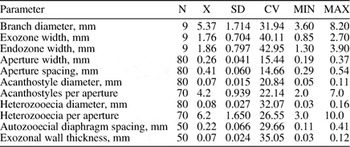
Descriptive statistics of Dyscritellopsis isoseptatus Schäfer & Grant Mackie, 1994

CV=coefficient of variation; MAX=maximal value; MIN=minimal value; N=number of measurements; SD=sample standard deviation; X=mean.
Holotype
BZ160. Institute of Geological and Nuclear Sciences Limited (GNS Science), Lower Hutt, New Zealand.
Diagnosis
Branched and encrusting colonies, secondary overgrowths common.
In branched colonies, branch diameter 3.6–8.2 mm, with 1.3–3.9 mm wide endozones, 0.85–2.70 mm wide exozones. Secondary overgrowths 1.1–2.2 mm thick. Encrusting colonies 1.3–3.5 mm thick. Autozooecia long in the endozone of branched colonies, having polygonal shape in transverse section, bending at angles of 33°–55° in exozone and intersecting colony surface at angles of 83°–88°; in encrusting colonies autozooecia growing from laminated epitheca. Autozooecial apertures oval to rounded-polygonal. Autozooecial diaphragms usually abundant, straight or slightly curved distally. Acanthostyles moderate to large, varying in size throughout the colony, possessing narrow cores of hyaline material and wide laminated sheaths, originating in exozone, two to seven surrounding each autozooecial aperture. Heterozooecia representing narrow tubes abundant, locally containing thin diaphragms, originating at the base of exozone, 3–10 surrounding each autozooecial aperture. Autozooecial walls thin, displaying granular microstructure, 0.010–0.015 mm thick in endozone; merged, showing distinct convex lamination without visible zooecial boundaries, moderately to strongly thickened, non-beaded, 0.03–0.10 mm thick in exozone.
Material
Warepan of Ile Ducos: NC/f533 (AU7188-(1-2)). Warepan of Ile Page: NC/f336 (AU7786). Otapirian of Ile Hugon : NC/f7 (AU7149d, e); Warepan of Ile Hugon NC/f89 (AU7141(1, 6, 9, a, f)).
Occurrence
New Zealand; upper Carnian to lower Norian, Oretian. New Caledonia, Ile Ducos, Ile Page; Upper Triassic, Norian, Warepan. New Caledonia, Ile Hugon; Upper Triassic, Norian, Warepan. New Caledonia, Ile Hugon, Hill 121; Upper Triassic, Rhaetian, Otapirian.
Remarks
The present material is similar to Dyscritellopsis isoseptatus Schäfer and Grant-Mackie, Reference Schäfer and Grant-Mackie1994 from the upper Carnian to lower Norian of New Zealand. The New Zealand material has fewer heterozooecia. Dyscritellopsis isoseptatus differs from D. montelloensis Schäfer, Cuffey and Young, Reference Schäfer, Cuffey and Young2003 from the Lower Triassic of Nevada, USA in its branched and encrusting instead of massive colony form and in having larger autozooecial apertures (average autozooecial aperture width 0.26 mm vs. 0.15 mm in Dyscritellopsis montelloensis).
Genus Arcticopora Fritz, Reference Fritz1961
Type species
Arcticopora christiei Fritz, Reference Fritz1961. Lower Triassic (upper Dienerian – lower Smithian); Ellesmere Island, Canada.
Diagnosis
Cylindrical, branching and encrusting colonies. Significant distinction between endozone and exozone. Endozone thin-walled, autozooecia polygonal in transverse section; budding pattern of autozooecia acyclical in zooecial corners (interzooecial). Autozooecia long in endozone, almost parallel to zoarial growth direction, rapidly bending outward in endozone, meeting colony surface at 90° angles. Basal diaphragms locally present, more common in transition between endozone and exozones. Autozooecial apertures irregularly rounded to oval in shallowest tangential section, indented by acanthostyles, more angular in slightly deeper tangential section, arranged randomly on colony surface. Basal diaphragms common in exozones. Zooecial walls moderately thickened in exozone, non-beaded. Distinctly convex lamellar wall microstructure, zooecial boundaries amalgamated. Heterozooecia abundant, originating in the inner exozone, basal diaphragms present or absent. Distinct difference in diameter between autozooecia and smaller heterozooecia. Acanthostyles common but irregularly scattered, moderately thick, of one size, originating in endozone or exozone.
Occurrence
Lower-Upper Triassic; Canada, Europe, Japan, Siberia, Caucasus, New Zealand, New Caledonia.
Remarks
Arcticopora Fritz, Reference Fritz1961 differs from Pseudobatostomella Morozova, Reference Morozova1961 in possessing a less regular budding pattern of autozooecial apertures and more abundant diaphragms. Furthermore, Arcticopora develops colonies of branched and encrusting sheets, whereas Pseudobatostomella is known only as a branching form. Arcticopora differs from Dyscritella Girty, 1911 in the presence of diaphragms and less by the lack of diaphragms in the latter genus. Additionally, Dyscritella possesses exilazooecia, heteromorphs without diaphragms, whereas heterozooecia in Arcticopora have variable numbers of diaphragms.
Arcticopora lobatula (Schäfer and Grant-Mackie, Reference Schäfer and Grant-Mackie1994)
Figures 9.6–9.7, 10.1–10.6; Table 3
(1–6)Arcticopora lobatula (Schäfer & Grant-Mackie, Reference Schäfer and Grant-Mackie1994). (1, 2) J56, NC/f109, branch longitudinal section. (3) J52, NC/f7, branch transverse section. (4–6) J56, NC/f109, tangential section showing autozooecial apertures, acanthostyles and heterozooecia. (7, 8)Arcticopora kobayashii (Sakagami, Reference Sakagami1972), J61, NC/f8, branch longitudinal section.

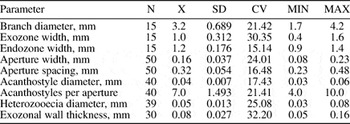
Descriptive statistics of Arcticopora lobatula (Schäfer and Grant Mackie, 1994)

CV=coefficient of variation; MAX=maximal value; MIN=minimal value; N=number of measurements; SD=sample standard deviation; X=mean.
1994 Pseudobatostomella lobatula Schäfer and Grant-Mackie, p. 19, figs. 18-21
Holotype
BZ159. BZ160. Institute of Geological and Nuclear Sciences Limited (GNS Science), Lower Hutt, New Zealand.
Description
Branched colonies, branch diameter 1.7–4.2 mm. Endozone 0.9–1.4 mm wide, exozone 0.4–1.6 mm wide. Secondary overgrowths uncommon. Autozooecia long in endozone, having polygonal shape in transverse section, bending at angles of 30°–51° in exozone and intersecting colony surface at angles of 83°–88°. Autozooecial apertures oval to subpolygonal and strongly petaloid due to indenting acanthostyles. Autozooecial diaphragms rare or absent in the endozone, rare to abundant in the exozone, thin and planar. Autozooecial walls thin, displaying granular microstructure, 0.01- to 0.02-mm thick in endozone; merged, showing distinct convex lamination without visible zooecial boundaries, moderately to strongly thickened, non-beaded, 0.05- to 0.16-mm thick in exozone. Acanthostyles moderate to large, possessing narrow cores of hyaline material and wide laminated sheaths, originating in exozone, four to ten surrounding each autozooecial aperture. Heterozooecia representing narrow tubes rare, small, rarely containing thin diaphragms, originating at the base of exozone. Maculae indistinct consisting of slightly larger autozooecia and more abundant heterozooecia and acanthostyles than in intermacular area.
Material
Otapirian of Ile Hugon: NC/f4 (AU7148), NC/f7 (Au7149d-e), NC/f109 (A7U165(1-7)), Otapirian of Ile Ducos: f50 (AU7194a (228)), NC/f60 (AU7214a), NC/f97 (AU9677-9); NC/f508 (Au 7153), NC/f509 (AU7154), NC/f555 (AU7218 (252b)), NC/f559 (AU7213); Otapirian of Ile Leprédour: Otapirian of Ilot Turpin: NC/f77 (AU7791); Warepan of Ile Page: NC/f336 (AU7786-6).
Occurrence
New Zealand; upper Carnian to lower Norian, Oretian. New Caledonia, Ile Page, Ile Leprédour; Upper Triassic, Norian, Warepan. New Caledonia, Ile Ducos, Ile Hugon; Upper Triassic, Rhaetian, Otapirian.
Remarks
Arcticopora lobatula (Schäfer and Grant-Mackie, Reference Schäfer and Grant-Mackie1994) differs from A. christiei Fritz, Reference Fritz1961 from the Lower Triassic of Canada in its larger autozooecial apertures and greater distances between aperture centers (average aperture width 0.16 mm vs. 0.11 mm in A. christiei; average distances between aperture centers 0.32 mm vs. 0.26 mm in A. christiei). Arcticopora lobatula differs from A. kobayashii in the greater distances between aperture centers (average distances between aperture centers 0.32 mm vs. 0.27 mm in A. kobayashii).
Arcticopora kobayashii (Sakagami, Reference Sakagami1972)
Figures 10.7–10.8, 11.1–11.6; Table 4
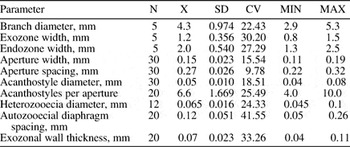
(1–6)Arcticopora kobayashii (Sakagami, Reference Sakagami1972). (1, 2) J61, NC/f8, longitudinal section. (3) J60, NC/f8, longitudinal section. (4, 5) J61, NC/f8, tangential section showing autozooecial apertures and acanthostyles. (6) J60, NC/f8, tangential section showing autozooecial apertures and acanthostyles.

Descriptive statistics of Arcticopora kobayashi (Sakagami, Reference Sakagami1972)

CV=coefficient of variation; MAX=maximal value; MIN=minimal value; N=number of measurements; SD=sample standard deviation; X=mean.
1948 Ceriopora sp. Kobayashi, p. 176.
1949 Ceriopora sp. Kobayashi, p. 137.
1972 Pseudobatostomella kobayashii Sakagami, p. 274, pl. 33. figs. 1–6.
1979 Pseudobatostomella kobayashii Sakagami, Reference Sakagami1979 – Sakagami and Sakai, p. 83, pl. 13, figs. 3–5.
Holotype
1001. Department of Geology, Faculty of Education, Ehime University, Japan.
Description
Branched and encrusting colonies. In branched colonies, branch diameter 2.9–5.3 mm, endozone 1.3–2.5 mm wide, exozone 0.8–1.5 mm wide. Secondary overgrowths common, individual sheets 0.8–0.9 mm thick. Exozone distinctly separated from endozone. Autozooecia long in endozone, polygonal in transverse section. Autozooecial apertures rounded-polygonal. Autozooecial diaphragms usually abundant throughout colonies, straight or slightly curved distally, originating from laminated cingulum of autozooecial walls. Acanthostyles moderate to large, varying in size throughout colony, possessing narrow cores of hyaline material and wide laminated sheaths, originating both in endo-and exozone, four to ten surrounding each autozooecial aperture. Heterozooecia rare, short, with rounded-polygonal apertures, restricted to exozone. Autozooecial walls thin, displaying granular microstructure, 0.01- to 0.02-mm thick in endozone; merged, showing distinct convex lamination without visible zooecial boundaries, moderately to strongly thickened, non-beaded, 0.04- to 0.11-mm thick in exozone. Laminated cingulum often developed, with lamination parallel to autozooecial wall surface, 0.005- to 0.030-mm thick. Maculae indistinct, consisting of autozooecia with thickened walls and larger acanthostyles.
Occurrence
Japan; Upper Triassic, middle Norian. New Caledonia, Ile Hugon, Ile Ducos; Upper Triassic, Rhaetian, Otapirian.
Material
Otapirian of Ile Hugon: NC/f8 (AU7795(1-2)); Otapirian of Ile Ducos: NC/f120 (AU7180), NC/f503 (AU7147).
Remarks
Arcticopora kobayashii Sakagami, Reference Sakagami1972 differs from A. morbosa (Morozova, Reference Morozova1969) from the Upper Triassic of Pamir in having more abundant heterozooecia and larger acanthostyles (acanthostyle diameter 0.04–0.08 mm vs. 0.02–0.03 mm in A. morbosa). Arcticopora kobayashii differs from A. formosum (Morozova, Reference Morozova1969) in having fewer heterozooecia. Arcticopora kobayashii differs from A. lobatula (Schäfer and Grant-Mackie, Reference Schäfer and Grant-Mackie1994) in the smaller distances between aperture centers (average distances between aperture centers 0.27 mm vs. 0.32 mm in A. lobatula).
Discussion
Paleoecology and adaptation
The bryozoans come from rocks that mostly are fairly coarse volcaniclastics (fine to medium conglomerates and breccias) indicating position in the vicinity of an island arc complex. The matrix of the embedding sediment often contains high amounts of rounded particles of igneous rocks and organic remains (Fig. 9.6–7). Most species reveal stout, often massive to cushion-shaped colonies indicating adaptation to a high-energy environment, and even those like Arcticopora lobatula and A. kobayashii with dendroid colony shape may be fairly well adapted to cope with stronger water agitation.
The bryozoan fauna is accompanied by quite a rich biota dominated by brachiopods and bivalves, with fewer corals, cephalopods, gastropods, and echinoderms, and rare marine vertebrates, trace fossils and wood, totaling more than 100 species. This association is dominated by members of the benthic fauna occupying hard bottoms, with a few soft-bottom taxa (Phaenodesmia, Maoritrigonia, Parallelodon, Torastarte, Unionites, Makoiamya, Triaphorus, Kalentera, and perhaps the limids); a small number were nekton or pelagic (Heterastridium, Halobia, the cephalopods and vertebrates), and the wood is of terrestrial origin (included in some of the Otapirian (Rhaetian) collections are specimens of Monotidae derived from the immediately underlying Leprédour Shellbed which must have been being eroded at the time these bryozoans were living at the site).
The presence of rudites with a dominantly hard-bottom fauna overlying an unconformity indicates a period of erosion, perhaps even emergence, at the beginning of Otapirian time, and this may be partly coincident with, even part of, the event that sparked the widespread submarine slumping at the end of the Warepan in the Murihiku Terrane (see Grant-Mackie and Lowry, Reference Grant-Mackie and Lowry1964) and which is also apparent in Warepan sequences in New Caledonia in the Téremba Terrane.
Biogeography
The bryozoan fauna from the Triassic of New Caledonia reveals a mixture of elements showing connections both with the Murihiku and the Torlesse terranes of New Zealand [compare Schäfer and Grant-Mackie, (Reference Schäfer and Grant-Mackie1994) for the Triassic New Zealand bryozoan fauna], and to the Upper Triassic of Japan (Sakagami, Reference Sakagami1972). Whereas Metastenodiscus zealandicus was first described from the lower to middle Norian (Otamitan) Murihiku terrane indicating a Gondwana provenience, Dyscritellopsis isoseptatus and Arcticopora lobatula first described from the Torlesse terrane of New Zealand display a Tethyan provenance (Schäfer and Grant-Mackie, Reference Schäfer and Grant-Mackie1994). The same holds for Arcticopora kobayashii first described by Sakagami (Reference Sakagami1972) from Triassic (lower Carnian) rocks of the Sakawa basin, Shikoku island (Japan) also considered to be of Tethyan character (Table 5). So far, no simple Gondwana connection can be stated for the Triassic bryozoans from New Caledonia.
Distribution of bryozoan species from the Upper Triassic of New Caledonia (this paper).

Evolution and Elvis taxa
On a global scale, Triassic bryozoans are holdovers of various Paleozoic stenolaemate stocks most belonging to the order Trepostomata. Most of the Palaeozoic stenolaemate orders were extinguished during or at the end of the Permian. The exception was the order Trepostomata, which reoccurred in the earliest Triassic and within a time span over 50 million years radiated again to evolve a substantial number of species. The youngest trepostomes are known from the Rhaetian, the group finally being extinguished by the end of the Triassic. An alternative hypothesis, suggested by Boardman (Reference Boardman1984), proposes a direct relation between Meso-/Cenozoic Cyclostomata and Paleozoic orders.
Bryozoans demonstrate various examples of homeomorphy (e.g., Voigt and Flor, Reference Voigt and Flor1970; Hinds, Reference Hinds1975; Blake, Reference Blake1980; McKinney et al., Reference McKinney, Taylor and Zullo1993; Taylor and Badve, Reference Taylor and Badve1995, Ernst et al., Reference Ernst, Taylor, Bohatý and Wyse Jackson2012). Homeomorphy results from convergent evolution of traits (homoplasy), sometimes through heterochrony (Anstey, Reference Anstey1987). Stenolaemate bryozoans show homeomorphy not only of external characters such as lyra-shaped colonies in fenestrates and cyclostomes (McKinney et al., Reference McKinney, Taylor and Zullo1993) but also of internal characters. One of the best studied examples includes the development of four-sided autozooecial chambers in trepostome bryozoans (Boardman and McKinney, Reference Boardman and McKinney1976), independently developed several times during the Palaeozoic (e.g., Rhombotrypa, Rhombotrypella , Tetratoechus, and Eodyscritella).
Certainly, the presence of homeomorphy significantly compromises stenolaemate bryozoan taxonomy. Indeed, molecular sequence data obtained from Recent cyclostomes has shown numerous skeletal morphological characters (e.g., maculae, diaphragms or hemiphragms, brooding structures) to represent homoplasy (Taylor and Weedon, Reference Taylor and Weedon2000; Waeschenbach et al., Reference Waeschenbach, Cox, Littlewood, Porter and Taylor2009), implying high levels of homeomorphy among stenolaemates. Therefore, a certain caution is required in interpreting morphological characters in bryozoans, especially in taxa distantly positioned in age. Most Triassic trepostomes have been interpreted as belonging to middle to late Palaeozoic families and even genera (notably Paralioclema, Pseudobatostomella, Stenodiscus, Dyscritella), although, more likely, they represent separate genera that have evolved from the late Palaeozoic genera. For most of the Triassic species, a common morphologic character is the development of numerous diaphragms both in autozooecia and heterozooecia. This makes them similar to Devonian taxa (e.g., Paralioclema, Pseudobatostomella). However, it seems to be an independent phenomenon for the Triassic genera and species, representing homeomorphy.
Acknowledgments
J.A.G.-M. acknowledges with thanks support from the Sir Charles Fleming Fund, Royal Society of New Zealand, for visiting Kiel, and the hospitality of the Institut für Geowissenschaften, Christian-Albrechts-Universität, Kiel, and its staff during a month’s visit associated with this project.
Much assistance with data and information was provided by Dr. H. J. Campbell, GNS Science, Wellington, who also provided specimens collected with Pierre Maurizot, Bureau de Recherches Géologiques et Minières, Nouméa, New Caledonia. Dr N. Hudson, School of Environment, University of Auckland, assisted in tracking down locality data and collections. Ms Louise Cotterall, of the same institution, is thanked for the production of the line drawings. Specimen slides and acetate peels were provided by Wolfgang Reimers; photographs by Ute Schuldt.
Appendix 1
New Caledonian localities yielding the Triassic Bryozoa discussed in this work, with their catalogue numbers, grid references, formations, collection data, and lists of associated biota, given in order of age (oldest first), and, within each age group, in order of “f” number.
Locality and collection numbers (f…; AU….) are explained in the text. For collectors, CHP=C. H. Pharo; HJC=H. J. Campbell; JAGM=J. A. Grant-Mackie; NdeJ=N. J. de Jersey; N.H.=N. Hudson; PM=P. Maurizot. For other abbreviations, asl=above mean sea-level; fmn=formation; HTM=high tide mark; E, N, NW, etc. are approximate compass bearings (from a stated object) or orientations (on a physical feature). Fossil names in square brackets are for reworked specimens.
Grid references are from the appropriate map sheet (no. 4824, 4828, 4829, or 4832) in the 1:50 000 ‘Série Orange’ of topographic maps of New Caledonia published by the Institut Géographique National, Paris.
1. Oretian (Ouarai Formation).
f302. AU10249, JAGM 10/81. GR: 7375 9598. Rocky shore exposure S of Téremba (for locality see map, fig.2, in Campbell et al. Reference Campbell, Grant-Mackie and Paris1985). Bryozoa indet. (not identifiable), Eoheteropora maorica, Oxycolpella, Retzia cf. reticularis, “Spiriferina”, Psioidiella australis, Ps. nelsonensis, Sakawairhynchia aparimaensis, “Dielasma” cf. zelandica, terebratulid, gastropod, Maoritrigonia waddicki, M. pirouteti, Cucullaea wellmani, Halobia, “Lima” georgii-boehmi, Triaphorus zelandicus, Unionites sp., ichthyosaur vertebra, wood.
2. Otamitan (Ouamoui Formation).
NC/f17. AU7169, JAGM 18/10/79; AU6075, HJC 10/76; GS 12730, HJC 18/10/79 [= HUG1312054]. GR: 0624 6573. Well-exposed beds on S side of E end of conspicuous ridge immediately N of Mare aux Canards, Ile Ducos. Metastenodiscus zealandicus, Dyscritellopsis isoseptatus, Manticula problematica, Maoritrigonia pirouteti, Caledogonia globosa.
3. Warepan (Leprédour Shellbed).
f77. AU7791, JAGM 17/10/80. GR: 0992 5974. Well-exposed beds, N tip of Ilot Turpin, S of Ile Trélon. Arcticopora lobatula, Rhynchonellidae, Oxycolpella caledonica, Pseudocyrtina, Clavigera planchesi, M. (Maorimonotis) routhieri, M. (Entomonotis) richmondiana gr.
f89. AU7141, JAGM 17/9/77, 11/10/79. GR: 0847 6290. Beach boulders and in situ sandstone in shore platform, NE point of Ile Hugon, 600 m SE of sand wharf. Dyscritellopsis isoseptatus, Eoheteropora maorica, Oxycolpella caledonica, Clavigera planchesi, Monotis (Entomonotis) richmondiana s.s., Hokonuia limaeformis, gastropod, ammonoid.
f334. AU7782, JAGM 16/10/80. GR: 1128 6050. Ile Page, SW point, in cliff. Metastenodiscus zealandicus, Pseudocrytina, Rastelligera mackayi, Monotis (Pacimonotis) discordans, M. (Maorimonotis).
f336. AU7786, JAGM 16/10/80. GR: 1164 5993. Ile Page, cliffs & shore platform on rocky NW point. Metastenodiscus zealandicus, Arcticopora lobatula, Discritellopsis isoseptatus, Rhynchonellid, Oxycolpella caledonica, Clavigera planchesi, Pseudocyrtina, Psioidiella, ?Monotis (Maorimonotis) calvata, wood.
f533. AU7188, JAGM 23/10/79. GR: 0593 6356. Ile Ducos – W side of S tip, 0-100 m from tip. Dyscritellopsis isoseptatus, Heterastridium conglobatum (s.s.), Psioidiella, Monotis (Maorimonotis) maniapotoi, wood
f602. AU7792, JAGM 17/10/80. GR: 6123 5613, NE coast, Ile Page, immediately E of fault 250 m NE & E of f626. Arcticopora lobulata, Monotis (Entomonotis) richmondiana acutecostata, wood.
4. Otapirian (Bouraké Formation).
N. B. Those taxa with names in brackets are believed to have been derived from the underlying Leprédour Shellbed.
f4. AU7148, JAGM 13/10/79. GR: 0773 6329. Small spur to N of road to sand quarry & SE of workers’ quarters & chez Durand, N Ile Hugon; small outlier in fault relation with Permian to N. Metastenodiscus zealandicus, Arcticopora lobulata, Paraconularia matauraensis, Eoheteropora ?caledonica, terebratulid, rhynchonellid, Rastelligera, Psioidiella, Clavigera planchesi, “Dielasma”, [Monotis (Maorimonotis) calvata], Kalentera, Torastarte bensoni, Parallelodon, Cenoceras, ammonoids 2 spp., gastropods 2 spp.
f5. AU7146, JAGM 13/10/79; GS 12718 [= HUG1212051], HJC & PM, 13/10/79: GR 0772 6301. Conspicuous bedding plane exposed on broadly rounded crest of NE ridge of Hill 121, overlooking chez Durand, c. 90 m asl, N Ile Hugon. Arcticopora lobatula, Eoheteropora maorica, Terebratulid, Clavigera planchesi, Fissirhynchia pacifica, Sakawairhynchia hugonensis, Oxycolpella cf. wreyi, “Dielasma”, Pseudocyrtina, Zugmayerella taringaturaensis, Psioidiella drotae, ?”Mentzelia”, Rastelligera, Heterastridium conglobatum (s.s.), Antiquilima, Maoritrigonia, Torastarte bensoni, ?Oxytoma, Kalentera, Astartidae, Cucullaeidae, gastropod 2 spp., ammonoid, bone, wood.
f7. AU7149, JAGM 13/10/79; GS 15597, HJC 14/12/05. GR: 0787 6317. NE end of NE ridge of hill 121, N Ile Hugon, just below change in slope to sand wharf, c. 55 m asl. Metastenodiscus zealandicus, Dyscritellopsis isoseptatus, Arcticopora lobatula, Eoheteropora caledonica, “Dielasma”, “Mentzelia”, Rastelligera diomedea, Zugmayerella taringaturaensis, Clavigera bisulcata, ?Zeilleria, Antiquilima, [Monotis (Maorimonotis) calvata], gastropod, [gastropod].
f8. AU7795, JAGM 17/10/80; GS12730 [= HUG1512054], HJC & PM 13/10/79. GR: 0769 6283. Blocks & poorly exposed beds on ridge crest, NE ridge of Hill 121 c. 115 m asl; just below top of ridge, N Ile Hugon. Metastenodiscus zealandicus, Arcticopora lobatula, Arcticopora kobayashii, Eoheteropora maorica, Paraconularia matauraensis, echinoid spine, terebratulid, Clavigera planchesi, Zugmayerella taringaturaensis, “Mentzelia”, Fissirhynchia pacifica, Sakawairhynchia hugonensis, “Dielasma”, Rastelligera, [?Monotis (Maorimonotis) calvata], Pseudoplacunopsis placentoides, Antiquilima/Pseudolimea, Oxytoma, Torastarte bensoni, gastropod 2 spp.
f50. AU7194, JAGM 24/10/79. GR: 0876 6574. Shore platform & cliffs, S coast, NW of Ile Jacqueline, E Ile Ducos. Metastenodiscus zealandicus, Arcticopora lobatula, Terebratulid, Clavigera planchesi, “Dielasma”, “Mentzelia”, Psioidiella/Rastelligera, Antiquilima, Kalentera cf. marwicki, Makoiamya cotterallae, [Monotis (Maorimonotis) calvata], Mine-/Maoritrigonia, Pleurotomariidae.
f60. AU7214, JAGM 26/10.79. GR: 0772 6628, Ile Ducos; conspicuous exposure on shore platform at small headland in centre of bayhead, Baie des Moustiques. Arcticopora lobatula, Rhynchonellida, Terebratulida, “Mentzelia”, Maoritrigonia ?leedae, Arcestidae, brachiopod indet., bivalve indet.
f82. AU7799, JAGM 18/10/80. GR: 0807 6516. Distinctive bed exposed along S coast of central Ile Ducos, in coastal cliffs and shore platform S of Hill 36. Metastenodiscus zealandicus, Terebratulid, Clavigera planchesi, Rastelligera, Sakawairhynchia hugonensis, “Mentzelia,” ?Pseudocyrtina, Kalentera, Minetrigonia otapiriensis, Torastarte bensoni, Raha, “Pleurotomaria,” gastropod, ichthyosaur vertebra.
f83. GS12989, HJC, 18/10/80. GR: 0828 6519. Surface collection, scabby weathered rock on edge of low coastal cliff immediately behind point to SE of Hill 36, S coast, central Ile Ducos. Metastenodiscus zealandicus, Conulariid, “Dielasma”, Clavigera, Rastelligera, [Monotis (Maorimonotis) calvata], Rhacophyllites.
f87. AU7168, JAGM 17/10/79. GR: 0582 6378. Cliff & fallen blocks on point & to S, 400 m N of SW tip of Ile Ducos. Metastenodiscus zealandicus, Paraconularia matauraensis, terebratulid, Clavigera planchesi, “Mentzelia”, Rastelligera, ?Zugmayerella taringaturaensis, Fissirhynchia pacifica, Makoiamya cotterallae, “Chlamys” cf. tullbergi, Antiquilima, Torastarte bensoni, Parallelodon, Minetrigonia otapiriensis, Kalentera, [Monotis (Maorimonotis) calvata], [Monotis (Pacimonotis) discordans], Astartidae, cf. Raha, gastropod, Arcestes cf. subumbilicatus, ammonoid, crinoids, wood.
f97. AU9677, JAGM 14/10/83. GR: 6059 5641. Ile Ducos, SW coast, 600 m N of southernmost point, 100 m N of f120. Metastenodiscus zealandicus, Arcticopora lobatula, Clavigera fragments.
f109. AU7165, JAGM 15/10/79. GR: 0771 6211. Central N Ile Hugon, to S of hill 152, c. 125 m asl, just above change in slope down to conspicuous saddle. Arcticopora lobatula, Clavigera planchesi, Psioidiella, “Dielasma”, [Monotis (Maorimonotis) calvata], [M. (Entomonotis)].
f111. AU7796, JAGM, 15/10/79. GR: 0828 6519, S central coast, Ile Ducos, in well exposed fossiliferous grit bed. Arcticopora kobayashii, Eoheteropora maorica, Rastelligera, ‘Dielasma’, Clavigera bisulcata, ‘Rhynchonella’, Mentzelia kawhiana, Spiriferinidae, Paraconularia matauraensis, [Monotis (Maorimonotis) calvata], Otapiria dissimilis, bivalve indet.
f120. AU7180, JAGM & JDC, 19/10/79; GS 15599 [=HUG1312053], HJC & PM , 13/12/05; JDC 19/10/79. GR: 0583 6401. SW corner of Ile Ducos, just below HTM, 600 m NNW of SW tip of island. Metastenodiscus zealandicus, Arcticopora lobatula, Arcticopora kobayashii, Dyscritellopsis isoseptatus, Conulariid, rhynchonellid, Clavigera planchesi, “Mentzelia”, Pseudocyrtina, Psioidiella, ?Rastelligera, cf. Cucullaea/Paralellodon, Limatula, Antiquilima, Torastarte bensoni, Triaphorus grantmackiei, wood.
f503. AU7147, JAGM 13/10/79. GR: 0772 6306. Ile Hugon, on northernmost slope at c. 80 m asl, and c. 350 m SW of sand wharf. Metastenodiscus zealandicus, Arcticopora kobayashii, Psioidiella, “Dielasma”, ?Zugmayerella taringaturaensis, Fissirhynchia pacifica, Sakawairhynchia harihariensis, Pseudolimea, Torastarte bensoni, Grammatodon/Parallelodon, ?Kalentera, gastropod.
f508. AU7153, JAGM 14/10/79. GR: 0770 6289. Ile Hugon, northernmost slope, at c. 105 m asl, 100 m N of hill 121, 150 m S of f5, and 80 m S of tree on E side of ridge crest. Arcticopora lobatula, Eoheteropora, Clavigera, ?Pseudolimea, [Monotis sp. indet.- fragments].
f509. AU7154, JAGM 14/10/79. GR: 0771 6278. Ile Hugon, on NE side of summit of hill 121, at c. 117 m asl and 100 m SSE of f508. Metastenodiscus zealandicus, Arcticopora lobatula, Sakawairhynchia hugonensis, Clavigera planchesi, “Dielasma”, Psioidiella, Pseudocyrtina, [Monotis (Maorimonotis) calvata], [M. (M.) routhieri].
f555. AU7218, JAGM 26/10/79. GR: 0823 6661. Ile Ducos, at old wharf and shed, SE corner of Baie des Moustiques. Arcticopora lobatula, “Mentzelia”, “Dielasma”, [?Monotis (Maorimonotis) calvata].
f559. AU7213, JAGM 26/10/79. GR: 0755 6635. Ile Ducos, on foreshore in SW corner of Baie des Moustiques, c. 100m N of f558. Arcticopora lobatula, Clavigera planchesi, Rastelligera.
f795. AU10251, CHP 11-12/65. GR: 6018 5693. Ile Leprédour, on central ridge of island at 110 m asl, 530 m NW of hill 225 and 70 m NW of saddle between highest hill (hill 225) and that at c. 125 m. Arcticopora lobatula, Eoheteropora maorica, ?Lingula, Sakawairhynchia, Clavigera planchesi, “Palaeoneilo”, Cucullaea cf. wellmani, Makoiamya cotterallae, ?Torastarte bensoni, Kalenteridae, [Monotis (Entomonotis)], [M. (Maorimonotis) calvata], gastropod.