Introduction
Ants (Hymenoptera: Formicidae) are broadly distributed in terrestrial ecosystems and they are among the leading predators of other insects (Hölldobler & Wilson, Reference Hölldobler and Wilson1990). Since Janzen (Reference Janzen1966) reported that ants could act as biotic defences protecting plants against herbivores and parasites, several authors observed that the predatory action of ants against phytophagous insects benefited plants (Karhu, Reference Karhu1998; Styrsky & Eubanks, Reference Styrsky and Eubanks2007; Rosumek et al., Reference Rosumek, Silveira, de Neves, de Barbosa, Newton, Diniz, Oki and Cornelissen2009; Olotu et al., Reference Olotu, Plessis, Seguni and Maniania2012). However, most ant species are omnivorous and combine the protein obtained through predation and scavenging with plant-derived carbohydrates. Ants collect carbohydrates from floral and extrafloral nectar, food bodies, elaiosomes and especially honeydew produced by plant-feeding Hemiptera with which they have evolved mutualistic associations (Way, Reference Way1963; Carroll & Janzen, Reference Carroll and Janzen1973; Hölldobler & Wilson, Reference Hölldobler and Wilson1990; Wäckers, Reference Wäckers, Wäckers, van Rijn and Bruin2005). Thus, by acting simultaneously as predators and as hemipteran mutualists, ants are at the center of a complex food web affecting the composition and the population dynamics of a wide arthropod community (Kaplan & Eubanks, Reference Kaplan and Eubanks2005; Styrsky & Eubanks, Reference Styrsky and Eubanks2007).
In the ant-Hemiptera mutualism, the net benefits for each partner are context dependent (Stadler & Dixon, Reference Stadler and Dixon2005; Yoo & Holway, Reference Yoo and Holway2011). It is typically assumed that ants obtain honeydew, a food source that is copious, nutritive and spatiotemporally constant and in exchange, ants protect the honeydew producers from their natural enemies or other competing herbivores (Flanders, Reference Flanders1951; Bartlett, Reference Bartlett1961; Way, Reference Way1963; Buckley, Reference Buckley1987; Rosumek et al., Reference Rosumek, Silveira, de Neves, de Barbosa, Newton, Diniz, Oki and Cornelissen2009). Under ant protection, honeydew producers usually perform better and more quickly develop larger populations, which eventually results in greater plant damage. This is particularly evident in agricultural ecosystems, where numerous studies have reported decreased populations of ant-attended honeydew producers and lower crop damage following ant-exclusion experiments (Flanders, Reference Flanders1951; Bach, Reference Bach1991; Itioka & Inoue, Reference Itioka and Inoue1996a ; James et al., Reference James, Stevens and O'Malley1997; Daane et al., Reference Daane, Sime, Fallon and Cooper2007; Mgocheki & Addison, Reference Mgocheki and Addison2010). In citrus crops, Moreno et al. (Reference Moreno, Haney and Luck1987) reported that the exclusion of the Argentine ant Linepithema humile (Mayr) was associated with lower densities of the citrus mealybug Planococcus citri Risso (Hemiptera: Pseudococcidae) and of the woolly whitefly Aleurothrixus floccosus Maskell (Hemiptera: Aleyrodidae). Itioka & Inoue (Reference Itioka and Inoue1996a ) reported that the ant Lasius niger L. showed an aggressive behavior toward natural enemies of the mealybug Pseudococcus citriculus Green (Hemiptera: Pseudococcidae) resulting in a drastic (94%) decrease in a mealybug population when ants were excluded. An ant-exclusion experiment revealed that ant-attendance caused an increase in the population growth rate of Ceroplastes rubens Maskell (Hemiptera: Coccidae) due to a decrease in the percentage of parasitism by Anicetus beneficus Ishii et Yasumatsu (Hymenoptera: Encyrtidae) (Itioka & Inoue, Reference Itioka and Inoue1996b ).
Surprisingly, ants have been reported to induce population increases, and concomitant plant damage, of non-honeydew producing insect herbivores (Bartlett, Reference Bartlett1961). For example, Flanders (Reference Flanders1945) demonstrated that the activity of L. humile resulted in higher infestations of the diaspidid Aonidiella citrina Coquillet (Hemiptera: Diaspididae). Similar population increases were reported for the California red scale (hereafter CRS) Aonidiella aurantii Maskell (Hemiptera: Diaspididae) caused by the action of Pheidole megacephala F. in Letaba (South Africa) (Steyn, Reference Steyn1954), L. humile in California (Moreno et al., Reference Moreno, Haney and Luck1987), Iridomyrmex rufoniger gp. sp. in Australia (James et al., Reference James, Stevens and O'Malley1997) and Lasius grandis (Forel) and Pheidole pallidula (Nylander) in Valencia (Spain) (Pekas et al., Reference Pekas, Tena, Aguilar and Garcia-Marí2010a ). Finally, Haney et al. (Reference Haney, Luck and Moreno1987) reported a population increase of the citrus red mite Panonynchus citri (McGregor) (Acarina: Tetranychidae) in the presence of L. humile. In the above studies, it is assumed that the underlying mechanism is indirect interference by the ants (while searching for honeydew) with the natural enemies of the non-honeydew producers.
The outcome of the interaction among ants, Hemiptera (both honeydew and non-honeydew producers) and natural enemies is likely to depend on the particular characteristics of the species involved. For example, the degree of protection against natural enemies provided to hemipterans varies depending on the ant species (Martinez-Ferrer et al., Reference Martinez-Ferrer, Grafton-Cardwell and Shorey2003; Styrsky & Eubanks, Reference Styrsky and Eubanks2007; McPhee et al., Reference McPhee, Garnas, Drummond and Groden2012). Several authors attribute these differences among ant species to biological traits such as foraging activity, numerical abundance, aggressiveness and territoriality (Buckley & Gullan, Reference Buckley and Gullan1991; Kaneko, Reference Kaneko2003; Paris & Espadaler, Reference Paris and Espadaler2009; McPhee et al., Reference McPhee, Garnas, Drummond and Groden2012). Likewise, susceptibility of parasitoids and predators to ant activity differs greatly among species (Flanders, Reference Flanders1958; Bartlett, Reference Bartlett1961; Völkl, Reference Völkl1992; Daane et al., Reference Daane, Sime, Fallon and Cooper2007).
The citrus agro-ecosystem, due to its perennial character, provides ideal conditions for the proliferation of insect herbivores, many of which are honeydew producers (Bodenheimer, Reference Bodenheimer1951; Garcia-Marí, Reference Garcia-Marí2012). At the same time, ants are among the most abundant arthropods in citrus (Bodenheimer, Reference Bodenheimer1951; Samways et al., Reference Samways, Nel and Prins1982; Samways, Reference Samways1983; Alvis & Garcia-Marí, Reference Alvis and Garcia-Marí2006). In western Mediterranean citrus, where we conducted our study, the two most abundant and widely distributed ant species are the native L. grandis and P. pallidula (Palacios et al., Reference Palacios, Martínez-Ferrer and Cerdá1999; Alvis-Dávila, Reference Alvis-Dávila2003; Vanaclocha et al., Reference Vanaclocha, Monzó, Gómez, Tortosa, Pina, Castañera and Urbaneja2005; Cerdá et al., Reference Cerdá, Palacios and Retana2009; Pekas et al., Reference Pekas, Tena, Aguilar and Garcia-Marí2011). Interestingly, Pekas et al. (Reference Pekas, Tena, Aguilar and Garcia-Marí2010a ) showed that mixed populations of these species were associated with increases in the densities of CRS populations. The invasive L. humile has been present in Spanish citrus orchards since 1923 (Font de Mora, Reference Font de Mora1923; García-Mercet, Reference García-Mercet1923), but it appears only occasionally here (Alvis & Garcia-Marí, Reference Alvis and Garcia-Marí2006). In other citrus-growing areas it is associated with strong increases in the abundance of both honeydew and non-honeydew producing hemipterans (Steyn, Reference Steyn1954; Moreno et al., Reference Moreno, Haney and Luck1987; Daane et al., Reference Daane, Sime, Fallon and Cooper2007).
In the present study, we conducted ant-exclusion experiments in the field in order to determine the impact of three species of ants on the infestation levels and parasitism of three of the most important citrus pests in western Mediterranean citrus: the honeydew producer A. floccosus and the non-honeydew producers A. aurantii and Phyllocnistis citrella (Staiton) (Lepidoptera: Gracillaridae). Concretely we asked the following questions: (i) are ants able to induce population increases of herbivores in citrus; (ii) is the impact of ants different for honeydew and non-honeydew producing herbivores; and (iii) is the parasitism of the honeydew and non-honeydew producing herbivores affected by ants?
Materials and methods
Study sites
The study was conducted during two consecutive growing seasons, from April 2010 to November 2011, in three commercial citrus orchards located in an extensive citrus-growing region located 30 km south of Valencia, eastern Spain (39°12′N, 0°20′W; 39°11′N, 0°20′W and 39°14′N, 0°15′W). The climate in the study areas is Mediterranean, with mild and wet winters, and dry, hot summers. From now on we will refer to the orchards according to the acronym of the predominant ant species present, PP (Pheidole pallidula), LG (Lasius grandis) and LH (Linepithema humile). Two orchards (PP and LG) were of sweet orange Citrus sinensis L. Osbeck (cv. Navelina) and one (orchard LH) of a mixture of two species, sweet orange C. sinensis (cv. Navelina) and Clementine mandarin Citrus reticulata Blanco (Cv. Clementina Fina). In orchard PP, the most abundant ant species ascending to the citrus canopies was P. pallidula, which was present in all of the trees. It was frequently found foraging on the canopy of the same tree together with Plagiolepis schmitzii (Forel) and to a much lesser extent with Tapinoma nigerrimum (Nylander). In orchard LG, the most abundant and predominant ant species was L. grandis, coexisting in some trees with P. schmitzii and T. nigerrimum, except in experimental plot 12 (see below) where L. grandis and P. pallidula were similarly abundant. L. grandis was never found foraging on the same tree with P. pallidula, as the two species are dominant and mutually exclusive (Pekas et al., Reference Pekas, Tena, Aguilar and Garcia-Marí2011). In orchard LH, L. humile was the only ant species present and foraging on the tree canopies.
The three orchards were flood irrigated and weeds were controlled by local application of herbicides (Glyphosate®, Bayer CropScience, Spain). No chemical treatments for pest control were applied during the two years prior to initiation of the experiments, neither during the two seasons of the experiments. In the three orchards, the ants were nesting in the soil beneath the trees. Orchards were selected based on previous studies (Pekas et al., Reference Pekas, Tena, Aguilar and Garcia-Marí2010a , Reference Pekas, Tena, Aguilar and Garcia-Marí2011) and previous field observations that revealed the spatial distribution of the ant species ascending to the tree canopies in each orchard.
Experimental design, ant exclusion and ant activity
For each orchard, the experimental design was fully randomized with four replicates (plots) of two treatments: ant-allowed and ant-excluded, with four adjacent repetitions per treatment. Each plot contained 16 trees (four rows by four trees). Ant-exclusion began in April 2011 in orchards PP and LG and in May 2011 in orchard LH and was maintained until November 2012 (19 months). During the first season (2011), ant exclusion was achieved by applying an insecticidal paint in a micro-encapsulated formulation (Inesfly FITO© (chlorpyrifos 3%)), Industrias Químicas Inesba S.L., Paiporta, Spain) to the trunk. In previous studies, in the same citrus area, Inesfly FITO© effectively excluded ants from citrus canopies (Juan-Blasco et al., Reference Juan-Blasco, Tena, Vanaclocha, Cambra, Urbaneja and Monzó2010). Inesfly FITO© was applied by painting a 25-cm-wide band (starting from the ground) on the tree trunks of ant-excluded treatments. To ensure that no ants reached the tree canopies, ant-excluded trees were inspected every month and the band repainted if ants were observed crossing the band. Due to the fact that we observed ants crossing the painted bands in some of the trees during the first growing season we changed the ant exclusion method during the subsequent season. Thus, during 2012 ant exclusion was conducted by applying Tangle-trap (Tanglefoot, Biagro, Valencia, Spain) sticky barriers on the tree trunks. The Tanglefoot was applied using a spatula on a 15 cm wide adhesive plastic tape fixed around the trunk and starting 30 cm above ground and was renewed every two months. No adverse effect on tree development was observed due to trunk painting or sticky barriers. In order to ensure that ants could not reach the canopies through alternative ways during the two seasons of the experiment, all trees were pruned periodically to prevent branches from touching the ground and the ground vegetation was trimmed.
Ant activity was defined as the number of ants moving up and down crossing an imaginary horizontal line on the tree trunk during 1 min. We monitored ant activity monthly from April 2011 until November 2012 by observing the trunk of the four central trees on each plot between 9:00 and 12:00 a.m., a period of the day where ants are actively foraging on the canopies (Pekas et al., Reference Pekas, Tena, Aguilar and Garcia-Marí2011). Thus, for each sampling date and in each orchard, we sampled ant activity on 16 ant-allowed and 16 ant-excluded trees.
Herbivore infestation levels in the ant-allowed and the ant-excluded treatments
California red scale
CRS infestation on twigs was assessed monthly by observing four twigs (a 20-cm-long terminal part of a 1–2-year-old branch) per tree, taken at hand height from the four central trees on each plot of the ant-allowed and the ant-excluded treatments. Infested twigs were ranked according to the following scale: 0=0 scales; 1=1–3 scales; 2=4–10 scales; 3=11–30 scales; 4=31–100 scales; 5>100 scales per twig. The infestation level was evaluated using the formula (Townsend & Heuberger, Reference Townsend and Heuberger1943):
 $$I(\% ) = \displaystyle{{{\rm \Sigma} (nv)} \over {NV}} \times 100$$
where n is the levels of infestation according to the scale; v is the number of twigs or fruits in each level of infestation; V is the total number of twigs or fruits screened; N is the highest level of the scale infestation (5 in our case).
This sampling was performed in the three orchards from May to July in 2011 and 2012. CRS population densities on fruits were determined monthly by applying the same scale to 20 fruits randomly selected per tree from the four central trees on each plot of the ant-allowed and the ant-excluded treatments. This sampling was performed in the three orchards from August to November 2011 and 2012, i.e., when fruits were available.
Citrus woolly whitefly
A. floccosus infestation was determined by estimating the percentage of shoots occupied. Once a month we observed ten shoots (a new, tender shoot with its leaves, which had just reached its full size) randomly selected per tree, taken at hand's height from the periphery of the four central trees on each plot of the ant-allowed and the ant-excluded treatments, and counted the number of shoots with A. floccosus present. This sampling was performed in the three orchards from July to October in 2011 and 2012, whenever A. floccosus was observed in the orchards.
Citrus leafminer
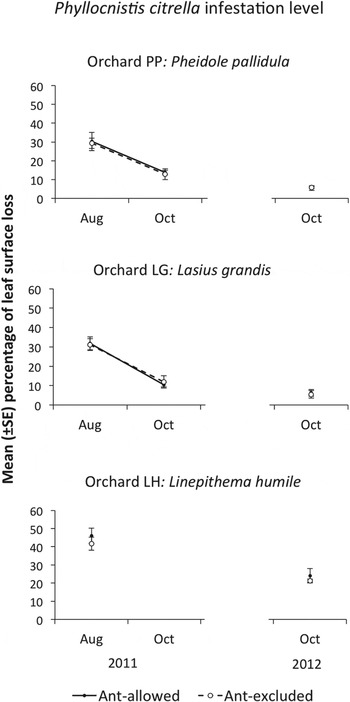
P. citrella infestation was estimated by calculating the percentage of leaf area damaged. To do so, once a month we randomly sampled ten young shoots, containing between five and ten leaves each, from the four central trees per plot of the ant-allowed and the ant-excluded treatments. Shoots were transferred to the laboratory, where we scored the damage on each leaf by visually estimating the percentage of reduction in surface area caused by P. citrella larvae, in 10% intervals from 0 to 100% (Schaffer et al., Reference Schaffer, Peña, Colls and Hunsberger1997). The above process was performed in August and October 2011 and in October 2012 for orchards PP and LG, as well as in August 2011 and October 2012 for orchard LH.
Percent parasitism in the ant-allowed and the ant-excluded treatments
California red scale
CRS parasitism was assessed once a month by sampling a minimum of five twigs, and when available five fruits, infested with CRS per tree from the four central trees of each plot of the ant-allowed and the ant-excluded treatments. The samples were carried to the laboratory where we observed under a stereomicroscope 50–100 (depending on the availability) individuals of CRS stages susceptible to parasitism and determined the number of parasitized and unparasitized scales. In some cases where CRS population was very low, between 30 and 50 individuals were considered sufficient. In the study area, CRS is parasitized by Aphytis chrysomphali (Mercet) and Aphytis melinus DeBach (Hymenoptera: Aphelinidae) (Pekas et al., Reference Pekas, Tena, Aguilar and Garcia-Marí2010b ; Pina et al., Reference Pina, Verdú, Urbaneja and Sabater-Munoz2012). Parasitism was identified by the presence of parasitoid eggs, larvae, prepupae or pupae. Percent parasitism was established as the number of parasitized scales×100/(number of parasitized scales + number of unparasitized scales) (Pekas et al., Reference Pekas, Tena, Aguilar and Garcia-Marí2010a ). The above procedure was repeated in June and July 2011, and July 2012 for assessing parasitism on twigs. On fruits, the percent parasitism was assessed in September and November 2011 and September and October 2012 for orchards PP and LG and in September and November 2011, and September, October and November 2012 for orchard LH.
Citrus woolly whitefly
Parasitism of A. floccosus was determined once a month by sampling a maximum of 20 leaves (when available) infested by A. floccosus from the four central trees per plot of the ant-allowed and the ant-excluded treatments. Samples were placed in plastic bags and transported to the laboratory where they were processed within the next 24 h. Under a stereomicroscope, the number of parasitized and unparasitized nymphs was counted in a 1 cm2 circular surface randomly selected inside the area covered by the whitefly colony on each leaf. In the study area, A. floccosus is parasitized by Cales noacki Howard (Hymenoptera: Aphelinidae) (Soto et al., Reference Soto, Ohlenschläger and Garcia-Marí2001; Garcia-Marí, Reference Garcia-Marí2012). Parasitized whiteflies were identified by the presence of swollen nymphs without waxy secretion (Soto et al., Reference Soto, Ohlenschläger and Garcia-Marí2001). Percent parasitism was established as number of parasitized×100/(number of parasitized+number of unparasitized) whiteflies. The above procedure was repeated in July and September 2011 an October 2012 for orchards PP and LG and in July, August and September 2011 and July and August 2012 for orchard LH.
Citrus leafminer
Parasitism of P. citrella was assessed once a month by sampling ten young shoots per tree from the four central trees on each plot of the ant-allowed and the ant-excluded treatments. Samples were transferred to the laboratory and were processed within the next 24 h. Under a stereomicroscope we observed a maximum of 50 (when available) leafminer individuals of stages susceptible to parasitism and counted the number of parasitized and unparasitized ones. In the study area P. citrella is mostly attacked by Citrostichus phyllocnistoides (Narayan) (Hymenoptera: Eulophidae) which accounts for more than the 97% of the parasitoids (Vercher et al., Reference Vercher, García Marí, Costa Comelles, Marzal and Granda2000; Garcia-Marí et al., Reference Garcia-Marí, Vercher, Costa-Comelles, Marzal and Villalba2004; Karamaouna et al., Reference Karamaouna, Pascual-Ruiz, Aguilar-Fenollosa, Verdú, Urbaneja and Jacas2010). Citrostichus phyllocnistoides attacks principally the second and third instars of P. citrella. Larval stages and parasitism were identified by visual observation, determining the presence of eggs, larvae or pupae of C. phyllocnistoides. Percent parasitism was calculated as: number of parasitized leafminers×100/(number of parasitized+number of unparasitized). The above procedure was repeated in September 2011 and 2012 when young shoots (the preferred plant substrate by the leafminer) were available.
Statistical analysis
The effectiveness of the ant-exclusion methods was tested using Repeated Measures analysis of variance (ANOVA) with the data log-transformed in order to meet normality assumptions. Treatment (ant-excluded versus ant-allowed) was the fixed factor, sampled tree nested into ant-exclusion was the random factor and sampling date was the Repeated Measures factor. The effects of the ant-exclusion on the herbivore infestation levels and percent parasitism on each sampling date were analyzed using one-way ANOVA. The season-long effects of ant-exclusion on herbivore infestation and percent parasitism were analyzed using Repeated Measures ANOVA. Treatment (ant-excluded versus ant-allowed) was the fixed factor, sampled tree nested into ant-exclusion was the random factor and sampling date was the Repeated Measures factor. Data were [arcsin
 $\sqrt x $
] transformed in order to meet normality assumptions. Means were compared by using Fisher's least significant difference (LSD) test with the significance level set at α=0.05. All statistical analyses were performed using Statgraphics 5.1 software (Statgraphics, 1994).
Results
Ant activity
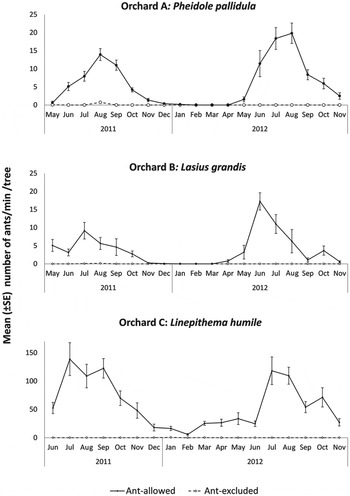
When examining the ant activity registered in each orchard, the invasive L. humile, predominant in orchard LH, showed the highest activity levels during the two years of the study (fig. 1). In both years, its activity peak was registered in July, when 139.8±29.1 (2011) and 118.3±24.4 ants min−1 tree−1 (2012) ascended to or descended from the tree canopies. The native P. pallidula and L. grandis, predominant in orchards PP and LG, respectively, showed considerably lower activity levels than L. humile (fig. 1). P. pallidula showed an activity peak in August in both years, with 13.9±1.6 (2011) and 19.8±2.8 ants min−1 tree−1 (2012) ascending to or descending from the citrus canopies. L. grandis exhibited an activity peak in July in 2011 (9.2±2.3 ants min−1 tree−1) and in June in 2012 (17.3±2.4 ants min−1 tree−1). It is important to highlight that L. humile was active throughout the whole year, whereas almost no workers of P. pallidula or L. grandis were observed foraging on the tree canopies during the winter months, from December until March.
Mean (±SE) ant activity (number of ants ascending or descending the tree trunk per minute) in ant-allowed and ant-excluded trees in 2011 and 2012 in three citrus orchards in eastern Spain, each with presence of P. pallidula, L. grandis or L. humile.

In the ant-excluded treatment, ants were effectively excluded from the tree canopies during the two years of the study. From April 2011 to March 2012, when we used Inesfly FITO® paint for ant exclusion, ants were absent from almost all the tree canopies, except in a few trees for the three orchards studied (ant-allowed versus ant-excluded: orchard PP: 4.07±0.44 vs. 0.07±0.05; repeated-measures ANOVA: F 1, 6 =367.74; P<0.0001; orchard LG: 2.41±0.39 vs. 0.017±0.01; repeated-measures ANOVA: F 1, 6 =74.46; P=0.0001; orchard LH: 60.64±5.7 vs. 0.125±0.05; repeated-measures ANOVA: F 1, 6 =218.71; P<0.0001)(fig. 1). From April 2012 to November 2012 we used Tangle-trap sticky barriers for ant exclusion and ants were totally absent from all the tree canopies, showing thus 100% effectiveness in ant-exclusion (fig. 1).
Herbivore infestation levels
CRS infestation on twigs and fruits
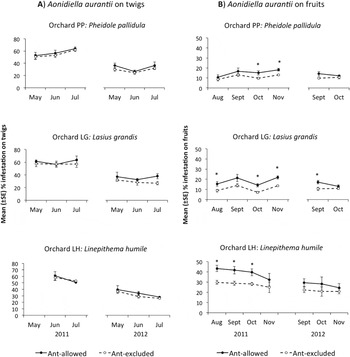
Overall, CRS infestation on twigs was significantly lower (5% in 2011 and 18% in 2012) in the ant-excluded than in the ant-allowed trees in orchard LG, whereas no significant differences between treatments were found for orchards PP and LH (pooled data from all sampling dates; Repeated Measures ANOVA: F 1, 30 =4.92; P=0.035, F 1, 30 =9.30; P=0.34 and F 1, 30 =2.94; P=0.097, respectively) (fig. 2a). When examining each sampling date separately, no significant differences in CRS densities were found for any sampling date for the three orchards (fig. 2a, table 1).
Mean (±SE) California red scale infestation index on (A) twigs and (B) fruits in ant-allowed and ant-excluded treatments in 2011 and 2012 in three citrus orchards in eastern Spain, each with presence of P. pallidula, L. grandis or L. humile. For each sampling date, asterisk indicates significant differences between treatments (P<0.05). For the entire period, CRS infestation on twigs was significantly higher in the ant-allowed than in the ant-excluded trees in the case of the orchard dominated by L. grandis, whereas CRS infestation on fruits was higher in the ant-allowed treatment for the three orchards for the three ant species studied (in both cases Repeated Measures ANOVA, LSD test; see text for details).

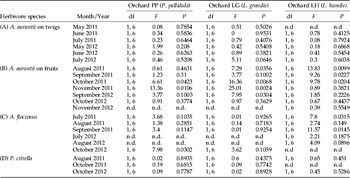
Results of one-way ANOVA for the effect of ant-excluded and ant-allowed treatments on (A) A. aurantii populations on twigs, (B) A. aurantii populations on fruits, (C) percentage of shoots occupied by A. floccosus and (D) percentage of leaf loss caused by Phyllocnistis citrella in ant-allowed and ant-excluded trees in 2011 and 2012 in three citrus orchards in eastern Spain, each with presence of P. pallidula, L. grandis or L. humile (n.d.=not determined).

CRS infestation on fruits was lower in the ant-excluded treatment for the three orchards (pooled data from all sampling dates; Repeated Measures ANOVA: orchard PP: F 1, 30 =11.45; P=0.002; orchard LG: F 1, 30 =34.91; P<0.0001; orchard LH: F 1, 30 =10.86; P=0.003). When examining each sampling date separately, CRS densities on fruits were significantly lower in the ant-excluded treatment in 9 out of 19 sampling dates (fig. 2b, table 1). Overall, we registered a significant reduction of the CRS densities on fruits in the ant-excluded treatment: 41 and 26% in 2011 and 2012, respectively, for orchard LG (where L. grandis was predominant), 28 and 21% for orchard PP (P. pallidula), and 27 and 21% in orchard LH (L. humile).
Citrus woolly whitefly
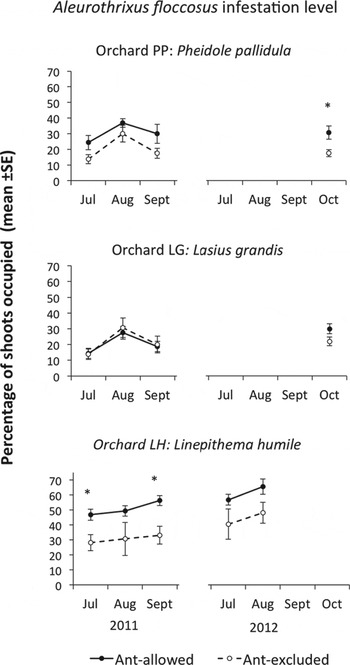
The percentage of shoots occupied by A. floccosus was significantly lower in the ant-excluded treatment in the case of orchards PP (P. pallidula) and LH (L. humile). On the other hand, no significant differences were found between treatments in the case of orchard LG (L. grandis) (pooled data from all sampling dates; Repeated Measures ANOVA: orchard PP: F 1, 30 =9.43; P=0.0045; orchard LG: F 1, 30 =0.22; P=0.646; orchard LH: F 1, 30 =18.65; P=0.0002) (fig. 3). When comparing each sampling date separately, the percent occupation of shoots was significantly higher in the ant-allowed treatment in one of the four dates (October 2012) for orchard PP and in two out of five sampling dates for orchard LH (fig. 3, table 1). Overall, the mean reduction of shoots occupied by A. floccosus in the ant-excluded treatment was 35% in 2011 and 43% in 2012 for orchard PP (P. pallidula) and 40% in 2011 and 26% in 2012 for orchard LH (L. humile).
Mean (±SE) percentage of shoots occupied by A. floccosus in ant-allowed and ant-excluded treatments in 2011 and 2012 in three citrus orchards in eastern Spain, each with presence of P. pallidula, L. grandis or L. humile. For each sampling date, asterisk indicates significant differences between treatments (P<0.05). For the entire period, the percentage of shoots occupied by A. floccosus was significantly higher in the ant-allowed treatment in the case of P. pallidula and L. humile whereas no significant differences were found between treatments for L. grandis (Repeated Measures ANOVA, LSD test; see text for details).

Citrus leafminer
We found no significant differences in the percent of leaf surface loss caused by larvae of P. citrella between ant-allowed and ant-excluded treatments for any of three orchards (pooled data from all sampling dates; Repeated Measures ANOVA: orchard PP: F 1, 6 =1.6; P=0.223; orchard LG: F 1, 6 =0.01; P=0.9327; orchard LH: F 1, 6 =0.03; P=0.8709) (fig. 4). When comparing each sampling date separately, no significant differences in the percent of leaf surface loss were found for any sampling date for the three orchards (fig. 4, table 1).
Mean (±SE) percentage of leaf surface loss caused by P. citrella larvae in ant-allowed and ant-excluded treatments in 2011 and 2012 in three citrus orchards in eastern Spain, each with presence of P. pallidula, L. grandis or L. humile. For each sampling date, asterisk indicates significant differences between treatments (significance level: P<0.05). For the entire period we found no significant differences in the percent of leaf surface loss between ant-allowed and ant-excluded treatments for none of three ant species (Repeated Measures ANOVA, LSD test; see text for details).

Percent parasitism
CRS on twigs and fruits
The mean (±SE) percent parasitism of CRS on twigs peaked in July and reached 13.4% (±2.07), 9.6% (±3.3) and 11.4% (±3.16) in orchards PP, LG and LH, respectively. The mean (±SE) percent parasitism of CRS on fruits peaked in September and was considerably higher than on twigs, reaching 45.6% (±3.6), 42.7% (±3.33) and 38.0% (±2.5) in orchards PP, LG and LH, respectively.
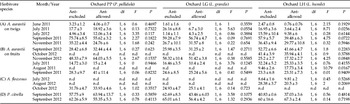
On twigs we found no differences in percent parasitism of CRS between ant-allowed and ant-excluded treatments in any of the three orchards studied when pooling data from all sampling dates (Repeated Measures ANOVA; orchard PP: F 1, 6 =1.61; P=0.2512; orchard LG: F 1, 6 =2.75; P=0.1481; orchard LH: F 1, 6 =1.81; P=0.2271). When comparing each sampling date separately, we found significantly higher percent parasitism in the ant-excluded treatment in orchard LH in one of three dates examined (July 2011). In this particular date, we found a percent parasitism of 16.9% (±3.63) in ant-excluded treatment versus 3.64% (±2.40) in the ant-allowed treatment (table 2).
Results of one-way ANOVA for the effect of ant-excluded and ant-allowed treatments on mean (±SE) percent parasitism of (A) A. aurantii on twigs. (B) A. aurantii on fruits. (C) A. floccosus and (D) Phyllocnistis citrella in ant-allowed and ant-excluded trees in 2011 and 2012 in three citrus orchards in eastern Spain, each with presence of P. pallidula, L. grandis or L. humile (n.d.=not determined).

Likewise, percent parasitism of CRS on fruits was similar between the ant-allowed and the ant-excluded treatments for the three orchards (Repeated Measures ANOVA: orchard PP: F 1, 6 =0.26; P=0.6288; orchard LG: F 1, 6 =0.02; P=0.8970; orchard LH: F 1, 6 =4.54; P=0.0772). Furthermore, no significant differences in percent parasitism on fruits between treatments were found when comparing each sampling date separately (table 2). In the orchard LH (L. humile), percent parasitism on fruits was consistently higher in the ant-excluded treatment; however, differences between treatments only approached statistical significance.
Citrus woolly whitefly
No significant differences in percent parasitism of A. floccosus were detected between ant-excluded and ant-allowed treatments in any of the three orchards studied (pooled data from all sampling dates; Repeated Measures ANOVA: orchard PP: F 1, 6 =0.71; P=0.4053; orchard LG: F 1, 6 =0.07; P=0.7951; orchard LH: F 1, 6 =0.65; P=0.4428). Similarly, no significant differences were found between treatments when comparing the data separately on each sampling date (table 2), except on one of the five dates examined in orchard LH. On this particular date we found significantly higher percent parasitism in the ant-allowed treatment (17.73%±3.40) than in the ant-excluded treatment (9.46%±2.60) (table 2).
Citrus leafminer
Percent parasitism of P. citrella was significantly higher in the ant-excluded plots in orchard LG (L. grandis), whereas no significant differences between treatments were found for orchards PP and LH (pooled data from all sampling dates; Repeated Measures ANOVA: F 1, 6 =15.11; P=0.0081; F 1, 6 =0.07; P=0.7995; F 1, 6 =0.75; P=0.4197, respectively). No significant differences between treatments were found for any of the three ant species when comparing each sampling date separately (table 2).
Discussion
CRS is one of the worst citrus pests worldwide and its presence on fruits is highly undesirable, especially for countries whose production goes to fresh fruit market. Our results showed that fruit infestation caused by CRS was higher in the ant-allowed treatment in the three orchards of the study. These results are in agreement with previous studies which showed that ants may induce population increases of CRS on fruits (DeBach et al., Reference DeBach, Fleschner and Dietrick1951; Steyn, Reference Steyn1954; Moreno et al., Reference Moreno, Haney and Luck1987; James et al., Reference James, Stevens and O'Malley1997; Pekas et al., Reference Pekas, Tena, Aguilar and Garcia-Marí2010a ). CRS does not produce honeydew and therefore is not tended by ants. Thus, the CRS population increase induced by ants is considered as an indirect effect; ants disrupt biological control of CRS when they accidentally encounter the CRS natural enemies while foraging on the tree canopies or while tending coincident honeydew producers (Steyn, Reference Steyn1954; Samways et al., Reference Samways, Nel and Prins1982; Murdoch et al., Reference Murdoch, Luck, Swarbrick, Walde, Yu and Reeve1995; Dao et al., Reference Dao, Meats, Beattie and Spooner-Hart2013). In most of the aforementioned studies, the ant species involved was the Argentine ant L. humile, which is known as an aggressive and disruptive species for biological control (Holway et al., Reference Holway, Lach, Suarez, Tsutsui and Case2002). In our study, it was much more abundant than the native species and moreover it remained active throughout the whole year. This result coincides with Monzó et al. (Reference Monzó, Juan-Blasco, Pekár, Mollá, Castañera and Urbaneja2013), who also found L. humile active throughout all the season in the same citrus-growing area. In general, invasive ants are usually strongly attracted to hemipteran honeydew and are more aggressive than native ants (Styrsky & Eubanks, Reference Styrsky and Eubanks2007). Given these attributes, L. humile would be expected to induce higher CRS populations on fruits compared with the native species. On the other hand, native ant species can also differ in their capacity of biological control disturbance, which is generally related to their aggressiveness and territoriality (Buckley & Gullan, Reference Buckley and Gullan1991; Kaneko, Reference Kaneko2003; Mgocheki & Addison, Reference Mgocheki and Addison2009). We cannot draw definitive conclusions whether native or invasive species affect the herbivores differently; however, the population increases of herbivores in orchard LH, dominated by the invasive L. humile, were not higher but similar or even lower in some cases to those of orchards PP and LG, where the native species P. pallidula and L. grandis were predominant. It should be taken into account that L. grandis and P. pallidula are dominant species in their native areas (Pekas et al., Reference Pekas, Tena, Aguilar and Garcia-Marí2011; Arnan et al., Reference Arnan, Cerdá and Retana2012) and show aggressive behavior as well (Seifert, Reference Seifert1992; Retana & Cerdá, Reference Retana and Cerdá1994; Katayama & Suzuki, Reference Katayama and Suzuki2003).
CRS infestation on twigs was similar in the ant-allowed and ant-excluded treatments. Assessments of CRS population densities on twigs were done visually without determining whether scales were alive or they were old dead scales remaining on the bark from previous generations. This fact might have masked the real effect of ant-exclusion on CRS population on twigs. In agreement with our results, Moreno et al. (Reference Moreno, Haney and Luck1987) also reported no differences in CRS infestation on twigs between ant-excluded and ant-allowed citrus trees while they did find significant differences on fruits, attributing these different results to the fact that the parasitoid A. melinus concentrates its activity on the periphery of the trees, where most of the fruits are located.
The woolly whitefly A. floccosus, as for many other honeydew producing Hemiptera, is tended by ants on the citrus canopies (Moreno et al., Reference Moreno, Haney and Luck1987; Pekas et al., Reference Pekas, Tena, Aguilar and Garcia-Marí2011). In fact, Moreno et al. (Reference Moreno, Haney and Luck1987) reported lower whitefly densities in citrus trees when L. humile was excluded from the canopies. According to our results, the percentage of shoots occupied by A. floccosus was significantly lower in the ant-excluded treatment in orchards PP and LH dominated by P. pallidula and L. humile respectively, whereas no differences were found in the orchard LG dominated by L. grandis. Given that A. floccosus is directly tended by ants, the outcome of the interaction between the whitefly and the ant species in our study is expected to be influenced by the seasonal activity pattern of the latter. The activity of L. grandis ascending to the canopies peaked in spring and decreased in July, a period when the populations of A. floccosus start to increase (Garcia-Marí, Reference Garcia-Marí2012). On the other hand, P. pallidula and L. humile were active during summer and autumn, the months of higher A. floccosus incidence in the field. In fact, in orchard LH where L. humile was predominant and exhibited high activity throughout most of the year, we found higher A. floccosus infestations in ant-allowed trees for all the sampling dates. Interestingly, in the case of P. pallidula, significantly higher A. floccosus infestations in the ant-allowed trees were recorded only on the sampling dates following the ant's peak activity (September and October).
Regarding the effect of ant exclusion on P. citrella, in the three orchards we observed no significant differences in the percent of leaf surface loss between the ant-allowed and ant-excluded treatments. Similarly, Urbaneja et al. (Reference Urbaneja, Muñoz, Garrido and Jacas2004) conducted an ant-exclusion study to determine the impact of Lasius niger (Latreille) on P. citrella and observed no differences in the number of P. citrella on leaves for ant-allowed and ant-excluded treatments. P. citrella produces no honeydew and moreover develops on young and tender leaves (Garcia-Marí et al., Reference Garcia-Marí, Granda, Zaragoza and Agustí2002) where other honeydew producing hemipterans are usually not found. Therefore, although the arboreal and highly aggressive weaver ants Oecophylla have been reported as efficient biological control agents of the citrus leafminer in Vietnam (Van Mele & Van Lenteren, Reference Van Mele and Van Lenteren2002), the activity of the ant species in our study apparently is not affecting the citrus leafminer populations directly or indirectly.
In previous studies, examining the impact of the ants on populations of honeydew-producing Hemiptera, lower parasitism rates were reported on plants with ants relative to plants without ants (DeBach et al., Reference DeBach, Fleschner and Dietrick1951; Bartlett, Reference Bartlett1961; Itioka & Inoue, Reference Itioka and Inoue1996b , Reference Itioka and Inoue1999). Moreover, in the case of non-honeydew producing Hemiptera, several studies showed that ants may disrupt parasitoid activity (DeBach et al., Reference DeBach, Fleschner and Dietrick1951; Flanders, Reference Flanders1958; Murdoch et al., Reference Murdoch, Luck, Swarbrick, Walde, Yu and Reeve1995; Heimpel et al., Reference Heimpel, Rosenheim and Mangel1997; Martinez-Ferrer et al., Reference Martinez-Ferrer, Grafton-Cardwell and Shorey2003). Recently, a study conducted on Australian citrus revealed that the parasitism of CRS by Encarsia perniciosi (Tower) and Encarsia citrina Craw (Hymenoptera: Aphelinidae) was severely reduced in the presence of the ant I. rufoniger (Lowne) (Dao et al. Reference Dao, Meats, Beattie and Spooner-Hart2013). In our study, however, we rarely found differences in percent parasitism between ant-allowed and ant-excluded treatments, either for the honeydew or non-honeydew producing insect herbivores. These results were consistent in the three orchards studied, each one of them with a different predominant ant species. Only in the case of CRS on fruits we did find lower parasitism levels in ant-allowed trees of orchard LH (with L. humile) although this reduction only approached statistical significance. In the same way, Pekas et al. (Reference Pekas, Tena, Aguilar and Garcia-Marí2010a ) reported no differences in the parasitism of CRS on fruits between ant-excluded and ant-allowed treatments despite the fact that higher numbers of CRS were recorded on fruits in the treatment where L. grandis or P. pallidula had access to the tree canopies. Murdoch et al. (Reference Murdoch, Luck, Swarbrick, Walde, Yu and Reeve1995) showed that the exclusion of L. humile did not affect CRS parasitism in samples taken from the exterior part of trees while they did find differences in the inner part and argued that ants were rarely seen in the exterior of trees. Urbaneja et al. (Reference Urbaneja, Muñoz, Garrido and Jacas2004) showed no differences in percentage parasitism of P. citrella between ant-allowed and ant-excluded treatments. Finally, regarding A. floccosus, to our knowledge there are no previous studies investigating the effect of ants on parasitism of this species.
Thus, apparently the parasitoid species involved in our study are not affected by the presence of ants. However, we might have failed to detect differences in percent parasitism between treatments due to the fact that the impact of parasitoids on host populations must be determined on a generational time scale (Van Driesche, Reference Van Driesche1983). This is because, depending on the synchronization between parasitoids and host populations, the contribution of the former to host population mortality may be overestimated or underestimated. Furthermore, other important sources of mortality induced by parasitoids such as host feeding or probing should be considered when determining percent parasitism (Kidd & Jervis, Reference Kidd, Jervis, Jervis and Kidd1996). Especially in the case of A. melinus, the mortality caused to CRS through host-feeding is almost equal to that due to parasitism (Rosen & DeBach, Reference Rosen and DeBach1979).
Alternatively, factors other than parasitism not assessed in our study may have contributed to the increased CRS and A. floccosus populations in the presence of ants. For instance, predation is an important mortality factor which nevertheless is difficult to assess accurately in the field. Piñol et al. (Reference Piñol, Espadaler and Cañellas2012b ), during a long-term experiment of ant exclusion in citrus in Catalonia, showed that ants had a negative effect on the abundance of various groups of predators. In Australian citrus, Dao et al. (Reference Dao, Meats, Beattie and Spooner-Hart2013) have recently shown that the predation of CRS by coccinellid beetles was significantly increased when the ant I. rufoniger was excluded. Bach (Reference Bach1991) reported lower mortality rates of the soft scale Coccus viridis (Green) (Hemiptera: Coccidae) in the presence of ants not only from parasitism but also from other undetermined causes. Interestingly, several studies have reported aggressive ant behavior against predators such as coccinellids, neuropterans or dipterans (Bartlett, Reference Bartlett1961; DeBach & Rosen, Reference DeBach and Rosen1991; Itioka & Inoue, Reference Itioka and Inoue1996a , Reference Itioka and Inoue1999; Katayama & Suzuki, Reference Katayama and Suzuki2003; Piñol et al., Reference Piñol, Espadaler, Cañellas, Martínez-Vilalta, Barrientos and Sol2010). Vanek & Potter (Reference Vanek and Potter2010) reported that the exclusion of the ant Formica subsericea Say led to a reduction of the soft scale Eulecanium cerasorum (Cockerell) (Hemiptera: Coccidae) densities caused principally by increased predation by Chrysoperla rufilabris (Burmeister) (Neuroptera: Chrysopidae), whereas parasitism of adult scales was similar between banded and control trees. In an ant-exclusion and predator-exclusion field experiment McPhee et al. (Reference McPhee, Garnas, Drummond and Groden2012) demonstrated that Myrmica rubra (L.) induced higher aphid abundance by reducing the impact of Chrysoperla carnea (Stephens). Preliminary observations in the same three orchards of our study show lower abundance of potential predators of CRS and A. flocossus, such as green lacewings in the ant-allowed treatment (Calabuig et al., unpublished data), which might explain the results obtained in the present study.
The exclusion method was very efficient in preventing the ants from ascending to the canopies in the two years of the study. The use of Inesfly FITO© paint during the first year of the exclusion had the advantage that one application could last for several months which is highly desirable in reducing costs as well as workload. However, we observed several trees where the ants managed to sidestep the painted barrier and eventually ascend to the canopy. Therefore, in the second year we shifted to the Tanglefoot sticky barrier which, although posing important practical difficulties to employ, is known to efficiently prevent the ants from ascending to the canopies (Pekas et al., Reference Pekas, Tena, Aguilar and Garcia-Marí2010a ). A potential drawback of the use of sticky barriers for ant-exclusion involves the possibility of excluding, apart from the ants, other non-flying predators such as earwigs and the ant-mimic bug Pilophorus sp., (Heteroptera: Miridae), potential predators of plant feeders in the canopy (Piñol et al., Reference Piñol, Ribes, Ribes and Espadaler2012a ; Romeu-Dalmau et al., Reference Romeu-Dalmau, Espadaler and Piñol2012). In our study however, we observed no earwigs on the tree trunk close to the exclusion zone and only a few Pilophorus sp. were obtained in tree samplings in a parallel study on the ant-allowed trees (Calabuig et al. unpublished data). Moreover, we are not aware of studies reporting earwigs or Pilophorus sp. preying upon A. aurantii, A. floccosus or P. citrella.
In conclusion, consistently higher populations of CRS were registered on fruits in the presence of the three ant species, L. grandis, P. pallidula and L. humile. Regarding the woolly whitefly A. floccosus, higher populations in the ant-allowed treatments were registered in the P. pallidula and L. humile orchards. We detected no effect of ants on populations of P. citrella for any of the three orchards studied. Overall, the increase of herbivore infestation in the orchard dominated by the invasive and much more active L. humile, were not higher but similar or even lower in some cases than in the orchards where the native P. pallidula and L. grandis predominated. Thus, irrespective of the species present, ants have the potential to increase the infestation levels of honeydew and non-honeydew producing herbivores in citrus. These results suggest that ant management should be considered in order to reduce herbivore infestations in citrus orchards. The sticky barriers used in the present study proved to be efficient in excluding ants from the canopies; nevertheless, this method might suffer practical drawbacks, e.g., increased workload when needs to be applied in commercial orchards. Alternative and environmental friendly methods based on manipulating the ant-hemiptera interaction (Nagy et al., Reference Nagy, Cross and Markó2013) or employing semiochemicals for disrupting ant foraging (Suckling et al., Reference Suckling, Peck, Stringer, Snook and Banko2010) seem promising. Regarding the underlying mechanism, parasitism alone cannot explain the differences in the herbivore population levels between treatments observed in our study. Other factors, such as the impact of ants on predators (James et al., Reference James, Stevens, O'Malley and Faulder1999; Piñol et al., Reference Piñol, Espadaler, Cañellas, Martínez-Vilalta, Barrientos and Sol2010) or host feeding by parasitoids are important and should be further investigated.
Acknowledgements
This work was supported by the project (RTA2010-00012-C02-02) assigned to F.G.M from the Instituto Nacional de Investigación y Tecnología Agraria y Alimentaria (INIA) of Spain. We thank three reviewers for their comments that considerably improved the manuscript.