


What is humanitarian action all about?
These are brief notes about very little things. Small things, just like a cup of coffee, pictures of flowers, animals, and landscapes, or a few drops of perfume. Very small things indeed, so derisory that they rarely dare to appear in reports, accounts, and media articles on humanitarian action in the field. Yet, such small things sometimes represent a substantial part, and perhaps a most meaningful one, of the activity of the International Committee of the Red Cross’ (ICRC) personnel in the field in the midst of armed conflicts and violence.
In my activity as a physician and as a medical delegate of the ICRC, I have visited various places of detention on various continents. When visiting places of detention, the ICRC works as an impartial, independent, and neutral organisation, within the framework of private, confidential interviews with detainees, and of a confidential dialogue with the detaining authorities.Footnote 1 Confidentiality in the interviews is essential to protect detainees and to establish a relationship of trust. The confidential dialogue with the authorities addresses general conclusions and recommendations based on observations made during the visits and on issues raised by detainees, while protecting the anonymity of the source of information. The aim of the visits is to improve the conditions of detention and the treatment of the detainees, to prevent or to stop the occurrence of ill-treatment, and to promote humane treatment and relationships in the detention facility. In 2012, ICRC delegates visited about 540,000 detainees in 97 countries and territories, more than 26,000 of whom were seen in private interviews. In many instances, the ICRC delegates are the only external visitors to the detainees.
These notes focus on visits to detainees. Because of confidentiality in ICRC activity, no place, time, or people's names will be disclosed. But the reader can imagine that similar issues occur in many different contexts.
What is the use of a cup of coffee?
This reflection stems from two questions asked by colleagues. These were perplexing questions, with no easy answers. Both questions, however, bring us to the core and to the limits of humanitarian action in situations of violence, and close to the very heart of humanitarian care and ethics.
The first question was in the form of a request from a renowned expert in positive psychology and resilience. He was looking for a study carried out by the ICRC some years ago in which, as he remembered it, people who had been succoured talked about what had been most helpful and made them feel good. He recalled that their answers often underlined simple things, gestures of kindness, such as offering them a cup of coffee.
On one hand, I could certainly appreciate the value of a cup of coffee; I also recognised that when an ICRC delegate comes to visit a detainee for a private talk, listening and sharing a cup of tea, coffee, orange juice, or cookies, it is sometimes an extraordinary event in the life of a detainee. On the other hand, I found it embarrassing to talk about positive experiences and resilience in situations in which people strive to survive in appalling conditions, sometimes victims of inhumane and degrading treatment or extreme violence. Most of our private talks in detention visits were about life in detention, isolation from the loved ones, hardship, dreadful experiences, sadness, suffering, and pain; and because I am a medical doctor, our conversations would often address ill health, physical ailments, chronic diseases, and psychosocial and mental disorders often related to captivity.
In such circumstances, a cup of coffee could certainly be greatly appreciated; yet I felt it risky to overestimate its value, thereby denying the suffering and possible trauma endured. In such situations, what is really the value of a visit? Does a cup of coffee offered with kindness really make a difference?
In a remarkable engraving from the series ‘The Disasters of War’, Goya depicts an old woman bringing a bowl of soup to a starving person, on the verge of death, during the 1810 famine in Madrid in the Spanish War of Independence.Footnote 2 This is a scene of humanity. Yet Goya questions the limited and derisory extent of this pittance with the title: ‘What is the use of a cup?’
Is this humanitarian action? Powerlessness in detention visits
The other question was raised a few months later by a medical doctor working with the ICRC in detention centres. This colleague had recently returned from a region of conflict where torture was a common and protracted practice. Detainees were beaten repeatedly and tortured in awful ways. The ICRC was visiting these places of detention, talking with detainees, collecting evidence of abuse and ill-treatment, and reporting to the authorities in order to obtain improvement and change. Yet not much progress occurred at the time, and the delegates could only witness the gravity, extent, and repetition of ill-treatment. Our colleague witnessed the devastating consequences of ill-treatment. The ICRC started to offer former prisoners psychosocial support after release, with counselling and mental health care if needed. The needs were huge however; hundreds of people would have benefited from such intervention, but the capacity to provide services was limited. Was it fair, to those not included in this programme? Then came other, more central questions: should the ICRC continue these visits? What was their value, if torture and ill-treatment continued? Does that make sense? He asked: ‘Is this humanitarian action?’
The aim of ICRC's visits to detainees is to ensure and promote humanity and respect for the dignity of the detainees, to improve their situation, and to ease their suffering. The ICRC knows from experience that perseverance is essential and that progress may only come in the long term through a confidential dialogue with authorities based on facts and on a strong commitment to humanitarian values. For the visits to make sense they must have an impact on the conditions of detention, and dialogue with the detaining authorities must be constructive. If these conditions are not met, the ICRC might decide to stop the visits and, eventually, to publicly denounce the situation.Footnote 3 This is a difficult decision to take, as in many instances it would leave the detainees without any other external visitor, thus increasing isolation, dependence and vulnerability.
Moments of shared humanity
In a movie made by the ICRC some years ago,Footnote 4 former detainees talked about their detention and about ICRC visits. This film simply shows their suffering, expressions of distress, pain, and tears when they recalled a terrible time in detention. Some intended to explain the isolation, ill-treatment – but suddenly kept silent. Words were missing. Even years after the events, talking was not possible.
In the movie, some former detainees remembered visits from ICRC delegates and commented on the importance of these visits. This reminded me of confidential talks with detainees, around a cup of tea, coffee, orange juice, and cookies. On some occasions, the visit became a real encounter. We would talk about our lives and families, about nature, about art and culture, beliefs and hopes, but quite often just about little things, small things in everyday life. Humour sometimes emerged, and joyful laughter would unexpectedly burst out in the midst of dire realities. There were intense moments; moments of shared humanity.
Pictures of hope
I experienced similar human encounters some years ago during visits in a particularly harsh place of detention. Whereas basic material needs, such as food, water, shelter, or medical services were met, the detainees suffered from isolation, inactivity, deprivation of personal property, tense relations with guards, and uncertainties as to their fate, all of which deeply affected their physical, mental, and psychosocial health. As in many places of detention, an important ICRC activity was the distribution and collection of family news through Red Cross messages, from families to their detained relative, and back from detainees to their families.Footnote 5 In this particular place there was another, quite peculiar, activity. ICRC staff also distributed pictures of landscapes, animals or flowers. During the visits we would see detainees selecting pictures from a pile presented by an ICRC delegate. This was a significant activity, with on average 20 pictures distributed per person in a visit. There was a vast choice of printed pictures of flowers, birds or wild beasts, cities and religious buildings and beautiful sunsets in vast landscapes.
What did the detainees do with these pictures? First, many hung them on the walls of their cells as a reminder that there is beauty in the world: there are beautiful flowers, strong animals, free birds flying, great cities, places for prayer and religious life – and beautiful sunsets. Second, many sent pictures to their relatives, often without any comment as if no words were needed, or as if no words could possibly tell what they were expressing; as if they were telling their loved ones: ‘I am here, and I share with you this picture; I offer you the beauty of nature and cities; I vibrate to the beauty of a sunset. I am human’.
These detainees were expressing their humanity through this simple method. They had endured war, ill-treatment, separations, isolation and harsh conditions of detention. They had been treated as non-human, as outside humanity. Through these pictures they were simply expressing dreams, hopes and probably their belonging to humanity. The gift of these beautiful pictures to their relatives was an expression of love and shared humanity.
Some of the ICRC staff seemed to have particular relational skills and sensitivity to this human dimension of their activity. For example, women in the visiting team played significant roles: they had developed this activity, they selected pictures on the Internet, printed them in postcard format, and organised the distribution. Some ICRC delegates displayed much dedication in bringing these pictures to the detainees, helping them to choose the most beautiful image to send home, discussing their choice with them as well as the meaning of an image. These were precious moments.
Small gifts and mutual recognition
Some detainees made yet another use of these printed images: during a private conversation, they would choose a picture from their collection and offer it to a visiting delegate. In a context deprived of most material objects, this small object became a gift of incalculable value. For detainees in very hard conditions of detention, the gift of a picture to the delegate expressed his or her own humanity, and restored his or her dignity. This small and gratuitous gift, from a most vulnerable and deprived person, expressed a sense of mutual recognition as human beings, the recognition of our common humanity.Footnote 6
Gifts by detainees to ICRC visitors are common, possibly having various meanings. If it is possible, detainees invite the ICRC delegate to share a cup of tea, a cold drink, or some food. This simple act establishes a relationship in which the visitor is received as a guest, thus restoring some symmetry and reciprocity in the relationship with the humanitarian actor. Many experienced delegates actually consider themselves as visitors to the detainees and express the same courtesy and respect they would expect from any guest in their home. Offering some drink or food is an invitation to a real encounter, to share a moment of humanity.
Also not infrequently, some detainees offer a drawing, a poem, or a piece of craftsmanship. This is not perceived as a response to a moral obligation to reciprocate the visit with a counter-gift, but rather as an expression of gratitude and a request for recognition as a human being with an identity and a history, emotions, sufferings and capacities.
A few drops of perfume and of dignity
One day, during a prison visit, a delegate colleague, a woman, received an unusual request. A detainee asked her whether she would see him again another day and bring him some perfume. The delegate was perplexed by the nature of the request, and because of the security rules. In the evening she asked a male colleague for some eau de toilet, and on the following day she visited again the detainee and gave him some drops of the perfume. The detainee sprayed himself generously and joyfully with the perfume, on his face, his hair and his clothes. The man was radiant, he sat up and looked up and said with gratefulness: ‘You know, today for the first time since I am here, I smell good. I feel I am human.’
Then he went to the courtyard to see his comrades, sharing his joy, and rubbing his clothes on theirs to share the perfume. When we saw them later in the day, they came to us, joyful and proudly sharing the good smell. A few drops of perfume that restored their feeling of human dignity.
Detainee held by the Afghan authorities. March 2009 © CICR/VII/NACHTWEY, James

Western Highlands, Baisu prison, Papua New Guinea. View outside the window bars. 4 May 2012 © CICR/KOKIC, Marko

Bujumbura, Mpimba prison. Visit and writing of Red Cross messages. 7 May 2001 © CICR/GASSMANN, Thierry
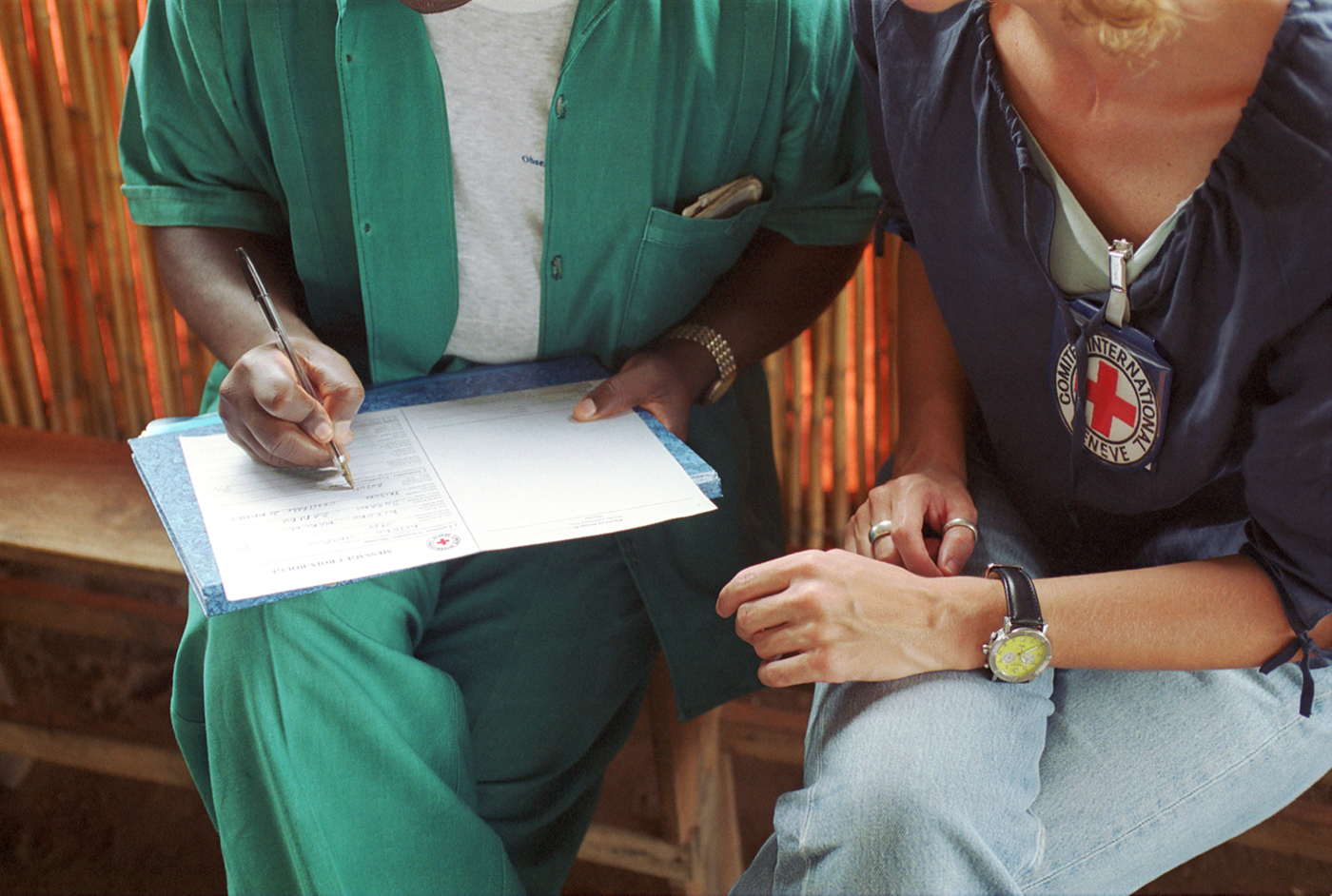
Phnom-Penh, Cambodia, Prison T3. Visit to the prison and interview with detainees. September 1993 © CICR/CORRIERAS, Serge

Kinshasa, office of the Central Tracing Agency. Writing a Red Cross message. 7 August 2000 © CICR/DI SILVESTRO, Jean-Patrick

Lima, Chorrillos high-security detention centre for women. Discussion between an ICRC delegate and a sick detainee in her cell. May 2007 © CICR/HEGER, Boris

Humanitarian care, from trauma to resilience
The small events and little things mentioned above illustrate some aspects of humanitarian care and its value in harsh places of detention. In some dehumanised places, humanitarian care can provide drops of humanity. Health professionals working with victims of abuse and extreme violence have played key roles in recognising the mental suffering related to violence and inhumane conditions and treatment. They have unveiled the reality of psychosocial trauma and its consequences. Yet, there is still a long way to go in the understanding and recognition of the deep damage that armed conflicts, extreme violence, inhuman and degrading treatment, or torture, cause to the health and dignity of the victims; and an even longer way to go in the learning of possible ways to help detainees recover and rebuild meaningful and active lives. Prudence and restraint are needed before drawing definitive conclusions on the possible role of a humanitarian encounter with those who are suffering, in particular in violent and dehumanising contexts.
Denying the reality of violence and abuse and their consequences easily occurs, and it may have lasting consequences on the fate of countless people in armed conflicts. Extreme violence is dehumanising. It is devastating to the human person. It destroys what is human in humans. For the humanitarian professional, meeting with a victim of extreme violence and listening to her or him can be a painful experience. Professionals are affected by the narratives of extreme violence and torture. They pay an emotional price for assisting victims of violence. Richard Mollica, who has worked with numerous victims of torture, calls this the ‘pain of the healer’. In his experience, ‘the act of witnessing violence can be as deeply injurious to the witness as it is to those actually experiencing violence’.Footnote 7 This secondary traumatisation, or ‘vicarious trauma’, results from ‘the cumulative effect of working with traumatised clients, and is reflected in interference with the professional's feelings, cognitive schemas, memories, self-esteem, sense of safety’.Footnote 8 This unique consequence of trauma work was first described in psychotherapists, and more recently in families of prisoners of war,Footnote 9 in interpreters working with torture victims,Footnote 10 and criminal lawyers exposed to criminal situations.Footnote 11
ICRC delegates can be affected by their activity related to victims of extreme violence. They may also witness the capacity of some victims to resist and to keep their own humanity despite dehumanising experiences. To what extent do the ICRC visits contribute to the resistance and coping capacities of victims? Do the visits at least contribute to promoting resilience? They probably do when the visits become the occasion of an encounter, a moment of shared humanity.
We were once discussing these issues in a training session. A female colleague, working as a physician in places of detention in which torture was common and protracted, said that things occurred in a different way. Indeed, professionals could be deeply affected by their work in places of detention, but it was not as if they visited a detainee and enhanced the detainee's capacity to build a resilience. She explained how, one day, she was meeting in private with a group of detainees. They were explaining terrible things, torture, suffering and pain. She was deeply moved, and she cried. The detainees spoke kindly to her. They explained how, together, they could overcome their suffering. They were supporting each other, and now they were supporting the delegate visiting them.
We learned important things from this narrative. First, this delegate was a good humanitarian and health professional; her tears simply expressed her sense of compassion and humanity in front of dehumanising narratives and the fact that, with all her experience, she had not become insensitive to suffering. Second, for the detainees this was the sign of an encounter with a human being. They found themselves in the position of providing her with support and advice, further sharing their experience.
The process of a positive learning by therapists from their patients about overcoming adversity has been described and called ‘vicarious resilience’,Footnote 12 an analogy to the vicarious traumas described in the work of professionals in contact with victims of extreme violence. Vicarious resilience is defined as a ‘process whereby professionals are positively affected by clients' resilience’.Footnote 13 This is an interesting development in our understanding of trauma and resilience. It suggests that a meaningful relationship of care is a transactional intersubjective process. The core element in humanitarian care probably lies in the relationship between the professional and the visited person, when the meeting becomes an encounter between two human beings. In this encounter each one comes as a person, with his or her identity, history, capacity and vulnerability. The building of resilience after extreme violence could be a process of mutual humanisation.
Humanitarian care facing aggressiveness
The small stories above describe situations in which the relationship between the humanitarian professional and detainees may possibly result in a human encounter. In their visits in detention centres, however, ICRC delegates sometimes face rejection or aggressiveness. They may also receive degrading insults, verbal abuse, even threats, or attacks with detainee's body fluids. These situations can be exceedingly difficult to endure and overcome. They can be another source of trauma to humanitarian professionals.
Many ICRC delegates have suffered from such situations. On occasion, detainees have come to the office to visit the delegates after release. They apologised, asked for understanding, and explained that this was their only means to express anger. Insults and aggressive behaviour were not personal, they said, but there were a means by which to communicate. A colleague commented that released detainees thanked her for her attitude when she was insulted, because she did not react personally. They said that this attitude helped them to cope with their suffering.
Aggressive acts against others or against oneself are often extreme ways of communication in detention. In a remarkable conference in 1975, dissident writer André Siniavski, released after seven years in camps in the Soviet Union, referred to some ‘extreme forms of communication in conditions of solitude’.Footnote 14 He told about unusual, weird, or perhaps shocking acts as forms of communication ‘where man is placed in an absolutely blocked situation’. ‘Where language and need for communication have no way out, life itself has no way out’, he commented.Footnote 15 In situations of extreme isolation, rejection or indifference, acts with or against one's own body, hunger strikes, mutilations, or other acts of self-violence should be understood as ‘particular means of communication’.Footnote 16
These acts express an extreme protest by the way of ‘an entirely negative communication, a rupture in communication’.Footnote 17 Recent anthropological and linguistics studies on extreme communicative acts in such situations reach similar conclusions.Footnote 18 Aggressive acts, such as insults, throwing of body liquids onto visitors, spreading faeces on the walls of cells, hunger strikes or mutilations should be understood, first, as acts of communication. They are a protest or an expression of despair when no other means of communication are available. They are a cry for dignity and recognition.
Humanitarian visitors of detention facilities need to be prepared to deal with such situations in order to avoid reacting personally or too formally to aggressive acts. Restoring a verbal communication ‘with’ the detained person is important: rather than talking ‘to’ or listening ‘to’ the person, the key may lie in restoring a dialogue, opening up a method of mutual recognition as capable and dignified human beings. Such a dialogue may help the visitor to understand the meaning, the reasons and the purpose of aggressive acts, and open a shared reflection on possible ways to communicate with the concerned persons or authorities.
Humanitarian visitors face a similar process in their dialogue with the authorities on ways to promote positive communication in the detention facility. A human response to a hunger strike, for instance, may be to set up regular meetings, between the detaining authorities and the detainees or their representatives. These meetings are opportunities to address important issues and to share reflections on possible solutions. Improvements in communication can have a major impact on the nature of the relationship between detainees and those who detain them in an institution, thereby leading to a decrease in violence and to better health of the detainees.
Little things as a way to humanisation
Violence and armed conflicts have devastating effects on individuals, families, societies and humanity. Examples taken from places of detention show that humanitarian action is about taking care of the person, and about humanising dehumanised places. This work often requires much humility, and a deep confidence in our capacity as humans to renounce violence and to engage in respectful and constructive relationships, even in the midst of armed conflicts. It also requires acceptance that the effects of humanitarian action may not be immediately observed. They may well come to light years later, when former detainees recall a cup of coffee, pictures of flowers, wild beasts, or sunsets, drops of perfume, simple moments of shared humanity – small things that restored their dignity, because they were recognised as being human.
In his remarkable book Humanity, philosopher Jonathan Glover analyses faces of inhumanity.Footnote 19 In his exploration he only meets a few examples of humanity. Only a few people, it seems, have the courage to take risks and to give the ‘human responses’, which are respect and sympathy.Footnote 20 In Nazi-occupied Europe, for prisoners in Mauthausen or for Jews in Berlin, ‘even a friendly face made a difference’.Footnote 21
Glover cites the case of writer and philosopher Jean Améry, who remembered cigarettes. After he had been tortured in Breendonk, one soldier tossed him a lighted cigarette through the cell bars. Later, in Auschwitz-Monowitz, he shared the last cigarette of Herbert Kap, a disabled soldier from Danzig. Améry remembered a few other people who made human gestures. They included Willy Schneider, a Catholic worker from Essen, ‘who addressed [him] by [his] already forgotten first name and gave [him] bread’.Footnote 22 But, Glover notes: ‘Jean Améry did not overlook how rare such gestures were.’ In his book, Améry explains that ‘the weight of these brave comrades was not enough’ when they were no longer in front of him ‘but lost in the middle of their people’:Footnote 23 for him, the human acts of a few cannot counterbalance the countless acts of complicity, consent, and collaboration by so many people. Amery explains the reasons for his resentment and the impossibility of overcoming what was done. He was deeply affected by torture and by the extermination camps. He did not consider himself to have been ‘traumatised’, instead, he wrote: ‘He had been dehumanized’.Footnote 24
In her narrative, Magda Hollander-Lafon also remembers small gestures of humanity in the midst of inhumanity and horror in Auschwitz:Footnote 25 someone, in the cattle train to Auschwitz, gave her a slice of sausage, which she shared with her mother and sister;Footnote 26 anonymous comrades saved her life, giving her a few drops of water while she was unconscious with thirst;Footnote 27 the ‘ugly guard with a mean voice’ gave her a pair of clogs and took care of her at work;Footnote 28 a comrade said words of fraternity, friendship and courage that helped her to live;Footnote 29 and a dying woman gave her four small pieces of bread so that she could survive and bear witness to what was happening in Auschwitz.Footnote 30 Such little things helped Magda Hollander-Lafon to overcome suffering and to follow her own way of humanisation.
There are many narratives of survivors of extreme violence. Each human experience is unique and irreplaceable. Likewise, there is no ‘ready-to-wear’ solution to humanitarian care. A request for a few drops of perfume emerged spontaneously in a particular place, during an encounter between two people. Through these drops a detainee felt recognised as a human being. The same liquid may be meaningless, and even offensive, in another context. People working in humanitarian action find their own way of humanitarian care. They work with their own humanity, their identity, their history, their capacities and vulnerabilities. All too often, especially in armed conflicts and other situations of violence, humanitarian professionals face the limits and powerlessness of their actions. But many of them know, from experience, that their ability to care and to act with respect and sympathy, along with their creativity, can help make a meeting with affected individuals – detainees, civilians, wounded or sick people – a real encounter, a moment of shared humanity. This relationship of humanitarian care is at the core of humanitarian action.


