Introduction
A ‘craniofacial resection’ is an open surgical approach to the anterior skull base. It was first described by Smith et al. in 1954,Reference Smith, Klopp and Williams 1 and then modified and popularised by Ketcham et al. in 1963.Reference Ketcham, Wilkins, Van Buren and Smith 2 The procedure involves a facial incision combined with a frontal craniotomy to expose the anterior skull base. It has remained the ‘gold standard’ for the removal of tumours involving the anterior skull base for many decades. The procedure involves frontal lobe retraction; hence, craniofacial resection is associated with high surgical morbidity, with a mortality rate of 4.5 per cent, a complication rate of 33 per cent and a five-year survival rate of 48 per cent.Reference Ganly, Patel, Singh, Kraus, Bridger and Cantu 3
In 1978, Raveh and his colleagues from Bern presented a modified technique, the ‘subcranial approach’, to achieve similar broad access to the anterior skull base,Reference Raveh, Turk, Lädrach, Seiler, Godoy and Chen 4 but with lower mortality and morbidity. This technique was used to manage anterior skull base trauma and reconstruct congenital craniofacial abnormalities, and was eventually used for resecting malignancies. The procedure involves disarticulation of the nasal root alongside the frontal table, providing good access to the inferior aspect of the anterior skull base, all the way from the frontal sinus anteriorly to the clivus posteriorly, between both superior orbital walls laterally, and from the frontal lobe superiorly to the paranasal sinuses inferiorly. The dissection is performed along the floor of the anterior cranial fossa, between the dura and skull base. It therefore removes the need for frontal lobe manipulation,Reference Raveh, Turk, Lädrach, Seiler, Godoy and Chen 4 and hence markedly reduces neurological morbidity and mortality and major complication rates.Reference Pepper, Ward, Lin, Sullivan, Hecht and Marentette 5 – Reference Kellman and Lawrence 7
For tumours that lie beyond the area adequately accessed through this approach (including the orbital apex, pterygopalatine fossa, infratemporal fossa, inferior aspect of the clivus, nasopharynx, maxillary antrum and hard palate), the subcranial approach may be combined with a second procedure, such as lateral rhinotomy, midface degloving, and orbitozygomatic or transorbital resection, to name a few. This improves surgical access and allows single-stage, en bloc removal of the malignant tumour.Reference Fliss, Abergel, Cavel, Margalit and Gil 8
The subcranial approach has been the surgical technique of choice in our institution since 2006 for the resection of malignant tumours involving the anterior skull base and paranasal sinuses. It may be combined with a second procedure if necessary to achieve en bloc oncological clearance. We have increasingly used this technique to treat advanced stage tumours (T3 or T4). This paper presents the outcomes of our subcranial craniofacial resections for this heterogeneous and rare cohort of patients.
Materials and methods
The Manchester Academic Health Sciences Centre is located at a university teaching hospital within the Central Manchester Teaching Hospital NHS Foundation Trust. It provides tertiary level head and neck surgical care for patients living in the Greater Manchester catchment area, England. It is the only local head and neck unit providing surgical treatment for tumours of the paranasal sinuses and anterior skull base. The unit is affiliated with The Christie (a cancer hospital), for provision of multidisciplinary care and access to multimodal treatment.
Details of head and neck oncological patients being treated at the unit are stored on a secure database. This database was used to identify all patients who had undergone surgery for a tumour involving the paranasal sinuses, nasal cavity, orbits or anterior skull base from January 2006 to December 2013. The search findings were crosschecked with lists obtained from the hospital-coding database and from operating theatre records.
The notes for these cases were obtained and analysed. The study included all patients who had undergone resection of their primary or recurrent malignant tumour using a ‘subcranial’ approach, either as the main operation or as part of a bigger surgical procedure. Only those with advanced malignant tumours, American Joint Committee on Cancer stage T3, T4a or T4b, were included. Any patients with an advanced tumour requiring a craniotomy for intracerebral extension, or those with early stage T1 and T2 tumours, were excluded.
A retrospective review of the case notes was performed. Data collected included: age, sex, co-morbidities, risk factors, presenting symptoms, previous surgery or radiotherapy, tumour location and extent, tumour–node–metastasis staging and grade, operative details, peri-operative and post-operative complications, length of stay in hospital, histology result and positive surgical margins, adjuvant therapy, recurrence, and survival status.
Survival analysis was performed and Kaplan–Meier estimates were generated using StatsDirect statistical software version 3 (StatsDirect, Altrincham, UK).
Patients diagnosed with a paranasal sinus tumour are discussed at our regional head and neck multidisciplinary team meetings. If a decision for operative treatment is made, the patient undergoes appropriate multimodality, triplanar, contrast imaging.
Those undergoing surgery are admitted as an in-patient prior to the operation, and medical management of any co-morbidities is optimised. All patients receive a dose of intravenous co-amoxiclav at the time of anaesthesia induction and thereafter until the removal of all wound drains. Lumbar drains and anti-epileptic medication are not routinely used. A single dose of intravenous dexamethasone is also given at the time of anaesthesia induction. En bloc removal of the tumour is performed to allow macroscopic clearance. This is accompanied by the use of frozen sections, if deemed appropriate.
The dural defect is reconstructed with a pericranium advancement flap, followed by an autologous fascia lata overlay secured with Tisseel® fibrin glue. For larger defects involving the orbit and maxilla, a free microvascular tissue transfer is performed, primarily a scapular flap.
Patients are kept sedated overnight on the intensive care unit, keeping intracerebral pressures steady. The following day, patients are transferred to the head and neck unit, where they are nursed at 45 degrees, with concerted efforts to avoid any straining. Patients are subsequently discharged home after 7–10 days.
Complications are classified into major or minor. Minor complications are regarded as temporary or not requiring correction with further surgery, whilst major complications are regarded as life-threatening or causing significant morbidity to warrant further operative treatment.
Results
Thirty-eight patients were identified through the database search. The notes for all of these patients were obtained and read. Twenty patients were excluded as they did not meet our inclusion criteria. Hence, 18 patients were included for further analysis in this study. There were 13 males and 5 females, with a male-to-female ratio of 2.6:1. Patients’ mean age was 55 years and median age was 60 years (range, 13–92 years). No patients received a peri-operative lumbar drain.
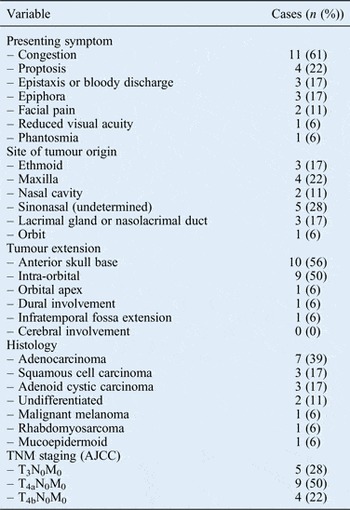
Seventeen of our 18 patients (94 per cent) had primary malignant tumours. One patient had undergone previous surgery for rhabdomyosarcoma. No patients had received previous radiotherapy or chemotherapy. In our cohort, nasal congestion was the primary presenting symptom, followed by proptosis and bloody nasal discharge. A comprehensive list is provided in Table I. Six of these patients had more than one symptom.
Presenting symptoms and pathological features

TNM = tumour–node–metastasis; AJCC = American Joint Committee on Cancer
Three out of seven patients with adenocarcinoma were woodworkers (42.9 per cent). Seven patients (38.9 per cent) had a history of smoking and three patients (16.7 per cent) had a history of alcohol abuse. No patients had a family history of sinonasal malignancy. Seven patients (38.9 per cent) had significant medical co-morbidities, namely hypertension, ischaemic heart disease, diabetes, asthma, chronic obstructive pulmonary disorder, previous cerebrovascular events, thromboembolic disease or a combination of these.
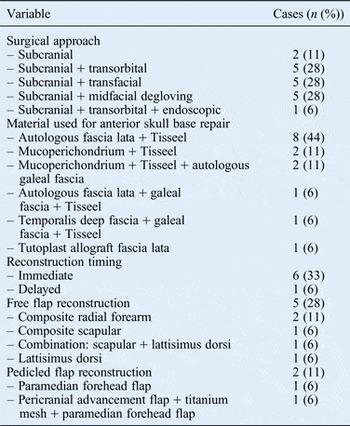
Fifteen cases (83.3 per cent) required a combined procedure for complex, advanced tumours, to allow adequate tumour exposure and en bloc oncological clearance. Details of the combined procedures used are provided in Table II.
Surgical approach and reconstruction methods

Fifteen patients (83.3 per cent) had an intra-operative repair of a small dural tear centred on the olfactory groove. Autologous fascia lata overlay was used in nine cases, secured with Tisseel fibrin glue. This was required in combination with a galeal aponeurotic advancement flap and temporalis fascia underlay in two cases. Other materials used for the repairs included mucoperichondrium harvested from the nasal septum and Tutoplast® allograft fascia lata (Table II).
Seven patients (38.9 per cent) required functional and cosmetic reconstruction of their facial defect. This was carried out during the primary surgery in six cases and was delayed in one case for three weeks to allow for clear surgical margins prior to reconstruction. Free tissue transfer with microvascular anastomosis was the preferred option for reconstruction and was employed in five out of seven cases. Further details are provided in Table II.
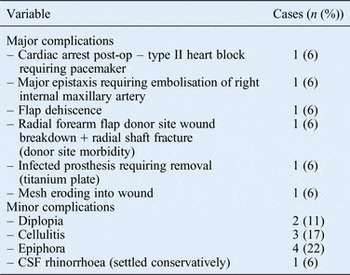
No peri-operative deaths occurred in this series. Mean stay in hospital was 11 days, with a median stay of 8 days (range, 4–54 days). One patient fell to the far right of the mean with a hospital stay of 54 days as a result of cardiorespiratory complications requiring medical treatment. Twelve patients (66.7 per cent) developed a post-operative complication; two of these patients (11.1 per cent) had two or more complications, and seven patients (38.9 per cent) had complications that were transient and showed complete resolution. One patient (5.6 per cent) had a cerebrospinal fluid leak, which spontaneously resolved following 3 days of conservative management. No other central nervous system complications occurred. Table III lists these complications and divides them into major or minor categories. The rate of major complications was 33.3 per cent and for minor complications it was 55.6 per cent.
Complications

Post-op = post-operation; CSF = cerebrospinal fluid
Adenocarcinoma was the most frequently observed tumour, followed by squamous cell carcinoma and then adenoid cystic carcinoma (Table I). Five patients had positive resection margins. The resection margins were clear in six patients. Margin involvement could not be confirmed in the remaining seven patients.
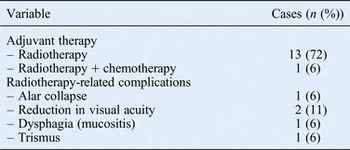
Thirteen patients (72.2 per cent) received adjuvant radiotherapy, and one (5.6 per cent) received a combination of cisplatin-based chemotherapy and radiotherapy. Four patients (22.2 per cent) developed radiotherapy-related complications (Table IV).
Post-operative adjuvant treatment and related complications

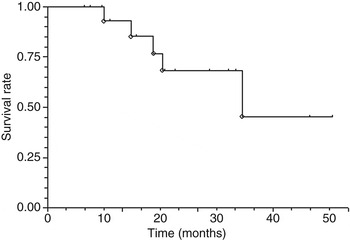
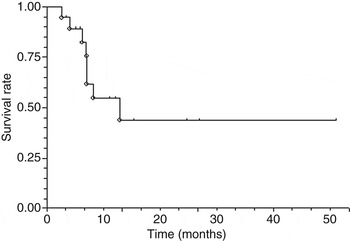
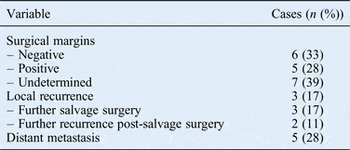
The mean follow-up period was 30 months (range, 2 months to 7 years). Three patients (16.7 per cent) developed a recurrence of their primary tumour following their primary surgery, after a mean duration of 13 months. These patients were offered further salvage surgery. One of these three patients is currently disease-free. Five patients (27.8 per cent) developed distant metastasis of their primary tumour, but remained disease-free at their original site of disease (Table V). Sites of metastases included ribs, spine, scalp, lung and liver. Five-year overall survival and disease-free survival estimates were both 40 per cent (Figures 1 and 2).
Overall survival estimate (Kaplan–Meier analysis).

Disease-free survival estimate (Kaplan–Meier analysis).

Surgical margins, local recurrence and distant metastasis

Discussion
Our series concentrates on stage T3 and T4 sinonasal malignancies resected via the subcranial approach. We believe that it is the largest reported series of its kind in the UK at the time of writing. Our results show a male preponderance, with a male-to-female ratio of 3:1. This is similar to other published series on sinonasal malignancies.Reference Raveh, Turk, Lädrach, Seiler, Godoy and Chen 4 – Reference Ross, Marentette, Moore and Switz 6 Occupational risk factors such as exposure to wood dust may contribute to this, as three of the male patients within our cohort who were diagnosed with adenocarcinoma were furniture makers. Other than adenocarcinoma, common histological subtypes seen within our cohort included squamous cell carcinoma and adenoid cystic carcinoma, once again consistent with other published series from the USA and Western Europe.Reference Pepper, Ward, Lin, Sullivan, Hecht and Marentette 5 , Reference Ross, Marentette, Moore and Switz 6 , Reference Howard, Valerie and William 9 The majority of our patients (72 per cent) presented with advanced stage T4 disease. This may reflect our sampling bias in our cohort; however, our experience suggests that this is a reflection of true practice and that most patients with sinonasal tumours have advanced disease at primary presentation.
We report no peri-operative deaths. This is in contrast to the published peri-operative mortality rates of 2–7 per cent associated with a standard craniofacial resection. Ketcham et al. reported a 7 per cent operative mortality in their cohort of 21 patients in 1966, where all mortalities were caused by post-operative meningitis.Reference Ketcham, Hoye, Van Buren, Johnson and Smith 10 Thirty years later, in 1996, Deschler and his team reported only a 2 per cent mortality rate in their series of 49 craniofacial resections;Reference Deschler, Gutin, Mamelak, McDermott and Kaplan 11 this outcome was perhaps secondary to improvements relating to surgical technique, surgical sepsis, anaesthesia and antibiotics. The findings of published subcranial craniofacial resection series reflect our low mortality rate, although direct comparisons are difficult as those studies involved heterogeneous groups of patients, including those with benign disease and low grade and stage tumours.Reference Deschler, Gutin, Mamelak, McDermott and Kaplan 11 , Reference Cantu, Solero, Miceli, Mattana, Riccio and Colombo 12
Our overall complication rate was 67 per cent. This included minor complications such as soft tissue infections that resolved with antibiotic therapy, transient double vision and epiphora. Owing to the advanced stage of presentation, half of our patients (50 per cent) had large surgical resections, necessitating tissue reconstruction. Our major complication rate was 33 per cent; two-thirds of these complications were related to the reconstruction. One patient went into cardiac asystole intra-operatively, which was fortunately reversed. This was triggered whilst resecting the retro-orbital tissues (despite local anaesthetic infiltration). Another patient suffered significant epistaxis post-operatively, which was managed by radiological embolisation of the right internal maxillary artery. One patient developed a neurological complication (6 per cent), namely transient cerebrospinal fluid rhinorrhoea. This resolved with conservative management within 3 days.
Our overall complication rates are similar to those published by other units: a complication rate of 46 per cent has been reported for those with malignant tumours being managed by a standard craniofacial resection,Reference Deschler, Gutin, Mamelak, McDermott and Kaplan 11 and 37–46 per cent for those undergoing a more conservative subcranial approach for tumour removal.Reference Pepper, Ward, Lin, Sullivan, Hecht and Marentette 5 , Reference Fliss, Abergel, Cavel, Margalit and Gil 8 However, our rate of neurological complications is substantially lower than other subcranial series, with Fliss et al.Reference Fliss, Abergel, Cavel, Margalit and Gil 8 and Pepper et al.Reference Pepper, Ward, Lin, Sullivan, Hecht and Marentette 5 reporting rates as high as 19–21 per cent.
The prognosis for advanced sinonasal malignancy remains poor. Our cohort had five-year overall survival and disease-free estimates of 40 per cent. Both estimates are similar because of the limited number of patients and follow-up period available. A multi-institutional study by Ganly et al. reported a five-year survival estimate of 53.3 per cent and a five-year recurrence-free survival rate of 45.8 per cent for patients undergoing standard craniofacial resection.Reference Ganly, Patel, Singh, Kraus, Bridger and Cantu 3 Another similar large mono-institutional series of 366 patients reported a 5-year survival rate of 59 per cent; the prognosis for those with intra-orbital involvement was much worse, with a 5-year survival estimate of 30 per cent.Reference Cantu, Solero, Miceli, Mattana, Riccio and Colombo 12 This is consistent with our series, in which nine of our patients had intra-orbital involvement (50 per cent), lowering the overall five-year survival estimate to 40 per cent. In our series, six of the nine patients with intra-orbital involvement (67 per cent) developed local recurrence or distant metastasis.
Technical innovation and technological advancement have led to expansion in the use of functional endoscopic sinus surgery for the treatment of sinonasal tumours that involve the anterior skull base. Direct comparison with craniofacial resections is difficult as there is a biased patient selection. Nevertheless, reported complication rates from an endoscopic approach ranged from 5.6 to 11 per cent, with better recurrence and survival rates.Reference Suh, Ramakrishnan, Chi, Palmer and Chiu 13 , Reference Hanna, DeMonte, Ibrahim, Roberts, Levine and Kupferman 14 Hence, the endoscopic approach must form part of a surgeon's armamentarium, with an increasing number of cases being treated via a combination of techniques.
-
• Resection of advanced craniofacial malignancy with skull base extension remains technically challenging
-
• The subcranial approach is safe and effective compared to a transfacial-transcranial approach, and can be used with other procedures
-
• There were no peri-operative deaths in our cohort of 18 patients and only 1 neurological complication (transient cerebrospinal fluid leak)
-
• Patient prognosis remains poor, with five-year overall survival and disease-free survival estimates of 40 per cent
-
• Those with intra-orbital involvement (9 out of 18 cases in our cohort) have a worse disease outcome
In the absence of orbital or facial bone involvement, we have employed the subcranial approach. This has been used alone to access both superior (skull base) and inferior (sinonasal) aspects of the tumour, or combined with a midfacial degloving approach for improved inferior access. Currently, an endoscopic approach is now used instead of the midfacial degloving approach, as the latter is not required or particularly advantageous in most cases if operating endoscopically. Whether or not a completely endoscopic approach should replace the subcranial approach entirely needs clarification, but our experience suggests that the complications specifically relating to subcranial access (i.e. removal of frontonasal bone flap and replacement) are minimal, and therefore any oncological advantage it may provide is probably worthwhile.
Conclusion
The subcranial approach has been shown to be safe and effective for exposing sinonasal malignancies with skull base extension. It can be combined with other approaches such as endoscopic access, a midfacial degloving procedure, orbital exenteration or other transfacial approaches to allow exposure of advanced tumours. Complete excision of the tumour mass en bloc is possible, even with extension to the infratemporal fossa or orbital apex. Neurological complications and operative mortalities are rare compared to resection via the traditional transfacial-transcranial route.