Introduction
In this article, I consider two late works by Robert Schumann: the Lied ‘Meine Rose’ Op. 90 No. 2 (1850) and the Fantasiestück Op. 73 No. 1 for clarinet and piano (1849). I analyse the works in the light of nineteenth-century developments in approaches to the treatment of tonality. Both ‘Meine Rose’ and the Fantasiestück are miniatures and can thus be linked with music-making in private social gatherings – indeed, in the manuscript of the three Fantasiestücke Schumann called the work Soirée-Stücke, which draws direct connections to soirées organized in private salons.
Although representing arguably the two main genres performed in salons – instrumental miniatures and Lieder – the two Schumann works can also be associated with some rather subtle philosophical and aesthetic ideas of early romanticism that transcend the bourgeois norms generally considered characteristic of the salon. I challenge the idea that music performed in salons would necessarily have been lightweight; on the contrary, both of the works analysed include musical features as subtle as anything that can be found in contemporaneous music, of any genre. Schumann seems to have been aware of the duality between the lightweight quality of the salon as a performance venue and the subtlety of his miniatures. The renaming of the Soirée-Stücke as Fantasiestücke reflects this duality; while the earlier name refers to salons and bourgeois musical activities, the later title can be associated with the romantic ideas of E.T.A. Hoffmann, as exemplified by his collection of writings entitled Fantasiestücke in Callot's Maniere.
My choice of the two works is based on musical as well as aesthetic factors. Musically, they both avoid confirming their main tonic in a definitive manner. Both works thus share a permeating air of instability, a feature we can link to early nineteenth-century aesthetics of longing. Most importantly, the music's inability to secure a firm tonal centre can be associated with those aesthetics. In the same way that unsuccessful attempts to secure the tonic underlie the two Schumann works, so contemporaneous aesthetics saw human existence as being governed by unfulfilled longing. I will argue that in ‘Meine Rose’ the romantic ideology can be connected to transcendental qualities associated with nature, while the Fantasiestück can be associated more generally with infinity and longing. In both works, it is precisely Schumann's special treatment of the tonic, drastically departing from classical conventions, that justifies connecting the works with these aesthetic issues.Footnote 1
The classical tradition had emphasized the significance of the tonic as well as the need to confirm it unequivocally. In his Die Kunst des reinen Satzes in der Musik (1771–79), Johann Philipp Kirnberger, for example, argues that the tonic must be clearly established both at the piece's beginning and at its end. Describing the opening of a musical work, he notes that ‘the main key that has been chosen must be completely established’; likewise, one must ‘end the entire piece with a cadence in the main key’.Footnote 2
Cadences, like the one that Kirnberger expects to end a piece, were considered to be of primary importance, and they provided the foundation for phrase structure and musical form. In his Versuch einer Anleitung zur Composition (1782–93), Heinrich Christoph Koch stresses the significance of cadential punctuation, making a detailed distinction among various kinds of punctuating gestures that occur at different hierarchical levels:
Certain more or less noticeable resting points are generally necessary in speech and thus also in the products of those fine arts which attain their goal through speech, namely poetry and rhetoric, if the subject that they present is to be comprehensible. Such resting points are just as necessary in melody if it is to affect our feeling. … By means of these more or less noticeable resting points, the products of these fine arts can be broken up into larger and smaller sections. … Just as in speech, the melody of a composition can be broken up into periods by means of analogous resting points, and these, again, into single phrases and melodic segments.Footnote 3
The perfect authentic cadence was primary among these resting points, as it unequivocally confirms the tonic key (or any other key) and signifies the closure of larger formal units. Without a perfect authentic cadence there could be no sense of closure, a point that Anton Reicha emphasized as late as 1814 in his Traité de melodie: ‘The whole must be called a period, because it has a perfectly defined ending which evokes a feeling of fulfillment. … [The period] always ends, without exception, with a perfect cadence’.Footnote 4
In the nineteenth century, composers started to challenge the stability of the tonic key as well as the need to end independent musical units in a perfect authentic cadence. As is well known, this process reached its peak in works like Richard Wagner's Tristan und Isolde (1857–1859), the harmonic language of which is characterized partly by omission of prepared cadences, together with the consequential tonal instability. Among composers of the second quarter of the nineteenth century, Robert Schumann was particularly inventive in obscuring the sense of the governing tonal centre, as well as in avoiding cadential arrivals as markers of formal boundaries.
The fourth piece of Schumann's Kreisleriana Op. 16 (1838) clearly presents such features. The work is in a ternary form, but none of its formal units ends in an unequivocal cadence.Footnote 5 Moreover, the piece has no single main key or even clear tonal centres; it begins on what sounds like a dominant of B-flat major and ends on what sounds like a dominant of G minor, and there are no perfect authentic cadences. The opening A section ends on a low B@ (bar 11) sounded alone – a pitch that might suggest as its function the root of a B@ major triad, or the bass of a G minor six-three chord, or even a passing tone within a bass progression extending the dominant of G minor, whose goal, a bass-pitch A, has been elided. Throughout the B section, the music oscillates between the keys of G minor and B-flat major, neither of which is confirmed – indeed, the section ends on a diminished seventh chord (bar 23) that could function, depending on its enharmonic spelling, as a leading-tone seventh chord of either G minor or B-flat major. Finally, the A′ section ends on an open fifth D–A (or, in the revised edition of 1850, a D major triad), which hints at the function of a dominant of G minor. In sum, the work includes neither one global tonic key nor any tonal closure, both of these being features that authors in preceding generations saw as principal foundations of musical works. John Daverio has used the term ‘incomprehensibility topos’ when referring to Schumann's ‘discontinuous mode of utterance’.Footnote 6 The fourth piece of Kreisleriana is a clear representative of this topos.Footnote 7
While both ‘Meine Rose’ and the Fantasiestück Op. 73 No. 1 are less extreme than the fourth piece of Kreisleriana, they manifest the questioning of the tonic's status that is reflected in the earlier piece. Both works begin and end in the tonic, but the role of their initial and concluding tonics is far from straightforward. In addition, in both pieces the tonal excursions of the ternary form's middle section grow out of the opening formal section's difficulties in securing the tonic.
My analytical commentary will approach the music from two perspectives: relatively straightforward commentary on local harmony and form, on the one hand, and Schenkerian analysis, on the other. I use Schenkerian analysis mainly to deepen the observations made of local harmony and form, as well as to clarify the global tonal structure. Those readers not familiar with Schenkerian theory should be able to follow my reasoning, even without consulting the voice-leading graphs and commentaries thereto.
‘Meine Rose’
‘Meine Rose’ is in a ternary form, with all three sections consisting, quite unusually, of the same thematic material; thus the form may be schematized as A–A’–A’’. The contrasting quality of the middle A’ section stems from harmony; while the framing A and A’’ sections (bars 1–14 and 37–54, respectively) are in the home key, B-flat major, the contrasting A’ section (bars 14–28) is in the remote G-flat major, a tonicized @VI. A retransition (bars 29–36), prolonging the home-key dominant, leads the music from the A’ section's @VI to the A’’ section's tonic.
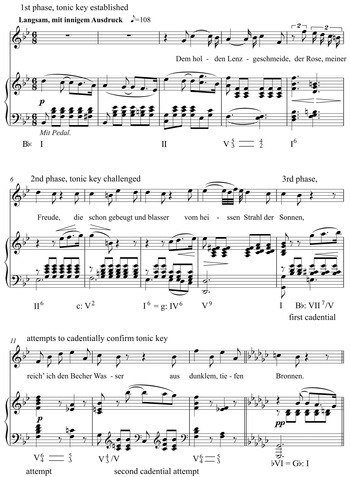
I have divided the opening A section into three phases (Ex. 1).Footnote 8 The first phase (bars 1–5) is harmonically straightforward: its first four-bar segment establishes the tonic B-flat major through sounding the tonic, a pre-dominant II, and the dominant, respectively, while bar 5 transforms the opening tonic into a six-three harmony. In the second phase (bars 6–10) the harmonic structure becomes more complex. The pre-dominant II6 of bar 6 is tonicized, so that the unambiguous governing of the tonic key is fleetingly called into doubt. After the ensuing brief tonicization of G minor, which further obscures the sense of a tonal centre, the third phase (bars 10–14) brings back the untroubled tonic key. The third phase consists of two cadential attempts, neither of which is successful. The second attempt ends in a deceptive cadence, whose concluding @VI is retrospectively reinterpreted as the tonic of the A’ section's G-flat major. The A section thus ends without succeeding to confirm the tonic key cadentially.Footnote 9
Schumann, ‘Meine Rose’, bars 1–14

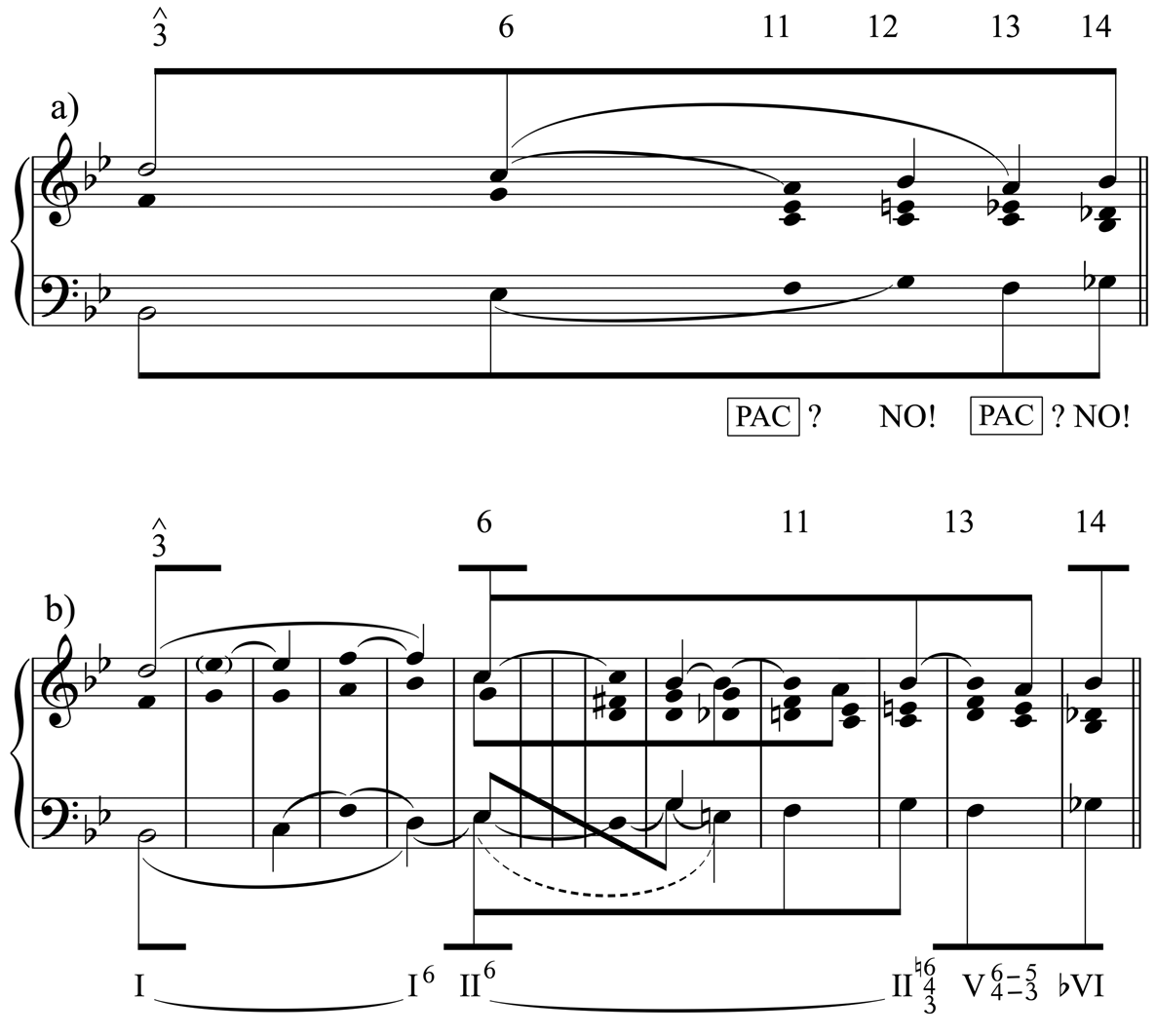
Example 2 shows the tonal structure of the A section. In the middleground, the harmonies prepare a strong cadential dominant. In bar 6 the opening tonic (bars 1–5) is followed by a II6, which is twice transformed into a secondary dominant – first in bar 10 into a VII7/V and then in bar 12 into a V43/V. As a result, the dominant receives, in both of the cadential attempts, a strong pre-dominant preparation – a preparation that enhances the listener's expectations of a cadence. Yet both times (bars 11 and 13) the dominant bass is hierarchically subordinate to the 6̂ (bar 12) or @6̂ (bar 14) that follows it. In all, the A section leaves the overall impression of a tonal failure (which does not mean, of course, expressive or musical deficiency) – the music aims at a confirming gesture that never arrives.
Schumann, ‘Meine Rose’, bars 1–14, analytical sketch

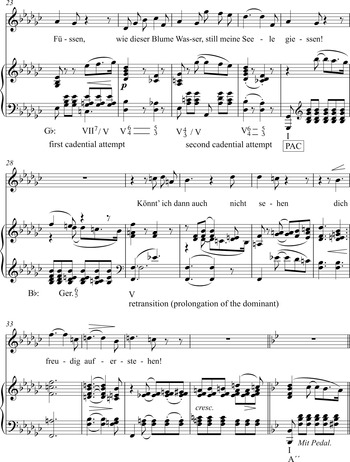
The A’ section repeats the music of the opening section with only small changes of figuration, so that we hear the three phases over again, this time in the remote key of G-flat major. Yet there is one highly significant difference between the two sections (Ex. 3): at the end of the A’ section, the third phase's second cadential attempt is successful, leading to a perfect authentic cadence (bar 27). The situation is noteworthy. We have seen that the song's opening section is unable to confirm the main key cadentially, thus to sustain the work's most stable centre; the ensuing A’ section, by contrast, manages to confirm @VI, a chord that, owing to its tonal remoteness in the global framework, is an unstable harmony. Moreover, Schumann almost immediately transforms the local G-flat major tonic into a German augmented sixth chord, a sonority that also locally challenges the stability of the @VI. The augmented sixth chord then leads to the home-key dominant, prolonged in the retransition. In sum, we hear in bar 27 a perfect authentic cadence that initially suggests tonal confirmation, but this cadence occurs within a harmonic context that globally denies full stability. The work thus still seeks a cadential confirmation that would be a completely satisfying closure.
Schumann, ‘Meine Rose’, bars 23–37

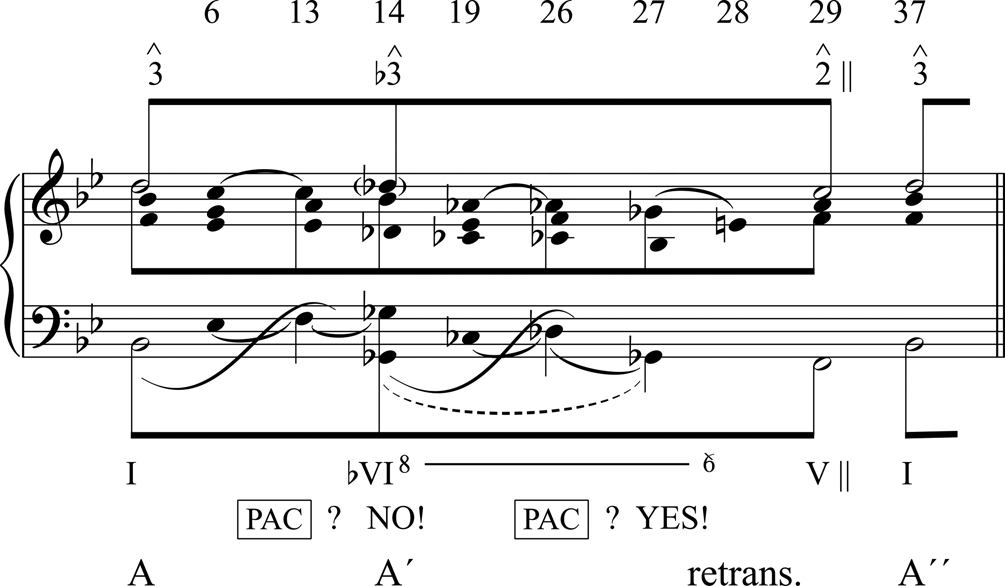
Ex. 4 shows the role that the cadentially confirmed @VI has in the global structure. At the deepest levels, the dominant that arrives in bar 29 concludes the first branch of the interrupted structure; that is, the largest-scale framework is a top-voice descent 3̂–2̂, supported by a I–V progression. Prior to the arrival at the 2̂, the uppermost voice descends from the top voice D to an inner voice F; when the concluding F arrives, the 2̂ of the interruption is sounded above it. The @VI is thus subordinate to the V of the retransition, a feature that further challenges the concluding quality of the G-flat major perfect authentic cadence in bar 27.
Schumann, ‘Meine Rose’, bars 1–37, analytical sketch

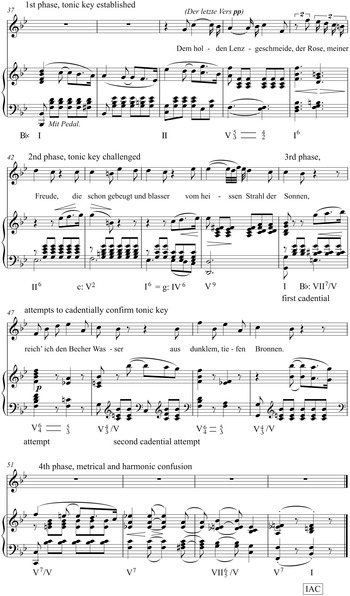
As ‘Meine Rose’ has so far been unable to confirm the tonic key cadentially, we would expect the song's final A’’ section to provide the longed-for structural closure. But Schumann's music has the opposite effect (Ex. 5). The music exactly repeats the opening material up to bar 49, the second cadential attempt of the section's third phase. In the ensuing bar, the singer ends on a B@, a 1̂ that could function as a structural conclusion. A deceptive cadence again avoids a cadential arrival, however, so that the singer starts his concluding silence before a tonal closure has been reached. It is thus the task of the piano alone to bring the song to a structural conclusion. No clear conclusion arrives, however; rather, the A’’ section's fourth phase, not heard in the two preceding sections, seems to lose metrical and harmonic stability. As a result, even though the song ends in a V7–I progression – with an imperfect rather than perfect authentic cadence, to be sure – the unstable expression and the silence of the singer hardly provide an unequivocal closure for the song's drama. That is, the cadential closure in the tonic that the music has so many times prepared never arrives. As Ex. 6 shows, the song's ending provides a syntactical closure for the background structure, but this closure is so fleeting and indeterminate that it leaves the musical drama unfinished. The dramatic process that the song suggests thus remains, in some significant sense, uncompleted throughout the entire work.Footnote 10
Schumann, ‘Meine Rose’, bars 37–54

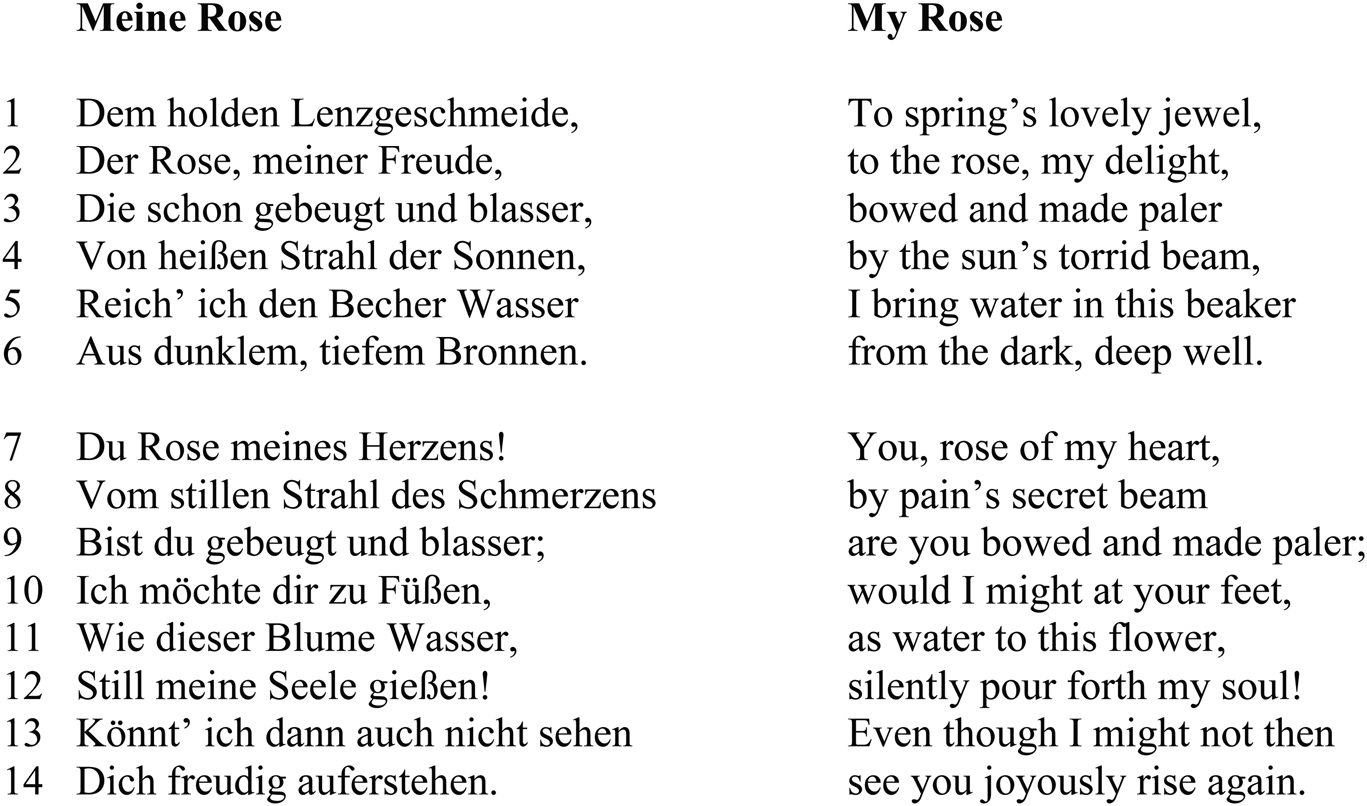
These musical features can be associated with Nikolaus Lenau's poem, given in Figure 1.Footnote 11 The poem consists of two stanzas of unequal length (six and eight lines, respectively). The first stanza describes a rose, bowing and paling under the hot sun. The poem's speaker tries to make the rose – the ‘spring's lovely jewel’ – recover by bringing it water. The second stanza compares the speaker's emotions with the condition of the rose. The speaker's heart, too, is bowed and pale, and he hopes that he might find happiness through pouring out his soul to the flower, just as water was poured for the flower in the first stanza. The final two lines remind the speaker that the outcome is uncertain.Footnote 12
Nikolaus Lenau, `Meine Rose'

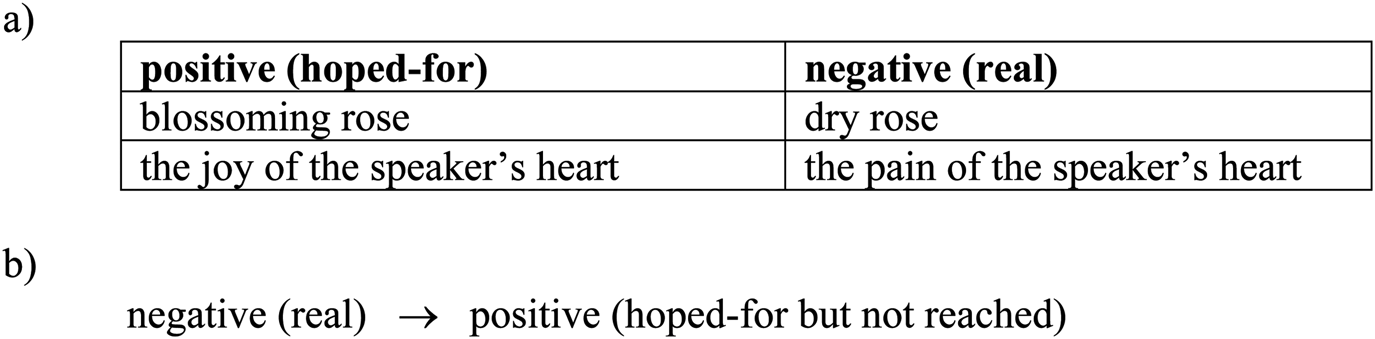
As Figure 2a shows, underlying the poem's concrete imagery is a binary opposition, whose one side (blossoming rose and the joy of the speaker's heart) represents a positive, hoped-for state, while the other side (dry rose and the pain of the speaker's heart) represents the negative, real state of affairs. The poem also implies an uncompleted and uncertain temporal trajectory (Fig. 2b), which would move, the speaker hopes, from present misery (dry rose and heart's pain) into future happiness (blossoming rose and heart's joy).
Nikolaus Lenau, ‘Meine Rose', (a) binary opposition underlying the poem’s concrete imagery and (b) the implied temporal trajectory

Both the juxtaposition of the two states (Fig. 2a) and the implied trajectory (Fig. 2b) are reflected in Schumann's music. Each of the song's three formal sections consists of three phases, the first of which, tonally stable, sets lines 1–2 (A and A’’) or lines 7–8 (A’). Lines 1–2 describe the rose as an undisturbed spring's jewel, musically mirrored by the stable and unproblematic tonal environment. (In the A’ section, line 8 introduces shadows already in the first phase, thus anticipating the ensuing more tragic music.) The second phases set lines 3–4 (A and A’’) or lines 9–10 (A’). Now the tonicizations of minor-mode II and VI reflect the tragic tone of the poetic lines. The settings of the ensuing lines 5–6 (A and A’’) and 11–12 (A’) differ from each other. In the A and A’’ sections the prepared tonic cadence never arrives, which suggests that the speaker acknowledges the uncertainty as to whether his water helps the rose to recover. In the A’ section, by contrast, we do hear a perfect authentic cadence in the local key of G-flat major, but the remoteness of the key creates an air of unreality. Poetically, the speaker wishes to believe that his hopes might be fulfilled (the perfect authentic cadence), knowing that this is uncertain (the dream-like key of G-flat major). The retransition sets the poem's final lines 13–14 that remind the speaker of the reality; likewise, the music here brings back the tonic key after the A’ section's @VI. The transformation of the @VI into a German augmented sixth chord enhances the notion that reality (home-key dominant) here replaces illusion (@VI).
The song's cadential structure can be seen to mirror the temporal layer of Figure 2b. In the same way that the speaker anticipates what may happen in the future, the music prepares a cadential confirmation of the tonic. But the poem does not reach the anticipated future; likewise, the prepared cadence never materializes. In all, we can interpret some basic musico-poetic associations between the music's tonal structure and the poem's concrete imagery (the pallid rose and the unhappy speaker paired with the hope of a better time, whose arrival is uncertain). A cadentially confirmed tonic might be seen to represent the better time. As such confirmation never arrives, the speaker cannot tell if the better time will come. Yet its vision can be perceived in the A’ section's perfect authentic cadence in the remote, dream-like G-flat major.
Lenau's poem can be interpreted also in a context that takes romantic ideas of nature as its starting point – the speaker pairs his feelings with the rose, after all. This shifts the foundation of musico-poetic associations from the concrete imagery discussed above into more abstract, even ineffable layers. Early romantic aesthetics often stated that the human spirit attempts to reach unification with nature, which symbolized a kind of higher state of being. Friedrich Schiller, for example, noted in Über naive und sentimentalische Dichtung (1795), when referring to creatures of nature, that ‘they are what we should once again become. We were nature just as they, and our culture, by means of reason and freedom, should lead us back to nature.’Footnote 13 Some authors saw such a unification as the highest fulfilment of love, which draws a further link to Lenau's poem, where the speaker aspires to a happier future through a reference to nature. In his novel Lucinde (1799), Friedrich Schlegel described the bliss that the novel's lovers Julius and Lucinde would reach through dying together: ‘There will come a time when the two of us will perceive in a single spirit that we are blossoms of a single plant or petals of a single flower’.Footnote 14
This striving towards nature was one of the foundations of the romantic yearning (Sehnsucht). Nature was seen to represent the absolute (the object) that the individual spirit (the subject) tries to attain. This attempt at a reconciliation was particularly evident in Schelling's philosophy. As Helmut J. Schneider has pointed out, for Schelling
the human intellect remains split from a nature reified as its foreign Other, unless reason attains to that higher stage of knowing which is the recognition that the objective world is its own work – that is, a product of spirit. Schelling calls this final stage of a reconciliation between the external and the internal, to which all knowledge and experience of the spirit aspire, ‘intellectual intuition’.Footnote 15
Through works of art, Schelling argues, we can attempt to break the barrier between the finite (subject) and the infinite (object).
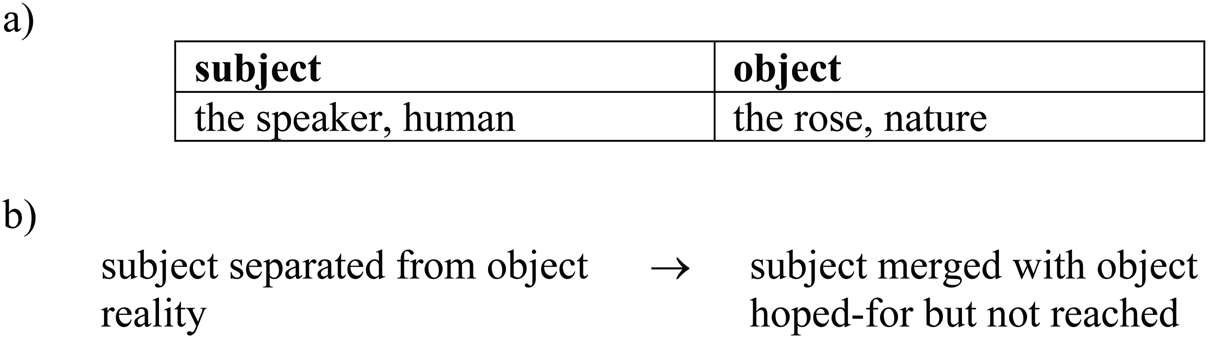
Underlying the concrete imagery of Lenau's ‘Meine Rose’ we can interpret a layer addressing the juxtaposition of subject and object (Fig. 3) – the poem's speaker represents the human spirit and subject, the rose, nature and object. The poem's aspiration is now not just a happier future, as in the reading offered above, but rather a more metaphysical unification of the speaker (the subject) with nature and the infinite (the object). In the second stanza (lines 10–12), the speaker indeed does utter his wish to become one with nature, to relinquish his personal soul to the rose: ‘I would at your feet, / as water to this flower, / silently pour forth my soul!’
Nikolaus Lenau, ‘Meine Rose’, (a) opposition of subject and object and (b) the attempted temporal trajectory

From the musico-poetic perspective, this idea is reflected in the two guises of the tonic. The clearly expressed tonic key in the first phases of the song's formal sections can be interpreted as representing the current state of affairs – the separation of subject and object, the normal human condition from which our spirit aspires to attain transcendence through the merging of subject and object. The second phase, with its more tragic expression, indicates the negative quality of the separation. The third phases in the A and A’’ sections, with their unsuccessful attempts to confirm the tonic cadentially, are significant. As the romantic philosophers noted, the merging of subject and object is difficult to achieve, and, if reached, would transcend our conceptual knowledge. Likewise, the music is unable to reach a cadentially confirmed tonic, even though it announces its aspiration to such a tonic through the many cadential attempts. The cadential closure at the end of the A’ section, in turn, adumbrates such merging, but its remote key makes it a vague vision rather than a solid attainment.
My second interpretation is much more speculative than the first. Yet I find it justifiable: the poem's underlying layer and the music can both be understood to announce a goal that never arrives. This interpretation locates the Lied's musico-poetic associations in a historical context which recognizes the fundamentally ineffable quality of art. As it transcends concrete concepts, the merging of subject and object can be approached only, as Schelling emphasized, through ‘intellectual intuition’. Such a non-conceptual intuition can provide a foundation for the analysis of instrumental music as well as vocal music. Thus, in moving on to the interpretation of an instrumental work, Schumann's Fantasiestück Op. 73 No. 1, we will be able to base our reading on a pairing of the finite subject with the infinite object that the subject attempts to attain.
Fantasiestück Op. 73 No. 1
In his famous review of Beethoven's Fifth Symphony, in 1810, E.T.A. Hoffmann noted that longing is a characteristic aspect of romantic instrumental music: ‘When music is spoken of as an independent art the term can properly apply only to instrumental music, which scorns all aid, all admixture of other arts, and gives pure expression to its own peculiar artistic nature.’Footnote 16 This ‘peculiar artistic nature’ was most clearly audible in Beethoven's music, which, Hoffmann states, is the most romantic of all music: ‘Beethoven's music sets in motion the machinery of awe, of fear, of terror, of pain, and awakens that infinite yearning which is the essence of romanticism. Beethoven is a purely romantic, and therefore truly musical, composer.’Footnote 17
Hoffmann's comment emphasizes the significance of yearning as a symbol of a process that aims at a goal whose attainment is difficult, if not impossible. The idea of an uncompleted process is important for romantic aesthetics generally, not only for romantic views on music. Friedrich Schlegel stressed the process-like nature of romantic poetry in his Athenaeum Fragment No. 116 (1798–1800):
Other kinds of poetry are finished and are now capable of being fully analyzed. The romantic kind of poetry is still in the state of becoming; that, in fact, is its real essence: that it should forever be becoming and never be perfected. It can be exhausted by no theory and only a divinatory criticism would dare try to characterize its ideal. It alone is infinite, just as it alone is free.Footnote 18
Romantic poetry thus never reaches a final goal, since it is constantly in the state of becoming.
I believe that the Fantasiestück Op. 73 No. 1 – in particular, the role of the tonic in this piece – can be associated with yearning, a quality Hoffmann saw as a defining feature of romanticism, as well as with uncompleted processes, an aspect Schlegel connected with romantic poetry. Its form is ternary (ABA’ with coda), but the boundaries between the sections are blurred, which affects the role given to the tonic. The role of the tonic is quite complex from the very beginning, even though the work's opening phrase (bars 1–6) at first seems to introduce a straightforward and unproblematic tonic (Ex. 7): the tonic both begins and ends the phrase, and the II6 and V7 seem to confirm it unequivocally. A closer look at the phrase structure and metre indicates, however, that the situation is more complex than this (Ex. 8). The uncertainty primarily concerns the function of the A minor triad in bar 1. First of all, in the middle of the bar a 5–6 progression transforms the chord into the first inversion of an F major triad (E–F motion will later turn out to be a highly significant motivic component in the piece). Thus, on the surface the A minor triad is almost immediately displaced. More importantly, the clarinet's upbeat preparation for the B in bar 2 makes the onset of the second bar a local goal of motion. Therefore, from the perspective of phrase structure, I interpret bar 1 as a thematic introduction, and in the hypermetrical structure as an elongated upbeat.Footnote 19 That is, both phrase-structurally and metrically bar 1 represents the before-the-beginning function that precedes the functional onset of the phrase and the hypermeasure in bar 2. The preparatory quality of the opening tonic might even justify the interpretation shown in Ex. 9, where the opening A minor triad is taken as an apparent tonic, and the structural I arrives only in bar 6.
Schumann, ‘Meine Rose’, bars 37–54, analytical sketch

Schumann, Fantasiestück Op. 73 No. 1, bars 1–6

Schumann, Fantasiestück Op. 73 No. 1, bars 1–6, analytical sketch

In the surface rhetoric, the dominant chord prolonged in bars 3–5 is much more strongly emphasized than the tonic triad (Ex. 8b). In addition to the subordinate, preparatory quality of the tonic in bar 1, the rather fleeting air of the tonic chord is enhanced by the way in which the I returns in bar 6. This tonic is weakened by three factors: first, a 5–6 progression again transforms the chord into an F major triad; second, the preceding dominant (bars 3–5) is resolved to the tonic via a stepwise bass progression rather than through a cadential gesture (Ex. 8);Footnote 20 third, the phrase starting in bar 6 soon leaves the tonic key (bar 8) and modulates towards D minor. In all, the role of the opening tonic is multi-layered. On the one hand, the key of A minor governs the music at the beginning without any doubt; on the other hand, the A minor triad does not occur as an unequivocal harmonic centre, and A minor is not cadentially confirmed. Thus the strength and stability of the tonic are challenged at the start, and the work's onset suggests a beginning in medias res rather than with a statement of an unequivocal opening tonic. Uncertainty concerning the strength of the tonic will be an issue throughout the piece.
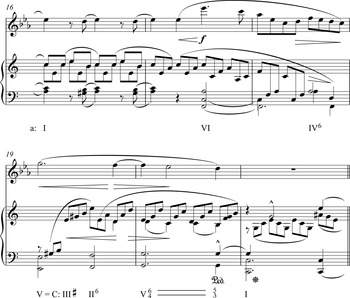
Towards the end of the A section, the music starts to hark back to the tonic key (Ex. 10). After the tonicized D minor (bar 10) and F major (bar 12), the tonic key returns in bar 16, and a strong half-cadential dominant arrives in bar 19, reached through a pre-dominant (bars 17–18) that exhibits the work's registral and rhetorical high point so far. But when studied in a larger context, the function of the half cadence in bar 19, as well as the role of the tonic key at the end of the A section, is ambiguous. Even though the initial impression of the E major chord in bar 19 is as an unequivocal dominant of A minor, the continuation of the music suggests a different function for the chord: it begins a cadential progression tonicizing C major. Thus it functions, from a retrospective point of view, as a chromatically altered mediant in this key. That is, the function of the E major chord differs when studied, on the one hand, in the context provided by the preceding music, and, on the other, in the context of the music that follows.Footnote 21
Schumann, Fantasiestück Op. 73 No. 1, bars 1–6, alternative interpretation

Schumann, Fantasiestück Op. 73 No. 1, bars 16–21

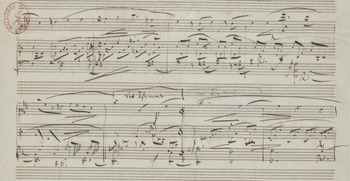
Schumann's manuscript suggests that this ambiguity is intentional (Ex. 11). His initial plan was to have a repetition after bar 19, in which case the E major chord in the first ending would unequivocally function as a main-key dominant. The omission of the repetition, however, introduces an ultimately unresolved ambiguity. This omission also affects the clarity of the formal organization, and formally bars 19–21 represent a kind of grey area. The downbeat of bar 19 sounds like a conclusion of the A section, but the concluding quality is immediately challenged by the harmonic reinterpretation of the chord as a chromatically modified mediant in C major. Only with the arrival at the C major chord in bar 21 do we sense that the contrasting B section really starts. But even the clarity of this C major sonority is somewhat downplayed; the top voice omits the C that both the clarinet and the uppermost voice of the piano have prepared.
Schumann, Soirée-Stück No. 1, bars 14–20, autograph (Paris, Bibliothèque Nationale)

The end of the A section is quite unsettled also in regard to the large-scale tonal structure, and the A minor that closes the section is an apparent key only (Ex. 12). The dominant of bar 19 is a goal of a deliberate middleground motion (I–IV–V), so that when it arrives, it suggests, structurally, the function of a deep-level dominant. The subsequent events deny this function, however, and the chord is reinterpreted as a sonority built on the upper third above the forthcoming bass-pitch C, the root of a mediant in the main key. The music thus downplays the role of the key-defining dominant sonority, a feature that introduces in the middleground structure, too, the vagueness of the tonic that we have encountered in the foreground.
The onset of the A’ section is thematically clear, signalled by the return of the opening material in bar 37 (Ex. 13). But from the harmonic perspective, the situation is again more complex. The thematic recapitulation is aligned with the arrival at the dominant chord, which concludes the first branch of the interrupted deep-level structure (Ex. 12). That is, because the conclusion of a tonal process is aligned with the onset of a thematic process, the concluding and initiating functions occur at the same time. And as the thematic initiation is not underpinned by a tonic sonority, the structural I is heard, in the A’ section, only very fleetingly in bar 42. If the tonic chord was only weakly articulated at the piece's beginning, it is now utterly downplayed.
Schumann, Fantasiestück Op. 73 No. 1, bars 1–42, analytical sketch

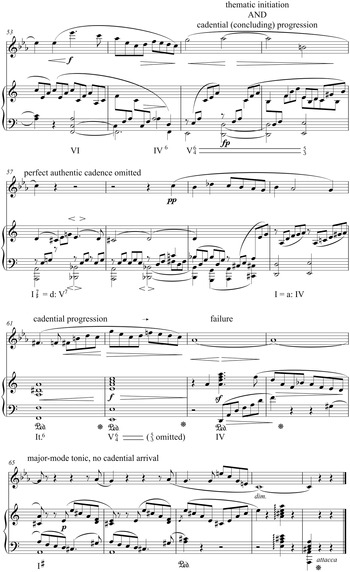
The most powerful downplaying of the tonic occurs at the end of the piece (Ex. 14). At the end of the A’ section the music begins to prepare a closing cadence that might, finally, both confirm the tonic cadentially and give the tonic sonority time to be properly established. This does not happen, however. When the coda starts in bar 57, the expected tonic triad is replaced by a dominant seventh chord on A. Because the beginning of the coda tonicizes D minor, the dominant seventh-type chord of bar 57 can be understood both as a modified tonic and as a dominant of D minor, an ambiguous situation that challenges the stability of the tonic.Footnote 22 The thematic material further calls into question the impression of bar 57 as an arrival (Exx. 14 and 15b). With an upbeat to bar 56, the piano starts what one assumes might be a sentential unit; thus bar 57 occurs within an initiating phase that has already started.
Schumann, Fantasiestück Op. 73 No. 1, bars 33–42

But also the significance of the tonicized D minor is called into question (Ex. 14). In bar 61 the D minor triad is transformed into an Italian augmented sixth chord; thus, retrospectively, the D minor chord turns out to be a subdominant of A minor – a role that this chord has had at deeper levels throughout. Bar 62 suggests the function of a cadential six-four chord, so we assume that the music might finally reach a strong tonic cadence. Once more, however, this expectation fails. The six-four sonority is not resolved into a five-three chord, but rather moves directly to a D minor triad. As a result, the six-four chord is a passing harmony, not a cadential sonority (Ex. 15b), and what one assumes to be a cadential temporal function is transformed into a codetta. A major-mode tonic triad arrives in bar 65, but this is not reached through a cadential dominant; thus the piece ends without exhibiting one single authentic cadence in the tonic.Footnote 23 As in ‘Meine Rose’, so also in the Fantasiestück the deep-level structure reaches a closure (Ex. 15a), but this closure is invested, as we have seen, with numerous local factors that create instability. That is, the musical goal remains, in quite a concrete sense, outside the reach of the music, the structural closure notwithstanding.
Schumann, Fantasiestück Op. 73 No. 1, bars 53–69

Schumann, Fantasiestück Op. 73 No. 1, bars 55–69, analytical sketch

We can associate the attempt to reach a cadentially confirmed tonic, the avoidance of locally emphasized tonic triads, and the abundance of tonally uncertain features in this piece with the ideas of romantic aesthetics discussed earlier – in particular, with the unfulfilled yearning that E.T.A. Hoffmann wrote about. The very fact that the centre of the tonal framework, the tonic triad, is never stated unequivocally creates a sense of yearning – the music aims at stability, without ever properly reaching it. As the ending provides no closure, we can understand that the yearning still continues when the piece finishes. The major triad at the end, in turn, suggests that the continuing yearning is fundamentally positive. The idea of musical longing extending beyond the piece's end reflects Friedrich Schlegel's view of romantic poetry, whose defining feature is that it ‘is still in the state of becoming’.Footnote 24
Epilogue
My discussion has elucidated three analytical levels, which move from the concrete towards the more abstract and speculative. The first level concentrates on technical music analysis, examining, for example, aspects of harmony, form, voice leading and cadential punctuation. This layer is concrete. Although based, of course, on my own readings of the musical structure, it applies well-established analytical theories; thus, it is possible to make quite unequivocal interpretations, with which the reader may agree or disagree. In addition, the first layer is intramusical, concentrating on the music only. The second, a kind of mediating level, appears only in the analysis of ‘Meine Rose’. It elucidates musico-poetic associations derived from the poem's imagery (Fig. 2). Now extramusical associations are added to the intramusical interpretation, but these draw on relatively straightforward similarities between music and text – both music and text announce a goal (a perfect authentic cadence in the music, the recovery of the pale rose and the speaker's heart in the poem) which never arrives. The similarity of the dramatic arches is enhanced by the local expressive correspondences between music and text.
The third layer is by far the most speculative. Here I have referred to some very general ideas of early-romantic aesthetics, first to transcendental ideas associated with nature (‘Meine Rose’) and then to the pairing of subject and object, or the human spirit and the infinite. I have then argued that Schumann's handling of the tonic – the avoidance of a perfect authentic cadence in the main key, in particular – could be paired with the subject's (human spirit) ultimately unsuccessful aspirations to merge with the object (the infinite). This pairing can be challenged on several counts, of which I will mention only the most obvious: I have associated the very vague idea of the infinite and yearning towards it with the very concrete perfect authentic cadence in the tonic. The contradiction is only apparent, however. It is not the qualities of the infinite and the tonic cadence as such that justify the pairing, but rather the fact that the ideas of romantic aesthetics and the two Schumann works reach towards something remaining unattainable. Thus it is the process of aiming at a goal – doomed to fail, as suggested by Hoffmann's reference to ‘infinite yearning’ – that provides the foundation for the pairing.
The omission of the assumed goal at the end of a musical work radically departs from classical conventions, related to Enlightenment ideals of reason. As noted at the beginning of this article, late-eighteenth-century musicians recognized the need to close pieces, as well as independent musical units within pieces, in perfect authentic cadences. That such a cadence cannot be attained leaves the musical process in a significant way incomplete – when the piece ends, it is ‘still in the state of becoming’, as Friedrich Schlegel described the characteristic feature of romantic poetry. In the two Schumann pieces and in romantic poetry, as well as in romantic aesthetics more generally, something concrete and clear – in the Schumann works an unequivocally established tonic key and closures through perfect authentic cadences – is replaced by elements that are vague, implying layers beyond one's direct perception. In this respect the two Schumann pieces are genuinely romantic; they might be seen to approach the extreme form of romantic music, as defined by Karl August Timotheus Kahlert (1848): ‘Some composers sink into a dream world, into a silent, inner existence, and they seek to bring hidden treasure to light from the profoundest depths.’Footnote 25
Although much of the small-scale music performed in salons may have been lightweight, numerous miniatures are as subtle in their own way as any larger-scale music composed in the second quarter of the nineteenth century. The shared qualities of Schumann's ‘Meine Rose’ and the Fantasiestück Op. 73 No. 1 include a layer of reference that can be seen to reflect aesthetic issues featuring prominently in early nineteenth-century literature and philosophy. We may assume that the more literary-minded participants in musical salons were familiar with these ideas so that they were able to move beyond the music's attractive surface and become receptive to its deeper meaning.