Probably there is no thoughtful collector in America today who does not deplore the means by which some of his most valued treasures became available, at the same time that he cherishes and reveres them as great works of art of a universal moment.
Benjamin March2
March, China and Japan in Our Museums, 26.
When the Fogg Art Museum reopened its doors to the public on the June 20, 1927, following the construction of its new building, a polychromed clay Bodhisattva figure from the site of Dunhuang, Gansu Province, China sat prominently in a glass case in the Asian gallery. The Fogg was reimagined as a crucial component of director Edward Waldo Forbes' vision for an art laboratory at Harvard, a locus for the detailed study and preservation of original art objects representing cultures from all over the world and a place for drawing inspiration from the original and authentic object.3
Bewer, “Technical Research and the Care of Works of Art at the Fogg Art Museum (1900 to 1950),” and Brush, Vastly More than Bricks and Mortar.
Warner, The Long Old Road in China, 221–22.
The cave numbers (according to the current system used at Dunhuang) are: 320, 321, 323, 328, 329, and 335.

The removal of the Kneeling Attendant Bodhisattva statue (now HUAM Accession No. 1924.70) from Cave 328, January 1924. Courtesy of and held at the Straus Center for Conservation, HUAM © President and Fellows of Harvard College.
This paper considers the example of the collection of Dunhuang wall painting fragments at the Fogg Art Museum, now part of the Harvard University Art Museums (HUAM), as a window into the preservation ethics and collecting policies of Western institutions in early twentieth-century China.6
I do not discuss the three Chinese Central Asian expeditions of Count Otani Kozui (1876–1948) because the materials he and his team removed were for the Nishi Honganji monastery in Kyoto.
March, China and Japan in Our Museums, vi.
One of the most important justifications for collecting artifacts during the early twentieth century was the assertion that significant cultural heritage was best preserved within Western institutions where it could be physically secured, scientifically studied, and suitably admired for its aesthetic characteristics. Although preservation today has come to suggest a relatively neutral practice with the intention of saving heritage for the universal human good, it was and continues to be highly politically charged. The ownership of cultural heritage is often contested, along with the associated responsibilities of caring for, studying, interpreting and displaying this material; this is particularly the case for artifacts removed from their original sites under colonial or imperial rule.
This study examines the added complications involved when immovable heritage, or rather, physical parts of a site are dismantled for purposes of preservation and in the process damage the site itself. I suggest that early preservation ethics condoned the partial destruction of intact visual archives for the purposes of museum building, and that this violence left its traces both on the original site as well as on the removed artifact. In less successful cases, the traces of removal in fact scar both the artifact and the site so much so that the integrity of both is irreparably compromised, and they become more valuable as records of the acquisition process than as artistic products of their original culture. I consider how the scars of preservation are transformed into pedagogical tools and how the legacies of early preservation ethics continue to haunt contemporary museological practice.
COLLECTING FROM THE BARREN WASTE OF SAND
In 1922, Langdon Warner wrote,
The British, the French and the Germans and the Russians have so added to our knowledge of the history of the human race and incidentally enriched their museums with artistic monuments brought back from Turkestan [current day Xinjiang province in western China] that it has become almost a matter of reproach that America has contributed nothing in that direction.8
Warner to Unknown, n.d. HUAMA, Folder: Warner, Langdon, Chinese Expedition/1922–1923, also 1925–1926.
Later that same year, Fogg director Edward Waldo Forbes asked potential funders to support an expedition to China because Harvard possessed “records of certain sites of the early trade route, which make it virtually certain that important artistic and archaeological treasure are awaiting to be brought to light.”9
Forbes to Funders, September 22, 1922, HUAMA, Folder: Warner, Langdon, China Expedition.
Forbes to Funders, September 22, 1922, HUAMA, Folder: Warner, Langdon, China Expedition.
See for example, Von le Coq's Buried Treasures of Chinese Turkestan, Pelliot's “Une Bibliothèque Médiévale Retrouvée au Kan-sou,” or Stein's Sand-buried Ruins of Khotan.
Hevia, English Lessons.
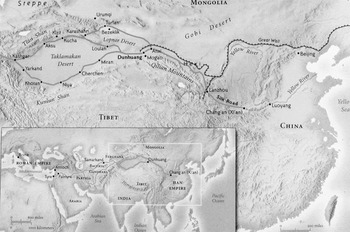
Among the many sites of the region, the Caves of the Thousand Buddhas in Dunhuang, as the last trading point of the Chinese Silk Road before the Taklamakan Desert, held a particular interest for early explorers (see Figure 2). Dunhuang's several hundred intact painted and decorated caves, dating from the fourth to the fourteenth centuries, were first documented by the Hungarian Széchenyi expedition in 1879; an 1899 publication described the splendors of the site and established its precise physical longitudinal and latitudinal location for the first time.13
Russell-Smith, “Hungarian Explorers in Dunhuang,” 360.
Wang, Sir Aurel Stein in the Times, 144. The cave is now referred to as Cave 17.
Bongard-Levin et al., Correspondances Orientalistes, 211. This is my translation. Foucher's statement underscores the frequently physically and sexually violent language common to explorers' narratives at the time.
Forbes to Pelliot, December 7, 1921, HUAMA, Folder: Warner, Langdon, Chinese Expedition/1922–1923, also 1925–1926.

Important archaeological sites along the Silk Road. © 2000 the J. Paul Getty Trust.
As early as January 1922, the Fogg Visiting Committee acknowledged that Chinese sculpture and paintings in particular were “not adequately represented” at the museum.18
Brush, Vastly More than Bricks and Mortar, 45.
Hevia, English Lessons, 132.
Hevia, English Lessons, 132.
Conn, “Where is East?”
The China Expedition was envisioned as a 5-year project, with the first year to be led by Langdon Warner and devoted to identifying and documenting sites of interest. Warner and Forbes, both Harvard graduates and family friends, interacted while the former was a curator in training at MFA's department of Asiatic art. Forbes appointed Warner to a teaching position at Harvard in 1913 with the belief that he “ought to be an Oriental specialist.”23
Forbes, History of the Fogg Art Museum, 224. This was the first time that courses in Asian art were offered at an American university.
Bowie, Langdon Warner Through His Letters, 29.
Warner was also offered fieldwork in Java or Khotan (1906), in Japan (1909), with Pelliot in Turkestan (after 1914), and for the Cleveland Museum in Turkestan (1915).
Six years before I had urged the study and publication of the Lung-Men grottoes but the Museum discouraged so visionary a plan, and when the money did finally come in sight, Chavannes was in the field working on his publication that has since become famous…. By that one piece of work he has put French scholarship and enterprise at the head in Chinese research.26
Bowie, Langdon Warner Through His Letters, 45–46.
I suggest that these frustrations of his prior attempts to establish himself as a field-based scholar in China fueled his drive to produce results for Harvard.
Forbes was aware that the results of the China Expedition's inaugural year might be “wholly on paper, as to separate sculptures from the living rock would be a vandalism of which [he did] not approve.”27
Warner to Unknown, n.d. HUAMA, Folder: Warner, Langdon, Chinese Expedition/1922–1923, also 1925–1926.
These differences in opinion are significant in that they suggest that there was more than one point of view as to what was acceptable for removal even within the Fogg. Forbes and Warner clashed again over how to proceed during the Second Fogg Expedition.
Warner to Unknown, n.d. HUAMA, Folder: Warner, Langdon, Chinese Expedition/1922–1923, also 1925–1926.
I would like to thank Robert Mowry for suggesting this to me.
Unlike sites in Europe where local agencies and cultural institutions actively protested the removal and destruction of what was seen as national cultural heritage, the isolated Buddhist grottoes of western China and Central Asia had no such advocates in the early twentieth century. First, because of the chaos of the end of the Qing Dynasty [1644–1911] and the creation of the new Republic of China [1912–1949], there was no single governmental agency in China overseeing such matters; and there was no law against exporting archaeological or artistic objects until 1930.33
“Statement Regarding Sir Aurel Stein's Archaeological Expedition in Chinese Turkestan,” written by the National Commission for the Preservation of Antiquities, HUA, Folder: Langdon Warner, Correspondence, Sir Aurel Stein.
Watson, “Palaces, Museums, and Squares.”
Hamlish, “Preserving the Palace.”
Watson, “Palaces, Museums and Squares” 8.
Hamlish, “Preserving the Palace.” I use Peking, Peiping, and Beijing in keeping with what the city was called during different historical and political moments.
Millward, “Coming Onto the Map,” 61–98.
For discussions of literati painting, see Li and Watt, The Chinese Scholar's Studio, and Sullivan, The Three Perfections. I thank Robert Mowry for his kind guidance on this subject.
Russell-Smith, “Hungarian Explorers in Dunhuang,” 352.
For Western scholars keen to establish artistic and religious connections between China and India in particular, the Buddhist wall paintings along the Silk Road provided evidence for the continuity and transference of these traditions. The discovery of partially intact sites with their elaborate wall paintings at Turfan, Niya, Miran, and Khotan offered unique collecting prospects. The relative lack of interest on the part of the Chinese in these sites was ample justification and opportunity for removing as much as possible for preservation and study in Western institutions. In the narrative of Western expeditions and museums, the removal of these materials was a heroic act meant to protect the culture of ancient China at a time when China was neither invested in nor capable of doing so. In the Chinese narrative since the mid-1920s and particularly in 1928 with the establishment of the Chinese National Commission for the Preservation of Cultural Objects (NCPCO), these Western expeditions were legitimized plunder. The Fogg sent three expeditions to China: the first, under Warner in 1924; another, also led by Warner in 1925; and a final expedition led by Sir Aurel Stein in 1931. The latter two expeditions were blocked by various Chinese agencies who argued that Westerners had removed cultural materials under false pretences for far too long. In 1931, the NCPCO cancelled the Fogg's final expedition, admonishing not only Harvard but all Western institutions for the exploitation of sites and artifacts in such a way that the “rightful owners, the Chinese, who are the most competent scholars for [the] study [of Chinese materials were] deprived of their opportunity as well as their ownership.”41
National Commission for the Preservation of Cultural Objects, “Statement regarding Sir Aurel Stein's Archaeological Expedition in Chinese Turkestan.” HUA, Folder: Langdon Warner, Correspondence, Sir Aurel Stein.
PRESERVATION ETHICS OF THE EARLY TWENTIETH CENTURY
With increased colonial and military expeditions as well as more intense archaeological excavation in the nineteenth century, preservation became an important justification for collecting non-Western artifacts for Western institutions.42
McBryde, “Introduction,” and Barkan, “Amending Historical Injustices.”
Hevia, English Lessons.
Hooper-Greenhill, Museums and the Shaping of Knowledge.
Lyons and Papadopoulos, “Archaeology and Colonialism.”
Conn, “Where Is East?” 164.
Clunas, “China in Britain,” 47.
The powerful teaching role of museums and those who collected for them was lauded in the 1929 publication China and Japan in Our Museums; the preface noted that “those who provide our American public with these opportunities of visual learning ‘are to be complimented upon calling our attention to people whom in every way it behooves us to know’.”49
March, China and Japan in Our Museums, vi.
until comparatively recently … been due to the interest of individuals who were themselves usually collectors. In later years, the general recognition of the right of China and Japan to representation among the fine arts has encouraged the development of collections in most museums of good standing.50
March, China and Japan in Our Museums, 10.
Western museums were perceived as uniquely suitable for the preservation of material culture. First, they were identified as scientific institutions with specialists capable of properly cataloging, studying, and analyzing the material. Next, they were proposed as safe and secure repositories for artifacts. Finally, it was assumed that artifacts could be better appreciated for their intrinsic artistic, cultural, and historic significance by Western museum audiences rather than in their home countries where they were little valued.
The earliest explorations of western China were focused on surveying the region rather than on archaeological excavation.51
Wood, The Silk Road.
Certainly we believe [his] narrative when he assures us that he took nothing but monuments in complete ruin and only after having drawn plans and taken necessary reference marks…. And then it is necessary that the most virtuous archaeologist surrender to the law of the times: the savant societies which have sent him would not be pleased at all if he pushed loyalty to high principles only to return home empty handed.52
Foucher, “A. Grünwedel,” 442. This is my translation.
Warner, too, was keenly aware of the weight of producing results with the “Fogg's hard-begged dollars,” but he was also intent on establishing himself in academia.53
Warner, Buddhist Wall-Paintings, xiv.
Warner, The Long Old Road in China, 147.
In contrast to surface finds or other easily portable objects that could be removed and packed with minimal damage, architectural remains often required extensive stabilization and considerable labor to be moved and transported. Why was the removal of this immovable heritage worth the effort? Unlike portable heads of statues or pieces of textile or paper, these wall painting fragments were creations unique to a specific site; it was therefore possible to acquire a part of the site itself rather than an object that came to be placed there. Expeditions including Albert Von le Coq's (1860–1930) and Stein's traveled with individuals trained in the painstaking work of sawing out sections of painted walls, the prevalent removal technique at the time. This method entailed cutting surfaces into several smaller blocks, thus transforming once-intact visual surfaces into elaborate jigsaw puzzle pieces. The Bezeklik wall paintings at the Berlin Museum für Völkerkunde showed evidence of these vertical and horizontal saw marks, which could not be effaced even by skillful restorers. Although such dismantling and partial destruction of a site would have been problematic in other places, it was acceptable in western China. As Pelliot wrote:
While I am an enemy of all archaeological operations which gouge the monument under study, and I would agitate against museum agents who would want to take away pieces of Ajanta with them … here the situation is quite different…. One can … say without hypocrisy that by removing the frescoes … we are saving them, at least saving them in pieces.55
Pelliot, “Chronique: Chine,” 207–08. This is my translation.
What was the difference between the cave temples at Ajanta in western India and those in western China according to Pelliot? Unlike the former, which was being studied, documented, and protected by the (British) Archaeological Survey of India, in the view of Pelliot and others, the isolated sites of western China were vulnerable to the ravages of the environment and time, and worse, unprotected from vandalism. As there were no mechanisms to ensure the security of the sites in situ, he argued that it was responsible and ethical to dismantle them for safe-keeping and study in Western museums. Therefore, any damage inflicted on either the site or the fragments that would come from it were in fact a necessary part of their preservation. Fred Andrews, the restorer in charge of the wall paintings removed by Stein, noted the following:
It has been contended that such [wall] paintings and other objects of artistic and archaeological interest should not be removed from their original site. In some instances the argument is justifiable, but in the case of these paintings, to have left them would have meant their ultimate complete disappearance, as it was impracticable to safeguard them in situ…. It would seem therefore, that the only way of saving what remained was to bring them away.56
Andrews, “Central Asian Wall-Paintings,” 4.
The safety of these archaeological finds could be ensured in Western institutions in part because they would be out of the hands of Orientals, a term used to describe the Russians, Muslim communities, and Chinese in western China. The first two groups were thought to vandalize ancient Chinese heritage out of ignorance and religious fervor, respectively, and because the culture they destroyed was not their own. But Russian soldiers in Dunhuang, who marked “the mouth of the Buddha … [with] some Slav obscenity,” and Muslim Dungan bandits, who burned wooden statues and temple facades at the site, while deplored, were less culpable than the “Chinese irresponsibles” who did not care for their own cultural heritage.57
March, China and Japan in Our Museums, 25. Russell-Smith, “Hungarian Explorers in Dunhuang,” 358.
Warner, The Long Old Road in China, 217.
Watson, “Palaces, Museums and Squares: Chinese National Spaces,” and Hamlish, “Preserving the Palace.”
Shelton has noted that the acquisition of collections is a mediated event; and however unbalanced this interaction may be, “the desires of the collector must always engage with the criteria adopted by an originating community in stipulating what can and cannot be alienated.”60
Shelton, “Introduction. ‘Doubts Affirmations,’ ” 18.
See 〈http://idp.bl.uk/archives/news12/idpnews_12a4d〉 (Last accessed January 13, 2007). See also Whitfield, Dunhuang Manuscript Forgeries.
Pelliot, “Chronique: Chine,” and March, China and Japan in Our Museums, 25.
Warner, The Long Old Road in China, 219.
This version of the story has been disputed by Rong Xinjiang, who suggests that the collection was in fact dispersed after it reached the Ministry of Education in Peking. See 〈http://idp.bl.uk/archives/news12/idpnews_12.a4d〉 (last accessed 13 January 2007).
The stereotyping and distrust of the Orientals brushed aside existing Chinese structures for the study, renewal and preservation of cultural heritage. Western explorers ignored evidence of a long-standing antiquarian tradition that had persisted in China since the Song Dynasty (960–1279) and was based on the study of inscriptions on metal and on stone artifacts.65
Von Falkenhausen, “Rediscovering the Past.”
Warner, The Long Old Road in China, 219.
Mirsky, Sir Aurel Stein, 279.
Warner, The Long Old Road in China, 57.
Warner, The Long Old Road in China, 57.
Stein to Publius Allen, December 2, 1907, BOD MS Stein 4.
Von Falkenhausen, “Rediscovering the Past,” 41. Li Ji is also spelled Li Chi. See Yang, “A History of Modern Chinese Archaeology” for discussions of Chinese-led scientific expeditions and archaeological excavations since the early 1900s.
THE SCARS OF PRESERVATION
Although preservation supposes the protection of an original, authentic artifact, the application of preservation principles always marks or changes the original object. When a site is dismantled for the purposes of preservation, both the removed fragments and the site are physically and symbolically transformed. This moment of collecting, then, is legible both on the removed artifacts and the site, changing both from evidence simply of a specific period in antiquity to evidence of a specific modern moment as well. These hybrid objects therefore no longer represent merely China or Buddhist art, but also the hands of Western collectors. In turn, the preservation of these artifacts and sites also preserves the method of, and intentions behind, their dismantling. Both Hevia72
Hevia, English Lessons.
Clunas, “China in Britain.”
Clunas, “China in Britain,” 48.
As discussed, the preservation ethics of the time justified the removal of both movable and immovable materials from abandoned, ruined, or partially destroyed sites—I suggest that these kinds of sites were chosen so as to arouse minimal local resentment when artifacts were removed or sites further damaged. At sites such as Dunhuang where “the cave temples … were still real cult places ‘in being’ [that] … drew the villagers and townspeople of the oasis by the thousands to the site,” Stein made do with surreptitiously negotiating the acquisition of portable artifacts rather than wall paintings.75
Stein, Lowell Lecture XII: “The Cave Shrines of the “Thousand Buddhas.” December 1929. BOD MS Stein 414/2.
Warner asked Forbes to suggest materials that would best stabilize the delicate surfaces of wall paintings without changing their appearance. He wanted to avoid using the paraffin wax and celluloid commonly in use by other explorers because they often darkened or clouded the painting surfaces. See Warner to Forbes, February 14, 1923, HUAMA, Folder: Warner, Langdon, Correspondence 1910–1950.
The strappo method promised the ability to simply strip away the painting surface from a wall, leaving both the wall and the paint layer structurally intact. This technique not only offered an alternative to the destructive and labor-intensive sawing method, but would also make transporting wall paintings far easier. Daniel Varney Thompson (1902–1980), a student of Forbes' who was training in the use of the method in Italy, advised Warner on its appropriate application but cautioned that its efficacy was unknown on Asian wall paintings, which were not true frescoes.77
Thompson to Warner, June 10, 1923, HUAMA, Folder: EW Forbes/DV Thompson 1922–1923.
Thompson to Warner, June 10, 1923, HUAMA, Folder: EW Forbes/DV Thompson 1922–1923. Recent analysis completed by Narayan Khandekar at the Straus Center for Conservation showed that Warner did not precisely follow Thompson's advice on the kinds of adhesives to use. Fourier Transform Infrared Spectroscopy showed that in addition to rabbit skin glue and nikawa (an animal glue), Warner also used gum Arabic, which was not suggested by Thompson.
Warner's letters to his wife Lorraine Roosevelt Warner and Forbes in early 1924 are the only documentation of his immediate reactions to reaching the site after nearly 6 months after he and his assistant Horace Jayne (1898–1975) arrived in Peking. This correspondence captures with striking immediacy Warner's complex and contradictory emotions on reaching the site. He was genuinely in awe of the beauty of the wall paintings and their state of preservation but equally concerned about the ongoing vandalism and deterioration of the caves. Warner was arrogant enough to believe that it was his duty to save some of the most important parts of Dunhuang yet also tortured by his fear that his actions to remove wall painting fragments would be unsuccessful. Because Jayne fell ill and did not accompany Warner to Dunhuang, Warner was left to confront his inner demons alone and carry out the work of removing wall painting fragments on his own. He first attempted the more familiar method of sawing paintings out of the cave walls; however, when this yielded little but powder, Warner steeled himself to try the strappo technique despite “being neither chemist nor trained picture restorer, but an ordinary person with an active archaeological conscience.”79
Warner, The Long Old Road in China, 216–17.
Warner, The Long Old Road in China, 219. Ultimately, Warner only removed 12 of the 14 fragments he originally intended to strip.
Had Jayne been at Dunhuang with Warner, perhaps there would have been more photographs of the removal of the fragments.
Warner to Forbes, February 10, 1924, HA, Folder: Warner, L 1881–1955, Correspondence 1906–1946.
Warner to Forbes, February 10, 1924, HA, Folder: Warner, L 1881–1955, Correspondence to Forbes, 1906–1946.
Warner, “Preliminary Report of the Fogg Museum,” n.d., HUAMA, Folder: Warner, Langdon, Correspondence 1910–1950.

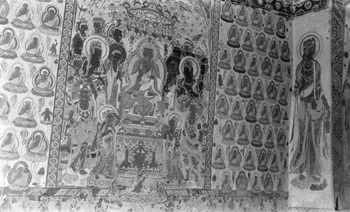
Warner's photograph of the south wall of Cave 320 before the removal of two wall painting fragments. The dark rectangle to the right of the central figure is now Bust of a Bodhisattva, with Lohan and Guardian (HUAM Accession No. 1924.44). Courtesy of Historic Photographs, Fine Arts Library, Harvard College Library.
In Warner's words, “Five days of labour from morning till dark and five nights of remorse for what I had done … saw the fragments of paintings securely packed … for the eighteen weeks' trip by springless jolting cart, railroad and ship to the Fogg Museum at Harvard.”85
Warner, The Long Old Road in China, 216–17.
Thompson, “Delta Fragment” treatment report. SCC Ob, Folder: AC 1924.40-47.
Thompson, “Alpha Fragment” treatment report. SCC Ob, Folder: AC 1924.40-47. The current whereabouts of this fragment are unknown.
Stout and Binyon, “Transference of Mutilated Chinese Wall Painting,” March 1, 1930. SCC, Objects, Folder: AC 1924.40-47.

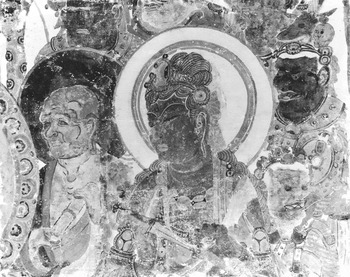
Bust of a Bodhisattva, with Lohan and Guardian (HUAM Accession No. 1924.44) soon after conservation treatment in 1924. Courtesy of the Photograph Collection, Fine Arts Library, Harvard College Library.
For the Fogg, the unattractive and damaged final appearance of some of the Dunhuang paintings must have come as a blow, particularly given Forbes' commitment to a strongly preservation-minded approach to the study of art objects. The fragments remained unframed for several months, and photographs of them were not published in articles describing the China Expedition, much to Warner's dismay. His hopes of establishing himself within Harvard's fine arts department were seemingly dashed by the lukewarm reaction to the results of his expedition. A letter from Warner to Forbes reveals his disappointment that his colleague Denman Ross, an important collector of Asian art “wasn't keen about [the Bodhisattva statue] or much interested in the frescoes.”89
Warner to Forbes, September 11 or 12, 1924, HUAMA, Folder: Warner, Langdon, China Expedition.
I depend entirely on you and Paul and him to let me know if the work that we have undertaken is worthwhile. My own judgment cannot always be relied on because I sometimes mix aesthetics with archaeological importance or rarity or something else that is quite foreign to it.90
Warner to Forbes, September 11 or 12, 1924, HUAMA, Folder: Warner, Langdon, China Expedition.
When the painting fragments were accessioned into the Fogg collection, little remained of the architectural context from which they originated. Once part of layers of painted mud plaster on carved cave walls, the fragments were physically reduced to millimeter-thin layers of pigment coated with adhesives and glued onto canvas, Japanese paper, or asbestos-board. The significance of these fragments in their original architectural contexts was also obscured by their renaming during the accessioning process; for example, images once part of the retelling of Buddhism's introduction to China were rather plainly titled Three Figures (HUAM Accession number 1924.40) or Eight men ferrying a statue of the Buddha (HUAM Accession number 1924.41). Other fragments became generic busts of Bodhisattvas or adoring figures. In some instances, however, the original image was so obscured that the new titles given to the fragments became their primary identifying feature. The damaged condition of several of the objects also made it impossible to display fragments from the same cave together, a format that would have allowed for some understanding of the various styles, themes, and time periods of the different objects. Even today, only two paintings from the same cave, Cave 320, are displayed together.91
These fragments are Bust of an attendant Bodhisattva (HUAM Accession No. 1924.43) and Bust of a Bodhisattva, with Lohan and guardian (HUAM Accession No. 1924.44).
What of scars on the location from which the fragments were stripped? Although Stein and Pelliot acquired far greater numbers of objects from Dunhuang than did Warner, there is little but an empty cave to suggest their presence at the site. Evidence of Warner's hand, however, is unavoidable in the caves where he worked; stark white, generally rectilinear spaces with ghostly tracings of the paintings once there stand in sharp contrast to their elaborately painted and often well-preserved surroundings. Areas alongside the losses show darkened glue drips and splatters, further evidence of Warner's untrained glue application and unpracticed removal methods. The scars of the missing fragments disrupt and change the narratives at Dunhuang in two separate ways. First, the areas of loss interrupt the visual narratives painted on the grotto walls, sometimes removing details significant to the stories depicted in the caves. For example, in Cave 321, the arrival of the first statue of the Buddha, (now Eight men ferrying a statue of the Buddha, HUAM Accession number 1924.41) an important part of the story of Buddhism's introduction to China, has been erased from its original context. Second, the missing fragments have become part of a contemporary narrative about the historical and artistic significance of Dunhuang. Today, tour guides at Dunhuang orient visitors to these caves with mention of not only Tang Dynasty patronage and craftsmanship but also the destruction of Chinese cultural heritage by Warner and the Americans. In this way, the scars of a modern preservation policy upstage the authentic and largely intact ancient narratives on the walls.
OBJECT LESSONS
I have examined how the collection and preservation of both movable and immovable artifacts have played an important role in the pedagogical mission of Western museums both in China and in their home countries. Thus far, these artifacts have held the relatively passive roles of being possessed, removed, or preserved. I now turn to the kinds of lessons the objects themselves taught, both to those who possessed them and to those who were “deprived of their ownership.”92
Chinese Commission for the Preservation of Cultural Objects, “Statement regarding Sir Aurel Stein's Archaeological Expedition in Chinese Turkestan.” HUA, Folder: Langdon Warner, Correspondence, Sir Aurel Stein.
Brush, Vastly More than Brick and Mortar, 60.
The Fogg's Second China Expedition came close on the heels of the first, with its primary purpose to establish relationships with Chinese universities in the hope of creating a Peking-based institute for the study of Chinese culture. Backed by Charles M. Hall, who wished to fund projects “educating the Chinese,” the so-called Big Scheme was to provide a secure location in China for archaeological finds from future field expeditions where an interdisciplinary group of American and Chinese scholars could study them.94
Forbes, History of the Fogg Art Museum, 273.
Warner to Pelliot, August 10, 1924, HUAMA, Folder: Warner, Langdon, China Expedition.
Changed circumstances in China, in particular new government legislation requiring the preservation of antiquities as well as increased communist agitation against foreigners, made for fewer opportunities to remove artifacts for Western collections. Even government-sponsored expeditions such as John Gunnar Andersson's (1874–1960) work for the Geological Survey of China ran into trouble when the Gansu provincial authorities were dissatisfied with the division of specimens between Sweden and China.96
Jayne to Forbes, April 9, 1925, HUAMA, Folder: Chinese Expedition, Tun Huang Caves 1924–1926. Andersson worked with the National Geological Survey between 1915–1925. See Fiskesjö and Chen, China Before China.
Warner to Willys, May 5, 1925, HUAM Asian, Folder: Tun Huang Frescoes, Accession Information, 1924.40-47.
As previously mentioned, Jayne fell ill during the First Fogg Expedition and was not with Warner during his sojourn to Dunhuang.
The circumstances had altered much from Warner's successful trip last season: it was known frescoes had been removed and it must have been suspected that more were to be removed; it was a very different matter to remove a few fragments of damaged frescoes which could be done swiftly without attracting attention or causing undue distress among the priests or local people, compared with attempting to take away one or more complete caves, a matter of three or four months work at least, which would inevitably attract great local attention and probably actual disturbance.99
Jayne to Forbes, April 9, 1925, HUAMA, folder: Chinese Expedition, Tun Huang Caves, 1924–1926.
When the expedition arrived at the site, it was received by an angry 100-strong crowd and escorted under a “guard of mounted riflemen.”100
Warner to Forbes, May 28, 1925, HUAMA, Folder: Chinese Expedition, Tun Huang Caves, 1924–1926.
After you had left last year the populace was exceedingly displeased with what had been removed, had raised a fearful row and accused the magistrate at TH [Dunhuang] of accepting a bribe to allow you to take things away, and in consequence thereof he had to be removed from office.101
Jayne to Warner, May 4, 1925, HUAM Asian, Folder: Tun Huang Frescoes, Accession Info, 1924.40-47.
Rumors of Warner's spoils had also apparently been spread by “a retired Yamen official coming to Peking and a post office clerk [in Lanchow].”102
Warner to Willys, May 5, 1925, HUAM Asian, Folder: Tun Huang Frescoes, Accession Information, 1924.40-47.
Jayne to Warner, May 4, 1925, HUAM Asian, Folder: Tun Huang Frescoes, Accession Information, 1924.40-47.
Warner to Forbes, May 28, 1925, HUAMA, Folder: Chinese Expedition, Tun Huang Caves, 1924–1926.
I have been racking my brains to find out if anything that I did last year was a mistake in policy but can find nothing. When I left Tun Huang the scene seemed quite set for another year's work and everyone pleased with the foreigner's visit. Wang, the interpreter, told me at the time that it would be easier on the next trip!105
Warner to Forbes, May 28, 1925, HUAMA, Folder: Chinese Expedition, Tun Huang Caves, 1924–1926.
Unbeknownst to Warner, the Second Fogg expedition was in fact effectively blocked from its inception by his own interpreter Wang Jinren, and William Hung, an American-trained historian and dean of the College of Arts and Sciences at Yanjing University in Peking who would later teach at Harvard.106
Wang Jinren was formerly spelled Wang Chin-jen. Yanjing University was formerly spelled Yenching University.
He discovered him in one of the grottos working with some cloth over one of the murals … [Warner had] explained that the murals on these walls were of great historical and artistic value. Unfortunately, he said, the Chinese were not interested in such matters; but as the universities in America were eager to study them, he was experimenting with a process … to see whether he could transfer some of the murals back to America…. But he told him not to tell anybody, which led Wang to suspect that what he was doing was not authorized. Now this Warner was back with a big delegation of Americans…. Wang was certain that they wanted to take all of the murals away.107
Egan, A Latterday Confucian, 112–13.
Hung immediately went to see the Vice Minister of Education in Peking, Qin Fen, who then “sent a telegram to every governor, district magistrate, and police commissioner along the way to Tun-huang, [i.e., Dunhuang], saying that very soon, a delegation from a great institution in America would be coming” and “on no account allow them to touch any historical relics.”108
Egan, A Latterday Confucian, 114. Hung's dictated tapes to Egan, currently held at the Harvard University Archives, will be opened to public in 2007 and more details may be forthcoming. It should be noted that Hung was instrumental in securing funds for the opening of the Peking Historical Museum in 1926, an institution which apparently drew one fifth of the city's population in its inaugural month (Egan, 95). Qin Fen was formerly spelled Ch'in Fen.
The Second Fogg Expedition ended in disappointment for Warner. He was unable to acquire any significant materials for the museum's collection and had to comfort himself with the photographic study of the nearby Wan Fo Hsia caves, already visited by Stein. Plans for the Big Scheme also eventually fell through, leaving Warner bitter and keen to identify the saboteurs of his expedition.109
The Harvard-Yenching Institute was eventually founded in 1928 with funding from Hall.
Warner to Willys, May 5, 1925, HUAM Asian, Folder: Tun Huang Frescoes, Accession Information, 1924.40-47.
Warner to Roger S. Greene, June 23, 1925. HUAMA, Folder: Chinese Expedition, Tun Huang Caves, 1924–1926.
Although the Second China Expedition ended without the removal of any wall paintings from Dunhuang, the existing collection at the Fogg transformed it into an important center for the study and conservation of Asian wall paintings. This was caused by Forbes' establishment of a research department at the Fogg in 1928, where conservator George Leslie Stout and chemist Rutherford John Gettens were charged with investigating the preservation of Chinese wall paintings using scientific means. Both Gettens and Stout were engaged in studying and identifying the original materials and techniques used in the fabrication of these art objects. Gettens' unpublished work on the pigments of the Dunhuang wall paintings and Bodhisattva statue remains one of the most important references on early Chinese polychromy today.112
Gettens, “Preliminary Report on Chinese Pigments,” 1935, SCC Pt, Folder: Microscopy, General Notes—Far East Wall Paintings, 1924.40.
This course was taught by Paul Sachs, who often invited his colleagues to present various topics to students hoping to pursue museum careers.
There are two possible aims in transferring the painted wall surfaces of the Far Eastern type. The more important of these is to restore the painting and leave it in situ. Occasionally, however, circumstances demand that it be removed entirely and transported to another and safer location.114
Stout, “Museum Work and Museum Problems,” November 21, 1930, SCC Pt, Folder: Paintings, Conservation, Treatment, Transference, Oriental.
There must have been considerable administrative pressure for Gettens and Stout to develop improved methods for the removal of wall paintings as the Fogg was embarking on the Asiatic Expedition, to be led by Sir Aurel Stein in 1930. Stein intended to explore Xinjiang province (then called Chinese Turkestan), “which in its scattered oases [comprised] an almost entirely non-Chinese population accustomed to view Western travelers with friendly eyes,” and a region of China Stein considered “in practice independent from whatever central authority has prevailed in China proper.”115
Stein to Forbes, January 11, 1930, HUAMA, Folder: Directors' Files, EW Forbes, Sir Aurel Stein.
These experiments included “The Transfer of a Painting Made Without a Binding Material Upon an Artificial Mud Wall”; “Studies in the Fixation of a Mud or Clay Surface with Various Lacquers”; “Further Study in the Fixation of Mud or Clay with Vinylite and Vinyl Resin”; “An Investigation of the Cause of ‘Buckling’ or ‘Lifting’ of the Paint Film in Chinese Mud Wall Paintings”; “Experiments to Show the Extent of Adhesion of a Glued Facing to a Smooth Vinylite Lacquer Surface.” See SCC Pt, Folder: Transfer, Chinese Wall Paintings, Early Experiments.
Gettens, March 1930, “Transfer of a Painting Made Without a Binding Material Upon an Artificial Wall,” SCC Pt, Folder: Transfer, Chinese Wall Paintings, Early Experiments.
Archaeological expeditions in the past occasionally have made attempts to remove Eastern Mud Wall paintings in the field, and to transport them to this country. In many cases their efforts have been unsuccessful or only partially successful due to lack of equipment and to unforeseen difficulties. Now that many of these difficulties can be anticipated from the experience of others, it only remains to provide these expeditions with the proper equipment.118
Laboratories for Technical Research, “Equipment for Field Use,” 1930. SCC Pt, Folder: Conservation Treatment, Transference-General. The final materials chosen for field use were rabbit skin glue, glycerine, and a vinyl resin in varying concentrations mixed in different solvents.
In addition to producing appropriate preservation tools for individuals leaving for the field, Gettens and Stout also gave hands-on practical training in their use. For example, both Stein and his assistant Milton Bramlette were given demonstrations of the method in hopes that this would minimize damage to immovable cultural heritage removed from the field. Ultimately, these preparations were of little use: Stein's travel pass was cancelled by the Chinese government in March 1931 and his work denounced as vandalism by China's National Commission for the Preservation of Antiquities.
Even after the end of the Fogg expeditions, Gettens and Stout continued to work on technical issues related to Chinese and Central Asian wall paintings because of the increased looting of cultural sites in China. A 1930 law banning export of Chinese antiquities did little to staunch the flow of illicit archaeological material into the international art market; wall painting fragments were relatively easily available because they could be sawn out of isolated temple and grotto walls and then sold piecemeal to various bidders. In cases where large sections of wall paintings were purchased by museum institutions, these fragments required extensive conservation and reassembly before they could be placed on display. Gettens' and Stout's expertise in Chinese wall paintings thus made them particularly sought after in North America. The Fogg's conservation staff examined and reconstructed large-scale Asian wall paintings purchased by institutions including the Pennsylvania (now Philadelphia) Museum of Art; the MFA; and the Royal Ontario Museum, Toronto.119
Department of Conservation, “Chinese Wall Paintings,” n.d., SCC Ob, Folder: AC 1924.40-47.
Phillimore, “Initial Report on the Treatment of Two 13th Century Chinese Wall Paintings in the Royal Ontario Museum, Toronto,” 153. Stout, “The Assembly of Transferred Fragments of Chinese Wall Painting,” 1934, SCC Pt, Folder: Conservation, Transference—General, Treatment. Xinghua-si was formerly spelled Hsing-hua Ssu.
Any man seeking or needing to sell will naturally dispose of his goods to the highest bidder, and it is difficult to blame either seller or buyer in such a transaction, as long as irreplaceable objects of merit are preserved from destruction…It is not improbable that the knowledge of a market largely created by Western collectors has saved many choice pieces from oblivion.121
March, China and Japan in Our Museums, 26.
THE LEGACIES OF PRESERVATION
Because no reconciliation [between China and the West] was ever arrived at, because the past continues to be selectively plundered by the present, the scars, both physical and mental, remain, shaping the consciousness of the next generation.
James Hevia122
Hevia, English Lessons, 349.
At the 2004 conference on the “Conservation of Ancient Sites Along the Silk Road” held at Dunhuang, Fan Jinshi, director of the Dunhuang Academy, called for the recovery of all objects originally from the site.123
This conference was coorganized by the Getty Conservation Institute and the Dunhuang Academy.
The site has been preserved by the Dunhuang Academy since 1943; currently, the site and materials from the site are being studied, documented, and conserved by the Dunhuang Academy in collaboration with several international organizations, notably the Getty Conservation Institute and the International Dunhuang Project. See 〈http://www.getty.edu/conservation/field_projects/mogao/index.html〉 and 〈http://idp.bl.uk/〉, respectively (last accessed January 13, 2007).
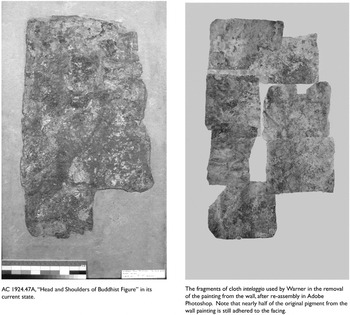
My original research project aimed to recover, through nondestructive analytical techniques, the pigments and painting techniques used during the Tang Dynasty period from the damaged Dunhuang fragments at the HUAM.125
The unpublished documentation for this project is currently held at the Straus Center for Conservation, HUAM.
I would like to thank Francesca Bewer for bringing these objects to my attention.

[See image] Photographs by Sanchita Balachandran. Courtesy of the Straus Center for Conservation, HUAM.
History has dealt harshly with many of the larger-than-life figures who traversed the difficult terrain of western China in the late nineteenth and early twentieth centuries, alternately propping them up as saviors or as foreign devils. Shelton warns that “peoples of one historical epoch removed from our own are also ‘other’ to us, and it is dangerous and at worst disingenuous to impute their motives or project judgments from a totally unlike historical milieu such as that which we ourselves occupy.”127
Shelton, “Introduction. ‘Doubts Affirmations,’ ” 18–19.
The near-century since Warner's expedition to Dunhuang has demonstrated the unpredictable nature of events which affect the preservation of cultural heritage. Can either museums or sites effectively and indefinitely ensure the survival of the cultural and material significance they contain? Although current conservation ethics lean toward preserving both movable and immovable cultural in situ whenever possible, there are also countless examples of how materials were preserved because of their dispersal from their original sites. Precisely because Dunhuang remains in an extraordinary state of preservation, it is perhaps easier to dwell on and condemn the destructive effects of removing movable and immovable artifacts from the site. Two Bodhisattvas in Cave 321 and 323, which Warner outlined and framed with his adhesive but never removed still stand intact, whereas only 4 of the 12 fragments he transferred for the Fogg are on view today. Not all sites remain as intact as Dunhuang, and in these cases, the documentation of Western expeditions and the catalogs of artifacts they removed are the solitary evidence for what once existed. These traces, then, offer opportunities to recover information of ancient pasts, but also demand that the institutions that hold them acknowledge their own troubled and difficult journeys on the “Long Old Road in China.”128
This is the name of Warner's memoir.
Archive Abbreviations