Introduction
The late Cambrian–earliest Ordovician was a time of decreased to stagnant global diversity (e.g., Sepkoski, Reference Sepkoski1978, Reference Sepkoski1979, Reference Sepkoski1981, Reference Sepkoski1995, Reference Sepkoski1997; Bambach et al., Reference Bambach, Knoll and Wang2004; Smith et al., Reference Smith, Lloyd and McGowan2012). This “Cambrian Diversity Plateau” followed the Cambrian Explosion and preceded the Great Ordovician Biodiversification Event (Servais et al., Reference Servais, Owen, Harper, Kroger and Munnecke2010). The cause of the global diversity plateau is unclear, but repeated trilobite extinctions that affected shelf communities punctuate this interval in Laurentia (e.g., Lochman and Duncan, Reference Lochman and Duncan1944; Lochman-Balk and Wilson, Reference Lochman-Balk and Wilson1958; Palmer, Reference Palmer1965, Reference Palmer1979, Reference Palmer1984; Longacre, Reference Longacre1970; Stitt, Reference Stitt1971a, Reference Stittb, Reference Stitt1975, Reference Stitt1977, Reference Stitt1983; Westrop and Ludvigsen, Reference Westrop and Ludvigsen1987; Westrop, Reference Westrop1988, Reference Westrop1989, Reference Westrop1990, Reference Westrop1996; Loch et al., Reference Loch, Stitt and Derby1993; Westrop and Cuggy, Reference Westrop and Cuggy1999; Taylor et al., Reference Taylor, Myrow, Ripperdan, Loch and Ethington2004; Adrain et al., Reference Adrain, McAdams and Westrop2009; Saltzman et al., Reference Saltzman, Edwards, Adrain and Westrop2015). The term ‘biomere’ refers to the stratigraphic packages bounded by these extinctions (Palmer, Reference Palmer1965; review in Taylor, Reference Taylor2006). Directly above the strata recording the extinction event are thin ‘critical periods’ (Westrop and Ludvigsen, 1987) or ‘critical intervals’ (Taylor, Reference Taylor2006) dominated by one seemingly opportunistic trilobite species. These intervals include taxa not related to genera found in strata below and are apparent migrants from deeper water environments (e.g., Palmer, Reference Palmer1979). The bases of these critical intervals are used to define North American stage boundaries (Ludvigsen and Westrop, Reference Ludvigsen and Westrop1983), although disagreement exists as to whether these intervals represent the last stage of one biomere (Stitt, Reference Stitt1971b, Reference Stitt1975, Reference Stitt1983; Taylor, Reference Taylor2006) or the first stage of the overlying biomere (Palmer, Reference Palmer1979). Further controversy has centered on whether the extinctions were caused by changing environmental conditions, such as water temperature or oxygen level (e.g., Lochman and Duncan, Reference Lochman and Duncan1944; Stitt, Reference Stitt1971b, Reference Stitt1975, Reference Stitt1977; Palmer, Reference Palmer1984; Loch et al., Reference Loch, Stitt and Derby1993; Perfetta et al., Reference Perfetta, Shelton and Stitt1999; Gill et al., Reference Gill, Lyons, Young, Kump, Knoll and Saltzman2011; Saltzman et al., Reference Saltzman, Edwards, Adrain and Westrop2015; Gerhardt and Gill, Reference Gerhardt and Gill2016) or were due to a changing distribution and merging of biofacies associated with sea level rise (e.g., Ludvigsen and Westrop, Reference Ludvigsen and Westrop1983; Westrop and Ludvigsen, Reference Westrop and Ludvigsen1987; Westrop, Reference Westrop1996; Westrop and Cuggy, Reference Westrop and Cuggy1999). Implicit in many of these hypotheses for the extinction events is the idea that the same changing environmental conditions that caused the extinction also facilitated the migration of trilobite species, giving rise to replacement faunas.
A trilobite family that is particularly dominant in the fauna of the biomere gives the biomere its name, thus the biomere coinciding with the Sunwaptan Stage is the Ptychaspid biomere (Longacre, Reference Longacre1970) and the Skullrockian Stage corresponds to the Symphysurinid biomere (Stitt, Reference Stitt1983). These extinctions and the environmental changes associated with them have been traced globally (Öpik, 1966, Reference Öpik1967; Miller, Reference Miller1984; Saltzman et al., Reference Saltzman, Brasier, Ripperdan, Ergaliev, Kh., Lohman, Robison, Chang, Peng and Runnegar2000; Westrop and Adrain, Reference Westrop and Adrain2013; Landing and Westrop, Reference Landing and Westrop2015).
The timing of these extinction events suggests that they played some role in ending the Cambrian Explosion, and with their cessation, allowed the Great Ordovician Biodiversification Event to proceed (Adrain, Reference Adrain2010; Saltzman et al., Reference Saltzman, Edwards, Adrain and Westrop2015), but despite much work on the nature of the sedimentary and trilobite fossil record across these intervals (e.g., Ludvigsen and Westrop, Reference Ludvigsen and Westrop1983; Westrop, Reference Westrop1988, Reference Westrop1989, Reference Westrop1990; Loch et al., Reference Loch, Stitt and Derby1993; Osleger and Read, Reference Osleger and Read1993; Saltzman, Reference Saltzman1999; Taylor et al., Reference Taylor, Loch and Perfetta1999, Reference Taylor, Myrow, Ripperdan, Loch and Ethington2004; Westrop and Cuggy, Reference Westrop and Cuggy1999; Adrain et al., Reference Adrain, McAdams and Westrop2009; Saltzman et al., Reference Saltzman, Cowan, Runkel, Runnegar, Stewart and Palmer2004; Landing et al., Reference Landing, Westrop, Kröger and English2011) and the geochemical signatures of the events (e.g., Saltzman et al., Reference Saltzman, Davidson, Holden, Runnegar and Lohman1995, Reference Saltzman, Runnegar and Lohman1998, Reference Saltzman, Brasier, Ripperdan, Ergaliev, Kh., Lohman, Robison, Chang, Peng and Runnegar2000, Reference Saltzman, Cowan, Runkel, Runnegar, Stewart and Palmer2004; Perfetta et al., Reference Perfetta, Shelton and Stitt1999; Saltzman, Reference Saltzman1999; Montañez et al., Reference Montañez, Osleger, Banner, Mack and Musgrove2000; Taylor et al., Reference Taylor, Myrow, Ripperdan, Loch and Ethington2004; Gill et al., Reference Gill, Lyons, Young, Kump, Knoll and Saltzman2011; Saltzman et al., Reference Saltzman, Edwards, Adrain and Westrop2015; Gerhardt and Gill, Reference Gerhardt and Gill2016) their cause remains unclear.
Incomplete documentation of the effect the events had on other members of the Cambrian benthic community hampers our understanding of these extinctions. Linguliform brachiopods are members of the Cambrian Fauna along with trilobites (Sepkoski, Reference Sepkoski1979, Reference Sepkoski1981) and are abundant in Cambrian strata, yet few studies have considered the impact of the extinction on brachiopods (Freeman and Stitt, Reference Freeman and Stitt1996; Westrop, Reference Westrop1996; Landing and Westrop, Reference Landing and Westrop2015). Rowell and Brady (Reference Rowell and Brady1976) suggested that linguliform brachiopods were not significantly affected by the events causing repeated extinction among trilobites.
Field area and methods
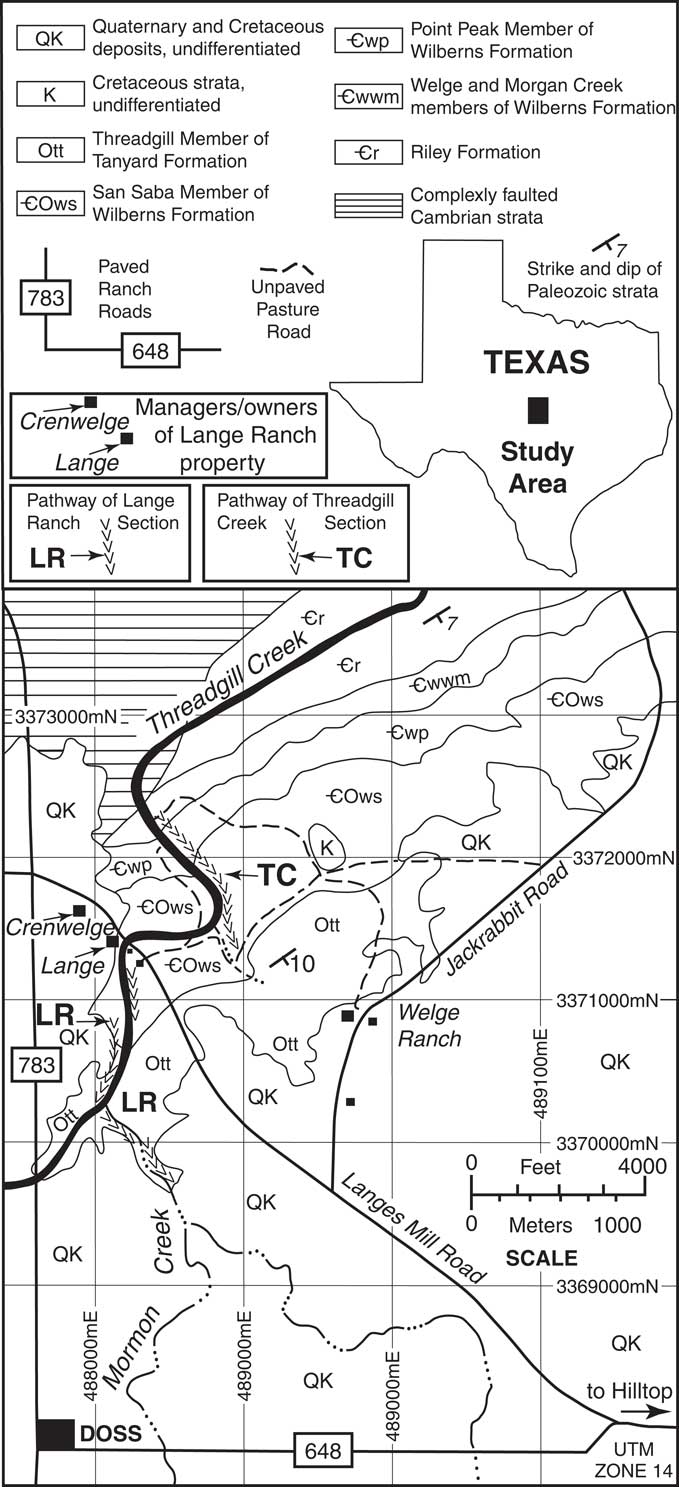
Our brachiopod collections are from limestones deposited in a shallow subtidal environment on the Laurentian platform (Lochman-Balk, Reference Lochman-Balk1970; Barnes and Bell, Reference Barnes and Bell1977; Osleger and Read, Reference Osleger and Read1993). The samples were collected from the Cambrian–Ordovician Wilberns Formation (uppermost Point Peak Member and lowermost San Saba Member) and Ordovician Tanyard Formation exposed around the Llano Uplift in central Texas (Fig. 1). The Wilberns Formation includes abundant grainstones, indicating high-energy, shallow conditions. Brachiopods from samples of the Wilberns Formation are generally fragmental. The overlying type section of the Threadgill Member of the Tanyard Formation is primarily lime mudstone and yielded specimens that were somewhat more complete, although frequently crushed. The interval includes parts of two North American upper Cambrian–lowermost Ordovician stages (Fig. 2), the Sunwaptan and Skullrockian stages, approximately correlating to the global Cambrian Furongian stages 9–10 and the Lower Ordovician Tremadocian Stage.
Location of two measured sections near the Llano Uplift. LR is Lange Ranch Section; TC is Threadgill Creek Section.

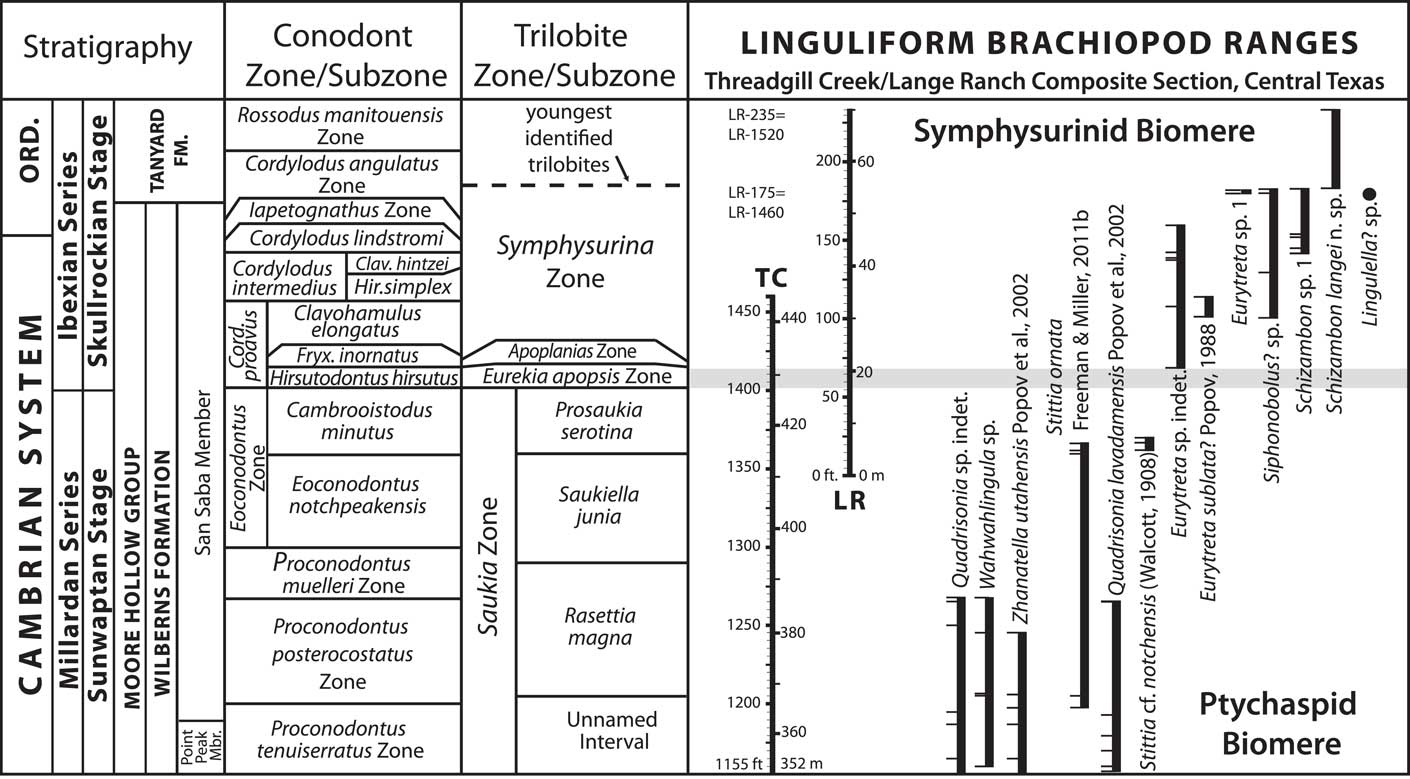
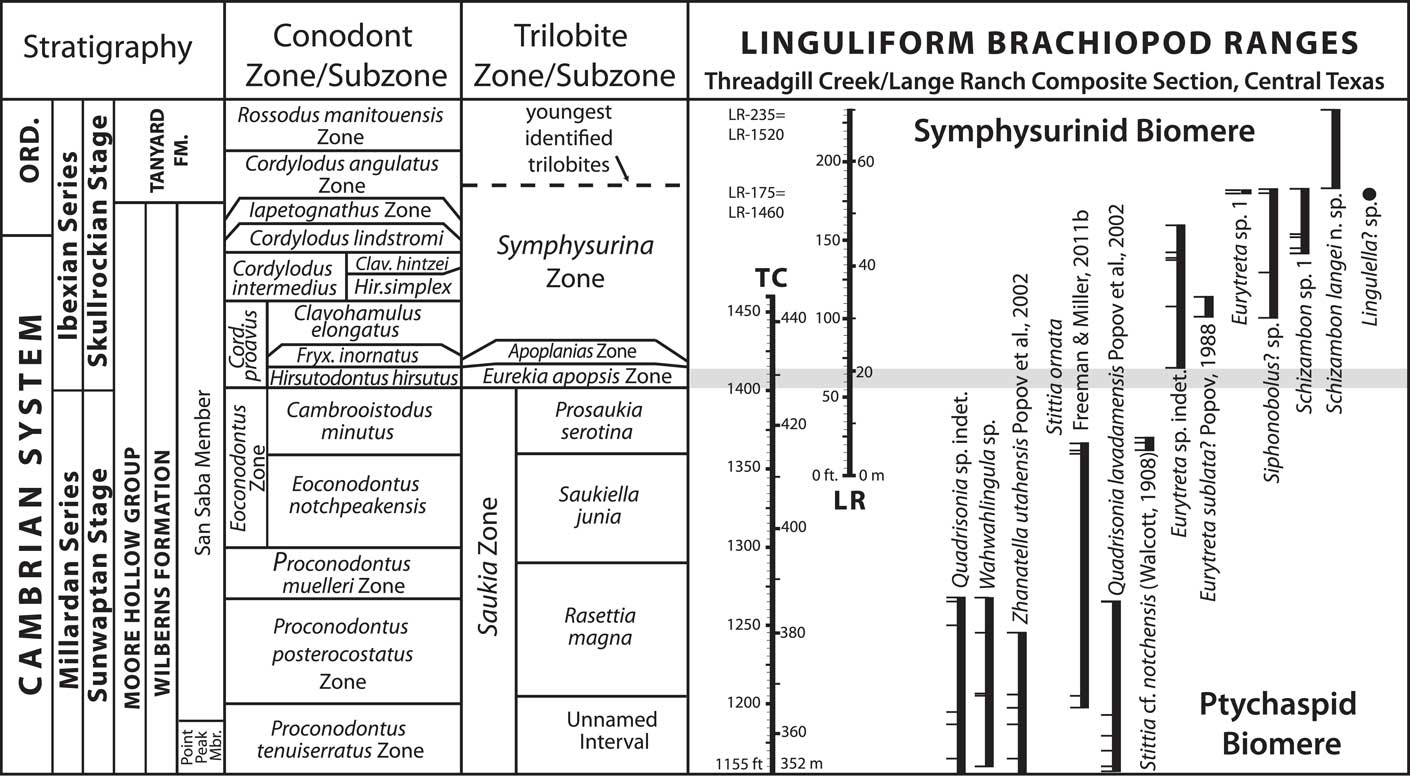
Stratigraphic ranges of linguliform brachiopods in the Threadgill Creek/Lange Range composite section, Gillespie County, Texas. Conodont and trilobite zonation after Loch and Taylor (Reference Loch and Taylor2011) and Miller et al. (Reference Miller, Loch and Taylor2012). Tic marks indicate sampled horizons that yielded brachiopods. The two sections are correlated at the base of the Cordylodus intermedius Zone, at 445 m above the base of the Threadgill Creek section and 34.1 m above the base of the Lange Ranch Section. Gray shaded ‘critical interval’ is Stage 4 of Stitt’s (Reference Stitt1971b) and Stage 1 of Palmer’s (Reference Palmer1979) interpretations of the biomere concept. Clav.=Clavohamulus hintzei conodont Subzone; Hir.=Hirsutodontus simplex conodont Subzone; and Fryx.=Fryellodontus inornatus conodont Subzone.
Samples from these strata were collected at two measured sections that form a composite section. The sections are on two private ranches near Doss, Texas (Fig. 1), and permission from the owners is necessary to visit them. The section measurements in meters correspond to previously published section measurements (reviewed in Miller et al., Reference Miller, Loch and Taylor2012). The accessible part of the Threadgill Creek section (TC) under consideration begins at 30.485309N, -99.121655W (Datum WGS84), although only the upper part of the section was collected for this project. The Lange Ranch section (LR) begins a little farther upstream on Threadgill Creek at 30.474924N, -99.123782W and continues up Mormon Creek. These sections are part of the Threadgill Creek section measured and described by V.E. Barnes (Bridge et al., Reference Bridge, Barnes and Cloud1947) and later expanded by Barnes and Bell (Reference Barnes and Bell1977). The faunas of these strata have been the subject of numerous investigations particularly focusing on trilobite and conodont biostratigraphy (Bell and Ellinwood, Reference Bell and Ellinwood1962; Winston and Nicholls, Reference Winston and Nicholls1967; Longacre, Reference Longacre1970; Miller et al., Reference Miller, Taylor, Stitt, Ethington, Hintze and Taylor1982; Stitt and Miller, Reference Stitt and Miller1987; Miller and Stitt, Reference Miller and Stitt1995; Stitt and Metcalf, Reference Stitt and Metcalf1995; Miller et al., Reference Miller, Evans, Loch, Ethington, Stitt, Holmer and Popov2003, Reference Miller, Loch and Taylor2012; Loch and Taylor, Reference Loch and Taylor2011). Other papers (Miller et al., Reference Miller, Evans, Loch, Ethington, Stitt, Holmer and Popov2003; Bassett et al., Reference Bassett, McLeod, Miller and Ethington2007) document the chemostratigraphy and sequence stratigraphy of the strata as well.
The sample numbering system (Fig. 2 and Supplemental Data Tables 1, 2) is complex due to a measurement error. The Threadgill Creek section was measured in feet (Bridge et al., Reference Bridge, Barnes and Cloud1947) and the zero-foot mark of the composite section (Barnes and Bell, Reference Barnes and Bell1977) was placed at the Precambrian/Cambrian contact. Measurement along Threadgill Creek ended at 1460 ft (445 m) at a lithologic change thought to be the contact between the Wilberns and Tanyard formations; overlying strata are poorly exposed. Measurement was offset to what is now called the Lange Ranch section (Fig. 2), and the footage ‘1460’ was painted at the Wilberns/Tanyard contact. Later, J.F. Miller discovered ~63 ft (~19 m) of strata missed in making the offset (Barnes and Bell, Reference Barnes and Bell1977). These strata and strata exposed below are assigned to the uppermost Wilberns Formation and were numbered 1–175 ft, with LR-175 (top of Wilberns Formation) equivalent to LR-1460 (base of Tanyard Formation in Barnes’ original section), and LR-112 equivalent to TC-1460 in the original section. The Tanyard Formation exposed in the Lange Ranch section is measured upward continuing from LR-1460 following paint marks made by V.E. Barnes.
Bulk samples of 2–5 kg dissolved in 10% acetic acid yielded insoluble residue containing 813 identifiable brachiopod valves from 41 stratigraphic levels. Examination and imaging of specimens utilized Hitachi 4800, Hitachi S3400N, and JEOL JSM-6010 scanning electron microscopes (SEM).
Repositories and institutional abbreviations
Specimens are reposited with the University of Texas-Austin Non-Vertebrate Paleontology Laboratory (NPL). Abbreviations used for type specimen repositories are as follows: Central Scientific Research Geological Exploration Museum, St. Petersburg (CNIGR), and United States National Museum (USNM).
Systematic paleontology
Classification is after Holmer and Popov (Reference Holmer and Popov2000), with exceptions noted.
Subphylum Linguliforma Williams et al., Reference Williams, Carlson, Brunton, Popov and Holmer1996
Class Lingulata Gorjansky and Popov, Reference Gorjansky and Popov1985
Order Lingulida Waagen, Reference Waagen1885
Superfamily Linguloidea Menke, Reference Menke1828
Family Obolidae King, Reference King1846
Subfamily Obolinae King, Reference King1846
Genus Lingulella Salter, Reference Salter1866
Type species
Lingula davisii M’Coy, Reference M’Coy1851.
Diagnosis
Sutton et al. (Reference Sutton, Bassett and Cherns2000) redescribed the type species, and we follow their concept of the genus.
Lingulella? sp.
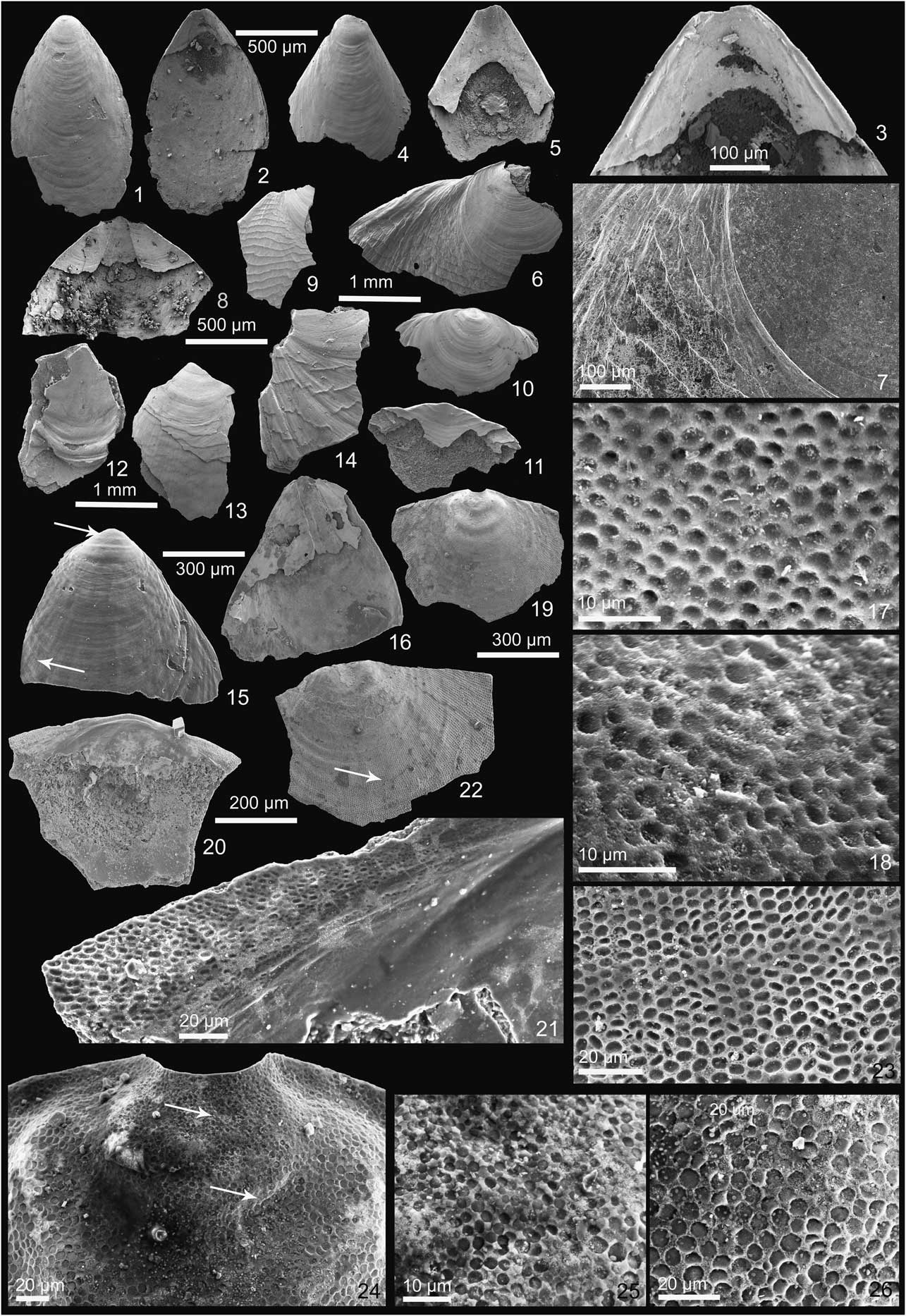
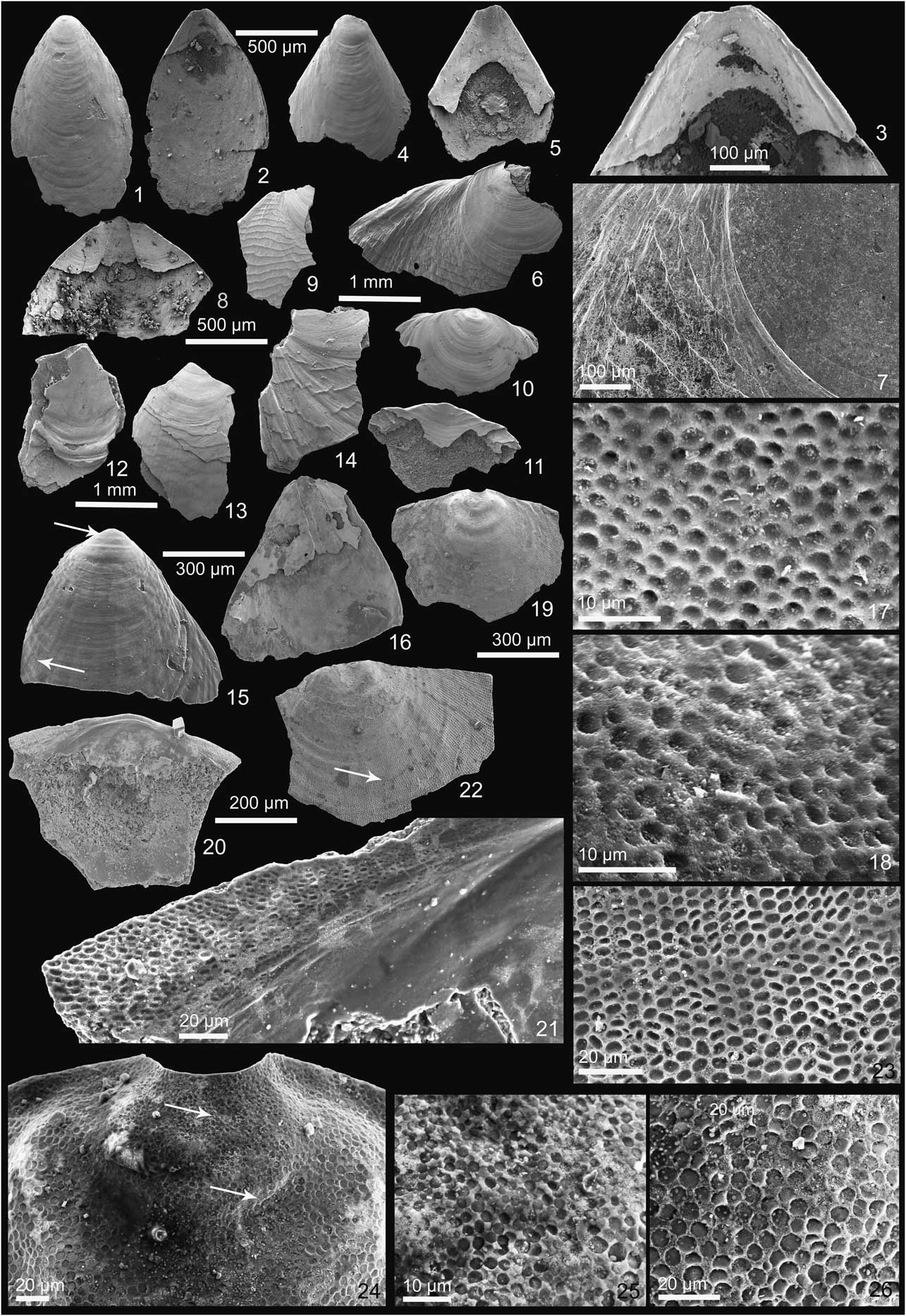
Lingulella sp., from the Cordylodus angulatus conodont Zone, in the Threadgill Member of the Tanyard Formation, Texas; scale bar is 500 μm: (1–3) ventral exterior and interior valve from LR-1465.5, detail of hinge (NPL 45434); (4, 5), ventral valve fragment exterior, interior from LR-1465.5 (NPL 45435). Stittia ornata from lower Saukia trilobite Zone and the Proconodontus tenuiserratus conodont Zone, in the San Saba Member of the Wilberns Formation, Texas; scale bar is 1 mm (6, 7), 500 μm (8): (6, 7), dorsal exterior fragment from TC-1197.5, detail of larval shell and postlarval ornament, (NPL 45436); (8) ventral interior fragment from TC-1197.5 (NPL 45438). Stittia?, from the Cambrooistodus minutus Subzone of the Eoconodontus notchpeakensis conodont Zone and the Prosaukia serotina Subzone of the Saukia trilobite Zone, in the San Saba Member of the Wilberns Formation, Texas; scale bar is 1 mm: (9) fragment from LR-21, exterior showing larval and postlarval ornamentation (NPL 45439). Stittia sp., from the Eoconodontus notchpeakensis Subzone of the Eoconodontus conodont Zone and the Prosaukia serotina Subzone of the Saukia trilobite Zone, in the San Saba Member of the Wilberns Formation, Texas; scale bar equals 500 μm: (10, 11) dorsal fragment exterior and interior from LR-13.5 (NPL 45441). Stittia cf. S. notchensis (Walcott, Reference Walcott1908) from the Cambrooistodus minutus Subzone of the Eoconodontus notchpeakensis conodont Zone and the Prosaukia serotina Subzone of the Saukia trilobite Zone, in the San Saba Member of the Wilberns Formation, Texas; scale bar is 1 mm (12, 13), 500 μm (14): dorsal (?) fragment interior and exterior from LR-24 (NPL 45442); (14) fragment showing larval and postlarval growth from LR-24 (NPL 45443). Wahwahlingula sp. from the Proconodontus posterocostatus conodont Zone and the Rasettia magna Subzone of the Saukia trilobite Zone of the San Saba Member of the Wilberns Formation, Texas; scale bar is 300 μm unless indicated otherwise: (15–18) ventral exterior and interior, detail of ornament on postlarval shell at position indicated by arrow on 15, detail of ornament on larval shell at position indicated by arrow on 15 (NPL 85570). Zhanatella utahensis Popov, Holmer, and Miller Reference Popov, Holmer and Miller2002, from Proconodontus posterocostatus conodont Zone and the Rasettia magna trilobite Subzone of the Saukia Zone in the San Saba Member of the Wilberns Formation, Texas; scale bar is 300 μm unless indicated otherwise: (19, 24–26) ventral valve exterior, detail of larval shell, ornament of early larval shell growth, ornament of later larval shell growth, from TC-1245 (NPL 45448). Zhanatella utahensis Koneva, Reference Koneva1986, from the Proconodontus tenuiserratus conodont Zone and the Saukia trilobite Zone of the San Saba Member of the Wilberns Formation, Texas; scale bar is 200 μm unless indicated otherwise: (20, 21) dorsal interior, detail of ornament on proparea (NPL 85571); (22, 23) dorsal exterior, detail of ornament at position indicated by arrow on 22 (NPL 8557).
Occurrence
In sample LR-1465.5, 5.5 ft (1.7 m) above the base of the Tanyard Formation, in the Cordylodus angulatus conodont Zone.
Description
Ventral valve suboval, laterally elongated with sharply acuminate posterior margin. Larval shell round in outline, prominent, ~250 μm in width. Pseudointerarea with wide, shallow, subtriangular pedicle groove. Anterior margin of pedicle groove strongly concave in outline (Fig. 3.2, 3.5). Flexure lines faint (Fig. 3.3). Dorsal valve not known.
Materials
Five ventral valves, all fragmental (Supplemental Data Table 2), including illustrated ventral valves NPL 45434 and NPL 45435.
Remarks
The material is tentatively assigned to the genus Lingulella because internal pitting, a character of the type species, is not seen, although the collection is of poorly preserved juveniles and small fragments of larger valves on which the pitting is unlikely to be preserved.
Stittia Freeman and Miller, Reference Freeman and Miller2011b
Type species
Stittia ornata Freeman and Miller, Reference Freeman and Miller2011b.
Diagnosis
As in Freeman and Miller (Reference Freeman and Miller2011b).
Stittia ornata Freeman and Miller, Reference Freeman and Miller2011b
2011a Genus and species indeterminate, Reference Freeman and MillerFreeman and Miller, p. 698, figs. 1, 2.
2011b Stittia ornata Reference Freeman and MillerFreeman and Miller, p. 45, fig. 4F–4P.
Holotype
Ventral valve (USNM 542983) from the upper Cambrian Hellnmaria Member of the Notch Peak Formation, western Utah (Freeman and Miller, Reference Freeman and Miller2011b, fig. 4M, 4N).
Diagnosis
As in Freeman and Miller (Reference Freeman and Miller2011b).
Occurrence
In the Saukia trilobite Zone and the Proconodontus tenuiserratus and Proconodontus posterocostatus conodont zones, in the Point Peak Member and San Saba Member of the Wilberns Formation. In the same conodont zones in the Hellnmaria Member of the Notch Peak Formation, Utah (Freeman and Miller, Reference Freeman and Miller2011b). Possibly in the Eoconodontus notchpeakensis and lowest Cambrooistodus minutus conodont Subzones and the Prosaukia serotina Subzone of the Saukia trilobite Zone in the San Saba Member of the Wilberns Formation.
Description
Larval shells 700–800 μm wide, as reconstructed from a fragment (Fig. 3.6). Larval shell with faint radial ornamentation and strong growth lines. Postlarval ornamentation of transverse terrace-like ridges, asymmetrical in lateral profile (Fig. 3.6, 3.7). Ridges cross growth lines and may truncate against the posterior lateral margins of larval shell. Ridges spaced 50–60 μm apart.
Materials
Four dorsal valves and one ventral valve, all fragmental, and numerous small fragments (Supplemental Data Table 1), including illustrated dorsal valves fragments NPL 45436, and ventral valve fragment 45438.
Remarks
Despite the fragmental nature of this material, diagnostic characteristics can be seen in the smooth larval shell and transverse postlarval ornament. Transverse grooves in the dorsal pseudointerarea are another diagnostic characteristic of the genus. This feature is present on fragments not identified to species due to lack of preserved ornament. The material differs slightly from Utah material assigned to Stittia ornata (Freeman and Miller, Reference Freeman and Miller2011b) in the spacing of the transverse ornament. On these specimens, it is spaced at 50–60 μm apart on neanic (juvenile) growth, but it is spaced 40–55 μm on Utah material. Well-preserved specimens of the species are rare in both locations, and differences in ornament may be variable among individuals. The spacing of the transverse ornament distinguishes the species from Stittia cf. S. notchensis (Walcott, Reference Walcott1908), on which transverse ridges are spaced 100–200 μm apart on neanic growth.
Stittia cf. S. notchensis (Walcott, Reference Walcott1908)
1908 Obolus (Westonia) notchensis Reference WalcottWalcott, p. 69, fig. 13.
1912 Obolus (Westonia) notchensis Walcott; Reference WalcottWalcott, p. 463, pl. 63, fig. 9.
2011b Stittia cf. notchensis (Walcott); Reference Freeman and MillerFreeman and Miller, p. 46, fig. 4A–4E.
Holotype
Ventral valve (USNM 51731a) from the Notch Peak Formation, western Utah (Walcott, Reference Walcott1908, pl. 7, fig. 13).
Occurrence
In the Eoconodontus notchpeakensis and Cambrooistodus minutus conodont zones and the Prosaukia serotina Subzone of the Saukia trilobite Zone, in the San Saba Member of the Wilberns Formation.
Materials
One dorsal valve fragment (NPL 45442) and 10 fragments unidentifiable to valve (Supplemental Data Table 1), including illustrated specimen NPL 45443.
Remarks
The species is identified from comminuted shell fragments, some preserving parts of the smooth larval shell and characteristic postlarval ornament of transverse ridges spaced ~200 μm apart (Fig. 3.15), as well as from one dorsal valve fragment with the characteristic elongated dorsal median groove (Fig. 3.13).
Family Zhanatellidae Koneva, Reference Koneva1986
Genus Wahwahlingula Popov, Holmer, and Miller, Reference Popov, Holmer and Miller2002
Type species
Lingula antiquissima Jeremejew, Reference Jeremejew1856.
Diagnosis
Wahwahlingula with larval ornament of circular to subcircular, 2–4 μm diameter flat-bottomed pits. Pits may overlap each other (Fig. 3.18). Postlarval ornament of circular to subcircular, 3–5 μm diameter round-bottomed pits, evenly spaced and arranged in indistinct and randomly oriented lines (Fig. 3.17).
Occurrence
In the lowest strata of the Saukia trilobite Zone, and in the Proconodontus tenuiserratus, Proconodontus posterocostatus conodont zones, and lowest strata of the Proconodontus muelleri conodont Zone, in the Morgan Creek Limestone Member, Point Peak Member, and San Saba Member of the Wilberns Formation.
Description
Low pedicle groove with subparallel margins (Fig. 3.16). Propareas low with faint flexure lines (Fig. 3.16).
Materials
Five ventral valve fragments, including illustrated ventral valve fragment NPL 85570.
Remarks
These specimens represent fragments of the thickened ventral propareas of what were clearly much larger specimens. The species differs from the type species in the pattern of pitting on postlarval growth. The species differs from Wahwahlingula sp. 1 reported from a similar stratigraphic interval in Utah (Freeman and Miller, Reference Freeman and Miller2011b) in having evenly spaced, mostly uniform round-bottomed pits in the postlarval growth. It differs from Wahwahlingula sp. 2, also from a similar stratigraphic position in Utah (Freeman and Miller, Reference Freeman and Miller2011b) in having subcircular rather than oval round-bottomed pits. It differs from the stratigraphically higher Utah Wahwahlingula sevierensis Holmer et al., Reference Holmer, Popov, Streng and Miller2005 in the slightly larger size of both the larval and postlarval pits. It differs from Wahwahlingula? emanuelensis Brock and Holmer, Reference Brock and Holmer2004, and Wahwahlingula kharbashi Ghobadi Pour, Kebriaee-Zadeh, and Popov, Reference Ghobadi Pour, Kebriaee-Zadeh and Popov2011, in having pitted ornament on its larval shell.
Genus Zhanatella Koneva, Reference Koneva1986
Type species
Zhanatella rotunda Koneva, Reference Koneva1986.
Zhanatella utahensis Popov, Holmer, and Miller, Reference Popov, Holmer and Miller2002
2002 Zhanatella utahensis Reference Popov, Holmer and MillerPopov, Holmer, and Miller, p. 221, fig. 5.1–5.19.
2011b Zhanatella utahensis Popov et al.; Reference Freeman and MillerFreeman and Miller, p. 53, fig. 7I–7V.
Holotype
Ventral valve (USNM 516778) from the Red Tops Member of the Notch Peak Formation, western Utah (Popov et al., Reference Popov, Holmer and Miller2002, fig. 5.16–5.18).
Diagnosis
As in Popov et al. (Reference Popov, Holmer and Miller2002).
Occurrence
In the Proconodontus tenuiserratus and Proconodontus posterocostatus conodont zones and the Saukia trilobite Zone, in the Point Peak Member and San Saba Member of the Wilberns Formation. In the same conodont zones, in the Hellnmaria Member of the Notch Peak Formation in western Utah (Freeman and Miller, Reference Freeman and Miller2011b), and in the Cambrooistodus minutus conodont Subzone, in the Red Tops Member of the Notch Peak Formation in western Utah (Popov et al., Reference Popov, Holmer and Miller2002).
Materials
Seven dorsal valves and one ventral valve (Supplemental Data Table 1), including illustrated dorsal valves NPL 85571and NPL 85572 and ventral valve NPL 45448.
Remarks
The material is fragmental, but matches material described and illustrated previously. Freeman and Miller (Reference Freeman and Miller2011b) illustrated but did not discuss differences between ornamentation on the larval shell versus postlarval ornamentation. Pits on the larval shell are more nearly round, are flat-bottomed (Fig. 3.25, 3.26), and vary in size from 1–3 μm near the beak of the larval shell (Fig. 3.25) to 4–6 μm closer to the margin of the larval shell (Fig. 3.26), whereas pits on postlarval growth are strongly oval in outline and round-bottomed, forming irregular, longitudinal rows (Fig. 3.22, 3.23). The pits on the larval shell are more randomly arranged, and may overlap each other (Fig. 3.25, 3.26).
Order Acrotretida Kuhn, Reference Kuhn1949
Superfamily Acrotretoidea Schuchert, Reference Schuchert1893
Family Acrotretidae Schuchert, Reference Schuchert1893
Genus Eurytreta Rowell, Reference Rowell1966
Type species
Acrotreta curvata Walcott, Reference Walcott1902.
Diagnosis
As in Streng et al. (Reference Streng, Mellbin, Landing and Keppie2011).
Eurytreta sublata? Popov in Koneva and Popov, Reference Koneva and Popov1988
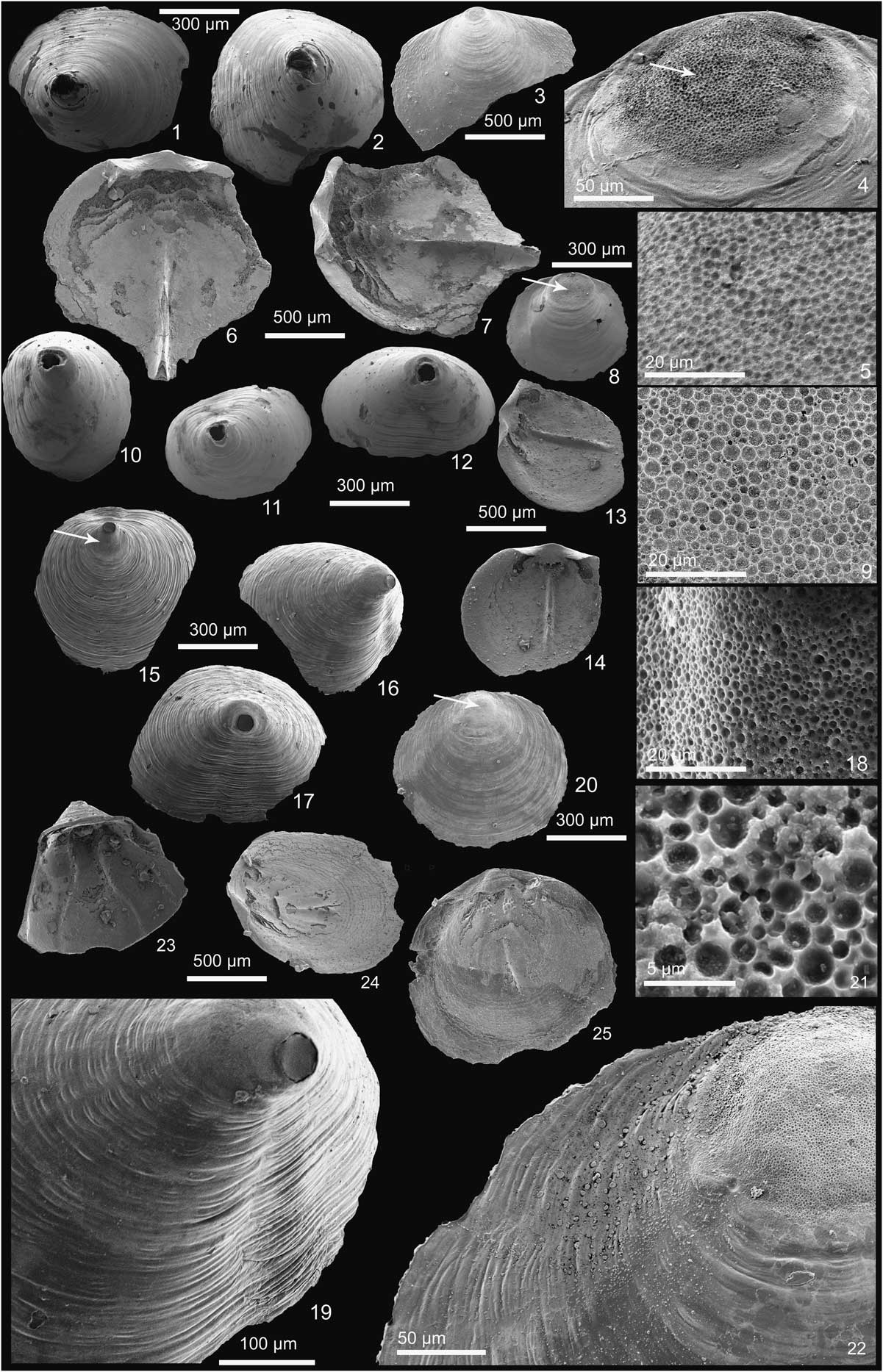
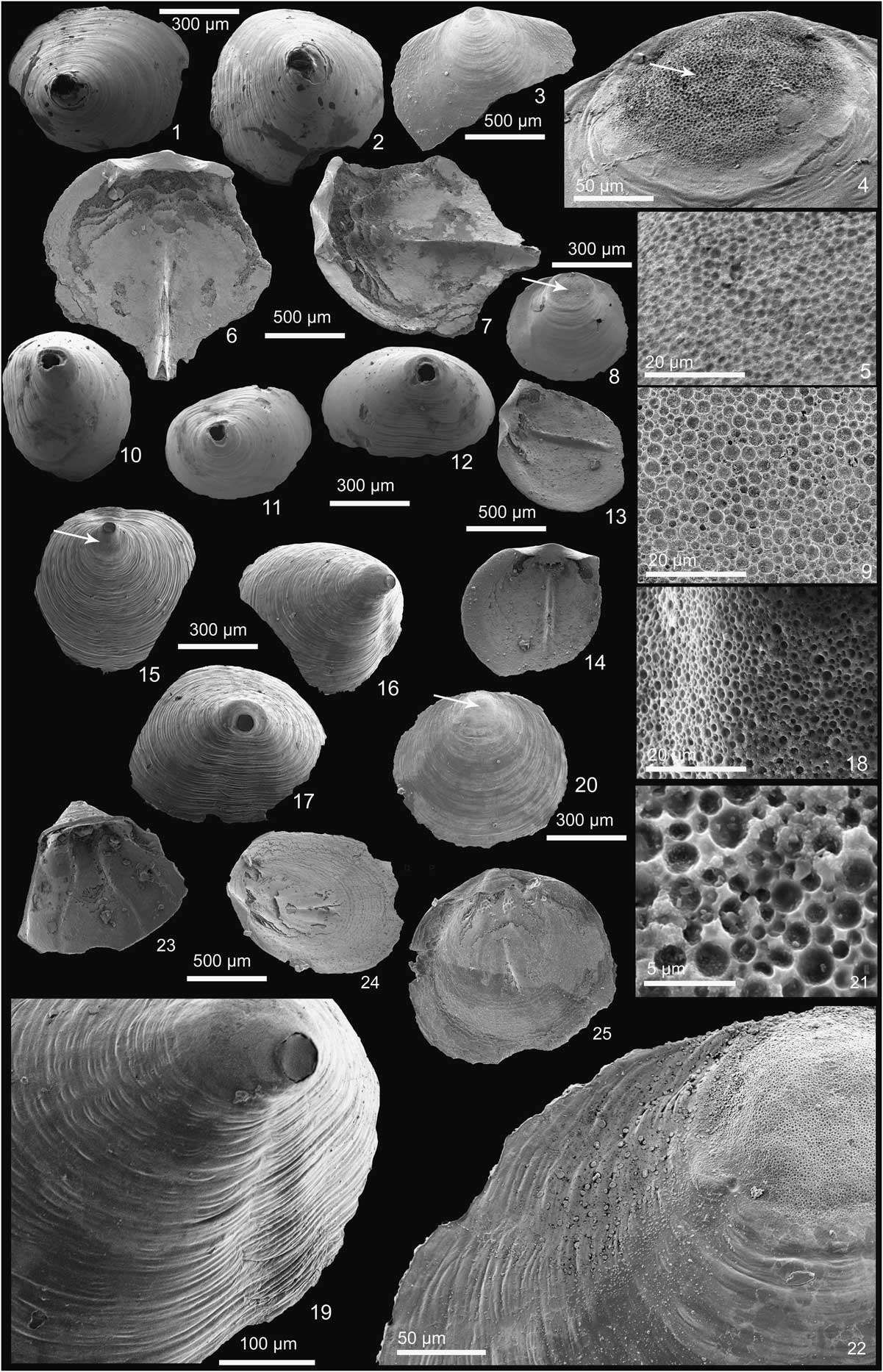
Eurytreta sublata? Popov, in Koneva and Popov, 1988 from the base of the Cordylodus intermedius conodont Zone and from the Symphysurina trilobite Zone, in the San Saba Member of the Wilberns Formation, Texas; all are from sample TC-1460; scale bar is 300 μm (1, 2) and 500 μm (3, 6, 7): (1, 2) ventral valve exterior and oblique exterior (NPL 45471); (3–5) dorsal valve exterior, detail of larval shell, and detail of micrornament on larval shell at location indicated by arrow on (4) (NPL 45472); (6, 7) dorsal valve interior, oblique view of dorsal interior (NPL 45473). Eurytreta sp. 1, from the Cordylodus angulatus conodont Zone, in the lowest part of the Threadgill Member of the Tanyard Formation, Texas; all are from sample LR-1465.5 Scale bar is 300 μm (8, 10–12) and 500 μm (13, 14): (8, 9) dorsal valve exterior, detail of microornament on larval shell at position indicated by arrow on 8 (NPL 45474); (10–12) ventral valve oblique lateral view, oblique exterior, and oblique posterior view, NPL 45475; (13, 14) dorsal valve oblique interior, interior, (NPL 45476). Quadrisonia lavadamensis Popov, Holmer, and Miller, Reference Popov, Holmer and Miller2002, from TC-1160 in the Proconodontus tenuiserratus conodont Zone, in the Point Peak Member of the Wilberns Formation, Texas: scale bar is 300 μm (15–17, 20), 500 μm for all others unless indicated otherwise: (15–19) ventral valve exterior, oblique view of exterior, posterior view, detail of larval shell ornament at location indicated by arrow on (15), detail of larval shell and intertrough (NPL 85573); (20–22) dorsal valve exterior, detail of larval shell ornament at location indicated by arrow on 20, detail of larval shell and postlarval shell drapery-like ornament (NPL 85574); (23) ventral valve fragment interior (NPL 85575); (24, 25) dorsal valve interior, oblique view of dorsal valve interior (NPL 85576).
1967 Conotreta sp. Reference Winston and NichollsWinston and Nicholls, p. 92, pl. 12, figs. 21, 24, 27.
1988 Eurytreta sublata Popov in Reference Koneva and PopovKoneva and Popov, p. 60, pl. 2.4–2.8, pl. 3.11, fig. 3.
2001 Eurytreta sublata Popov; Reference Holmer, Popov, Koneva and BassettHolmer et al., p. 90, pl. 24.9–24.17, pl. 25.1, 25.2, 25.4.
2002 Eurytreta sublata Popov; Reference Popov, Holmer and MillerPopov et al., p. 223, fig. 8.10–8.28.
Holotype
Dorsal valve (CNIGR 13/12034) from the upper Cambrian Batrybay Section, Malyi Karatau, Kazakhstan (Koneva and Popov, Reference Koneva and Popov1988, pl. 2.4).
Diagnosis
As in Popov et al. (Reference Popov, Holmer and Miller2002).
Occurrence
At the base of the Cordylodus intermedius conodont Zone, and in the Clavohamulus elongatus Subzone of the Cordylodus proavus conodont Zone, in the Symphysurina trilobite Zone, in the San Saba Member of the Wilberns Formation. Species occurs in the Cordylodus proavus and Cordylodus intermedius conodont zones and the Apoplanias trilobite Zone and the Symphysurina trilobite Zone in the Lava Dam Member of the Notch Peak Formation and the lower part of the Barn Canyon Member of the House Limestone in Utah (Popov et al., Reference Popov, Holmer and Miller2002; Miller et al., Reference Miller, Evans, Freeman, Ripperdan and Taylor2011). Type material from Malyi Karatau Range, southern Kazakhstan Euloma-Leiostegium trilobite beds (Koneva and Popov, Reference Koneva and Popov1988), and Cordylodus proavus conodont Zone (Holmer et al., Reference Holmer, Popov, Koneva and Bassett2001). In Iran in the latest Cambrian Shirgesht Formation, slightly below strata bearing the conodont Cordylodus angulatus (Popov et al., Reference Popov, Bassett, Holmer and Pour2009a).
Description
Subconical ventral valve and gently inflated dorsal valve. Shape of outline of shell not known. Larval shell ~150 μm in diameter with prominent, slightly raised margin. Larval shell ornamented with micropits, circular in outline, with rounded bottoms, from ~3 μm in diameter to <1 μm.
Dorsal larval shell with prominent thickened rim at margin (Fig. 4.4). Dorsal valve with occasional small disruptions of growth exhibited as ‘nickpoints,’ especially in posterolateral area of valve. Slightly anacline pseudointerarea divided by wide, triangular median groove. Median buttress prominent, transversely subrectangular. Low median ridge arises just anterior to median buttress and extends anteriorly for an undetermined distance (Fig. 4.6, 4.7). Cardinal muscle scars suboval, closely spaced, and located slightly lateral to the median buttress.
Ventral pseudointerarea apparently catacline to slightly procline, divided by narrow interridge (Fig. 4.1, 4.2). Posterior margin convex in outline, with lateral edges of pseudointerarea poorly defined. External foramen contained within larval shell, located at apex. Internal pedicle tube. All other features of ventral interior exfoliated or obscured by sediment.
Materials
Eighty-seven dorsal valves and 77 ventral valves (Supplemental Data Tables 1, 2), including illustrated dorsal valves NPL 45472 and NPL 45473, and ventral valve NPL 45471.
Remarks
The interridge on these fragmental, poorly preserved ventral valves is a useful character for identification, because most species of Eurytreta have an intertrough or an undivided pseudointerarea. Eurytreta discors Popov in Koneva and Popov, Reference Koneva and Popov1988 has an interridge, but differs in being procline. Although no complete dorsal valves were recovered, a low median septum is present and is a characteristic of E. sublata. The dorsal cardinal muscle scars of Eurytreta sublata are raised and surrounded by a high rim, which is a feature not clearly seen on this abraded and exfoliated material.
Streng et al. (Reference Streng, Mellbin, Landing and Keppie2011) rediagnosed the genus Eurytreta using key characteristics that include a catacline to apsacline ventral pseudointerarea, hemispherical (round-bottomed) pits on larval growth, and a baculate mantle canal system. This rediagnosis questionably included the species E. sublata in the genus because of its catacline to weakly procline ventral pseudointerarea and because of lack of knowledge of larval shell pitting. This Texas material reveals the type of larval pitting assignable to the genus Eurytreta, but it is too poorly preserved to allow determination of the mantle canal system.
The specimens identified as Conotreta sp. by Winston and Nicholls (Reference Winston and Nicholls1967) from coeval strata in central Texas demonstrate the distinctive characteristics of E. sublata, including a pronounced ventral interridge and a low, narrow but elongate dorsal septum that does not form a triangular tip. Winston and Nicholls (Reference Winston and Nicholls1967) described dorsal specimens with a small but deep median groove, whereas Popov et al. (Reference Popov, Holmer and Miller2002) described the median groove of the species as shallow. Winston and Nicholls’ illustrated specimen (1967, pl. 12, fig. 27) does not appear to differ in this regard from previously illustrated specimens of E. sublata (Koneva and Popov, Reference Koneva and Popov1988; Holmer et al., Reference Holmer, Popov, Koneva and Bassett2001; Popov et al., Reference Popov, Holmer and Miller2002).
Eurytreta sp. 1
Occurrence
In the Cordylodus angulatus conodont Zone, in the lowest part of the Threadgill Member of the Tanyard Formation.
Description
High, subconical ventral valve with foramen placed at apex, within larval shell. Ventral valve transversely suboval in outline. Steeply procline to catacline pseudinterarea with broad, poorly defined intertrough on some specimens. Growth lines especially prominent in central area of ventral pseudointerarea (Fig. 4.10–4.12). Larval shell of ventral valve ~150 μm in diameter, with microornamentation of hemispherical pits ~3 μm in diameter interspersed with clusters of smaller pits <1 μm in diameter. An internal pedicle tube is present, but other features of the ventral interior are exfoliated or obscured by matrix.
Gently convex dorsal valve, transversely suboval in outline. Larval shell with margin thickened and prominent (Fig. 4.8). Gently anacline pseudointerarea divided by wide, shallow, triangular median groove. Median buttress well developed, transversely rectangular in outline. Low median ridge arises just anterior of median buttress and extends to a position well to the anterior of median point of valve length (Fig. 4.13, 4.14). Median ridge rounded along ventral margin. Suboval cardinal muscle scars large and prominent, closely spaced.
Materials
Sixty dorsal valves, 28 ventral valves, and one whole shell (Supplemental Data Table 2), including illustrated dorsal valves NPL 45474 and NPL 45476 and ventral valve NPL 45475.
Remarks
The material is badly exfoliated and mostly fragmental. Pseudointerareas of the ventral valves have either a weak intertrough (Fig. 4.10–4.12) or are undivided—a feature common to many species of Eurytreta. Interior features of both valves are poorly known due to exfoliation.
The low median ridge of the dorsal valve is similar to stratigraphically lower specimens assigned herein to Eurytreta sublata?, but the ventral valves differ in having an indistinct intertrough rather than an interridge. In Utah the species Eurytreta cf. bisecta (Matthew, Reference Matthew1901) replaces Eurytreta sublata in the lower part of the Cordylodus lindstromi conodont Zone (Popov et al., Reference Popov, Holmer and Miller2002), but this Texas material is not assignable to E. cf. E. bisecta, which has an angular tip on the dorsal median ridge. Popov et al. (Reference Popov, Holmer and Miller2002) described specimens of Eurytreta sublata from the Cordylodus proavus Zone as more commonly having an interridge than stratigraphically higher specimens that were more commonly undivided. The lower Texas Eurytreta specimens assigned to E. sublata? herein are from the Cordylodus proavus Zone and the base of the overlying Cordylodus intermedius Zone, and it is possible that the stratigraphically higher specimens with an undivided ventral pseudointerea assigned to Eurytreta sp. 1 herein may be Eurytreta sublata instead.
A low median ridge connected to the median buttress, a thickened margin of the dorsal larval shell, and an indistinctly divided ventral pseudointerarea are characteristics of E. sabrinae (Callaway, Reference Callaway1877) as well (Streng et al., Reference Streng, Mellbin, Landing and Keppie2011). The Texas material is too poorly preserved to compare other diagnostic characters of the species, although the median ridge on the few unexfoliated dorsal valves (Fig. 4.13, 4.14) appears similar to E. sabrinae.
Genus Quadrisonia Rowell and Henderson, Reference Rowell and Henderson1978
Type species
Quadrisonia minor Rowell and Henderson, Reference Rowell and Henderson1978.
Diagnosis
As in Freeman and Miller (Reference Freeman and Miller2011b).
Quadrisonia lavadamensis Popov, Holmer, and Miller, Reference Popov, Holmer and Miller2002
2002 Quadrisonia? lavadamensis Reference Popov, Holmer and MillerPopov, Holmer, and Miller, p. 225, fig. 8.1–8.9.
2011b Quadrisonia lavadamensis (Popov et al., Reference Popov, Holmer and Miller2002); Reference Freeman and MillerFreeman and Miller, p. 59, fig. 9A–9O.
Holotype
Dorsal valve (USNM 516760) from the Lava Dam Member of the Notch Peak Formation, western Utah (Popov et al., Reference Popov, Holmer and Miller2002, fig. 8.3).
Diagnosis
As in Popov et al. (Reference Popov, Holmer and Miller2002).
Occurrence
In the Saukia trilobite Zone and the Proconodontus tenuiserratus and Proconodontus posterocostatus conodont zones, in the Point Peak Member and the San Saba Member of the Wilberns Formation. In the same conodont zones in the Hellnmaria Member of the Notch Peak Formation in Utah (Freeman and Miller, Reference Freeman and Miller2011b) and in the Proconodontus muelleri conodont Zone and the Eoconodontus notchpeakensis and Cambrooistodus minutus subzones of the Eoconodontus conodont Zone in the Red Tops Member and Lava Dam Member of the Notch Peak Formation in Utah (Popov et al., Reference Popov, Holmer and Miller2002; Miller et al., Reference Miller, Evans, Freeman, Ripperdan and Taylor2011).
Materials
Sixty dorsal valves and 51 ventral valves (Supplemental Data Table 1), including illustrated dorsal valves NPL 85573 and NPL 85574, and ventral valves NPL 85575 and NPL 85576.
Remarks
Most specimens were too fragmental and abraded to measure accurately, but proportions of more complete specimens appear to be identical to the type material (Popov et al., Reference Popov, Holmer and Miller2002). The most complete valves are figured.
Order Siphonotretida Kuhn, Reference Kuhn1949
Superfamily Siphonotretoidea Kutorga, Reference Kutorga1848
Family Siphonotretidae Kutorga, Reference Kutorga1848
Genus Schizambon Walcott, Reference Walcott1884
Type species
Schizambon typicalis Walcott, Reference Walcott1884.
Schizambon langei new species
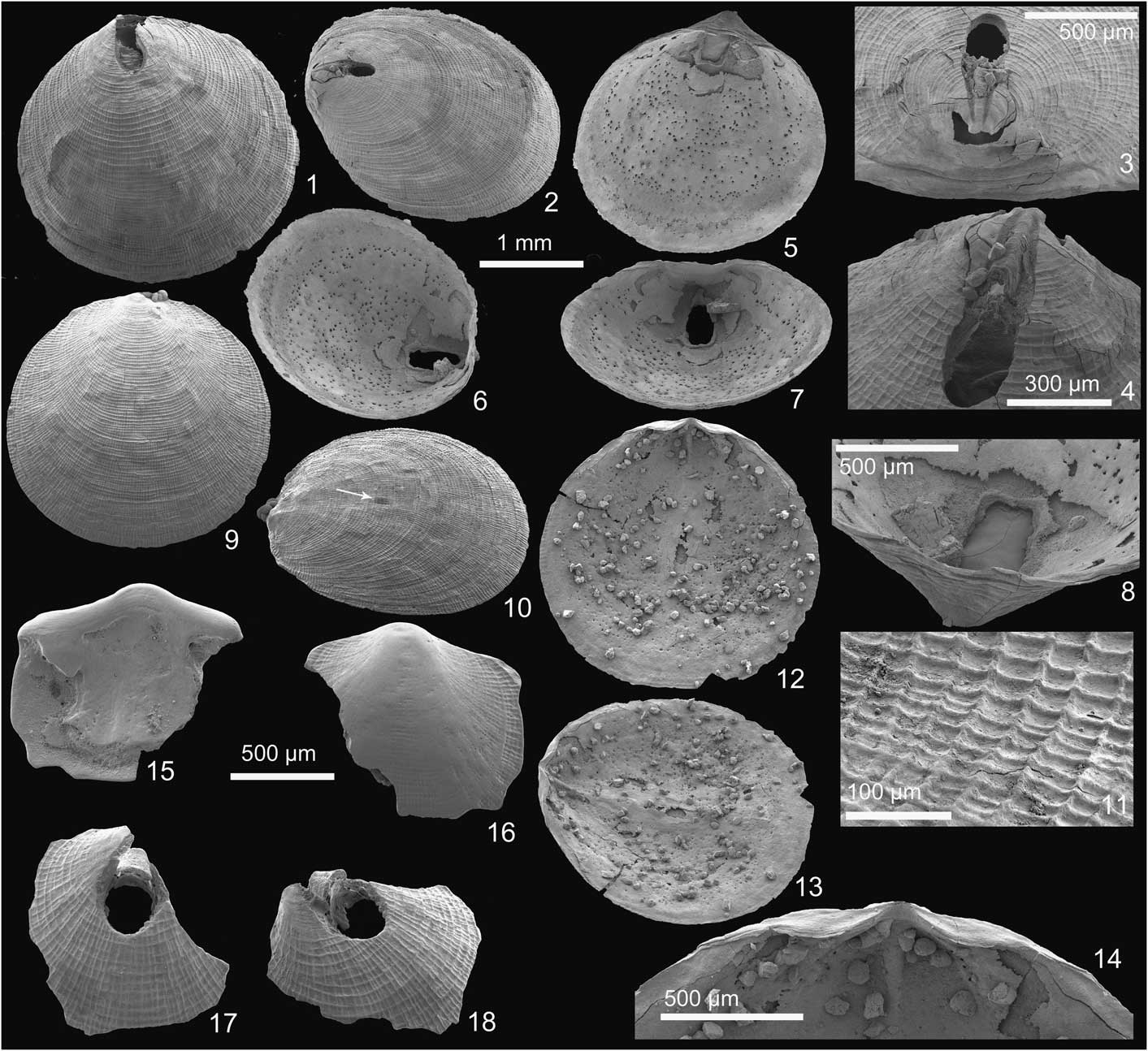
Schizambon langei n. sp., from LR-1520 in the Loxodus bransoni Subzone of the Rossodus manitouensis condont Zone, in the Threadgill Member of the Tanyard Formation, Texas; scale bar is 1 mm unless indicated otherwise: (1) ventral valve exterior (NPL 85577); (2–4) ventral valve oblique view of exterior, ventral interarea and formamen from posterior, detail of foramen (NPL 85578); (5–8) ventral valve interior, oblique view of interior, interior view from anterior, detail of interarea from posterior (NPL 85579); (9–11) dorsal valve (holotype) exterior, oblique view of exterior, detail of detail of postlarval ornament (NPL 45507); (12–14) dorsal valve interior, oblique view of interior, detail of pseudointerarea, (NPL 45506). Schizambon sp., from the Iapetognathus and Cordylodus angulatus conodont zones and the Symphysurina trilobite Zone, in the upper part of the San Saba Member of the Wilberns Formation and the lowest part of the Threadgill Member of the Tanyard Formation, Texas; scale bar is 500 μm: (15, 16) dorsal valve from LR-152 interior, exterior (NPL 45509); (17, 18) ventral valve from LR-1468 view of exterior, oblique view of exterior (NPL 45508).

Holotype
Dorsal valve NPL 45507 (Fig. 5.9–5.11), sample LR-1520, Threadgill Member of the Tanyard Formation (Lower Ordovician, Cordylous angulatus conodont Zone and the Loxodus bransoni Subzone of the Rossodus manitouensis condont Zone), Texas.
Diagnosis
Ventribiconvex shell with faintly sulcate dorsal valve. Apsacline ventral psedudointerarea. Well-developed median buttress elongated into short median septum tapering into low median ridge on dorsal valve. Ornament of radiating parvicostellae intersecting with pronounced concentric lamellae, at whose intersection low nodes and pustules are developed, not extending into spines.
Occurrence
In the Cordylous angulatus conodont Zone and the Loxodus bransoni Subzone of the Rossodus manitouensis condont Zone, in the Threadgill Member of the Tanyard Formation.
Description
Ventribiconvex, subcircular in outline. Shell thin and fragile. Postlarval ornament of strong parvicostellae crossed by equally strong, rounded lamellae that follow growth lines (Fig. 5.11). Rounded nodes formed by intersection of parvicostellae, not forming spines. Parvicostellae spaced 20–25 μm apart and lamellae spaced 30–35 μm apart in mid-stages of adult growth, resulting in laterally elongated grid pattern. Lamellae more closely and more irregularly spaced in later growth. Interior of both valves with irregularly spaced, deeply impressed rounded pits, variable in diameter 5–15 μm.
Dorsal valve gently convex, with anterior central part of shell flattened to very faintly and broadly sulcate (Fig. 5.9, 5.10). Dorsal valve transversely suboval in outline, nearly equidimensional with length 95% or more of width. Maximum width may be 3 mm or more on mature specimens. Larval shell of dorsal valve ~325 μm in width, bearing two poorly developed nodes separated by median depression. Short, narrow, orthocline dorsal pseudointerarea occupying less than half the maximum width of the valve and <5% of maximum length (Fig. 5.12, 5.14). Wide, triangular median groove divides propareas that have a concave surface and upturned anterior margin. Anterior margin of propareas slightly curved in outline. Median buttress extends into low median septum, which extends anteriorally a short distance and tapers into more gently defined median ridge extending to about two-thirds valve length (Fig. 5.12–5.13). Transversely suboval central muscle scars located lateral to median ridge at about one-third length of shell.
Ventral valve strongly inflated, with greatest height at approximately one-third of length from posterior to anterior, width 90–95% of valve length (Fig. 5.1, 5.2). Ventral pseudointerarea low, apsacline, not divided, convex in lateral profile (Fig. 5.3). Posterior margin of pseudointerarea thickened and rounded. Pedicle foramen elongate oval in shape, ~270 μm long and 190 μm wide (Fig. 5.4). Foramen covered with a thickened plate posteriorally, ~220 μm long and 130 μm wide. Plate exhibits prominent growth lines and is elevated along its length to a height equal to or greater than the valve laterally, and is bounded by deeply impressed grooves. Intact ventral valves rare in this collection and invariably exfoliated around the internal pedicle opening; details of internal pedicle tube not known. Visceral fields lightly impressed and not easily observable.
Etymology
After Dennis and Shirley Lange and their daughter Peggy Lange Crenwelge, owners of the Lange Ranch, where this species was found.
Materials
Two hundred thirty two dorsal valves and 44 mostly fragmented ventral valves, including the holotype and other illustrated material, dorsal valve NPL 45506 and ventral valves NPL 85577–85579.
Remarks
This material is similar to Schizambon obtusus Holmer et al., Reference Holmer, Popov, Streng and Miller2005 but differs in having a strongly developed dorsal median buttress extending toward the anterior as a short median ridge and in having low nodes, rather than spines, developed at the intersections of the parvicostellae and lamellae. Another difference is a more robust and well-developed plate posterior to the foramen, but because the ventral valves are so fragile, this description is based on a single specimen.
Schizambon sp.
Occurrence
In the Cordylodus lindstromi s. l., Iapetognathus, and Cordylodus angulatus conodont zones and the Symphysurina trilobite Zone, in the upper part of the San Saba Member of the Wilberns Formation and the lowest part of the Threadgill Member of the Tanyard Formation.
Description
Thick shelled and biconvex, with mature ornament of parvicostellae crossed by prominent rounded concentric lamellae. Lamellae spaced 50–70 μm apart on mature growth, and parvicostellae spaced more irregularly, 25–40 μm apart. Intersections of lamellae and parvicostellae form rounded nodes.
Ventral valve with large foramen enlarged by resorption and filled in to posterior with thick rounded, elevated plate (Fig. 5.17, 5.18). Details of ventral interior not known.
Dorsal valve with reduced orthocline pseudointerarea divided by broad median groove with poorly defined lateral edges (Fig. 5.15). Other details of interior not known.
Materials
Ten dorsal and seven ventral valves, all fragmental, (Supplemental Data Table 2) including illustrated dorsal valve NPL 45509 and ventral valve NPL 45508.
Remarks
This material is fragmentary, but distinguishable from the much larger, thin-shelled Schizambon langei n. sp., which co-occurs with this species in one sample. In features that can be observed, it is similar to Schizambon typicalis Walcott, Reference Walcott1884, which occurs in coeval strata in Utah and Nevada (Popov et al., Reference Popov, Holmer and Miller2002). The short spines characteristic of that species are not present on this material, but the specimens are poorly preserved and clearly abraded.
Genus Siphonobolus Havlíček, Reference Havlíček1982
Siphonobolus? sp.
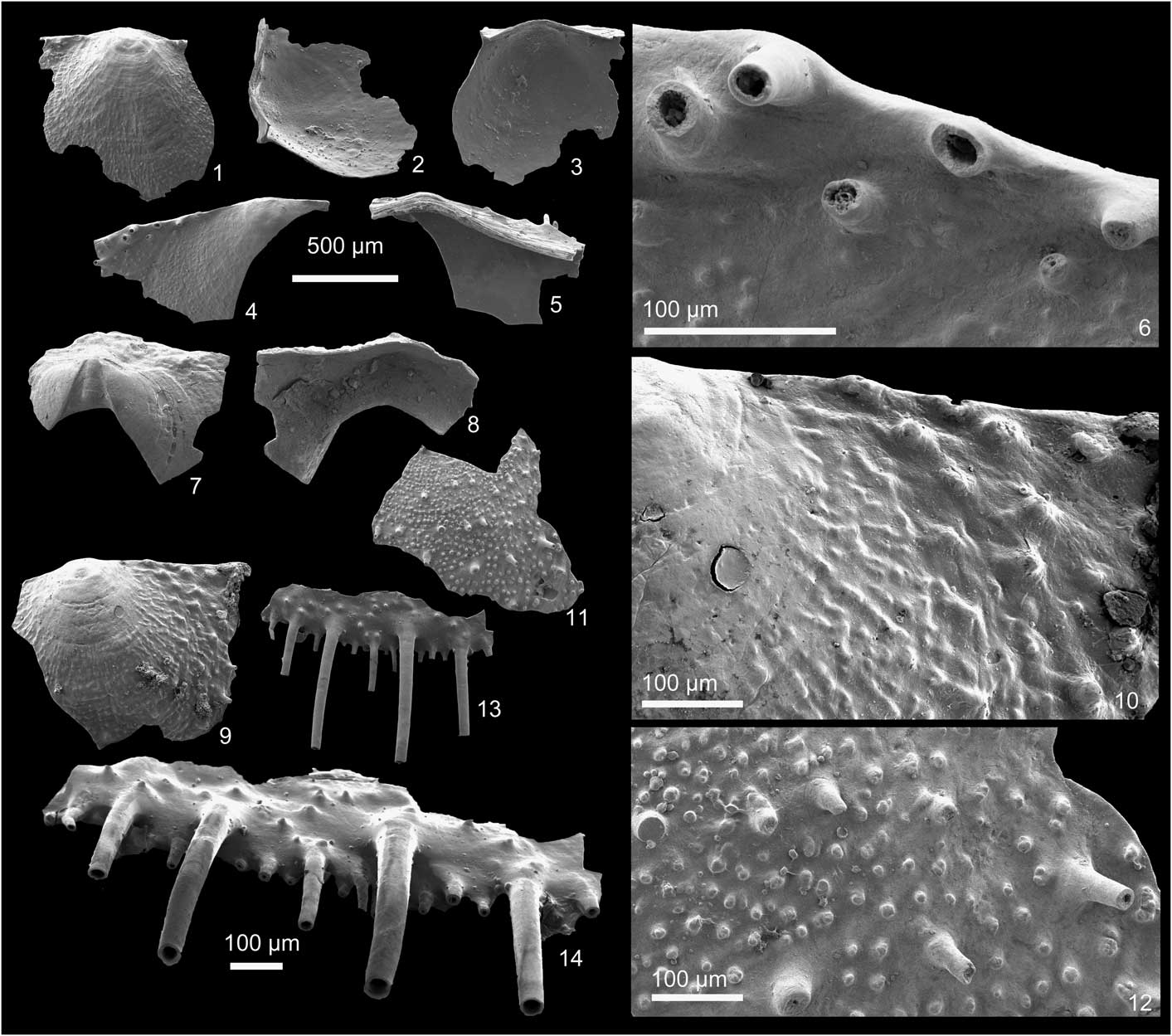
Siphonobolus? sp., from the Clavohamulua elongatus Subzone of the Cordylodus proavus Zone, the Iapetoganthus Zone, and the Cordylodus angulatus conodont Zone, and the Symphysurina trilobite Zone, in the uppermost San Saba Member of the Wilberns Formation and the lowermost Threadgill Member of the Tanyard Formation, Texas; scale bar is 500 μm unless indicated otherwise: (1–3) dorsal valve from LR-101, exterior, oblique view of interior, interior (NPL 45514); (4–6) dorsal valve fragment from LR-101, exterior, interior, detail of ornament (NPL 45515); (7, 8) ventral valve from LR-154, exterior, interior (NPL 45511); (9, 10) dorsal valve exterior from LR-1468, detail of ornament (NPL 45510); (11, 12) shell fragment and detail of hollow spines and pustulose ornament on postlarval growth, from LR-1468 (NPL 45513); (13, 14) fragment of margin of valve from LR-1468, detail of edge of shell, tilted at 45° (NPL 45512).

Occurrence
In the Clavohamulus elongatus Subzone of the Cordylodus proavus conodont Zone, the Hirstutodontus simplex Subzone of the Cordylodus intermedius conodont Zone, the Iapetognathus conodont Zone, and the Cordylodus angulatus conodont Zone, and in the Symphysurina trilobite Zone, in the uppermost San Saba Member of the Wilberns Formation and the lowermost Threadgill Member of the Tanyard Formation, Texas.
Description
Postlarval growth ornamented with short node-like spines and longer hollow spines. Hollow spines along lateral posterior margins of both valves; long hollow spines of two sizes present along line of commissure (Fig. 6.13, 6.14). Hollow spines and tubercles arranged in irregular rows on mature growth (Fig. 6.11, 6.12). Tubercles arranged in poorly expressed radial pattern. Tubercles vary in size from <10 μm in diameter on neanic growth up to 20 μm in diameter on adult growth (Fig. 6.10, 6.12). Larval shell smooth, transversely suboval in outline, and ~225–275 μm in width.
Dorsal valve gently inflated. Posterior margin convex, extending out beyond beak at apex of valve. Dorsal pseudointerarea strongly anacline, raised above valve floor, undivided (Fig. 6.2, 6.3, 6.5). Anterior border of pseudointerarea thickened and enrolled. Visceral area slightly thickened.
Ventral valve with short, steeply procline pseudointerarea. External pedicle opening apparently large, enlarged by resorption of shell and closed off along posterior margin by new growth, forming a triangular plate bisected by a low ridge, terminating at beak situated at posterior margin of larval shell (Fig. 6.7).
Materials
Eight dorsal valves, seven ventral valves, all broken, and many fragments (Supplemental Data Table 2), including illustrated dorsal valves NPL 45510, 45514, and NPL 45515, ventral valve NPL 45511, and fragments NPL 45512 and NPL 45513.
Remarks
Holmer et al. (Reference Holmer, Popov, Streng and Miller2005) reported a siphonotretid with similar ornament of long hollow spines from slightly higher strata in the Cordylus angulatus Zone in Utah. The single dorsal valve from Utah appears to be less inflated and have more spines and fewer nodes than this Texas material.
Results
Sunwaptan ties to the Great Basin
Quadrisonia lavadamensis Popov, Holmer, and Miller, Reference Popov, Holmer and Miller2002 occurs in the Sunwaptan part of the section. This species was reported previously in Utah (Popov et al., Reference Popov, Holmer and Miller2002), and the genus has a wide distribution in strata equivalent to the Sunwaptan globally (Freeman and Miller, Reference Freeman and Miller2011b). Zhanatella utahensis Popov et al., Reference Popov, Holmer and Miller2002 also ranges through the Sunwaptan part of the section (Rasettia magna Subzone of the Saukia trilobite Zone, Fig. 2), which is a distribution similar to the other reported occurrence of the species in Utah (Popov et al., Reference Popov, Holmer and Miller2002; Freeman and Miller, Reference Freeman and Miller2011b). Although Z. utahensis is known only from these two occurrences in North America, the genus Zhanatella is globally distributed and is reported from Kazakhstan (Koneva, Reference Koneva1986; Popov and Holmer, Reference Popov and Holmer1994; Holmer et al., Reference Holmer, Popov, Koneva and Bassett2001; Koneva and Ushatinskaya, Reference Koneva and Ushatinskaya2008), the Montagne Noire region of France (González-Gómez, Reference González-Gómez2005; Álvaro et al., Reference Álvaro, Ferretti, González-Gómez, Serpagli, Tortello, Vecoli and Vizcaïno2007), and Antarctica (Henderson et al., Reference Henderson, Debrenne, Rowell and Webers1992). Specimens of Wahwahlingula Popov, Holmer, and Miller, Reference Popov, Holmer and Miller2002 occur in middle Sunwaptan strata in Texas (Taenicephalus Zone to Rasettia magna Subzone). This cosmopolitan genus occurs in Russia (Popov et al., Reference Popov, Holmer and Miller2002), Iran (Ghobadi Pour et al., Reference Ghobadi Pour, Kebriaee-Zadeh and Popov2011), as well as possibly East Gondwana (Australia; Brock and Holmer, Reference Brock and Holmer2004) and the Western Gondwanan Montaigne Noire region of France (González-Gómez, Reference González-Gómez2005).
Stittia ornata Freeman and Miller Reference Freeman and Miller2011b was previously reported only from Utah, in equivalent Sunwaptan strata (Freeman and Miller Reference Freeman and Miller2011a, Reference Freeman and Miller2011b). This genus is endemic to North America.
Sunwaptan–Skullrockian turnover
The turnover of brachiopod taxa is complete across the Sunwaptan–Skullrockian boundary at both the generic and specific levels. However, a 23.5 m interval encompassing most of the Prosaukia serotina and Eurekia apoposis trilobite zones and the Cambrooistodus minutus and Hirsutodontus hirsutus conodont subzones (Fig. 2) yielded no identifiable brachiopods. Sampling thoroughly covered the interval, but the ~125 samples processed yielded either no brachiopods at all, or linguliform shell hash so thoroughly comminuted that identification was impossible.
Cosmopolitan Skullrockian fauna
The lowest identifiable Skullrockian brachiopod is a single specimen of Eurytreta Rowell, Reference Rowell1966 in the highest part of the Eurekia apopsis trilobite Zone (Fig. 2). The specimen is not identifiable to species. Eurytreta is associated particularly with Skullrockian and higher strata in North America (Popov et al., Reference Popov, Holmer and Miller2002; Holmer et al., Reference Holmer, Popov, Streng and Miller2005; Miller et al., Reference Miller, Evans, Freeman, Ripperdan and Taylor2011; Miller et al., Reference Miller, Evans, Freeman, Ripperdan and Taylor2014), but has a cosmopolitan distribution (Ushatinskaya, Reference Ushatinskaya2010). Stitt (1971b, 1975, Reference Stitt1977) identified the Eurekia apopsis trilobite zone as the critical interval (stage four of Stitt’s four-stage biomere development). Taylor (Reference Taylor2006) considered the overlying Apoplanias trilobite Zone to be the true critical interval, and samples from this interval did not yield recognizable brachiopods in Texas. The species Eurytreta sublata Popov in Koneva and Popov, Reference Koneva and Popov1988 tentatively is identified in lower Skullrockian strata (Fig. 2). This species has been reported previously from Utah (Popov et al., Reference Popov, Holmer and Miller2002), Kazakhstan (Holmer and Popov, Reference Holmer, Popov, Koneva and Bassett2001), and Iran (Popov et al., Reference Popov, Bassett, Holmer and Pour2009a). Distinctive fragments of a hollow-spined siphonotretid, possibly Siphonobolus Havlíček, Reference Havlíček1982, occur in the same sample, in the Symphysurina trilobite Zone (Fig. 2). A similar siphonotretid occurs in equivalent strata in Iran, based on conodont stratigraphy (Popov et al., Reference Popov, Bassett, Holmer and Pour2009a) and is associated with Eurytreta sublata. Siphonotretids with hollow spines are also reported from slightly older strata (possible Proconodontus tenuiserratus conodont Zone) from a different location in Iran (Popov et al., Reference Popov, Pour, Hosseini and Holmer2009b), which is the oldest report of such a morphology.
Two species of Schizambon Walcott, Reference Walcott1884 appear in lower Skullrockian strata (Symphysurina trilobite Zone) at a similar stratigraphic level as the occurrence of the oldest known species reported from Laurentia, S. typicalis Walcott Reference Walcott1884 (Walcott, Reference Walcott1884, Reference Walcott1912; Popov et al., Reference Popov, Holmer and Miller2002). The genus Schizambon ranges upper middle Cambrian to Ordovician (Holmer and Popov, 2000) and has a global distribution (Popov et al., Reference Popov, Holmer, Bassett, Pour and Percival2013).
Discussion
Brachiopods and sequence boundaries
The Sunwaptan–Skullrockian boundary in the study area has been interpreted to coincide with a period of lowered sea level, the Lange Ranch Lowstand or Lange Ranch Eustatic Event (Miller, Reference Miller1978, Reference Miller1984, Reference Miller1992; Miller et al., Reference Miller, Evans, Loch, Ethington, Stitt, Holmer and Popov2003). The absence of linguliform brachiopods in any form other than comminuted shell hash could support the interpretation of a shallow, high-energy depositional environment, although the comminuted hash can alternatively be interpreted as a bioclastic lag associated with transgression. Detailed sampling across the same interval in Utah also failed to yield identifiable linguliform specimens (Popov et al., Reference Popov, Holmer and Miller2002). If this interval is interpreted as the beginning of a transgression, then the coincidence of the trilobite extinction/apparent brachiopod extinction with the underlying sequence boundary is consistent with the prediction that apparent extinction events may be related to stratigraphic processes (e.g., Holland and Patzkowsky, Reference Holland and Patzkowsky2015). The appearance of brachiopods with global affinities as sea level rose (Osleger and Read, Reference Osleger and Read1993; Miller et al., Reference Miller, Evans, Loch, Ethington, Stitt, Holmer and Popov2003) is consistent with cratonward-shifting biofacies during the subsequent transgression. The presence of unidentifiable comminuted linguliform brachiopod hash in some samples above the ‘extinction,’ and before the ‘recovery’ indicates that our perception of the timing of these events is affected by taphonomic factors related to depositional conditions.
Potential Kazakhstan/Gondwana to Laurentia Skullrockian post-extinction migration
The distribution of Eurytreta sublata in Iran (Popov et al., Reference Popov, Bassett, Holmer and Pour2009a) and Kazakhstan (Homer et al., 2001) suggests migration between Laurentia, Kazakhstan, and Gondwana after the Sunwaptan–Skullrockian extinction. The lowest appearance of Eurytreta cf. E. sublata in lower Skullrockian strata in both the Great Basin and Texas suggests migration of that genus from outside of Laurentia. One possibility is Kazakhstan, where another Eurytreta species occurs in Sunwaptan-equivalent strata in the Malyi Karatau Range (Holmer et al., Reference Holmer, Popov, Koneva and Bassett2001). Another older occurrence of species of Eurytreta is in the Cordillera Oriental of Argentina, on the margin of Gondwana (Mergl et al., Reference Mergl, Herrera, Villas and Ortega2015).
Although the species of Schizambon documented in Texas are apparently endemic to Laurentia, the oldest reported occurrences of the genus are from Gondwana terranes in strata coeval with the Laurentian Cambrian upper Steptoean Stage (Shergold et al., Reference Shergold, Cooper, MacKinnon and Yochelson1976; Henderson et al., Reference Henderson, Debrenne, Rowell and Webers1992; González-Gómez, Reference González-Gómez2005) or Sunwaptan Stage (Mergl et al., Reference Mergl, Herrera, Villas and Ortega2015). Schizambon has its lowest appearance in lower Skullrockian strata in the Great Basin (Popov et al., Reference Popov, Holmer and Miller2002), the same stratigraphic level as in Texas, suggesting migration of species of the genus from Gondwana to Laurentia during or after the Sunwaptan–Skullrockian faunal turnover. Migration from Gondwana to Laurentia is again suggested by the coeval lowest occurrence of siphonotretids with spines in both this study and in the Shirgest Formation of Iran (Popov et al., Reference Popov, Bassett, Holmer and Pour2009a), and the potentially slightly older occurrence of this morphology in the Mila Formation of Iran (Popov et al., Reference Popov, Pour, Hosseini and Holmer2009b).
The appearance of the Gondwana-/Kazakhstan-linked Skullrockian fauna implies that biofacies shifts did play more of a role in the recovery of linguliform brachiopod faunas after the Sunwaptan–Skullrockian extinction. Nonetheless, this biofacies shift was not a shift of the Laurentian shelf margin biofacies shoreward because the two faunas are virtually identical in upper Sunwaptan strata. The appearance of Eurytreta, whose lowest occurrence is in the seamount margin facies of the Malyi Karatau Range of Kazakhstan (Cook et al., Reference Cook, Apollonov, Ergaliev, Kh., Sargaskaev, Taylor, Zhemchuzhnikov, Dubinina and Mel’nikova1991) reveals that migration of Eurytreta sublata was from Kazakhstan to the Laurentian shelf/slope.
Extinctions and recoveries as separate events
We suggest that working exclusively with trilobite faunas, which show consistent post-extinction replacement by deep-water cosmopolitan faunas, has led to conflating the process of extinction with the process of recovery while considering the potential causes of the repeating late Cambrian–earliest Ordovician crises. The Sunwaptan–Skullrockian extinction event appears to coincide with a sequence boundary, while the appearance of the globally distributed recovery fauna appears to coincide with a subsequent transgression. Recoveries from extinction may certainly be influenced by the events that caused extinction, but recoveries are complex phenomena and other factors may play a role (e.g., Erwin, Reference Erwin2001). As research into the nature of the biomere events continues, greater emphasis should be placed on understanding the changing nature of the larger ecosystem through both extinction and recovery phases by integrating multiple data sets (e.g., Saltzman et al., Reference Saltzman, Edwards, Adrain and Westrop2015).
Conclusions
The mid to upper Sunwaptan strata of central Texas record similarity between linguliform faunas of the Laurentian platform and those of the shelf margin of the Great Basin. Sunwaptan–Skullrockian trilobite and conodont extinction events apparently coincide with complete turnover of linguliform brachiopod taxa at the genus level, which may be related to a sequence boundary. After these events, the replacement linguliform brachiopod fauna demonstrates global affinities. The timing of appearance of these taxa in Laurentia as compared to Kazakhstan and Gondwana suggests migration from these areas to Laurentia during transgression. The extinction event and the event that facilitated the repopulation of the Laurentian shelf are separate events.
Acknowledgments
The Welge, Lange, and Crenwelge families of Doss, Texas generously provided hospitality and access to their ranches. Freeman’s research was supported by the W. Kent McWilliams Geological Research Fund of Tulane University as well as by a CRAA grant from the University of Kentucky’s College of Arts and Sciences. Miller’s research was funded by National Science Foundation Grants EAR 8108621, EAR 8407281, and EAR 8804352, and by Faculty Research Grants from Missouri State University. Parts of this work were carried out in the Argast Family Instrumentation and Analysis Lab at Indiana University Purdue University Fort Wayne. J. Loch, J. Taylor, and K. Evans gave invaluable assistance with fieldwork. We thank two anonymous reviewers for thoughtful reviews that improved the paper. This paper is a contribution to IGCP 653: the onset of the Great Ordovician Biodiversification Event.
Accessibility of supplemental data
Data available from the Dryad Digital Repository:http://doi.org/10.5061/dryad.64td7