



Loneliness, an emotional state of mismatch between desired and actual social interactions, is recognised as a significant risk factor for adverse physical and mental health outcomes. Reference Hawkley and Cacioppo1 It is linked with an increased risk of psychopathology, Reference Chau, Zhu and So2 including various mental health symptoms and disorders. Reference Chau, Zhu and So2 Longitudinal studies indicate that individuals experiencing prolonged loneliness are at higher risk for suicide Reference McClelland, Evans, Nowland, Ferguson and O’Connor3 and poorer quality of life. Reference Holt-Lunstad, Smith, Baker, Harris and Stephenson4
Epidemiological and clinical research documented a bidirectional relationship between loneliness and psychosis. Reference Rhodes, Vasilopoulou and Hutton5 In general populations, loneliness is associated with an increased risk of psychotic-like experiences, Reference Narita, Stickley and DeVylder6 potentially mediated by multiple pathways such as inefficient emotion recognition and high perceived rejection. Reference Chau, Zhu and So2 Loneliness can also act as a form of subjective adversity, increasing the risk of psychotic disorders similar to that of other forms of adverse childhood experiences (ACE). Reference Varese, Smeets, Drukker, Lieverse, Lataster and Viechtbauer7 Individuals with schizophrenia are around 2.3 times more likely to experience loneliness than the general population. Reference Eglit, Palmer, Martin, Tu and Jeste8 In schizophrenia spectrum disorders (SSD), loneliness is associated with paranoia, Reference Lamster, Lincoln, Nittel, Rief and Mehl9 hallucinations Reference Brederoo, de Boer, Linszen, Blom, Begemann and Sommer10 and depressive symptoms. Reference Eglit, Palmer, Martin, Tu and Jeste8 Furthermore, loneliness in SSD correlates with social-cognitive impairments, including mentalising and emotion-recognition deficits. Reference Okruszek, Jarkiewicz, Piejka, Chrustowicz, Krawczyk and Schudy11 Genome-wide association studies (GWAS) have also found a significant genetic correlation between loneliness and psychosis. Reference Day, Ong and Perry12 We recently identified a bidirectional causal relationship between loneliness and schizophrenia, with genetic risk variation for loneliness having a greater impact on schizophrenia risk in females. Reference Andreu-Bernabeu, Díaz-Caneja, Costas, De Hoyos, Stella and Gurriarán13
Loneliness has become increasingly prevalent in recent years, with a particularly marked increase in youth following the COVID-19 pandemic. Reference Lee, Cadigan and Rhew14 Recent studies reported prevalence rates of loneliness among adolescents ranging from 35% in self-reported measures to 67.6% in parent-reported. Reference Farrell, Vitoroulis, Eriksson and Vaillancourt15 Moreover, loneliness was associated with greater symptom severity and lower overall functioning in ultrahigh-risk youth. Reference Robustelli, Newberry, Whisman and Mittal16 Few studies have examined the impact of early loneliness on later mental health. One study suggests that peer-related loneliness in childhood increases predisposition to depressive symptoms in adolescence. Reference Qualter, Brown, Munn and Rotenberg17 Another links loneliness from ages 14 to 16 years to increased risk of anxiety and depression in adulthood. Reference Xerxa, Rescorla, Shanahan, Tiemeier and Copeland18 Additionally, data from a Norwegian population database indicate that adolescents experiencing loneliness are more likely to be prescribed antipsychotics, mood stabilisers and antidepressants in adulthood. Reference Rodríguez-Cano, Lotre, von Soest, Rognli and Bramness19 To our knowledge, no previous research has assessed the association between prolonged childhood and adolescent loneliness (CAL) and SSD.
In this study, we aimed to assess the effect of CAL on SSD risk by leveraging a large sample of patients with SSD, their unaffected siblings and healthy unrelated controls from the European Network of National Networks studying Gene−Environment Interactions in Schizophrenia (EU-GEI). We hypothesised that prolonged CAL would be associated with increased odds of SSD and more severe symptomatology. We also investigated gender differences in these associations (note that although genetic sex was confirmed in the majority of the sample, this was not the case for 100% of participants, and therefore ‘gender’ has been used as the more appropriate term throughout). Additionally, we assessed the potential interaction effect between CAL and genetic liability to schizophrenia on SSD risk using the Relative Excess Risk due to Interaction (RERI) method. Reference Guloksuz, Pries, Delespaul, Kenis, Luykx and Lin20
Method
Study population
Data were collected between 2010 and 2015 in Turkey, Spain and Serbia as part of WP6 of the EU-GEI project. The study included 1261 patients with SSD according to DSM-IV-TR, 1282 unaffected siblings and 1525 healthy controls with no lifetime history of psychotic disorders. Patients with psychotic disorders due to medical conditions or an IQ below 70 were excluded. We selected participants with genetic data and CAL measures. Following quality control, the final sample included 1037 SSD patients, 1193 siblings and 1100 healthy controls (further details can be found elsewhere Reference Guloksuz, Pries, Delespaul, Kenis, Luykx and Lin20,21 and in the Supplementary Information).
Clinical assessment
We assessed prolonged loneliness in childhood and adolescence by asking participants, ‘Have you ever felt lonely for a significant period (i.e. 6 months or longer)?’ at two time points: before the age of 12 years (LNL12) and between ages 12 and 16 years (LNL12-16). Psychotic-like symptoms were assessed using the Community Assessment of Psychic Experiences (CAPE-42) scale, Reference Konings, Bak, Hanssen, Van Os and Krabbendam22 which measures the frequency of positive (CAPE-pos), negative (CAPE-neg) and depressive (CAPE-dep) experiences. CAPE-42 demonstrates high validity, reliability and strong correlation with established psychometric measures. Reference Konings, Bak, Hanssen, Van Os and Krabbendam22 We calculated mean frequency scores for each domain and the overall mean frequency score across all dimensions (CAPE-total). Reference van Os, Pries, ten Have, de Graaf, van Dorsselaer and Delespaul23 We used the ‘Peer Relationships’ score from the Premorbid Adjustment Scale (PAS) for ages under 12 and ages 12–16 years as our main proxy for social isolation in childhood and adolescence, while ‘Sociability and Withdrawal’ and ‘Adaption to School’ scores were used to capture the multidimensional nature of social functioning, which may affect both social isolation and loneliness in those years. Reference Brill, Reichenberg, Weiser and Rabinowitz24 Both PAS and CAPE-dep were used for sensitivity analyses (see Table 1 and Supplementary Information).
Calculation of schizophrenia polygenic risk score
We used the polygenic risk score prediction method under continuous shrinkage (PRS-CS) Reference Ge, Chen, Ni, Feng and Smoller25 to estimate genome-wide polygenic scores (PGSSZ), accessing leave-one-out summary statistics from the latest schizophrenia PGC3-GWAS Reference Trubetskoy, Pardiñas, Qi, Panagiotaropoulou, Awasthi and Bigdeli26 (excluding overlapping EU-GEI samples). The association of PGSSZ with case-control and sibling-control status was examined through logistic regression, adjusting for age, gender and the first ten principal component analysis (PC)A-derived ancestry components (see Supplementary Information).
Statistical analyses
We used mixed regression models with a random intercept for country, assessing the association between CAL and (a) SSD risk and (b) psychotic symptoms. Separate models were run for LNL12 and LNL12-16. Multilevel logistic models examined the relationship between LNL12/LNL12-16 and case-control or sibling-control status, with age, self-reported biological gender and loneliness as fixed effects and country as a random effect. We also explored gender-specific effects through a loneliness × gender interaction and by stratifying the models by gender.
Sensitivity analyses adjusted for (a) social isolation during childhood and adolescence, (b) CAPE-dep scores and (c) exclusion of participants with an earlier age of onset (<18, <19 and <20 years). Mixed linear regression models evaluated the association of LNL12/LNL12-16 with log-transformed CAPE scores (CAPE-pos, CAPE-neg, CAPE-dep and CAPE-total), including clinical group (case/sibling/control) as an additional fixed effect. Analyses were further stratified by clinical group.
In a second set of models, we assessed the interaction between LNL12/LNL12-16 and dichotomised PGSSZ on SSD risk and psychotic symptoms. We first checked for a correlation between PGSSZ and CAL in controls. Following previous studies with this cohort, we used dichotomised PGSSZ, with the highest quartile (>75%) of the control population as a cut-off. Reference Guloksuz, Pries, Delespaul, Kenis, Luykx and Lin20,Reference Pries, Dal Ferro, van Os, Delespaul, Kenis and Lin27 We also conducted sensitivity analyses using the highest decile (>90%) cut-off. The interaction between CAL and PGSSZ on case-control and sibling-control status was assessed using multilevel logistic models, adjusting for age, gender and the first ten PCA ancestry components as fixed effects and country as a random effect. The interaction was evaluated on an additive scale using RERI with 95% CIs, calculated via the Delta and bootstrap methods (1000 permutations).
Gender-stratified case-control models were compared using Wilcoxon–Mann–Whitney tests with bootstrap resampling (5000 permutations). We further assessed the interaction between CAL and PGSSZ on CAPE scores, using mixed linear regression models stratified by clinical group and gender.
We evaluated the performance of case-control models by assessing the area under the curve (AUC), and the amount of variance explained using Nakagawa-R2. Sensitivity, specificity and positive predictive value (PPV) were calculated using Monte Carlo simulations to generate 95% CIs. For these calculations, a prevalence of 1% for schizophrenia was used. We used the Benjamini–Hochberg false discovery rate (FDR) method for multiple testing correction. Reference Benjamini and Hochberg28 All analyses were conducted in R using the lme4 package (see Supplementary Information).
Ethical approval
This study was conducted in accordance with the ethical standards of the relevant national and institutional committees on human experimentation, and the Declaration of Helsinki of 1975 as revised in 2013. The EU-GEI study, conducted across multiple sites, received ethical approval from the respective local ethics committees before commencing participant enrollment. Reference Guloksuz, Pries, Delespaul, Kenis, Luykx and Lin20,21 In Spain, ethical approval was obtained through the CIBERSAM network (partners SERMAS and SERMES) and, in Turkey, approval was granted by the National Schizophrenia Network (partners AU and Omega Pro). All participants provided written informed consent prior to inclusion in the study.
Results
Association between CAL and SSD
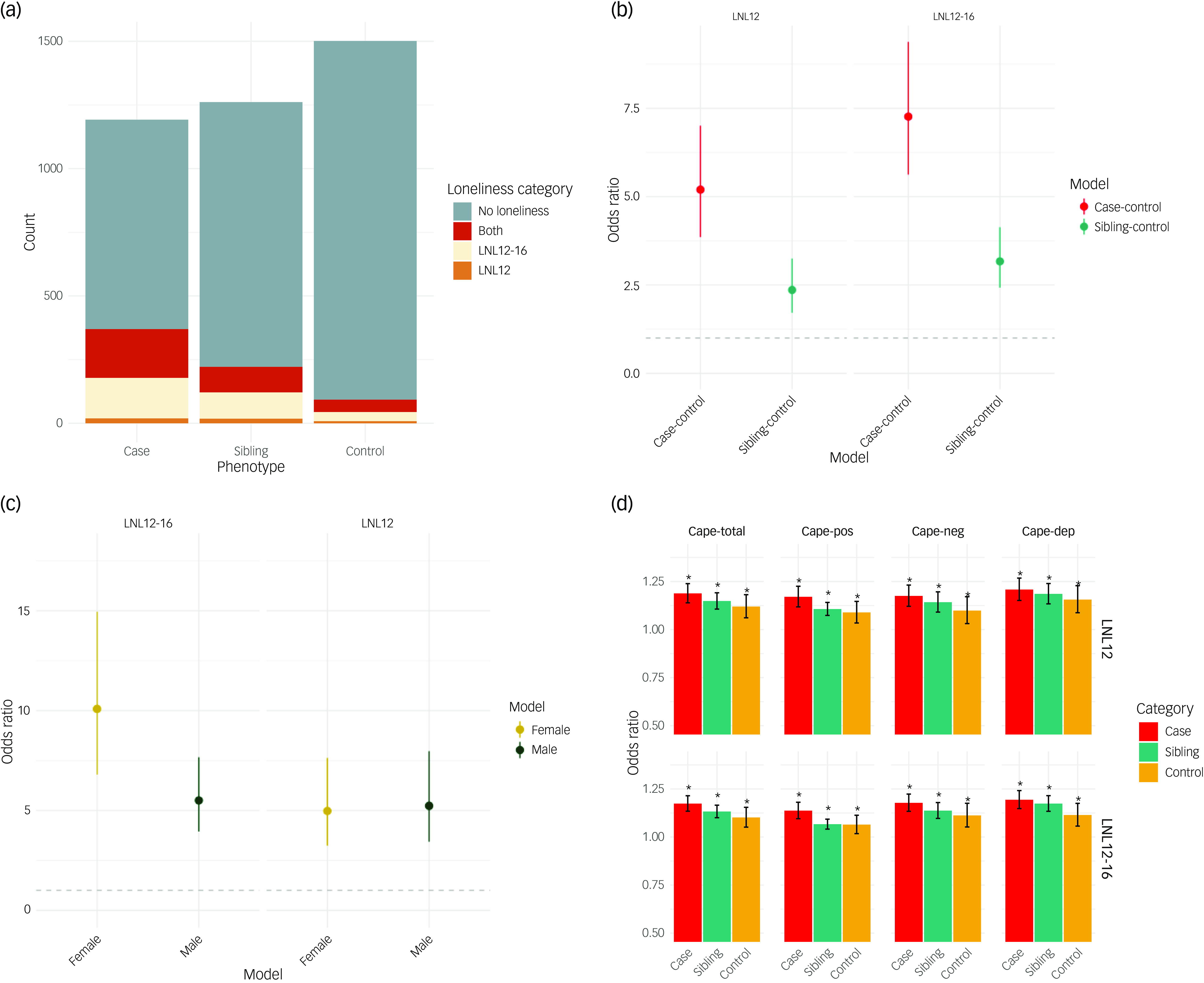
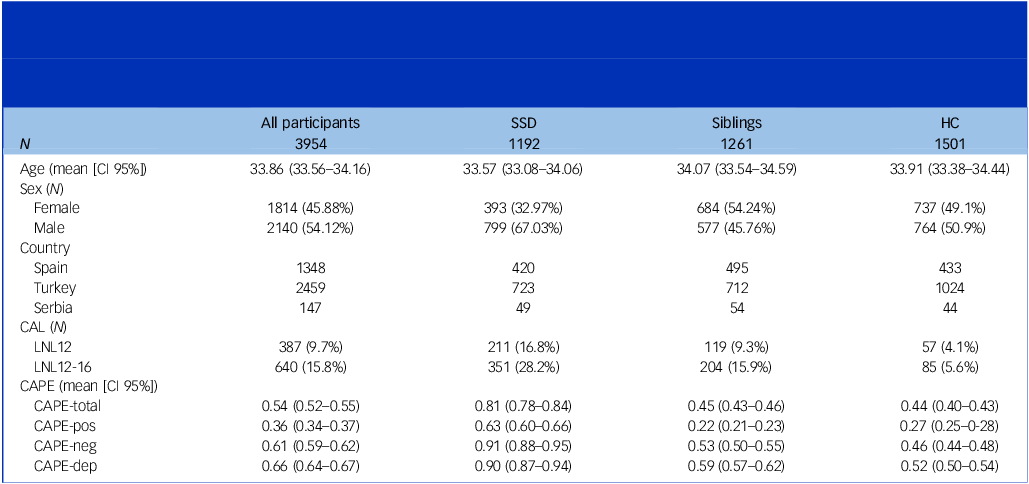
Table 1 shows the demographic and clinical data for the study sample. Figure 1(a) illustrates the distribution of CAL in the sample. Among the participants, 16.8 and 28.2% of patients with SSD, 9.3 and 15.9% of siblings and 4.1 and 5.6% of healthy controls reported experiencing loneliness before the age of 12 and between the ages of 12 and 16 years, respectively.
Relationship between childhood and adolescence loneliness (CAL) with schizophrenia spectrum disorders (SSD). (a) Prevalence of loneliness before 12 years of age (LNL12) and between 12 and 16 years (LNL12-16) in schizophrenia spectrum disorders (SSD) patients (n = 1192), siblings (n = 1261) and healthy controls (HC) (n = 1501). ‘Both’ refers to LNL12 and LNL1216. (b) Effect of LNL12/LNL12-16 on case-control and sibling-control status. (c) Association between LNL12/LNL12-16 and case-control status in females (light grey) and males (dark grey) (SZmales = 799, SZfemales = 393, HCmales = 734, HCfemales = 737). Results are based on mixed logistic regression models including age as a fixed effect, and a random intercept for country (Spain, Turkey and Serbia) to account for clustering. (d) Effect of LNL12/LNL12-16 on symptomatology in SSD patients, siblings and HC. Mean frequency scores were assessed for each of the Community Assessment of Psychotic Experiences (CAPE-42) domains (positive [CAPE-pos], negative [CAPE-neg] and depressive [CAPE-dep]), as well as the overall mean frequency score across all dimensions (CAPE-total). Results are based on mixed linear regression models including age and sex as fixed effects, and a random intercept for country (Spain, Turkey and Serbia) to account for clustering. AUC, area under the curve.

Demographic and clinical characteristics of the sample. Age, sex, childhood and adolescence loneliness (CAL) and average frequency scores of each symptomatology domain from the CAPE-42 scale across all participants, patients with schizophrenia spectrum disorders (SSD), siblings and healthy controls (HC) are described. CAPE, Community Assessment of Psychotic Experiences; CAPE-dep, depressive domain from CAPE; CAPE-neg, negative domain from CAPE; CAPE-pos, positive domain from CAPE; LNL12, loneliness experienced for a significant period (e.g. 6 months or more) before age 12 years; LNL12-16, loneliness experienced for a significant period (e.g. 6 months or more) between ages 12 and 16 years

We found a significant association between LNL12 (odds ratio [95% CI] = 5.20 [3.85; 7.01], positive FDR [pFDR] = 8.56 × 10⁻²⁷) and LNL12-16 (odds ratio [95% CI] = 7.26 [5.63; 9.38], pFDR = 2.52 × 10−51) and case-control status (Fig. 1(b)). These associations remained significant after controlling for depressive symptoms (CAPE-dep), with comparable effect sizes. In the sensitivity analyses adjusting for different proxy dimensions of social isolation in childhood and adolescence, the associations for both LNL12 and LNL12-16 with SSD remained significant across dimensions. The only exception was for LNL12 when controlling for Peer Relationships in childhood, which was not significant under the stricter FDR adjustment (pFDR = 0.081). For all other dimensions, including Sociability and Withdrawal (odds ratio [95% CI] = 1.79 [1.13; 2.84], pFDR = 0.013), the associations remained robust, with LNL12-16 consistently showing significant results (Supplementary Data 1).
We found a significant association of LNL12 and LNL12-16 with sibling-control status, with smaller effect sizes (odds ratio [95% CI] = 2.35 [1.71; 3.25], pFDR = 1.84 × 10⁻⁷ and odds ratio [95% CI] = 3.16 [2.42; 4.13], pFDR = 5.7 × 10⁻¹⁷, respectively; Fig. 1(b)).
We found a significant interaction effect between gender and LNL12-16, but not LNL12, on case-control status (odds ratio [95% CI] = 1.83 [1.10; 2.03], pFDR = 0.03; Fig. 1(c)). Gender-stratified analyses showed that LNL12-16 is associated with higher odds of SSD risk in females (odds ratio [95% CI] = 10.04 [6.80; 14.94], pFDR = 1.42 × 10⁻²⁹) than in males (odds ratio [95% CI] = 5.50 [3.95; 7.66], pFDR = 2.58 × 10⁻²³; Supplementary Data 2 and Supplementary Information).
Association between CAL and symptomatology
We assessed the association between LNL12/LNL12-16 and CAPE measures of positive, negative, depressive and total symptoms. Both were significantly linked with CAPE-total in all groups, with larger effects in cases than in siblings and controls. Similar associations were found for the negative, positive and depressive domains (Fig. 1(d)). No significant interaction between LNL12/LNL12-16 and gender was found following FDR correction (Supplementary Data 3).
Interaction between PGSSZ and CAL on schizophrenia risk
There were no significant differences in age, gender or LNL12/LNL12-16 among cases, controls and siblings, or between the complete data-set and the subset, with the total information available (83.5% of the whole EU-GEI data-set; Supplementary Data 4).
We found a significant additive interaction effect between PGSSZ and LNL12/LNL12-16 on case-control status (Fig. 2(a)). This was observed for both LNL12 (RERI [95% CI] = 11.31 [3.16; 31.76], pFDR < 0.001) and LNL12-16 (RERI [95% CI] = 23.46 [10.75; 53.53], pFDR < 0.001). These interaction effects were not attributable to correlation, because there was no significant association between PGSSZ and LNL12 or LNL12-16 within the control group (Supplementary Data 5). Sensitivity analyses using a first decile threshold for PGSSZ (>90% of the control population) showed a larger interaction effect for LNL12 (RERI [95% CI] = 28.30 [7.62; 4.7 × 10⁻¹⁰], pFDR = 0.005) and LNL12-16 (RERI [95% CI] = 33.71 [12.72; 191.18], pFDR < 0.001).
Additive effects of loneliness before age 12 years (LNL12) and between ages 12 and 16 years (LNL12-16) on the association between polygenic risk score for schizophrenia (PGSSZ; 75% cut-off point) and (a) case-control or (b) sibling-control status. The relative excess risk due to interaction (RERI) was estimated from multilevel logistic regression models including country as random effect and age, sex and ten principal components for ancestry. Light blue represents RERI for the case–control comparison, dark blue represents RERI for the sibling–control comparison) and the different shades of grey/black represent unexposed, PGS ≥ 75%, loneliness only and both exposures). PGS-75, only PGSsz effect.

The interaction effect between PGSSZ and LNL12-16 on case-control status was larger for females (RERI [95% CI] = 45.18 [14.78; 288.55], pFDR < 0.001) than for males (RERI [95% CI] = 12.34 [1.10; 62.18], pFDR = 0.005; Supplementary Fig. 3, Supplementary Data 6). Bootstrap resampling confirmed gender-based differences (Mann–Whitney P < 2 × 10⁻¹⁶, Supplementary Data 7), with a lesser effect for LNL12 (P < 2 × 10⁻¹¹). We also found a significant PGSSZ × CAL additive interaction effect on sibling-control status for both LNL12 and LNL12-16, with smaller effect sizes than those found for case-control status (Fig. 2(b) and Supplementary Data 6). We found no significant PGSSZ × CAL interaction effect (either for LNL12 or LNL12-16) on clinical symptoms in the total sample, nor within any of the three clinical subgroups (Supplementary Data 8).
Predictive value of the interaction between PGSSZ and CAL on SSD risk
Incorporating the interaction term between PGSSZ and LNL12/LNL12-16 enhanced the predictive capability of the multivariate regression model significantly relative to the model not including the interaction term (likelihood ratio test: LNL12, chi-squared = 202.7, P < 2 × 10⁻¹⁶; LNL12-16, chi-squared = 282.56, P < 2 × 10⁻¹⁶), with an increase of 6.8 and 12.3%, respectively, in AUC for models including PGSsz × LNL12 (AUC [95% CI] = 0.74 [0.72; 0.76]) and PGSSZ × LNL12-16 (AU [95% CI] = 0.76 [0.74; 0.78]) (Supplementary Data 9).
We estimated the sensitivity, specificity and positive predictive value (PPV) for PGSSZ, LNL12/LNL12-16 and PGSSZ × LNL12/LNL12-16 terms in the models assessing LNL12 and LNL12-16 (Fig. 3 and Supplementary Data 10). We observed a PPV for PGSSZ × LNL of 13.8 and 17%, respectively, in the LNL12 and LNL12-16 models. These values were higher than those for the PGSSZ (2.6 and 2.8%, respectively) and LNL12/LNL12-16 terms (4.4 and 4.6%, respectively). After using a PGSSZ threshold of 90%, PPV for the PGSSZ ×LNL interaction term in the LNL12 and LNL12-16 models increased to 26% in both cases (Fig. 3(b)). For LNL12-16, but not for LNL12, PPV was higher for females (22.5%) than for males (12.85%).
Positive predictive value (PPV) of schizophrenia spectrum disorder (SSD) classification based on genetic risk and adolescent loneliness. Multilevel logistic regression models including polygenic risk score for schizophrenia (PGSSZ), loneliness between ages 12 and 16 years (LNL12-16) and the interaction PGSSZ × LNL12-16 terms and adjusted for sex, age and the first ten ancestry principal components (as fixed effects) and country (as a random effect) were performed. The probability of a subject being classified by the regression model as a SSD patient is coloured in red in the following contexts: (a) all subjects, (b) males only, (c) females only, considering a PGSSZ threshold of 75%, and (d) considering a PGSSZ threshold of 90% for the control population. AUC, area under the curve.

Discussion
In this study, CAL was associated with increased odds of SSD, as well as with the severity of broad-spectrum psychotic symptoms, in a large sample of patients, siblings and controls. The association with loneliness experienced in adolescence is more pronounced in females, in whom the odds of SSD when loneliness is present are twice those observed in males. Furthermore, our results suggest that CAL may increase the odds of SSD in individuals with high schizophrenia polygenic risk, particularly in females. Incorporating the interaction between CAL and genetic risk enhanced predictive capacity, yielding a PPV of 17–26% for genetically high-risk individuals. Specifically, an individual with a PGSSZ above 75% and reported loneliness in adolescence has a 17% chance of being classified as a true patient, rising to 26% for those with a PGSSZ above 90%. This study is the first to examine the effects of prolonged CAL and its interaction with genetic liability on SSD risk.
Adverse childhood experiences – such as childhood abuse, parental neglect and trauma – have consistently been associated with a significant increase in psychosis risk. Reference Trotta, Murray, David, Kolliakou, O’Connor and Di Forti29 CAL, as a form of subjective adversity Reference Stein and Tuval-Mashiach30 or potential early risk marker, has not been sufficiently explored concerning psychosis. Reference Eglit, Palmer, Martin, Tu and Jeste8 Our study reveals that an extended state of loneliness lasting more than 6 months, particularly during adolescence, is associated with an increase in SSD odds comparable to those of established risk factors such as cannabis use Reference Di Forti, Quattrone, Freeman, Tripoli, Gayer-Anderson and Quigley31 or sexual abuse. Reference Guloksuz, Pries, Delespaul, Kenis, Luykx and Lin20 In this sense, adolescence is a critical vulnerability period for SSD, which aligns with the prevalence peak in reported loneliness between the ages of 14 and 16 years in recent studies. Reference Xerxa, Rescorla, Shanahan, Tiemeier and Copeland18 We also found that CAL influences dimensional symptom expression across the psychotic spectrum, with significant effects in cases, siblings and controls and a gradual decrease in the strength of effects across the three groups. This finding aligns with the greater prevalence of CAL observed in siblings than in controls, and the significant effect of CAL on sibling-control status, suggesting a dimensionality that may encompass both biological and shared environmental factors. Our findings also align with previous reports of an association between loneliness and positive and negative symptoms in clinical and non-clinical populations. Reference Rhodes, Vasilopoulou and Hutton5,Reference Lamster, Lincoln, Nittel, Rief and Mehl9
In previous work, we described shared genetic contributions to loneliness and schizophrenia and identified a bidirectional causal relationship between both phenotypes. Reference Andreu-Bernabeu, Díaz-Caneja, Costas, De Hoyos, Stella and Gurriarán13 Here, we describe a significant interaction effect between genetic risk for schizophrenia and CAL on SSD risk. Although the impact of prolonged CAL on the odds of SSD is similar to that of other risk factors, we found a larger interaction effect for CAL compared with some of these factors. Reference Varese, Smeets, Drukker, Lieverse, Lataster and Viechtbauer7,Reference Guloksuz, Pries, Delespaul, Kenis, Luykx and Lin20,Reference Di Forti, Quattrone, Freeman, Tripoli, Gayer-Anderson and Quigley31 For example, the observed interaction effect between high genetic risk for schizophrenia and the experience of prolonged loneliness during adolescence (RERI = 23.5) is approximately four times higher than that observed for cannabis use on SSD risk in this cohort (RERI = 5.6 Reference Guloksuz, Pries, Delespaul, Kenis, Luykx and Lin20 ). Understanding the differences between prolonged and cumulative experiences should be studied further. Substantial evidence supports the detrimental effects of cumulative ACEs, showing a dose-dependent relationship with increased risks for mental disorders and multimorbidity. Reference Senaratne, Thakkar, Smith, Hales, Marryat and Colvin32 Conversely, recent research has revealed alterations in molecular markers of ageing linked to prolonged ACEs, such as extended parent–child separation. Reference Wang, Zhao, Yu, Tao, Liu and Sun33 Additionally, individuals with high genetic risk who experience prolonged parent–child separation face a heightened risk of pain. Reference Chen, Xu, Zeng, Zhang, Tao and Sun34 This underscores the importance of understanding how prolonged states and cumulative adverse experiences uniquely affect long-term mental health outcomes, including the interaction effects of genetic risk, which could improve predictive models and advance future gene–environment studies.
A previous study showed that polygenic risk for schizophrenia predicts loneliness in the general population. Reference Abdellaoui, Nivard, Hottenga, Fedko, Verweij and Baselmans35 However, we observed no relationship between genetic risk for schizophrenia and reported CAL in our control sample, suggesting that this relationship could not be attributed solely to a potential gene–environment correlation. In this sense, gene–environment correlation has been found to account for only a small portion of the relationship between reported childhood adversity and psychosis. Reference Woolway, Smart, Lynham, Lloyd, Owen and Jones36 Moreover, our study did not find a significant contribution from PGSSZ or an additive interaction effect between CAL and PGSSZ on clinical severity across psychotic dimensions, demonstrating the difficulty in capturing variance when using data from dichotomous GWAS for more distant phenotypic entities such as symptomatology. Reference Lewis and Vassos37
We found larger effects for both CAL and the CAL × PGSSZ interaction on schizophrenia risk in females than in males. Our findings align with previous reports indicating that loneliness has a greater impact on psychiatric outcomes in females Reference Liu, Zhang, Yang and Yu38 and is more prevalent in female SSD patients. Reference Badcock, Shah, Mackinnon, Stain, Galletly and Jablensky39 Our findings also align with previous research indicating a greater influence of loneliness-related genetic variants among women with schizophrenia. Reference Andreu-Bernabeu, Díaz-Caneja, Costas, De Hoyos, Stella and Gurriarán13 The larger effects of CAL in females could be attributed to their more negative perception of social isolation and a greater protective network effect in males. Reference Benenson, Markovits, Hultgren, Nguyen, Bullock and Wrangham40 Males and females are exposed to different environments, influenced by factors ranging from hormones to psychosocial experiences. Reference Riecher-Rössler, Butler and Kulkarni41 For instance, in the context of psychotic disorders, the ‘oestrogen hypothesis’ suggests that oestradiol provides a protective effect against the onset of psychosis in females, from adolescence through to middle adulthood. Reference Riecher-Rössler42 Higher variability in oestradiol levels has been associated with increased sensitivity to social rejection, Reference Gordon, Rubinow, Eisenlohr-Moul, Leserman and Girdler43 thus pointing to the potential role of sexual hormones in gender differences in the effects of prolonged loneliness during adolescence on psychosis risk. Reference Fujisawa, Nishitani, Obara and Shinohara44
Despite the efforts to implement the use of PGS in clinical practice, their applicability remains limited in the mental health field. Reference Di Forti, Quattrone, Freeman, Tripoli, Gayer-Anderson and Quigley31 There is increasing interest in the use of models combining genetic risk with clinical or environmental variables to predict the risk of complex diseases such as schizophrenia. In this study, the predictive ability of our models significantly improved when the interaction term between prolonged CAL and PGSSZ was included (e.g. during adolescence the AUC increased from 0.68 to 0.76 relative to a model not including the interaction). This improvement brings our model closer to those utilised in fields such as cardiology and oncology, where PGS have effectively enhanced predictive ability by integrating multiple risk factors. Reference O’Sullivan, Raghavan, Marquez-Luna, Luzum, Damrauer and Ashley45,Reference Mavaddat, Michailidou, Dennis, Lush, Fachal and Lee46 Moreover, a PPV of 17% for schizophrenia in individuals with high genetic risk who experienced loneliness, especially during adolescence – increasing to 22.5% when stratified by females (Fig. 3) – supports the investigation of CAL as a potentially cost-effective strategy for further stratification of high-risk populations, particularly in females. The inclusion of the interaction between CAL and genetic risk significantly enhanced predictive accuracy, far exceeding the PPV for genetic risk alone (2.6 and 2.8%, respectively), emphasising the value of incorporating factors such as CAL. Future studies could also effectively analyse the contribution of incorporating additional risk factors, such as socioeconomic environments and cultural contexts, Reference Andreu-Bernabeu, González-Peñas, Arango and Díaz-Caneja47 to develop integrated prediction models.
Limitations
Our study is subject to several limitations. First, we employed a retrospective, single-item measure of childhood and adolescent loneliness which, despite previous evidence supporting the validity of lonelinss single-item assessments, Reference Day, Ong and Perry12 may not fully capture the multidimensional nature of loneliness and is vulnerable to recall bias. Second, our proxy measure for social isolation, derived from the PAS, does not encompass all facets of objective social isolation. In response to these concerns, we conducted several sensitivity analyses that incorporated additional PAS dimensions and controlled for current depressive symptoms. Despite the inherent limitations of using proxy measures for social isolation, our findings remained consistent across multiple analyses – particularly with respect to adolescent loneliness, underscoring the robustness of our results. We also examined whether reported CAL might reflect prodromal or early disease signs Reference Cornblatt, Lencz, Smith, Correll, Auther and Nakayama48 by excluding participants of younger age at onset using different cut-offs, and found consistent results (Supplementary Data 1c). Future studies could benefit from a prospective design and more accurate loneliness measures, such as the UCLA Loneliness Scale or Ecological Momentary Assessment. Reference Xiao, Robertson, Long, Flaig, Kirby and Romaniuk49 Despite a large sample, stratification by genetic risk and CAL (especially childhood loneliness) may have resulted in small groups, affecting model sensitivity. Additionally, findings may have been limited by the predominance of European ancestry in our sample and the schizophrenia GWAS used for PGS calculations, restricting generalizability to other ethnic and cultural groups. Reference Trubetskoy, Pardiñas, Qi, Panagiotaropoulou, Awasthi and Bigdeli26 Our models incorporate only CAL and dichotomised PGS as predictors, limiting the complexity of schizophrenia risk. To improve robustness and applicability in future research, more diverse samples with comprehensive genetic and environmental data from various cultures and ancestries are needed. Reference Peterson, Kuchenbaecker, Walters, Chen, Popejoy and Periyasamy50 Future models should also incorporate a wider range of risk factors, focusing on critical time windows and the complexities of subjective, long-lasting experiences.
In conclusion, we found that prolonged CAL is associated with increased odds of SSD and dimensional expression of psychotic symptoms. Predictive models combining genetic risk with CAL yielded strong positive predictive values, particularly in females. Considering that CAL can be readily identified in both clinical and non-clinical settings and is a potentially modifiable factor, our findings support the potential usefulness of early identification of CAL to guide selective preventive interventions and improve outcomes in youth.
Supplementary material
The supplementary material can be found online at https://doi.org/10.1192/bjp.2025.100
Data availability
The data that support the findings of this study are available from the corresponding author (A.A.-B.) upon reasonable request under the condition of the approval of the EUG-EI committee.
Acknowledgements
The EU-GEI Project was funded by grant agreement no. HEALTH-F2-2010-241909 (Project EU-GEI) from the European Community’s Seventh Framework Programme. This work was partially supported by the Spanish Ministry of Science and Innovation, Instituto de Salud Carlos III (ISCIII) (nos. JR19/00024, PI19/01024, PI20/00721, PI22/01824, PI23/00625); CIBER, Consorcio Centro de Investigación Biomédica en Red- (no. CB/07/09/0023), co-financed by the European Union and ERDF Funds from the European Commission, ‘A way of making Europe’; NextGenerationEU (no. PMP21/00051); Madrid Regional Government (no. S2022/BMD-7216 AGES 3-CM); European Union Structural Funds; EU Seventh Framework Programme; EU H2020 Programme under the Innovative Medicines Initiative 2 Joint Undertaking (grant agreement no. 101034377, Project PRISM-2 and grant agreement no. 777394, Project AIMS-2-TRIALS); and Horizon Europe (grant agreement no. 101057182, project Youth-GEMs), the National Institute of Mental Health of the National Institutes of Health under award nos 1U01MH124639-01 (Project ProNET) and 5P50MH115846-03 (project FEP-CAUSAL), Fundación Familia Alonso and Fundación Alicia Koplowitz.
Author contributions
A.A.-B., J.G.-P. and C.M.D.-C. contributed to the conception and design of the study. J.G.-P. and A.A.-B. performed the data analysis. A.A.-B. and C.M.D.-C. were primarily involved in writing the manuscript, and C.M.D.-C. and C. Arango edited it. The remaining authors contributed to patient recruitment and data collection. All authors have reviewed and approved the final version of the manuscript.
Funding statement
The EU-GEI Project was funded by grant agreement no. HEALTH-F2-2010-241909 (Project EUGEI) from the European Community’s Seventh Framework Programme. This work was partially supported by the Spanish Ministry of Science and Innovation, Instituto de Salud Carlos III (ISCIII) (nos. JR19/00024, PI19/01024, PI20/00721, PI22/01824, PI23/00625).
Declaration of interest
C. Arango has been a consultant to, or has received honoraria or grants from, Acadia, Angelini, Gedeon Richter, Janssen Cilag, Lundbeck, Minerva, Otsuka, Roche, Sage, Servier, Shire, Schering Plough, Sumitomo Dainippon Pharma, Sunovion and Takeda.
C.M.D.-C. has received honoraria from Angelini and Viatris, and support to attend conferences from Janssen and Angelini.
J.B. has received research grants and served as a consultant, advisor or speaker within the last 5 years for AB-Biotics, Acadia Pharmaceuticals, Alkermes, Allergan, Ambrosetti-Angelini, Biogen, Casen Recordati, D&A Pharma, Exeltis, Gilead, Indivior, GW Pharmaceuticals, Janssen-Cilag, Jazz Pharmaceuticals, Lundbeck, Mundipharma, Newron, Otsuka, Pfizer, Roche, Sage Therapeutics, Servier, Schwabe Farma Ibérica, Shire and Takeda; and has received research funding from the Spanish Ministry of Economy and Competiveness – Centro de Investigación Biomedica en Red area de Salud Mental (CIBERSAM) and Instituto de Salud Carlos III – and the Spanish Ministry of Health.
M.P.G.-P. has been a consultant to, and/or has received honoraria/grants from, Angelini, Otsuka-Lundbeck Alliance, Instituto de Salud Carlos III, Janssen-Cilag, Lundbeck, Otsuka, Pfizer and Sage Therapeutics.
P.A.S. has been a consultant to, and/or has received honoraria/research grants from, Adamed, Alter Medica, Angelini Pharma, CIBERSAM, Ethypharm Digital Therapy, European Commission, Government of the Principality of Asturias, Instituto de Salud Carlos III, Janssen-Cilag, Lundbeck, Otsuka, Pfizer, Plan Nacional Sobre Drogas, Servier and Viatris España.
The role of funding source was carried out by J.B., M.P.G.-P. and P.S., who received partial support from the Government of the Principality of Asturias (no. PCTI-2021-2023 IDI/2021/111), Fundación para la Investigación e Innovación Biosanitaria del Principado de Asturias (FINBA), Centro de Investigación Biomédica en Red de Salud Mental (CIBERSAM), Instituto de Salud Carlos III and Ministerio de Ciencia e Innovación. The funders had no role in study design, data collection and analysis, decision to publish or preparation of the manuscript.
S.G. is a member of the British Journal of Psychiatry editorial board; however, we confirm that he was not involved in the peer review or editorial decision-making process for this manuscript. The remaining authors declare no competing interests.




eLetters
No eLetters have been published for this article.