INTRODUCTION
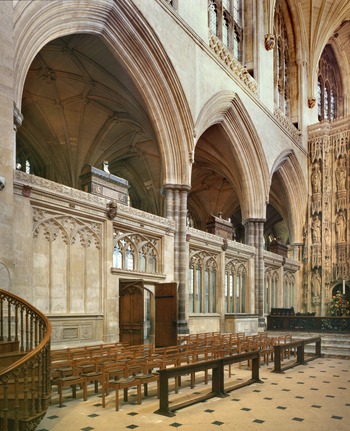
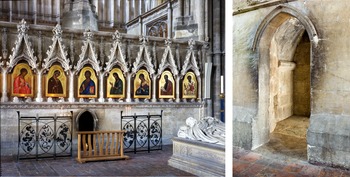
The six Renaissance style ‘mortuary chests’ on top of the stone screens flanking the presbytery of Winchester Cathedral (figs 1–2) have long attracted the attention of visitors. In 1685, for example, the diarist John Evelyn noted ‘the Coffines of the 6 Saxon Kings, whose bones had been scattered by the sacrilegious Rebells of 1641, in expectation (I suppose) of finding some valuable Reliques’Footnote 1 and, following her visit to the cathedral on 3 August 1791, Fanny Burney (Mme d’Arblay) noted ‘The bones of eleven Saxon kings are lodged there in seven curious old chests, in which they were deposited after being dug up and disturbed in civil wars and ensuing confusions … One chest contains the bones entire of Egbert, our first King. Edred, also, I distinguished’.Footnote 2 Neither of these diarists’ observations was entirely accurate, as we shall see.
Winchester Cathedral presbytery. Mortuary chests on north screen. Photograph: author.

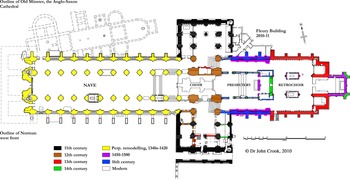
Phased plan of Winchester Cathedral, showing the location of the presbytery, retrochoir, and the Feretory in the bay behind the high altar. Diagram: author.

The chests are the last in a series of similar arrangements for the safekeeping of the mortal remains of Winchester’s illustrious dead. Here, according to their Latin tituli, are the bones of some great figures of English history: Kings Ecgberht, Æthelwulf, Cnut, William Rufus, Queen Emma of Normandy and several pre-Conquest bishops of Winchester. Fig 3 shows the layout of the chests and the names on the tituli. Eleven individuals are named on the chests, from Cynegils, first Christian king of Wessex, to Rufus, the only monarch to be buried within Winchester Cathedral from the outset. Antiquarian accounts provide further names observed before the depredations of the seventeenth-century civil war, including Archbishop Stigand and Harthacnut.
Present layout of chests. S2 and S3 have reverted to their positions pre-1932, when they were interchanged. Diagram: author.

Despite the confident tituli, many recorded investigations, especially in the nineteenth and twentieth centuries, indicated that the bones were so jumbled that identifying individual skeletons seemed a hopeless prospect. This challenge was taken up in 2010 when Winchester Cathedral, in partnership with a team of biological anthropologists from the University of Bristol, embarked upon an ongoing research project whose principal aim is to reassemble the skeletal remains, radiocarbon date them, work out familial relationships through aDNA analysis, determine diet, pathology and lifestyle, and perhaps attempt facial reconstructions. As part of the same project, the chests themselves have been studied and conserved, a project funded by National Heritage Lottery. The conservation and scientific work were undertaken in a temporary laboratory set up within the cathedral. Here, the painstaking work of reassociating the skeletons took place, mainly by carefully measuring each bone, analysing how bones articulated and using other diagnostic features such as staining. It soon became apparent that there are more skeletons than the eleven mentioned in the inscriptions, though many of them are very incomplete. There are at least twenty males, together with at least one female and two juveniles.
The first results of this research were made public on 15 May 2019, notably the fact that radiocarbon dating had shown that the date of the bones fitted the range of the individuals traditionally said to be within the chests. The identification of a female skeleton as Queen Emma of Normandy was also announced.Footnote 3 Analysis of the skeletal material continues, and the full results will be published in due course. Meanwhile, public engagement is assured by a major exhibit on the ‘science of the bones’ in the cathedral’s new permanent exhibition, Kings & Scribes: the birth of a nation, which opened on 21 May 2019.
This paper sets the history of the mortuary chests and their contents in the wider context of medieval royal and episcopal burials in Winchester Cathedral, considering in particular the various movements of the skeletal material since the bodies were first laid to rest. Given the disparity between the named occupants of the chests and the number of skeletons within them, it also attempts to propose, from documentary evidence, possible candidates for the dozen or so ‘extra’ individuals.
PREDECESSORS OF THE MORTUARY CHESTS
The earliest known reference to the predecessors of the present mortuary chests is found in the Cartulary of St Swithun’s Priory:
Anno incarnationis Domini m.c.lviij. Dominus Henricus Wyntoniensis episcopus corpora Regum et Pontificum que a vetere monasterio in novam ecclesiam translata fuerunt [recte fuerant] ab indecenti loco elevata circa magnum altare beatorum apostolorum Petri et Pauli honorificientius collocari fecit.Footnote 4
In the year of our Lord’s incarnation 1158 Henry, Lord Bishop of Winchester, caused the bodies of kings and bishops, which had been translated from Old Minster into the new church, being raised up from an unseemly place, to be set together more honourably around the high altar of the blessed apostles Peter and Paul.
The Cartulary dates from the early fourteenth century, but the text itself is probably earlier. Another important and apparently early reference to Bishop Henry’s actions was likewise incorporated in the Liber Historialis, a Winchester chronicle copied by the St Swithun’s monk John of Exeter in 1531.Footnote 5 I have suggested that the Liber was in fact mainly the work of the prolific Winchester monk Thomas Rudborne.Footnote 6 It claims to incorporate a passage from the lost acta of Bishops William Giffard and Henry of Blois, attributed to Prior Robert (1165–73):
Corpora vero christianorum regum Westsaxonum ante monarchiam sepulta in Wentana ecclesia … [Corpora] Estuini, Kentwyni, Athellardique, fratris Fretheswythe regine, Kenulphi … consepulta erant in orientali cripta ut scribit Vigilantius ‘de Basilica Petri’ cap o vj o sed postmodum tempore Henrici Blesensi translata sunt et propter ignorantiam qui essent reges et qui essent episcopi et quod non erant tituli inscripti supra monumenta eorum predictus Henricus posuit in sarcofagis plumbeis regis cum episcopis et episcopos cum regibus sic permixtos ut habetur in quodam libello Roberti prioris Wintoniensis et postmodum Glastoniensis abbatis de actibus Willelmi et Henrici episcoporum.Footnote 7
Now the bodies of the West Saxon Kings before the monarchy were buried in the church of Winchester … the bodies of Æscuin, Centwine and Æthelheard, the brother of Queen Frithswitha, [and] of Cynewulf were buried together in the eastern crypt as Vigilantius writes in De Basilica Petri chapter 6, but afterwards, in the time of Henry of Blois, they were translated, and because it was not known which were kings and which were bishops, and because there were no inscriptions on their monuments, the aforesaid Henry mixed bishops with kings and kings with bishops all together in lead sarcophagi, as appears in a certain booklet by Robert, Prior of Winchester and subsequently Abbot of Glastonbury, concerning the acts of Bishops William and Henry.
On the basis of these texts it was long assumed that all the bodies in the chests (apart from the obvious late-comer William Rufus) had been exhumed by Henry of Blois – insufficient attention was given to the specific reference to ante monarchiam in the Liber Historialis restricting the group to the early kings of Wessex.Footnote 8 In 2005, however, Professor Martin Biddle convincingly argued that more recent monarchs and bishops, notably the Anglo-Danish kings and their associates, had been translated into the present cathedral c 1093 when it was first consecrated.Footnote 9 He suggested that their remains had been walled up within the stylobate of the arcade around the Norman choir, and that Cnut and Emma had been buried in the most prestigious position, namely the stylobate of the apse, near the high altar. When the choir was remodelled c 1310 some of the burials were similarly immured within the stone benches between the new choir arcade piers, but the complete removal of the apse meant that the bones of Cnut and Emma had to be re-housed. It was then, Biddle argued, that they were placed in coffers that were the predecessors of the present mortuary chests.
According to this interpretation, the mortuary chests comprise two distinct groups. The earlier individuals, including the early kings of Wessex specifically mentioned in the Liber Historialis, were placed in lead coffers in 1158. The eleventh-century monarchs reached the chests only in the early fourteenth century. In the following section I discuss the archaeological and textual evidence for the movements of these two groups of prestigious human remains.
THE EARLY KINGS AND BISHOPS RE-HOUSED BY HENRY OF BLOIS
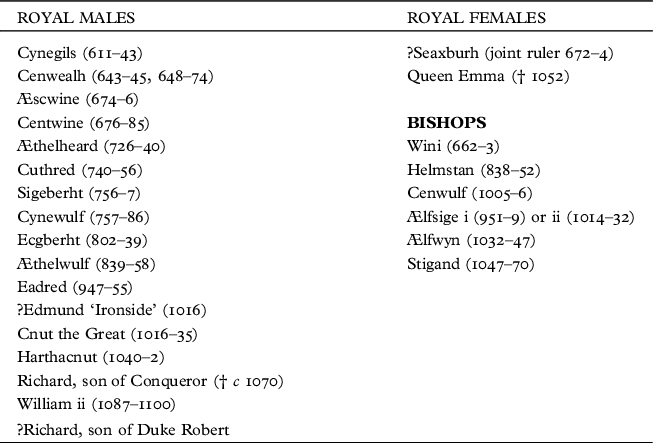
Although Old Minster cannot lay claim to having been an exclusive mausoleum for the kings of Wessex and then of all England until the Conquest, about half are recorded (albeit in post-Conquest sources) as having been buried there since the church was built c 635 (Table 1). From Cynegils (611–42) to Æthelwulf (839–58) all but two kings of Wessex were buried in Old Minster. Æthelwulf’s sons were, however, buried elsewhere. At the end of the ninth century, New Minster was constructed, which became the royal mausoleum for Alfred the Great and his family until their remains were translated to Hyde Abbey in 1110. Between Alfred and Cnut only Eadred is recorded as having been buried in Old Minster. The total number of royal burials (including two wives) is about fifteen. The Anglo-Danes, on the other hand, namely Cnut, Emma, Harthacnut and Earl Bjorn, appear to have been interred in the large eastern extension of Old Minster built by Bishop Ælfheah (984–1006), which, with its later added frieze depicting scenes from Norse mythology, served as a funerary chapel. One must assume that most bishops after Headda (the first bishop of Wessex to have his seat at Winchester) were buried in Old Minster. They number about twenty-six before the Conquest.
Rulers of Wessex and all England showing their burial places. Burials in Old Minster are indicated in bold type. Individuals claimed to be within the mortuary chests are shown in bold italic type. Asterisks indicate burials referred to in the Anglo-Saxon Chronicle.

The location of the burials within Old Minster before the Anglo-Danes is uncertain, though the fifteenth-century chroniclers attempted to define some locations. Their testimony must be treated with caution, given that they believed their church was one and the same as Old Minster (a confusion that persisted until the 1830s). The small church as originally built would have afforded limited space for interments. Its enlargement in the tenth century would have provided extra burial space for bishops, and later for the Anglo-Danish dynasty.
During the preparation for the demolition of Old Minster in 1093–4 consideration was presumably given to its prestigious burials. The recent dead may have been incorporated within the very fabric of the new cathedral, but earlier monarchs were buried in a location that by 1158 was an ‘unseemly place’. I previously suggested that it was the ‘memorial court’ that had been formed around St Swithun’s empty grave following the demolition of the tenth-century westwork of Old Minster in 1093–4.Footnote 10 This now seems improbable. The interpretation relied on a scribal error in a relative clause in the Chartulary cited above: que a vetere monasterio in novam ecclesiam translata fuerunt. As Martin Biddle has pointed out, this is grammatically incorrect, and fuerunt should be read fuerant.Footnote 11 This implies that the earlier group of royal and episcopal remains had also been translated into the present cathedral in 1093–4. The most probable location is the Romanesque crypt, which was beginning to flood each winter by the twelfth century and could in 1158 have been described as ‘unseemly’. Moving the remains from the crypt to the choir apse also makes better sense of the adjective elevata. Finally, the alleged quotation in the Liber Historialis from the mythical Vigilantius has previously been discarded by historians, but the statement that the bodies of early kings and bishops of Wessex had been buried in ‘the eastern crypt’ might in fact indicate that their stone coffins had been placed in the crypt of the axial chapel of the Romanesque cathedral, bearing in mind that the fifteenth-century chroniclers believed the crypt to be part of Old Minster. It is unlikely they were buried beneath the plaster floor of the crypt, and indeed when the accumulation of infill was removed from the crypt in 1886 by Dean Kitchin he noted only two burials, probably above the original floor level.Footnote 12 Such coffins, probably originally identified by monuments or tituli in Old Minster, would presumably not themselves have borne names, which would explain the confusion that ensued when Bishop Henry ‘elevated’ them.
THE GROUP REBURIED IN THE ROMANESQUE STYLOBATE
The choir as built by Bishop Walkelin was apsidal, separated from the lateral aisles and ambulatory by an arcade supported on a stylobate wall no more than 460mm high. The survival of one of the apse pier-bases shows that the stylobate here was at the same level as the straight bays, so the choir may have been at the same level throughout, or with no more than two steps up to the high altar, located on the chord of the apse.
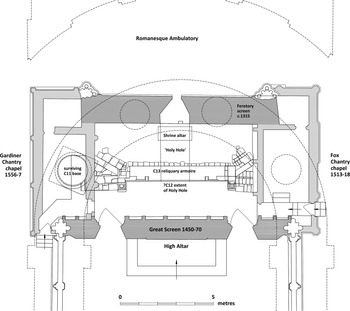
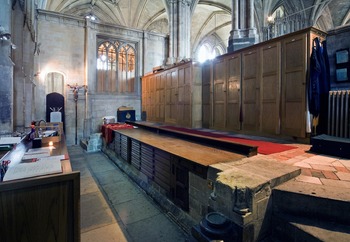
Shortly before 1150 a masonry platform was inserted into the apse, behind the high altar, accessible by means of flanking flights of steps (figs 4–5). Its most unusual feature was a low barrel-vaulted axial tunnel running westwards from the ambulatory, known since at least the fifteenth century as the ‘Holy Hole’. I have argued that the feature was inspired by the ring-crypts of Rome and that its purpose was to provide access to the relics translated to the area around the new shrine altar of St Swithun above it by Bishop Henry of Blois in 1150, and especially to provide proximity to the patron saint himself.Footnote 13
Plan of the Feretory (east at top) with outline of Romanesque apse. Diagram: author.

View within the Feretory, looking NNE. Photograph: author.

When the Norman choir was rebuilt as the present presbytery in the early fourteenth century, the Romanesque apse was replaced by a square east end, still incorporating the ‘Holy Hole’ (fig 6). The new arcade, with quatrefoil piers of coursed Purbeck marble on polygonal bases, was rebuilt on the line of the eleventh-century choir arcade in order to derive support from the arcade in the crypt, but the fourteenth-century piers could be more widely spaced than their Romanesque predecessors; the crypt ‘arcade’ is in reality a massive wall punctuated by small arches, so there was no need to place the new piers strictly over the centre of those in the crypt.
Feretory screen at west end of retrochoir, and detail of the Holy Hole. Photographs: author.

Between the fourteenth-century piers, abutting their octagonal bases, are low stone benches that appear originally simply to have formed a demarcation between the choir and its aisles, just as the Romanesque stylobate had done. Their stone types (reused Quarr stone and Caen stone) and the chunky cavetto moulding of the bench nosing are consistent with a fourteenth-century date.
In the sixteenth century, stone screens were added either side of the presbytery, sitting on the benches. They are well dated by inscriptions and heraldry to the time of Bishop Richard Fox, and indeed bear the date 1525. They comprise a plinth wall 960mm high in each intercolumniation with a pair of traceried windows above it, now part-glazed. The design of the plinth walls is different to north and south. The plinth of the south screen includes two canopied niches on the aisle side in Bay 2 with inscriptions relating to ‘burials’ within the bench beneath; that of the north screen has inscribed panels resembling the sides of table tombs, and indeed one actual table tomb (Bishop John of Pontoise) is incorporated within the screen with its lateral panel facing the aisle.
The theory that the more recent royal and episcopal burials were buried within the stylobate rests particularly on the observation that burials are still indicated within the fourteenth-century benches; Biddle suggested that these are close to their original locations in the Romanesque stylobate and that they only had to be moved slightly to east or west in order to fit the new spacing of the fourteenth-century arcade.Footnote 14 At least one such ‘reburial’ (the lead coffer containing the remains of Richard and Earl Bjorn, discussed below) is still in place and the heights of the Romanesque stylobate and the fourteenth-century bench were similar: 460mm and 445mm (the latter excluding the thick seat slab).
Needless to say, the demolition of the Romanesque apse c 1310 has destroyed any in situ evidence for burials within it. Some epigraphic evidence survives, however, in the form of ten ashlar blocks bearing inscriptions that were discovered during the partial demolition of a fourteenth-century screen wall between two of the chapels in the south transept, plus two more still in place in a rebuilt part of the south-west entrance to the crypt. They are splayed on plan and the angles show that they formed part of a curved wall matching the radius of the choir apse.Footnote 15
The inscriptions date from the late twelfth or early thirteenth centuries on palaeographic grounds and appear to have been cut in situ after the creation of the Feretory platform; some are in Latin, but two bear fragments of Old French. All appear to have followed the formula ‘here lies …’ followed by a list of the manors whose revenues were given to the cathedral priory. Three names of these ‘charters in stone’ may be identified: Queen Emma, her confessor Bishop Ælfwyn, and King Æthelwulf, here claimed as donor of the Chilcombe estate (an older tradition attributes this to Cynegils). Fig 7 is a reconstruction of some of the inscriptions, the most complete being that commemorating Ælfwyn and the nine manors whose income he gave to the monastery having been cleared, through Emma’s legendary ordeal, of the charge of a carnal relationship with the queen.Footnote 16 The name [R]eine Emme (Emma) is also discernible, and the place name ‘Hayling’, one of the nine manors that she gave, corresponding to the nine plough-shares of her ordeal. It will be seen that the inscriptions were on several courses of the apse stonework, and some of them overlapped.
Reconstruction of some of the inscriptions from the apse wall. Diagram: author.

Emma, Ælfwyn and Æthelwulf are among the names on the mortuary chests. I previously argued that the inscriptions drew attention to the remains of those individuals that were within the lead chests given by Bishop Henry, but it now seems more likely that they related to interments within the very fabric of the apse. So far a block with the name of Cnut has not been found, but one may conjecture that he too was similarly buried there. The inscription commemorating Æthelwulf suggests that it was not only the Anglo-Danes that were treated in this manner, but that important earlier kings were also buried within the apse stylobate. It suggests that the Annalist’s statement should be treated more literally, and that only the kings ante monarchiam together with early bishops were relegated to the crypt in 1094.
As previously mentioned, any burials within the Romanesque stylobate of the apse hemicycle would have been disturbed when the Norman apse was demolished c 1310. It was then that the bones of Emma, Ælfwyn and Æthelwulf – together one may suppose with Cnut and probably others besides – were placed in mortuary chests in a similar arrangement to that previously established in 1158 for the early kings and bishops. Their coffers would thereafter be visible, perhaps on top of the fourteenth-century stone screens surrounding the enlarged Feretory platform within the canted bay at the east end of the presbytery; later they would be moved to the top of Bishop Fox’s screens.
Whereas the graves within the Romanesque apse stylobate had to be removed to a completely new position, it would have been possible for the remains of some of those individuals who had been immured in the eleventh-century stylobate of the straight bays to north and south of the choir to be replaced within the new stone benches in more or less in the same position, the main factor being the position of the fourteenth-century piers.Footnote 17 Professor Biddle’s argument finds support in the inscription recording Harthacnut’s interment on the north side in Bay 3; there is, however, no recorded occupant in the corresponding position on the south, where the main ‘burials’ are in Bay 2.
BURIALS WITHIN THE FOURTEENTH-CENTURY BENCHES
The hypothesis that some individuals were reburied within the fourteenth-century benches is supported by various inscribed panels on the plinth walls of Bishop Fox’s lateral screens. They indicate that the most prestigious burials were at the east end: Harthacnut on the north side and Richard son of the Conqueror and Earl Bjorn on the south; then two heart-burials west of them, and other bishops further west still.
The tomb of Richard of Normandy and Earl Bjorn
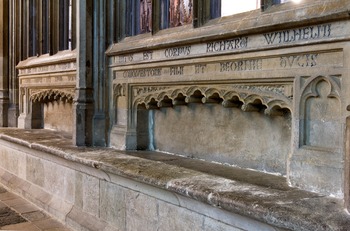
On the aisle side of Bay 2 of the retrochoir are a pair of decorated niches within the plinth wall below the traceried openings of Bishop Fox’s stone screen (fig 8); they are clearly integral with the screen itself and contemporary with it. They resemble tomb niches of the type commonly set in church walls, but their rear faces are not solid masonry but narrow slabs set vertically, allowing the plinth walls to be reduced to the minimum thickness. Inscriptions name the occupants, and above the east niche are the words INTVS EST CORPVS RICHARDI WILHELMI CONQVESTORIS FILII ET BEORNIE DVCIS (literally ‘within is the body of Richard son of William the Conqueror and Duke of Beornia’). The singular corpus reflects a long-standing confusion, implying that just one individual was buried here, namely ‘Richard, son of William the Conqueror and duke of Beornia’ The place name Beornia is entirely fanciful. The first authority to identify the inscription as a reference to Earl Bjorn was Henry Howard, an army officer with archaeological leanings who had examined the contents of the mortuary chests in 1797.Footnote 18 Reporting Howard’s observation, John Milner rightly concluded that the inscription on the sixteenth-century screen was ‘a manifest deviation’ of that on the stone slab. The matter was not resolved, however, and so as late as 1919 Canon John Vaughan suggested that Beornia was the Norman town of Bernay.Footnote 19
Sixteenth-century niches in Bay 2 south. Photograph: author.

In fact, both earlier epigraphy, discussed below, and manuscript evidence clearly indicate that two individuals are concerned: Richard son of the Conqueror, and Earl Bjorn. Richard was the second son of William i and Matilda of Flanders, born c 1054. Like his younger brother William thirty years later, he died in a hunting accident in the New Forest aged about fifteen. Orderic Vitalis relates that while pursuing a wild beast Richard rode beneath a tree and was crushed between a branch and the pommel of his saddle.Footnote 20 He died of his injuries shortly afterwards. Though the chronicler does not give his place of burial, merely locating it ‘in England’, there is no reason to doubt he was laid to rest in Old Minster c 1069.
Earl Bjorn was the son of Earl Ulf and Cnut’s sister Estrith: he was murdered in 1049 and initially ‘deeply buried’ in Devon (probably Dartmouth). According to the Anglo-Saxon Chronicle his body was later exhumed and brought to Winchester to be buried in Old Minster ‘with King Cnut his uncle’.Footnote 21 He was therefore one of the Anglo-Danes thought to have been interred in the eastern chapel of the Anglo-Saxon cathedral, and reburied in the choir stylobate c 1093.
Beneath the niche, set on top of the fourteenth-century stone bench, is an earlier grave marker (fig 9) consisting of a Purbeck marble slab with an inscription running along one side: HIC:IACET:RICARDVS:WILĽI:SENIORIS:REGIS:FILI’:ET:BEORN:DUX. The inscription is inverted when viewed from the aisle; it was meant to be read from within the choir before the screen was added. The use of Purbeck marble implies a date no earlier than the mid-twelfth century. In fact the most likely historical context for the setting of the slab is the early fourteenth century, when the stone bench was created between the new choir arcade. During that operation the chest would have been visible, allowing the inscription to be copied (with the addition of hic iacet). In support of this dating, the best parallel for the latter forms is found in the tituli below the statue niches of the east side of the stone screen separating the Feretory from the retrochoir, which dates from c 1315 and formed part of the same building operation as the arcade and benches.
Inscribed slab commemorating Duke Richard and Earl Bjorn. Photograph: author.

The addition of hic iacet introduced the ambiguity that led to the manifest error of the sixteenth-century inscription. Hic iacent would be expected, but those who viewed the chest in the early fourteenth century took the shorter inscription to refer to one person.
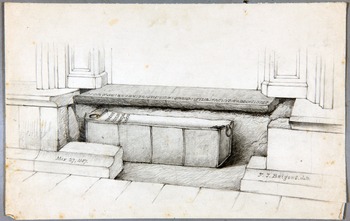
New light was shed on the matter in 1887 when a stone table tomb was created for Bishop Richard Courtenay († 1492), whose coffin had recently been discovered in the Lady chapel crypt.Footnote 22 The monument was to be located within the presbytery in the entire east half of Bay 2, replicating the sixteenth-century tomb chest of Bishop John of Pontoise on the opposite side. The project involved cutting into the north side of the bench. Given the clear epigraphic evidence for burial(s) within the bench, a local antiquary, Francis Joseph Baigent (no doubt encouraged by Dean Kitchin, a keen archaeologist), undertook an investigation, removing the facing stonework on the aisle side. He recorded the operation in a number of annotated sketches, as well as more worked-up drawings, all now in the cathedral archives. Embedded within the fourteenth-century rubble core of the bench he revealed a lead coffer with an incised inscription: RICARD’ FILI’ WL’I SENIORIS REGIS ET BEORN DUX.Footnote 23 There is little ambiguity here. There are two proper names in the nominative, Ricardus and Beorn Dux ie Richard and Earl Beorn. The first is further defined as ‘son of king William the Elder’, which suggests that the inscription dates from the time of William ii, ie after 1087. The uncial lettering style is also entirely consistent with a late eleventh-century date.
It seems, therefore, as Martin Biddle has argued, that in the early 1090s the graves of Duke Richard and Earl Bjorn in Old Minster were opened, and their bones were placed in a single lead coffer, which was then translated into the new cathedral, perhaps at the time of its inauguration in April 1093.
The drawing made when the entire coffer had been exposed (fig 10) seems to show one corner of the lid slightly rolled back, and if any access were possible it is inconceivable that Baigent would not have looked inside. Thirty years later, Canon John Vaughan wrote: ‘Mr F. J. Baigent, who was present with Dean Kitchin when the tomb was opened, states that the skull within the leaden coffin was a small one, with a curiously-shaped, narrow jaw-bone, clearly that of a boy not more than sixteen years of age.’Footnote 24 This appears to have been a verbal communication from Baigent to Vaughan, and if Baigent wrote notes on the discovery they have not survived in the cathedral archives. Canon Vaughan’s book was completed at the end of Baigent’s life and is dedicated to him.
F J Baigent. The lead coffer revealed to its maximum extent, 27 May 1887. HRO, DC/K1.

That only one skull was observed did not come as a surprise to Baigent, for he believed (despite the inscription on the lead coffer) that the burial in question was that of a single individual. The limited access provided through one corner of the coffin might not have allowed him to see another skull, perhaps at the far end of the chest or concealed by disarticulated bones.
It is to be hoped that, as part of the ongoing investigations into the contents of the mortuary chests, the bench might be opened up again, by removing the masonry that was reset in 1887 and the lead coffer carefully reopened. This would permit aDNA sampling, with the potential to provide cross-matches with the alleged bones of William Rufus (Richard’s brother) and Cnut (Bjorn’s uncle), thereby identifying two of the skeletons in the mortuary chests.
The heart-burial of Bishop Nicholas of Ely
Brief mention should be made here – given its importance as a reference point in earlier accounts of the mortuary chests above – of the occupant of the niche in the western half of Bay 2 of the south arcade. The inscription above the niche reads INTUS EST COR NICHOLAI ELY OLIM WINTON[IENSIS] EPISCOPI CUIUS CORPUS EST APUD WAVARLEI (‘Herein is the heart of Nicholas [of] Ely, formerly bishop of Winchester, whose body is at Waverley’). Nicholas of Ely was bishop from 1268–80. He was buried, apart from his heart, at the new church at Waverley Abbey, which he had dedicated on St Matthew’s day 1278.Footnote 25
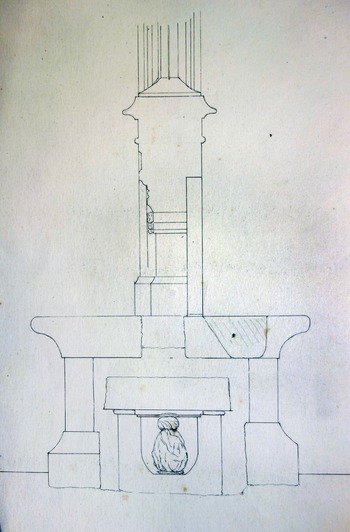
Although this end of Bay 2 was largely unaffected by the construction of Bishop Courtenay’s new tomb, Francis Baigent pursued his research. Baigent’s drawings (eg fig 11) clearly indicate that he opened up the wall bench on the north side, so he must temporarily have removed a second incised slab, discussed in the following section. A thick cover stone was revealed over a stone block incorporating a cavity that was sealed by a lead plate inscribed Hic humatum est cor Nycholay de Hely Wynttuniensis episcopi qui obiyt Anno gracie MCC˚LXXIX˚ die lune ante festum sancti Valentyni (‘Here is buried the heart of Nicholas of Ely, Bishop of Winchester, who died ad 1279 [ie 1280] on the Monday before St Valentine’s day’). The heart, wrapped in faded red cloth, was recorded.
F J Baigent. Section of fourteenth-century bench and lower part of Fox screen looking west, showing the heart-burial of Bishop Nicholas of Ely. HRO, DC/K1.

The burial of Edward Ironside
Confusingly, in the west half of the Bay 2 of the south screen is another incised stone similar to that commemorating Richard and Bjorn, visible only on the main vessel side of the screen. Its inscription, in similar lettering to the first, reads HIC:IACET:EDMUNDVS:REX:EðELDREDI:REGIS:FILIVS (‘Here lies King Edmund, son of King Ethelred’).
I suggested in 1994 that the Edmund in question was Edmund Ironside († 1016), son of Ethelred the Unready and Ælfgyfu of York, even though the Anglo-Saxon Chronicle and the fifteenth-century Winchester chroniclers are unanimous that Edmund was buried at Glastonbury.Footnote 26 Professor Biddle has explored the matter further, suggesting that Cnut, who ‘seems to have called Edmund his “brother”, may in 1032 have brought his body or part of it the 100km (62 miles) from Glastonbury to Old Minster’.Footnote 27
Previous commentators, however, identified this Edmund as Ælfred the Great’s eldest son, who had died in infancy. The confusion seems to turn on the monk Thomas Rudborne’s apparent misreading of the name Eþeldredi as Eweldredi, which he considered to be a variant form of Ælfredi; presumably he misread þ (thorn) as ƿ (wynn) and converted it to W. He discusses the variant forms of Alfred’s name in the same passage.
The same error appears to be perpetuated in the painted inscription on the mortuary chest on top of the screen in this bay, now back in its correct position having been transposed with that in Bay 3 in the 1930s. The chest is labelled Edmundus Rex … qui, vivente patre, regia sceptra tulit (‘King Edmund, who wielded the royal sceptre during his father’s lifetime’). The inscribed stone was presumably moved to its present position in order to be close to the relevant chest.
The slab has been located here only since the early nineteenth century. Before that, Milner noted that it was ‘on the pavement’ of the Gardiner chantry chapel on the north side of the Feretory.Footnote 28 It was also observed there by the fifteenth-century chroniclers of Winchester Cathedral: Thomas Rudborne, writing perhaps c 1450 (a century before Gardiner’s chantry was erected), noted that Edmund’s ‘marble tomb … lies to this day on the ground on the north side of the altar where the morning or capitular mass is celebrated. And this epitaph is written on the marble: “Here lies King Edmund, son of King Aldred”’.Footnote 29 The altar in question was probably the shrine altar of St Swithun, within the Feretory as reconfigured in the fourteenth century. It seems possible that when the Romanesque apse enclosing Henry of Blois’s Feretory platform was demolished, a ‘burial’ within the apse stylobate – perhaps a lead coffer like that of Richard and Bjorn – was relocated beneath the pavement of the enlarged Feretory, and marked by a similar incised slab close to its earlier position. This, however, was where Bishop Gardiner’s chantry chapel was erected c 1556, which suggests that the slab was disturbed when the higher floor level of the chapel was established. By then, however, Edmund had his own mortuary chest, and it is difficult to understand why his lead coffer should have been disturbed before the chantry chapel was under construction.
Milner also mentions the intriguing possibility that Edmund’s bones were actually visible and accessible in the chapel at the end of the eighteenth century: ‘It is thought that his bones have been removed out of their sepulchre, and that those which are still seen in a large antique coffer at the upper end of the chapel, form a part of them which no person since has had the humanity to cover.’Footnote 30 The whereabouts of these remains is unknown. Had they been buried beneath the slab in the south bench this would undoubtedly have been recorded by Francis Baigent who (as shown below) carefully observed the works. They might of course have been silently placed in the mortuary chests at some time during the nineteenth century.
The evidence is contradictory. One possibility is that there were two Edmunds: Edmund Ironside, perhaps buried within the apse and its successor position, disturbed only when the Gardiner chantry chapel was built, and Edmund an elder son of Alfred the Great – but there is no record of the latter, and had he existed one would have expected that he would have been transferred to New Minster with the rest of the Alfredian dynasty.
The supposed tomb of Harthacnut
The design of Fox’s north screen differs significantly from that on the south. There are no niches, but the plinth wall has a series of relief panels facing the aisle (and in one case, the main vessel), resembling the sides of Renaissance tomb chests. The north side of the tomb of Bishop John of Pontoise, still in its fourteenth-century position, as is clear from the survival of its earlier plinth, actually forms part of the plinth wall facing the aisle. It is integral and contemporary with Fox’s screens. At the west end, in Bay 1, however, the remains of Bishop Toclyve are, according to a panel, simply buried within the fourteenth-century bench. These burials, however, including the complex evolution of the heart-burial of Bishop Aymer (Ethelmar) de Valence, indicated by a panel facing the aisle in Bay 2, lie outside the scope of this paper, being unrelated to the contents of the mortuary chests.
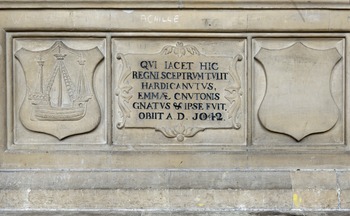
At the east end of the sequence, in the east half of Bay 3, is the alleged tomb of Harthacnut, marked by an inscribed panel facing the aisle (fig 12). It has a Purbeck marble fictive tomb top above, and the inscription in a scrolled cartouche is flanked by fictive heraldry; a ship on the left side, but a blank shield on the right, possibly once painted, or perhaps left blank with symbolic intent. The inscription reads: QVI IACET HIC REGNI SCEPTRVM TVLIT HARDICANVTVS EMMÆ CNVTONIS GNATVS & IPSE FVIT. OBIIT A.D. 1042 (‘Harthacnut who lies here wielded the royal sceptre and he was born of Emma and Cnut. He died ad 1042’).
Inscription datable to c 1525 stating that ‘Harthacnut lies here’. Photograph: author.

This inscription implies that the remains of Harthacnut might have been reburied within the fourteenth-century bench, near to an earlier reburial spot in the Romanesque stylobate, and it was supposed that they were housed in a lead coffer similar to that containing Richard and Bjorn in the equivalent position on the south side.
To test this theory the benches on either side were initially scanned with an amateur metal detector.Footnote 31 This produced an unmistakable signal on the south side (the coffer of Richard and Bjorn) but nothing on the north side. Subsequently the benches were also scanned using ground-penetrating radar, both facing downwards and laterally (ie with the antenna set horizontally), but no anomalies were detected; nor were any anomalies detected using the antenna facing downwards to check for sub-floor burials.Footnote 32 Finally, a sondage undertaken during necessary repairs to the bench proved conclusively that it was completely filled with flint corework from front to rear, with no cavity.
It is of course possible that the adverb hic should be interpreted more widely, and that the inscribed tablet refers to a burial beneath the high altar steps on the other side of the wall. In support of this proposition is the fact that the heart-burial urn of Bishop Aymer de Valence was discovered below those steps during the Commonwealth even though the sixteenth-century inscribed panel states that it was contained ‘within this very stone’ (cuius cor nunc tenet istud saxum). There is indeed plenty of space beneath the altar steps, as shown by the levels in fig 13.
East section through the Fox’s north screen and the fourteenth-century bench showing floor levels and extent of sondage within the bench. Diagram: author.

William Rufus
William Rufus was famously killed in the New Forest, and William of Malmesbury recounted about twenty years later that his body, ‘dripping with blood’, was brought in a cart to Winchester Cathedral where it was consigned to the earth infra ambitum turris (‘within the periphery of the tower’).Footnote 33 The tower, however, collapsed in 1107. The dos d’âne tomb in the centre of the choir, pointed out to visitors as the ‘Rufus Tomb’ until as recently as the 1970s, is in fact that of Bishop Henry of Blois. Moved from its original position in front of the high altar steps to the retrochoir in 1868, it was transferred to its present location in 1886 in the mistaken belief that it was reverting to its original position.Footnote 34
In his Annales of England, John Stow noted that Rufus had been buried ‘under a playne flat marble stone, before the lectorne in the queere, but long since his bones were translated into a coffer and layd with king Knutes bones’.Footnote 35 This is the first of many references to the two kings sharing a coffer. The grave of Rufus might have been re-established after the reconstruction of the tower, but possibly it was at that date that his bones were placed in a lead coffer similar to that of the Anglo-Danes. The pairing of Rufus and Cnut probably began under Bishop Fox.
This concludes our account of the material evidence for royal and other burials related to the contents of the mortuary chests: we turn now to the written testimony of early observers, notably those writing before the depredations of 1642.
PRE-FOX WRITTEN SOURCES FOR THE CONTENTS AND LAYOUT OF THE MORTUARY CHESTS AND OTHER BURIALS
The earliest list of occupants of the predecessors of the present chests occurs, as noted above, in the Liber Historialis. The author notes that Henry of Blois elevated four kings of Wessex: Æscwine, Centwine, Æthelheard and Cynewulf. Missing from his list are Cuthred and Sigeberht who reigned between the last two (see Table 1). The latter monarch is the only one to be named on the present chests, but the point of the chronicler’s observation is that it was no longer possible to identify the individuals, and indeed they were placed in the chests of 1158 ‘kings with bishops and bishops with kings’. The first three kings thus named might therefore be among the ten ‘extra’ male skeletons now identified in the chests, possibly even Cuthred and Sigeberht as well.
The Chronicon Wintoniense (possibly another text by Thomas Rudborne) supplies precious information about the location of the royal and episcopal bones between the works of the fourteenth century and the creation of the new mortuary chests of Bishop Fox c 1525. The bones of Cynegils and Æthelwulf were said to be in locello plumbeo ex australi parte altaris supra ostium meridionalis criptæ (‘in a lead casket on the south side of the altar above the door to the south “crypt”’).Footnote 36 It bore the text Hic rex Kingilsus requiescit rex et Athulphus/Quorum gesta manus docet hæc nunc suscipiamus. Thus, the first Christian king of Wessex and the mid-ninth-century father of Alfred the Great have shared a single chest since at least the fifteenth century. One of the fifteenth-century wooden chests, in which the lead casket was presumably enclosed, also bears their names, as ‘founder’ and ‘giver of Chilcombe’ respectively, and the inscription on the sixteenth-century chest N3 also bears their names as ‘founder’ and ‘benefactor’ (though the founder of Old Minster is traditionally identified as Cenwalh). The word crypta appears to be being used here in its primary sense of ‘vault’, and appears to refer to the south presbytery aisle, which may have retained at least part of its Romanesque vault until the aisles were rebuilt by Bishop Fox. The reference to ‘on the south side of the [high] altar’ must simply indicate the south side of the presbytery, because the fourteenth-century benches are intact except where interrupted by the doors in Bay 1.
The author also mentions another long-standing pairing: Cynewulf and Ecgberht, whose bones were in locello plumbeo supra tumulum ubi reconditur cor Nicholas Ely (‘in a lead casket above the tomb where Nicholas Ely lies’). As noted above, that heart-burial is still in the western half of Bay 2 of the south presbytery arcade. Again, the lead coffer appears to have been enclosed within a decorated wooden chest, which has also survived.
As previously noted, a passage in the Liber Historialis claimed that the bones of the early West Saxon kings Æscuin, Centwine, Æthelheard and Cynewulf, together with early bishops, had been placed in lead coffers ‘all mixed up together’ in 1158. If so, it is hard to understand how the bones of Cynewulf could subsequently have been extracted with certainty.
The fifteenth-century chroniclers suggest that Cenwalh, son of Cynegils and founder of Old Minster, was initially buried ‘in the eastern crypt’, The author of the Chronicon Wintoniense, and Thomas Rudborne in his Historia Maior, state that the remains were sub summo altare ubi usque in hodiernum diem corpus eius jacet humatum (‘under the high altar, where his remains lie buried to this day’). It would perhaps be surprising if the founder of Old Minster had not been translated with ceremony into the Norman cathedral c 1093. Cenwalh has never been mentioned as occupant of any of the successive mortuary chests – so, despite the fifteenth-century chroniclers’ confusion between Old Minster and their own church, it is just possible that his remains do indeed lie buried below the high altar platform, which is still in its eleventh-century location despite the remodelling of the entire cathedral east of the crossing tower.
As for the Anglo-Danish dynasty, the remains of Cnut are, according to the inscriptions on Chests N1 and S1, shared between those chests, together with Emma, Alwin, Wini and Rufus. It has long been apparent that this is not the case: the two chests share many more than four individuals. In the fifteenth century, according to the Chronicon Wintoniense, Cnut’s remains were in locello plumbeo circa ostium meridionalis cryptæ (‘in a lead coffer about [sic] the door of the south “crypt”’).Footnote 37 The chronicler does not mention Rufus in this context. Before the Parliamentary incursion of 1642, however, Cnut’s bones and those of Rufus occupied a single Renaissance chest above the south door into the choir, ie in the east half of Bay 1, so that position appears to perpetuate Cnut’s location before Bishop Fox’s reordering. The fifteenth-century chroniclers are silent regarding the whereabouts of Emma before Fox’s episcopate. Harthacnut, however, is said initially to have been laid to rest in boreali crypta (in the north ‘crypt’) – which may be the north presbytery aisle – but modo vero ossa eius reconditur in locello marmoreo in boriali parte maioris altaris extra praecinctum (‘now however his bones lie in a marble casket on the north side of the high altar, outside the chancel enclosure’).
Some pre-Fox burial places of bishops of Winchester are recorded by the late medieval chroniclers of Winchester Cathedral. An interpolation in the Vespasian manuscript of the Liber Historialis mentions that Thomas Langton iacet humatus in capella sancti Birini (‘Thomas Langton (bishop 1493–1500/1) lies buried in the chapel of St Birinus’).Footnote 38 This text was not known when an indulgence relating to the veneration of St Birinus was discovered in the Langton chantry chapel in 1923. The cathedral architect T D Atkinson then speculated that Langton had taken over the shrine chapel of the Anglo-Saxon bishop.Footnote 39 According to the Winchester Annals, his shrine (feretrum) had been given to the cathedral by Henry of Blois. Birinus’s successor, Wini, is not mentioned until the later seventeenth century. The succession of early bishops of Wessex thereafter are said to have been buried in various parts of the cathedral, though some may have been among the anonymous bishops said to have been mixed with the bones of kings in 1158.
Bishop Helmstan, on the other hand, was said in the Liber Historialis now to be in locello plumbeo posito ex boreali plaga altaris supra tumulum Richardi Toclyv episcopi (‘in a lead coffer placed on the north side of the high altar above the tomb of Bishop Richard Toclyve’).Footnote 40 Toclyve is now claimed to be buried in Bay 1 of the north presbytery arcade (see above). The chroniclers pass over the post-Conquest history of the movements of subsequent bishops, apart of course from SS Swithun and Birinus. Two eleventh-century bishops receive better mention: ‘John of Exeter’ wrote that Bishop Ælfwyn sepultus fuit primitus in cripta, ex parte australi summi altaris, modo vero ponitur in sarcofago plumbeo super ostium illius cripte ex parte sinistra (‘was initially buried in the “crypt” on the south side of the high altar, but he now lies in a lead coffer above the door of the same “crypt” on the left hand’).Footnote 41 Finally, Bishop Stigand (the deposed archbishop of Canterbury) was said to lie in sarcophago plumbeo ex australi parte summi altaris iuxta cathedrem episcopalem (‘in a lead coffer on the south side of the high altar next to the bishop’s throne’).Footnote 42
The location of the ‘burials’ within the fourteenth-century bench and the lead coffers above them are shown in fig 14.
Location of burials within the fourteenth-century benches (bold type) and location of lead coffers as recorded by fifteenth-century chroniclers (italic type). Diagram: author.

SOURCES FOR THE CONTENTS AND LAYOUT OF BISHOP FOX’S MORTUARY CHESTS AND OTHER BURIALS
We turn now to the graphical and written evidence for Bishop Fox’s chests before the destruction of 1642. The antiquary Robert Glover, Somerset Herald at the College of Arms, visited Winchester, probably in the period 1570–88, and noted ‘Kinges buryed in the Cathedrall Church of Winchester’.Footnote 43 He sketched ten heraldic shields (including two for Queen Emma and for Edmund, which are possibly those on the mortuary chests, though no mention is actually made of the chests themselves). Allowing for the fact that by that date Ecgberht/Cynwulf and Æthelwulf/Cynegils shared two chests (as shown by the survival of their fifteenth-century ‘inner chests’) Glover accounts only for six chests.
In the 1590s an anonymous antiquary, whom I have named ‘Q’ (not Glover, as is clear from the handwriting and date), made on-site notes on the monuments of Winchester Cathedral, with a particular emphasis on their heraldry.Footnote 44 His list of the mortuary chests is entitled ‘Certain monuments newly set up and on high above their old positions’ (Quædam Monumenta noviter et in alto redacta supra Locos antiquos). The accuracy of Q’s transcriptions may be assessed from his rendering of inscriptions that have survived: Edmund, Ecgberht/Cynewulf, Eadred, Æthelwulf/Cynegils.
Q’s list suggests that there were ten chests (the entry for each chest is divided from the next by a horizontal line, apart from one instance where there is simply a wider space).Footnote 45 Comparison with the location of chests recorded by seventeenth-century observers indicates that he listed first the chests on the north side of the presbytery, working west to east, then those on the south, again from west to east.
At the west end on the north side Queen Emma was in a single chest, marked by an inscription (which, given its length, may have been painted on the wall):
Eu [?] Emmam Cista Reginam continet ista
Duxit Etheldredus Rex hanc et postea Cnutus
Eduardum sanctum parit haec ac Hadicanutus [sic]
Quatuos hos reges haec vidit sceptra tenentes
Anglorum regni fuerat sic mater et uxor
This chest holds Queen Emma,
King Ethelred married her, and then Cnut
She gives birth to Edward and Harthacnut
She saw these four kings wielding the sceptre
This she was both mother and wife of the kingdom of England
Working eastwards, the other four chests on the north side contained bishops, named by Q as as Alwinus episcopus, Alfinus praesul, Elmstanus successorque Ranulphus, Oswinus episcopus et ep[iscopus] ?alter. There are some difficulties with this list: Alfinus or Alsinus is perhaps Ælfsige i (951–59) or Ælfsige ii (1014–32). Bishop Helmstan († 852) was succeeded by St Swithun; Ranulphus is identified by other observers as Bishop Cenwulf (1005–6), and in his De Praesulibus Francis Godwin cites the inscription on the chest: Pontifices haec capsa duos tenet incineratos/Primus Elmstanus, huic successorque Kynulphus.Footnote 46 Oswinus must be Bishop Wini (c 662–70, a misreading of ossa Wini as [ossa] Oswini. The inscription to ?another bishop on the easternmost chest appears to have been illegible, but other observers concur that this was Stigand, bishop of Winchester and Archbishop of Canterbury in plurality until he was deposed by the Conqueror. The best authority is a local historian, John Trussell, mayor of Winchester in 1624 and 1633.Footnote 47 In two unpublished works, the last completed in the fateful year 1642, he mentioned that Stigand ‘was buried in St. Swythins monasterye with Bishopp Wina uppon whose urne appeereth this superscription, Hic iacet Stigandus Archiepiscopus’.Footnote 48
The sequence as recorded by Q on the south side is simpler: Cnut and Rufus at the west end, followed by Edmund (now chest S3), Ecgberht and Cynewulf (now N2), Eadred (now S2) and Æthelwulf and Cynegils (now N3). As explained below, the four surviving chests escaped the attentions of the Parliamentarians in 1642, who, surprisingly systematically, started on the north side and threw down only Cnut and Rufus’s chest on the south.
The list provided by Q omits one important royal burial, that of Harthacnut. That would be explicable if the king’s remains were interred in the fourteenth-century bench, as indicated by Fox’s inscription, or perhaps below the high altar step nearby. However, other early seventeenth-century observers state that his remains were in a mortuary chest. In 1635 a ‘Lieutenant of the Military Company in Norwich’ toured the ‘western counties’ making careful observations. He is usually identified as ‘Lieutenant Hammond’ because while visiting Malden he noted that he was the namesake of the then town clerk. His description of the mortuary chests reads as follows:Footnote 49
Her Monuments are many, fayre, and ancient especially 10. in little woodden gilt Coffers, are wrapt, and shrin’d in Lead, the bones of 4. Saxon Kings, 2. Danish Kings, and 4. Bishops, and a Queen ; which were taken vp, and preseru’d by Bishop Fox, when he built vp that part of the Quire where they were interr’d : They are equally plac’d and fix’d betweene the Quire, and the High Altar, on the top of the wall, 5. on one hand and 5. on the other, vizt. King Canutus, and his Son Hardicanute both in one, and 4. more Saxon Kings, Egbert, Elfred, Adulphus, and Gilsus, with their Crownes on the top of those Boxes.
On the North side is Queen Emma, and her Sonne, and 4. Saxon Bishops, with the Miters thereon.
The plaine Marble Tombe of William Rufus, in the fashion of a Coffin.
Hammond may have been confused by the inscription to Emma, believing that one of her sons, presumably Edward the Confessor, shared her mortuary chest. The most obvious discrepancy, of course, is his assertion that Cnut and Harthacnut (rather than Rufus) shared the westernmost chest on the south side. This might have been simple confusion, as he ends with a mention of the ‘Rufus tomb’ (recte that of Bishop Henry of Blois) without stating that it was empty.
There is no doubt that Q, Lieutenant Hammond and John Trussell wrote from direct observation, and it is perhaps likely that Francis Godwin also visited Winchester. It is on the basis of their first-hand observations that the layout shown in fig 15 is proposed.
Occupants of chests 1525–1642. Diagram: author.

Authors writing after 1642 relied on second-hand information. Chief among these is the Royalist propaganda of Mercurius Rusticus, Bruno Ryves. There are some obvious errors in his list of the occupants of the mortuary chests:Footnote 50
the bones of many Kings and Queenes, as of Alfredus, Edwinus Senior, Eadredus the brother of Athelstane, Edwinus, Canutus, Hardecanutus, Emma the Mother, and Edward the Confessor her Sonne, Kiniglissus the first founder of the Cathedrall of Winchester, Egbert who abolishing the Heptarchy of the Saxons, was the first English Monarch, William Rufus and diverse others: with these, in the like Chests, were deposited the bones of many Godly Bishops, and Confessors, as, of Birinus, Hedda, Swithinus, Frithestanus, St Elphegus the Confessor, Stigandus, Wina, and others.
Alfred, Edward the Elder (Edwinus Senior) had of course been buried in New Minster then moved to Hyde Abbey; Edward the Confessor was at Westminster; Birinus and Swithun had occupied their own shrines until 1538. Given these errors it would be unwise to take Ryves’s account as confirming that Harthacnut was named as being in one of the mortuary chests. Of greater value is Ryves’s important description of the systematic way the soldiers worked, constrained no doubt by the need to use ladders:
on the North side of the Quire, they threw down the Chests, wherein were deposited the bones of the Bishops, the like they did to the bones of William Rufus, of Queen Emma, of Hardecanutus, and Edward the Confessor, and were going on to practise the like impiety on the bones of all the rest of the West Saxon Kings …Footnote 51
It seems from this account as though all the chests on the north side were destroyed, together with the westernmost chest on the south side. Thus, the only Fox chests to have survived are the other four on the south side, which escaped violation.
Writing later still, an account of the chests before 1642 was written by Precentor Thomas Gray in the cathedral’s composite baptism, marriage and burial register.Footnote 52 Gray had been admitted a minor canon on 29 September 1683,Footnote 53 and was precentor by 25 November 1684.Footnote 54 In the Christening section, foliated from the end of the book as turned upside down, he wrote an account of ‘The Monuments in ye Chathedral Church of Winton most Observable’.Footnote 55 The order of the chests is as today. His account of the occupants of the chests pre-1642 broadly concurs with first-hand observers. Gray was, however, confused by the 1660s chests at the west end, perhaps not realising that they were replacements; he faithfully copied the 1660s inscriptions that he noted had been added ‘of late’. The chests certainly lacked inscriptions in September 1662 when the Dutch artist Willem Schellinks visited Winchester; thus Cnut, Rufus, Emma, Ælfwyn and Wini are missing from his transcriptions, and he wrote that ‘in the choir stand two tomb chests without any inscription’.Footnote 56
Another later seventeenth-century account is provided by the Earl of Clarendon, as published by Gale. Henry Hyde, 2nd Earl of Clarendon, was only four in 1642, so was definitely not a first-hand observer. In 1684 he wrote an ‘Account of the Tombs and Monuments in the Cathedral Church of Winchester, finish’d this 17th Day of February, 1683[/4]’. The two texts, by Clarendon and Gray, are often identical, and it is not immediately apparent which is the original. It is, however, unlikely that Clarendon would have had access to the register in which Gray wrote his notes; and Gray would not have been in charge of that volume until late in 1684 when he became precentor. Gray includes some interesting material about Bishop Aymer de Valence’s heart-burial slab that was omitted from Clarendon’s account, but he omits to say, as Clarendon does, that Stigand’s bones were formerly enclosed with Wini – though both place Wini’s chest at the west end on the north side. It is perhaps possible that Clarendon and Gray collaborated on the notes. One additional candidate is ‘Alfimus’, who had been named by Q in the 1590s; possibly one of the two Bishops Ælfsige, as suggested above, his lead coffer is said to have been at the east end of the north screen wall rather than centrally, as stated by Q.
Stigand remains a problem. A persistent legend maintains that his remains were shared among the two westernmost chests when they were created c 1661. For example, Charles Ball wrote in 1818 that the ‘mingled relics’ in those two chests included ‘those of Cnute and his Queen Emma, of William Rufus, and of the Bishops Wina, Alwyn, and Stigand’, even though his transcription of the ‘nearly illegible’ inscription listing the occupants does not mention the archbishop.Footnote 57
OTHER POSSIBLE OCCUPANTS OF THE CHESTS
Some other possible occupants of the mortuary chests may briefly be mentioned here. As noted above, a fifteenth-century chronicler, possibly Thomas Rudborne, specially mentioned three early kings of Wessex not named by other authorities: Cenwalh, Æscwine and Centwine. Cenwalh, on the other hand, was buried ‘beneath the high altar … to this day’. Also unaccounted for are three eighth-century monarchs, Æthelheard and Cuthred (possibly brothers), and Sigeberht (perhaps related to Cuthred).
As for the two juveniles, the facial reconstruction in the new exhibition Kings & Scribes suggests one of them might be Richard of Normandy, killed in the New Forest, but, as noted above, his labelled coffer still contains at least one skull. Another potential candidate is the younger Richard, bastard son of Duke Robert of Normandy (thus the Conqueror’s grandson) also accidentally killed in the New Forest, being shot by an arrow while hunting, as recorded by Orderic Vitalis, William of Malmesbury and ‘Florence’ of Worcester and his continuator.Footnote 58 John Trussell wrote that he had fallen caught by a branch (presumably confusing with the older Richard) and continued, ‘Hee was buried by his unkle [Rufus] in St. Swythins att Winchester’.Footnote 59 Trussell does not, however, surmise where his bones might lie, and he is the only authority to propose Winchester.
It is possible that the unknown skeleton in the chest in the Gardiner chantry chapel, said by Milner to have been ‘buried’, was also placed in one of the chests. There is one other candidate, albeit a highly speculative one. On 21 September 1538 the shrine of St Swithun was destroyed. The following year Thomas Derby, clerk to the privy council under Thomas Cromwell, drafted a sermon, in which he claimed ‘St Swythan and other reliques wheraboute abuse of ipocrasy was be layde save, and not, as it is untruely surmitted, brent, but according to reason collocate secretely, wher ther shal be no cause of superstition giuen by them’.Footnote 60 Could the bones of St Swithun (minus his head, which is allegedly at Evreux Cathedral and one of his arms, formerly at Stavanger) have been quietly slipped into the mortuary chests in 1538?
CONCLUSIONS
As was made clear at the start of this paper, it is based on historic sources and archaeological observations. Table 2 lists the possible occupants of the mortuary chests based on this methodology. Meanwhile the scientific work of identifying the skeletal material continues, and these may prove or disprove these tentative findings.
List of possible occupants of the mortuary chests.

ACKNOWLEDGEMENTS
I am grateful to Professor Martin Biddle for discussions over many years about royal burials at Winchester, and to Professor Barbara Yorke for her valuable comments on this paper. Special thanks are due to the scientific team, originally based at University of Bristol, for facilitating a project that the cathedral has hoped to undertake for more than two decades.
ABBREVIATIONS AND BIBLIOGRAPHY
Abbreviations
- aDNA
-
ancient DNA
- AS
-
All Souls College, Oxford
- BL
-
British Library, London
- Bodleian
-
Bodleian Library, Oxford
- CCCC
-
Corpus Christi College, Cambridge
- HRO
-
Hampshire Record Office, Winchester
- RS
-
Rolls Series
- SAL
-
Society of Antiquaries of London
- WCA
-
Winchester Cathedral Archives (at HRO)