These are little meditations inspired by childhood, offered in homage to childhood, full of tenderness, of softness, sometimes cheerful and lively too, but always intimate and made to evoke a calm ‘nursery’ atmosphere. […] So isn't it undoubtedly a paradox […] that [Louis Laloy] has gathered together, to illustrate these children's pieces, a pantomime, childlike to be sure, but incoherent, noisy, muddled, set in the open air, where there are clowns slapping each other about, a hoodwinked nurse, a toy-selling rabbit and who knows what else? And which is in absolute and chaotic disharmony with M. Fauré's exquisite music.Footnote 1
This was Reynaldo Hahn's response to Dolly, a highly successful ballet mounted at the Théâtre des Arts in Paris in January 1913. The musical ‘meditations’ to which Hahn referred were the movements of Fauré's Dolly Suite, performed in Henri Rabaud's orchestration.Footnote 2 (Since the ballet and Fauré's suite have the same title, I refer to the ballet as Dolly and to Fauré's music always as the Dolly Suite, to avoid potential ambiguity.) As these remarks suggest, Dolly exemplified two important elements of early twentieth-century theatrical ballet in France, challenging as it did perceptions of congruity between music and dance, and appropriating circus and music-hall entertainment. Overshadowed by the spectacles of the Ballets Russes, this production has not been investigated in detail. The ballet was presented in the Parisian press as a form of choreographic criticism of Fauré's suite which dismantled the interpretative framework that conventionally guided its hearing. Through examining this production, we can perhaps learn from its ‘criticism’ and reconsider the assumptions that may still dictate how we listen to this well-known work.Footnote 3
A more favourable critic than Hahn called Dolly an ‘explosive little intellectual fantaisie’, an assessment which prompts my examination of the ballet.Footnote 4 Like today's critics, Hahn and his contemporaries heard the Dolly Suite as embodying a particular attitude towards childhood, a perception informed by the work's titles and by knowledge of the circumstances of its creation. For Hahn, Louis Laloy's ‘pantomime’ sought to intertwine the movement of Fauré's music with ‘childlike’ movement of a quite different character – ‘puérile’ rather than ‘enfantine’. This article places Dolly in the context of the highly contested valuation of the ‘childlike’ (an aesthetic category with important political dimensions) in French culture in the early years of the twentieth century. Laloy's choreography, I suggest, sought to distance Fauré's music from a particular mawkish, moralizing attitude towards childhood increasingly scorned by contemporaneous literary thought. Dolly marks a revealing moment in a wider artistic revaluation of the childlike as an irrational condition, comic and chaotic, though suffused with innocence. This revaluation reached its conclusion in the heterogeneous movement we call surrealism. Like several other ballets from the 1910s, Dolly 's exploration of the theme of childhood involved appropriating the gestural language of clowning. According to popular thought, this language enacted the manifestations of various pathological conditions in which unruly nerves overran the mind's ‘higher’ faculties. Provocatively and problematically, the ballet implicitly presented Fauré's music as generating versions of these ‘choreas’ – nervous disorders characterized by spasmodic physiological symptoms.Footnote 5 As Hahn hinted, the established associations of Fauré's music emphasized a perception of this dancing as a corporeal manifestation of the childlike.
This article aims to contribute to the developing scholarly interest in music's significance in the history of childhood, and especially in the concept of childhood as ‘an idea in a society's explanation of the world’ (to borrow Hugh Cunningham's phrase).Footnote 6 Central to this interest is the distinction between ‘children’ (growing biological entities) and ‘childhood’ (the conditions in which children develop).Footnote 7 Throughout the nineteenth century and into the twentieth, discourse about childhood was essential to the imagination of alternative modes of perception, and to reflection on the nature of subjectivity. Carolyn Steedman, for instance, argues that the concept of childhood – an apparently alien state that is nonetheless part of the fabric of our selves (since we were all once children) – became the primary idea giving shape to the notion of human interiority (most notably in the writings of Sigmund Freud).Footnote 8 Music's particular significance in these patterns of thought derived partly from its ability to articulate the ‘childlike’, but also from its purported capacity to evoke states that critics sometimes described, if obscurely, as recapturing childhood. Implicit in the following discussion is the claim that Fauré's music became an unlikely instrument in a wider cultural project – to undermine the assumption that the conscious ‘I’ always controls a unitary self. Music and movement came together not just to represent a reconfiguration of this view, but as symptoms and agents of that reconfiguration.
Choreographic disharmony
Dolly belonged to the second of three ‘spectacles de musique’ with which Jacques Rouché concluded his three-year directorship of the Théâtre des Arts. Lynn Garafola calls his directorship ‘an important episode in the history of early twentieth-century French theater’.Footnote 9 Rouché's directorial ambitions included restaging eighteenth-century lyric repertoire, reviving French operettas from the recent past and promoting contemporary French compositions in their capacities as ballet music, whether arranged or specially created for this purpose. The range and character of his programmes are exemplified by the works with which Dolly shared its first programme: the prologue of Lully's Thésée and Chabrier's one-act operetta Une éducation manquée. Productions at the Théâtre des Arts generally gave dance special prominence, as in plays such as Laloy's own Le chagrin dans le Palais de Han (1912), an adaptation of a fourteenth-century Chinese drama. Rouché's theatrical uses of contemporary French music manifested an apparent penchant for childhood-related subject matter. In 1912, he had staged a ballet version of Ravel's Ma mère l'oye, arranged by the composer from the original piano version. In April 1913, the theatre would première Le festin de l'araignée (The Spider's Feast), a ‘ballet pantomime’ comparable to Dolly, with music by Albert Roussel and a scenario by Gilbert de Voisins.Footnote 10 In his review of Dolly in Le théâtre, H. Décé noted that in general Rouché's ‘musical spectacles’ open ‘visions of dream, landscapes from long ago or fairytales from today’.Footnote 11
The ballet's choreographer, Léo Staats, who worked on most of Rouché's ballets, usually employed dancers ‘from the concert stage and commercial world’.Footnote 12 The clowns to whom Hahn referred were Tommy and Georgey Foottit, sons of George Foottit (also a clown), who had achieved immense success at the Nouveau Cirque from the 1890s.Footnote 13 The sons also played the mantises in Le festin de l'araignée. Laloy, who wrote the scenario for Dolly, described it in his 1928 memoirs as ‘a sort of danced skit, [which] showed for the first time (to my knowledge) on a theatre stage the burlesque of the circus and the music hall’.Footnote 14 In general, the burlesque as an artistic mode embraced ‘extravagant ideas in the service of farcical, even vulgar, expressions’. In the context of language and comportment, it implied ‘clumsy buffoonery serv[ing] the purposes of laughter or mockery’.Footnote 15 Here, in the sense of ‘buffoonery’, the term referred especially to a distinctive quality of movement that characterized the performance styles of various interrelated entertainment genres of the day. These genres could include clown routines, other comic pochades (sketches), non-academic dance numbers, acrobatic routines and various styles of singing – all of which were often, at this time, loosely organized into revues. To varying degrees, they were all staple genres in the late belle-époque music hall, café-concert, circus and fête foraine, although the extravagance with which they were staged was as varied as these venues' prices and clienteles.Footnote 16
Laloy's remark implicitly claimed precedence over a series of music-theatrical events that appeared several years after Dolly. Indeed, after his brief outline of the ballet, Fauré's biographer Jean-Michel Nectoux speculates that Jean Cocteau might have borrowed some of the characters of Parade from the ‘tiresome little girl, a dancer, [and] acrobatic clowns’ that appeared in Dolly.Footnote 17 Certainly, various notable productions in the 1910s and early 1920s also choreographed the gestural patterns of ‘burlesque’ (if in quite different ways) through their own appropriations of music-hall entertainment. They were principally ballets with scenarios by Cocteau and music by Satie and members of Les Six – such as Parade (1917), a ‘spectacle-concert’ (1920) and the pièce-ballet Les mariés de la tour Eiffel (1921).Footnote 18 A slightly later instance appears in Colette and Ravel's L'enfant et les sortilèges (1925). Laloy conveniently overlooked earlier, less direct and rather different theatrical realizations of ‘burlesque’ such as Alfred Jarry and Claude Terrasse's Ubu roi (1896) and Michael Fokine and Stravinsky's Pétrouchka (1911). At least one other possible precedent had appeared at the Théâtre des Arts: a satire of music-hall revues staged in the spring of 1912 (and entitled 1912), with music by Florent Schmitt.Footnote 19
Hahn was not alone in considering the character of the ‘burlesque’ and the content of the ballet's scenario to be ‘out of tune’ with the character of Fauré's music. Pierre Lalo wrote in Le temps:
But I find it completely impossible to discover what link could actually exist between it [the action] and M. Fauré's music. It could just as well be superimposed onto whatever other music you want, onto the Siegfried Idyll, for example, or indeed L'après-midi d'un faune […]. We've been given, on top of the fine music of Dolly, a muddled clownery.Footnote 20
The disconcerted Georges Pioch admitted that ‘listening to […] this supple and tender music […] doesn't begin to prompt in me the frolicking which indisputably entertained the public yesterday’.Footnote 21 Émile Vuillermoz, a friend of Laloy who ‘shared his taste’ for the music hall, was effectively the ballet's spokesperson in the press.Footnote 22 Vuillermoz delighted in, rather than downplayed, the provocative relation between music and action. Using Dolly, the ballet's eponymous protagonist, as a metonym for the production itself, he declared that she had ‘abandoned herself to the artists of the music hall, circus and Montmartre cabaret while calling herself – supreme impertinence! – the Director of the Conservatoire!’Footnote 23 He acknowledged that the ballet raised, among many other things, ‘aesthetic problems’.Footnote 24
For Lalo, the explanation was clear: ‘The Russians […] have managed to corrupt our sense of harmony and unity.’Footnote 25
Since they showed us their glistening ballets, […] we've become used to […] applauding choreographic entertainments which gather together a musical work not written for this purpose with an action that has not the least relation to this musical work, or even with a meaning exactly contrary to it.Footnote 26
His pointed reference to L'après-midi d'un faune recalled Nijinsky's choreography of Debussy's tone poem the previous year. As Davinia Caddy observes, this production is generally considered ‘one of the first examples of a dissonant – theorists might call it “anempathetic” – relation between music and visuals’.Footnote 27 Garafola describes Rouché's tenure at the Théâtre des Arts as both ‘clearly indebted to the fusionist ideology […] of the Ballets Russes’ and ‘a Gallic antidote’ to their ‘cosmopolitanism’.Footnote 28 Certainly, critics of all persuasions understood Dolly through reference to Ballets Russes innovations. Vuillermoz stated:
We haven't had in France since the revelations of the Ballets Russes an experiment in synaesthesia worthy of comparison with this. […] We can get quick revenge by fighting on the terrain of fantasy, wit and good spirits […]. Only we have the key to certain subtle musical enigmas.Footnote 29
This ‘experiment in synaesthesia’, Vuillermoz suggested, aimed to create ‘new associations of ideas between a melody, a gesture and a feeling’.Footnote 30 As well as ‘aesthetic problems’, the ballet manifested ‘criticisms in action’.Footnote 31 Vuillermoz explained this idea by invoking a precedent. This was not L'après-midi d'un faune, but Fokine and Léon Bakst's 1910 staging of Rimsky-Korsakov's Sheherazade:
[Dolly] seeks to justify herself by evoking that bewitching Sheherazade which, despite its preordained form as a maritime tableau, has become, through the tyrannical imagination of a ballet master, a very eloquent and precise commentary upon an adventure in a harem!Footnote 32
For Vuillermoz, Laloy and Staats's ballet sought to exploit dance's proved potential to transform how we hear a familiar piece, replacing or refreshing images that become inextricable from the act of listening. Fauré's suite seemed to occupy both its own sphere of meaning, distinct from that of the action (preserving ‘something of its original identity’, as a pre-existing work), and the more comprehensive sphere of meaning encompassed by the ballet's ‘composite form’, in which it found a new identity as one with the action.Footnote 33 Dolly 's choreography exploited a tension between these two identities.
‘Physical translations’
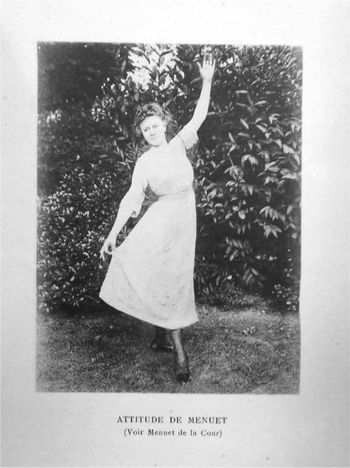
How exactly could dance serve as ‘criticism’? Hahn and Ravel conceived the role of balletic action as ‘illustration’, a matching of gestural to musical character.Footnote 34 As ‘illustration’, the ballet's choreography tested the possibility of the ‘transfer of attributes’ (to borrow Nicholas Cook's phrase) from dance to music and vice versa.Footnote 35 Vuillermoz conceived the action's role differently, describing dance at one point as ‘physical translations’ of musical rhythm.Footnote 36 In doing so, he reflected a wider preoccupation of the time. In the issue of Comoedia illustré that preceded the one containing Ravel's review of Dolly, a full-page advertisement promoted Henriette Régnier's The Harmony of Gesture: Exercises in Grace and Deportment for the Use of Young Girls.Footnote 37 The premiss of this well-reviewed manual was that elegant eighteenth-century dance music could induce gracious comportment in ‘la jeune Française’.Footnote 38 Figure 1 is a typical exercise, Figure 2 a typical illustration. Régnier's preface stated that ‘a musical rhythm should accompany the performance of our exercises. It commands them and models some sort of performance of them.’Footnote 39 Régnier's manual illustrates the literalness with which contemporaneous French thought embraced the idea that dance ‘embodies’ musical character. It also exemplifies a prevailing culture against which Dolly was reacting – the obsessive cultivation of ‘civilized’ ideals in future republican citizens.
Henriette Régnier, L'harmonie du geste (Paris, 1913), 50th exercise. Paris, Bibliothèque Nationale de France.

Régnier, L'harmonie du geste, illustration of ‘Minuet’ comportment. Paris, Bibliothèque Nationale de France.

An important proponent of the Dalcrozian thought from which Régnier's book stemmed was Jean d'Udine, whose writings, as Caddy observes, proposed a ‘parallelism between music and movement that exalted their shared basis in […] movements of the soul’.Footnote 40 In the work of psychophysiologists such as Charles Féré, and of philosophers such as Henri Bergson, perception had its basis in (usually) imperceptible muscular contractions – instinctive mimesis of motion in the object of perception.Footnote 41 Music was a central example of a sensory stimulus generating motor reaction. Albert de Rochas theorized music's corporeal effects as automatic and coercive, different ‘notes’ determining ‘different muscular contractions’.Footnote 42 These ideas elevated dance's significance as an interpretation of its accompanying music, since the question ‘What movement does the music induce?’ tends towards the question ‘What is the music's character?’ Gesture approaches the status of a musical performance, and vice versa (as Régnier's manual demonstrates). Combining ‘unexpected’ choreographies with Fauré's music, Staats and Laloy exploited the currency of these ideas.Footnote 43 ‘Disharmonious’ choreographies were also a natural reaction to these ideas, since conceiving gesture as rendering music in physical form threatens dance with redundancy. Pioch's bewilderment at the ballet's ‘frolicking’ shows the importance of kinaesthetic empathy to contemporaneous thought about dance. The question that underpinned his mode of spectatorship was: ‘Does Fauré's music prompt this in me?’
Not all spectators shared Pioch's response to this question. Ravel agreed so far as the ‘Berceuse’ went: ‘The contrast is too obvious between this gracious, slow, and subdued melody, and the angry stamping of a little girl, the pirouettes and slaps in the face of the two Pierrots […], who, between two caprioles, pester […] a frolicsome nurse.’Footnote 44 ‘But except for this detail,’ he continued, ‘the action is adapted so skilfully to the music that the music seems to have been composed in order to illustrate it.’ In fact, hardly any of the short reviews in daily, non-specialist newspapers remarked on a ‘paradox’ or ‘disharmony’ between the character of the music and that of the dance. Henri Quittard, for instance, in Le Figaro, reported that ‘Laloy has arranged a ballet of a subtle and charming fantasy’.Footnote 45 The revival of Dolly in May was applauded in Le matin as the ‘tender, comic and delicious ballet of Messieurs Gabriel Fauré and Louis Laloy’.Footnote 46 Hahn himself despairingly acknowledged Dolly 's warm public reception. Rouché's packed programme precluded a long run, but significantly he concluded his final show as director of the Théâtre des Arts with a performance of Laloy and Staats's ballet.Footnote 47
Caddy suggests in relation to L'après-midi d'un faune that to become immersed in debates about whether the action ‘matched’ the dance is to miss the point. She proposes that Faune, resisting ‘conventional paradigms’ of signification, exemplified modernism's broad reaction against the ‘comforts of verisimilitude and mimesis’.Footnote 48 She refers to Hans Gumbrecht's idea that, in the early twentieth century, artists sought to evade the systems of signification governing conventional aesthetic interpretation, attempting to rediscover instead the ‘sensual qualities’ of those elements that had hitherto been primarily ‘signifiers’.Footnote 49 Nijinsky's choreography, then, ‘tests the limits of musical signifiers, strains their significance’.Footnote 50 I suggest that we might think of the action of Dolly, and the wide range of responses that it generated, in the same ways. The basic role of Laloy's staging of the Dolly Suite was to obstruct and unsettle the posing of questions about the music, in so far as their answers were already routine: ‘What does it mean?’, ‘What does it signify?’ By virtue of being a ballet, Dolly in some sense interpreted Fauré's music as ‘embodying’ the burlesque of the music-hall and circus sketch. But it tested and toyed with the limits of this perception. Like Faune, it could also be meaningful in ways clarified by, and demanding, a form of ‘audio-visual analysis’ that is not ‘staunchly analogical’.Footnote 51 As Ravel's hearing suggests, it could, like Faune, shift between modes of choreomusical relation.
Comparable practices became more extreme in later theatrical appropriations of circus clownerie. In the 1920 pantomime Le boeuf sur le toit, Cocteau imposed his scenario retrospectively onto Milhaud's music and, as Nancy Perloff notes, ‘embraced the lack of congruity and accentuated it by choreographing very slow movements in contrast to the lively tempo of the music’.Footnote 52 Referring to the inter-art relations of Parade, Daniel Albright describes the ballet as ‘an exercise in coordinate incongruity’.Footnote 53 The phrase might also be applied to Dolly. The suggestions of what we might call ‘non-sense’ in the relationship of music and gesture were central to the ballet's carnivalesque aesthetic and, ultimately, to the particular conception of the ‘childlike’ that it embodied. This article does not offer hypotheses about Laloy's precise intentions, but considers the numerous ways in which we might consider Dolly – given the surviving evidence, and in the context of contemporaneous discourses to which it related – an act of criticism.
The ballet
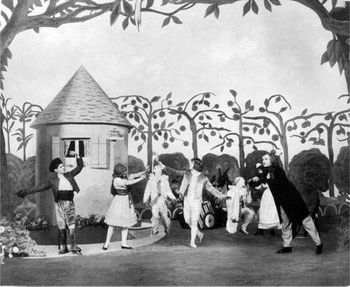
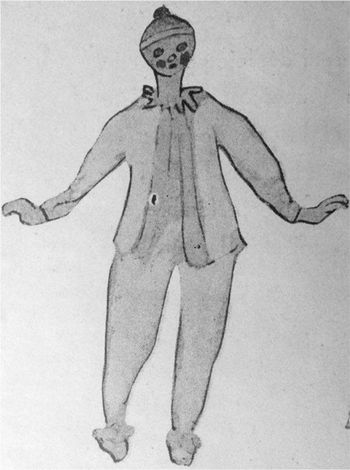
A production photograph published in Le théâtre arranged the ballet's characters in representative poses (see Figure 3). These are, from left to right, the Gypsy (played by a ‘M. Miralès’), Dolly (the English dancer and mime Eva Reid), the First Clown (Tommy Foottit), the Dancer (‘M. Aveline’), the Toy-Selling Rabbit (‘M. Marcel Héronville’), the Second Clown (Georgey Foottit), the Nurse (‘Mme Varaille’) and the Musician (‘Pieri Sandrini’).Footnote 54 The programme booklet contained an account of the ballet's scenario, as well as reproductions of the sketches for each character's costume by Constance Lloyd, who also designed the set and décor.Footnote 55 Figure 4 shows Lloyd's sketch for one of the clowns. The action accompanying each of the movements of Fauré's suite was described as follows:Footnote 56
I – Berceuse
The Toy-Selling Rabbit crosses the bottom of the garden. Dolly arrives unexpectedly, accompanied by the Nurse. She's a spoilt child, who throws her doll on the ground and lacks respect for the Nurse. The cottage at the bend in the path intrigues her and she decides to stay there, enjoying the armchair under the tree. Resigned, the Nurse tucks her in and rocks her. Dolly's expectations are not disappointed: the cottage door opens, two Clowns slip outside and play tricks on the Nurse, who sets off in pursuit of them.
II – Mi-a-ouFootnote 57
The two Clowns entertain Dolly with their dances and their gambols. She agrees, not without apprehension, to dance with them. But then another character appears at the cottage doorstep. It's the Gypsy, who watches the scene and all of a sudden, savagely, knocks one of the Clowns to the ground, where he lies still. The other, weeping, carries away the body of his brother. In the commotion, the Dancer has left. The criminal is arrested and imprisoned in the house.
III – Le jardin de Dolly
The Dancer displays all his graces to Dolly; he calls the Musician and begs him to play a serenade on his behalf. Dolly likes him [the Dancer] and finds him preferable to the dolls. He offers her the most beautiful flower in the garden, while the Musician, indifferent at first, gets gradually worked up, stung by jealousy.
IV – Kitty-valse
Dolly has accepted the invitation of the Dancer, but sometimes gets away from him to listen to the Musician, who prowls around miserably. The Dancer is insistent. Dolly leaves both of them.
V – Tendresse
The Musician and the Dancer compete beside the sulking Dolly. They emphasize their talents, they plead with her; indifferent, she provokes them and runs away from them.
VI – Pas espagnol
Suddenly, the Gypsy breaks down the door of his prison, grabs hold of Dolly without a word and drags her away in a dance so ardent that the Dancer, overcome in spite of himself, comes and joins them, soon followed by the two Clowns, resuscitated by the rhythm. The Nurse also joins in; the Musician accompanies them. Nevertheless, the Gypsy rebukes anyone who approaches his conquest, whom he ends up snatching away, leaving the others stupefied. The Toy-Selling Rabbit passes by.
Photograph of the production of Dolly, Le théâtre, 340 (February 1913). Paris, Bibliothèque Nationale de France.

Constance Lloyd, sketch for a clown's costume, in Louis Laloy, Dolly (Paris, Théâtre des Arts, 9 January 1913). Paris, Bibliothèque Nationale de France, Arts du spectacle, 8-RO-10939.

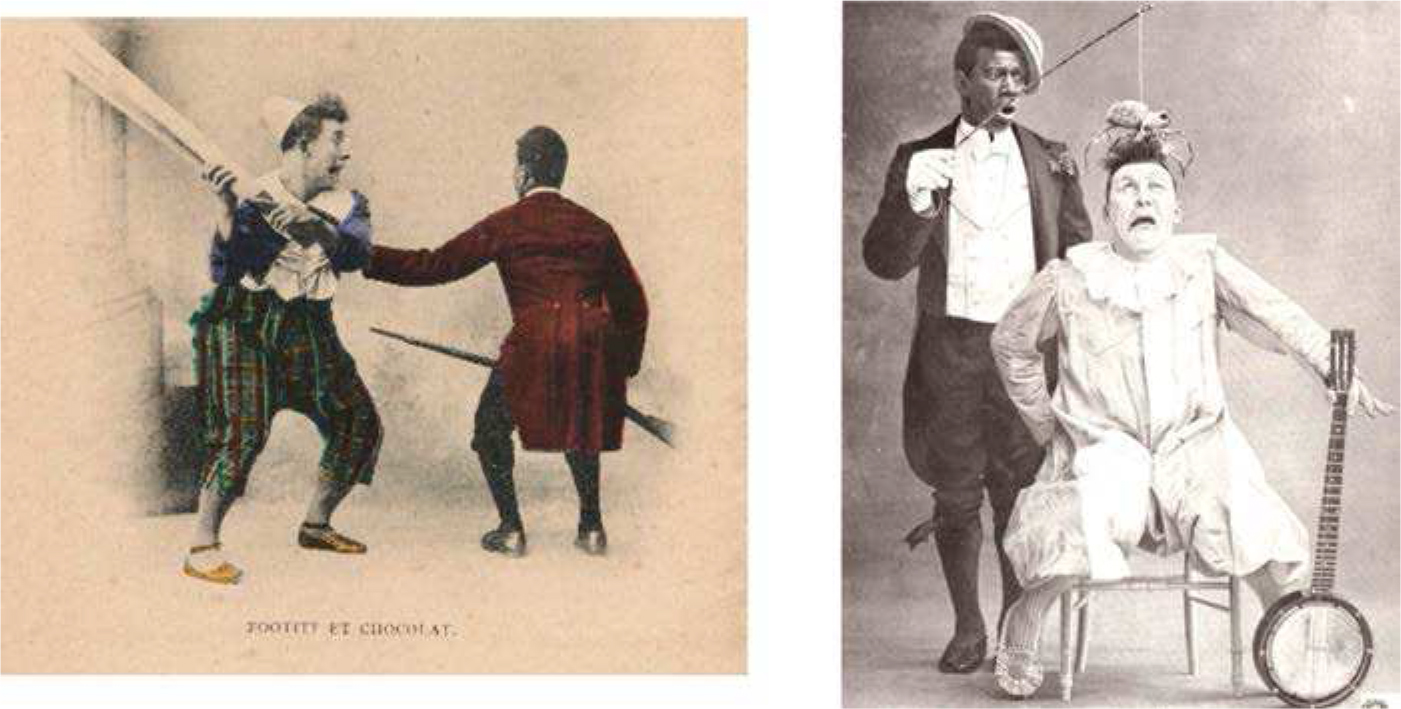
Le théâtre designated Dolly ‘a mimed, acrobatic, choreographed fantaisie’.Footnote 58 Others, as we have seen, designated it a clownerie and a pantomime.Footnote 59 This last term could, of course, denote a wide range of genres involving dance and mime. The most famous examples of the form of ‘pantomime’ under consideration here were probably the ‘nautical’ clowning and acrobatic routines staged at the Nouveau Cirque around the turn of the century, often featuring the clowns George Foottit and Rafael Padilla (see Figure 5).Footnote 60 In a well-known chapter from his memoirs, Cocteau recollects the chaotic, proto-surreal character of one of these pantomimes: ‘Water-lily leaves on which a tulle-clad dancer performed arabesques, a transparent windmill where the rooms filled with shadows, horses and huntsmen diving into the water, Footit [sic] enticing a floating calf's head with oil and vinegar’.Footnote 61 Vuillermoz was eager to assert that in Dolly the circus-style mime, gesture and acrobatics were precisely choreographed: the dancers ‘counterpoint Fauré's music with such precise, meticulously established, skilfully planned gestures, under the guise of a disordered fantasy’.Footnote 62
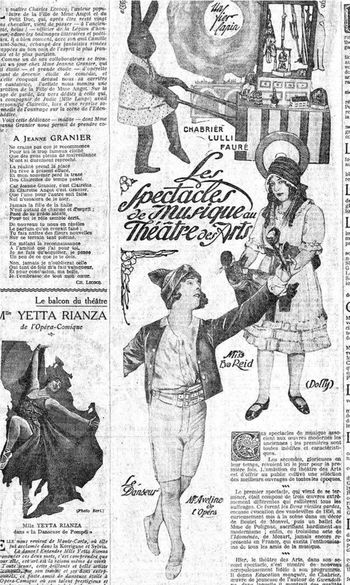
The press descriptions of Dolly give us further details. Images of the Rabbit, the Dancer and Dolly appeared in Le matin (see Figure 6). The Rabbit was, Vuillermoz observed, ‘a young black rabbit wearing stylish lace trousers’.Footnote 63 Ravel described its proto-surreal opening move: ‘a large fluffy rabbit […] crosses the stage, pushing a carriage overloaded with red balloons’.Footnote 64 Ravel's description of the action of the ‘Berceuse’ confirms that Hahn's remark about the two clowns ‘slapping each other about’ was a literal reference. The clowns' action (in the ‘Berceuse’, ‘Mi-a-ou’ and ‘Pas espagnol’) was often summarized as cocasserie (bizarreness, comical antics).Footnote 65 Contemporaneous clowns were highly skilled, acrobatic performers. One of Vuillermoz's exclamations is worth quoting in full: ‘Whoever didn't enjoy the purely musical flavour of Tommy's fragmented pizzicato, the trills he performs on his head or the waist-twirling of the astounding Espagnol doesn't know the deep joy of the physical stylizations and translations of a rhythm!’Footnote 66 Describing a sketch at the Folies-Bergère in April 1913, Laloy self-servingly recalled the Foottits' role in his own project: ‘Tommy Footit [sic] […], supported by his brother Georgy [sic], animates the four hooves of the bull of which their father is the toreador, in a parody of Carmen […]. [Their] emotive buffoonery in Dolly […] has not been forgotten.’Footnote 67 Dolly herself – the only character explicitly designated by critics as a mime – was routinely described as manifesting a ‘grâce mutine’ (impish or mischievous grace).Footnote 68 The Dancer's movements (in ‘Le jardin de Dolly’, ‘Kitty-valse’ and ‘Tendresse’) seem to have been essentially danse d'école, as opposed to the clowning acrobatics and the ‘exotic’ or ‘eccentric’ dance styles of the other characters. Vuillermoz noted that ‘all Aveline's grace and classical science can't equal the “character” and originality of his companions!’Footnote 69 Almost all reviews noted that this ‘elegant’ performer was hired from the Opéra.Footnote 70 Miralès (the dancer who played the Gypsy) was known to be Spanish himself, and his dancing seems to have drawn on an established exotic dance style.Footnote 71 Le petit parisien described him as ‘a gypsy who plays castanets and performs the fandango like Peppo el amoso himself’.Footnote 72 The Gypsy's ‘diabolical drive’ evidently conveyed the frenzy described in the scenario for ‘Pas espagnol’.Footnote 73 Most critics did not interpret his snatching away of Dolly as an abduction: Gignoux, for example, stated that Dolly ‘abandons all her friends for a Spanish pirate’.Footnote 74
Foottit and Padilla at the Nouveau Cirque, from the dossier ‘Footit [sic] et Chocolat, artistes de cirque: Documents iconographiques’, Paris, Bibliothèque Nationale de France, Arts du spectacle, 4-ICO PER-9849.

Images of characters in Dolly published in Le matin (15 January 1913), 5. Paris, Bibliothèque Nationale de France.

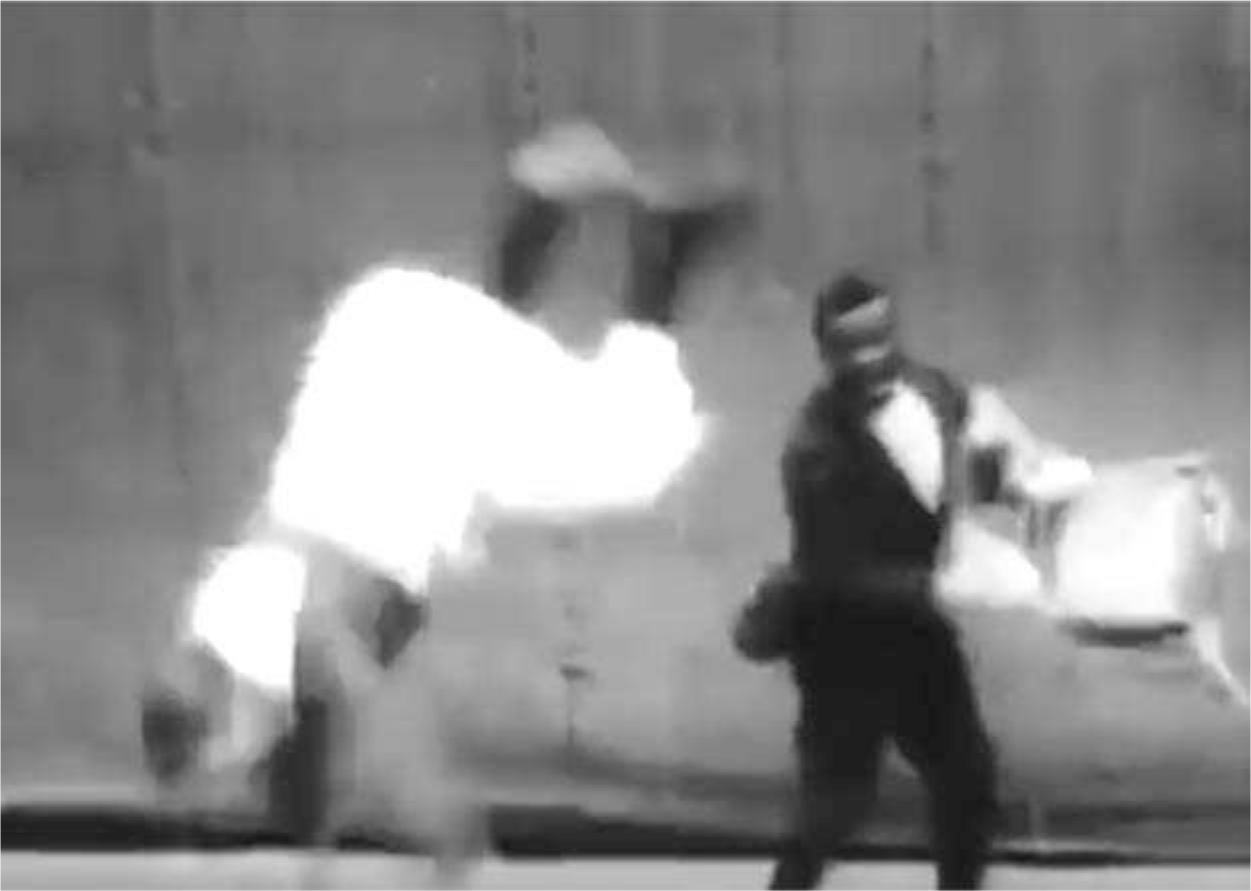
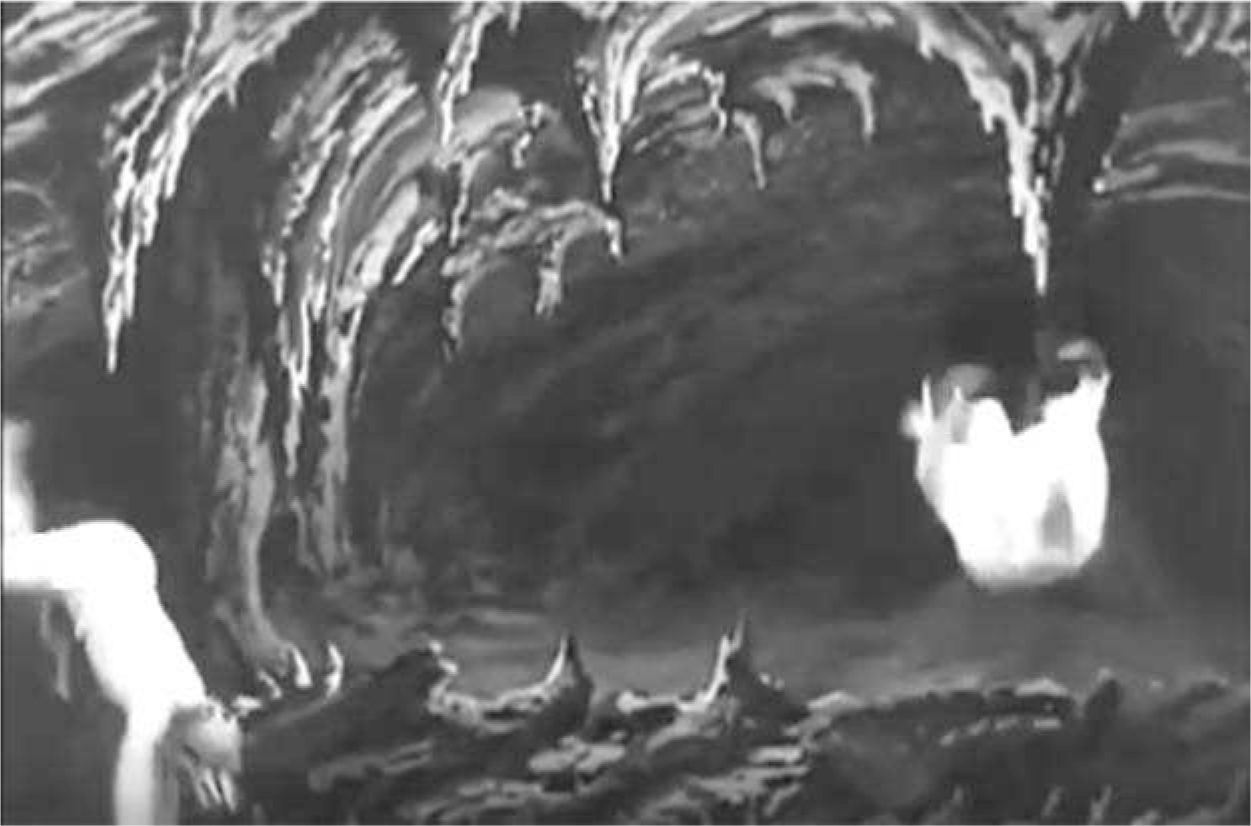
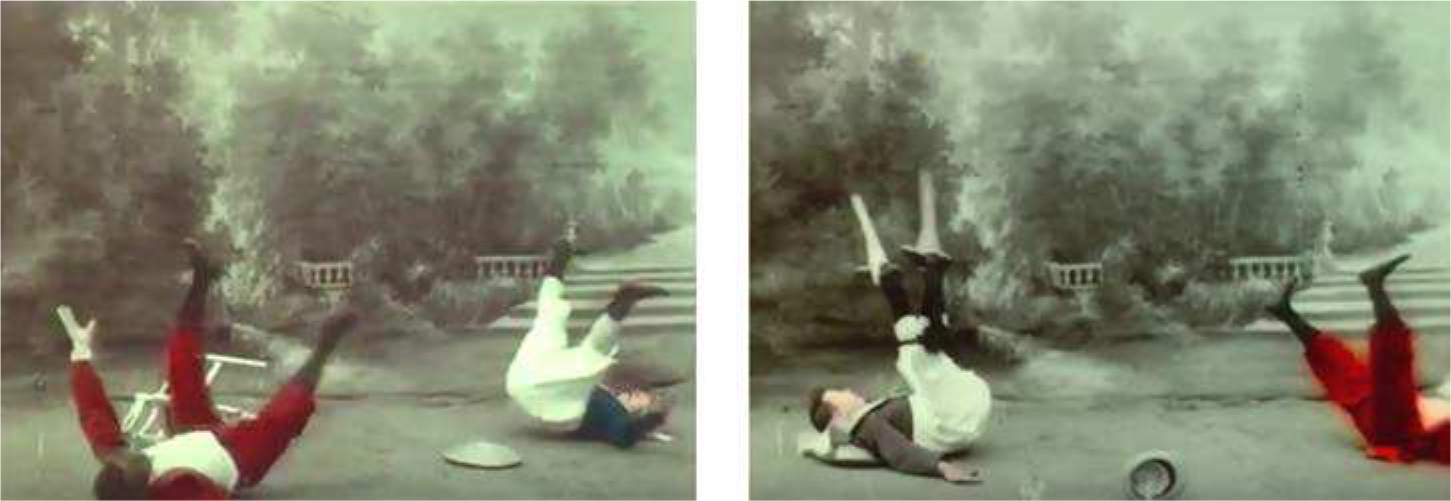
What did this action actually look like? As one critic noted, ‘The ‘easy-going clowneries to which the admirers of the mischievous Dolly have abandoned themselves do not narrate themselves: you have to see them.’Footnote 75 No footage apparently exists of Dolly. Nonetheless, ample footage does exist of the character of the ‘burlesque’ that Staats sought to choreograph to Fauré's music – the chaotic hyperactivity of conventional circus clowning, acrobatics and comic music-hall pantomime that Hahn found so inappropriate. Lumière filmed several of Foottit and Padilla's sketches for the Nouveau Cirque in the early 1900s, including ‘Acrobates sur la chaise’, ‘Chaise en bascule’ and ‘Guillaume Tell’.Footnote 76 Throughout the 1900s, George Foottit worked with his sons so that they could inherit and develop his clowning techniques. In her discussions of late belle-époque popular entertainment, Rae Beth Gordon proposes the existence of a general but distinctive, instantly recognizable quality of gait and gesture that characterized music-hall and circus entertainment. She argues that this quality is the ‘frenetic, anarchic movement that is so present in early French film comedy’.Footnote 77 There is, she claims, a ‘continuous line and directing force running from the cabaret and café-concert performances of the last quarter of the nineteenth century, through the films of Méliès'.Footnote 78 As Georges Sadoul observes, ‘Early comic films were drawn primarily from and sometimes simply recorded short, familiar music-hall routines.’Footnote 79 Silent cinema drew inevitably from this pre-existing form of short, spectacular entertainment and, naturally, was initially understood in its terms. Richard Abel states that Georges Méliès saw himself as an ‘innovative composer of cinematic revues’; his famous Le voyage dans la lune (1902) played for several months at the Olympia Music Hall.Footnote 80 Many of Méliès's féeries and trick films from roughly 1896 to 1904 exhibit circus acrobatics, clowneries and comic pantomimes, with a theatre stage effectively constituting the set.Footnote 81 These films' characters proceed, as do Padilla and Foottit in the Lumière footage, with a relentless, frenetic and faintly mechanistic jollity, interspersing acrobatics with constant, spasmodic gesticulations.Footnote 82 In Le voyage dans la lune, the half-crustacean, half-primate Selenites that the explorers encounter were played by acrobats from the Folies-Bergère, switching dizzyingly between flips, contorted positions and constant mechanistic bouncing.Footnote 83 In Le cake-walk infernal (1903), the opening female chorus is succeeded by two white-clad characters whose masks and acrobatics closely recall those of the Selenite army. After some cartwheels, the figure on the left bounces rapidly between supporting himself on his feet and on his hands, in replication of Foottit's strange gestures at the end of ‘Chaise en bascule’ (see Figures 7 and 8). It is possible that this was a Foottit; either way, these correspondences illustrate the existence of an established repertoire of clowning gestures.Footnote 84 This gesture could, conceivably, have corresponded to the ‘trills [Tommy Foottit] performs on his head’.
Foottit and Padilla performing at the Nouveau Cirque, Auguste and Louis Lumière, ‘Vues comiques prises au Nouveau Cirque’ (Paris, 1900), ‘Chaise en bascule’, no. 1140.

Clowning acrobatics in Georges Méliès, Le cake-walk infernal (Paris, 1903).

Hahn's, Lalo's and Vuillermoz's responses to the action of Dolly arose primarily not from the way in which it was a ‘clownery’, but from the fact that it was a ‘clownery’, and from the character of movement that defined ‘clownery’ in general. (We might say that the theatrical context ‘marked’ the dancing as ‘clownery’, rather than as, say, ‘handstand’ or ‘somersault’.) The gestural aesthetic explored by Gordon – this ‘frenetic anarchic movement’ – was what Staats sought to fit to Fauré's music, above all in the ‘Berceuse’, ‘Mi-a-ou’ and ‘Pas espagnol’. Almost all reviewers of Dolly characterized the ballet in terms of a superabundance of motion. For Aderer, in Le petit parisien, ‘everyone leaps and jumps around’.Footnote 85 Ravel's description of the ‘Berceuse’ emphasizes the range, violence and juxtaposition of motion. Several reviews emphasized the performers' toy-like or puppet-like character when describing their frenetic qualities of motion. One described the production as ‘a ballet of toys which come alive, dance, race around […], fight each other’.Footnote 86 As Gordon has shown, puppets and toys were also common metaphors for the qualities of movement manifested by music-hall and circus performers.Footnote 87 It is worth re-emphasizing that the dancers in Dolly were not merely imitators of clowning, but well-known practitioners hired from the commercial world.
‘Criticisms in action’
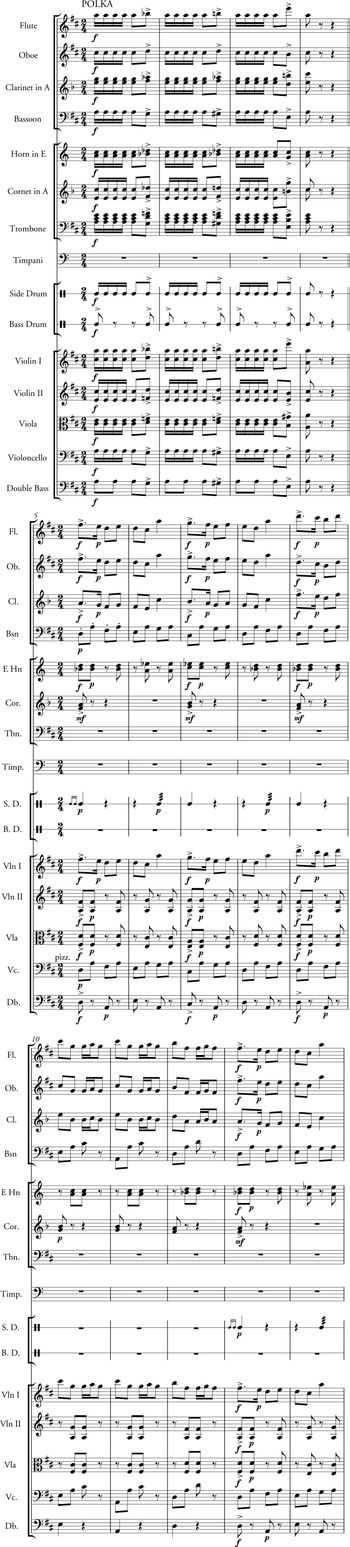
To what extent, and in what ways, might Fauré's music ‘illustrate’ or be ‘translated’ into this ‘burlesque’? Circus pantomimes of the day had their own, sometimes specially composed, musical accompaniments. At the Nouveau Cirque, these were usually provided (as was customary) by the circus orchestra's conductor Laurent Grillet.Footnote 88 In 1899, a euphoric notice in L'aurore praising his compositions mentioned, alongside some of his pantomimes, Grillet's orchestral polka Footit [sic] et Chocolat, whose title suggests an attempt to evoke musically the clowns' famous cocasserie. Example 1 gives the opening. The music that signifies ‘clowning’ is one of simple, energetic, blithe, diatonic jollity. The accentuation at the beginning of each iteration of the main theme's principal two-bar motif suggests a manner of performance that emphasizes its repetitious, foursquare quality. It recalls a wide range of music, including that associated with ‘popular’ stage forms, from Chabrier to the underlying character of the Barman's theme in Milhaud's Le boeuf sur le toit (a score originally written to accompany a Charlie Chaplin film).Footnote 89 In 1913, Footit et Chocolat was arranged in an ‘easy’ version for the piano sheet-music market, suggesting its continued popularity.Footnote 90 The relationship between this music and the clowns' antics might have been perceived in a number of ways: one embodying the other, for instance, or distancing it behind a screen of jollity. Grillet's polka forces us to consider how much our conceptions of the musically ‘frenetic’ may have altered since 1900, within the wider universe of musical possibilities that determine those conceptions. It supports the idea that a movement such as Fauré's ‘Mi-a-ou’ (‘Messieu Aoul!’) could, as Ravel stated, successfully ‘illustrate’ a version of Foottit's frenetic, spasmodic motions.
Opening of Laurent Grillet, Footit et Chocolat polka (Paris, 1899).

What was the ‘fragmented’ quality that Vuillermoz found translated in Tommy Foottit's ‘pizzicato’? In his discussion of L'après-midi d'un faune, Timothy B. Cochran treats the extant information about the choreography as an interpretative frame for Debussy's music, a starting point for analytical enquiry.Footnote 91 The details of Dolly support a similar approach to Fauré's music. Vuillermoz's ‘pizzicato’ remark identifies the A section of the suite's second movement. The main theme of ‘Mi-a-ou’ is evidently characterized by an infiltration of the triple time by a duple metre. This metric tension is complemented by an underlying hypermetric one: the shape of the melody, the harmonic outline and the metric instability of the bass part cast the first bar (bar 5), at least on first hearing, as much as a hypermetric upbeat as anything else (see Example 2). In the theme's reiteration at bar 21 (and later at bar 104), these tensions are more pronounced. As Example 3 indicates, our expectations establish the same duple metre across the triple time; but from bar 24, both these metric possibilities become overrun by another duple impulse, established by the bass line and the melodic figuration. The two-bar hypermetric pattern is also interrupted at bar 24, and its replacement is then itself cut short at bar 31. The effect approaches a kind of hypermetric freefall that comes abruptly to a halt with the perfect cadence. We can hear these constant dislocations not as mere surface tension, but as irruptive, comically disjointed. The melodic disjuncture in the upper parts accentuates this ‘dislocated’ quality. The suite's second movement arguably combines the regular phraseology that accompanied music-hall dancing with an aestheticization of the frenetic, even spasmodic qualities of that dance.Footnote 92
Metric and hypermetric tension in Gabriel Fauré, Dolly Suite, op. 56, 1897 (London, 2010), ‘Messieu Aoul!’ (‘Mi-a-ou’), bars 5–8. All subsequent extracts from this work refer to this edition. (I use the original piano version, rather than the orchestral arrangement that accompanied the ballet, for ease and clarity of reference.)

Metric displacement in Fauré, Dolly Suite, ‘Messieu Aoul!’ (‘Mi-a-ou’), bars 21–31.

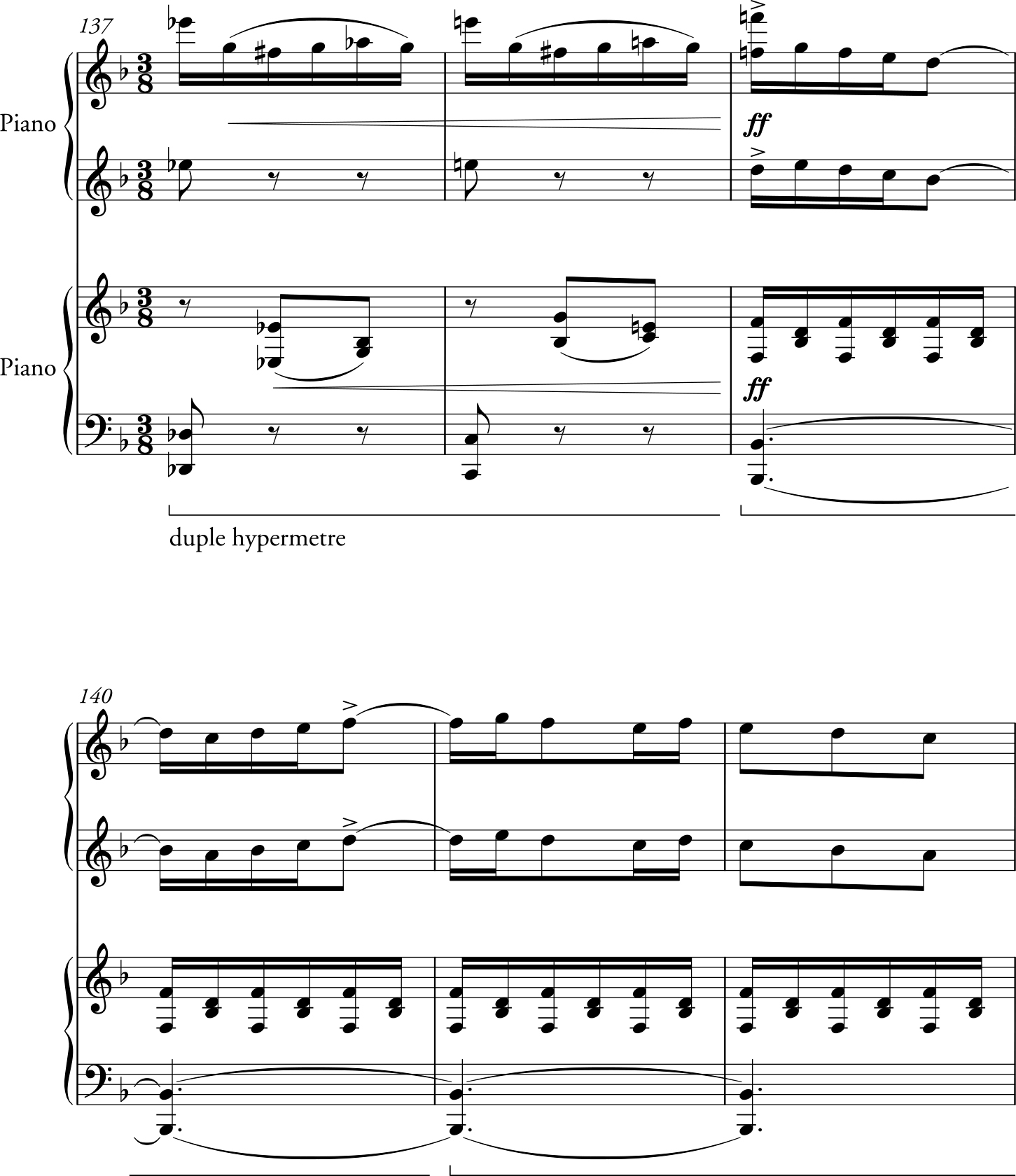
The scenario for ‘Pas espagnol’, the height of the ballet's clownerie, also draws attention to the metric and hypermetric play that characterizes this movement, such as the initial metric ambiguity of the opening phrase and the regular interjections of hemiola patterns. Example 4 shows perhaps its most vivacious moment of ‘waist-twirling’, when the subdominant breaks through in place of what is emphatically prepared as the tonic (bar 139). This breakthrough, with its dynamic swirling figure (first heard at bar 65), spins free from and momentarily disrupts the movement's driving duple hypermetre: with the bass at a standstill, at bar 141 the strong hypermetric beat is not, for once, stressed by the melodic voice, while the following weak beat is confounded by the emphatic hemiola in bars 141 and 142. Roy Howat notes the ‘affectionately witty’ qualities of ‘Pas espagnol’, and its significance as an ‘obvious riposte to Chabrier's España’.Footnote 93 The scenario brings the movement's comic (rather than simply ebullient) strain to the fore. The antics of the pointedly ‘exotic’ Gypsy figure with his castanets, which appealed to the percussion section introduced by Rabaud's full-blooded orchestration, insist on the self-consciousness of this musical exercise in ‘Spanishness’.Footnote 94
Fauré, Dolly Suite, ‘Pas espagnol’, bars 137–42.

What did the ballet ‘do’ to the suite's slower movements (to echo Caddy's question about L'après-midi)?Footnote 95 For these movements in particular, the scenario's absurdities might read as mocking the tenderness that listeners such as Hahn found in Fauré's music. The ‘grotesque’ Musician (as several critics described him), who plays in ‘Le jardin de Dolly’, ‘Kitty-valse’ and (the scenario implies) ‘Tendresse’, was an echo of the circus type of ‘musical clown’. One famous example was the Fratellinis' The Cello Parody, which delivered a ‘mock performance of Romantic melodies’ on a pigskin ‘cello’.Footnote 96 There are subtler ways of interpreting the scenario. Lindberg describes the shift to the relative minor in the B section of ‘Le jardin’, with its broad lyricism (lusciously orchestrated by Rabaud), in terms of an ‘almost self-indulgent melancholy’, suggesting there to be playfulness, and even self-consciousness, latent in the effusiveness of much of the suite's slower movements.Footnote 97 The ballet points directly towards these qualities. In considering the slower movements, the question is raised of how, as Caddy puts it, the choreography ‘conceptualize[d]’ the music: whether ‘as sonic backcloth, diegetic appendage, temporal yardstick’.Footnote 98 In ‘Le jardin de Dolly’ and ‘Tendresse’, as well as ‘Kitty-valse’, the Dancer courts Dolly, and is eventually joined in this pursuit by the Musician. The Dancer's ‘graces’ are supplied by the equivalent ‘graces’ of the music of ‘Le jardin de Dolly’. The playing of the violinist (the Musician) also implies that Fauré's music is in some sense diegetic, contained within the ballet's fictional world.Footnote 99 To the extent that it does so, this action, along with the Dancer's, places a kind of aesthetic frame around Fauré's music. Laloy's scenario draws out an exaggeratedly emotive quality from, for instance, ‘Le jardin de Dolly’, but it re-presents this excess as an exhibition of the drama's absurdity. The proto-surreal action demands a comically exaggerated sweetness from Fauré's music, presenting it as knowingly sentimental.
Hugh MacDonald notes that the movement ‘Petit mari, petite femme’ in Bizet's Jeux d'enfants ‘really portrays a passion too grown-up for children’.Footnote 100 Passages in the A section of ‘Tendresse’ invite a similar observation.Footnote 101 Here, Fauré's harmonic feints and playful voice-leading slips and substitutions (which also characterize the A section of ‘Le jardin’) produce a distinct emotional turbulence, which is emphasized by the marked contrast of the B section's candour. Fleeting suggestions of anguished yearning stand out from the suite's general character, as in Example 5, where a move towards a resolution in G♭ (bars 7–8) is overtaken by a pained tritone leap in the melody, reharmonizing the G♭ in bar 9 as the bass of an alien B minor 6/4 chord, enharmonically respelt, which dissolves in the continuing progression after the first beat. This harmonic move, and the harmonic sidesteps that follow it, are repeated with variation three bars later. The scenario thematizes these moments, with their evocations of adult passions, by dramatically illustrating them with the pleading gestures of Dolly's admirers, caught in the vicissitudes of an unrequited courtship that could exist only in a dreamworld. This comic setting frames the intensity of the fervent moments of ‘Tendresse’. It both satirizes them and casts Fauré's music as an effective participant in absurdist humour.
Fauré, Dolly Suite, ‘Tendresse’, bars 7–10.

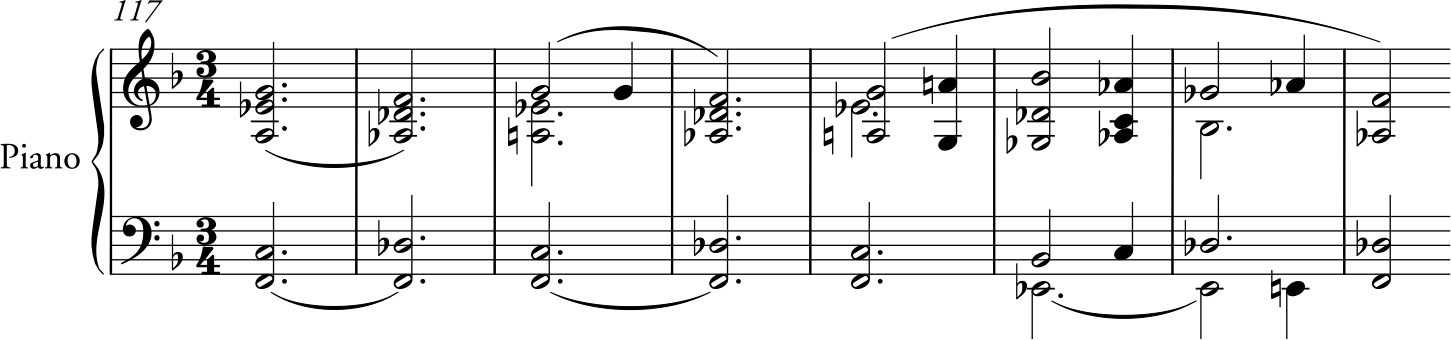
The scenario also enhances the suite's sense of progression, grouping together ‘Le jardin de Dolly’, ‘Kitty-valse’ and ‘Tendresse’. If we might tend to consider the lyrical, slower movements – the first, third and fifth – as constituting the suite's central thread (as Lindberg's study implies), the ballet emphasizes the other movements as characterizing the suite's essential atmosphere. Certainly, in the ballet's positive reception, Fauré's suite was perceived as fundamentally comic. We can also tentatively reconstruct more specific correlations of music and action. For instance, towards the end of ‘Mi-a-ou’, the melodic outline of the well-known lullaby ‘Do, do, l'enfant do’ softly interjects. The harmonic pivoting above the F pedal is melancholically exquisite, an apt instance of Hahn's ‘tender “nursery” atmosphere’ (see Example 6). This passage is the only one that clearly corresponds to the moment when one Clown weeps over his companion, struck down by the Gypsy (whose capture and imprisonment corresponds to the preceding climax). Hearing this moment as an ‘illustration’ of this pantomime act affords it a quite different meaning. The exquise character is subtly turned on its head, and an indulgently, self-consciously lugubrious quality emerges. The choreography even adapts and distorts the lullaby reference: the Clown has, as the song suggests, ‘gone to sleep very quickly’, having been knocked unconscious.
Fauré, Dolly Suite, ‘Messieu Aoul!’ (‘Mi-a-ou’), bars 117–24.

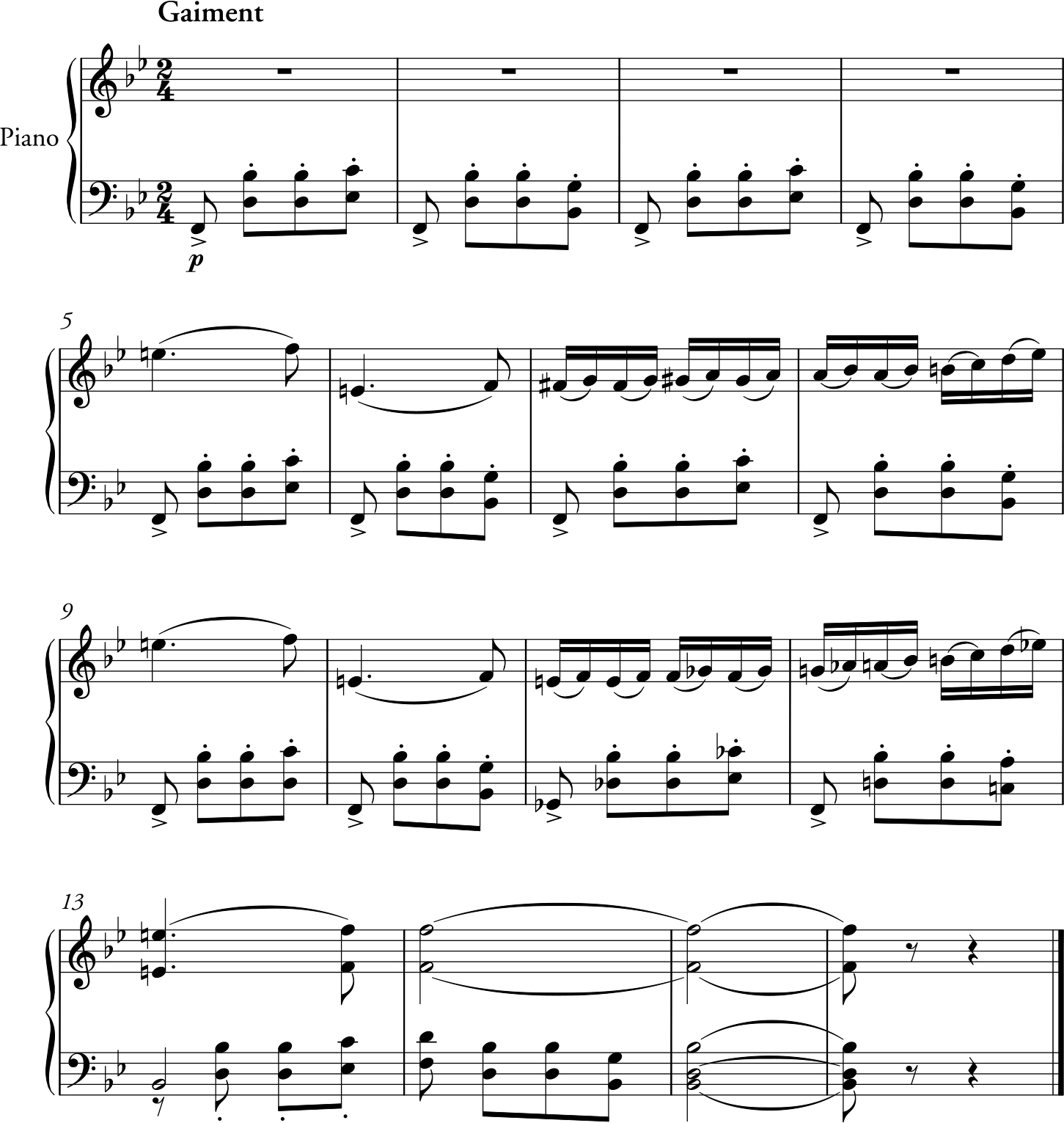
It may be useful to distinguish briefly the choreomusical experiment manifested in Dolly from those that underlay other music-theatrical appropriations of clownerie. In his 1928 memoirs, Laloy noted a piece of music that itself manifested a ‘vigorous burlesque’: Terrasse's incidental music to Jarry's Ubu roi, given its infamous première in 1896.Footnote 102 Gordon argues convincingly that Ubu's savage, absurd, bumbling monstrosity – as realized on stage by Firmin Gémier – drew directly from the music hall's gestural aesthetic of bouffonnerie.Footnote 103 In 1897, the Mercure de France ran 300 copies of an edition of the play that included a facsimile of Terrasse's complete manuscript score in piano arrangement; the following year, it published two new numbers and a four-hand version of the overture.Footnote 104 The music, as Peter Lamothe notes, is of a ‘studied naïveté ’, angular and spare.Footnote 105 Example 7 gives one of the more strident passages: the introductory music to scene ii, which finds Père Ubu seated at his splendid table. Here, Terrasse defamiliarizes the rhythmic patterns, melodic gestures and phraseologies characteristic of (among many other genres) opérette, a music-hall genre in which Terrasse had established himself as Offenbach's successor by 1913.Footnote 106 The ‘wrong-note’ distortion helps to realize musically the bouffonnerie that it accompanied. This defamiliarization is reminiscent of, and anticipates, compositions by Satie and Les Six which accompanied many of Cocteau's own theatrical appropriations of music-hall and circus entertainment.Footnote 107 In a preface written for his 1920 ‘spectacle-concert’, Cocteau celebrated what he called the ‘musique à l'emporte-pièce’ that accompanied the show.Footnote 108 The phrase ‘à l'emporte-pièce’ could refer to the incisive, acerbic quality of a remark, and also to a way of doing something – in a hurry, in one go, without thinking. It encapsulates the cheerfully mechanistic, headlong quality of, for instance, Auric's foxtrot Adieu, New York!, which accompanied the ‘dance’ partie of the ‘spectacle-concert’, and itself featured one of the Foottit clowns. The foxtrot also developed the compositional procedures of earlier piano music by Debussy, Satie and Stravinsky which was either presented or perceived as embodying the chaotic buffoonery of contemporaneous clowning.Footnote 109
Claude Terrasse, Ubu roi (Paris, 1897), introductory music for scene ii.

Dolly, of course, appropriated a pre-existent musical work as a basis for the theatrical experiments that, in Cocteau's milieu, would themselves be the basis of musical experiment. In certain passages (the ‘Berceuse’, perhaps, being one), Dolly seemed to pursue expressive possibilities derived from the music's resistance to being perceived as embodying clownerie, evading – to borrow Caddy's phrase – ballet's ‘conventional paradigms’ of signification (see above, note 48). The fact that some critics were not exercised by the ballet's combination of music and action is potentially explained by the immense variety of music heard in circus and music-hall venues. Pasler notes that at the end of the nineteenth century art music was sometimes ‘used to introduce circus acts, [or] to animate cabaret shadow plays’.Footnote 110 In 1913, selections of concert-hall repertoire, alongside the latest popular dances and songs, continued to appear on the music hall stage (and not solely for purposes of parody). Laloy praised the ‘amiable music’ that accompanied the ‘farces’ of the Folies-Bergère show involving the Foottits: ‘a light orchestral framework, popular tunes and fragments of appropriate [concert] works, such as that impression of morning whose naïve tenderness the public savour, without knowing the name of its author, Edvard Grieg’.Footnote 111 Here, in the music hall, music of ‘naïve tenderness’ seems to have accompanied clownerie. Perhaps this light-hearted combination of tenderness and buffoonery also manifested the ‘subtle musical enigmas’ that, for Vuillermoz, Dolly exemplified. Recent music-and-dance scholarship has noted a tendency to impose simplistic, anachronistic distinctions between ‘high’ and ‘low’ onto the fluid identity of fin de siècle ‘popular’ culture. Staats's work for both the music hall and the Opéra is evidence of what Catherine Hindson calls the ‘dynamic relationships between artistic movements and popular performers […] at the fin-de-siècle’.Footnote 112 Nonetheless, Vuillermoz acknowledged the controversy of choreographing circus burlesque to music composed by the director of the Paris Conservatoire. Laloy's scenario evidently constituted a very general ‘criticism in action’: it invited spectators to hear Fauré's own ‘amiable music’ as having, in some sense, an affinity with the atmosphere of the music hall.
This sense becomes more explicit in the context of contemporaneous debates about the relation between music-hall and concert-hall musical culture. In a 1911 article in La revue musicale, the critic and composer Jean Huré promoted the unpretentious musical styles associated with the café-concert as an antidote to the sensibility that characterized much modern composition.Footnote 113 He began: ‘“Bad music” – the frivolous music that we have agreed to call “bad music” – is always “musical” […]. What we call “good music”, well-constructed music, serious music (!) is, most often, empty of invention, spontaneity, natural logic.’Footnote 114 A comparable critical objective underpins Laloy's articles on the music hall.Footnote 115 Of course, it was discourse such as Huré's that propagated the very distinction between ‘high’ and ‘low’.Footnote 116 Implicitly appealing to this discourse, Laloy's ballet drew attention to the Dolly Suite – with its succession of light, tuneful forms – as a modern composition free from any trace of dry academicism (notwithstanding the canon at the octave in ‘Tendresse’). This was the most general sense in which Dolly brought together ‘popular’ entertainment and childhood – as alternative celebrations of the value of unlearnedness. The importance of Laloy's ballet within the artistic culture of its day becomes clear only when we examine the status of the idea of childhood within that culture.
Childhood contested
In 1913, images of childhood were inseparable from the Dolly Suite in the critical imagination. Both Hahn and Ravel, for instance, described Fauré's original duets as a ‘homage to childhood’. For Ravel, the musical qualities that bore this association were (much as they were for Hahn) a ‘tender charm and harmonic grace’.Footnote 117 This conventional interpretation was partly informed by a basic understanding of the circumstances of the pieces’ composition. In 1907, Magnus Synnestvedt had described the suite in Le mercure musical as written ‘for some little child friends’.Footnote 118 The suite's dedication, on the front of the Hamelle score, was to a Mademoiselle Hélène Bardac, who (as has been well documented since) was the daughter of Fauré's mistress, Emma Bardac, and known as Dolly. The individual movements of the original four-hand version were either written or presented to accompany various events in Dolly's life. For instance, ‘Messieu Aoul!’ (whose title refers to the way in which Dolly pronounced ‘Monsieur Raoul’, her elder brother's name) was written for Dolly's second birthday in 1894, while ‘Le jardin de Dolly’ was a present for New Year's Day in 1895. A gift for Dolly's fourth birthday, ‘Ketty-valse’ is, as Nectoux puts it, ‘a whirling portrait of the family dog, Ketty’.Footnote 119 The suite's status in 1913 was comparable to its status today: as, in Carlo Caballero's words, almost ‘an extension of Fauré's private communications’, with the title serving both ‘to honor its dedicatee and suggest a world of childhood’.Footnote 120 In an article on Fauré's piano music from 1910, J. Saint-Jean designated the Dolly Suite as ‘scènes d'enfant’.Footnote 121 This subtitle accompanied versions of Schumann's Kinderszenen on the sheet-music market, suggesting reminiscences of childhood whose affective content is given musical form.Footnote 122 How one heard the Dolly Suite (in its orchestral as well as its piano version) was evidently bound up with the status of the idea of childhood in early twentieth-century French culture. In its aesthetic, social and political contexts, this idea was contentious.
The ways of understanding the ‘childlike’ that informed Hahn's perceptions had equivalents in much literary and artistic work. Saint-Jean's mention of ‘scènes d'enfant’ recalls the highly successful genre of popular fiction known as scènes enfantines, which flourished roughly from 1885 to 1920. These told simple, undramatic stories of the day-to-day events of children's lives with a sentimental realism. In Marina Bethlenfalvay's words, they emphasized ‘the picturesque aspects of this little world through anecdotes, sometimes entertaining, sometimes poignant’.Footnote 123 Examples included André Lichtenberger's books centred on a little boy called ‘Trott’, and similar stories by Paul and Victor Margueritte. These fictions indulged a kind of domestic exoticism, setting out a fantasy child-world into which parents installed their offspring, while pretending that that world was of the child's own making. Their subject was what Guillemette Tison calls ‘quilted childhoods in haute bourgeoisie settings’.Footnote 124 Tison describes these miniatures as ‘l’écriture du petit' (‘the writing of littleness’), noting their fragmentary writing and interest in childhood vocabulary.Footnote 125 She dates the beginning of this literary fashion from Antoine Gustave Droz's Monsieur, Madame et Bébé of 1866, a collection of detailed scenes of family intimacy, both humorous and gushing.Footnote 126 Strikingly popular (reaching its 266th edition in 1924), it was praised for its promotion of sensitive, upstanding moral values.
The sheet-music market followed the literary fashion for scènes enfantines. From the mid-1880s onwards, the term became a relatively frequent title of collections within the market for piano sheet-music for children. Lichtenberger's stories were transformed into musical storybooks with illustrations.Footnote 127 As with the late belle-époque pièce enfantine in general, titles such as ‘En route pour la promenade’ often evoked particular childhood activities, which were then illustrated by simple thumbnail cover images.Footnote 128 Often the slower, sentimental numbers (‘Tendre innocence’, ‘Doux souvenir’) seemed addressed less to the child and more to the doting, listening parent. The suite's original four-hand version – described by Hahn as a collection of pièces enfantines – follows a convention in four-hand music for children in combining a simple prima part for a child to play with a considerably more difficult seconda part intended for a teacher or parent. Fauré himself is likely to have performed the piece with children in this way in domestic settings.Footnote 129 With the possible exception of the final movement, the prima part is generally no more technically challenging (at times it is less challenging) than the average pièce enfantine available on the sheet-music market of the day. Hahn's, Saint-Jeans's and others’ accounts of Fauré's suite seem to place it, at least implicitly, alongside the more general artistic culture of the scène enfantine in its nostalgic evocation of a tender, charming, bourgeois nursery world.
The phenomenon of scènes enfantines was symptomatic of a more general aspect of turn-of-the-century French culture, embodied in what Bethlenfalvay calls ‘His [and her] majesty the child’.Footnote 130 This phenomenon derived partly from a preoccupation, from the 1880s onwards, with the careful moral protection of children within the family. As Sylvia Schafer states: ‘Leading politicians and commentators channelled their anxiety about moral decline toward the family, […] consecrating it as the basic educative and social unit of a truly healthy, truly republican polity.’Footnote 131 With the harmonious family promoted as a metonym for the harmonious state, the moral education of children became synonymous with cultivating the health of the republic. These ideals percolated into a large market of children's literature. Penny Brown observes of early twentieth-century French children's literature: ‘The sentimentalised image of the child and the family persisted alongside narratives portraying a transgressive child whom the reader is encouraged not to emulate.’Footnote 132 In general, writers and publishers adopted a ‘stance that would satisfy parents by not violating accepted social and moral values’.Footnote 133
There was a wide range of artistic reactions against ‘Sa majesté l'enfant’. Perhaps the best known was summarized by Jules Renard, in a frequently cited journal entry from February 1890 about how his contemporary authors represented children: ‘You have to grind down the child into the sugar that all the Drozs have hitherto given to the public to suck on. The child is an unavoidable little animal. A cat is more human.’Footnote 134 These views were realized in Renard's Poil de carotte (1894), the bitter, ironic story of a redhead's abusive treatment by his family. For Bethlenfalvay, Renard's novel belonged to a new generation of writing that ‘rejected the ethos of the bourgeois family’ as repressive and restrictive.Footnote 135 ‘With this demystification of the so-called “bonheur familial”’, Bethlenfalvay writes, there developed ‘an accusatory literature about the family and the child's revolt against the tyranny and hypocrisy of adults’.Footnote 136 In early 1913, a new member of this generation had just appeared: Louis Pergaud's La guerre des boutons (The War of the Buttons), published in 1912. It was subtitled Novel of my Twelfth Year (Roman de ma douzième année), but addressed explicitly to adults. It described in controversially vivid, colloquial language a rivalry between two groups of rural children, who ‘kill’ each other by ripping buttons from each other's clothes. In his preface, Pergaud recorded his intention of describing the ‘enthusiastic and brutal life of vigorous wildlings […], that is to say, liberated from the hypocrisies of the family and school’.Footnote 137 Pergaud was reacting as much against what he perceived to be the weakening, emasculating effects of the culture of la famille as against its distance from the fraught, intense reality of children's lives.
The existence of this conflict about the significance of childhood is, in itself, unremarkable. It would be difficult not to find some form of it at any given moment in a modern literary culture. What is noteworthy is the intensity of this conflict and, as both Bethlenfalvy and Tison propose, the state of particular flux in which the idea of childhood found itself at the turn of the twentieth century. Given this, and given Hahn's and Vuillermoz's comments on Dolly, it is difficult not to interpret Laloy's ballet as a struggle with the status of the ‘childlike’, as an ambiguous affective state inextricable from the Dolly Suite 's identity. More specifically, we can understand Dolly as an attempt to dissociate Fauré's music from the cloying atmosphere of ‘Sa majesté l'enfant’, with which conventional interpretations implicitly linked it. Laloy's scenario for Dolly embodies a reaction against the ethos of la famille comparable to Renard's or Pergaud's, but taking a very different form. As Gignoux wrote (presumably with some understatement), the ballet was ‘not without irony’.Footnote 138 In one sense, the scenario turns Fauré's music into the accompaniment of a series of scènes enfantines, beginning with a little bourgeois girl's trip to a garden with her nurse. But these ‘childhood scenes’ are given the form and content of a circus pantomime. Dolly's farcical obnoxiousness parodies Droz's saccharine angels. The scenario emphasizes Dolly's rejection of her dolls in both the ‘Berceuse’ and ‘Le jardin de Dolly’. Dolls were instruments and symbols of socialization, and Dolly's rejection of them seems to formalize a reaction against a conventional bourgeois republicanism that is intrinsic to the ballet's action.Footnote 139 Her final elopement with the Gypsy is a striking transgression of familial authority and control, and, more generally, of the social and moral values that parents and publishers were keen to uphold. It is testament to the ballet's dreamlike character that critics did not react more strongly to this final gesture.
Dolly was less a parody of Fauré's music than a parody of a way of hearing that music. Vuillermoz noted that Dolly (the metonym for Dolly) ‘grants to descriptive music only a vague and imprecise power of evocation’.Footnote 140 In one sense, Laloy's scenario carefully realizes an established programmatic interpretation of the suite, derived from a literal dramatization of the movements’ titles, which played on the listener's knowledge that the suite was written for a little girl called Dolly. Little details emphasize this fact, such as the moment when, in the ‘Berceuse’, the Nurse rocks Dolly. For all Hahn's complaints about the ‘open air’, the ballet's setting is effectively a ‘jardin de Dolly’. The humour of Laloy's scenario arises from the fact that this interpretation, at the same time, totally contravenes the tenor of established programmatic interpretations of Fauré's suite. ‘Pas espagnol’ is an absurdly literal – as well as literally absurd – dramatization of the movement's title. Caddy suggests that Nijinksy's provocative combination of music and dance in Faune in 1912 served to challenge what she calls the ‘representational mandate’ of Debussy's music.Footnote 141 Laloy seemed to do this with Fauré's music on several levels. An interpretation such as Hahn's interpreted Fauré's music as signifying particular subjects and situations. The ballet's action replaces these subjects and situations with circus caricatures of themselves, thereby calling into question music's presumed ability to signify such things. Here the ballet brings together some themes and preoccupations that would shortly become central to French modernism, both musical and theatrical.
Non-sense
One of these preoccupations was with elevating the apparently nonsensical, together with the closely related categories of the illogical, the inconsequential, the irrational and the absurd. French artists turned increasingly to the music hall as providing one of its most extensive manifestations. This artistic interest had already taken musical form, as in the narrative illogicality of Debussy's evocation of clownerie in ‘Minstrels’.Footnote 142 The most strident (and deeply problematic) promotion of these qualities appeared later in 1913, with Marinetti's ‘Le music-hall: Manifeste futuriste’, which glorified its ‘abysses of the ridiculous’.Footnote 143 For Marinetti, the ‘laws that dominate life’, as illustrated by the music-hall, included ‘the necessity of complications and differing rhythms’ and ‘the inevitability of lies and contradictions’.Footnote 144 His emphasis is on incongruity as a simultaneous, rather than a merely narrative, phenomenon. In Dolly, this quality was, in part, choreomusical. At least, at times, the relation between music and action manifested the improbable entwinements that Marinetti celebrated. This was, to borrow Ravel's words, the overlaying of the ‘gracious, slow’ ‘Berceuse’ with the action's ‘angry stamping’ and ‘pirouettes’. Fauré's music became a crucial component in an aesthetic of illogicality, rather than straightforwardly embodying that aesthetic. Through its experimentation in ‘coordinate incongruity’, Dolly qualifies as an early instance of Albright's conception of surrealist theatre (a conception based on Apollinaire's use of the term).Footnote 145 It qualifies through its apparent interest in reaching beyond the limits of music's capacity to embody gesture, exploring forms of non-analogous choreomusical relation.
For surrealists of all kinds, a certain image of childhood also became the vehicle for promoting the virtues of absurdity and irrationality. As André Breton observed (in an essay on Lewis Carroll), ‘Deference towards the absurd reopens to the adult the mysterious kingdom of childhood.’Footnote 146 Childhood's enviable condition of being at ease with the irrational received perhaps its most unambiguous affirmation in Breton's 1924 surrealist manifesto, in which he famously observed that ‘the mind which plunges into surrealism relives with exaltation the best part of its childhood’.Footnote 147 Here, as David Hopkins observes, childhood was an essential symbol of a project of ‘re-enchantment’, which sought to undermine the ‘rationalizing, progressivist, and modernizing currents in early twentieth-century French society’.Footnote 148 Again, it is difficult not to interpret Laloy's transposition of the music hall's anarchic silliness as an instance of this project (if, perhaps, less disconcerting than its successors). Dolly's unpunished transgressions anticipate the way in which the bored, delinquent child became both an image of creative fecundity and a symbol of intellectual resistance against social strictures.Footnote 149
The elevation of childhood as society's prime source of the pre-rational reframed the notion of the child's ‘fresh sight’ (or ‘lucidity’, in Breton's formulation), which had extended across a range of idealizations from Rousseau to Wordsworth, Baudelaire to Rimbaud.Footnote 150 Laloy's scenario appealed to one particular literary exploration of nonsense through the child's perspective, which was also the prompt for Breton's aforementioned linking of childhood and absurdity. This was the dreamworld of Lewis Carroll's Alice books, with their demonstration of the proximity of the logical and the illogical, when logic is pursued in a certain way.Footnote 151 Carroll's central character, as with Dolly, is a bourgeois girl thrust into a series of situations that are simultaneously comic, absurd and disconcertingly violent. Part of the significance of the ballet's framing device was surely its subtle evocation of the entry of the rabbit that precipitates Alice's fall down the rabbit hole into the inner realms of Wonderland. Generally, of course, the role of the rabbit figure in Dolly was to strike an immediate tone of anarchic nonsense. More specifically, its toys inaugurate a world of childhood, while its identity as an itinerant salesperson suggests the promises of the fair – a realm of chaotic ‘popular’ entertainment closely related to the music hall in the contemporaneous imagination.
The significance of Dolly as a piece of theatre derives from its explicit fusion of childhood and music-hall entertainment as closely affinitive realms. (Again, this synthesis had been made to some extent in musical form, most obviously in Debussy's inclusion of ‘Golliwogg's Cake Walk’ in Children's Corner.Footnote 152) Marking this connection was the figure of the clown. In early twentieth-century theatrical writing, many politicized connotations were common to the image of the clown and to the idea of childhood. In Giovanni Lista's words, the clown manifested ‘the exaltation of the powers of the irrational against the pretence of rational order asserted by the “logic” of bourgeois thinking’.Footnote 153 After claiming Parade as a form of children's entertainment, Cocteau goes on to say that Foottit enchanted grown-ups as well as children by ‘bringing their childhood back to them’.Footnote 154 As we shall see shortly, according to some contemporaneous thought, this implied a distinctly disquieting regression.
Dolly herself marks the beginning of a small succession of important musical child characters that appeared on the French theatrical stage in the 1910s and 1920s. These characters are at the centre of a surreal world that involved stagings of the ‘burlesque’ of popular entertainment. They belong with the list noted earlier: the Little American Girl of Parade, the child figure in Les mariés de la Tour Eiffel, and the protagonist of L'enfant et les sortilèges.Footnote 155 These characters are not similar enough to be regarded as instances of a single type, but their affinities suggest a common pattern of thought about the childlike, imagined choreographically as much as musically. This pattern of thought brings together diverse images and ideas: clowning, illogicality, the surrealist unconscious and, most importantly, the circus's ‘burlesque’ corporeality. We gain some insight into the connections uniting these elements by considering medical and anthropological ideas important in French thought in the years before the First World War.
Infantile chorea
As Mark S. Micale notes, the ‘language of nervous and mental pathology became a common feature of French social, cultural and political commentary between 1870 and 1914’.Footnote 156 Contemporaneous perceptions of belle-époque popular entertainment illustrate this with particular directness. Gordon has exhaustively demonstrated that, from roughly 1875 until 1910, the ‘convulsive body language’ that characterized music-hall performance style was construed by its contemporaries as a staging of nervous pathology – specifically, of hysteria. ‘Epileptic singers’ and ‘idiot comics’ thronged the music-hall stage at the same time that neurological investigations of hysteria – which included the conditions of ‘epilepsy’ and idiotisme – were popularized in the Parisian press.Footnote 157 As many scholars have noted, from the 1880s, the demonstration room of the Salpêtrière hospital, in which the clinician Jean-Martin Charcot induced and cured hysterical attacks, became a popular spectacle. Music's capacity to induce hysteria, and the hysteric's heightened musical sensibilities, were essential to this ‘gestural’ pathology. Dansomanie was an important symptom of hysteria.Footnote 158 One of the most famous epileptic singers, Jane Avril, was diagnosed with St Vitus's dance.Footnote 159 In his 1896 book on contemporary entertainments, Georges Montorgueil observed that ‘half of the hit songs of this period belong to the jiggling pit of the late Charcot’.Footnote 160
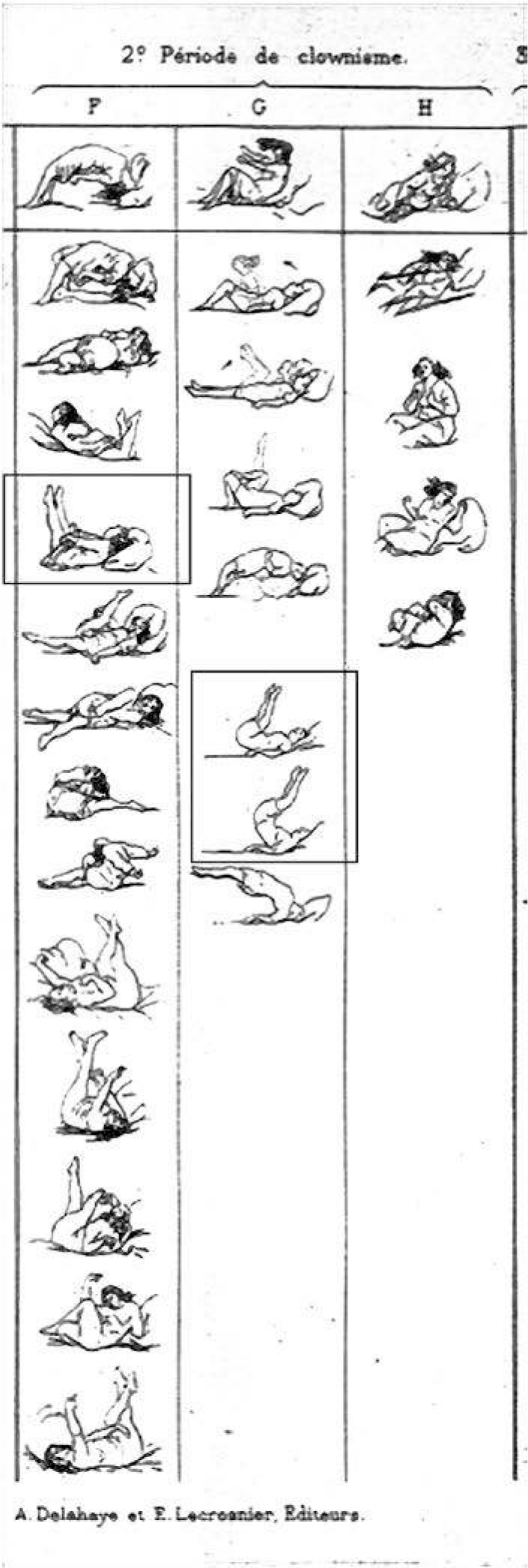
Clowning was a particular focus of this pathologization of the body language that characterized music-hall and circus entertainment.Footnote 161 Clownisme was the second stage in Charcot's influential study of hysteria. As Sophie Basch notes, a ‘semantic muddle transformed “clonic spasm” (from the Greek klonos, violent motion) into clownisme’.Footnote 162 In his 1902 study Art and Medicine, the clinician Paul Richer described the stage of clownisme as that of ‘contortions and great movements’, in which the patient displays a ‘suppleness, an agility […] guaranteed to astonish the spectator’.Footnote 163 In a famous illustration in an earlier study of hysteria, Richer attempted to break down and reproduce these movements (see Figure 9).Footnote 164 The correspondences are clear between (in particular) three of these movements (see boxed illustrations in Figure 9) and moments of the Lumière footage of Foottit and Padilla's bouffonnerie – notably their tumbling and flailing legs (see Figure 10).Footnote 165 Michael R. Finn notes that the late nineteenth-century Parisian public was especially captivated by clownisme: he cites one journalist's declaration, in response to attending Charcot's demonstrations, that ‘everyone is a clown in the circus that is Paris’; ‘everyone becomes conscious that she or he is partially hysterical’.Footnote 166
Pathological clownisme movements as illustrated in Paul Richer, Études clinique sur la grande hystérie ou hystéro-épilepsie (Paris, 1885), 166. Paris, Bibliothèque Nationale de France.

Foottit and Padilla's clownisme movements, Lumière and Lumière, ‘Vues comiques prises au Nouveau Cirque’, ‘Acrobates sur la chaise’, no. 1139.

These, then, were the associations bound up with the freneticism of Tommy Foottit's ‘pizzicati disloqués’. In her discussion of L'après-midi d'un faune, Caddy suggests that Nijinsky's choreography ‘thematizes a spectatorial response to Debussy's score’, one which is also pathological.Footnote 167 This response is hypnosis: Nijinsky's postures echo popularized images of hypnotized patients at the Salpêtrière. Dolly thematized another kind of corporeal automatism as a response to Fauré's music. This was ‘clowning’ itself, the frenetic irrepressible motion noted by almost all reviewers. As one would expect, given that the Foottits themselves were among the dancers, press descriptions of the action are almost interchangeable with Richer's description of hysterical clownisme as a ‘suppleness, an agility […] guaranteed to astonish the spectator’. The thematization is explicit in ‘Pas espagnol’, whose ‘rhythm’ resuscitates the clowns and whose ardour compels the Dancer to join in. The Gypsy's castanets and the Musician's violin signify the presence of music within the ballet's world – ‘Spanish’ music, but also intoxicating exotic music more generally. The ‘rhythm’ to which the programme referred is, implicitly, that of Fauré's music. Embodied in the Gypsy's movements, it is this that carries out the coercive work upon the characters' bodies within the fictive world of the ballet. The scene proposed, playfully, that Fauré's music shares what Laloy called the music hall's ‘irresistible power’ of moving the body.Footnote 168 It implicitly generated a hysterical chorea. Dolly, then, exemplified a theatrical work through which music became involved in ‘reflecting and shap[ing] the meaning and reality of disability’.Footnote 169
The basis of these dance pathologies was, in Gordon's words, the ‘radical division between the higher and lower faculties: reason, judgment, choice, and will as opposed to sensation, motor response, automatisms, and instinct’.Footnote 170 This psychological belief combined with the era's basic anthropological vision of a ‘ladder of civilization’, on whose highest rung stood the ‘civilized’, European (white) man. The rungs beneath supported a variety of beings and conditions, characterized by the dominance of the ‘lower’ faculties over the ‘higher’ ones. The ‘civilized’ could descend to these rungs, however, in what became a widespread fin de siècle fear of ‘degeneration’, born from popular understandings of Darwinism: if ‘Man descends from the Ape’, Man could return to that state, both individually and as a society.Footnote 171 As Gordon observes, the dominance of the ‘lower’ faculties was demonstrated by what was perceived to be the ‘common penchant of degenerates and savages for dancing’; this dancing signified and exemplified the control of the so-called ‘corporeal unconscious’.Footnote 172 With its spectacular and often convulsive movements, the ‘burlesque’ of the circus and music hall staged this dancing. Its performance styles therefore embodied those conditions in which the ‘corporeal unconscious’ reigned. Together with the hysteric, the ‘primitive’ was perhaps the most significant of these conditions. On rungs near to those occupied by the primitive and the hysteric were animals, France's own ‘lower’ and criminal classes, as well as prostitutes and alcoholics.Footnote 173 Like the primitive, these states had their transmutations in forms of music-hall dance (such as Mistinguett's version of the Apache dance). As Gordon demonstrates, the thrill of the music hall for middle-class spectators derived partly from the perceived risk of their own degeneration.Footnote 174 Pathological states could be acquired merely by aural stimulation and visual suggestion. If all perception involved mimetic movement (at least subliminally), then to watch ‘clowning’ was in some sense to mimic its performance. Into the second decade of the twentieth century, the music hall remained a space of nervous contagion.
Childhood was also a state that occupied the lower rungs of the ‘ladder of civilization’. So-called ‘recapitulation theory’ fused the categories of the primitive and the childlike, in proposing that the civilized being's childhood reconstituted the primitive's state of adulthood. To the contemporaneous clinician, the childlike was also a state in which the ‘corporeal unconscious’ dominated the ‘higher’ faculties, although no commentary on these dance pathologies seems to have acknowledged this. This is illustrated most clearly by clinical discussions of ‘infantilism’, an adult affliction closely related to the conditions of the idiote and the imbécile. As the specialist Magalhaes Lemos stated in a 1906 article in the Nouvelle iconographe de la Salpêtrière, symptoms included ‘the various choreas of degenerates’ – those that also indicated hysteria and epilepsy.Footnote 175 In one of his case studies, Lemos notes a patient's fits of ‘excitation’ and ‘accès maniaque’ (in which the patient breaks windows).Footnote 176 In 1911, Henry Meige presented a paper at the Twenty-First Conference of French Psychiatrists entitled ‘Mental Infantilism and Motor Infantilism’, which was summarized in the Revue de psychiatrie. Footnote 177 In line with the principles of psychophysiology, his thesis was that mental infantilism reveals, and is realized in, motor infantilism. The link between the mental and the motor was a certain category of ‘nervous reactions’ called ‘infantile’.Footnote 178 Meige justified his proposition of this link through reference to a conception of the child's corporeality: ‘In these individuals suffering from mental infantilism, […] we observe the same kinds of motor reactions as in the child: unstable comportment, clumsiness of movements, […] apparent jerkiness [or spasmodicness] of reactions.’Footnote 179 The child's way of moving, determined by the state of development of its ‘motor reactions’, dovetails precisely with the corporeality of clownisme. Meige's description speaks especially to the puppet- or toy-like quality of movement noted in both reviews of Dolly and descriptions of the ‘body-madness’ (to borrow Marinetti's term) manifested in music-hall performance style.
This, then, was the corporeality that Laloy and Staats controversially imposed onto Fauré's music. When Hahn described the pantomime's chaotic exuberance as ‘puérile à vrai dire’ (in the remark quoted at the opening of this article), his choice of adjective, I suggest, was more precise than one might assume, more than a merely casual turn of phrase. Dolly's manifestation of circus ‘burlesque’ did more than take aim at the ideals of perfect feminine comportment imposed on children by publications such as L'harmonie du geste. The chorea implicitly exhibited by the ballet's characters was, specifically, infantilism. Through the established associations of Fauré's music, as well as the ballet's subject-matter, the spectacle at the Théâtre des Arts emphasized a connection between the ‘burlesque’ of its dancing and the category of the childlike, realizing a corporeal conception of childhood as a chaotic, irrational, comic, nonsensical state. This was also (as Breton would have insisted) an innocent state, in the post-Romantic understanding that avoided conflating innocence with virtue – and we might consider Fauré's music, in both its congruence and incongruence with the ballet's ‘burlesque’, as a means of exhibiting the strange relation between the innocent and the transgressive. Any interpretative light shed by this discussion will also illuminate the aforementioned repertoire that composers and critics considered to embody forms of clownerie.Footnote 180 We should, however, be tentative in applying these ideas to later balletic appropriations of the ‘burlesque’. From roughly 1910 onwards, the medical beliefs that gave rise to the ‘corporeal unconscious’ began to fade.Footnote 181
Hahn's remarks suggested that the provocative choreomusical relation that characterized Dolly manifested another form of provocative relation – between the perceptions of childhood that music and action implicitly articulated, and which this discussion has sought to elaborate and contextualize. These were: childhood as a distant, joyful realm, inviting nostalgia, and childhood as a transgressive, unruly condition of pre-rational nervous instability, to which one might regress through contagion. The question which exercised commentators – whether the ballet's action carried a ‘meaning’ (sens) compatible with its music – extends itself into a question about the compatibility of these perceptions. Just as Dolly 's choreomusical provocations probe the limitations of an interpretation such as Hahn's, so they play with the assumption that these perceptions are necessarily exclusive. For the surrealists, nostalgic sentiments about childhood were a resource for, rather than inimical to, their studiously anarchic rejection of rational, ordered life. Beginning his surrealist manifesto with the assertion that ‘Man’ inevitably loses his belief in ‘real life’, Breton insists that ‘if he retains any lucidity, he can only turn back to his childhood, which, butchered as it has been by the care of his trainers, nevertheless seems to him full of charms’.Footnote 182 More straightforwardly than Rimbaud's, Breton's thought inverts the natural valuation of maturity and immaturity. Consequently, it is the results of regression – a return to childhood's apparent incapacities – that become the object of nostalgia. Degeneration makes possible the return or recuperation for which nostalgia purports to yearn. Dolly 's choreomusical relation performed this improbable alignment by entwining a musical vehicle for tender nostalgia with a choreography that presented that music as opening a path of regression to the infantile.
Laloy's ballet demanded that its audiences discover within the suite's ‘nursery atmosphere’ – and within the nostalgic impulses which that atmosphere might occasion – something stranger, more dynamic and more comic than they were accustomed to searching for. Some listeners were apparently able to make the interpretative stretch of finding in the Dolly Suite the affective worlds of both nursery and circus. Lindberg states that ‘when Fauré scholars discuss [the] Dolly [Suite], they tend to remark on three things: its charm, its relative musical simplicity, and its dedicatee’.Footnote 183 Laloy's ballet provides a foundation for re-examining Fauré's music within fresh perspectives, to enrich our understanding of its charm and simplicity, and alert us to its capacity to manifest ‘subtle musical enigmas’. The ballet was not ultimately successful in forging ‘new associations’ between melody, gesture and feeling, but it may again prove helpful in questioning existent ones.
APPENDIXSCENARIO FOR DOLLY PRINTED IN THE PRODUCTION'S PROGRAMME
dolly
Musique de M. G. Fauré: Instrumentation de M. H. Rabaud
Ballet de M. Louis Laloy: Réglé par M. Leo Staats
Décors et costumes de Mlle Lloyd
I – Berceuse
Le Lapin marchand de jouets passe au fond du jardin. Survient Dolly accompagnée de la Nourrice. C'est une enfant gâtée qui jette sa poupée à terre et manque de respect à la Nourrice. Cette maisonette, au détour de l'allée, l'intrigue et elle décide de rester là, profitant de ce fauteuil sous l'arbre. Résignée, la Nourrice la borde et la berce. L'attente de Dolly n'est pas déçue: la porte de la maisonnette s'ouvre, deux Clowns se glissent dehors et jouent des tours à la Nourrice qui part à leur poursuite.
II – Mi-a-ou
Les deux Clowns amusent Dolly par leurs danses et leurs gambades. Elle consent non sans crainte à danser avec eux. Mais alors un autre personnage paraît au seuil de la maisonnette. C'est le Bohémien qui observe la scène et tout à coup, farouche, abat un des Clowns à terre où il reste inanimé. L'autre emporte en pleurant le corps de son frère. Au bruit, le Danseur est sorti. On arrête le criminel et on l'enferme dans la maisonnette.
III – Le jardin de Dolly
Le Danseur déploie pour Dolly toutes ses grâces; il appelle le Musicien et le prie de jouer en son nom une sérénade. Dolly l'admire et le trouve préférable aux poupées. Il lui offre la plus belle fleur du jardin, cependant que le Musicien, indifférent d'abord, s'anime peu à peu, piqué de jalousie.
IV – Kitty-valse
Dolly a accepté l'invitation du Danseur, mais parfois lui échappe pour écouter le Musicien qui rôde lamentablement alentour. Le Danseur insiste. Dolly les quitte tous deux.
V – Tendresse
Le Musicien et le Danseur rivalisent auprès de la boudeuse. Ils font valoir leurs talents, ils la supplient; indifférente, elle les provoque et les fuit.
VI – Pas espagnol
Tout à coup le Bohémien enfonce la porte de sa prison, s'empare sans discussion de Dolly et l'entraîne en une danse si fougueuse que le Danseur gagné malgré lui vient s'y joindre, suivi bientôt par les deux Clowns que le rythme ressuscite. La Nourrice s'en mêle aussi, le Musicien accompagne. Cependant le Bohémien gronde si on approche de sa conquête qu'il finit par enlever, laissant les autres stupéfaits. Le Lapin marchand de jouets passe.