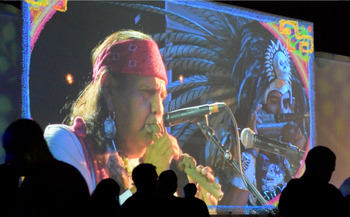
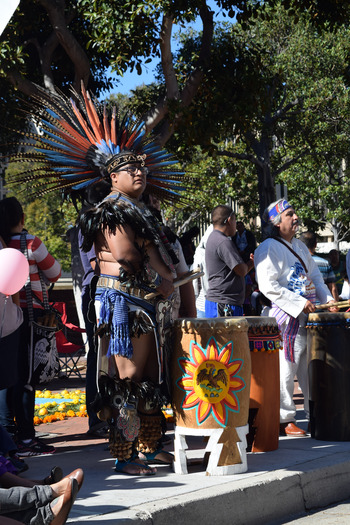
In 2016, Xavier Quijas Yxayotl, who is among the leading artists of pre-Hispanic Mesoamerican instruments, performed on the main stage of the Día de los Muertos celebration at the iconic Hollywood Forever Cemetery in Los Angeles, California. This celebration, held among the graves, has become a popular annual event. Speaking to the festive crowd of thousands, Yxayotl announced, alternating in English and Spanish, “We will present to you the music and dance of the ancient Mexico like our ancestors played over 2,000 years ago. We use the old traditional instruments, the Mayan clay flute, the drums, the Aztec drums, the Maya drums.” Following this introduction, Yxayotl performed on a series of flutes to the accompaniment of drums, including the chest-rattling beats of the large log drum known as the huehuetl. To his right, Aztec dancers resplendent with elaborate regalia, feathers and face paint, danced under multicoloured lighting (see Figures 1 and 2). For a moment, pre-Hispanic music and dance were viscerally present in the cemetery: audiences could hear the past, smell the fragrance of copal floating on the evening breeze, feel the rhythms course through their bodies, and see tantalising images of what could have been.
Yxayotl performing at the Hollywood Forever Cemetery in Los Angeles, California, on 24 October 2015 (photo by author).

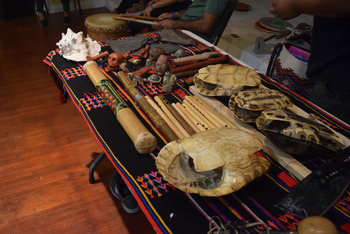
A table with an assortment of Mesoamerican instruments used for an Aztec music rehearsal (photo by author, 2015).

In the early 1500s, the Mexica tribe ruled what is today commonly referred to as the Aztec Empire from the capital of Tenochtitlan located in the Valley of Mexico. Although Yxayotl and other musicians performing on Mesoamerican instruments often reference ancestors in their performances, there are at best tenuous connections between the music and the Mexica people. As observed by Yxayotl, modern performers use replicas of instruments from across Mesoamerica under the umbrella of “Aztec music,” though most are aware that their music is neither directly Mexica nor Aztec.Footnote 1 The vast majority of Aztec-music performers and dancers in the United States do not identify as Aztec, nor are they exclusively from Central Mexico. In fact, both musicians and dancers identify with a mixture of Chicano/a, Mexican, and Indigenous heritages and identities. Dancers often find themselves in the situation of identifying with Indigenous heritage while at the same time not meeting the strict criteria for Indigenous recognition, including historical continuity and acceptance by an Indigenous community (United Nations 2009:4). While plenty of participants in contemporary Aztec dance and music are from territories that belonged to the Aztec Empire, many other participants are from regions outside its historical borders. Today, despite the best efforts of scholars and Mexican music enthusiasts, there are no verified examples of surviving melodies or rhythms from the Mexica.
In fact, contemporary interpretations of Aztecness stem from the twentieth century. In 1920, the newly-elected president of Mexico, Álvaro Obregón, faced the daunting task of uniting a Mexico fractured by conflicts into a single, cohesive nation-state. The situation facing the incoming administration was dire following a decade of violence, widespread food shortages, and illness (McCaa Reference McCaa2003:370). This social and political milieu had a profound impact on the new school of Mexican anthropology that was emerging during the 1920s. Specifically, it affected the core understanding of the social sciences as an opportunity for nation-building at a time when stability was the highest priority (Klor de Alva Reference Klor de Alva and Alva1992:xiv–xv). To achieve this collective goal, anthropologists, educators, politicians, historians, and artists in the visual and performing arts embarked on a social engineering project that sought to change the very core of how citizens conceived of their national heritage and ethnicity. Through the humanities, social sciences, and educational policy, the Mexican state sought to re-define the symbolic relationship between the state and Indigenous peoples in order to create a shared national image of “Mexicanness” or mexicanidad (Klor de Alva Reference Klor de Alva and Alva1992:xiv–xv; Hellier-Tinoco Reference Hellier-Tinoco2011:31). This political ideology, known as indigenismo, became a dominant force in the twentieth century and provided a blueprint for Mexican nation-building. Manuel Gamio, an anthropologist and archaeologist in Mexico at the turn of the century, was among the intellectual leaders of this movement. Gamio studied with Franz Boas in the United States and integrated historical studies, archaeology, and sociology to form a new school of Mexican anthropology (Armstrong-Fumero Reference Armstrong-Fumero and Armstrong-Fumero2010:1).Footnote 2 Indigenismo dominated the Mexican academy until the 1970s, when Mexican anthropologist Guillermo Bonfil Batalla introduced a critical stance that challenged the ideology as creating an “imaginary Mexico”—an argument he outlined in México Profundo: Reclaiming a Civilization (Reference Batalla and Dennis1996[1987]).
Still, the political and cultural frameworks of indigenismo remain a vital force for Mexican nationalism both in Mexico and in the United States, where it blended with the Chicano Movement and the concept of Aztlán—the mythological homeland of the Mexica people (Cooper Alarcón Reference Cooper Alarcón1997:xvii; Alberto Reference Alberto2016:109). Indigenismo underpins the collective ancestry referenced by Yxayotl on the Hollywood Forever Cemetery stage. Music, culture, and people are no longer Mixtec, Nahua, or Maya; instead, they become a common people and culture with a collective national inheritance and history. Aztec music on archaeologically-informed replicas of ancient instruments creates historical experiences for listeners that similarly reference indigenismo. In the words of Gamio in his book Forjando Patria (Forging a Nation), which circulated widely among Mexico’s ruling elite in the early twentieth century: “History offers a transcendent value if we think of it as a copious archive.… The experiences of the past might constitute history in and of themselves, but they remain mute and invisible to us if we do not make an effort to make sense of them, classify them, and present them to the public” (Gamio Reference Gamio and Armstrong-Fumero2010[1916]:72; see also Armstrong-Fumero Reference Armstrong-Fumero and Armstrong-Fumero2010:5).
Music has been one critically important site for this indigenista approach. A number of studies, such as Sydney Hutchinson’s (Reference Hutchinson, Nájera-Ramírez, Cantú and Romero2009) analysis of discourses of authenticity in the Ballet Folklórico, and Ruth Hellier-Tinoco’s (Reference Hellier-Tinoco2011) exploration of the folkloricised Danza de los Viejitos (Dance of the Old Men) in Michoacán, have contextualised the ways in which musical discourses have situated Indigeneity in the past. Anthropologist Johannes Fabian has referred to this phenomenon as the denial of “co-evalness,” meaning Indigeneity and Indigenous people are situated in the past. This in turn facilitates the state’s co-option of Indigenous people and culture while simultaneously disempowering present-day Indigenous communities (Fabian Reference Fabian1983:31; Hellier-Tinoco Reference Hellier-Tinoco2011:28–31). The “presenting” of the Aztec past regularly employs discourses of authenticity rooted in the denial of co-evalness. Hellier-Tinoco remarks on this trend in her review of Yxayotl’s Reference Yxayotl2002 CD Aztec Dances, where she describes the presenting of the music as “traditional” (Hellier-Tinoco Reference Hellier-Tinoco2006)—much as Yxayotl did at the cemetery. Indigenista musical projects have been critiqued for employing such terms, which are seen as contributing to the erasure of contemporary Indigenous communities and the co-option of Indigenous cultures.Footnote 3 But what does indigenismo and its symbolic web of meanings signify in Los Angeles, where both Indigenous and non-Indigenous Mexicans encounter Anglo-American oppression and discrimination?
With these criticisms of indigenismo in mind, this essay seeks to interrogate the ways in which indigenismo and its historical and nationalist frameworks have been re-signified musically in the borderlands where Mexican-Americans experience a different constellation of racial, linguistic, and cultural power dynamics. Drawing on Alejandro Madrid’s observations that Mexican-Americans have required separate strategies to contend with U.S. racial and political discourses (Reference Madrid and Madrid2011:6), I suggest that musicians have transformed Aztec musical spaces into an increasingly malleable framework. This framework retains foundational elements of indigenismo and legacies of twentieth-century Mexican musical anthropological and archaeological studies that continue to draw on the Aztec as a “charter myth” for Mexico and Mexican-American unity (Klor de Alva Reference Klor de Alva and Alva1992:xv). At the same time, an increasing awareness of Mexico’s pluricultural identity has also transformed understandings of Aztecness in the multicultural milieu of Los Angeles. Aztecness has increasingly become a basis for broader pan-Indigenous understandings of Indigenous music, culture, and heritage as a growing number of Mexican-Americans question the erasure of their Indigenous heritages. My analysis draws on interviews with Aztec musicians in the Greater Los Angeles region from 2015 through 2019 and aims to situate their artistic practices within the contexts of the competing forces of Indigenous homogenisation and the growing awareness of Mexican Indigenous pluriculturalism.
Developing the Contemporary Aztec Aesthetic
In the introduction to the critical essay collection Aztlán: Essays on the Chicano Homeland, Rudolfo A. Anaya and Francisco Lomelí write that Aztlán is not about living in the past, but rather, “the community choos[ing] to find its tap root of identity in its history so that it [can] more confidently create the future” (Reference Anaya, Lomelí, Anaya and Lomelí1989:ii). As suggested by Gamio more than seventy years earlier, the archive of history can become exactly such a taproot from which to draw upon (Reference Gamio and Armstrong-Fumero2010[1916]:72). Today, Aztec musicians in Los Angeles employ this same model in what might be considered their own small-scale applied anthropology projects that echo those of the Mexican state. History becomes a vehicle for achieving a new set of cultural and social goals to address pressing issues identified by members of the community. These goals include providing positive portrayals of Mexican heritage; educating children about Indigenous Mexico; addressing gang violence and providing positive cultural alternatives; encouraging children and adolescents to complete their education; and advocating for adults to learn about their heritage through books and participation in cultural events.
To achieve these goals, many musicians use the same research methods as academics did nearly a century earlier, when they first began detailed investigations and recreations of Aztec music under the auspices of academic institutions. As a result, contemporary projects often encounter many of the same contradictions of indigenismo as did researchers and performers before them. These contradictions include Mexica- or Aztec-centric approaches, echoes of evolutionism that draw on Darwinism, and salvage ethnomusicological projects intent on the preservation of perceived cultural authenticity. They also occasionally draw on reconstruction methods that reflect diffusionist understandings of cultural dissemination. These models position some Indigenous cultures as repositories or strata from which to excavate historical materials, justifying their use in recovery efforts. Yet, while academics have readily criticised Aztec performances, little has been written about how these performances and their musical approaches stem directly from twentieth-century musicology, archaeology, and anthropology.
Pre-Hispanic instruments have served as an important taproot for a Mexican musical identity since the early twentieth century, when Gamio and other political and cultural theorists began advocating for archaeological and musicological investigations of Aztec sound. As the Secretary of Education under president Álvaro Obregón (1920–1924), José Vasconcelos, who is best known for his utopic-historical book La Raza Cósmica (The Cosmic Race), promoted an Aztec aesthetic in Mexican art, music, and dance (Reference Vasconcelos and Jaén1997[1925]). The exploration of an Aztec music aesthetic paralleled similar developments in the visual arts and dance. In the realm of classical music, Vasconcelos commissioned composer Carlos Chávez to write an Aztec-inspired ballet, El Fuego Nuevo (The New Fire, composed in 1921), which introduced concert-going audiences to ceramic flutes, the huehuetl, the two-toned teponaztli drum, and rasps (Parker Reference Parker2001; Saavedra Reference Saavedra and Saavedra2015). Among dance communities, the government began funding conchero groups in Mexico City that practised syncretic Indigenous and Catholic dance rituals. Within the span of a few decades, many conchero groups transformed their attire and sound, swapping modest dress for colourful regalia, bigger feathers, and bare chests that drew on surviving iconography from codices and murals. Additionally, many conchero groups replaced the strumming of the concha, the traditional string instrument from which conchero takes its name, with the thunderous beats of the huehuetl (Kurath Reference Kurath1946:388; Stone Reference Stone1975:173; González Torres Reference González Torres2005:138–146; Rostas Reference Rostas2009:11–12). These efforts, both cultural and musical, became an extension of the state’s applied cultural project.
In 1933, Daniel Castañeda and Vicente T. Mendoza published Instrumental precortesiano (Precortesian Instruments) while working in the Academia de Investigación of the National Conservatory of Music (Reference Castañeda and Mendoza1990[1933]). Carlos Chávez founded the Academia de Investigación during his tenure as the director of the Conservatorio Nacional de Música (Parker Reference Parker2001). As described in the introductory pages of Castañeda and Mendoza’s book, their research draws on five distinct lines of evidence, including archaeological instruments from museums; reconstructions of instruments created for study; ceramics and statues with depictions of music; hieroglyphics depicting representations of instruments and musical performance; and surviving manuscripts, documents, and chronicles with references to music, dance, and performance (op. cit.:v).Footnote 4 These five lines of research remain in use in contemporary revitalisation efforts.
Castañeda and Mendoza’s monumental publication highlights the paradoxes of early twentieth-century Mexican nationalism that continue in present-day Los Angeles. On the one hand, Castañeda and Mendoza rejected Eurocentrism; on the other, they too drew on evolutionist ideas when convenient to their nationalist endeavours. For example, slit drums from Africa were labelled “proto-teponaztlis,” effectively reorienting musical theories of evolution and diffusionism to the Mexica, rather than Western Europeans, as the apex of human civilisation, in contrast to the German ethnographic studies of the era (ibid.:Lamina D).Footnote 5 Furthermore, the evolutionist ideas that developed in Mexico took a distinctly nationalistic, Mexica-centric form that placed Mexica culture at the peak of Indigenous musical evolution. Evolutionism in this guise offered a convenient framework for the Mexican state: Indigenous people should be modernised and brought to the elevated height of Mexica culture, transformed from the “primitive pueblos” to a modern, “superior” culture that would be homogenised in the process (Gamio Reference Gamio1987[1935]:37). At the same time, their argument emphasised that Indigenous Mexican music was equal to those of “the great cultures” (Castañeda and Mendoza Reference Castañeda and Mendoza1990[1933]:xiv–xv)—effectively supporting key tenets of evolutionist thinking through the juxtaposition of “great” and “primitive” cultures.
Gamio’s applied archaeological and anthropological goals, paired with Castañeda and Mendoza’s applications of theories of Mexican—and particularly Mexica—musical exceptionalism, had a significant influence on subsequent generations of music researchers, performers, and Mexican audiences. Nearly fifty years after Gamio’s first publication, Samuel Martí echoed Castañeda and Mendoza in the preamble to his Reference Martí1968 publication Instrumentos musicales precortesianos (Precortesian Musical Instruments), in which he asserts Mexican musical exceptionalism: “There cannot remain any doubt that pre-Columbian music reached a period of development comparable, and perhaps superior, to those of European, Asian, and South American origins” (Reference Martí1968:13). Martí justified his claim by pointing to the quantity and variety of instruments found at archaeological sites, directly quoting and refuting Curt Sachs’s dismissal of music from Mesoamerica as “incredibly primitive” (Sachs Reference Sachs1940:196; Martí Reference Martí1968:13).
Martí’s research reflects other significant changes in Indigenous and Aztec music research in the mid-twentieth century, as the nationalist project became more deeply interwoven with the fabric of Mexican art, thought, and national culture. While earlier generations of scholars faced the task of introducing Aztec and pre-Hispanic culture and symbols previously unknown to many Mexican citizens, by the 1960s and 1970s Aztec symbols were already widely accepted in the national narrative. The applied anthropological political project of Gamio’s generation had succeeded in coupling a new, modern Mexican present with the pre-Hispanic past. Upon this foundation, pre-Hispanic symbols and the Mexica became newly symbolic, particularly as renewed interest in Aztec culture grew (Klor de Alva Reference Klor de Alva and Alva1992:xiv-xix; Alberto Reference Alberto2016:111). As argued by Martí, Aztec music was no longer considered to be simply equal to European music: It was “more developed,” and intimately connected to the cosmos and spirituality (Reference Martí1968:15). Music research was no longer just a convenient platform for developing a shared musical language; instead, it had become a project to recover a culture that had been lost. The opening two sentences of the epigraph by prominent Mexican historian Ángel María Garibay in Martí’s Instrumentos musicales precortesianos elucidates how this seemingly small shift transformed the goal of music research: “The explanation for the interest in the past can be found in light of the acquisition of consciousness about an inherited nobility. Not like the children without parents who hide in the shade, but instead like children who know they have brave ancestors and begin to inquire about their ancestral grandeur” (Reference Martí1968; my translation).
Taking this mission to heart, Mexica cultural recovery movements in Mexico City, known as mexikayotl organisations, initiated a revival of pre-Hispanic Mexica culture (Iwańska Reference Iwańska1977:64; Peña Reference Peña1998; González Torres Reference González Torres2005:159). Mexikayotl sought to remove European influences from Indigenous practices, a sort of reverse engineering of syncretism, in an effort to recover pre-Hispanic thought and culture, as well as music and dance. The movement lies at a complex intersection of Mexican nationalism, New Ageism (which was gaining traction in the 1970s), and anthropology influenced by twentieth-century indigenismo (Iwańska Reference Iwańska1977:64; Peña Reference Peña1998:57). Methodologically, mexikayotl organisations followed closely in the footsteps of Castañeda and Mendoza, believing contemporary Indigenous communities retained cultural vestiges from the Mexica that could be recovered. To “recover” these traditions, they employed salvage ethnographic methods and enlisted dancers and musicians from Nahua communities to teach them rituals and dances (Iwańska Reference Iwańska1977:93; González Torres Reference González Torres2005:167). Some participants even began to identify as Mexica despite the fact that there is no evidence of continuing Mexica cultural cohesion in the decades following the destruction of Tenochtitlan (Rostas Reference Rostas2002, Reference Rostas2009:206). Gamio and others of his generation could not have foreseen this shift when they first introduced Aztec symbols into their nation-building project fifty years earlier.
Today’s Aztec music scene in Los Angeles underscores the resilience of these research methods, themes of culture loss and renewal, and Mexica-centric narratives that readily extend to all of Mexico. As emphasised in Yxayotl’s words at the cemetery, the Mexica and Aztecs more broadly still serve as a national ancestor that can be drawn upon to harness collective narratives of Mexican unity and provide an ethos of cultural survival and renewal. Musicians build upon the legacies of mid-century musicologists and archaeologists to bring the past to life and create powerful experiences of Aztec history and culture.
In the early 1970s, mexikayotl and the Aztec sound arrived in the U.S. with Danza Azteca. Lazaro Arvizu, one of the twelve dancers who arrived in the U.S. from Mexico City in 1972, recalls that Florencio Yescas, his teacher and the organiser of the trip to the U.S., sought to introduce cultural pride in mexicanidad through his performance dance group “Esplendor Azteca” (Aztec Splendour) (Arvizu, interview, 23 November Reference Arvizu2016). According to Arvizu, Yescas felt that Aztec music was strictly spiritual and not political. However, the political circumstances surrounding it upon its arrival in the U.S. quickly blurred these distinctions for the eager audiences at his performances. The Chicano Movement and American Indian Movement were both ongoing at the time. Not unlike the effects of nationalism in Mexico half a century earlier, mexicanidad and Aztec symbols became a vehicle for uniting Mexican-Americans at a time where it was considered a social and political necessity.
Aztec Music and Dance in Present Day Los Angeles
Martin Espino recalls that when he began performing on Mesoamerican instruments in the 1990s, to his knowledge he was the only musician doing so in Los Angeles (interview, 13 June Reference Espino2019). Since that time, the number of musicians who perform on Mesoamerican wind and percussion instruments has grown rapidly, and the community reflects the diversity of Mexican-American experiences. Some musicians, like Espino, were born in the U.S. Others, like Daniel Carlos Jimenez Vasquez and Cuezalin, who represent a younger generation and prefers to go by his Nahuatl name, lived in Mexico before moving to the U.S. Espino recounts that he did not learn to speak Spanish in his childhood; in contrast, Vasquez and Cuezalin first learned English in the U.S. Furthermore, Espino is a professionally trained musician who studied classical guitar in college, while Vasquez and Cuezalin first began exploring Mesoamerican instruments through the Aztec dance community.
Today, the significant diversity of Indigenous Mexican ancestry and cultural heritage has gained recognition in Aztec music and dance communities. My conversations with dancers and musicians suggest that this trend has accelerated in the last decade, as younger generations adapt Mexican nationalism and Chicano/a culture—and by extension, the indigenismo that underpins them—to accommodate increasingly pluricultural understandings of Mexico. The trend towards engaging in these debates marks a significant shift from literary scholar Daniel Cooper Alarcón’s observations in The Aztec Palimpsest, where he asserted that Chicano nationalism and paradigms lacked the flexibility to accommodate such “intracultural differences” (Reference Cooper Alarcón1997:4). These conversations are still ongoing, and the rhetorical strategies and music of musicians performing on Mesoamerican instruments reflect the continuing challenges of merging pluriculturalism and indigenismo. On the one hand, musicians increasingly challenge the prevailing nation-building myths that homogenise Mexican Indigenous people through their acknowledgement of their own Indigenous ancestries and source materials. On the other hand, they still often invoke salient symbols of mexicanidad and indigenismo, drawing upon the “taproot” identified by Anaya and Lomelí (Reference Anaya, Lomelí, Anaya and Lomelí1989:ii). This fosters a shared understanding of history and a common Indigenous and national identity. Further complicating matters, even as artists might recognise and challenge portions of prevalent indigenista paradigms, audiences can still readily interpret their performances through this lens, given the decades spent cultivating them as national symbols for a shared pre-Hispanic past.
In the second half of this article, I focus on the music and perspectives of three musicians in Los Angeles to consider how indigenismo and Gamio’s vision of an experiential history have endured and been adapted in the U.S. I trace how musicians continue to draw on earlier models of applied anthropology, history, and musicology to counter Eurocentrism, foster pride in Mexican culture, and counter Mexican Indigenous erasure.
Case Study 1: Carlos Daniel Jimenez Vasquez and Cuezalin
Carlos Daniel Jimenez Vasquez and Cuezalin, represent a younger generation of musicians and dancers in their thirties and forties in Los Angeles. Footnote 6 Vasquez plays Mesoamerican wind and percussion instruments with Danza Azteca communities and leads an Aztec music performance ensemble in Los Angeles (see Figure 3). Vasquez is from the Zapotec community of Macuilxochitl, Nahuatl for “five flowers,” a name that he feels indicates the vital cultural link between his home state of Oaxaca and the Aztec capital Tenochtitlan prior to colonisation. While both of his parents are native Zapotec speakers, Vasquez did not learn Zapotec, likely because Mexican Indigenous languages remain heavily stigmatised in Mexico. Instead, his parents, and particularly his father, sought to integrate the family into American culture. His embrace of Mexican Indigenous heritage has proven contentious with his father (Vasquez, interview, 9 August Reference Vasquez2016). This tension likely stems from stark generational differences that underscore the paradoxes of indigenismo and Indigenous revitalisation as for Vasquez’s father’s generation, Indigenous languages were frequently framed by the state and educational institutions as barriers to upward mobility.
Vasquez playing the huehuetl in Santa Ana for a Day of the Dead celebration in November 2015 (photo by Kaj Skov Nielsen).

Cuezalin has made similar observations about the choice of shedding Indigenous ethnic identities and culture to gain social mobility in Mexico. Cuezalin remarked on the prevailing logic for those leaving their ethnic identities: “[They say] bueno, if I don’t dress like an Indian, and if I don’t live like an Indian, and I don’t speak the language anymore, then ‘no soy indio’ [I’m not Indian]. …It is not even about blood. It is about what you say you are and what you do or don’t do” (interview, 25 March 2016). Like Vasquez, Cuezalin arrived in the U.S. when he was thirteen. His ancestry includes Mezcalteco and other Indigenous heritages from the state of Nayarit in northwestern Mexico, but his family in Mexico identifies primarily as Cora, or, as they self-identify, the Nájari people. Cuezalin recounts that his grandfather used to play the musical bow in the town plaza, although Cuezalin never got the chance to learn the songs. Today, Cuezalin leads a mexikayotl community, known as a calpulli, that regularly practises danza and ceremonies. Cuezalin has introduced new songs and dances that draw upon his Indigenous heritage, historical research, and collaborations with others.
For the younger generation represented by Vasquez and Cuezalin, Aztec cultural spaces have provided a starting point for acknowledging and celebrating Indigenous Mexican ancestries. Aztec cultural frameworks have been adapted to provide musicians like Vasquez and Cuezalin with malleable creative spaces that reflect the complexities of their experiences, Indigenous heritages, and identities. This is particularly significant as neither they, nor many others in similar situations, can receive official recognition in either the U.S. or Mexico, as they do not meet state definitions of Indigenous people, despite their Indigenous ancestry.
In interview, both Cuezalin and Vasquez described the ways in which they integrate their own Indigenous heritages into Aztec musical spaces. For instance, Vasquez plays Zapotec songs and original compositions with instrument replicas at events, as well as melodies based on Aztec dance rhythms that are commonly performed with dancers similar to the music Yxayotl played at the Hollywood Forever Cemetery. At the same time, mexikayotl and mexicanidad provide a meaningful context for connecting with other musicians and for situating his own Zapotec heritage within a broader framework of Aztecness. Vasquez shared how he views this connection:
A lot of people ask me “where are you from?” and I say “I am from Oaxaca.” They say “Hey, there are not Aztecs over there!” And I say, well, no and yes. No because originally my people were Zapotecos, and yes because the name of my town is Macuilxochitl, so, obviously it was conquered by Aztecs—or at least it was an influence. And my people, from what I read, were merchants. Oaxacan people were trading so they had to go [to Tenochtitlan] and they had to come back.… I think that there is a connection with the type of music that is played in Oaxaca with what was played here at one point at Tenochtitlan.
(interview, 9 August 2016)Cuezalin’s musical process is similar. Describing the composition process for “Nanyeri,” a rhythm and dance he created for his calpulli, Cuezalin offers insight into how musicians increasingly draw on their own heritages in Aztec spaces and cultivate pluriculturalism:
I wanted to encourage other people to represent their states, their ethnicity, or their pueblo. In Mexico, all the states have a state song.… My state is called Nayarit, which comes from the Nájari people, who are the Cora and my ancestors. They call themselves Nájari and the state is Nayarit.… The reason why I chose this rhythm, besides it being the state’s song, is because the Cora are people that are very happy and they like these rhythms that are very “dancy” round rhythms.… My family is from the coast and they are like that. They like to dance, they like to be happy. It is a warrior dance, but it is very playful also. All the movements are about holding weapons, fighting, or attacking, or defending, or setting yourself free.
(interview, 2 June 2016)These strategies challenge Mexica- and Aztec-centric approaches that have traditionally grounded indigenismo. While indigenista cultural projects appropriated material from Indigenous communities to further the objectives of the state and homogenise Mexican citizens, these contemporary efforts have in many cases begun to reframe Aztecness as a starting point for self-exploration and space in which to recognise Indigenous Mexican diversity.
Nonetheless, despite such efforts to recognise and embrace pluriculturalism in many Aztec musical and cultural spaces, the Aztecs still retain unrivalled symbolic currency. Even as contemporary Indigenous identity is acknowledged, the past, particularly Aztec source materials and histories, continues to offer tantalising materials and symbols to draw upon. This reflects the complicated balancing act of navigating converging Mexican national and ethnic identities in the U.S. Vasquez’s musical process illustrates how these influences, both national and local—as well as past and present—are blended musically:
You learn about something, you learn history—where you are from. I learn danzas and I talk to people, and then I create my own conclusions, and I create my own ideas of how it must have been. I don’t try to replicate what they did—I transform. I grab pieces here and there and I make something new because you can’t really replicate what they did.… I can only interpret a certain part of it. And obviously myself, I grab things from Oaxaca, I grab things from here [Los Angeles], I grab things from Mexico, and I incorporate all of them. I make a mixture.
(interview, 9 August 2016)These historical and musical interpretations reflect Vasquez’s own experiences, as well as his historical studies, his time with Aztec dancers, many of whom are influenced by mexikayotl, and his own aesthetic preferences. They also suggest that, even within a pan-Indigenous framework, the past remains a powerful source of contemporary understandings of Mexican Indigeneity in the Mexican-American community.
A conversation with Cuezalin further underscored the challenges of navigating pan-Indigeneity within an Aztec nationalist paradigm that has historically subsumed other Indigenous cultures. Cuezalin described a collection of songs he collaboratively composed with a group known as the Xochimecayahualli based on texts from the Cantares mexicanos (Songs of the Aztecs). The Nahuatl song texts in this collection date predominantly from the mid-1500s and reference Mexica ancestors and spirituality (Bierhorst Reference Bierhorst1985:106–109). Cuezalin spoke to the significance of these song texts:
I believe that their power is in the connection they establish to the words of the ancients. And when we pronounce the words that they pronounced, that for them were special, when we sing their songs we are transported to an ancient time—to a time that unites many of us that are descended from the Aztecs, so to speak, the people that spoke in those times. Even though our ancestors may not have been Nahuatl speakers at that time, these are words that were spoken in the time that our ancestors lived. Therefore, they transport us like a time capsule.
(interview, 15 October 2015)Even as Cuezalin is perfectly aware of his own Cora Indigenous heritage and acknowledges it through compositions like “Nanyeri,” ancient song texts in Nahuatl still provide a source for tapping into an Indigenous heritage that, from his perspective of history, is intertwined with his own. Without access to one’s own Indigenous heritage, the Aztecs become a proxy for Indigenous ancestors—even as participants simultaneously acknowledge and honour their own diverse Indigenous ancestries.
The experiences and musical approaches of Cuezalin and Vasquez highlight both the potentials and limitations of adapting Aztec and Mexica frameworks into pan-Indigenous spaces. On the one hand, musicians can challenge the continuing marginalisation of contemporary Indigenous communities. Furthermore, these musical adaptations can provide a critical space to rebuke assimilation, both in Mexico and in the United States, and to challenge current definitions of Indigeneity that deny individuals of Indigenous heritage the ability to identify as such. On the other hand, even the most conscientious efforts to build a pan-Indigenous framework around Aztecness struggle under the weight of symbolic state legacies of indigenismo and mythic nation-building. Despite these challenges, Aztecness and applied anthropological models from the twentieth century continue to provide a critical focal point for projects that seek to re-introduce people to their ancestors. Today, this includes not only the “ancestral grandeur” of a national character referred to by Garibay (Martí Reference Martí1968: epigraph), but also, increasingly, individuals’ own distinct Indigenous heritages.
Case Study 2: Martin Espino
While Espino occasionally collaborates with dance communities, most of his current musical endeavours focus on performing instrumental and vocal music with his group, Mexika. Espino’s approach is driven by an urge to educate audiences about the full musical potential of Mesoamerican instruments and to counter Eurocentric legacies that have situated Mesoamerican instruments as “primitive”—a belief that many artists I spoke to see as still pervasive in the Mexican-American community. Unlike Martí, Castañeda, and Mendoza, who countered Eurocentrism in their writings, Espino employs his musicality and skill with the instruments to continue dismantling these legacies and their harmful effects on the community.
Espino shared that he was an undergraduate at Immaculate Heart College in Los Angeles when he first learned the word for what he was experiencing in his life and education: Eurocentrism. Espino recounted his frustrations from his first experiences delving into Mexican music and folklore as a college student:
I wondered what my folklore was like, so I opened up the books, and this is when I learned two things: One of them [is that] somebody else wrote our history. The other one is [that] I learn by getting angry.… So I got mad and I thought “That’s it?” A 300-page book on music.… Curt Sachs who is supposed to be the big musical ethnographic guy on instruments and everything like that.…That was the guy, man, Curt Sachs, he knew everything about world music. I looked up Mexico, 300 pages, page 75, “rattles and flutes,” and I got mad! There’s gotta be more! Are you going to tell me they made all these pyramids and mathematical advances, medical advances, food advances…and their music stayed the same with rattles and primitive flutes?! Something is wrong! …So that led me into studying.
(Espino, interview, 13 June Reference Espino2019)This revelation fuelled Espino’s explorations of Indigenous Mexican music and his first attempts to grapple with the question: What would a less Eurocentric Mexican music sound like? To answer this question and move beyond the trope of “rattles and flutes,” Espino began to research ancient Mexican Indigenous music. Although he had been performing years before that, in 1990 he made “explicit moves to perform these Indigenous instruments in a wider public view in museums and concerts” (Espino, pers. comm., 22 April Reference Espino2020). His approach to removing Eurocentrism centres on presenting the instruments in all of their musical complexity. Espino draws on a mixture of influences that have laid the groundwork for his experimentations with pre-Hispanic instruments including sci-fi soundtracks—citing the soundtrack for Forbidden Planet as highly influential in his musical career; his experience playing Andean guitar; contemporary Indigenous music and rituals; and the electric guitar, particularly the edgy sounds of Jimi Hendrix that captivated him in his youth. In the words of Espino, “these different sounds opened my mind up to hear the microtonal and pan-tonal sonorities of the Mexican ancestral instruments. It made it very easy for me to like them when I first heard them” (ibid.).
Espino makes no pretence that his music is ancient or authentic, although he “performs in as much a traditional/ancient way as possible, based on intensive scholarly research, and musical interpretations with pre-Hispanic sounds” (ibid.). Espino’s musical experimentations with pre-Hispanic sounds challenge the approaches of many archaeologists working with musical artefacts that lean towards a positivistic approach that attempts to separate artistry and interpretation from sound production. These recordings by archaeologists often fall short of capturing the full range of sounds that instruments are capable of producing. Espino cites a set of recordings of Mesoamerican instruments played by Jorje Daher that feature thirty to forty-second clips of eighty-nine instruments from across Mexico as an example of this common shortcoming in archaeological music research recordings (Mendelssohn Reference Mendelssohn1972). Although Espino found the sounds intriguing, he felt the album was a wasted opportunity to demonstrate the full potential of the instruments.
Like other musicians I spoke to in Los Angeles, Espino folds historical research into his sound. He has read widely on Indigenous Mesoamerican music and scoured codices and primary sources for references to music and dance. He has also read more recent publications, including the prolific work of Latin American music researcher Robert Stevenson, whom Espino met after he gave a guest lecture at the University of California, Los Angeles. He was particularly interested in Stevenson’s analysis of intervals and the studies of keys in archaeological instruments (Espino, interview, 13 June Reference Espino2019).Footnote 7 In addition to experiments with pitch, Espino believes it is critical to reconsider rhythm, since “they were not all in 6/8 or in 2, 4, or 4/4. There is evidence of different rhythmic meters” (Espino, pers. comm., 22 April Reference Espino2020):
I like to try to reflect what I think was really going on. There were different kinds of music—it says it in the Cantares mexicanos: music for viejos [the old], music for a funeral.… Are you going to tell me that the ancient peoples played the same rhythms that we hear in the Aztec dance today for the last 2,000 or 3,000 years? Just knowing how musicians are, people experiment. That is how the songs and the dances were created.
(Espino, interview, 13 June Reference Espino2019)His strategy is similar to that of Vasquez in that both draw on independent research and their own interpretation of the past as a source of inspiration.
Today, Espino teaches Indigenous music educational programmes in Los Angeles that continue to challenge Eurocentrism. The educational programmes he spearheaded echo Garibay’s urging of a new consciousness and the need to emerge from the shadows. The past serves as a source for knowing oneself, and, through knowledge of oneself, bettering oneself:
We don’t tell our kids where they are from. So how can we expect them to have pride in where they are from and what they do? …We don’t go back and say: Behind it [your family] are thousands of years of culture, and pyramids, buildings, and architects and poets, and one of the major languages in the world, and we go back so long in space and time and history, and you do have a place: You do have a place. You shouldn’t join a gang so you can feel better: Join knowledge, join history.
(Espino, interview, 13 June Reference Espino2019)Education and knowledge of the past, including experiential knowledge of history and national culture, remain vital to the understanding of oneself. While post-revolutionary anthropologists and musicians sought to use Aztec history for nation-building, in the United States Aztec symbols and music serve as a powerful rejection of assimilation, white-washing, and the forgetting of Indigenous Mexican culture.
Concluding Thoughts
My conversations with musicians in Los Angeles suggest that the applied anthropological project of twentieth-century Mexican nation-building continues to provide a useful template to counter Eurocentrism experienced by Mexican-Americans, to instil a shared sense of community, and, echoing the historical vision of Gamio, to render a mute past audible (Reference Gamio and Armstrong-Fumero2010[1916]:72). Contemporary Aztec and Mesoamerican musical and cultural projects remain deeply linked to indigenista musicological, archaeological, and anthropological studies with their applied mission. Nonetheless, aspects of this model that were beneficial for state-building in the twentieth century now pose substantial challenges in a new era and setting. For example, artists risk inadvertently sustaining Eurocentric theories of evolutionism and diffusionism that continue to linger from these earlier anthropological models. Aztec-centric, nationalist models are particularly insidious because, on the surface, they appear to disrupt Eurocentrism and promote Indigenous heritage. Even though the ideas they contain have been denounced and roundly rejected in academic circles, their continuing presence in many Aztec music and dance communities indicate that these legacies still retain currency. This problem points to the importance of communicating current anthropological and ethnomusicological research in public forums, as there is a risk of readily available, but outdated, sources continuing to espouse evolutionism in the guise of nationalism and ethnic pride. Similarly, treating Indigenous communities as historical repositories must be further contended with, as current approaches often still echo salvage ethnomusicology, diffusionism, and evolutionism in contemporary community applied anthropological projects.
My findings suggest that artists performing on Mesoamerican instrument replicas in Los Angeles, particularly those musicians who are acutely aware of their Indigenous heritages, have begun to grapple more vigorously with these nationalist legacies in their own works. As a result, mexikayotl organisations are increasingly drawing on Native American pan-Indigenous frameworks, particularly the model of the Native North American powwow. This model acknowledges Indigenous diversity while simultaneously providing an experience of a larger cohesive community. There is increasing recognition of individual heritages that challenge core tenets of mexicanidad and the twentieth-century emphasis on a single common Aztec ancestry.
Yet it remains to be seen whether Mesoamerican instrument replicas and music can be so easily extricated from their twentieth-century nationalist entanglements. Artists continue to strategically employ Aztec symbols and cultural heritage while simultaneously rejecting homogenisation. Even musicians who are conscientious of the shortcomings of Aztecness as a pan-Indigenous framework regularly draw upon Nahuatl, surviving texts and research, symbols, and mexikayotl perspectives of cultural recovery. This is largely the result of a practical problem: there is limited musical material for individuals to draw upon, as they have not learned the traditional songs or languages of their families. At the same time, other musicians actively position their music as authentic, such as Yxayotl’s claim to be performing the music of Aztec ancestors from almost 2,000 years ago. This claim taps into these national myths and the twentieth-century legacies of indigenismo and further complicates efforts to develop pan-Indigenous models that do not subsume Indigenous cultures into a single “Aztec” culture. As a result, Aztec music currently teeters between homogenising Indigenous people in the name of solidarity, and celebrating the diversity of Indigenous Mexican cultures through an increasingly pan-Indigenous cultural framework.