INTRODUCTION
The deposit-feeding sea cucumbers are common macrobenthos and play a key role in the marine ecosystem including nutrient recycling (Uthicke, Reference Uthicke2001) and bioturbation (Uthicke, Reference Uthicke1999). Additionally, some species of sea cucumbers, mainly in Stichopodidae and Holothuriidae, have high commercial value and their processed products, known as ‘beche-de-mer’ or ‘trepang’, are generally consumed in Asian regions (Conand, Reference Conand, Lovatelli, Conand, Purcell, Uthicke, Hamel and Mercier2004). The Beibu Gulf is a semi-enclosed bay that located in the north-west of the South China Sea. It is rich in holothurian fauna and among which, the Curry fish is high in commercial importance and exploited intensively (Hu et al., Reference Hu, Xu, Wen, Zhang, Fan and Su2010).
Holothuria (Theelothuria) notabilis Ludwig, Reference Ludwig1875 is a medium-sized species and has a wide distribution among the Indo-West Pacific where it has been documented in Madagascar, the Gulf of Thailand, Andaman Sea, Peninsular Malaysia, the Philippines and northern Australia (Clark, Reference Clark1946; Cannon & Silver, Reference Cannon and Silver1986; Lane et al., Reference Lane, Marsh, VandenSpiegel and Rowe2000; Putchakarn & Sonchaeng, Reference Putchakarn and Sonchaeng2004; Kamarudin et al., Reference Kamarudin, Rehan, Hashim and Usup2010). This species prefers to inhabit in lagoons and seagrass beds on sandy substrata between 0 and 10 m depth. Holothuria (T.) notabilis has been added to the list of commercial species in recent years, and it is one of the main exploited species in the south of Madagascar (Rasolofonirina, Reference Rasolofonirina, Conand and Muthiga2007).
Liao (Reference Liao1997) made extensive studies of the holothurian fauna from both deep and shallow water in China, and only two species from the subgenus theelothuria were documented: Holothuria (Theelothuria) foresti Cherbonnier & Féral, Reference Cherbonnier and Féral1981; and Holothuria (Theelothuria) spinifera Théel, Reference Théel1886. More recently, Chao & Wu (Reference Chao and Wu2012) collected 21 species of holothurians from the intertidal zone of Houbihu in southern Taiwan. However, so far H. (T.) notabilis has not yet been recorded from China. Records of new occurrence for holothurians were consecutively reported lately, and these new findings improved upon the initially poor taxonomic studies and studies of the colonization events of holothurians (Teo & Ng, Reference Teo and Ng2009; Dabbageh et al., Reference Dabbagh, Keshavarz, Mohammadikia, Afkhami and Nateghi2012; González-Wangüement & Borrero-Pérez, Reference González-Wangüement and Borrero-Pérez2012; Martins et al., Reference Martins, Souto and Menegola2012). Here we first identify and report a description of H. (T.) notabilis in the Beibu Gulf, South China Sea with scanning electron microscopy images and DNA sequencing.
MATERIALS AND METHODS
The authors first noted this species on 5 July 2013. Five specimens were sent to our laboratories by a local sea cucumber processor, who collected the specimens from the sandy bottoms of the intertidal zone of Beihai (21°23′N 109°10′E), north-east of the Beibu Gulf. Photographs were taken and the species was subsequently identified as Holothuria (Theelothuria) notabilis based on their external morphological characters. One specimen was preserved in 95% ethanol and was deposited in the Marine Life Museum of the South China Sea Institute of Oceanology, Chinese Academy of Sciences, China.
Traditional taxonomic characters, such as ossicles, were applied to confirm the identity of the specimens on the basis of the original description of this species (Ludwig, Reference Ludwig1875) and another relevant taxonomic paper (Liao, Reference Liao1997). Ossicles were extracted from small pieces of dorsal tissue, ventral tissue, tentacles and ambulacral feet by the NaClO method (Liao, Reference Liao1997; Wen et al., Reference Wen, Zhang, Hu and Shen2009), and then dried at 65°C, gilded and examined under scanning electron microscope (Hitachi S-3400N, Japan). Moreover, partial fragments of two mitochondrial DNA genes (16S ribosomal RNA gene (16S) and cytochrome oxidase subunit I gene (COI)) were amplified using two pairs of conserved primers in echinoderms, 16S with the primers 16Sar (5′ CGCCTGTTTATCAAAAACAT 3′) and 16Sbr (5′CTCCGGTTTGAACTCAGATCA 3′), and COI with the primers co1eF (5′ATAATGATAGGAGGRTTTGG 3′) and co1eR (5′GCTCGTGTRTCTACRTCCAT 3′) (Arndt et al., Reference Arndt, Marquez, Lambert and Smith1996; Kerr et al., Reference Kerr, Janies, Clouse, Samyn, Kuszak and Kim2005). The PCR amplification reactions were performed using a Veriti thermal cycler (ABI, USA) in a total volume of 50 µl, each containing 100 ng of genomic DNA, 0.2 µM of each primer, 0.2 mM of each dNTP, 2 U of Taq DNA polymerase (Takara, Japan) and 1 × PCR Buffer. The thermal profiles were 95°C for 2 min; 35 cycles of 30 s at 95°C, 30 s at 50°C for 16S or at 48°C for COI, and 45 s at 72°C; final extension step of 10 min at 72°C. The PCR products were sequenced using Big Dye Terminator kits (ABI, USA) on an ABI 3730 automated sequencer with both primer pairs.
RESULTS
SYSTEMATICS
Order ASPIDOCHIROTIDA Grube, 1840
Family HOLOTHURIIDAE Ludwig, 1894
Genus Holothuria Linnaeus, 1767
Subgenus Theelothuria Deichmann, 1958
Holothuria (Theelothuria) notabilis Ludwig, Reference Ludwig1875 (figure 43)
Holothuria (Theelothuria) notabilis Ludwig, Reference Ludwig1875: 102, pl. 7, figure 43; Clark, Reference Clark1946: 432.
MATERIAL EXAMINED
Specimens were collected from the sandy bottoms in the intertidal zone of Beihai (21°23′N 109°10′E), in the north-east of the Beibu Gulf. The collector of these specimens was Debin Pang.
MORPHOLOGY
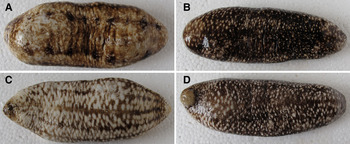
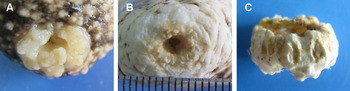
At rest, a large individual is up to 180 mm in length. It is cylindrical in shape and tapered near the anus. The tegument is rough with light papillae, and the tegument colour is varied from uniform dark brown to brownish with numerous series of darker blotches (Figure 1A–D). The blotches in ventral region are lighter in coloration and smaller in size in contrast to those dorsally (Figure 1A–D). Tube feet are small and numerous, and scattered throughout the body. The mouth is ventral and possesses 20 small peltate tentacles surrounded with papillae collar (Figure 2A). The anus is terminal and possesses apparently papillae (Figure 2B). The body wall is thin and parchment-like, no more than 2 mm in thickness, and gritty to touch. The calcareous ring is stout and well developed, and the radial and interradial plates are fused through connective tissue; radial plates with short and paired posterior bifurcation (Figure 2C).
Specimens of Holothuria (Theelothuria) notabilis collected from Beibu Gulf showing coloration variability: (A) dorsal view of brownish individual with darker blotches; (B) dorsal view of uniform dark brown individual; (C) ventral view of brownish individual with lighter blotches; (D) ventral view of uniform dark brown individual. Scale bar: 2 cm.

Holothuria (Theelothuria) notabilis: (A) peltate tentacles; (B) anal papillae; (C) calcareous ring. Scale bar: 2 cm.

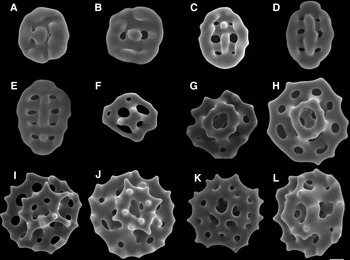
There are two kinds of body wall ossicles: numerous buttons and few tables. Buttons are knobbed and nearly oval usually with 3–4 pairs of holes, 40–60 µm in long diameter, about 40 µm in short diameter; the paired holes are bilaterally symmetrical and similar in size (Figure 3A–E). Tables are well developed with nearly circular disc; typical tables: disc concave with spinose margin, 65 µm in diameter, spire moderate and terminating in a cluster of spines (Figure 3G, H).
Holothuria (Theelothuria) notabilis: scanning electron microscopy images of ossicles (A–E) bottons at different development stages; (F–J) tables at different development stages; (K) disc of table; (L) lateral view of table. Scale bar: 10 µm.

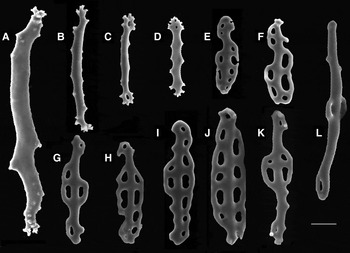
Supporting rods from tentacle are large spine rods (Figure 4A–D) and perforated rods (Figure 4E, F); while supporting rods from ambulacral feet possess central and peripheral perforations (Figure 4G–L).
Holothuria (Theelothuria) notabilis: scanning electron microscopy images of supporting rods from tentacles (A–F) and ambulacral feet (G–L). Scale bar: 20 µm.

DNA BARCODING
The two partial fragments of mitochondrial genes, 520-bp16S gene and 652-bp COI gene, were amplified and sequenced (GenBank accession numbers KJ801944 and KJ801945, respectively). The blast of the obtained 16S sequence in GenBank identified the individual from Beibu Gulf as H. (T.) notabilis with a 99% maximum identity with FJ223872 (Peninsular Malaysia, Malaysia). There is only one nucleotide variance between these two sequences, and therefore the different haplotype was recorded as KJ801944. The obtained COI sequence is the first H. notabilis COI data.
DISCUSSION
The holotype of Holothuria (Theelothuria) notabilis came from Bowen, Queensland, Australia. Subsequently, two specimens were taken by the Great Barrier Reef Expedition in 1929. The Great Barrier Reef specimens are only about half as big as the holotype. The tegument colour of the holotype, with double series of darker blotches on the back, is in contrast to the specimens from Great Barrier Reef, which are dark brown (Ludwig, Reference Ludwig1875; Clark, Reference Clark1946). Our specimens include these two types of body colour. Moreover, the brownish specimens possess other series of lighter blotches in ventral region in addition to the double on the back, which is described for the specimen from Bowen. The body colour of H. (T.) notabilis may be related to how long it lives. The darker blotches of the tegument gradually occur with increasing age, judging from the fact that the specimens with darker blotches are usually larger in size than those, which is uniform dark brown. Other morphological characters in our specimens, such as ossicles, were consistent with the description of the holotype by Ludwig (Reference Ludwig1875).
As well as H. (T.) notabilis, two other subgenus theelothuria species have been reported on the coast of China (Liao, Reference Liao1997): Holothuria (Theelothuria) foresti; and Holothuria (Theelothuria) spinifera. Neither of these was reported in the Beibu Gulf. At present, the northernmost site in the South China Sea where H. (T.) notabilis has been reported was the Philippine waters (Lane et al., Reference Lane, Marsh, VandenSpiegel and Rowe2000). Climate changes and human impact were thought to be related to the colonization of Holothuria arguinensis (Koehler & Vaney, Reference Koehler and Vaney1906) from the Atlantic Ocean to the Mediterranean Sea (González-Wangüement & Borrero-Pérez, Reference González-Wangüement and Borrero-Pérez2012). The increase of shipping traffic in the South China Sea would facilitate the dispersal of H. (T.) notabilis, mainly during the settled pentacula larvae. In addition, the increase of temperatures in Beibu Gulf would allow this species to adapt to the local environmental conditions and to colonize the Beibu Gulf (Chen et al., Reference Chen, Li, Yu, Zheng, Wang and Chen2013). Holothuria (T.) notabilis had the highest biomass and density with 6000 kg/ha and 60000 individuals/ha in the seagrass habitat before it was exploited in Madagascar. But this species is now the most exploited species in the area as other species are being depleted, and its biomass has decreased considerably. Up to now there are no known species-specific conservation measures for this species and more studies are needed about the impact of fisheries on this species population.
In conclusion, the collected specimens provide the first evidence that H. (T.) notabilis is present in the Beibu Gulf waters. This finding widens the geographical range of H. (T.) notabilis and indicates that this species may expand northwards in the South China Sea.
ACKNOWLEDGEMENT
This work was supported by the Key Projects in the National Science & Technology Pillar Program during the 12th Five-year Plan Period (C.H., 2012BAD18B03) and (Z.Y., 2011BAD13B02).