1. INTRODUCTION
Engineering design is considered both an art and a science, which encourages the use of engineering principles, imagination, and a designer's intuition to create novel engineering solutions. Nature is a powerful resource for engineering designers. The natural world provides numerous cases for analogy and inspiration in engineering design (Brebbia et al., Reference Brebbia, Sucharov and Pascolo2002; Brebbia & Collins, Reference Brebbia and Collins2004; Bar-Cohen, Reference Bar-Cohen2006b; Brebbia, Reference Brebbia2006, Reference Brebbia2008; Brebbia & Carpi, Reference Brebbia and Carpi2010). Biological organisms, phenomena, and strategies, herein referred to as biological systems, provide insight into sustainable and adaptable design and offer engineers billions of years of valuable experience, which can be used to inspire engineering innovation. Many engineering breakthroughs have occurred based on biological phenomena, and it is evident that mimicking biological systems or using them for inspiration has led to successful innovations (e.g., velcro, flapping wing micro air vehicles, synthetic muscles, self-cleaning glass).
Nature has influenced engineering and the engineering design process. Although inspiration from nature can be taken at multiple stages in the engineering design process, it most notably occurs during concept generation, when inspiration in the form of analogies, metaphors, and connections from multiple engineering domains and other sources (e.g., biological domain) are utilized for developing novel or creative solutions to a design problem. Concept generation methods and tools help stimulate designer creativity and encourage exploration of the solution space beyond an individual designer's knowledge and experience (Gordon, Reference Gordon1961; Hyman, Reference Hyman1998; Otto & Wood, Reference Otto and Wood2001; Dym & Little, Reference Dym and Little2004; Ulrich & Eppinger, Reference Ulrich and Eppinger2004; Voland, Reference Voland2004; Pahl et al., Reference Pahl, Beitz, Feldhusen and Grote2007; Cross, Reference Cross2008; Ullman, Reference Ullman2009). There are multiple approaches to concept generation for engineering design; however, most are not computational. Although in recent years, computation-based or automatic concept generation has gained importance in the engineering design research community and has taken many forms (Hong-Zhong et al., Reference Hong-Zhong, Bo and Chen2006; Bryant et al., Reference Bryant, Bohm, McAdams and Stone2007; Jin & Li, Reference Jin and Li2007; Bohm et al., Reference Bohm, Vucovich and Stone2008; Bryant Arnold et al., Reference Bryant Arnold, Stone and McAdams2008; Kurtoglu et al., Reference Kurtoglu, Swantner and Campbell2008; Yao Zu, Reference Yao, Xiao and Zhang2009). Identifying and presenting the valuable knowledge from the biological domain to an engineering designer during concept generation is currently a manual, in most cases, and somewhat disorganized process. This research aims to define and formalize the information identification and knowledge transfer processes, which will result in a systematic technique for developing biologically inspired, or biomimetic, designs.
This paper presents a computational approach that combines established function-based design tools to enable systematic development of biologically inspired designs. In order to facilitate concept generation for biologically inspired engineering design, two bodies of knowledge are required: successful engineered systems and biological systems, both indexed by engineering function. A Design Repository (Bohm et al., Reference Bohm, Vucovich and Stone2008), containing descriptive product information, serves as the engineered systems body of knowledge. Instead of creating a database containing functionally decomposed biological systems, similar to the Design Repository, a biology textbook serves as the biological systems body of knowledge. To circumvent the terminology difference issue, which is indexed by natural language rather than engineering function, an engineering to biology thesaurus is utilized (Nagel et al., Reference Nagel, Stone and McAdams2010). Structurally, the thesaurus acts as a set of correspondent terms to the functions and flows of the functional basis (Hirtz et al., Reference Hirtz, Stone, McAdams, Szykman and Wood2002), which provides term mapping between the biological and engineering domains for the support of concept generation. Integrating biological system information with an established, computational method for concept generation enables designers to consider taking inspiration from biology without having to expend extra effort to learn a new method.
This paper begins by introducing the reader to related biologically inspired design research and information retrieval in engineering design, followed by a section describing background research. Next, the computational framework and algorithm for discovering biological inspiration during concept generation is presented and discussed. The paper ends with an illustrative example, conclusions, and future work.
2. RELATED WORK
With biology-inspired design emerging as its own field, engineering design research as turned to investigating methods and techniques for transferring biological knowledge to the engineering domain. Prominent research focuses on investigating individual aspects of the overall engineering design process involving biological systems for inspiration (Vincent et al., Reference Vincent, Bogatyreva, Bogatyrev, Bowyer and Pahl2006; Linsey et al., Reference Linsey, Wood and Markman2008; Mak & Shu, Reference Mak and Shu2008; Nagel et al., Reference Nagel, Tinsley, Midha, McAdams, Stone and Shu2008; Wen et al., Reference Wen, Zhang, Hapeshi and Wang2008; Helms et al., Reference Helms, Vattam and Goel2009), and computational design techniques. The main goal of these research efforts is to create generalized methods, knowledge, and tools such that biomimetic design can be broadly practiced in engineering. Biology-inspired design “offers enormous potential for inspiring new capabilities for exciting future technologies” and encourages engineering innovation (Lindemann & Gramann, Reference Lindemann and Gramann2004; Bar-Cohen, Reference Bar-Cohen2006a).
Work in the area of computational biologically inspired design techniques involves the creation of databases, software, and search methods. Chakrabarti et al. (Reference Chakrabarti, Sarkar, Leelavathamma and Nataraju2005) developed a software package entitled Idea-Inspire that searches a database of natural and complex artificial mechanical systems by chosen function, behavior, and structure terms. Their database comprises natural and complex artificial mechanical systems and aims to inspire the designer during the design process (Srinivasan & Chakrabarti, Reference Srinivasan and Chakrabarti2009). Another database-driven method is ontology driven bioinspired Design Repository developed by Wilson et al. (Reference Wilson, Chang, Yim and Rosen2009). This ontology is encoded using description logics and uses subsumption, an inference mechanism, to precisely retrieve relevant biological strategies from the repository. Chiu and Shu (Reference Chiu and Shu2007a, Reference Chiu and Shu2007b) developed a method for identifying biological analogies by searching a biological corpus using functional keywords. A set of natural-language keywords is defined for each engineering keyword to yield better results during the analogy search. This method has successfully generated engineering solutions analogous to biological phenomena (Shu et al., Reference Shu, Hansen, Gegeckaite, Moon and Chan2006).
Work in the area of information retrieval in design related to this research involves the design of a hierarchal thesaurus, software, and search methods. A general approach to design information retrieval was undertaken by Wood et al. (Reference Wood, Yang, Cutkosky and Agogino1998), which created a hierarchical thesaurus of component and system functional decompositions to capture design context. Strategies for retrieval, similar to search heuristics, of issue based and component/function information were presented. Bouchard et al. (Reference Bouchard, Omhover, Mougenot, Aoussat and Westerman2008) developed a content-based information retrieval system named TRENDS. This software aims at improving designers' access to Web-based resources by helping them to find appropriate materials, to structure these materials in way that supports their design activities and identify design trends. The TRENDS system integrates flexible content-based image retrieval based on ontological referencing and clustering components through conjoint trends analysis. Cheong et al. (Reference Cheong, Shu, Stone and McAdams2008) developed a set of search cases for determining sets of biologically meaningful keywords to engineering keywords. Although the results are subjective, the process for retrieving the words is systematic and was successful in determining biologically meaningful words to several functions of the reconciled functional basis.
3. SUPPORTING DESIGN TOOLS
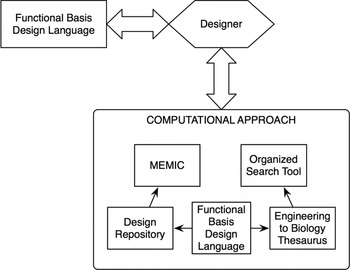
This section provides background information on the two computational tools and the respective supporting design tools that are required to achieve the computational framework for discovering biological inspiration. Figure 1 illustrates how the design tools integrate to achieve the computational framework. The designer interfaces directly with the functional basis design language to develop the inputs for the computational approach. Consistency of design language across the design tools facilitates integration. The remaining design tools serve each other to automate the search process within the concept generation phase of design. Researchers of the Design Engineering Lab developed each design tool described within this section. The tools are accessible at http://www.designengineeringlab.org.
Integration of supporting design tools.

3.1. Functional basis design language
Functional representation through functional modeling has a long history of use in systematic design methods (Pahl et al., Reference Pahl, Beitz, Feldhusen and Grote2007). Stone and Wood (Reference Stone and Wood2000) created a well-defined modeling language comprises function and flow sets with definitions and examples, entitled the functional basis. Hirtz et al. (Reference Hirtz, Stone, McAdams, Szykman and Wood2002) later reconciled the functional basis into its most current set of terms, with research efforts from the National Institute of Standards and Technology, two universities, and their industrial partners. In the functional basis lexicon, a function represents an action or transformation (verb) being carried out, and a flow represents the type (noun), material, signal, or energy, passing through the functions of the system. There exist eight classes of functions and three classes of flows, both having an increase in specification at the secondary and tertiary levels. Both functions and flows have a set of correspondent terms that aid the designer in choosing correct functional basis terms during model creation. The complete function and flow lexicon can be found in Hirtz et al. (Reference Hirtz, Stone, McAdams, Szykman and Wood2002). Functional models for any product can be generated using this design language. Functional models reveal functional and flow dependencies and are used to capture design knowledge from existing products or define the dependencies for future products. Advantages to using a design language for modeling include repeatability, archival, and transmittal of design information, comparison of functionality, and product architecture development (Stone & Wood, Reference Stone and Wood2000; Otto & Wood, Reference Otto and Wood2001; Pahl et al., Reference Pahl, Beitz, Feldhusen and Grote2007).
3.2. Engineering to biology thesaurus
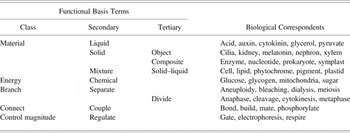
The engineering to biology thesaurus (Nagel et al., Reference Nagel, Stone and McAdams2010) was developed to enhance the reconciled functional basis compiled by Hirtz et al. (Reference Hirtz, Stone, McAdams, Szykman and Wood2002) to encourage collaboration, creation, and discovery. The structure of the thesaurus (shown in Table 1) was molded to fit the knowledge and purpose of the authors; synonyms and related concepts to the functional basis are grouped at class, secondary, and tertiary levels. It does not include an index nor does it include adjectives. Only verbs and nouns that are synonymous to terms of the functional basis are considered. The functional basis class level terms, however, do emulate the classes of a traditional thesaurus. Furthermore, the secondary and tertiary level functional basis terms emulate the categories of a traditional thesaurus. A tool such as the engineering to biology thesaurus increases the interaction between the users and the knowledge resource (Lopez-Huertas, Reference Lopez-Huertas1997) by presenting the information as a look-up table. This simple format fosters one to make associations between the engineering and biological lexicons, thus, strengthening the designer's ability to utilize biological information. The thesaurus aids in many steps of the design process and it increases the probability of a creative or innovative design. Plausible applications of the thesaurus include design inspiration, comprehension of biological information, functional modeling, creative design, and concept generation. Overall, the thesaurus provides a designer several opportunities for interfacing with biological information.
Example function and flow terminology relationships

3.3. Concept generation software: Morphological evaluation machine and interactive conceptualizer (MEMIC)
Computational concept generation is an efficient way to generate several conceptual design variants. It also adds the benefit of providing lists of engineering components that may be used to solve a particular function. MEMIC was created for use during the early stages of design to produce design solutions for an engineering design from a given functional model using knowledge of existing engineered products (Bryant et al., Reference Bryant, Bohm, McAdams and Stone2007; Bryant Arnold et al., Reference Bryant Arnold, Stone and McAdams2008). The concept generator software MEMIC accepts an input functional model and uses functionality and compatibility information stored in the Design Repository to generate, filter, and rank full concept variants. The MEMIC algorithm utilizes the relationships contained in a function–component matrix and the compatibility information contained in a design structure matrix, both of which are generated from the Design Repository contents (Bryant, Stone, et al., Reference Bryant, Stone, McAdams, Kurtoglu and Campbell2005). MEMIC returns a listing of engineering component solutions for each function–flow pair of the input functional model. This allows a designer to easily choose between multiple solutions for a given function and interactively build a complete conceptual design.
3.4. Design Repository
The Design Repository housed at Oregon State University contains descriptive product information such as functionality, component physical parameters, manufacturing processes, failure, and component compatibility of over 130 consumer products. Each consumer product was decomposed and functionally modeled using the functional basis. Each repository entry is designated as an artifact or assembly of artifacts, whether it performs a supporting function (secondary to the product's operation) and the class of the artifact when entered into the repository database. In addition, several artifact attributes are captured and stored in a relational database where each record contains an artifact name, part number, and part family that can be used to catalog similar artifacts. Information about the actual function of an artifact is captured as a subfunction value.
3.5. Organized search tool
The organized search tool was originally developed for retrieving relevant biological systems that performed functions of interest. In this research we extend the search tool to better facilitate biologically inspired design through combination with other established function-based design tools. Specifically, the organized search tool is designed to work with nonengineering subject domain specific information. The majority of nonengineering domain texts are written in natural-language format, which prompted the investigation of using both a functional basis function and flow term when searching for solutions. Realizing how the topic of the text is treated increases the extensibility of the organized verb–noun search algorithm. This organized verb–noun combination search strategy provides two levels of results: associated with verb only, of which the user can choose to utilize or ignore, and the narrowed results associated with verb–noun. This search strategy requires the designer to first form an abstraction (e.g., functional model) of the unsolved problem using the functional basis lexicon. The verbs (functions) of the abstraction are input as keywords in the organized search tool to generate a list of matches, and subsequently a list of words that occur in proximity to the searched verb in those matches. The generated list contains mostly nouns, which can be thought of as flows (materials, energies, and signals), synonymous with the correspondent words already provided in the functional basis flow set. The noun listing is then used in combination with the search verb results for a second, more detailed search to locate specific text excerpts that describe how the nonengineering domain systems perform the abstracted functionality with certain flows. The verb searches are constrained to the chosen corpus and the verb–noun searches are constrained to the extracted sentences that include the search verb.
This search strategy is embodied in an automated retrieval tool that allows an engineering designer to selectively choose which corpus or documents to search and to upload additional searchable information as it is made available. The user interface initially presents the designer with a function (verb) entry field and search options. Search options prompt the designer to choose from exact word, derivatives of the word, and partial word. Once the information is searched for the function term the designer is presented with a flow (noun) listing for each searched corpus or document followed by a group of sentences that include the function and listed flows. If the designer does not want to search by verb–noun then the designer simply scrolls down to the group of sentences, which include the desired function. For this application, the nonengineering domain chosen for examples is biology.
The designer utilizing this organized search technique does not need an extensive background in the nonengineering domain but instead needs sufficient engineering background to abstract the unsolved problem to its most basic level utilizing the functional basis lexicon. The search tool typically yields more than one biological system for potential design inspiration.
4. COMPUTATIONAL APPROACH
Automated concept generation methods promise engineers a faster realization of potential design solutions based upon previously known products and implementations. The approach described here requires the designer to input desired functionality, and based on an algorithm, several concept variants are presented to the designer. Functionality is a useful metric for defining a conceptual idea, as functional representation has been shown to reduce fixation of how a product or device would look and operate (Otto & Wood, Reference Otto and Wood2001; Pahl et al., Reference Pahl, Beitz, Feldhusen and Grote2007).
Required input to the computational approach is a functional model that abstractly represents a conceptual engineered solution. The functional model is then digitized and represented as a matrix of forward flows. Each function/flow pair of the model is then searched in the engineering and biological knowledge bases, the Design Repository and a chosen biological corpus, respectively, to identify solutions. The search algorithm parses the repository entries for the exact engineering function/flow pair, where as, the biological corpus is parsed repeatedly with the biological terms corresponding to the engineering terms per the engineering to biology thesaurus. Multiple solutions from both domains, to each function/flow pair, are returned and presented to the designer. The biological solutions are not indented for physical use, but are intended for spurring creative ideas or connections to the engineering domain that could be implemented in an engineered system that partially (i.e., one or two components) to completely (i.e., entire design) mimic a biological system.
To make a biologically inspired concept work, a leap is required from the designer to understand that component mapping is an activity that relates biological system attributes to engineered components. This computational approach assists with identifying biological solutions to engineering functions; however, to arrive at the final concept, the designer is required to identify principles, components, materials, and/or systems within the engineering domain that support what the biological solution suggests. Therefore, this approach lends itself more toward innovative design problems where novel solutions tend to dominate.
Computational concept generation provides the added advantage of limitless resources for inspiration. The technique described in this section can be extended by adding entries into the Design Repository and texts or documents into the biological corpus database. With this technique the well-known customer needs driven engineering design approach is utilized, which is an additional advantage.
4.1. Algorithm
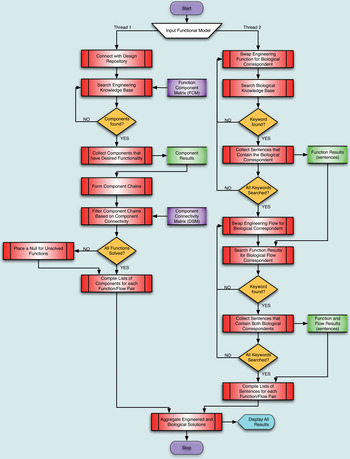
Our approach utilizes the functional basis, Design Repository, MEMIC, organized search tool and engineering to biology thesaurus to create, filter, and inspire concept variants. The algorithm combines the research efforts that developed MEMIC and the organized search tool, but also adds recursive biological text search functionality using the engineering to biology thesaurus. There are two threads in this algorithm that execute simultaneously: parse the Design Repository to find engineering solutions, and parse chosen biological corpus with thesaurus terms to find biological solutions for engineering inspiration. Figure 2 provides the algorithm flowchart.
The flowchart of the computational approach. [A color version of this figure can be viewed online at http://journals.cambridge.org/aie]

4.1.1. Thread 1: Parse Design Repository for engineering solutions
The computational approach utilizes function–component relationships established through an function–component matrix to compute a set of engineering components that solve the function/flow pairs of the input functional model. Next, the resultant set is filtered using component–component knowledge through a design structure matrix. Each match is stored for display to the user. The resultant engineering components found in the repository and are compatible are displayed to the user as a list of potential solutions that have previously solved that function/flow pair.
4.1.2. Thread 2: Parse biological corpus for biological solutions using thesaurus terms
The algorithm swaps the engineering function and flow terms for corresponding biological function and flow terms. The biological corpus is then searched for the biological function and all sentences containing the function are extracted for further processing. The algorithm then searches those sentences for any of the corresponding biological flow terms. Each match is stored for display to the user. When multiple biological function terms are present, the search is executed recursively until all corresponding biological functions have been searched. The resultant biological information is displayed to the designer as individual sentences containing the desired function/flow pairs, which are indicators of potential solutions from the biological domain.
4.2. Algorithm results
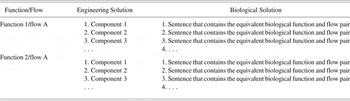
Once both threads of the algorithm have finished the results are aggregated into a table to organize the resultant information. Three columns sort function/flow pair, engineering solutions and biological solutions, while the number of rows corresponds to the number of function/flow pairs of the input functional model. Table 2 demonstrates the structure of the results. The engineered and biological solutions to the function/flow pairs are presented in an arbitrary order and the order in which they were found, respectively. Solutions between the columns are not correlated in any way, that is, engineered component 1 does not match to biological solution 1. However, it is possible for a designer to make connections between the returned lists of engineering and biological solutions.
Structure of the results

Engineering solutions are in the form of a component name, either the actual name or a component basis name (Kurtoglu et al., Reference Kurtoglu, Campbell, Bryant, Stone and McAdams2009). For example, a coffee maker has an LED that alerts the user the power is on and water level tube with a floating ball that allows the user to gage how much water to put in. Possible component names are “power light” and “water level tube,” respectively. Under the component basis naming taxonomy, both of these can be labeled as indicators. Actual names provide a context for use, although the component basis names are intentionally vague to not seed a designer's thoughts with contextual information.
Biological solutions are in the form of individual sentences that contain the function/flow pair in any order. The search terms are generally not found in consecutive order due to the natural language format of the biological information. However, when both of the desired terms fall within a sentence the meaning is denoted. Furthermore, the amount of information provided in a sentence is sufficient for a designer to judge the relevance of the information with regard to the design when reviewing tens to hundreds of sentences. Computationally speaking, parsing data as sentences and collecting the relevant sentences is quick and inexpensive.
4.3. Limitations to the computational approach
As with all computational design approaches the designer is limited by the information made available to the software. For this case, the limitations are the engineering and biological knowledge bases. Entries into the Design Repository have varied levels of detail and mostly focus on consumer products. With regard to the biological corpus, the limitation is the natural language used in the text. Although these limitations are present, both knowledge bases return useful solutions that can be implemented in design. A designer who is familiar with considering components and systems abstractly and by function will succeed even with the limitations expressed here. However, both knowledge bases can be improved. A broader range of products can be entered into the Design Repository and different biological texts can be added for searching.
5. ILLUSTRATIVE EXAMPLE
To illustrate the proposed computational concept generation technique, a smart flooring example is presented. The computational approach is utilized to search engineered and biological systems for solutions that can be implemented in the example product. When using the functional basis for product design there are a few basic steps needed before function-based concept generation can begin. First, one must define the customer needs and convert them into engineering terms (Otto & Wood, Reference Otto and Wood2001; Kurfman et al., Reference Kurfman, Stone, Rajan and Wood2003; Pahl et al., Reference Pahl, Beitz, Feldhusen and Grote2007). Second, one must develop either a conceptual functional model of the desired new product or a functional model of an existing product to be redesigned using the functional basis lexicon. Examples can be found in Bryant, McAdams, et al. (Reference Bryant, McAdams, Stone, Kurtoglu and Campbell2005), Stone and Wood (Reference Stone and Wood2000), and Nagel et al. (Reference Nagel, Stone and McAdams2007). With the functional model, the designer now has several function–flow pairs that represent the desired new product. These pairs are utilized by the computational concept generation technique to gather engineering and biological inspiration.
5.1. Problem definition
Consider the following scenario. A customer wants to create a security/surveillance product that looks like ordinary carpet, mats, rugs, and so forth, to detect intruders, a presence, or movement. Requirements for the smart flooring include detection mechanism unseen by human eye, durability, and composed of common materials and a quick detection response. In addition, the system needs to be autonomous. Meaning a signal generated can alert personnel and does not require a person to monitor the surveillance system. It is known that tagged systems require the user to carry a badge or other device to be tracked or monitored, and simply removing the traceable item can defeat the system. Radar or similar systems require calibration and an area map to be created. Each time the area layout is changed, the map needs to be updated. Video surveillance and heat signature systems can be very expensive and often require a person to watch the real-time video feed who can be unreliable. The design should offer advantages over the others listed.
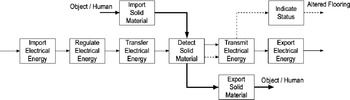
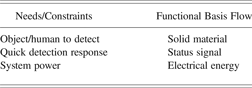
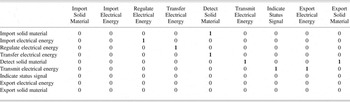
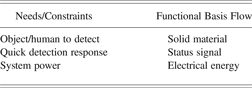
With this knowledge the customer needs are mapped to flows (Table 3) for the creation of a functional model (Fig. 3). The model of Figure 2 was created with a boundary of the flooring in place, energy is being supplied to the detection mechanism and when an object or human interacts with the flooring a signal is generated. Importation of human/object symbolizes interaction and exportation symbolizes the human/object exiting the boundary. In order to use the computational approach, an adjacency matrix representing the forward flows of the model in Figure 3 must be created. Table 4 demonstrates the adjacency matrix for the smart flooring conceptual functional model.
The smart flooring conceptual functional model.

Needs of smart flooring device mapped to flows
Smart flooring adjacency matrix

5.2. Application of computational approach
The corpus chosen as the biological knowledge base is Life, The Science of Biology by Purves et al. (Reference Purves, Sadava, Orians and Heller2001). This corpus comprises 58 chapters; however, our algorithm searches only 37 chapters. Chapters that have little relevance or provide results that are generally abstract, ambiguous, or are in the context of scientists discovering something have been left out; these chapters include the introduction chapter, chapters on evolutionary processes, evolution of diversity, ecology, and biogeography. Thus, the remaining 37 chapters on the cell, information and heredity, the biology of flowering plants, and the biology of animals serve as the biological knowledge base and offer sources of biological inspiration.
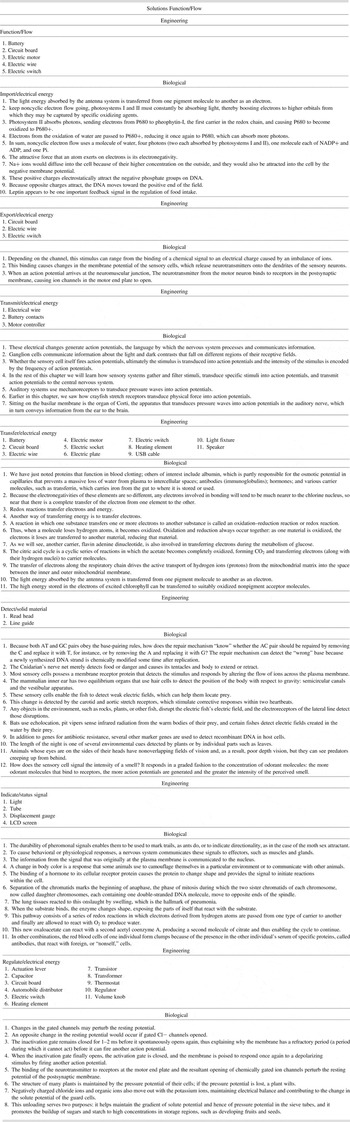
With the knowledge bases chosen the algorithm can be executed. Executing the computational approach with the adjacency matrix of Table 4 resulted in a total of 31 unique, engineering solutions and 60 unique, biological text excerpts (in the form of individual sentences) for the seven function/flow pairs. Table 5 lists the resulting engineering and biological solutions. The table format has been modified to enhance clarity of presentation. Engineered solutions that have multiple functions (e.g., circuit board, electric switch) are repeated. Although less likely, biological solutions that are associated with multiple functions will also be repeated.
Smart flooring search results

5.3. Discussion of results
The computational approach method fosters and guides the abilities of the designer and encourages objective evaluation of results. After the search algorithm has been applied the designer must synthesize concept variants from the resulting engineering and biological solutions. A designer must use good design judgment and knowledge of constraints external to the design itself (e.g., manufacturing process, materials) to determine if the solutions within the design space are feasible. Again, this computational approach assists with identifying solutions, engineered and biological, to engineering functions; however, to arrive at the final biologically inspired concept, the designer is required to make correlations to the engineering domain that support what the biological solution suggests. Several such correlations can be made with the solutions identified by the computational approach (Table 5) for the smart flooring example.
Correlations between the resulting engineering and biological solutions in Table 5 are present. For example, sensory cells (Bio Solution 3 for Transmit Electrical Energy in Table 5) are described as a biological system that encodes, sends, and receives electrical signals related to stimulus intensity, which is analogous to a motor controller (Engr Solution 3 for Transmit Electrical Energy in Table 5) that encodes, sends, and receives electrical signals related to feedback. This type of correlation is easy when there is a long list of engineering solutions. When the number of engineering solutions is low, as in the case of the function/flow pair detect solid material, the biological solutions should be correlated to analogous engineering principles, components, materials, and/or systems external to the engineering solutions identified by our computational approach. Analogies can be discovered through application of prior knowledge and experience (intuitive), or found through reference materials (directed). It is the correlations that facilitate the leap from biology to engineering for the development of a biologically inspired design.
Starting with the boundaries of the smart flooring conceptual functional model, importation and exportation of solid material did return biological solutions; however, in regard to the voluntary human/object interaction with the flooring the results are out of context. Therefore, the solutions to import and export solid material can be ignored and are not included in the results. The remaining function/flow pairs of the functional model offer insight for solutions that can be used for developing concept variants.
Considering the flow of electrical energy through the smart flooring conceptual functional model, and the respective functions that transform it, the Design Repository returned several relevant engineering solutions. Solutions of electrical wire, electrical switch, circuit board, and battery are commonplace, but offer a wide range of functionality. These engineering solutions are appropriate and have the advantage of being cost-effective components. Reviewing the biological solutions to the functions of import, regulate, transfer, transmit, and export electrical energy did not inspire engineered solutions beyond those already represented in the results. Although the biological solutions to importing, regulating, transferring, transmitting, and exporting electrical energy did not offer practical implementations, the results are interesting and informative. Essentially, what an engineer can gain from these biological solutions is that natural systems do utilize electrical energy for communication, sensing, regulating metabolism, photosynthesis, and many other processes.
Results that are more intriguing are those relevant to the function of detect. The two engineering results for detect solid material are mechanical objects that move, which goes against the design criteria for the smart flooring. Therefore, to synthesize concepts following this approach the designer must turn to the biological solutions for inspiration. Biological phenomena relevant to the function of detect are natural ways of detecting, which designers can use to formulate connections and inspire an engineered sensing solution. Of the 12 biological solutions for the engineering function detect, most of them offer inspiration and the single-sentence description demonstrates relevance to the smart flooring design problem. Relevant biological solutions are explored further to enable correlations to be discovered and adapted for use in engineered systems.
Sensory cells (Bio Solution 3 for Detect Solid Material in Table 5) that alter the flow of ions are effectively changing the electrical current flowing across the membrane. With regard to sensory cells in the nose (Bio Solution 12 for Detect Solid Material in Table 5), the flow of ions correlates to the concentration of odorant molecules. This biological system correlates well with a material's change in resistivity or conductivity when deformed. Choosing a material that when stepped on changes the flow of electrical current and can be woven into carpet is a very good candidate for this design. Considering a plant's ability to detect and measure the length of night (Bio Solution 10 for Detect Solid Material in Table 5) evokes a detection solution that relies on blocking light. Blocked light sensors distributed within the flooring would signal detection of an object; however, this could be troublesome if shadows also trigger the signal. Durability is of major concern for this design; therefore, it should be determined what detriment the light sensors can withstand. The two biological solutions referencing DNA (Bio Solutions 1, 9 for Detect Solid Material in Table 5) inspires a mechanism that detects a color change, mark, or chemical modification on the flooring, which does not fulfill the customer need of unseen to the human eye. A dye, mark, or chemical modification that can only be seen under UV light most likely will not allow automated detection. The idea of nonoverlapping fields of vision (Bio Solution 11 for Detect Solid Material in Table 5) is not helpful here as camera-based solutions have already been ruled out.
The hair cell (Bio Solution 4 for Detect Solid Material in Table 5) readily inspires a connection to engineering. Hair cells are analogous to cantilevers and would detect a presence when disturbed by deflection. The deflection from applied weight or force changes the electrical potential of the cell attached to the protruding hair or cilia, identically to the sensory cell description. Pit organs that sense heat and infrared radiation (Bio Solution 8 for Detect Solid Material in Table 5) connect with current solutions that can read heat signatures; however, objects that do not emit a wavelength in the infrared range would not be detected. Thus, this approach would not be reliable. Electroreception of fish and echolocation of bats (Bio Solutions 5, 8 for Detect Solid Material in Table 5) uses electric waves and sound waves, respectively, for detection. These natural sensing systems inspire a near-field sensing device that can detect the presence of an object when it is just above the flooring. Echolocation is analogous to radar. Radar is already used to detect objects; however, it is not a distributed system, as would be needed for a smart flooring concept. Electroreceptors of fish generate an electric field for navigation of the environment, to locate objects, which is also analogous to radar. Carotid and aortic stretch receptors (Bio Solution 6 for Detect Solid Material in Table 5) assist with the regulation of blood pressure and circulation in animals. Working against gravity, these stretch receptors keep blood regulated within the body by expanding and contracting as needed. This biological system inspires a detection mechanism that is pliable and sends a signal when deformed. After reviewing the 12 biological systems and their potential application to the smart flooring design, three inspire advantageous solutions to the function of detect. Hair cells and carotid and aortic stretch receptors offer natural tactile responses that could be exploited to achieve the customer requirements as well as the flow of ions across a sensory cell that correspond to a stimulus.
Solutions for the function/flow pair indicate status signal are a mixed set of analog and digital methods. The engineered solutions are simple and could be easily implemented for remote indication. Expelling of pheromones (Bio Solution 1 for Indicate Status Signal in Table 5) inspires an indicator that changes smell. The biological solutions involving communication of signals (Bio Solution 2, 3 for Indicate Status Signal in Table 5) correlate to the engineered solutions of LCD screen, light, and displacement gauge. Biological systems that change in color or shape (Bio Solution 4, 5, 6, 7, 8 for Indicate Status Signal in Table 5) to indicate their status are interesting, but are applicable to this design problem as analogous systems identified would go against the needs of the design problem. Some of the biological results are more informative than useful; however, in the event that the resultant engineered solutions are not useful the designer has the opportunity to become inspired by the biological solutions.
Now that the search results have been analyzed and reflected upon to get to a biologically inspired product concept, the formalized connections between the biology and engineering and the returned engineering solutions are synthesized. Functional representation enables a thorough understanding of the requirements while decreasing the tendency of designers to fixate on some particular physical solution for a problem. Therefore, this approach is form independent and relies on the designer's ability to develop a reasonable form for the concept. The computational approach results and biological inspiration are synthesized into two concept variants.
Both concept variants use wires and circuits boards to perform the functions involving electrical energy and will likely be powered by an external, low-voltage power supply. Regardless of the concept, a flexible circuitry layer and buffer layer would need to be underneath the visible flooring layer to connect the array to a processing unit and to protect the underlying circuitry, respectively. These are represented in the concept sketch closeup views as the orange layer between two black layers. Wanting to remotely monitor a space means that the solution for indicate status signal must also be remotely located to the smart flooring. For both concept variants, the LCD screen is a viable option, as the detection mechanism will produce a measurable result, which can be displayed on the LCD screen. The concept variants are centered around a biologically inspired detection mechanism; therefore, the auxiliary components (i.e., power supply and LCD screen) are not shown in the concept sketches.
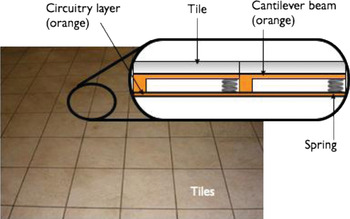
Recall that the critical need is unseen by the human eye. Considering the tactile response of the hair cell (Bio Solution 4 for Detect Solid Material) as a cantilever and flooring shaped as individual tiles, each tile could act as one cantilever to detect a load. The array of cantilever load sensors would then sense a pressure differential as a person walks across the smart flooring. A spring is added to the design to keep the tile from collapsing, while allowing the cantilever bend. A concept sketch is shown in Figure 4. Research would need to be completed to determine the cantilever material that would best respond and last in a high traffic environment.
Concept variant one for the smart flooring device. [A color version of this figure can be viewed online at http://journals.cambridge.org/aie]

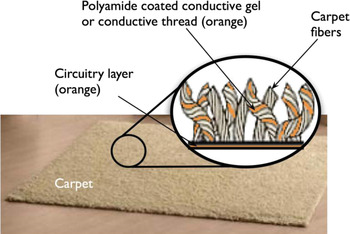
The second concept variant simultaneously exploits the tactile response of the hair cell (Bio Solution 4 for Detect Solid Material) and the carotid and aortic stretch receptors cell (Bio Solution 6 for Detect Solid Material) and the change in electric potential from the sensory cells cell (Bio Solution 3 for Detect Solid Material). Hair cells are vertical structures, while stretch receptors are found in multiple orientations. Taking inspiration from the hair cell and stretch receptor morphology leads to a detector design that comprises a vertical structure that can be stretched in multiple orientations, offering flexibility and ruggedness for repeated deflection. This detector design would not be a good choice for hard tiles, but could work for woven flooring such as carpet. Taking inspiration from the sensory cells, flexion of the carpet fibers would result in a change of resistivity, similar to a strain gage, or generate a voltage by the principle of piezoelectricity. Polyamide is a high-performance synthetic polymer and is commonly used in textiles. Fabricating polyamide tubes with a conductive gel or paste that can be woven into carpet to form an array would achieve the biologically inspired design. Materials research would need to be completed to determine if the polyamide and conductive gel or paste would last in a high traffic environment. Alternatively, conductive thread, another detector solution that can be stretched in multiple orientations, could easily be woven into carpet and offer a change of resistivity. Conductive thread exists and is used in garments and accessories that merge technology into clothing. Materials research would need to be completed to determine if the conductive thread would provide a significant change in resistively or conductivity once woven into a carpet. A concept sketch is shown in Figure 5. Shaded strands in the closeup view of the carpet fibers in Figure 5 represent durable feedback elements woven into the carpet, providing hidden sensing capabilities.
Concept variant two for the smart flooring device. [A color version of this figure can be viewed online at http://journals.cambridge.org/aie]

Looking to literature for a similar surveillance device uncovered a handful of attempts to create a “smart” floor or flooring. The first concept described above, individual tiles that detect a load placed in an array as shown in Figure 4, has been done. Richardson et al. (Reference Richardson, Leydon, Fernström and Paradiso2004) have developed hexagonal, puzzle-like pieces called nodes that are placed in an array to detect pressure. Their tiles contain force sensitive resistors and interlock to form a self-organizing network that passes data to the tile with an external data connection. An earlier approach to the smart floor involved only one measuring tile made of load cells, a steel plate, and data acquisition hardware, and was not intended to be hidden (Orr & Abowd, Reference Orr and Abowd2000). Rather, it was created as an alternative to biometric identification by recognizing a person's unique footstep profile. Two other approaches that utilize load cells and layered flooring to conceal the sensors are nearly identical to the first concept variant. Liau et al. (Reference Liau, Wu and Fu2008) place a sensor in the center of every 60 × 60 cm wood-covered tile, where Addlesee et al. (Reference Addlesee, Jones, Livesey and Samaria1997) place a sensor at each intersection of four carpet covered tiles. Load cells are similar in principle to cantilever beams in that deflection is transduced into an electrical signal that can be interpreted. A literature review reveals that the first biologically inspired concept (Fig. 4) is feasible and has been attempted.
Investigating the second concept variant for smart flooring shown in Figure 5 revealed only one existing design that is similar. Researchers at Infineon Technologies have woven conductive fibers into carpet and attached them to tiny sensor modules inlaid in the fabric to build a mesh network (Institution of Electrical Engineers, 2003). The flooring can report where a person is located, which way they are moving, and if a sensor module has failed. Each conductor in the design is a copper wire coated with silver to prevent corrosion and then covered with polyester (Institution of Electrical Engineers, 2003). A German textile company, Vorwerk, has teamed up with Infineon to develop and market the smart carpet (Vorwerk & Co., 2004; Crane, Reference Crane2005). The Vorwerk/Infineon product is similar in structure to the second concept variant in that a conductor is concealed and woven into a textile product. In this design the conductor is copper where as in the second concept variant the conductor was proposed to be a gel or thread that mimics the flexibility of carotid and aortic stretch receptors. Both suggest a protective coating for the conductor. A literature review revealed that the second biologically inspired concept (Fig. 5) is feasible.
6. CONCLUSIONS AND FUTURE WORK
Concept generation and synthesis is perhaps the most exciting, important, and challenging step of engineering design. This research makes fundamental contributions to engineering design through the creation of a computational approach that identifies biological solutions based on engineering function. The key contributions of this research extend beyond computational design practices and biological information retrieval. Our design tool represents a first step toward enabling widespread biologically inspired concept generation, and subsequently, biologically inspired design. In addition, this research will enable engineers knowledgeable of customer needs driven design activities, but a limited biological background, to begin biomimetic design activities. Mimicking nature offers more than just the observable aspects that conjure up engineering solutions performing similar functions, but also less obvious strategic and sustainable aspects. It is these less obvious aspects that this research aims to facilitate as they hold the greatest potential for impact.
The computational approach to biologically inspired design assists with developing biomimetic designs by presenting the designer with short descriptions of biological systems that perform an engineering function of interest. From these descriptions the designer can make connections, similar to the process of Synectics (Prince, Reference Prince1967, Reference Prince1970) that correlate the biological solutions to engineering solutions, principles, components, systems, and materials. A key part of the connection making process is considering the biological systems from several viewpoints. Multiple viewpoints can spur novel and innovative ideas (Prince, Reference Prince1970). Integrating a strategic search method for indexing nonengineering information with an established computational concept generation method affords a computational foundation for accessing stored engineering information and, in this case, biological solutions for use with design activities. By placing the focus on function during concept generation, rather than form or component, the computational approach presented here has shown to successfully extract relevant biological solutions. Example results from the proposed technique were demonstrated with a smart flooring example.
The illustrative smart flooring example demonstrates that it is possible to use a computational approach to identify biological inspiration for engineering design. Biological solutions corresponding to the function/flow pairs of the conceptual functional model for designing smart flooring as a potential security/surveillance device were discussed. The connections between the biological solutions and engineering domain for detect were analyzed. For the smart flooring example, the biological systems of the hair cell, action potentials of sensory cells, and carotid and aortic stretch receptors offered strong connections to the engineering domain, which were used as inspiration to synthesize two concept variants. The other functions yielded informative results of how natural and engineered systems utilize electrical energy. Validation of the concepts occurred through a literature review. Existing systems that were very similar to both concept variants were found. Therefore, both concept variants are considered feasible. Our computational approach provides targeted results and prompts designers to make correlations across domains, which result in creative solutions.
Through the incorporation of the engineering to biology thesaurus in this algorithm, a 33% increase of relevant biological solutions for the function of detect resulted when compared to prior organized search tool results in Stroble et al. (Reference Stroble, Stone, McAdams and Watkins2009). It should also be noted that the 21 nonrelevant, biological results in Stroble et al. (Reference Stroble, Stone, McAdams and Watkins2009) were ignored with this computational approach. Therefore, this approach is further validated at successfully extracting specific biological solutions that perform the functions/flow pairs of a conceptual functional model.
The biological domain provides many opportunities for identifying connections between what is found in the natural world and engineered systems. It is important to understand that the computational approach does not generate complete concepts; that is, the task of the designer. However, it does provide a systematic method for discovering biological inspiration based on function, so that it may be easier for the designer to make the necessary correlations leading to biologically inspired designs.
Future work includes the addition of hyperlinks to detailed biological information, integration of images into the results, and implementation of search heuristics. Visuals can stimulate designers in a different manner than text alone. Search heuristics could be applied to input functional models to reduce the number of function/flow pairs that are searched by this approach, which would further reduce the necessary time and effort to find relevant biological inspiration. Another avenue for this research is engineering education. The computational approach could be used to assist engineering students with discovering the connections between the biology and engineering domains.
ACKNOWLEDGMENTS
This material is partly based on work supported by the National Science Foundation under Grant CMMI-0968410. Any opinions, findings, and conclusions or recommendations expressed in this material are those of the authors and do not necessarily reflect the views of the National Science Foundation.
Jacquelyn K. S. Nagel is currently an Assistant Professor in the School of Engineering at James Madison University. She worked as an engineering contractor at Mission Critical Technologies prior to James Madison University. Jacquelyn obtained her PhD in mechanical engineering from Oregon State University researching biologically inspired design. Jacquelyn earned her MS and BS in manufacturing engineering and electrical engineering, respectively, from the University of Missouri–Rolla (now known as Missouri University of Science and Technology). Her research interests include sensor technology, biomimicry, engineering design, optics/photonics, applied control theory, robotics, and automation.
Robert B. Stone is a Professor and the Interim Head of the School of Mechanical, Industrial, and Manufacturing Engineering at Oregon State University. He was a Distinguished Visiting Professor in the Department of Engineering Mechanics at the US Air Force Academy from 2006 to 2007. He attained his PhD from the University of Texas at Austin. Prior to initiating his graduate work, Dr. Stone worked in the Missions Operation Directorate of NASA Johnson Space Center as a Space Shuttle Flight Controller for the Guidance, Navigation, and Control Section. Rob has received numerous awards for his research in product design.