Exposure to chronic stress and adversity, especially early in life, has been convincingly shown to augment risks for physical and mental health problems, not only in childhood, but also across the human life span (Hertzman & Boyce, Reference Hertzman and Boyce2010; McEwen, Reference McEwen1998; Obradović, Reference Obradović2012; Taylor, Lerner, Sage, Lehman, & Seeman, Reference Taylor, Lerner, Sage, Lehman and Seeman2004). A primary pathway through which adversity exerts this influence is via changes in stress-responsive biological systems, especially the sympathetic and parasympathetic branches of the autonomic nervous system (ANS), the hypothalamic–pituitary–adrenal (HPA) axis, and their target tissues (Berntson, Cacioppo, & Quigley, Reference Berntson, Cacioppo and Quigley1993; Cicchetti & Rogosch, Reference Cicchetti and Rogosch2012; Porges, Reference Porges2007; Sapolsky, Romero, & Munck, Reference Sapolsky, Romero and Munck2000).
Stress-induced neurobiological responses in these channels have evolved to guide adaptive and essential responses to environmental challenge, and an impressive body of research has elaborately delineated the processes underlying these responses (De Kloet, Fitzsimons, Datson, Meijer, & Vreugdenhil, Reference De Kloet, Fitzsimons, Datson, Meijer and Vreugdenhil2009; Gunnar, Wewerka, Frenn, Long, & Griggs, Reference Gunnar, Wewerka, Frenn, Long and Griggs2009; Porges, Reference Porges2007). Within seconds of stressor onset, for instance, activation of the sympathetic nervous system (SNS) readies the organism for action by producing a broad array of catecholamine-mediated fight or flight responses, inducing functional changes in target organs (Cacioppo et al., Reference Cacioppo, Berntson, Malarkey, Kiecolt-Glaser, Sheridan and Poehlmann1998). Concomitant withdrawal or deactivation of parasympathetic neurotransmitter signaling can amplify SNS responses, or activation of the parasympathetic nervous system (PNS) can serve as a “brake” on the sympathetic effects, restoring homeostatic control of end-organ function and counterregulating excitation (Porges, Reference Porges2007). The HPA axis is also activated, though with a range of slower, transcription-mediated neuroendocrine effects, which can lead to both suppressive and excitatory influences that further allow the organism to adapt to and recover following stress exposure (Sapolsky et al., Reference Sapolsky, Romero and Munck2000).
In contrast, heightened or prolonged responses, including activation of either the SNS or the HPA axis, as well as prolonged deactivation of the PNS, can confer increased risk for a range of physical and mental health morbidities (e.g., Essex, Boyce, et al., Reference Essex, Boyce, Goldstein, Armstrong, Kraemer and Kupfer2002; Taylor et al., Reference Taylor, Lerner, Sage, Lehman and Seeman2004). These risks have been identified across the life span, but they are believed to be profoundly influenced by heightened responses that began in early childhood, when the systems were still developing and becoming calibrated to environmental demands (Alkon, Boyce, Davis, & Eskenazi, Reference Alkon, Boyce, Davis and Eskenazi2011; Miller et al., Reference Miller, Chen, Fok, Walker, Lim and Nicholls2009). A large body of work has revealed associations between dysregulated reactivity of the ANS and HPA axis and a host of negative outcomes (e.g., Beauchaine, Neuhaus, Brenner, & Gatzke-Kopp, Reference Beauchaine, Neuhaus, Brenner and Gatzke-Kopp2010; Boyce et al., Reference Boyce, Quas, Alkon, Smider, Essex and Kupfer2001; El-Sheikh, Erath, Buckhalt, Granger, & Mize, Reference El-Sheikh, Erath, Buckhalt, Granger and Mize2008; Obradović, Bush, & Boyce, Reference Obradović, Bush and Boyce2011). However, a majority of this work, particularly in children, has focused on one or two stress-responsive systems and has rarely taken into account the complex nature of coordination across multiple systems. This research has also not considered how different facets of this coordination may increase risk for negative health consequences (for a discussion of this issue, see Beauchaine, Reference Beauchaine2009). The purpose of the current research was to comprehensively investigate patterns of physiological arousal and reactivity across systems and development, and thus lay the foundation for continued research on the varied ways in which stress-responsive systems are coordinated and how this coordination may relate to subsequent health morbidities.
We are certainly not the first to propose cross-system coordination of stress responses. Several theoretical accounts have eloquently described different ways in which multiple physiological systems interact when exposed to stress and challenge. McEwen and colleagues (e.g., McEwen, Reference McEwen2006; McEwen & Gianaros, Reference McEwen and Gianaros2010; McEwen & Stellar, Reference McEwen and Stellar1993) proposed the construct of allostatic load as a measurable biological cost of chronic, multisystem efforts to maintain homeostatic balance under conditions of chronic stress. Sapolsky et al. (Reference Sapolsky, Romero and Munck2000) discussed the combined and closely cooperative functions of stress reactivity systems, pointing out complementarity in the timing and duration of responses, the systems’ cross-regulatory functions at peripheral and central levels, and the systems’ separable and balanced effects on target organs.
Other models have suggested multiple ways in which the systems are coordinated, with some types of coordination likely conferring subsequent risk. Berntson et al. (Reference Berntson, Cacioppo and Quigley1993), for example, developed a two-dimensional model of autonomic space, whereby different combinations of activation and deactivation of the sympathetic and parasympathetic systems to challenge lead to several patterns of responses.Footnote 1 The most well-studied patterns include two that are complimentary: coactivation (sympathetic activation combined with parasympathetic activation) and coinhibition (parasympathetic deactivation combined with sympathetic deactivation); and two that are opposing: reciprocal sympathetic activation (heightened arousal, induced by sympathetic activation combined with parasympathetic deactivation) and reciprocal parasympathetic activation (low arousal, induced by parasympathetic activation combined with sympathetic deactivation). Bauer, Quas, and Boyce (Reference Bauer, Quas and Boyce2002) similarly argued for the existence of a two-dimensional model, but they identified the sympathetic system and HPA axis as key contributors, particularly in relation to stress regulation in childhood. Specifically, building on Sapolsky et al.'s (Reference Sapolsky, Romero and Munck2000) detailed description of the HPA axis's ability to exert inhibitory pressure on stress-induced SNS responses, Bauer et al. argued that cross-system response tendencies can be reciprocal or opposing. Reciprocity following stress exposure, as reflected in high HPA axis activity serving as a regulatory check on high SNS activation, indicates well-coordinated biological response tendencies, whereas activation of one system without the other, that is, opposing responses, indicates dysregulation or poor coordination.
Empirical research testing these theoretical models has taken one of several methodological approaches (Alkon et al., Reference Alkon, Goldstein, Smider, Essex, Kupfer and Boyce2003; Gordis, Granger, Susman, & Trickett, Reference Gordis, Granger, Susman and Trickett2006; Salomon, Matthews, & Allen, Reference Salomon, Matthews and Allen2000). In developmental studies, for example, children have often been assigned to groups according to median splits or cross-products on measures of sympathetic (e.g., preejection period [PEP], blood pressure, or alpha amylase) and parasympathetic (e.g., respiratory sinus arrhythmia or vagal tone) reactivity or HPA axis (e.g., salivary cortisol levels) reactivity to laboratory stressors (Gordis, Feres, Olezeski, Rabkin, & Trickett, Reference Gordis, Feres, Olezeski, Rabkin and Trickett2010; Kroenke et al., Reference Kroenke, Epel, Adler, Bush, Obradović and Lin2011). Groups have then been compared across various predictors or outcomes. With such an approach, Salomon et al. (Reference Salomon, Matthews and Allen2000) found that youth, ages 7–8 through midteens, classified as co-inhibitors according to Berntson et al.'s SNS–PNS model, tended to come from families with higher levels of conflict and hostility than did youth classified as co-activators. Somewhat different results were reported by El Sheikh et al. (Reference El-Sheikh, Kouros, Erath, Cummings, Keller and Staton2009), who found that, in later childhood (i.e., ages 8–10 years), co-inhibitors and co-activators were at greater risk for behavior problems following exposure to family conflict than were reciprocal sympathetic or parasympathetic co-activators.
Studies testing Bauer et al.'s (Reference Bauer, Quas and Boyce2002) model of cross-system response tendencies have typically relied on cross-products between SNS and HPA axis markers of reactivity (Gordis, Granger, Susman, & Trickett, Reference Gordis, Granger, Susman and Trickett2008; Kroenke et al., Reference Kroenke, Epel, Adler, Bush, Obradović and Lin2011; Lisonbee, Pendry, Mize, & Gwynn, Reference Lisonbee, Pendry, Mize and Gwynn2010). Again, the findings vary: Gordis et al. (Reference Gordis, Granger, Susman and Trickett2006) found that reciprocal HPA axis–SNS responses to a laboratory stressor, as reflected in high levels of salivary cortisol (an index of HPA axis activation) and low salivary alpha amylase (an index of SNS activation) relative to baseline markers of both responses, were associated with low levels of aggressive tendencies in 11- to 13-year-olds, while concurrently low levels of cortisol and salivary alpha amylase to the same stressor were associated with high aggressive tendencies. Hastings et al. (Reference Hastings, Shirtcliff, Klimes-Dougan, Allison, Derose and Kendziora2011) found somewhat similar results in 11-year-olds who completed a surprise speech task in the laboratory while samples of cortisol and peripheral markers of autonomic arousal (heart rate and blood pressure) were collected. High cortisol and blood pressure predicted lower concurrent internalizing problems, while high cortisol and low blood pressure predicted higher internalizing symptoms (a similar interaction was observed for externalizing symptoms between cortisol and heart rate). However, when behavioral problems were examined 2 years later, for girls, concurrently high cortisol and heart rate now predicted larger increases in internalizing symptoms, whereas for boys, reciprocal patterns of low cortisol and high heart rate predicted larger increases in such symptoms. Finally, Koss et al. (Reference Koss, George, Cummings, Davies, El-Sheikh and Cicchetti2013) compared physiological response and behavior problems in 7- to 9-year-olds who had been exposed to varying level of family conflict. Results again diverged. Children who exhibited high SNS responses followed by low HPA axis responses were at greatest risk for behavior problems (relative to children who exhibited low SNS responses, or high SNS and high HPA axis responses), but only when they came from families with parents reporting high levels of marital conflict. When parents reported low levels of conflict, children with high SNS and high HPA axis responses were at greatest risk for behavior problems.
Despite inconsistencies in specific findings, the results to date nonetheless highlight that (a) different individuals exhibit varying patterns of reactivity across several stress-responsive physiological systems, and (b) these patterns may be functionally linked to specific phenotypic behavioral outcomes. To understand these potential links better though, several critical issues need to be addressed. First, there is the need to consider not only reactivity to stress but also basal levels of arousal within and across systems. Like reactivity, baseline arousal also varies substantially between individuals and has implications for physical and mental health morbidities (Bruce, Fisher, Pears, & Levine, Reference Bruce, Fisher, Pears and Levine2009; Calkins, Reference Calkins1997; Essex, Klein, Cho, & Kalin, Reference Essex, Klein, Cho and Kalin2002; Hinnant & El-Sheikh, Reference Hinnant and El-Sheikh2009). Second, and perhaps more critical, is the need to expand models of cross-system coordination to consider more than two biological components or axes. Both branches of the ANS, as well as the HPA axis, contribute to regulatory functions following stress exposure (Cannon, Reference Cannon1932; Sapolsky et al., Reference Sapolsky, Romero and Munck2000), suggesting that optimal response measurements would involve concurrent examination of these systems. Any such examination should ideally include markers central to the systems’ responses themselves rather than only markers considered peripheral indices of autonomic arousal (e.g., heart rate and blood pressure) that can be affected by factors unrelated to stress (Faes, De Neeling, Kingma, TenVoorde, & Karemaker, Reference Faes, De Neeling, Kingma, TenVoorde and Karemaker1995; Gellman et al., Reference Gellman, Spitzer, Ironson, Llabre, Saab and Pasin1990). Third, another issue, which has been virtually ignored in extant empirical research, concerns how cross-system response tendencies are shaped by developmental processes. The role that development plays has implications not only for conceptualizations of patterns of reactivity but also for understanding how and when cross-system patterns of responses confer increased or decreased risk (Alkon et al., Reference Alkon, Boyce, Davis and Eskenazi2011; Loman & Gunnar, Reference Loman and Gunnar2010; Lupien, McEwen, Gunnar, & Heim, Reference Lupien, McEwen, Gunnar and Heim2009).
More specifically, with regard to the need for attending to basal levels of arousal, relatively few multisystem investigations of physiological responses have included baseline measures in their analytic approach. Ignoring baseline levels of arousal may be appropriate when studying adults in laboratory settings, who have typically been given ample time (e.g., 30 min) to achieve comparable levels of relaxation and hence baseline states of arousal. However, such approaches are neither appropriate nor feasible in children, given that their baseline levels of arousal, even during well-controlled laboratory relaxation activities, vary considerably (Alkon et al., Reference Alkon, Boyce, Davis and Eskenazi2011; Essex, Klein, et al., Reference Essex, Klein, Cho and Kalin2002). Some studies have adjusted for individual differences in basal arousal, for instance, by calculating adjusted difference scores or by computing area under the curve (Harkness, Stewart, & Wynne-Edwards, Reference Harkness, Stewart and Wynne-Edwards2011; Quas, Murowchick, Bensadoun, & Boyce, Reference Quas, Murowchick, Bensadoun and Boyce2002). However, such statistical approaches fail to address the possibility, which has been substantiated by numerous studies, that basal levels of arousal per se are linked to prior experiences and are predictive of subsequent health (e.g., El Sheikh et al., Reference El-Sheikh, Kouros, Erath, Cummings, Keller and Staton2009; Lupien, King, Meaney, & McEwen, Reference Lupien, King, Meaney and McEwen2001; Quevedo, Johnson, Loman, LaFavor, & Gunnar, Reference Quevedo, Johnson, Loman, LaFavor and Gunnar2012; Tarullo & Gunnar, Reference Tarullo and Gunnar2006). A few investigations have relied on multilevel modeling procedures in their analyses that take into account children's baseline arousal and hence adjust for initial conditions (e.g., El-Sheikh, Keller, & Erath, Reference El-Sheikh, Keller and Erath2007; Quas, Yim, Edelstein, Cahill, & Rush, Reference Quas, Yim, Edelstein, Cahill and Rush2011; Shirtcliff & Essex, Reference Shirtcliff and Essex2008). However, these studies have not incorporated, in a complex manner, multiple systems’ response tendencies concurrently. Given that an individual's baseline levels of arousal can directly affect the absolute level of reactivity that the individual can achieve (Berntson, Uchino, & Cacioppo, Reference Berntson, Uchino and Cacioppo1994; Lovallo, Reference Lovallo1975; Wilder, Reference Wilder1958) and given that baseline levels of arousal have direct implications for subsequent risk, basal arousal needs to be considered when children's cross-system functioning is examined (Burt & Obradović, Reference Burt and Obradović2012).
For the issue of multisystem models, none of the theoretical models that argue for the existence and importance of cross-system patterns of physiological stress response have elaborated on how more than two biological systems operate in conjunction with one another. Berntson, Cacioppo, Quigley, and Fabro (Reference Berntson, Cacioppo, Quigley and Fabro1994), for example, did not consider the role of HPA axis activation, directly or in coordination with autonomic indices, despite the importance of HPA arousal and reactivity in moderating activation of other stress-responsive systems and predicting morbidities (Gunnar, Tout, de Haan, Pierce, & Stanbury, Reference Gunnar, Tout, de Haan, Pierce and Stanbury1997; Heim & Nemeroff, Reference Heim and Nemeroff1999; McEwen, Reference McEwen1998; Sapolsky et al., Reference Sapolsky, Romero and Munck2000; Torpy & Chrousos, Reference Torpy and Chrousos1996). Likewise, Bauer et al. (Reference Bauer, Quas and Boyce2002) did not take into account the regulatory function of the parasympathetic system, which may be critical in abating responses driven by sympathetic activation for some children, but for others may augment the already heightened levels of reactivity in other systems (Beauchaine, Reference Beauchaine2009; Davies, Sturge-Apple, Cicchetti, Manning, & Zale, Reference Davies, Sturge-Apple, Cicchetti, Manning and Zale2009).
Recently, Del Giudice, Ellis, and Shirtcliff (Reference Del Giudice, Ellis and Shirtcliff2011) described an adaptive calibration model, in which they theorize how different constellations of early childhood experiences may give rise to varying patterns of baseline arousal and stress-induced activation of the HPA axis, as well as both branches of the ANS. The researchers argue for four primary patterns of response tendencies: children labeled as “sensitive” exhibit moderate to high sympathetic and HPA axis responses at baseline and following stress exposure and concurrently high parasympathetic activation. In terms of childhood experiences, sensitive children theoretically come from safe family environments and have warm family relationships. Children in a second group, termed “buffered,” are believed to have been exposed to moderate environmental stress, with their physiological responses reflected in moderate levels of arousal and reactivity across the sympathetic and parasympathetic branches of the ANS and the HPA axis. A third typology, “vigilant,” is characterized by children exhibiting parasympathetic deactivation and sympathetic and HPA axis activation to challenge, a pattern that likely results from exposure to chronically stressful environments requiring children to be constantly prepared for action or coping. Fourth, an “unemotional” pattern, indicated by low reactivity, particularly of the sympathetic system and HPA axis, results from extreme stress exposure or low empathy and emotional responsiveness, especially in males.
In a preliminary test of their model, the researchers examined patterns of stress reactivity across the two branches of the ANS, at baseline and following completion of a laboratory stressor, in 8- to 10-year-olds (Del Giudice, Benjamin Hinnant, Ellis, & El-Sheikh, Reference Del Giudice, Benjamin Hinnant, Ellis and El-Sheikh2012). Although only two systems were considered, some evidence suggestive of the patterns emerged. The largest number of children was classified as buffered, and smaller numbers were classified as sensitive, unemotional, and vigilant. Higher levels of family stress were evident in the unemotional and vigilant groups, as would be expected. However, more frequent negative family interactions were also common in the sensitive group. This was unexpected. Although these preliminary findings are intriguing, HPA axis activation was not considered concurrently, limiting inferences that can be drawn about cross-system coordination or the overall model itself. Moreover, Del Giudice et al.'s (Reference Del Giudice, Ellis and Shirtcliff2011) model only minimally distinguishes sympathetic and HPA axis reactivity, despite markedly different functions and response times across these systems. Nuanced variations between them may be critical in relation to prior experience and subsequent risk.
A final important limitation to existing models and empirical work on cross-system responsivity concerns the lack of direct consideration of developmental changes. This is not to say that models fail to acknowledge that development may be important. Several models directly suggest that early stress exposure alters how neurobiological stress-responsive pathways are established and calibrates physiological systems’ response tendencies to specific environmental input (Boyce & Ellis, Reference Boyce and Ellis2005; Del Giudice et al., Reference Del Giudice, Benjamin Hinnant, Ellis and El-Sheikh2012; Evans & Kim, Reference Evans and Kim2007; Gunnar & Herrera, Reference Gunnar and Herrera2013). These suggestions have been supported by an extensive body of work revealing links between early stress exposure and later physiological reactivity (Gunnar & Quevedo, Reference Gunnar and Quevedo2007; Loman & Gunnar, Reference Loman and Gunnar2010; Rogosch, Dackis, & Cicchetti, Reference Rogosch, Dackis and Cicchetti2011), with early chronic stress exposure, particularly before ages 5 or 6 years, being linked to dysregulation in baseline arousal and reactivity of the ANS and HPA, at least when individual systems have been studied. With regard to cross-system coordination, it may not be until after this early developmental period of heightened sensitivity to environmental conditions, for instance, by middle childhood, that integrated patterns of responses across systems emerge (e.g., Del Giudice et al., Reference Del Giudice, Benjamin Hinnant, Ellis and El-Sheikh2012). If these integrated patterns of responses emerge in middle childhood, particularly in response to exposure to normative, perhaps relatively mild, environmental stress, the patterns may well reflect a high degree of coordination, or perhaps symmetry as described by Bauer et al. (Reference Bauer, Quas and Boyce2002) or sensitivity as described by Del Giudice et al. (Reference Del Giudice, Ellis and Shirtcliff2011). Moreover, the patterns may then undergo little further developmental variation, at least in the absence of dramatic changes in environmental input.
By contrast, in light of substantial reorganization of neurological and biological stress responses across the pubertal transition (Dahl & Gunnar, Reference Dahl and Gunnar2009; Forbes & Dahl, Reference Forbes and Dahl2010), cross-system coordination may be relatively unstable until after puberty onset. Extant studies of multiple systems’ responses to date have either not directly examined developmental changes in how the systems operate in conjunction with one another or focused on a restricted age range, usually in middle to late childhood, precluding insight into the stability, or lack thereof, in patterns of ANS and HPA axis responses across development.
In order to ascertain the ways in which physiological systems are coordinated in response to stress exposure, a comprehensive, empirical investigation of basal arousal and reactivity across both branches of the ANS and the HPA axis is needed. Such an investigation must include children spanning a wide age range to evaluate whether patterns emerge consistently across development. Finally, the investigation needs to be broadly exploratory in order to capture unique interactive patterns of responses, potentially reflective of both adaptive and maladaptive forms of responding to environmental conditions.
The present study constitutes such an investigation. We examined arousal and reactivity of the ANS and the HPA axis in four separate samples of children, ranging in age from 4 to 14 years. We tested whether reliable subgroups existed within each sample that exhibited unique patterns of responses, whether those subgroups were similar across samples, and whether the subgroups differed across development, at least across childhood up to the beginning of the pubertal transition. We further examined whether family adversity variables predicted subgroup membership in meaningful ways.
In each sample, children completed standardized, stress-inducing laboratory assessment tasks while measures of autonomic and adrenocortical responses were collected. Measures included PEP, an index of sympathetic influence on the cardiac cycle (Cacioppo, Uchino, & Berntson, Reference Cacioppo, Uchino and Berntson1994); respiratory sinus arrhythmia (RSA), a measure of parasympathetic regulation of cardiac chronotropy (Cacioppo et al., Reference Cacioppo, Uchino and Berntson1994; Porges, Reference Porges2007); heart rate (HR), an integrated signal reflecting multiple components of cardiac activity; and salivary cortisol, an indicator of HPA axis activation (Kirschbaum & Hellhammer, Reference Kirschbaum and Hellhammer1994). Across the studies, the precise laboratory stress tasks that children completed varied, but the same autonomic and HPA axis measures were collected, which enabled us to subject each sample's data to comparable analyses and identify subgroups. If the groups overlapped substantially, findings would suggest important regularities in responses that may have implications for children's mental health and adaptation.
Because such an investigation has never been conducted before, we were wary of advancing strong predictions about the anticipated subgroups. Nonetheless, on theoretical grounds, we generated several tentative hypotheses. First, insofar as the normative experience for a majority of children growing up in Western society (i.e., the children in our samples) does not include extreme stress exposure, we expected a large group of children to exhibit moderate levels of both arousal and reactivity, consistent with models of biological sensitivity to environmental demands (Boyce & Ellis, Reference Boyce and Ellis2005; Del Giudice et al., Reference Del Giudice, Ellis and Shirtcliff2011). Second, given reciprocal feedback loops among the stress-responsive systems and their components (Sapolsky et al., Reference Sapolsky, Romero and Munck2000), we anticipated that a subset of children would exhibit a pattern suggestive of coordinated reciprocity: moderate to high levels of activation of the SNS, paired with countervailing activation of the HPA axis as well as heightened activation (i.e., regulation) of the PNS (Bauer et al., Reference Bauer, Quas and Boyce2002; Boyce & Ellis, Reference Boyce and Ellis2005; Gordis et al., Reference Gordis, Granger, Susman and Trickett2008). Third, a small set of children, it was hypothesized, would exhibit heightened reactivity across all systems (i.e., high activation of the SNS and the HPA axis, and high deactivation of the PNS), a pattern suggested by studies in which reactivity in multiple systems have each independently been linked to early childhood stress and suggested by Del Giudice et al. (Reference Del Giudice, Ellis and Shirtcliff2011) among children exposed to chronic threats in their environment. Fourth, as has been noted in some studies of physiological responses in maltreated and other high-risk samples, a pattern of underarousal, in both baseline and reactivity, was anticipated in a subset of children (El-Sheikh et al., Reference El-Sheikh, Erath, Buckhalt, Granger and Mize2008; Raine, Reference Raine2002; Shirtcliff, Granger, Booth, & Johnson, Reference Shirtcliff, Granger, Booth and Johnson2005). Fifth, beyond our heuristic group expectations, we explored whether age differences emerged in the proportion of children in the different cohorts, speculating that perhaps a larger proportion of older children and adolescents relative to younger children would show reciprocal patterns of reactivity, given potential age differences in cross-system coordination.
Method
Peers and Wellness Study (PAWS)
Participants
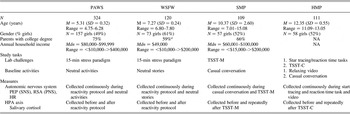
A total of 324 4- to 6-year-olds involved in a longitudinal study of family social status, biological responses to adversity, and health served as participants (Obradović et al., Reference Obradović, Bush and Boyce2011). Children were recruited from kindergarten classrooms in public schools in an urban area in Northern California. Ethnicity varied (19% African American, 11% Asian, 43% European/White, 4% Latino, 22% multiethnic, and 2% other). All parents provided written consent to participate (additional demographic details are located in Table 1).
Sample characteristics for each of the cohorts

Note: The stress paradigm included a brief social interview, the digit span, a sensation test, and watching emotional videos (Boyce et al., Reference Boyce, Quas, Alkon, Smider, Essex and Kupfer2001; Quas et al., 2004). PAWS, Peers and Wellness Study; WSFW, Wisconsin Study of Families and Work; SMP, Stress and Memory Project; HMP, Hearts and Minds Project; TSST, Trier Social Stress Test (Kirschbaum et al., Reference Kirschbaum, Pirke and Hellhammer1993); SNS, sympathetic nervous system; PEP, preejection period; RSA, respiratory sinus arrhythmia; HR heart rate; HPA, hypothalamic–pituitary–adrenal. The TSST-M (Yim et al., Reference Yim, Quas, Cahill and Hayakawa2010) required children give a speech about themselves and complete mental arithmetic. The TSST-C (Buske-Kirschbaum et al., Reference Buske-Kirschbaum, Jobst, Psych, Wustmans, Kirschbaum and Rauh1997) required children answer questions about a story and complete a mental arithmetic.
a For WSFW, the percentage corresponds to mothers.
Procedures and measures
Testing times were scheduled at children's schools in the afternoons to control for diurnal changes in circulating cortisol. The stress paradigm, a reactivity protocol, was administered in the fall, after children were settled into their school year. The protocol began with children being introduced to the research assistant (RA) and equipment, the latter of which consisted of electrodes connected to an impedance cardiography system (Biopac MP150) to collect continuous autonomic data. Once these were placed on the child and he/she had adjusted to the equipment and the RA, an initial saliva sample was collected. Next, the child individually completed a standardized reactivity protocol (Boyce et al., Reference Boyce, Quas, Alkon, Smider, Essex and Kupfer2001), composed of four age-appropriate, ecologically valid challenges. These included a social task, which contained questions about the child's likes and dislikes; a cognitive task, which required the child to repeat digits read by the RA; a sensory task, for which the child tasted an unfamiliar substance; and an emotional task, which involved the child watching emotionally evocative video clips (the protocol's development is described in full in Alkon et al., Reference Alkon, Goldstein, Smider, Essex, Kupfer and Boyce2003). Each challenge lasted 1–3 min and was preceded by a motor activity-matched baseline activity. After the final task was complete, a second saliva sample was collected (see Table 1 for details).
The autonomic data were cleaned and edited for artifact using MINDWARE Software (Columbus, OH), and then averaged first into 1-min epochs within each task and baseline activity. From these, averages were created for each of the four challenges and four baseline activities for PEP, RSA, and HR responses, and finally, the task and baseline scores were averaged again to create one of each for PEP, RSA, and HR. The saliva samples were frozen for storage and later assayed in duplicate for cortisol using a commercial immunoassay with chemiluminescence detection (Cortisol Luminescence Immunoassay, IBL-Hamburg, Hamburg, Germany). Additional information regarding the physiological data coding, editing, and assaying can be found in Obradović, Bush, Stamperdahl, Adler, and Boyce (Reference Obradović, Bush, Stamperdahl, Adler and Boyce2010).
While children were taking part in the larger study, parents completed measures of their background and functioning. Background information included their child's age and ethnicity, as well as their family annual income and the highest educational attainment of both parents. From the measures of income and education, a composite index of socioeconomic status (SES) was created by averaging the standardized mean of the highest level of education attained by a parent and family annual income. Parents also completed measures of their mental health, financial stress, parental stress, and marital/relationship functioning, both in the fall of children's participation in the larger study and again in the spring (Obradović et al., Reference Obradović, Bush, Stamperdahl, Adler and Boyce2010, Reference Obradović, Bush and Boyce2011). For mental health, parents completed the 20-item Center for Epidemiological Studies Depression Scale (α = 0.81; Radloff, Reference Radloff1977). Financial stress was indexed via parents’ responses to 4 items from Essex, Boyce, et al. (Reference Essex, Boyce, Goldstein, Armstrong, Kraemer and Kupfer2002) that asked about their feelings regarding money problems, difficulty paying bills, and limited opportunities because of lack of finances (α = 0.81). To capture parents’ own feelings of stress, their responses to 5 items about their feelings of being overwhelmed with parenting duties, juggling conflicting obligations, and lacking time to rest or pursue desired activities were averaged (α = 0.79) Finally, parents’ responses to the O'Leary–Porter Overt Hostility Scale (α = 0.72) were included as a measure of marital stress. Questions ask about such topics as how often parents openly argue, display physical and verbal hostility, and criticize each other in the presence of their children (Johnson & O'Leary, Reference Johnson and O'Leary1987; Porter & O'Leary, Reference Porter and O'Leary1980). An overall index of chronic stress was created by averaging parents’ standardized scores on the four measures in the fall and spring. This created a single cross-time marker of chronic family adversity that could be included as a predictor of subgroup reactivity differences.
Wisconsin Study of Families and Work (WSFW)
Participants
One hundred twenty 6- and 7-year-olds who were taking part in a study of children's reactivity and functioning participated (Boyce et al., Reference Boyce, Essex, Alkon, Goldsmith, Kraemer and Kupfer2006; Essex et al., Reference Essex, Kraemer, Armstrong, Boyce, Goldsmith and Klein2006). The children were recruited from a large, longitudinal investigation of maternal well-being, family, work, and children's development taking place in a university town in the Midwest (Klein, Hyde, Essex, & Clark, Reference Klein, Hyde, Essex and Clark1998). The sample was selected to include equal numbers of children with high (comparable internalizing and externalizing problems) and low reported symptoms based on an assessment when children were 5 years of age. Most (90%) children were Caucasian; the remaining were multiethnic (see Table 1 for further details).
Procedures and measures
The laboratory assessment protocol was highly similar to that in the PAWS study. Thus, following parental consent, children completed a protocol composed of four developmentally appropriate challenges while continuous autonomic measures were collected via an electrocardiogram. Differences in procedures between this study and PAWS included the following. In WSFW, the protocol was administered in a mobile laboratory at children's homes. The baseline activity consisted of listening to neutral stories, before and after the protocol was complete (Table 1). Autonomic data were collected using a Minnesota Impedance Cardiograph Model 304B, and the autonomic editing software was ANSUITE (Columbus, OH). PEP, RSA, and HR task scores were created as they were in PAWS. Baseline arousal was computed from participants’ mean response while listening to the first 3-min story that was read to them. Saliva samples were collected before and after the protocol. The delay between samples was comparable to that in PAWS (20 min). Samples were then frozen for storage and later assayed for cortisol (for further details, see Boyce et al., Reference Boyce, Essex, Alkon, Goldsmith, Kraemer and Kupfer2006). Assays were conducted using the Pantex (Santa Monica, CA) 125I Cortisol RIA Kit modified for saliva. All samples were assayed in duplicate, and results were considered acceptable if they achieved a coefficient of variation of <25% for cortisol concentrations of <0.0552 g/dl or <15% for concentrations of <90.0552 g/dl. Repeat assays were performed on all samples not meeting these criteria.
Children completed sessions in either the morning or the afternoon. Children who completed the protocol in the morning had cortisol levels according to the sample collected after the protocol ended, in what was considered their task response, than children who completed the protocol in the afternoon, t (117) = 2.59, p = .01. However, the two groups’ baseline cortisol levels, as reflected in their preprotocol levels, and their cortisol reactivity (task minus baseline) scores did not vary depending on the time of day of the session, ts (116–117) < 1.28, ns. Nonetheless, to account for subtle circadian variations in circulating cortisol levels, cortisol scores were standardized separately for children in the morning and the afternoon session groups.
Stress and Memory Project (SMP)
Participants
This sample included 109 7- to 14-year-olds who completed a study of stress and memory (Quas et al., Reference Quas, Yim, Edelstein, Cahill and Rush2011). Families lived in suburban neighborhoods in Southern California and were recruited via a marketing firm specializing in obtaining diverse samples for scientific research. Children with chronic health problems, on medication, or who had anxiety of public speaking or math were excluded. Children's ethnicity varied (8% African American, 1% Asian and Middle Eastern, 45% Caucasian, 9% Hispanic, and 36% multiethnic), as did household income and parental education (see Table 1).
Procedures and measures
Sessions took place in a laboratory between 1:30 and 5:30 p.m. and consisted of children completing a modified version of the Trier Social Stress Test (TSST-M; Yim, Quas, Cahill, & Hayakawa, Reference Yim, Quas, Cahill and Hayakawa2010). The TSST (Kirschbaum, Pirke, & Hellhammer, Reference Kirschbaum, Pirke and Hellhammer1993) is a widely used laboratory protocol that requires participants to complete a speech and arithmetic task in front of neutral observers. Numerous studies have found that the TSST and TSST-M induces physiological, behavioral, and self-reported arousal in children as young as 7–8 years, adolescents, and adults (Buske-Kirschbaum et al., Reference Buske-Kirschbaum, Jobst, Psych, Wustmans, Kirschbaum and Rauh1997; Gunnar, Frenn, Wewerka, & Van Ryzin, Reference Gunnar, Frenn, Wewerka and Van Ryzin2009).
Following parental consent, and after an initial minute acclimation period, children were introduced to the physiological equipment, which consisted of a BIONEX electrocardiograph and eight spot electrodes. These were placed on children to collect autonomic data. After a 5-min adjustment period to become comfortable with the autonomic equipment, children completed a baseline activity (engaging in a casual conversation with a familiar RA) and then provided a saliva sample (samples were collected with the Salivette sampling device, Sarstedt, Nümbrecht, Germany). Next, children were escorted into an adjacent room to complete the 15-min TSST-M, which consisted of a 2-min instruction period, a 3-min preparation period, a 5-min speech about themselves, and a 5-min math task (for details, see Yim et al., Reference Yim, Quas, Cahill and Hayakawa2010). Children's autonomic responses were recorded continuously throughout the TSST-M. Immediately after the TSST-M ended, children completed a second, identical baseline activity. Additional saliva samples were collected 1, 10, 20, 30, 45, 60, and 75 min after the end of the TSST-M. Procedure details are presented in Table 1.
Once collected, samples were frozen at −70 °C until assayed. Cortisol was determined by a commercially available enzyme immunoassay (ELISA, IBL-America, Minneapolis, MN). Samples were assayed in duplicate. Children's cortisol levels from the initial (pre-TSST-M) time point were considered baseline scores. Five children were missing these scores, and the average of their final three samples (which did not significantly differ for others from their pre-TSST-M value) was substituted. The largest of the 10-, 20-, or 30-min posttask scores was taken as a child's task response. Reactivity scores reflected the difference between children's task and baseline cortisol levels.
Participants’ autonomic data were edited for artifact using MINDWARE (Columbus, OH). PEP, RSA, and HR were computed in 1-min epochs. Then, averages were created for the first baseline activity to index baseline arousal and the combined speech and math tasks to index their task response. One child's PEP baseline score was missing. The child's post-TSST-M baseline score was substituted. Participants’ baseline values were subtracted from their task responses to obtain reactivity scores.
Hearts and Minds Project (HMP)
Participants
This sample included 111 11- and 12-year-olds in an urban public school in northwestern Canada whose parents consented to a science study on stress regulation. Ethnicity and family income were not available because data were collected exclusively from children while at school, although given the demographics of the region where the study was conducted, a majority was presumed to be Caucasian.
Procedures and measures
Children completed two afternoon sessions (delay = 2 weeks) in a mobile laboratory. In Session 1, children were affixed with electrodes and connected to a BIOPAC MP150 electrocardiograph to obtain autonomic data. Then they watched a 5-min relaxing video (baseline activity), which was followed by a tracing (tracing an image in a mirror; buzzer sounded when children erred) and reaction time (pressing a button when distinct sounds are heard among many) task, widely used procedures to induce autonomic responses in children (El-Sheikh et al., Reference El-Sheikh, Erath, Buckhalt, Granger and Mize2008). Children's autonomic responses were extracted in 1-min epochs and then edited using Mindware Software (Columbus, OH). The average of their responses across the two challenging tasks and the average of their responses across the baseline activity were then computed (see Table 1).
In Session 2, children completed the TSST—Child (TSST-C; Buske-Kirschbaum et al., Reference Buske-Kirschbaum, Jobst, Psych, Wustmans, Kirschbaum and Rauh1997), which required they finish a story and complete mental arithmetic in front of one observer. Saliva samples were collected using a dental role (Sullivan Dental Products, St. Laurent, Quebec) before the TSST-C began (baseline) and 10 and 25 min after the TSST-C ended. Samples were frozen at −20 °C for storage and later assayed for quantitative cortisol using the Salimetrics High Sensitivity Salivary Cortisol Enzyme Immunoassay Kit (Salimetrics LCC, Philadelphia, PA) at the University of British Columbia Weinberg Laboratory. Intra- and interassay coefficients of variation were 2.92% and 3.41%, respectively. The higher of the 10- and 25-min sample values served as the child's task response.
Results
Main measures and analytic plan
In each study, all children completed laboratory challenges and baseline activities while measures of ANS (SNS and PNS) and HPA axis responses were collected. Table 1 provides for a more direct comparison, across samples, of the procedures, measures, and demographic characteristics. As is evident, the precise challenges and baseline activities varied across studies, as did children's ages. In addition, as noted above, the hardware and software used to collect, edit, and assay the physiological data varied. These variations can affect the raw physiological scores and the magnitude of children's responses and can lead to differences in cross-system response tendencies that are due to idiosyncratic variations across samples. Laboratory environments have been shown to act as a confound in psychobiological and biomarker research (Crabbe, Wahlsten, & Dudek, Reference Crabbe, Wahlsten and Dudek1999; Lewejohann et al., Reference Lewejohann, Reinhard, Schrewe, Brandewiede, Haemisch and Görtz2006). Thus, it is inappropriate to collapse all children into a single cohort and compare responses directly in a single analysis. Instead, because all studies collected identical measures of PEP, RSA, HR, and cortisol during laboratory challenges and during baseline activities, we were able to use an identical statistical approach with each sample and detect potentially important and meaningful cross-system response tendencies in a clean and unconfounded manner. We were then able to visually compare the patterns in each sample to identify patterns of similarities and differences across them in response tendencies.
For each child in each sample, eight standardized physiological scores were calculated: four baseline arousal scores and four reactivity scores, computed for PEP, RSA, HR, and cortisol. PEP and RSA scores were further reversed so that higher scores on each are indicative of greater arousal. For the three autonomic measures, data were normally distributed, with no evidence of skewness or kurtosis. Cortisol was skewed. Baseline and reactivity scores were thus log transformed prior to their inclusion in the analyses. Finally, some scores were extremely high or low (e.g., standardized scores fell >3 SD above or <–3 SD below the mean) but were still biologically plausible, while a smaller number of scores fell into a range of being no longer physiologically possible (>5 or <–5 SD). The latter scores, which occurred less than .1% of the time, were excluded from the analyses. By including plausible outliers, we were able to determine whether important but very small subsets of children existed who exhibited extreme patterns of response tendencies.
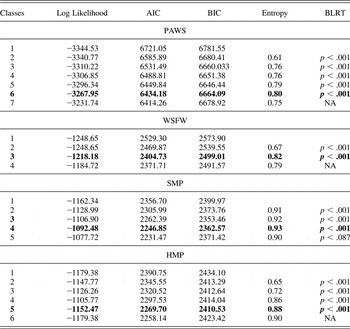
Scores in each sample were entered into latent profile analysis (LPA), a form of finite mixture modeling that identifies potential unobserved subgroups among a set of indicators (for a review, see Muthén, Reference Muthén2008). Models were fitted within a structural equation framework, and missing data were estimated using full information maximum likelihood using Mplus 6.11 (http://www.statmodel.com). Four fit indices were then evaluated for each cohort. These included Akaike information criterion (AIC) and Bayesian information criterion (BIC), statistical information criteria for which decreasing values indicate better fit (the number of classes is determined when values no longer decrease); entropy, a measure indicating average classification accuracy when assigning participants to classes (values closer to 1 indicate greater precision); and the bootstrap-likelihood ratio test (BLRT), which compares class enumeration between K and K–1 classes (p < .05 suggests that K classes fit the data better than K–1; p > .05 reveals that neither K nor K–1 classes is necessarily better). With psychological data, it is rare for different fit indices to converge on a single, best fitting model (Nagin & Odgers, Reference Nagin and Odgers2010). Thus, as is often done in psychological research, including studies of physiological response tendencies (Del Giudice et al., Reference Del Giudice, Benjamin Hinnant, Ellis and El-Sheikh2012), we evaluated the combination of the four fit indices (see Table 2), in conjunction with the subgroup profile plots, to identify the best models and most likely number of classes or subgroups in each data set. When the indices were not uniform in suggesting a particular fit, we relied most heavily on BIC and BLRT, given evidence from simulation studies suggesting that these indices are more stable that other indices with smaller data sets (see Nagin & Odgers, Reference Nagin and Odgers2010; Nylund, Asparouhov, & Muthén, Reference Nylund, Asparouhov and Muthén2007, for a discussion of fit indices).
Latent profile analyses results

Note: The best fitting models across all fit indices are in bold. PAWS, Peers and Wellness Study; WSFW, Wisconsin Study of Families and Work; SMP, Stress and Memory Project; HMP, Hearts and Minds Project; AIC, Akaike information criterion; BIC, Bayesian information criterion. On both criteria, lower values indicate better fit. Entropy refers to the average classification accuracy when assigning participants to trajectory classes (values closer to 1 indicate greater precision). BLRT, bootstrap likelihood ratio test. The BLRT compares the classification between K and K–1 classes; values <.05 indicate that K classifications fit the data better than K–1 classes, and values >.05 indicate that K classes are not necessarily better. NA, models for which the likelihood ratios could not be replicated, so the BLRT results are not trustworthy.
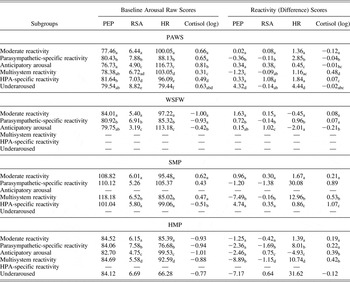
Raw data (baseline arousal and reactivity) for each emergent subgroup are presented in Table 3. Analyses of variance (ANOVAs) were conducted within each study to identify significant differences across subgroups. Groups with too few members were not included. ANOVAs and chi-squared analyses further tested whether subgroups differed in age, gender, and SES. Table 4 shows the subgroups’ age and gender distribution. Finally, for the largest cohort (PAWS), ANOVAs investigated whether the subgroups could be distinguished based on family adversity.
Mean scores for the eight indicators for each subgroup identified via latent profile analyses

Note: Raw scores are reported for all variables. PAWS, Peers and Wellness Study; WSFW, Wisconsin Study of Families and Work; SMP, Stress and Memory Project; HMP, Hearts and Minds Project; HPA, hypothalamic–pituitary–adrenal. For preejection period (PEP) and respiratory sinus arthythmia (RSA), larger values correspond to greater sympathetically or parasympathetically induced arousal, respectively. HR, Heart rate. Cortisol is reported in nanomoles per liter (nmol/l), log transformed. Analyses of variance compared group means within each sample. For significant main effects (all Fs < 3.63, ps < .01), different subscript letters correspond to groups that differed significantly (subgroups with small ns were not included) according to post hoc comparisons (ps < .05).
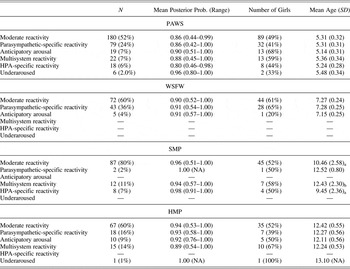
Characteristics of the subgroups

Note: PAWS, Peers and Wellness Study; WSFW, Wisconsin Study of Families and Work; SMP, Stress and Memory Project; HMP, Hearts and Minds Project; HPA, hypothalamic–pituitary–adrenal; Posterior Prob., the mean probability of children assigned to each subgroup actually belonging to that subgroup. HPA, For SMP, subgroups significantly differed in age, F (2, 104) = 4.10, p = .019. Different subscripts denote significant age differences according to post hoc tests (ps ≤ .05).
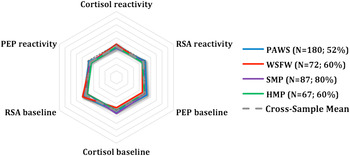
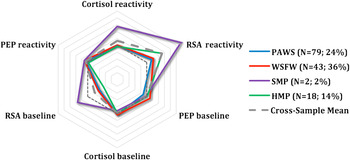
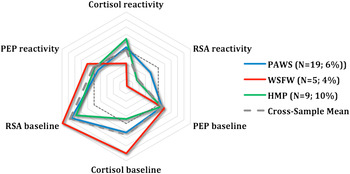
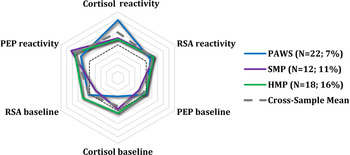
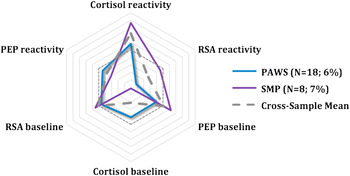
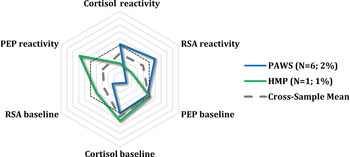
To provide a visual representation of group trends, the standardized scores on three main parameters (PEP, RSA, and cortisol) were plotted in a radial format for each identified subgroup across the four samples. PEP and RSA scores were reversed so that, for all scores, larger values correspond to greater arousal or reactivity. This visual representation reveals the often remarkable degree of consistency in arousal and reactivity of the subgroups across cohorts. The studies are depicted in different colors, with the average across studies shown in gray. The reference line (dashed), which reflects 0 scores for all parameters, is also shown. HR was not plotted because its inclusion did not further differentiate the cohorts and because HR scores were strongly collinear with RSA scores.
PAWS
LPA
The PAWS sample was the largest, most diverse group. As such, it represented the ideal sample on which to carry out the initial LPA analyses and evaluate whether subgroups reliably emerged from the different physiological markers of arousal and reactivity. Results of LPA are presented in Table 2. When all of the fit indices were evaluated concurrently, it was determined that the six-class model most closely fit the data. BIC values ceased to decrease once the number of classes increased to five, though entropy was slightly higher for the six-class solution. The fourth index, BLRT, was significant when comparing five to six classes, but also six to seven classes. However, the model was less stable with seven classes, and because of the convergence across indices at the six class solution, this was determined to best represent the data.
The largest percentage of children showed small to moderate responses across systems, at baseline and in response to laboratory stressors (Table 4), a moderately reactive group, as predicted. These children responded to the laboratory assessment, but their responses were not especially large, as suggested by their scores falling close to the mean across physiological markers at baseline and to the assessment tasks. A second and also sizable group of children exhibited a pattern of what could be called parasympathetic-specific reactivity. These children evidenced exaggerated reactivity across several measures, most notably in terms of parasympathetic deactivation (i.e., increased arousal) during the assessment tasks relative to their baseline arousal. Post hoc comparisons of RSA scores (Table 3) did confirm that this group differed markedly from the others in level of parasympathetic deactivation during the tasks.
The remaining subgroups identified in the model were substantially smaller: 6.5% appeared highly aroused across systems at baseline and reacted only minimally to the stressor itself, a pattern suggestive of anticipatory arousal; 7.2% exhibited large responses to the laboratory task across all parameters (sympathetic, parasympathetic, and HPA axis) and hence were considered multisystem reactive; 5.9% responded most vigorously in terms of HPA axis reactivity and were labeled HPA-specific reactivity; and 2% appeared minimally responsive across systems in terms of baseline arousal and stress reactivity, that is, the children seemed to be underaroused.
Posterior probabilities were examined to evaluate the appropriateness of the six-class solution. These probability values reflect how well each child fit his or her assigned subgroup; a heuristic cutoff of 0.80 is often used to infer that individuals fit their subgroup well (e.g., Kudel et al., Reference Kudel, Farber, Mrus, Leonard, Sherman and Tsevat2006). Probability means ranged from 0.80 to 0.96 across subgroups, indicating a high degree of certainty of classification of individual children into their respective groups (Table 4).
Predictors of group membership
Subgroups were compared in demographic features of gender, age, and family SES and in family adversity. The groups did not differ significantly in age, although the range was fairly restricted. Nor were boys and girls differentially distributed across groups (see Table 4 for age and gender distribution across subgroups). However, the subgroups did differ in SES, calculated as the mean of standardized scores based on parents’ highest education level and annual income, F (5, 284) = 2.56, p = .027. Children in the underaroused subgroup came from substantially lower SES families (M = −1.31) than children in the other subgroups (post hoc tests ps ≤ .01; moderate reactivity M = −0.01, parasympathetic-specific reactivity M = 0.10, anticipatory arousal = −0.12, multisystem reactivity M = 0.30, and HPA-specific reactivity, M = −0.07). A one-way group ANOVA conducted predicting the adversity index also revealed group differences, F (4, 223) = 2.48, p = .05. The adversity index was calculated as a composite standardized score across measures of parental well-being, income stress, parenting stress, and marital conflict over time. Children in the underaroused group were excluded from this analysis because of missing data from a few participants (given the group's already small size, even a few missing measures in the adversity index affected the ability to include the group in analyses). Post hoc tests indicated that children classified as multisystem reactive (M = 0.44) had higher adversity scores than children classified as moderately reactive (M = 0.03), parasympathetic-specific reactive (M = −0.11), anticipatory aroused (M = −0.17), and HPA-specific reactive (M = −0.23, ps < .05). Together, these analyses indicate that both underarousal and high levels of cross-system reactivity to laboratory stressors may well be linked to a history of family stress, as reflected in SES or chronic family adversity.
Converging evidence: Profiles in WSFW, SMP, and HMP
To assess whether meaningful subgroups emerged in the three smaller data sets, we subjected each of the cohorts’ physiological data to LPA. Again, because of differences in the precise procedures, ages, and methods used to collect the physiological data, it was not appropriate to collapse the cohorts into a single data set. For each cohort, we selected the number of classes based on the fit indices for that cohort. By not forcing each of the data sets to conform to the same number of groups that emerged in PAWS, we were able independently to evaluate whether similar subgroups existed in the three separate cohorts. For each one, we examined the posterior probabilities and conducted post hoc analyses to test for differences in the subgroups’ demographic characteristics. Finally, we plotted the groups in radial format, along with those from PAWS, to provide a visual comparison of pattern overlap across cohorts.
When the WSFW data were considered, a three-class solution was selected as the best fitting model (Table 2). Entropy and BLRT both suggested that the three-class model represented the best fit: entropy was highest and BLRT was significant. AIC and BIC decreased from two to three classes, but also from three to four classes, indicating that the four-class model could also fit. However, the BLRT results were no longer replicating with four classes, and the three-class model was thus selected. Moreover, the three groups bore a remarkable similarity to those in PAWS: 60% evidenced a moderately reactive pattern of responses; 36% displayed a pattern of parasympathetic-specific reactivity, and 4% displayed high levels of anticipatory arousal (see Table 4). Mean posterior probabilities for the three groups were also quite high, ranging from 0.90 to 0.91 (Table 4), suggesting children fit quite well into their respective subgroups.
The consistency of the patterns between PAWS and WSFW is also immediately and visibly evident in Figures 1–3, which show the subgroups response tendencies across the samples. Post hoc analyses comparing the groups across demographic characteristics revealed no age, gender, or SES differences (the latter calculated as the composite of standardized scores for parental income and education). However, SES variability was low in this cohort relative to PAWS.
(Color online) Moderate reactivity. PEP, preejection period; RSA, respiratory sinus arrhythmia; PAWS, Peers and Wellness Study; WSFW, Wisconsin Study of Families and Work; SMP, Stress and Memory Project; HMP, Hearts and Minds Project.

(Color online) Parasympathetic-specific reactivity. PEP, preejection period; RSA, respiratory sinus arrhythmia; PAWS, Peers and Wellness Study; WSFW, Wisconsin Study of Families and Work; SMP, Stress and Memory Project; HMP, Hearts and Minds Project.

(Color online) Anticipatory arousal. PEP, preejection period; RSA, respiratory sinus arrhythmia; PAWS, Peers and Wellness Study; WSFW, Wisconsin Study of Families and Work; HMP, Hearts and Minds Project.

Next, data from the SMP were examined. The four-class model best fit the data. The BLRT indicated a four-class model was significantly better than a three-class model. Classification accuracy, according to entropy, was highest, and AIC values ceased decreasing at four classes (Table 2). BIC continued to decrease until five classes, but the BLRT was no longer significant. Posterior probabilities, which ranged from 0.94 to 1.0 (Table 4), confirmed that the four subgroups captured individual children's response proclivities quite well.
The largest percentage of children (80%) fell into the moderately reactive group, similar to the prior two cohorts (see Figure 1). Smaller percentages were classified as parasympathetic-specific reactive (2%), multisystem reactive (12%), and HPA-specific reactivity, all classifications that overlapped substantially with PAWS, as is evident in Figures 2, 4, and 5. When we compared the moderately reactive, HPA-specific reactive, and multisystem reactive subgroups in demographic features (the parasympathetic-specific reactivity subgroup was not included because of its small sample size), no differences emerged in gender or SES. However, the groups differed in age (Table 4). This is perhaps not surprising, because the age range in the study (7–14 years) was sizably larger than that in the other studies. According to post hoc tests, children in the multisystem reactivity subgroup were significantly older than were children in the moderately reactive and HPA-specific reactivity subgroups, the latter of whom were the youngest age group. Children in the parasympathetic-specific reactivity group also seemed to be slightly older.
(Color online) Multisystem reactivity. PEP, preejection period; RSA, respiratory sinus arrhythmia; PAWS, Peers and Wellness Study; SMP, Stress and Memory Project; HMP, Hearts and Minds Project.

(Color online) Hypothalamic–pituitary–adrenal (HPA) specific reactivity. PEP, preejection period; RSA, respiratory sinus arrhythmia; PAWS, Peers and Wellness Study; SMP, Stress and Memory Project.

Finally, the HMP sample was examined. A five-class model was selected as the best fitting model. Classification accuracy was highest, both the AIC and BIC values ceased to decrease after five classes, and BLRT was significant (Table 2). Two subgroups overlapped with those of all the other cohorts: 60% displayed moderate reactivity and 16% displayed parasympathetic-specific reactivity. In addition, 9% displayed a pattern tending toward anticipatory arousal (similar to PAWS and WSFW; Figure 3) and 14% displayed a pattern consistent with multisystem reactivity subgroup seen in the PAWS and SMP cohorts (Figure 4). Only one participant was classified separately from these. She seemed to exhibit particularly low cortisol and RSA arousal and reactivity, similar to the underaroused children in PAWS (Figure 6), but she also had especially high heart rate reactivity. Thus, while we have labeled her underaroused, we are tentative in this classification. Posterior probabilities means ranged from 0.89 to 1.0, indicating that each child fit their group quite well. Finally, post hoc analyses revealed no gender or age differences across subgroups. SES data were not available.
(Color online) Underaroused. PEP, preejection period; RSA, respiratory sinus arrhythmia; PAWS, Peers and Wellness Study; HMP, Hearts and Minds Project.

Discussion
Although it is well established that biological stress reactivity plays a role in conferring increased risk for poor health and maladaptive outcomes across the life span, empirical findings testing precisely how reactivity leads to risk remain mixed. Some studies have found that additive linear associations and two-way interactions between different markers of physiological reactivity predict negative outcomes, whereas others report that low reactivity is associated with elevated risk or that baseline levels and not reactivity per se predict risk (El Sheikh et al., Reference El-Sheikh, Kouros, Erath, Cummings, Keller and Staton2009; Obradović, Reference Obradović2012; Salomon et al., Reference Salomon, Matthews and Allen2000; Weiner, Reference Weiner1992). A primary reason for the varied findings may be that empirical research has paid minimal attention to responses across neurobiological systems, including whether differential patterns exist in the ways in which the systems’ responses are coordinated when exposed to challenge. We took a novel approach in our efforts to advance understanding, in a significant and meaningful manner, of cross-system patterns of stress reactivity in childhood. We specifically applied LPA to biological data collected from multiple systems, both at baseline and in response to well-established laboratory challenges across four separate samples of children, ranging from 4.75 to slightly over 15 years of age.
What is perhaps most remarkable is the emergence of several meaningful subgroups of children in each sample, subgroups that overlapped in compelling manners across the studies. In the largest cohort, the largest number of subgroups emerged. However, virtually all of these subgroups were replicated in at least one of the other cohorts. The subgroups exhibited unique patterns in critical stress-responsive neurobiological circuits, were visibly consistent across studies, and differed in meaningful ways across demographic and experiential characteristics. Had only one system, simple linear interactions, or only markers of reactivity been examined, the evident patterns would not have been detected.
That the response constellations were visibly apparent and at times proportional across samples is even more impressive given significant differences in the samples’ ages and ethnic distribution, family SES, parents’ educational attainment, the location where each sample was collected, and in the types of laboratory stressors completed and the hardware and software used to collect the data. The most common pattern was the predicted moderately reactive subgroup (see Figure 1). None of the stress-responsive systems showed hyper- or hyporesponsivity in anticipation of or during the challenges, reflecting considerable intersystem balance and a potentially adaptive integration of biological responsivity when faced with challenge (Glassman, Reference Glassman1973). Of note, it is not that these children failed to exhibit a response, as is evidenced by their mean reactivity scores presented in Table 3. Instead, their responses were modulated and well coordinated, a type of buffered pattern (Del Giudice et al., Reference Del Giudice, Ellis and Shirtcliff2011) that may be acquired over time when children are raised in environments characterized by low levels of familial conflict, stressors, or challenges (Boyce & Ellis, Reference Boyce and Ellis2005; Obradović, Reference Obradović2012). The moderately reactive subgroup was not only sizable but also evident in all samples, and may be indicative of what could be characterized as an age-appropriate response proclivity among typically developing Western samples of children, at least samples that have not endured extreme trauma or deprivation. The size and existence of the moderately reactive groups may also be, in part, a function of the statistical approach, which involved standardizing scores, resulting ipso facto in large number of children being assigned to this group.
A pattern suggestive of parasympathetic-specific reactivity, although not directly predicted, was also evident in all samples, with between 2% and 36% of the children being classified as such (Figure 2). These children were reactive to the laboratory challenges, though nearly exclusively through deactivation (withdrawal) of parasympathetic cardiac chronotropy. Because PNS deactivation is often more easily evoked in laboratory stress paradigms than are SNS and HPA axis reactivity, variations in parasympathetic responsivity may be an especially sensitive indicator of predisposition to arousal and reactivity in childhood. This predisposition, which is similar to Del Giudice et al.'s (Reference Del Giudice, Ellis and Shirtcliff2011) adaptive calibration model's “sensitive” pattern, could result from children being raised in low stress environments who hence become calibrated to respond easily and quickly to environmental input. The ability to mount an appropriate response, largely via parasympathetic withdrawal, to mild environmental demands has been linked to enhanced attention and sociability (Doussard-Roosevelt, Montgomery, & Porges, Reference Doussard-Roosevelt, Montgomery and Porges2003; Porges, Reference Porges2007). At the same time, though, excessive parasympathetic deactivation (i.e., withdrawal) has also been linked to poor emotion regulation, internalizing symptoms, and low levels of social functioning (Beauchaine, Gatzke-Kopp, & Mead, Reference Beauchaine, Gatzke-Kopp and Mead2007). Understanding the conditions under which parasympathetic reactivity emerges in the absence of systematic variations in arousal and reactivity in other stress-responsive systems as well as the consequences of heightened reactivity of only this specific system are both critical areas that need to be explored in subsequent work.
In three of the samples, a pattern of anticipatory arousal was evident in between 4% and 9% of the children, see Figure 3. Multiple systems were activated before the laboratory challenges commenced, and responses to the actual challenges were somewhat blunted. Mounting an anticipatory response could be seen as adaptive, insofar as it reflects a preparatory response learned over time, although it may also be interpreted as maladaptive because it demonstrates poor regulatory capacity or chronic and persistent dysregulation (Boyce et al., Reference Boyce, Quas, Alkon, Smider, Essex and Kupfer2001), perhaps as a result of an accrual of allostatic load (McEwen, Reference McEwen1998; Sapolsky et al., Reference Sapolsky, Romero and Munck2000). Of note, in the PAWS cohort, children in the anticipatory arousal subgroup were not from families with high levels of stress or adversity, raising important questions as to the function of unprovoked multisystem arousal, particularly when coupled with blunted reactivity, in children whose response tendencies are still stabilizing.
Emerging in three cohorts was also a tendency toward exaggerated reactivity across the biological measures, that is, multisystem reactivity, including 7%–14% of the children (Figure 4). We had predicted such a group would emerge and be reflective of heightened vigilance among children who have grown up amid chronic threats in their environment (Del Giudice et al., Reference Del Giudice, Ellis and Shirtcliff2011). In support of such a possibility, in PAWS, the multisystem reactive children came from families with higher scores on the composite adversity index, a pattern that parallels prior research revealing links between early life adversity and physiological dysregulation (Cicchetti & Rogosch, Reference Cicchetti and Rogosch2001; Natsuaki et al., Reference Natsuaki, Klimes-Dougan, Ge, Shirtcliff, Hastings and Zahn-Waxler2009; Obradović et al., Reference Obradović, Bush, Stamperdahl, Adler and Boyce2010). What we did not identify, though, was a separate group of children that exhibited a vigorous SNS response, for instance, followed by HPA axis activation, which we had anticipated would be reflective of a sophisticated form of cross-system reciprocity or a high degree of regulation in the face of challenge (Bauer et al., Reference Bauer, Quas and Boyce2002; Roozendaal, Hahn, Nathan, Dominique, & McGaugh, Reference Roozendaal, Hahn, Nathan, Dominique and McGaugh2004; Sapolsky et al., Reference Sapolsky, Romero and Munck2000). Instead, our multisystem reactivity subgroup exhibited heightened responses in both the SNS and the PNS, as well as the HPA axis.
Despite substantial overlap in some emergent patterns, important differences also emerged. In two cohorts, smaller, unique subgroups were also evident. An HPA-axis specific reactivity subgroup emerged in PAWS and SMP with 6% and 14% of children, respectively. This group was most notable in SMP, with these children exhibiting robust HPA axis responses to the laboratory challenge, concurrent with an almost dampened response in both branches of the ANS (Figure 5). Of interest, in SMP, these children tended to be younger in age than children in that sample who exhibited heightened parasympathetic reactivity or reactivity across systems. Developmental changes are quite robust in terms of children's understanding of social evaluation, perceptions of threat and embarrassment, ability to cope with threat or challenge, and biological reactivity to stressors (Alkon et al., Reference Alkon, Boyce, Davis and Eskenazi2011; Compas, Connor-Smith, Saltzman, Thomsen, & Wadsworth, Reference Compas, Connor-Smith, Saltzman, Thomsen and Wadsworth2001; Gunnar, Wewerka, et al., Reference Gunnar, Wewerka, Frenn, Long and Griggs2009; Ruble, Boggiano, Feldman, & Loebl, Reference Ruble, Boggiano, Feldman and Loebl1980). These certainly could have contributed to early exaggerated responses within one system, as well as a gradual developmental shift to more global reaction tendencies. Hints of this pattern were also evident in PAWS, though, suggesting that other developmental processes may also have been at play.
Finally, in PAWs, the largest and youngest cohort included in the current study, a very small percentage of children, 2%, was nonresponsive or underaroused, both at baseline and in response to laboratory stressors (Figure 6). One child in HMP may also have exhibited this pattern. In PAWS, the underaroused children had significantly lower family SES than did the other subgroups. Perhaps these children had encountered a larger range of other potentially stressful experiences, rendering the laboratory assessment innocuous or unchallenging by comparison. Alternatively, exposure to mild chronic stress, which often accompanies low SES, may already be compromising these children's general response tendencies. Del Giudice et al. (Reference Del Giudice, Benjamin Hinnant, Ellis and El-Sheikh2012) identified a much larger percentage of underaroused children in their sample. However, HPA axis activation was not also examined. Thus, it is not known as to how many of the children would have remained classified as underaroused across all parameters. Overall, the prevalence and meaning of these smaller but quite interesting subgroups need to be determined.
Although comparable physiological measures were collected in each sample, the laboratory assessment procedures themselves varied and may have affected children's responses and the emergent subgroups. Children in the SMP and HMP, for instance, completed TSST-like procedures, requiring that they give a speech and solve math problems in front of neutral observers. The TSST is a widely used and particularly effective protocol to induce high levels of HPA activation in older children, adolescents, and young adults (Dickerson & Kemeny, Reference Dickerson and Kemeny2004; Kudielka, Buske-Kirschbaum, Hellhammer, & Kirschbaum, Reference Kudielka, Buske-Kirschbaum, Hellhammer and Kirschbaum2004; Yim et al., Reference Yim, Quas, Cahill and Hayakawa2010). The laboratory assessment protocol in the PAWS and WSFW cohorts, in contrast, might be milder, in that children simply watched emotionally evocative videoclips, repeated numbers, answered questions about themselves, and tasted an unfamiliar substance (Alkon et al., Reference Alkon, Goldstein, Smider, Essex, Kupfer and Boyce2003; Quas, Carrick, Alkon, Goldstein, & Boyce, Reference Quas, Carrick, Alkon, Goldstein and Boyce2006). However, it is not clear that administering the TSST-M, or a similar type of procedure, would have led to a comparable experience across age. Younger children have a more limited understanding of social evaluation, the primary feature in the TSST that is believed to underlie its effectiveness at inducing arousal (Dickerson & Kemeny, Reference Dickerson and Kemeny2004), and hence may not react as robustly, at least until the ages when social evaluation becomes more important, such as across the pubertal transition (Gunnar, Wewerka, et al., Reference Gunnar, Wewerka, Frenn, Long and Griggs2009; Yim et al., Reference Yim, Quas, Cahill and Hayakawa2010). Instead, and insofar as younger children tend to rely more on others to facilitate coping with novel, emotionally arousing experiences (Altshuler & Ruble, Reference Altshuler and Ruble1989; Zimmer-Gembeck & Skinner, Reference Zimmer-Gembeck and Skinner2011), emotionally evocative videos and social interactions may be sufficient to induce substantial reactivity in younger children. Overall, what the different laboratory assessment protocols mean to children and how they affect the different systems’ responsiveness need to be determined in order to evaluate, in a comprehensive manner, patterns of stress reactivity in the ANS and the HPA axis across childhood.
Beyond discussing the meaning and implications of the similarities and differences in the patterns of responses that emerged across the four cohorts, two other important issues deserve mention. One concerns developmental changes in how the ANS and corticotrophin releasing hormone system systems function together when exposed to threat. The other concerns the nature of our statistical approach and its implications both for interpreting our findings and for future research. Turning to development, we had speculated that perhaps, with age, stronger patterns of reciprocity (e.g., high SNS and HPA axis activation, as well as high PNS activation/regulation) would emerge, as the systems gradually calibrate to environmental input (Del Giudice et al., Reference Del Giudice, Ellis and Shirtcliff2011). Some hints that this was occurring emerged. For instance, the SMP had the widest age range and, as such, was the most likely to uncover age-related differences in the subgroups. Children classified as multisystem reactive were significantly older than children classified as moderately and HPA-specific reactive, with the latter children then tending to be the youngest. The HMP sample was the oldest on average, with this cohorts mean age being comparable to that of children in SMP classified as multisystem reactive. The HMP sample also had a subset of children who exhibited a multisystem pattern of responses, suggesting perhaps a developmental shift in cross-system regulatory abilities. This greater sophistication in coordination across system, for instance, with HPA axis activation, serving a regulatory function in controlling vigorous autonomic responses (Bauer et al., Reference Bauer, Quas and Boyce2002; Roozendaal et al., Reference Roozendaal, Hahn, Nathan, Dominique and McGaugh2004; Sapolsky et al., Reference Sapolsky, Romero and Munck2000), may come online with development. Of course, at times, multisystem reactivity may be indicative of chronic arousal or allostatic load, conferring risk for frequent, severe, or chronic stress-related morbidities, an interpretation supported by evidence from Del Giudice et al. (Reference Del Giudice, Benjamin Hinnant, Ellis and El-Sheikh2012). They found higher levels of family conflict in “vigilant” children, characterized by heightened sympathetic (though not parasympathetic) responses to laboratory challenges. Consistent with the latter view, the other cohort in which the multisystem reactive pattern emerged was PAWS, and the children in this subgroup had higher scores on the family adversity index than did the other children in that sample. Perhaps, therefore, the meaning of multiple systems responding to environmental stress varies developmentally. As additional research is conducted testing cross-system integration and reactivity, larger samples with children across wide age ranges must be included to ascertain not only how coordination varies with development but also the functional significance of these variations.
In the present investigation, we relied on LPA to extract potentially meaningful subgroups, that is, latent classes, from a large set of continuous predictors. Although inherently exploratory, LPA enabled us to detect patterns in a much richer way than we would have been able to do without the use of the procedure. We did detect unique patterns of responses in the largest samples, patterns that supported our initial hypotheses and that were then replicated in the smaller samples. Thus, hypotheses guided our work and were subsequently partially supported. Moreover, the emergent patterns were differentiated based on familial factors. Nonetheless, these classifications will likely need further refinement as more empirical evidence is accumulated. This evidence will need to address not only the replicability of the groups but also whether the identified “groups” truly reflect unique, qualitatively different response tendencies or instead differ in a more continuous manner across the response dimensions of interest. Prior models suggest that cross-system reactive tendencies are continuous (Bauer et al., Reference Bauer, Quas and Boyce2002), even when described, in functional terms, as categorical groups. We suspect that a similar phenomenon may be occurring here. At the same time. though, it may also be that some groups operate in categorically different manners, with accompanying neurological and phenotypic differences, similar to that observed with highly inhibited children (Kagan, Reference Kagan2011).
Our approach of applying LPA and identifying discrete subgroups in the cohorts may also have led to overestimations in the number of different patterns of responses across cohorts. That is, some of the different “subgroups” identified may instead reflect different quantitative response tendencies on some dimensions. For example, in the PAWS sample, we elected to examine the larger number of six subgroups rather than five, but the fit indices only minimally favored the former. Had we only included five subgroups, the HPA-specific reactivity subgroup would have been merged with the moderate reactivity subgroup. These groups, therefore, may reflect small continuous differences across the physiological parameters, more than separable subgroups, a possibility in need of further empirical investigation. More generally, both inter- and cross-class variability need to be taken into account in subsequent research, as will other behavioral (e.g., self-regulation and aggression) and neurobiological markers (e.g., serotonergic activity), all of which may lead to different constellations of responses with different phenotypic consequences (Boyce & Ellis, Reference Boyce and Ellis2005; Cicchetti & Rogosch, Reference Cicchetti and Rogosch2012). Likewise, and although the cohorts varied some in risk factors for morbidities, all were composed of community-based samples of children. Patterns will need to be confirmed and extended in clinical and other high-risk populations (Cicchetti, Reference Cicchetti2010).
In summary, despite clear evidence that multiple biological processes are involved, directly and interactively, in anticipating, responding to, and recovering from stressful psychological challenges, a vast majority of the reactivity literature, particular that focused on developmental populations, has sought to isolate potential effects of one or at most two systems on reactivity or adaptation. We took a novel approach in this research, methodologically and statistically, and examined patterns of responses across multiple neurobiological channels. We identified strikingly similar patterns of coherent response tendencies in four diverse cohorts that varied by location of study, demographics, developmental stage, and methodological approach. Our findings reveal a complex, symphonic network of central and peripheral, neural and neuroendocrine components that play a role both in children's basal levels of arousal and in their adaptive responses to environmental threats and challenges. Precisely how this network is organized varies across children and is modulated by the social context within which children are reared. The next step is to document more clearly the developmental and experiential underpinnings of this complexity and their combined links to subsequent maladaptive outcomes.