Introduction
The United Nations Food and Agriculture Organization (FAO) reports that 690 (9 percent) of the world's 7 599 documented breeds of livestock have become extinct within the past 150 years (Rischkowsky and Pilling, Reference Rischkowsky and Pilling2007). Furthermore, 1 487 (20 percent) additional breeds are now at risk of extinction, and the status of 2 732 (36 percent) of the remaining livestock breeds is unknown.
Means to conserve animal genetic resources (AnGR) for food and agriculture (AnGR) include: (1) in vitro methods, i.e. cryopreservation of reproductive material or other tissue samples and (2) in vivo methods, i.e. maintaining live populations either in situ (within the landscapes in which they were developed) or ex situ (outside of their original landscapes, e.g. in zoological parks). Geerlings, Mathias and Köhler-Rollefson (Reference Geerlings, Mathias and Köhler-Rollefson2002) advocate in situ conservation of live populations as the most realistic way to conserve locally adapted breeds of livestock, particularly if the production systems in which the breeds evolved can also be maintained. Köhler-Rollefson (Reference Köhler-Rollefson2000) explains: “[I]ndigenous breeds are products of specific ecological and cultural environments, and their genetic make-up and integrity will be affected if they are removed from their original contexts. Transfer of domestic animal populations into the controlled environments of government farms poses the danger of a gradual erosion of their adaptive traits” (p. 1).
Where protected areas overlap with landscapes created and utilized by people engaged in traditional agricultural or pastoral practices, a potential exists for protected areas to contribute to the in situ conservation of domestic animal diversity. In comparison with the role of protected areas in conserving plant genetic resources of interest for food and medicine (Prescott-Allen and Prescott-Allen, Reference Prescott-Allen and Prescott-Allen1983; Guzmán and Iltis, Reference Guzmán and Iltis1991; Nabhan and Tuxill, Reference Nabhan and Tuxill2001; Phillips, Reference Phillips2002; Argumedo, Reference Argumedo, Amend, Brown, Kothari, Phillips and Stolton2008; Bassols Isamat et al., Reference Bassols Isamat, Falgarona Bosch, Mallarach Carrera, Perramon Ramos, Amend, Brown, Kothari, Phillips and Stolton2008; Nozawa et al., Reference Nozawa, Malingan, Plantilla, Ong, Amend, Brown, Kothari, Phillips and Stolton2008; Sarmiento, Reference Sarmiento, Amend, Brown, Kothari, Phillips and Stolton2008), the contribution of protected areas to conserving domesticated animal genetic resources has received relatively little attention until recently (Henson, Reference Henson1992; Woelders et al., Reference Woelders, Zuidberg and Hiemstra2006; Bassi and Tache, Reference Bassi, Tache, Amend, Brown, Kothari, Phillips and Stolton2008; Cole and Phillips, Reference Cole, Phillips, Amend, Brown, Kothari, Phillips and Stolton2008; Ivanov, Reference Ivanov, Amend, Brown, Kothari, Phillips and Stolton2008; Pokorny, Reference Pokorny, Amend, Brown, Kothari, Phillips and Stolton2008; Rosenthal, Reference Rosenthal, Amend, Brown, Kothari, Phillips and Stolton2008).
The purpose of this study is to determine the extent to which national bodies reporting on the state of their country's animal genetic resources recognize protected areas as means of conserving domestic animal diversity. To accomplish this aim, a content analysis of country reports submitted for the FAO's State of the World's Animal Genetic Resources for Food and Agriculture report was conducted. Where protected areas were reported in the country reports as means to conserve domestic animal diversity, a wider review of academic literature and scholarly reports was conducted to characterize this role. Specific examples of protected areas and the roles they play in the conservation of some indigenous or at-risk breeds are highlighted, as are the ecological and socio-economic contributions of the breeds to protected area management.
Methods
In 2001, the FAO invited 188 countries to participate in the preparation of the first State of the World's Animal Genetic Resources report by preparing an assessment of their national animal genetic resources by the end of 2005. Guidelines and training were provided by the FAO to standardize the content of each country's report. The objectives of the country reports were: “a) to analyze and report on the state of AnGR, on the status and trends of these resources, and on their current and potential contribution to food, agriculture and rural development; b) to assess the state of the country's capacity to manage these essential resources, in order to determine priorities for future capacity building; and c) to identify the national priorities for action in the field of sustainable conservation and utilization of AnGR and related requirements for international co-operation” (FAO, 2001, p. 8). Information on the role of protected areas in conserving domestic animal diversity was not explicitly solicited in the FAO guidelines (FAO, 2001).
In January 2008, reports from 169 countries were available online from FAO's Domestic Animal Diversity Information System (DAD-IS) (FAO, 2008). Of those reports, 119 were available in English, 28 in French and 20 in Spanish. Some reports were submitted in English or French, as well as in an additional language. One report was submitted only in Italian and another only in Portuguese. Because of the author's unfamiliarity with these latter two languages, these reports were excluded from the analysis. Thus, the 167 reports in English, French or Spanish were analysed for terms relating to parks and protected areas using the search functions of Adobe Reader version 8.1.0 and Preview version 3.0.8. The search terms used include: in English: Natur*, *Reserv*, Protect*, Park; in French: Natur*, *Réserv*, Prot*, Parc, Aire; or in Spanish: Natur*, *Reserv*, Prote*, Parque. Asterisks indicate that search terms were structured to allow for variations, mainly in suffixes, of relevant words (e.g. searching for “reserv” could return terms such as reserve, preserve, preservation area). The term “conservation” and its equivalent in French and Spanish were not used in the searches because of the frequency of their use in the body of the documents in relation to the conservation of animal genetic resources, rather than in the context of environmental conservation. For the purposes of this analysis, a protected area is defined according to the International Union for Conservation of Nature (IUCN) definition as “a clearly defined geographical space, recognized, dedicated and managed, through legal or other effective means, to achieve the long-term conservation of nature with associated ecosystem services and cultural values” (Dudley, Reference Dudley2008, p. 8) and includes nature reserves, national parks, world heritage sites (natural), UNESCO biosphere reserves, etc. Farm parks, i.e. individual farms established to demonstrate breeds or farming practices, are not included in this analysis. In order to verify whether any terms relevant to protected areas were missed, 10 percent of the documents in each language (12 English, 3 French and 2 Spanish) were read from cover to cover.
The country reports that included any of the searched terms were analysed to determine the context in which the term was used. The country reports that mentioned protected areas were then categorized as (1) currently including AnGR within protected areas or (2) advocating the involvement of protected areas in AnGR conservation; and (a) referring to domesticated livestock or (b) referring to wild forms of animal genetic resources.
The results from the analysis of the country reports served as a starting point from which a literature review was conducted for additional information on the ways in which protected areas contributed to the conservation of domestic animal diversity and, conversely, on the ecological and socio-economic benefits offered by the breeds to the protected areas. The analysis was limited to initiatives involving indigenous breeds (i.e. breeds with a long history – at least 100 years – in the country of the protected area), and also considered programmes involving non-indigenous breeds that are at risk of extinction according to the DAD-IS. Scientific publications and scholarly reports were sought for these specific cases where protected areas were reported in the country reports to be involved in the conservation of indigenous or at-risk breeds. This literature review led to the discovery of some documents revealing the use of indigenous breeds in ways or places not mentioned in the country reports; however, literature was not explicitly sought other than to obtain further information about the cases mentioned in the country reports. Except for regarding Benin and Croatia, no attempt was made to directly obtain further information from protected area personnel or national coordinators for animal genetic resources. Individuals aware of examples of the use of indigenous or at-risk breeds in protected areas that were not addressed in this study are encouraged to contact the author to enable the development of a more complete assessment of the global extent of this phenomenon.
Results
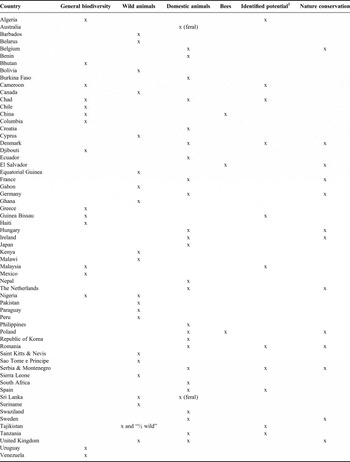
Sixty-one (37 percent) of the State of the World's Animal Genetic Resources Country Reports that were analysed mentioned protected areas, at least in relation to conservation of biodiversity in general (Table 1). One-third of these (21 countries) referred to protected areas specifically as means to conserve wild relatives of domesticated animals or wild game species. Sixteen of the country reports (10 percent of the country reports analysed) simply mentioned protected areas as a means to conserve biological diversity in general, but were not clear whether they were referring only to wild animal species or also to domesticated species. Three countries (Peru, Philippines and Swaziland) suggested that the presence of domesticated animals served as tourism attractions in protected areas. Two reports (Chad, Burkina Faso) simply indicated that livestock existed in protected areas.
Contexts in which parks and protected areas were mentioned in country reports.

1The column “Identified potential” indicates that the potential for protected areas to contribute to the conservation of AnGR was identified in the country report, but no indication was given that any initiatives were actually underway.
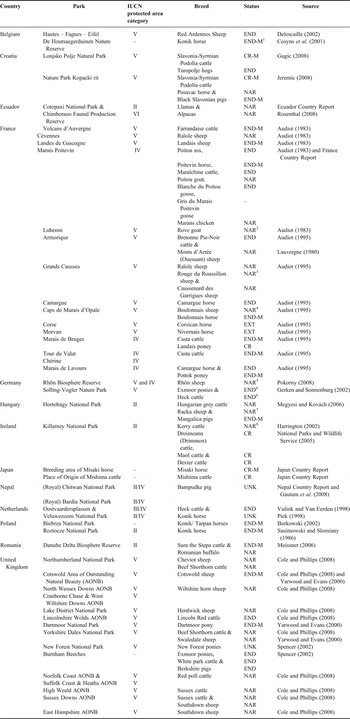
Only 15 reports (9 percent of all the country reports analysed) revealed that the use of some forms of domestic animal diversity was actively encouraged through programmes involving protected areas. Two countries (Japan and the Republic of Korea) designated some at-risk breeds, themselves, as natural monuments, which afforded the animals and their habitats protection. Benin reported that one nature park was involved in the conservation and development of the Somba cattle,Footnote 1 an indigenous breed, though no further details about the nature of the conservation activities were provided nor could be obtained from the Benin AnGR national coordinator. Poland reported that the indigenous Konik horse (Equus ferus f. caballus) is maintained in forest reserves. In Ecuador, the husbandry of domestic camelids is encouraged both in and around Cotopaxi National Park. The Nepal country report indicated that the nearly extinct Bampudke pig is found in and around the Chitwan and Bardia National Parks, and called for the creation of a breed conservation plan to be developed in partnership with the protected area authority. In France, Parc Interregional du Marais Poitevin provides assistance to breeders of seven breeds of at-risk livestock. Furthermore, the French report stated that the French Federation of Regional Natural Parks also initiated a network of stakeholders to exchange knowledge and encourage collaboration for maintaining protected areas through extensive grazing, particularly with indigenous breeds. Eight countries (Belgium, Croatia, Germany, Hungary, Ireland, The Netherlands, Sweden and the United Kingdom) stated that the conservation of domestic animal diversity was encouraged by protected area managers through the use of these animals as tools for ecological management (e.g. to maintain disturbance-dependent habitats, to control invasive vegetation, to create habitat for wildlife or to promote biodiversity). Information that was available on the specific breeds and protected areas involved in these active conservation programmes has been summarized in Table 2 and is based on the content analysis of the country reports as well as supplementary information gathered from the wider review of literature related to the case highlighted in the country reports.
Specific protected areas in which indigenous or at-risk breeds are reported in the literature reviewed.

IUCN categories: II = National Parks – large natural or near natural areas that protect large-scale ecological processes and species therein; III = Natural Monument or Features – specific natural monuments with high visitor value; IV = Habitat/Species Management Area – areas that protect particular species or habitats; V = Protected Landscapes/Seascapes – area that protects the ecological, biological, cultural and scenic values of areas shaped by the interaction of people and nature over time; VI = Protected Area with Sustainable Use of Natural Resources – natural areas in which a proportion of the land is used for sustainable, non-industrial natural resource management. For more information on these categories see Dudley (Reference Dudley2008).
CR: Critical. Total no. of breeding females ≤100 or total no. of breeding males ≤5 or total population size is ≤120 and decreasing and percent of females bred to males of same breed is <80 percent.
CR-M: Critical-Maintained. Critical populations for which active conservation programmes are in place.
END: Endangered. Total no. of breeding females is between 100 and 1 000.
END-M: Endangered-Maintained. Endangered populations for which active conservation programmes are in place.
EXT: Extinct.
NAR: Not at risk.
UNK: Risk status is unknown.
1This breed is not included in the list of breeds for Belgium in DAD-IS, but is END-M in Poland.
2Was END in 1983 when the conservation programme began.
3Was CR in the 1990s.
4Was END in 1983.
5Fewer than 100 were registered in 1975.
6These breeds are not included in the list of breeds for Germany in DAD-IS, but are both END in other countries.
7Listed as END-M in Austria and END in Romania.
8Listed as CR in the United Kingdom.
An additional three reports (Denmark, Romania, and Serbia and Montenegro) recognized that domestic animals could provide such ecological services in protected areas and recommended that domestic animals, especially older breeds, be encouraged to assist with nature conservation efforts. The Romanian country report indicated that domesticated animals are permitted in the Economic Zone of the Danube Delta Biosphere Reserve/World Heritage Site, but they are not allowed in national protected areas. The Romanian country report stressed the need for protected area authorities to acknowledge that indigenous domestic animals can be important components of natural landscapes where they could be conserved while contributing to nature protection initiatives. Similarly, the Tanzanian country report identified the exclusion of indigenous breeds of livestock from protected areas and game reserves as a constraint to the conservation of domestic animal diversity.
With regard to domestic animal diversity, protected areas received relatively little attention within the country reports submitted for the FAO's State of the World's Animal Genetic Resources reporting. Where protected areas were mentioned at all, rarely was more than a paragraph or two devoted to describing the nature of the involvement of protected areas in the conservation of domestic animal diversity. The wider search for literature to obtain additional details about these initiatives revealed that there are more cases in which protected areas are engaged in the conservation of domestic animal diversity than were acknowledged in the country reports. Indeed, some countries in which indigenous or at-risk breeds are utilized in conservation programmes within protected areas (e.g. Austria, see Schermer, Reference Schermer and Cristóvão2004), failed to identify such initiatives within their descriptions of the current mechanisms in place in their nation to conserve animal genetic resources for food and agriculture. Other countries (e.g. France and Ecuador) mentioned one or two protected areas involved in conserving domestic animal diversity, but overlooked important initiatives in other protected areas within their nation. Furthermore, when a protected area was identified as being involved in the conservation of indigenous breeds of livestock, the number of breeds conserved was under-reported at least in one circumstance (i.e. in the Ireland country report, only one indigenous breed was identified as being conserved in Killarney National Park, even though three critically endangered indigenous breeds are also raised there according to the Killarney National Park management plan; National Parks and Wildlife Service, 2005). In addition, new initiatives to conserve indigenous breeds of livestock within protected areas commenced after countries submitted their country reports to the FAO (e.g. Finland, see Lovén and Äänismaa, Reference Lovén and Äänismaa2006).
Discussion
The results of the content analysis of country reports and associated literature review reveal an under-representation of the extent of involvement of protected areas in the global conservation of domestic animal diversity. This fact may encourage those involved in developing national reports and strategies for the conservation of animal genetic resources to give the role of protected areas greater consideration in their future plans and reports. The following discussion reflects the themes that emerged from the extended literature review of cases initially mentioned in the country report and summarizes the main ways in which protected areas are currently contributing to the conservation of global animal genetic resources for food and agriculture.
Wild animal diversity
Because the primary objective of most protected areas is to conserve wild forms of biodiversity, it is not surprising that the context in which most of the reports mentioned protected areas was with regard to the conservation of game species or wild relatives of domesticated animals. The role of protected areas in the conservation of wild species is well established and its description is beyond the scope of this article.
Feral and free-ranging livestock
In some cases, it is difficult to categorize wild versus domesticated forms of animals (Clutton-Brock, Reference Clutton-Brock1989), as there are not always clear-cut boundaries between wild animals used in part by humans and free-ranging domesticated animals with little to no management by humans. Vicuñas (Vicugna vicugna), for example, are generally considered wild, but are corralled annually in some national parks by local community members to harvest fibre (Wheeler and Hoces, Reference Wheeler and Hoces1997). For the purposes of this study, vicuñas are treated as wild species and so further details of their conservation within protected areas were not sought.
Some country reports (e.g. Australia and Sri Lanka) identified the existence of feral animals within protected areas. In Australia feral Brumby horses and in Sri Lanka feral buffalo (Bubalus bubalus) are considered threats to natural features conserved within the protected areas, including endangered wild species. Management actions undertaken by several Australian protected areas aimed to reduce, if not eliminate, feral Brumby populations (Norris and Low, Reference Norris and Low2005). If populations of feral animals must be removed from protected areas for ecological reasons, consideration should be given to find appropriate venues for the ex situ conservation of potentially unique genetic resources in feral populations.
Konik horses and Heck cattle (Bos primigenius f. taurus), animals that were derived from domesticated animals with the intention of resurrecting characteristics of extinct wild Tarpan horses (Equus ferus ferus) or Auroch (Bos primigenius), respectively, are treated as domesticated animals for the purposes of this study as are free-ranging animals such as Exmoor ponies or Camargue horses that are owned or have some human management regarding breeding, so details of their use in protected areas are included in the following discussion.
Bees
The country reports were intended to focus on mammalian and avian species of interest to food and agriculture; however, some countries also provided commentary on bees (Apis spp.). Because of the difficulty in classifying bees as either domesticated or wild life forms, and in light of the widespread decline in bee populations and their importance to food and agriculture as sources of honey and pollination (Nabhan et al., Reference Nabhan, Allan-Wardell, Bernhardt, Burquez, Buchmann, Cane, Cox, Dalton, Feinsinger, Ingram, Inouye, Jones, Kennedy, Kevan, Koopowitz, Medellin, Medellin-Morales, Pavlik, Tepedino, Torchio and Walker1998) they are briefly given special consideration here. In particular, China, El Salvador and Poland identified protected areas as important reserves to prevent declines in bee populations. Efforts directed towards the conservation of bees both within and outside of protected areas may be worth further examination and possible inclusion in future State of the World's Animal Genetic Resources for Food and Agriculture reporting.
Grazing for nature conservation
In most of the countries that reported active promotion of domestic animal diversity within protected areas, livestock grazing was integrated as a means of achieving environmental conservation objectives, such as controlling invasive vegetation, maintaining disturbance-dependent habitats, increasing biological diversity, reducing soil erosion and creating habitat for wildlife. Examples of these nature conservation benefits associated with indigenous breeds of livestock grazing within protected areas are described below.
Indigenous and non-indigenous breeds
Although conservation grazing can theoretically be done with most breeds of livestock, some countries (e.g. Belgium, Ireland and Sweden) are beginning to prioritize the use of indigenous or at-risk breeds for this purpose. Because indigenous breeds are reputed to be hardier and better adapted to the local environment and extensive grazing conditions (e.g. Telenged, Reference Telenged, Humphrey and Sneath1996; Wright et al., Reference Wright, Dalziel, Ellis and Hall2002), they are believed to be well suited for conservation grazing projects. However, some comparisons between local versus industrial breeds at low grazing intensities (0.63–1.52 livestock units/ha) have not yet revealed any significant differences in the impact of grazing on biodiversity (Rook et al., Reference Rook, Dumont, Isselstein, Osoro, WallisDeVries, Parente and Mills2004; Scimone et al., Reference Scimone, Rook, Garel and Sahin2007; WallisDeVries et al., Reference WallisDeVries, Parkinson, Dulphy, Sayer and Diana2007). In these studies, however, no comparisons between industrial and traditional indigenous breeds were made at higher stocking rates, nor did these studies account for the role of the place of origin of the breeds in question, the history of the breeds’ existence in or around the study sites, or implications of the use of industrial breeds that were the results of crossbreeding with traditional indigenous breeds. Indeed, many more studies are necessary to determine whether indigenous breeds are more or less suitable than other breeds for fulfilling conservation grazing objectives.
Non-indigenous, at-risk Exmoor ponies or Konik horses and Heck cattle (a composite of indigenous and non-indigenous breeds) are used in protected areas in Germany and the Netherlands as surrogates for extinct megaherbivores that once occupied the landscape (Piek, Reference Piek, WallisDeVries, Makker and van Wieren1998; Bunzel-Drüke, Reference Bunzel-Drüke2001). Whether it is appropriate to use non-indigenous breeds for this purpose is debatable. Although inclusion within protected areas does contribute to the conservation of these at-risk breeds, it may be held that non-indigenous breeds are inappropriate elements to include in protected areas as they convey unauthentic representations of landscapes (Yarwood and Evans, Reference Yarwood, Evans, Philo and Wilbert2000). However, others recommend the use of these particular breeds for nature conservation because of their primitive nature and suitability for free-range grazing, especially where the indigenous wild horses and cattle are now extinct (Bunzel-Drüke, Reference Bunzel-Drüke2001).
It should be mentioned that there are some protected areas in landscapes that have no history of livestock grazing in which it may be inappropriate, and possibly ecologically detrimental, to introduce domesticated animals where they have never been before. Therefore, the following discussion should not be interpreted to suggest that indigenous breeds of livestock are a panacea to solving all nature conservation challenges, even where there is a history of livestock presence within the protected area. Indeed, any livestock grazing programme in ecologically sensitive areas should be carefully planned and monitored, allowing for adaptive management when necessary.
Control of invasive species
Several protected areas made use of indigenous breeds to address the spread of invasive species. A flock of 300 endangered Red Ardennes ewes with lambs was introduced in 1997 to Hautes-Fagnes plateau, Belgium, to control invasions of purple moor-grass (Molinia caerulea) on heaths and moors. The sheep uprooted Molinia tussocks and opened the litter layer, allowing the germination of plants that tended to become rare with M. caerulea invasions (Delescaille, Reference Delescaille, Redecker, Finck, Härdtle, Riecken and Schröder2002). In Ireland's Killarney National Park, summer to autumn grazing by Kerry cattle at a density of 0.5–1.0 head per hectare effectively reduced the dominance of M. caerulea in upland habitats and increased overall plant species diversity compared with control plots without grazing (Dunne and Doyle, Reference Dunne and Doyle1988). Attempts to control M. caerulea through grazing were not always successful. Grazing by indigenous heath sheep in Dutch nature reserves could not curb the spread of this grass, although experiments using cattle were more effective (Piek, Reference Piek, WallisDeVries, Makker and van Wieren1998).
To restore pasture that had become overgrown with false indigo (Amorpha fruticosa) in Lonjsko Polje Natural Park, 19 cows and 1 bull of the critical maintained Slavonia-Syrmium Podolia cattle breed were acquired by the Croatian Nature Park Public Service. Grazing by this breed, after mechanically mulching the overgrown pasture once, was found to be the most effective means of restoring the pastureland (Gugic, Reference Gugic2008).
Maintaining open environments
Across Europe, habitats associated with traditional agricultural practices are increasing in rarity as pastureland is abandoned, converted to cropland or subjected to intensive rather than extensive grazing systems (Ostermann, Reference Ostermann1998; Krebs et al., Reference Krebs, Wilson, Bradbury and Siriwardena1999; Isselstein, Jeangros & Pavlu, Reference Isselstein, Jeangros and Pavlu2005). Ostermann (Reference Ostermann1998) found that of the 198 ecologically important habitats identified by the European Commission's Habitat's Directive, 26 habitats (including eight priority habitats) are threatened abandonment of grazing. The cessation of grazing in semi-natural meadows in Europe often significantly reduces the species richness of non-domesticated plants (Persson, Reference Persson1984; Hansson and Fogelfors, Reference Hansson and Fogelfors2000; Huhta and Rautio, Reference Huhta and Rautio2005; Pykälä, Reference Pykälä2005). Some protected areas resumed grazing by indigenous or at-risk breeds to maintain such habitats and prevent encroachment of woody vegetation in disturbance-dependent ecosystems. For example, in response to encroachment of scrub in previously open marsh habitats, an experiment using Konik horses to graze small patches of marshland in Biebrza National Park, Poland began in the 1970s. Browsing and scratching by horses stopped or slowed encroachment of woody growth in all cases (though the level of effectiveness depended on season and intensity of grazing) and maintained or increased the number of breeding birds of species targeted by the management practice (Borkowski, Reference Borkowski, Bokdam, van Braeckel, Werpachowski and Znaniecka2002).
Increasing biological diversity
Livestock grazing in Croatia's Lonjsko Polje had many positive effects on biodiversity, such as seed dispersal by pigs, cattle and horses; creation of sparsely vegetated, shallow, warm pools of water for dragonflies (Ischnura pumillo and Lestes barbarus); creation and maintenance of amphibian habitat (Bombina bombina and Hyla arborea); and development of landscape heterogeneity that supports about 300 plant species, including 13 species that are specifically associated with pig pastures (Poschlod et al., Reference Poschlod, Schneider-Jacoby, Köstermeyer, Hill, Beinlich, Redecker, Finck, Härdtle, Riecken and Schröder2002).
Soil conservation
In Ecuador, alpacas (Vicugna pacos) were purchased in cooperation between the protected area authority, an international development agency, and local communities to encourage community members to reduce the numbers of sheep, which were believed to be responsible for high levels of soil erosion in the Chimborazo Faunal Production Reserve. The alpacas were expected to have less impact on the soil and vegetation, while providing economic development opportunities as breeding stock and as fibre-producing animals (Rosenthal, Reference Rosenthal2006).
Sustainable development
Although conserving natural environments is a priority of many protected areas, landscapes with a history of anthropogenic influence are increasingly being recognized as ecologically valuable, and in some cases these landscapes are dependent on the continuation of traditional agricultural land use. A special category of protected area (Category V, Protected Landscape/Seascape) was established by the IUCN to acknowledge the importance of conserving areas where interactions between humans (including their livestock) and their environment have “produced an area of distinct character with significant aesthetic, ecological and/or cultural value, and often with high biological diversity” (Phillips, Reference Phillips2002, p. 9). In these protected landscapes, managers are concerned not only to protect natural biological diversity, they also have a vested interest in promoting the continuation of traditional cultural and economic activities that have helped shape the landscape for generations. Thus, their roles extend beyond simply conserving and monitoring natural environments to incorporating social concerns into protected area management through cooperation with local landowners and forming partnerships for sustainable economic development. Many of the protected areas in which indigenous breeds of livestock are actively being promoted fall within the Category V Protected Landscape designation (Table 2), although such practices can also be justified within the management foci of other protected area categories (Dudley, Reference Dudley2008).
Examples of the synergies among nature conservation, livestock breed preservation and economic development objectives in many of the protected areas involved in promoting the use of indigenous breeds of livestock are summarized below.
Compensation for nature management services
Incentives and cost reductions associated with cooperating with protected areas for conservation grazing may at least partially offset the possible economic disadvantage of working with breeds that are perceived to be commercially inferior because of their smaller carcass size, limited milk production or coarser fibre. Beyond simply allowing indigenous or at-risk breeds of livestock to exist within protected area boundaries, which in itself can reduce costs and help develop positive relationships between local residents and protected area managers (Feremans, Godart and Deconinck, Reference Feremans, Godart, Deconinck, Gafta and Akeroyd2006), further economic incentives may be offered to farmers in exchange for the “nature management services” provided by their livestock. For example, in Belgium, herders’ wages and winter feed for their livestock is provided by the park service (Delescaille, Reference Delescaille, Redecker, Finck, Härdtle, Riecken and Schröder2002). In Sweden, funding for bush clearing, fencing, transport or farm buildings, or payments per head of livestock are offered to farmers involved in conservation grazing programmes (Matzon, Reference Matzon and Hodges1986). Conversely, Meissner (Reference Meissner2006) found that in Romania when farmers were charged a fee to pasture their animals on protected land within the Danube Delta, free-ranging horses were unclaimed by farmers and their numbers increased to the point that they began to overgraze ecologically sensitive areas.
In addition to the economic opportunities associated with conservation grazing, protected area managers contributed to the conservation of domestic animal diversity by initiating or supporting innovative sustainable development strategies involving local breeds of livestock. In Croatia, Ireland and France, for example, protected area authorities initiated “seed herd” programmes in which interested local residents can obtain a small number of breeding animals at no cost to establish their own small flock or herd of a breed in need of conservation. After a few breeding seasons, the recipients must return the same number of breeding animals to the authority which can then be used as another seed herd for an interested resident (Audiot, Reference Audiot1995; Harrington, Reference Harrington, Bokdam, van Braeckel, Werpachowski and Znaniecka2002; Gugic, Reference Gugic2008). Grazing by these animals could also be integrated within the protected areas’ vegetation management plans.
Raising livestock within protected areas, using practices that are ecologically beneficial, creates unique marketing opportunities to promote so-called “ecological” products from the meat, milk or fibre of livestock raised in these conditions. In Hungary's Hortobágy National Park, for example, indigenous Hungarian grey cattle, Racka sheep and Mangalica pigs are raised in the traditional extensive manner to maintain grassland vegetation by the Hortobágy Public Company for Nature Conservation and Gene Preservation, a group of nearly 60 herdsmen who manage one-fifth (17 000 ha) of the National Park area – reportedly the largest continuous area of organic agricultural production in Hungary and Europe (Megyesi and Kovách, Reference Megyesi, Kovách, Gorlach and Kovách2006). Meat from these breeds is featured in local restaurants, appealing to tourists who visit the national park. Similarly, Germany's Rhön Biosphere Reserve encourages direct marketing of local agricultural products such as products from heritage varieties of apples and traditional Rhön sheep through organizing cooking competitions using Rhön sheep products and forming partnerships with a gastronomic association that promotes items “From the Rhön for the Rhön” (Pokorny, Reference Pokorny, Amend, Brown, Kothari, Phillips and Stolton2008).
Research and Public education
Protected areas are often utilized as settings for scientific research. Monitoring of vegetation management strategies discussed in the section above on grazing for nature conservation provides much needed information on the effectiveness of using indigenous or at-risk breeds of livestock for such purposes. Protected areas may also establish partnerships with breeding associations and research institutes to conduct other types of research that aid with the conservation of domestic animal diversity. For example, the French regional park authorities with various partner organizations have undertaken genetic studies, animal health studies, breed inventories, market analyses and the creation and maintenance of breed registries, in addition to research focused on assessing the ecological effects of grazing by local breeds within their protected areas (Audiot, Reference Audiot1995; Martin and Morceau, Reference Martin and Morceau2006).
Protected areas may also contribute to public awareness of heritage breeds of livestock as part of their overall public education strategies. Information about local breeds of livestock is available at many park visitor information centres and on several protected area web sites. Other approaches to build awareness include the breeding centre for the Poitou donkey in France's Parc Naturel Régional du Marais Poitevin, which is open to the public and receives approximately 30 000 visitors annually who can view the animals, observe a presentation on the historic mule (Equus caballus × Equus asinus) breeding industry and visit the breed documentation centre (Martin and Morceau, Reference Martin and Morceau2006). Several approaches to raising awareness and promoting acceptance of conservation grazing initiatives using Exmoor ponies and Heck cattle in Germany's Solling-Vogler Nature Park include guided walks, evening lectures, media releases, information boards, a project video and field trips, which are particularly popular (Gerken and Sonnenburg, Reference Gerken, Sonnenburg, Redecker, Finck, Härdtle, Riecken and Schröder2002). Additional plans for building public support for the grazing initiatives in Solling-Vogler Nature Park include leaflets, a book about the project, construction of more nature trails and an “adopt-an-animal” sponsorship programme (Gerken and Sonnenburg, Reference Gerken, Sonnenburg, Redecker, Finck, Härdtle, Riecken and Schröder2002).
Conclusions
Although protected areas are not currently considered a major contributor to the conservation of non-wild animal genetic resources for food and agriculture, they are uniquely positioned to provide incentives for the use of under-utilized non-industrial breeds, particularly within conservation grazing programmes. The ecological benefits provided by such breeds of livestock can be of great value and compensation for these “ecological services” and other cost reductions such as free access to pasture land can offset the potential economic disadvantage to farmers of working with non-industrial, indigenous breeds. In addition to their focus on nature management, protected area managers can facilitate the development of partnerships for sustainable development, including establishing seed herd programmes, and working with farmers to develop value-added products such as organic meat, dairy or fibre production. As tourism attractions, protected areas draw potential customers who may be more likely to value ecologically produced agricultural products. There are many opportunities for protected area managers and authorities responsible for conserving animal genetic resources for food and agriculture to explore options such as those described in this article to fulfil mutually compatible objectives. Of course, the interactions of livestock and nature are complex and such initiatives should be carefully planned and closely monitored to ensure that domestic animal diversity is conserved without compromising other values of the protected areas involved.
Acknowledgements
I would like to acknowledge the support and direction from my supervisors, Dr Reino Pulkki (Lakehead University) and Dr Lesley Lovett-Doust (Nipissing University). I am also grateful to Dr William Wilson and two anonymous reviewers for their valuable suggestions.
Category 1: livestock species emphasis = general
Category 2: technical emphasis = conservation