Introduction
During December 2019, the Wuhan Municipal Health Commission in China reported a cluster of pneumonia cases of unknown cause. The causative agent (virus) was subsequently identified as the novel coronavirus (SARS-CoV-2), with the disease it causes later named coronavirus disease 2019 (Covid-19). This novel infectious disease spread rapidly and reached the UK in late January, and a global pandemic was declared by the World Health Organization on 11 March 2020.1 Following the initial rise and fall in confirmed cases during the first six months of 2020, recent months have seen a worrying resurgence in numbers of confirmed cases worldwide. At the time of writing, there are over 91.9 million globally confirmed cases distributed over 191 countries and regions, with over 1.9 million deaths.2
The impact of Covid-19 extends far beyond the immediate burden on healthcare systems caused by the hospitalisation of patients with the disease itself. There has been a major shift away from face-to-face consultations and towards remote consultations, in both primary and secondary care. Alongside this drastic reduction in the availability of face-to-face contact with primary care providers, the pandemic has influenced the health-seeking behaviour of the general population. An Ipsos Mori poll published in June 2020, found that 20 per cent of respondents felt uncomfortable about presenting to their local general practitioner, with higher numbers uncomfortable presenting to their local hospital.3 Of this cohort, the vast majority cited concerns about exposure to Covid-19 as the reason for their reticence.
Head and neck cancer, comprising cancers of the larynx, oral cavity, oropharynx, hypopharynx, nasopharynx, major salivary glands, the nose and paranasal sinuses, is the eighth most common cancer in the UK. In 2017, there were 12 312 new diagnoses of head and neck cancer, which accounted for 3 per cent of all new cancer diagnoses.4 There were 4102 deaths attributed to head and neck cancer in the UK in 2017, which made up 2 per cent of all cancer deaths.
National guidance in the UK recommends the use of local proformas when making referrals for potential head and neck cancer, with the referral being made within 1 working day of the decision to refer.5 The two-week-wait rule for fast-track referrals was implemented to improve access to specialist services in order to reach a diagnosis and to initiate quicker treatment. The National Health Service (NHS) England targets are: 2 weeks from urgent referral to an appointment with a specialist, 31 days from a cancer diagnosis to the initiation of definitive treatment, and 62 days from urgent referral to the initiation of definitive treatment.6
The presenting symptoms of head and neck cancers are often vague and non-specific. Studies pre-dating the Covid-19 pandemic consistently found relatively low diagnostic yield rates amongst patients referred on suspected head and neck cancer two-week-wait pathways.Reference Kumar, Drinnan, Mehanna and Paleri7,Reference Rimmer, Watson, O'Flynn and Vaz8
Aim
This study aimed to investigate the impact of the Covid-19 pandemic on the referral rate of patients to the suspected head and neck cancer two-week-wait clinic, and their subsequent management.
Materials and methods
This was a multicentre retrospective study. Data were collected for all patients attending the suspected head and neck cancer two-week-wait clinic in the ENT departments at two centres in the West Midlands (Royal Wolverhampton NHS Trust and Dudley Group NHS Foundation Trust) in the months of February, March, and April in 2019 and 2020. Only those who were referred from the primary care setting were included in this study, and direct referrals from other specialties were excluded.
For each patient, the initial referral and clinic letters were evaluated to obtain the reason for referral, the time elapsed before being seen in clinic, the time to first investigation, and the time to the patient being informed of their diagnosis. For each patient with a confirmed cancer diagnosis, the American Joint Committee on Cancer seventh edition tumour–node–metastasis (TNM) stageReference Edge and Compton9 was recorded. The outcome was coded as one of three possibilities: (1) attendance in clinic with immediate discharge; (2) attendance in clinic, and subsequent investigation with a benign diagnosis; and (3) attendance in clinic, subsequent investigation and a diagnosis of cancer.
Statistical significance was calculated using the student's t-test and chi-square test for independence, where appropriate.
Results
After exclusions as outlined above, a total of 509 fast-track referrals were received in the months of February to April in 2019, compared to a total of 399 referrals in the corresponding months of 2020. Whilst telephone triage of suspected head and neck cancer referrals has now been instigated at both centres, during the study period all referral patients were offered face-to-face appointments.
In 2019, 57 per cent of patients (n = 290) were discharged following their first clinic attendance with no further investigation, compared with 58 per cent (n = 232) in 2020. The proportions of patients undergoing further investigation who were found to have benign disease (36 per cent (n = 181) in 2019, and 34 per cent (n = 136) in 2020) and who were diagnosed with cancer (7 per cent (n = 38) in 2019, and 8 per cent (n = 31) in 2020) were also remarkably similar between years. There was no statistically significant difference between the 2019 and 2020 cohorts with regard to the proportion of cancer diagnoses (χ2 (1, n = 908) = 0.0294, p = 0.86). Of the patients who were diagnosed with cancer in the 2019 cohort, 47 per cent (n = 18) were diagnosed at an advanced stage (T3–4 and/or N+M+), compared with 58 per cent (n = 18) in 2020.
Reasons for referral
The reasons for referral to the two-week-wait clinic are shown in Table 1. In both 2019 and 2020, the commonest reason for referral was unexplained hoarseness for more than 3 weeks in those aged over 45 years (168 patients (28.9 per cent) in 2019, and 151 patients (31.0 per cent) in 2020).
Indications for referrals between February and April in 2019 and 2020

In some cases, referrers selected more than one reason for referral; hence the number of referrals is greater than the total number of referrals. Reasons for referral, by code: code A – unexplained hoarseness for more than 3 weeks (in individuals aged over 45 years); code B – unexplained persistent sore throat for more than 3 weeks; code C – unexplained ulceration of oral cavity lasting more than 3 weeks; code D – assessed by a dentist as having a lump on lip or oral cavity consistent with oral cancer; code E – assessed by a dentist or doctor as having a red or white patch in oral cavity consistent with erythroplakia or erythroleukoplakia; code F – a persistent unexplained lump in neck for more than 3 weeks; code G – unexplained thyroid lump; code H – unexplained pain in head and neck for more than 4 weeks with otalgia, but with normal otoscopy findings; code I – unexplained lesion in nasopharynx; code J – progressive dysphagia; code K – unilateral tonsillar swelling; code L – unilateral nasal obstruction and malodour; code M – white or speckled mucosal patch with pain, swelling or bleeding; code N – unexplained or persistent swelling in parotid or submandibular gland; and code O – other
The highest rate of cancer diagnoses was seen in those patients referred with a persistent lump in the neck for more than three weeks, with rates of 4.3 per cent (n = 25) in 2019 and 4.1 per cent (n = 20) in 2020.
Analysis of referral date
There were a greater number of referrals and subsequent cancer diagnoses in 2019 (n = 509, 38 diagnoses) than in 2020 (n = 399, 31 diagnoses) (Figure 1). Eleven referrals made in 2020 are still pending results for diagnoses.
Number of referrals according to month, subdivided according to final diagnosis. Eleven patients referred in 2020 are still pending diagnosis. There were no statistical differences noted between benign and cancer diagnoses when comparing months in 2019 and 2020, for February (χ2 (1, n = 309) = 1.62, p = 0.20), March (χ2 (1, n = 336) = 0.13, p = 0.71) and April (χ2 (1, n = 263) = 3.58, p = 0.06).

There were no statistically significant differences in the proportions of benign and malignant diagnoses between the two years. In 2019, 8 per cent of referrals were diagnosed as cancer, compared to 7 per cent in the following year.
Figure 1 shows the numbers of referrals by month in both 2019 and 2020. The greatest discrepancy between the two years was in the month of April, which saw a 62.4 per cent reduction in referral rate in 2020 compared to 2019.
Time from referral to appointment and investigation
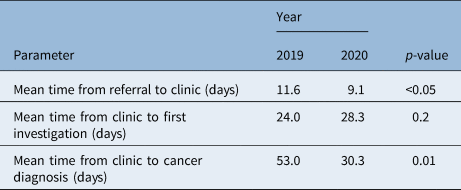
On average, the time from referral to the two-week-wait clinic appointment was shorter in 2020 (9.1 days), when compared to 2019 (11.6 days) (p < 0.05).
For those who attended two-week-wait clinics in 2019, 337 patients (66.2 per cent) required at least one investigation. The average time taken between the clinic appointment date and the date of the first investigation for all patients seen in 2019 was 24.0 days. In 2020, 174 patients (43.6 per cent) required investigation, and the average time from the clinic appointment to the first investigation was 28.3 days. There was no statistically significant difference in the time between the clinic appointment and the initial investigations in the years 2019 and 2020 (24.0 vs 28.3 days; p = 0.2). The time taken from referral to a formal cancer diagnosis was significantly less in 2020 (n = 30.3 days) when compared to 2019 (n = 53.0 days) (p = 001). Table 2 shows the times to clinic appointment, investigation and diagnosis in the two study periods.
Time from referral to clinic appointment, investigation and diagnosis

Statistical analysis performed using unpaired t-test
Discussion
Our results show a 21.6 per cent reduction in the referral rate for suspected head and neck cancer during February, March and April in 2020 (n = 487) when compared to the same period in 2019 (n = 581). However, the detection rate for cancers remained the same. This suggests that people with head and neck cancers may not have presented to the suspected head and neck cancer clinic, and therefore suffered delayed or missed diagnoses during the first wave of the Covid-19 pandemic. The reduction in referral rate, whilst concerning, is not as marked as that seen in other areas.Reference Taylor, Omakobia, Sood and Glore10 Indeed, reductions of up to 80 per cent have been reported in the media for two-week-wait cancer referrals in general.Reference Bodkin11 The British Medical Association estimates that between 274 000 and 286 000 fewer urgent cancer referrals (two-week-wait clinics) were made between April and June 2020.12
There are several possible explanations for the reduction in referrals to the fast-track suspected head and neck cancer clinic during spring 2020. Firstly, older patients who are at increased risk of head and neck cancers may have avoided presenting to their general practitioners because they were shielding for other health conditions, or because of anxiety about leaving the house given the possibility of contracting Covid-19. An Ipsos Mori study conducted in June 2020 found that amongst those who did not present to either a local hospital or general practitioner service, potential exposure to Covid-19 was cited as the reason.3 Secondly, the national lockdown restrictions that were imposed by the UK Government for the three months from 23 March 2020 to 23 June 2020, which coincided with the release of guidelines for shielding amongst those most vulnerable, is likely to have had a significant impact on the likelihood of patients seeking medical attention for non-Covid-19 related symptoms. Our results show a significant reduction in referrals between February and March 2020. Finally, it is likely that there was a perceived lack of availability of primary care and secondary care appointments, which may have discouraged some from seeking medical attention.
Despite a smaller number of referrals, a similar percentage of patients were diagnosed with cancer in 2020 (7.18 per cent) as in 2019 (7.75 per cent), with the detection rate in both years being comparable to the rates (6.3–14.6 per cent) reported elsewhere.Reference Kumar, Drinnan, Mehanna and Paleri7 This is further emphasised by a similar number of fast-track clinic appointments satisfying ‘outcome 3’ (attendance in clinic, subsequent investigation and a diagnosis of cancer) in 2020 (7.77 per cent) as in 2019 (7.47 per cent). The stable detection rate despite a reduced number of referrals raises the possibility that some cancers may have gone undiagnosed in the second study period.
The most common reason for referral in 2019 (28.9 per cent) and 2020 (31.0 per cent) was hoarseness of voice for more than three weeks in those aged over 45 years. Laryngitis is a common clinical presentation for those who have contracted the common cold or influenza, which itself is very prevalent during the UK winter.Reference Fleming and Elliot13 The increase in those being referred for this symptom may indeed coincide with the Covid-19 pandemic, with prolonged laryngitis a common symptom amongst those affected.
The rate of those who attended clinic, underwent further investigation and who were eventually diagnosed marginally increased in 2020 (7.77 per cent) compared to 2019 (7.47 per cent), despite a decrease in the total number of referrals. Selection bias may have played a role in this; a larger number of individuals with increased symptom severity and therefore potentially more likely to have a cancer diagnosis, may have presented to their general practitioner in comparison to pre-pandemic times. The percentage of individuals who attended the fast-track clinic only to be immediately discharged without further investigation increased from 2019 (56.97 per cent) to 2020 (58.15 per cent). The combination of anxiety induced by the ongoing pandemic as well as virtual consultation, which does not allow for examination and therefore means the individual is more likely to be referred for a fast-track clinic appointment, may explain the increase in the percentage of benign diagnoses.
The height of the pandemic saw the widescale redeployment of staff within primary and secondary care, to ensure that the NHS could withstand the anticipated increase in Covid-19 related admissions. Guidance suggested prioritising re-allocation to admission and in-patient teams, over those delivering ongoing time-critical elective care such as cancer treatments and other elective care such as virtual clinics.14 There were subsequent reductions in the numbers of: clinicians able to facilitate clinics, multidisciplinary team discussions to decide on treatment plans, and clinicians able to implement any subsequent treatment.12 This caused concerns about possible delays to cancer diagnoses. However, this was not found to be the case in our centres, with no increase in the time from referral to clinic appointment or to cancer diagnosis.
• The coronavirus disease 2019 (Covid-19) impact extends far beyond the immediate healthcare burden caused by hospitalisation of patients with the disease itself
• There has been a major shift from face-to-face consultations towards remote consultations, in both primary and secondary care
• Coronavirus has had a major impact on health-seeking behaviour in patients with a variety of symptoms, some of whom will inevitably have underlying cancers
• Urgent policy interventions may be required to compensate for the hidden impact that the Covid-19 pandemic has had on those with cancer
Physical distancing measures have resulted in reduced capacity in out-patient clinics and have halted national cancer screening programmes.15 In order to maintain patient flow in the elective setting, there has been an increased uptake in ‘virtual clinics’. This concept has seen enthusiastic adoption in the setting of head and neck cancer two-week-wait clinics where, given the low diagnostic yield rate, there is a renewed incentive to bring only those likely to need clinical examination and further investigation to the face-to-face clinic. A risk calculator based on demographics, risk factors and symptoms has been developed to aid this decision-making process.Reference Tikka, Kavanagh, Lowit, Jiafeng, Burns and Nixon16 The long-term efficacy and safety of such a significant change in clinical practice is yet to be determined, with studies still ongoing.
Conclusion
The healthcare impact of the Covid-19 pandemic goes beyond the acute clinical setting. It has firmly embedded itself in the psyche of the public and has resulted in changes to the health-seeking behaviours of patients with a variety of symptoms, some of whom will inevitably have underlying cancers. Urgent policy interventions may be required to compensate for the hidden impact that the Covid-19 pandemic has had on those with cancer.
Acknowledgement
The authors wish to thank Dr Vaibhavi Kulkarni (Department of Otolaryngology, Dudley Group NHS Foundation Trust, UK).
Competing interests
None declared