Implications
This research investigated the interest in the use of agro-industrial by-products in ruminant feeding. It has increased due to environmental, economic and social inclusion with the increase in biofuel politics. Among the many possible sources of by-products is licuri cake, which is extracted from a northeastern Brazilian native semi-arid palm tree and can be used as a supplement in dairy cow diets. Licuri cake can be a choice for supplementing cows by reducing feed costs and increasing milk and cheese fat, which may add value at the time of marketing for industry, raising the income of the farmer.
Introduction
In milk production that intensively relies on grazing, greater producing cows typically require concentrate supplementation with complementary nutrients that are not provided by tropical pastures. In this regard, the use of agro-industrial by-products in ruminant feed has increased due the greater availability in structured markets and reduced costs relative to traditional ingredients, such as soy (Glycine max) meal and ground corn (Zea mays) (Lima et al., Reference Lima, Oliveira, Garcez Neto, Bagaldo, Abreu, Silva, Carvalho and Bezerra2015; Silva et al., Reference Silva, Medeiros, Oliveira, Gonzaga Neto, Queiroga R de CR do, Ribeiro, Leão and Bezerra2016a). The informations regarding the use of these by-products in ruminant feed are essential to ensure the sustainability of this practice (Gonzaga Neto et al., Reference Gonzaga Neto, Oliveira, Lima, Medeiros, Bezerra, Viegas, Nascimento and Freitas Neto2015; Silva et al., Reference Silva, Oliveira, Nascimento, Pellegrini, Trajano, Rocha, Bezerra and Borja2016b).
Licuri is a palm tree that is very drought resistant and an important feed resource in semi-arid zones for humans and animals; licuri blossoms and bears fruit throughout the year, with March and April being the peaks of production and harvest, characterizing the harvest period. In other months, production falls by ~50%. The average annual production in one native hectare of licuri is 3000 kg of coconuts. Licuri can be used in ruminant nutrition as an oil (Lima et al., Reference Lima, Oliveira, Garcez Neto, Bagaldo, Abreu, Silva, Carvalho and Bezerra2015) or cake that is extracted by pressing at high temperature and pressure (Costa et al., Reference Costa, Oliveira, Silva, Ribeiro, Silva, Leão, Bezerra and Rocha2016), and the licuri may be used in ruminant feed as a beneficial energy source in the diets of lactating cows on managed pastures (Oliveira et al., Reference Oliveira, Neto, de Lima, de Medeiros, Bezerra, Pereira, Bagaldo, de Pellegrini and Correia2016).
The chemical composition of licuri cake presents values of 935±4 g/kg dry matter (DM), 240±5 g/kg CP, 105±3 g/kg ether extract (EE), 525±3.5 g/kg NDF, 325±3 g/kg ADF and 115 g/kg ADL (Borja et al., Reference Borja, Oliveira, Bagaldo, Pereira, Portela, Barbosa, Ribeiro and Carvalho2014; Costa et al., Reference Costa, Oliveira, Silva, Ribeiro, Silva, Leão, Bezerra and Rocha2016). However, studies of the inclusion of licuri cake as a replacement for conventional ingredients in feeding dairy cows are necessary to evaluate the performance and the influence of this by-product on quantitative and qualitative characteristics of milk.
Thus, we hypothesize that using licuri cake to partially replace ground corn and soybean meal reduces the total cost of concentrated supplements, without harming the metabolic parameters of cows in mid-lactation and improving the production and composition of the milk and Minas frescal cheese. The objective of this study was to evaluate the effects of the licuri cake supplementation level on intake, digestibility, nitrogen balance (NB), blood metabolites, performance, production and composition of the milk and Minas frescal cheese as well as feeding behavior and concentrate supplementation profitability.
Material and methods
Ethical considerations, animals and experimental design
The experiment was conducted at the Federal University of Bahia according to the guidelines of the National Council for Animal Experiments Control (Permit Number: 17-2014).
Eight Holstein (3/4)×Gyr crossbred (5/8), multiparous (three lactations) cows with 480±25 kg mean BW, body condition score (BCS) 3.25, between 45 and 90 days of lactation were distributed in a duplicated 4×4 Latin square design. The experiment lasted 60 days and was divided into four periods of 15 days each; the first 11 days of each period were intended for the adaptation of the animals to the diets, and the last 4 days were used for data collection. In total, 10 days before the first experimental period (described below), the cows were dewormed with ivermectin (Ivomec Gold®; Merial, Salvador, Bahia, Brazil), supplemented with an injectable solution containing vitamins A, D, E, B complex vitamins and mineral mixture.
Grazing and supplementation (treatments)
The animals were managed in an area of 8.0 ha containing Panicum maximum cv. Massai divided into 10 paddocks that covered an area of 8000 m2. They were surrounded by electric fencing under rotational grazing for 4 days followed by 36 days of rest (a grazing cycle of 40 days) to ensure an average forage allowance (on a DM basis) of 100 g/kg of BW. The monitoring of the pasture availability was performed using the square method previously described by Hodgson et al. (Reference Hodgson, Matthews, Matthew and Harrington2000), with a 1 m2 area randomly harvested ten times in each paddock before the entry and exit of the animals.
The difference between the amount of forage before entry and after exit was used to determine the forage accumulation rate, used for the load adjustment. During the experimental period, the mean forage mass was 8000 kg DM/ha, and the forage offered was 10.2% BW on a DM basis. All the cows were grazed in the same paddocks, had access to shaded areas and ad libitum supplies of water and mineral supplements.
The feeds used in the concentrate supplements included the following: licuri cake, soybean meal, ground corn, mineral mixture, urea and ammonium sulfate. The licuri cakes were obtained via the double pressing of whole grains using a mechanical press-type ʻexpellerʼ (Termal Prenss Pelegrin®, Pellegrin, Curitiba, Paraná, Brazil). The licuri cakes were incorporated into the supplements at concentrations of 0, 200, 400 and 600 g/kg (DM basis).
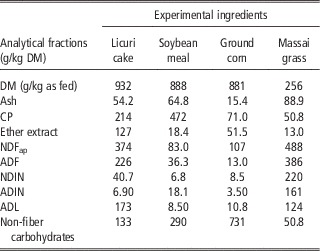
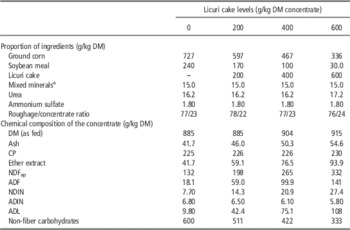
The diets were formulated according to the requirements provided by the National Research Council (NRC) (2001) to meet the requirements of cows during milking. The cows received 3 kg of concentrate per day individually with restricted access, given in two feedings, 1/2 in the morning and 1/2 in the afternoon (0600 and 1600 h). Chemical analyses of the diets (Tables 1 and 2) were performed on composite samples from the pasture, feed concentrates, supplements and licuri cakes. At the end of each collection period, animal, treatment and period samples were collected.
Chemical compositions of the experimental ingredients

DM=dry matter; NDFap=neutral detergent fiber corrected for ash and protein; NDIN=neutral detergent insoluble nitrogen (g/kg CP); ADIN=acid detergent insoluble nitrogen (g/kg CP).
Proportion and chemical compositions of the experimental diets

DM=dry matter; NDFap=neutral detergent fiber corrected for ash and protein; NDIN=neutral detergent insoluble nitrogen (g/kg CP); ADIN=acid detergent insoluble nitrogen (g/kg CP).
a Guaranteed levels (per kilogram, in active elements): calcium (maximum)=220.00 g and calcium (minimum)=209.00 g; phosphorus=163.00 g; sulfur=12.00 g; magnesium=12.50 g; copper=3500 mg; cobalt=310 mg; iron=1960 mg; iodine=280 mg; manganese=3640 mg; selenium=32 mg; zinc=9000 mg; and fluorine (max.)=1630 mg.
Diet analysis
The samples of ingredients, forage and diets were pre-dried at 55°C for 72 h and dried to determine the DM concentration according the Association of Official Analytical Chemists (AOAC) (1990; method 967.03), and the samples were then ground with a Wiley mill (Tecnal, Piracicaba, São Paulo, Brazil) with a 1 mm sieve, stored in airtight plastic containers (ASS, Ribeirão Preto, São Paulo, Brazil), and analyzed for ash (method 942.05), CP (method 981.10) and EE (method 920.29).
Neutral detergent fiber was determined according to the methodology of Van Soest et al. (Reference Van Soest, Robertson and Lewis1991) using heat-stable α-amylase and sodium sulfite, and ADF was determined according to the AOAC (1990; method 954.01) using an ANKOM 2000 Fiber Analyzer (ANKOM Tech. Corp., Fairport, NY, USA). Acid detergent lignin was determined according to AOAC (2000; method 973.18) in which the ADF residue was treated with 72% sulfuric acid. The NDF was corrected for ash and protein (NDFap). The NDF residue was incinerated in an oven at 600°C for 4 h, and the correction for protein content was applied by subtracting the neutral detergent insoluble nitrogen (NDIN) content.
The NDIN and acid detergent insoluble nitrogen were obtained according to the recommendations of Licitra et al. (Reference Licitra, Hernandez and Van Soest1996). The non-fiber carbohydrates (NFC; g/kg) of the pasture were calculated using the following equation: 100−(NDF+CP+EE+Ash). The NFCs of the supplements were calculated according to the following equation: 100−[(CP−CP derived from urea+urea)+NDF+EE+Ash] (Hall, Reference Hall2000).
Intake and digestibility estimation
The supplement intake was determined directly from the difference between the amount of feed that was offered and the amount that remained. The estimated grass intake was calculated according to the dry matter intake (DMI) equation of Berchielli et al. (Reference Berchielli, Oliveira, Carrilho, Feitosa and Lopes2005): DMI (kg/day)={[(FP×NDFiF) IS]/CIFO}+DMIS, where DMI (kg/day), FP the fecal production (kg/day), NDFiF the iNDF (indigestible neutral detergent fiber) concentration (kg/kg DM) in the feces, IS the iNDF in the supplement (kg/day), CIFO the iNDF forage (kg/kg DM) and DMIS the DMI of the supplement (kg/day).
To estimate the fecal output, chromic oxide was used as an external indicator and was provided daily for 12 days at 0900 h in a single 10 g dose (Kimura and Miller, Reference Kimura and Miller1952). Seven days were provided for adaptation of the marker excretion, and the stool was collected for 5 days. The feces were collected directly from the rectum once per day and stored in a cold chamber at −10°C. The stool samples were analyzed by atomic absorption spectrophotometry (Perkin-Elmer®, Perkin-Elmer, Überlingen, Germany) for chromium dosage as in Willians et al. (Reference Willians, David and Iilma1962).
To determine the iNDF, samples of the fodder concentrates and feces were incubated in the rumen of four fistulated animals for 144 h, and the residue was assumed to be indigestible according to the method described by Cochran et al. (Reference Cochran, Adams, Wallace and Galyean1986). The digestibility and DMI were estimated from the fecal production and were verified using chromium oxide (Cr2O3) as external marker and iNDF as internal marker.
The digestibility coefficients (DC; g/kg) of DM, CP, NDF, NFC and EE were calculated as DC=[(kilogram of the portion ingested–kilogram of the portion excreted)/(kilogram of the portion ingested)]×100. The intake of total digestible nutrients (TDN) was calculated according to Sniffen et al. (Reference Sniffen, O’Connor, Van Soest, Fox and Russell1992) using the equation ITDN=[(ICP–CPf)+2.25 (IEE–EEf)+(iNDF–NDFf)+(INFC–NFCf)], where ICP, IEE, iNDF and INFC represent the intake of CP, EE, NDF and NFC, respectively, and where CPf, EEf, NDFf and NFCf refer to the excretion of CP, EE and TC, respectively, in the feces. Concentrations of TDN were obtained from the following equation: TDN (g/kg)=(TDN intake/DM intake)×100.
Nitrogen balance
The NB was calculated from the amounts of nitrogen (N) (g/day) that were consumed and excreted in the feces, urine and milk. Spot urine samples from all animals were collected on the 13th day of each experimental period, ~4 h after feeding in the morning. From each sample, 10 ml of urine was withdrawn and diluted in 40 ml of 0.036 M NH2SO4 to reduce the pH to values below 3.0, avoiding losses of nitrogen. Afterwards, the solutions were stored in plastic pots and stored in a freezer for the further analysis of urea and creatinine. The quantification of the urinary volume of each cow was used to calculate the daily excretion of total nitrogen and urea in the urine, multiplying the daily mean excretion of creatinine (29.00 mg/kg BW) of lactating cows (Valadares et al., Reference Valadares, Broderick, Valadares Filho and Clayton1999) by the animal BW and dividing the product by the creatinine concentration in mg/l observed in the urine spot sample of the respective animals. The NB was calculated: NB (g/d)=N intake−N feces excretion−N urine excretion−N milk production. The milk urea nitrogen (MUN) content was obtained by dividing the amount by the CP conversion factor of 6.38 (McDonald, Reference McDonald1993), and the N content of the feces was calculated using the factor 6.25 by method 968.06 (AOAC, 1990).
Blood serum parameters
Blood samples were collected with 10×25 mm sterile needles by left jugular vein puncture into 10 ml tubes on the 4th day of the collection period at the morning milking. After collection, the samples were centrifuged for 20 min at 2200×g. Subsequently, the serum was fractionated and stored in four 0.5 ml microcentrifuge tubes that were frozen at −20°C. The serum analyses were performed in an automatic biochemical analyzer (BIOPLUS 2000®; BIOPLUS, Barueri, São Paulo, Brazil). The determinations of the blood urea nitrogen (BUN), triglyceride and creatinine concentrations in the serum and the urea-deproteinized milk were performed according to the modified diacetyl method using LABTEST® (Lagoa Santa, Minas Gerais, Brazil) commercial kits in an automatic biochemical analyzer (BIOPLUS 2000®).
Production and composition of milk and Minas frescal cheeses
Body condition score and average daily weight gain (ADWG) were evaluated during the experimental period. The weight of the animals corresponded to the average of five successive weightings recorded between feeding and milking times. Body condition score measurements were performed according to the methodology of Edmonson et al. (Reference Edmonson, Lean and Weaver1989).
Milk samples (at 0600 and 1500 h) from each animal were mixed to form a composite sample, which was placed in plastic containers with Bronopol® preservative (Bronopol, D & F Control Systems, Dublin, USA) and stored in a freezer at −20°C until analysis of the chemical composition (100 ml sample) at the end of the experimental period. A slow pasteurization method (Brasil, 2003) was used, and the efficiency of this method was evaluated based on alkaline phosphatase and peroxidase tests included in the Laborclin kit® (Laborclin, Vargem Grande, Paraná, Brazil). Fat, protein, lactose, casein, urea, total solids and non-fat dry extract were assessed using a Milko-Scan 203 (Foss Electric DK-3400; Foss Electric, Hillerød, Denmark). Somatic cell counts (log 10/ml) were performed on Somacount 500 equipment (Bentley Instruments Incorporated, Chaska, MN, USA) by flow citometric according to the International Dairy Federation standard (IDF, 1995).
To correct the milk production for 0.035 fat (MPC), a formula cited by Gaines (1928) and suggested by Sklan et al. (Reference Sklan, Ashkenazi, Braun, Devorin and Tabori1992) was used: MPC0.035=(0.4255×PM)+[16.425×(Fat/100)×PM], where MP is the milk production (kg/day) and Fat the production of fat (kg/day). Minas frescal cheese was manufactured in accordance with the flowchart suggested by Silva (Reference Silva2005), and the cheese yield, which is expressed in liters of milk per kilogram of Minas frescal cheese (l/kg), was calculated by dividing the total volume of milk (l) by the total weight of the Minas frescal cheese (kg) after 24 h of cooling at 5°C. The yield was adjusted for 58% uniformity using the following formula: Adjusted yield=(Yield)×(100–Actual moisture (g/kg))/100–(Desired moisture).
Ingestive behavior
On the 8th day of each experimental period, for a period of 24 h (begun at 0900 h after the diet was offered) at intervals of 5 min, the animals were subjected to individual visual observations performed by two trained observers per animal to evaluate the feeding behaviors. During the nighttime, the observations were made with artificial lighting. The daily times spent eating, ruminating and idling were registered (Johnson and Combs, Reference Johnson and Combs1991). The animals were marked with ink to facilitate identification and to enable the observers to keep their distance to ensure that they would not affect the grazing behaviors of the animals.
The observers counted both the number of ruminating chews and the cakes ruminated per day. In addition, the time and the number of chews for each ruminal bolus for each animal were recorded. The feeding efficiency (FE), rumination efficiency (RE) and total chewing time were determined according to Bürger et al. (Reference Bürger, Pereira, Queiroz, Silva, Valadares Filho, Cecon and Casali2000).
Cost analysis of the diets
The cost analysis considered the descriptive analysis of the concentrate total cost during the 60 days of the experiment, with ingredients priced based on the current US$ quotation (Dairy Farm International Holdings Ltd), as well as the profit with the average milk production (kg/day) of the cows during the period of data collection that were multiplied by the total experimental period (kg/animal per 60 days). Gross margin of milk sales (US$/animal per 60 days)=Price received total milk (US$/kg per 60 days)–Cost with total feed (US$/60 days). The economic profitability (profit or loss) is presented in US$/animal per day.
Statistical analysis
The statistical model included the concentration of licuri cake inclusion (0, 200, 400 and 600 g/kg licuri cake inclusion) as fixed effects and period (4), animals (8) and residue as random effects. The data were subjected to an ANOVA and regression analyses (linear and quadratic) using the MIXED and REG procedures (SAS Institute Inc., Cary, NC, USA, version 9.2).
The significance level was set at a probability of 5% (P⩽0.05), and trends were considered present when P⩽0.10. The statistical model used was
 $$Y_{i} {\,\equals\,}\beta _{0} {\plus}\beta _{1} x_{i} {\plus} $$
ε
i
, where Y
i
is the i
th variable observation dependent on Y; x
i
the i
th value of the regression variables; β
0 the independent representing the intercept of the line at X=0; β
1 the regression variable for treatment x
i
; and ɛ
i
the random error associated with each observation.
Results
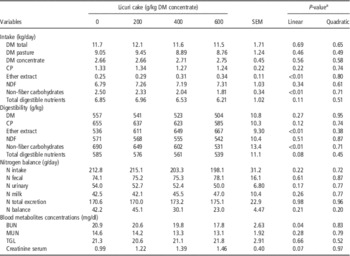
Supplementation for Holstein×Gyr cows during mid-lactation with licuri cake and partially replacing ground corn and soybean meal with licuri cake did not influence the total intakes of DM total, pasture or concentrate, CP, NDF and TDN (P>0.1); however, there was an increased intake of EE (P<0.01) and a decreased intake of NFC (P<0.01) by the animals consuming the licuri cake inclusion (Table 3). The average DMI of the cows was 11.7 kg/day. The animals of the group that received licuri cake consumed 610 g/kg less NFC and 90 g/kg more EE.
Intake, digestibility, nitrogen balance and blood metabolite concentrations of cows in pastures grazing and supplemented with licuri cake replacing ground corn and soybean meal in concentrate

DM=dry matter; BUN=blood urea nitrogen; MUN=milk urea nitrogen; TGL=triglycerides serum.
a Significance at 0.05<P<0.10.
The digestibilities of DM, CP and NDF were not influenced (P>0.1) by the partial replacement of ground corn and soybean meal with licuri cake in the concentrate supplementation (Table 3). Furthermore, the digestibility of EE (P<0.01) increased and the digestibility of NFC decreased (P<0.01). There was trend toward the reduction of TDN digestibility (P=0.08). The replacement of ground corn and soybean meal with licuri cake in the concentrate supplementation did not influence the NB (P<0.1). The cows had (P>0.1) a mean N intake of 207.3 g/day, a mean N excretion of 127.9, a mean fecal excretion of N of 75.6 g/day and a mean urinary excretion of N of 52.2 g/day.
There was an effect (P>0.1) of replacing ground corn and soybean meal with licuri cake in the concentrate on N intake; N fecal, urinary and total excretions; MUN; and N balance in g/day of the cows. However, the BUN (P=0.04) concentration decreased following the addition of licuri cakes. There was trend toward an increase in serum creatinine (P=0.07).
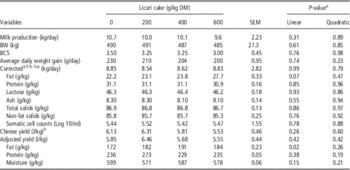
The partial replacement of ground corn and soybean meal with licuri cake in the concentrate supplementation did not affect (P>0.1) the BCS and milk production or the MPC3.5% Fat (kg/day) (Table 4). The ADWG (g/day) was reduced with the inclusion of licuri cake in supplementation. Milk fat (P=0.07) and cheese fat production (P=0.02) tended to be linearly increased with the inclusion of licuri cake in supplementation. The use of different levels of licuri cake in the replacement of ground corn and soybean meal in the concentrate supplementation did not influence (P>0.1) the protein, lactose, ash, total solids, non-fatty solids and somatic cell counts contents of the milk, yield, adjusted yield, CP and moisture of the cheese.
Production and composition of milk and Minas frescal cheese produced by cows in pastures, grazing and supplemented with licuri cake replacing ground corn and soybean meal in concentrate

DM=dry matter; BCS=body condition score.
a Significance at 0.05<P<0.10.
b Cheese type Minas frescal.
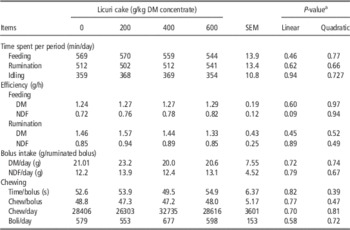
There were no effects (P>0.1) of partially replacing the ground corn and soybean meal with licuri cake in concentrate supplementation on the times spent per period (min/day) feeding, ruminating or idling, DM FE or the DM or NDF REs by the cows (Table 5). However, there was a trend toward increased NDF FE (P=0.09). The RE was 0.77 g/h, and the NDF RE was 0.88 g/h. The parameters of time/bolus, number of chews/bolus, chews/day and bolus/day were not affected (P>0.1) by the inclusion of licuri cake in the concentrate.
Ingestive behavior of cows in pastures grazing and supplemented with licuri cake replacing ground corn and soybean meal in concentrate

DM=dry matter.
a Significance at 0.05<P<0.10.
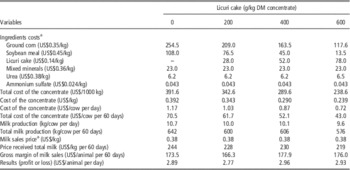
The partial replacing of ground corn and soybean meal with licuri cake decreased the concentrate cost of US$1.17 to US$0.72/cow per day (Table 6). Although the product had received US$25 more per cow by the milk at the end of the 60-day period, the gross margin of milk sales per animal during that period was US$4.4 greater in cows supplemented with 400 g/kg licuri cake replacing corn and soybeans in concentrate, and the profit was US$0.07/animal per day when compared with animals receiving only corn and soybean.
Diet cost analysis for cows in pastures grazing and supplemented with licuri cake replacing ground corn and soybean meal in concentrate

DM=dry matter.
a Price in dollars quoted at R$3.42.
Discussion
The partial replacement of ground corn and soybean meal with licuri cake in concentrate supplementation did not change the DMI of crossbreed Holstein×Gyr cows during mid-lactation. However, the increase in the intake and digestibility of EE promoted a linear decrease in the NFC intake because of the dilution of the endogenous EE by the addition of the concentrate (Pereira et al., Reference Pereira, Pereira, Arruda, Cabral, Oliveira, Mizubuti, Pinto, Campos, Gadelha and Carneiro2016), which increased the intake by 286 g/day and digestibility by 381 g/kg when the corn and soy were replaced with licuri cake. However, the greatest EE content in the diet with 600 g/kg of licuri cake was lower than the recommended maximum level (70 g/kg of the total diet) for ruminants (Palmquist and Moser, Reference Palmquist and Moser1981; Gouvêa et al., Reference Gouvêa, Oliveira, Leão, Assis, Bezerra, Nascimento Júnior, Trajano and Pereira2016), from which the lipids can negatively affect the nutrient intake through regulatory mechanisms that control the feed intake, by the limited ability of ruminants to oxidize fatty acids (Stoffel et al., Reference Stoffel, Crump and Armentano2015; Oliveira et al., Reference Oliveira, Neto, de Lima, de Medeiros, Bezerra, Pereira, Bagaldo, de Pellegrini and Correia2016; Silva et al., Reference Silva, Oliveira, Nascimento, Pellegrini, Trajano, Rocha, Bezerra and Borja2016b).
No difference in the digestibility and balance of protein was observed in the present study, reflecting similarities between the mean protein contents (226 g/kg CP) of the diets (Table 2). The positive NB observed in all experimental diets indicates that there were no losses of protein or nitrogen compounds during the experimental period, demonstrating that the protein content of the licuri cake was efficiently used by the animals (Borja et al., Reference Borja, Oliveira, Bagaldo, Pereira, Portela, Barbosa, Ribeiro and Carvalho2014). The fecal, urinary and mammary excretion mean N corresponded to 44%, 32% and 25% of N intake, respectively; 83% of the N intake was excreted, and only 17% was retained. The evaluated diets had no effect on the NB, which remained above 100 g/animal per day. The positive NB indicates that the intake protein was retained in the animal, which prevented conditions that lead to weight loss (Oliveira et al., Reference Oliveira, Neto, de Lima, de Medeiros, Bezerra, Pereira, Bagaldo, de Pellegrini and Correia2016) and optimized milk production. The BUN and MUN values exhibited by the animals were within the normal ranges for this category (Lima et al., Reference Lima, Oliveira, Garcez Neto, Bagaldo, Abreu, Silva, Carvalho and Bezerra2015). However, the reduction in BUN that occurred may have resulted due to the increase in NDIN (Table 1) that occurred following the addition of licuri cake to the cows’ concentrate supplement. Generally, changes in BUN and MUN concentrations are related to the ruminal ammonia content, which depends on the metabolic activity of rumen microorganisms that convert the N in ammonia to bacterial proteins (Gonzaga Neto et al., Reference Gonzaga Neto, Oliveira, Lima, Medeiros, Bezerra, Viegas, Nascimento and Freitas Neto2015).
The ADWG (211 g/day), BCS (3.25), average milk production (10.1 kg/day) and cheese yield (5.94 l/kg) were similar among treatments and may have been a direct reflection of the chemical composition of the diet and DM intake, which is one of the determinants of the performance of the animals (Oliveira et al., Reference Oliveira, Neto, de Lima, de Medeiros, Bezerra, Pereira, Bagaldo, de Pellegrini and Correia2016) and the starting point for the inflow of nutrients, especially the energy and protein required to meet the nutritional requirements for maintenance and production (NRC, 2001; Bezerra et al., Reference Bezerra, Gonzaga Neto, Medeiros, Mariz, Oliveira, Cândido and Silva2013). However, the greatest EE intake resulted from the inclusion of licuri cake and contributed to the amount of milk and cheese fat. Milk that is produced by grazing cows supplemented with by-products of biodiesel production has been shown to maintain the quality standards required by the market (Lima et al., Reference Lima, Oliveira, Garcez Neto, Bagaldo, Abreu, Silva, Carvalho and Bezerra2015; Oliveira et al., Reference Oliveira, Neto, de Lima, de Medeiros, Bezerra, Pereira, Bagaldo, de Pellegrini and Correia2016). This is important because the total solid contents of milk and cheese are important to the dairy industry. The results found in the present study were within the established standards (Stoffel et al., Reference Stoffel, Crump and Armentano2015). The cheese contained an average of 584 g/kg of moisture and was thus classified as thin and having high moisture (Oliveira et al., Reference Oliveira, Faria, Silva, Bezerra, Carvalho, Pinheiro, Simionato and Leão2015).
The lack of effect on the feeding behavior variables indicated a similar DMI (average 11.7 kg/day). Moreover, despite the increases in NDFap and EE due to the inclusion of licuri cake, the intake might not have been altered because the fiber from the licuri was physically effective (similar NDF content) and made it unnecessary for the animals to alter their behavioral characteristics related to chewing, leisure and rumination (Silva et al., Reference Silva, Oliveira, Nascimento, Pellegrini, Trajano, Rocha, Bezerra and Borja2016b). Another factor that might have resulted in the lack of alteration in the ingestive behavior variables is the amount of licuri cake that was added to the concentrated supplement because the animals spent most of their time grazing, which might have promoted a substitutive effect that matched the fiber diet (Oliveira et al., Reference Oliveira, Neto, de Lima, de Medeiros, Bezerra, Pereira, Bagaldo, de Pellegrini and Correia2016).
Although the total milk yield of the cows at 60 days was greater in the group fed without licuri cake in the concentrate, the profit per animal was greater (US$0.07+/animal per day) for the diets containing 400 g/kg of licuri cake in the concentrate instead of ground corn and soybean meal – very close to the diet with the greatest level (US$0.04+/animal per day), which is a fact that proves the economic inefficiency of the application of concentrate in the diet of dairy cows with these productions and this productive efficiency. Notably, the calculation of the net present value shows that this investment is only interesting when the value/kg of the licuri cake is below the price/kg of ground corn and soybean meal, thus obtaining less cost with the diet without concentrate, which usually occurs during the harvesting period of this biodiesel by-product.
Licuri cake is indicated for use in concentrated supplementations at concentrations of up to 400 g/kg for dairy cows with average productions of 10 kg/day because it provides an additional profit of US$0.07/animal per day and increases milk and Minas frescal cheese fat without compromising production; furthermore, it does not affect the performance, feeding behaviors, physiological parameters or metabolic responses of the cows.
Acknowledgment
The authors acknowledge National Council for Scientific and Technological Development (CNPq), Bahia Research Foundation - FAPESB (FAPESB) and Coordination for Improvement of Higher Education Staff (CAPES) for the fellowships and financial support.