INTRODUCTION
Cancer and Comorbid Illness in Older Adults
By the year 2030, one out of five Americans will be over the age of 65 (Rao & Cohen, Reference Rao and Cohen2004). Current collective health care resources are inadequate to meet the needs of this rapidly growing population, who represent high-volume users of health care services, particularly for medical conditions related to diabetes, heart disease, joint disease, and cancer. The greater need for mental health services can be anticipated among this large cohort of older, chronically ill patients (Institute of Medicine, 2008).
As many as one in seven Americans over the age of 65 has a history of cancer. These are primarily patients with breast, prostate, and colon cancer, for whom treatment continues for long periods, becoming similar to other chronic diseases. They must cope with the “double whammy” of aging and cancer, often experiencing physical losses of mobility, vision, hearing, mental acuity, and stamina, usually along with one or more comorbid medical problems (arthritis, hypertension, diabetes, and kidney and cardiovascular disease). Personal losses, such as the death of a spouse, family members, and friends of a similar age, isolate older adults even more, often resulting in their dealing with illness alone. This sense of isolation is further exacerbated by retirement and geographic scattering of families. Thus, it is no surprise that even physically healthy older individuals experience a significant level of depression or subsyndromal depression (Lyness, Reference Lyness2004). Among the elderly with chronic illness, the frequency of depression (15–25% or greater) often interferes with the ability to make treatment decisions and adhere to lengthy treatment (Katon & Sullivan, Reference Katon and Sullivan1990; Katon et al., Reference Katon, Schoenbaum and Fan2005, Reference Katon, Lin and Kroenke2007; Katon & Unutzer, Reference Katon and Unutzer2006; Reynolds et al., Reference Reynolds, Dew and Lenze2007).
Patients of all ages struggle to cope with a diagnosis of cancer. Although older people are generally thought to cope better with illness and loss than younger individuals (Zabora et al., Reference Zabora, BrintzenhofeSzoc and Curbow2001; Eton & Lepore, Reference Eton and Lepore2002; Blank et al., Reference Blank, Bellizzi and Murphy2003; Blank & Bellizzi, Reference Blank and Bellizzi2006; Institute of Medicine, 2007a), the presence of physical aging-related problems, comorbid medical conditions, and their symptom burden can overwhelm their strong coping ability, leading to increased vulnerability to distress, anxiety, and depression (Blazer, Reference Blazer, Schneider, Reynolds and Lebowitz1994; Kurtz et al., Reference Kurtz, Kurtz and Stommel2001). These facts represent a compelling clinical need to develop a psychosocial intervention tailored to fit the life stage and problems of older patients coping with aging and cancer.
Psychological and Social Issues
Issues facing geriatric cancer patients include demoralization, isolation, depression, and other quality-of-life problems.
Demoralization, Despair, and Existential Concerns
Older adults, especially those facing more urgent end-of-life issues, face a range of existential concerns, particularly demoralization (Kissane et al., Reference Kissane, Wein and Love2004; Jacobsen et al., Reference Jacobsen, Vanderwerker and Block2006). Jacobsen et al. (Reference Jacobsen, Vanderwerker and Block2006) relate demoralization to Erikson's (1950) concept of despair in the final stage of life. It refers to a sense of regret over the life one has lived as well as a feeling of hopelessness. Individuals who have achieved ego integrity, on the other hand, “make peace” with the life that they have led, continue to feel connected to others, and experience a sense of meaning and coherence as they face the approach of death. Kissane et al. (2004) describes demoralization as existential despair, hopelessness, helplessness, and loss of meaning and purpose in life. He distinguishes demoralization (as compared to depression) as a sense of subjective failure to achieve life's goals. Depression is characterized more by anhedonia. In a prospective study, Jacobsen et al. (Reference Jacobsen, Vanderwerker and Block2006) confirmed that these are distinct from each other and appear to be associated with the patient's degree of inner peacefulness. Although these studies have come from patients receiving palliative care and those near the end of life (Breitbart, Reference Breitbart2001; Chochinov, Reference Chochinov2007), with about 14% of individuals describing themselves as “demoralized,” we believe this construct may have applicability to older patients with cancer who are reporting distress.
Loneliness and Isolation
In both the geriatric and oncology literature, social isolation has been linked to an increased risk of mortality. The Nurses Health Study evaluated the impact of social support in 2,835 women with stage I–IV breast cancer. Socially isolated women had a 66% increased risk of all-cause mortality and a twofold increased risk of breast cancer-specific mortality, adjusted for covariates including stage of disease (Michael et al., Reference Michael, Kawachi and Berkman2000). Similar findings have been reported in the geriatric literature, demonstrating that an absence of social support is a predictor of poorer survival as well as greater psychological distress (Waxler et al., Reference Waxler-Morrison, Hislop and Mears1991; Kornblith et al., Reference Kornblith, Herndon and Raymond2003, Reference Kornblith, Dowell and Herndon2006).
Depression and Anxiety
Older patients do not readily complain of mental symptoms, and there is a tendency for physicians to assume that symptoms are related to “old age,” reflecting the cultural negative attitudes of ageism. Most research on the elderly has focused on depression, with less emphasis on anxiety and other problems of aging, though anxiety has been found to be generally correlated with depression.
Anxiety disorders in late life have been overlooked more than depression as a cause of morbidity. In the Epidemiologic Catchment Area studies, the prevalence of anxiety disorders in persons over 65 was 5.5%, similar to the prevalence in young adults. Moreover, there are some indications that anxiety is a particular problem for the elderly (Martin et al., Reference Martin, Fleming and Evans1995; Frazier et al., Reference Frazier, Moser and O'Brien2002). The onset of dementia may begin with symptoms of anxiety and depression (Henderson, Reference Henderson and Sadock2000).
Most studies of older people with chronic medical illness have been in primary care settings. In a review of 31 studies of 17,000 patients with chronic medical illness (diabetes, pulmonary disease, cardiac disease, and arthritis), Katon et al. (Reference Katon, Lin and Kroenke2007) found that those with chronic illness and comorbid chronic anxiety or depression reported significantly higher numbers of medical symptoms, even when controlling for disease severity. A similar review of 4,168 patients with diabetes found that those with major depression (487) reported significantly more diabetes symptoms than participants without depression, controlling for contributing variables (Ludman et al., Reference Ludman, Katon and Russo2004). The presentation of depression in the elderly frequently appears as minor or subsyndromal depression with an estimated rate of 15–25% in medically ill patients (Lyness et al., 2004). Older patients present with more somatic symptoms of depression than psychological ones, which compounds the likelihood of underdiagnosis and undertreatment (Yesavage et al., Reference Yesavage, Brink and Rose1983; Morley, Reference Morley2004).
Despite the prevalence of cancer in older patients, they have systematically been underrepresented in research studies (Aapro et al., Reference Aapro, Extermann and Repetto2000). Kua (Reference Kua2005) suggests that as many as a third of elderly cancer patients may experience some form of psychological distress. What research there is has focused largely on depression. In older patients with cancer, the estimates of depression range from 17% to 25% (Kurtz et al., Reference Kurtz, Kurtz and Stommel2001; Derks et al., Reference Derks, Leeuw and Hordijk2004; Rao & Cohen, Reference Rao and Cohen2004; Stommel et al., Reference Stommel, Kurtz and Kurtz2004; Kua, Reference Kua2005; Holland & Evcimen, Reference Holland and Evcimen2007). In a longitudinal study of patients with breast, prostate, colon, and lung cancer, the prevalence of depression was 26% after the diagnosis, and the rate remained high (16%; Stommel et al., Reference Stommel, Kurtz and Kurtz2004; Holland et al., Reference Holland, Anderson and Breitbart2007). In another longitudinal study of depression in elderly patients with colorectal cancer, the prevalence was 18% (Kurtz et al., Reference Kurtz, Kurtz and Stommel2002). Although several studies have reported lower rates of depressive disorders in elderly cancer patients compared to younger ones, this may reflect the scales used, phenomenological presenting symptoms, and a tendency to underdiagnose (Lander et al., Reference Lander, Wilson and Chochinov2000; Derks et al., Reference Derks, Leeuw and Hordijk2004). Comorbid disorders such as major depression and generalized anxiety disorder significantly impact the ability to cope with the physical losses and limitations of older age.
In older patients with chronic illness, there is a strong literature base indicating that physical symptoms are associated with poorer quality of life, increased emotional problems, and decreased vitality (Bacon et al., Reference Bacon, Giovannucci and Testa2002; Penson et al., Reference Penson, Feng and Kuniyuki2003; Penedo et al., Reference Penedo, Molton and Dahn2006). This is a significant problem for the elderly. For example, in a study by Walke et al. (Reference Walke, Gallo and Tinetti2004) of community-dwelling persons age 60 and older who had an advanced chronic disease, 86% had at least one moderate or severe physical symptom, and 69% had two or more severe symptoms of limited activity, fatigue, or physical discomfort.
REVIEW OF INTERVENTIONS
Life Review as an Intervention for Elderly Patients
As adults approach old age, there is an increasing tendency for reminiscence, or recall of memories from the past. Butler (Reference Butler1963) proposed the concept of “life review” by use of reminiscence of past experiences, events, and unresolved conflicts, structured around specific life themes. He noted life review to be a normal and universal occurrence among the elderly in response to a sense of impending mortality. It is the processing of past nostalgia and regrets, which results in conflict resolution, integration, and self-discovery (Butler, Reference Butler and Birren1996). Life review is widely practiced in nursing homes as well as in individual and group psychotherapy; reminiscence practiced in the context of life review is associated with enhanced life satisfaction (Cook, Reference Cook1998) higher ego-integrity scores (Taft & Nehrke, Reference Taft and Nehrke1990), and reduced depression (Pinquart et al., Reference Pinquart, Duberstein and Lyness2007). Cancer patients who practiced life review therapy showed improvement on both depression and self-esteem scales (Ando et al., Reference Ando, Tsuda and Moorey2006).
Interventions for Elderly Patients with Chronic Medical Illnesses
Interventions for elderly patients with chronic medical illness have focused primarily on depression. In a meta analysis of 17 studies of psychosocial interventions for geriatric depression in older people being treated for depression in a primary care setting, the authors found the interventions to be quite effective (effect size .75; Scogin & McElreath, Reference Scogin and McElreath1994). The interventions were either behavioral, cognitive, psychodynamic, reminiscence, or eclectic. A study examining 1,801 older persons receiving primary medical care with a psychiatric diagnosis of major depression or dysthymia received antidepression treatment, which was defined as two or more months of an antidepressant or four or more sessions of counseling or psychoeducational intervention. Although the treatment most often provided was antidepressant medication, most participants indicated a preference for counseling or psychoeducational intervention. In either case, only 8% had received either (Unützer et al., Reference Unützer, Katon and Callahan2003). In a large randomized study of 1,001 older depressed patients with arthritis, Lin et al. (Reference Lin, Katon and Von Korff2003) found that patients who received treatment with antidepressant medication and/or problem-solving psychoeducational intervention showed improved quality of life and functioning as well as a reduction in depressive symptoms and pain.
Interventions for Elderly Patients with Cancer
Despite the success of interventions for elderly patients with chronic illness and the desire for a nonmedication type of treatment, few psychotherapy or psychoeducational approaches have been specifically tested in elderly cancer patients (Rao & Cohen, Reference Rao and Cohen2004). Several studies support group-based interventions to improve coping in patients with cancer of all ages. Individuals who share their cancer experience with others in the same situation are more likely to begin cognitive restructuring and to experience a sense of meaning (Tedeschi & Calhoun, Reference Tedeschi and Calhoun1996; Lechner & Antoni, Reference Lechner and Antoni2004; Penedo et al., Reference Penedo, Molton and Dahn2006). They also engage in cognitive coping skills such as reframing and processing of difficult events. Interventions that focus on anxiety reduction and provide helpful tools to assist further in the processing of painful past and present events have been found to be effective (Tedeschi & Calhoun, 1996; Antoni et al., Reference Antoni, Lehman and Klibourn2001; Lechner & Antoni, Reference Lechner and Antoni2004; Penedo et al., Reference Penedo, Molton and Dahn2006).
A number of psychoeducational techniques have been tested in samples of cancer patients that contain elderly patients (Lander et al., Reference Lander, Wilson and Chochinov2000; Rao & Cohen, Reference Rao and Cohen2004). Supportive psychoeducational interventions and cognitive behavioral groups have specifically shown effectiveness (Leszcz, Reference Leszcz1990, Reference Leszcz1997; Rao & Cohen, Reference Rao and Cohen2004; Derks et al., Reference Derks, Leeuw and Hordijk2004).
Breitbart and colleagues have developed Meaning-Centered Psychoeducational Intervention based on the work of Viktor Frankl, which utilizes a manualized therapy to help patients with advanced cancer search for meaning (Breitbart, Reference Breitbart2001). Chochinov is conducting a multinational study of dignity therapy to help patients cope with the end of life and leave a written legacy document for loved ones. This facilitates patients' ability to arrive at an integrated overview and understanding of their lives (Chochinov, Reference Chochinov2007). Kissane et al. (Reference Kissane, McKenzie and Bloch2006) have developed a family-oriented therapy to facilitate a sense of meaning prior to a patient's death. Kissane has also tested a supportive expressive therapy for women with advanced breast cancer (Kissane et al., Reference Kissane, Grabsch and Clarke2007). These studies all address patients with advanced and end-of-life stage cancer.
Two studies showed the efficacy of interpersonal psychoeducational intervention on distress in largely older women with breast and lung cancer. In both studies, the intervention was delivered by telephone (Donnelly et al., Reference Donnelly, Kornblith and Fleishman2000; Gooen-Piels et al., Reference Gooen-Piels, Zuckerman and Fleishman2007). Penedo et al. (Reference Penedo, Molton and Dahn2006) looked at men with prostate cancer with an average age of 65 and found that a group-based cognitive behavioral stress management intervention improved quality of life while also helping patients find benefits from their cancer experience. A review of the literature supports that psychoeducational interventions comprised of the components above assist in improving quality of life and depressive symptoms (Fawzy & Fawzy, Reference Fawzy and Fawzy1998; Barsevick et al., Reference Barsevick, Sweeney and Haney2002; Graves, Reference Graves2003; Lepore et al., Reference Lepore, Helgeson and Eton2003; Quesnel et al., Reference Quesnel, Savard and Simard2003; Rehse & Pukrop, Reference Rehse and Pukrop2003; Penedo et al., Reference Penedo, Molton and Dahn2006).
A few interventions specifically tested on elderly cancer patients have shown some promise. Lapid et al. (Reference Lapid, Rummans and Brown2007) provided a multidisciplinary therapy for 16 elderly cancer patients, and those who completed the intervention had improved quality of life compared with patients who had been randomized to standard care. Kornblith et al. (Reference Kornblith, Dowell and Herndon2006) conducted a randomized controlled trial for Cancer and Leukemia Group B (CALGB). Older patients with advanced cancer receiving chemotherapy were randomized to educational materials addressing coping with cancer versus the educational materials and a monthly telephone call to assess anxiety and depressive symptoms. Patients scoring above a cutoff for caseness were referred to their oncology nurse, who in turn referred the patient to a mental health resource. Patients who received monthly telephone monitoring had significantly less anxiety, depression, and overall distress at 6 months. Patients commented that the call between office visits meant that “someone cares,” highlighting the qualitative evidence of their social isolation (Kornblith et al., Reference Kornblith, Herndon and Raymond2003).
A review of the literature suggests that there is a pressing need for innovation in developing and testing a psychoeducational approach aimed at helping elderly cancer patients cope with cancer and aging. Although interventions have been tested in elderly patients with chronic illness, these interventions have rarely been specifically applied to elderly cancer patients. Of the interventions that have been targeted for the elderly cancer patient, they have been relatively small studies, lacked a specific intervention, and have not taken into account either theoretically or practically the specific needs and challenges of the older person with cancer. In addition, many interventions in older medically ill patients have utilized medication, which does not specifically address loneliness and developing coping skills. There is a need for a novel intervention that includes a theoretical framework that addresses issues of aging (e.g. issues of Erikson's (1950) eighth stage) as well as a concept for helping patients cope with the practical concerns on a day-to-day basis (Folkman's (1997) reappraisal concept). This is presented as a model below.
THEORETICAL FRAMEWORK FOR A GERIATRIC-SPECIFIC PSYCHOEDUCATIONAL INTERVENTION
The theoretical framework for the geriatric-specific psychoeducational intervention is based on the integration of two well-established concepts in the psychiatric and psychosocial literature: the coping paradigm of Folkman (Folkman et al., Reference Folkman, Lazarus and Dunkel-Schetter1986a, Reference Folkman, Lazarus and Pimley1986b; Folkman, Reference Folkman1997; Park & Folkman, Reference Park and Folkman1997) and Erikson's developmental stages of life (Erikson et al., Reference Erikson, Erikson and Kivnick1986; Erikson, Reference Erikson1997), expanded by Vaillant (Reference Vaillant2002). Based on this framework, we propose a psychoeducational intervention that utilizes psychological and educational components. The therapeutic approaches are utilized in conjunction with recall of memories from the past (life review) and applying them to present situations.
Erikson's Stages of Development
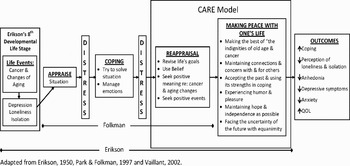
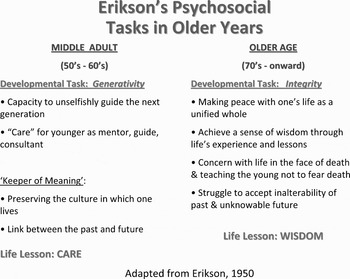
Erikson's (Reference Erikson1950) description of the psychosocial goals at life stages of normal aging serves as the first theoretical underpinning for this intervention. Stage 7, the middle adult stage, is characterized by the developmental task of generativity: moving from primary interest in oneself to concern for others and mentoring the next generation, serving as a link between the past and future (Vaillant, Reference Vaillant2002). Failure to accomplish these tasks leads to a sense of “stagnation” (including rejecting others and maintaining rigid views that interfere with interpersonal connectedness). In the eighth and final stage, the psychosocial task is to achieve ego integrity—a sense of “making peace” with one's life (see Fig. 1). This accounts for the strong reliance on life review as a therapeutic intervention in older people (Butler, Reference Butler1963). Achieving ego integrity is equated with achieving wisdom; the absence of ego integrity is “despair” and “disdain,” which, in today's terminology, suggests they are vulnerable to psychological distress, depressive symptoms, loneliness, and isolation. Elderly who, for many reasons, may fall short of “making peace” have fewer personal and interpersonal resources for facing cancer. They are vulnerable to developing depressive symptoms along the spectrum from minor to major depression. These reasons may contribute to the fact that depression in older people has a different clinical appearance and may explain the common form of subsyndromal depression seen in the elderly. This is consonant with clinical experience and adds weight to the importance of an intervention that addresses these symptoms from a developmental point of view.
An integrated approach, the care model: psychosocial intervention for elderly with cancer. Adapted from Erikson (1950), Park and Folkman (1997), and Vaillant (2002).

Folkman Model of Coping
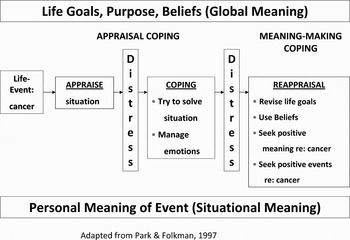
The literature on coping has shown that people deal with significant distress by using “meaning schemas,” or basic assumptions, beliefs, values and goals about the world (Janoff-Bulman, Reference Janoff-Bulman1989; Park & Folkman, Reference Park and Folkman1997), for example, the belief that the world is just or that events can be largely expected. When confronted with a life-threatening event, these assumptions are shattered. When this occurs, a new meaning schema must be developed that integrates the catastrophic event into an acceptable and tolerable “present” (Park & Folkman, Reference Park and Folkman1997). Lazarus and Folkman's original paradigm (Folkman et al., Reference Folkman, Lazarus and Dunkel-Schetter1986a, Reference Folkman, Lazarus and Pimley1986b) describing cognitive appraisal and reappraisal was modified by Folkman's later research, which expanded the reappraisal phase to address exploring the meaning of events (see Fig. 2). Thus, people facing life-threatening circumstances coped better when they were able to attach a tolerable meaning to (i.e., “reappraise”) the event through using prior beliefs, revising life goals, and finding positives within the otherwise negative circumstances (Folkman, Reference Folkman1997; Folkman & Greer, Reference Folkman and Greer2000).
Folkman's coping model.

Integration of the Folkman and Erikson Theoretical Models
The evidence indicates that older cancer patients generally adjust more effectively to cancer than do younger patients (Eton & Lepore, Reference Eton and Lepore2002; Blank et al., Reference Blank, Bellizzi and Murphy2003; Blank & Bellizzi, Reference Blank and Bellizzi2006; Institute of Medicine, 2007a, 2007b), suggesting that, for a majority of aging cancer patients, the developmental process of aging produces “psychological immunization.” Blank and Bellizzi (Reference Blank and Bellizzi2006) suggest that, as adults age past 65 years old, the way they view the world naturally shifts. They often develop a shorter time perspective for their goals, become more selective in their activities, focus on emotional regulation rather than exploring the world, and express a narrower range of emotions. Older adults tend to become more contemplative. These normal aspects of aging may help older individuals to cope with cancer. These responses fit well with Erikson's theory that as people develop integrity and wisdom, they become more internally focused and are able to use their life experience and wisdom. They also fit well with Folkman's suggestion that reappraising a situation helps one develop a tolerable meaning for it (see Fig. 3).
Geriatric-specific group psychoeducational intervention.

Despite the findings above, the literature suggests that around 20–25% of older patients with chronic medical illnesses, including cancer, exhibit significant levels of depressive spectrum symptoms (Lyness, Reference Lyness2004; Pirl, Reference Pirl2004). In addition, many are demoralized, anxious, and/or socially isolated, leading to a lower quality of life. It is proposed that these aging cancer patients are not utilizing age-appropriate developmental resources (those who have stagnation and despair in contrast to generativity and integrity) to most effectively help them cope. The negative feelings of despair in the eighth stage are associated with a sense of hopelessness that the life they have lived cannot be accepted and that “it is too late to change.” This is believed to translate clinically into the above symptoms. The proposed intervention targets these patients with an effort to help them adjust better to cancer using age-appropriate psychosocial strengths associated with older age (as suggested by Erikson et al., 1986; Vaillant, 2002), in the hopes of facilitating these patients' ability to reappraise their situation and develop a more adaptive coping (as suggested by Folkman (1997)). The content and mode of delivery are directed toward reducing depressive spectrum symptoms of depression, anxiety, and/or demoralization, coping, and countering the loneliness by the group intervention, thus improving quality of life.
The proposed psychoeducational intervention differs from others in that it intervenes with older patients whose illness often entails prolonged treatment over years. It is primarily cognitive based, utilizing Folkman's cognitive coping paradigm. She noted that coping ability is enhanced when reappraisal includes revising life goals, using spiritual beliefs, and finding positive aspects of negative events (Folkman, Reference Folkman1997; Park & Folkman, Reference Park and Folkman1997). The proposed therapy is also distinct from others in that it does not focus on end-of-life issues per se, but takes into account the aging process, with the threat of severe or chronic illness, and how to live a more fulfilled life in the face of cancer. There is an existential component that crosses all these therapies, because a natural part of aging involves thinking about death. However, it is believed that a cognitive coping approach combined with an understanding of the Eriksonian tasks of older age, that is, life review discussions, sharing memories, finding meaning and passing on wisdom, provides a more appropriate and pragmatic focus.
Development of a Geriatric-Specific Group Psychoeducational Intervention
As a first step in the development of this intervention, two expert panels were established, each comprised of patients over age 70 who had had cancer or were currently coping with it. Patients in the first group were given readings that included the works of Erikson and Vaillant regarding life stages and the coping paradigm of Folkman, along with personal stories of illness. They reviewed the content of the planned sessions and provided feedback about reading materials, the best route of delivery to reach people, how to advertise the program, and the likelihood that older adults would participate. Arean et al. (Reference Arean, Alvidrez and Barrera2002) explored this issue with elderly people and found that they preferred programs that included education along with support. The concept of a group intervention was maintained because of the significant social isolation reported and its deleterious effects on coping as well as outcome (Bruce et al., Reference Bruce, Ten Have and Reynolds2004; Institute of Medicine, 2007b).
With a second group, the group participated in seven 1-h simulated sessions; the last 30 min of each session was used to critique style and content. In keeping with known preference for psychoeducational interventions, participants outlined issues, problems, and resolutions relevant to the theme of the session and possible solutions. The panel wanted help with day-to-day practical problems of living and dealing with family issues. They were less interested in discussing abstract and existential issues related to death, though they were quite aware of their mortality. They liked the interaction with others who were “in the same boat.” Reading materials, session content, and the style of facilitation were modified as suggested. The intervention and evaluation plan have been markedly revised based on the feedback of the two panels to develop a more authentic “fit.” This intervention is presently proposed for trial of feasibility and acceptability. The seven sessions include the topical areas discussed in a group setting.
Group Session Topics
• Coping with Cancer and Aging: Dealing with the combined problems of illness and aging
• Facing the Unknowns of Cancer and Aging: Coping with concerns, worries, and fears of the future
• Loneliness and The Stigma of Cancer and Aging: Loneliness and reduced social circles in later years
• Making Peace with One's Life: Who Am I? Coming to terms with “who I am now”
• Wisdom and the Keepers of Meaning: Contributing to the greater good, passing on one's worth and wisdom
SUMMARY
The novelty of the proposed psychoeducational intervention lies in its grounding in a well-established developmental theory, integrated with cognitive therapy that capitalizes on older adults' particular receptiveness to cognitive reappraisal. Folkman's concept is used within Erikson's developmental framework to achieve integration with the adaptive developmental psychosocial tasks that accompany aging according to Erikson's model. This dual theoretical model will facilitate the reappraisal of one's situation within the context of both cancer and aging.
We anticipate expanding the development of this model therapy in collaboration with other facilities invested in applying a novel therapeutic approach for older adults. We developed this pilot intervention as a group intervention, as opposed to individual psychoeducational intervention, to additionally address issues of social isolation. However, such an intervention may be developed for a variety of delivery systems. Modifying the intervention to individual telephone-based settings could preserve the interpersonal psychoeducational component while making allowances for physical limitations that prohibit patients from attending group meetings.