
Introduction
In aquatic ecosystems, both marine or fluvial, algae and aquatic plants play many roles, acting as primary producers of organic matter and micro-habitat for an enormous fauna of microorganisms; they contribute to the self-purification of water with various chemical–physical processes and they cause a local slowdown of the water flow, with retention and sedimentation of fine inorganic and organic particles. Algae are renowned for their antifouling properties, so interesting and efficient that many studies tried to replicate them with artificial solutions.[Reference Maréchal and Hellio1, Reference Chapman, Hellio, Sullivan, Brown, Russell, Kiterringham, Le Nor and Regan2] Considering also their use as nutritious food in human society, for many years algae have been massively cultured in natural, controlled or artificial environments.[Reference Tamiya3] Because of this, many studies have been conducted with the aim to understand how external factors affect their growth and properties. One of the key factors is the hydrodynamic environment: water flow causes the movement of the algae which can occur in many ways, depending also on their shape, structure, and mechanical properties.[Reference Edgar4–Reference Olanrewaju, Magee, Kader and Tee10] Such motion influences their growth and productivity,[Reference Leigh, Paine, Quinn and Suchanek11] the exchanges of nutrients and carbon dioxide, as well the rates of photosynthesis.[Reference Gonen, Kimmel and Friedlander12] Although there is a lot of research about natural algae, few examples can be found regarding the use of artificial ones.
Materials science can help in finding new materials able to mimic some of the typical properties of algae that can be used for specific applications like Chapman et al. did,[Reference Chapman, Hellio, Sullivan, Brown, Russell, Kiterringham, Le Nor and Regan2] but also to create hybrid habitats where artificial algae can cohabit with other living organisms.[Reference Edgar4] A novel approach combining smart materials and high-definition free-form manufacture technologies can be explored, aiming at the design and manufacture of artificial algae whose movement can be remotely controlled not with a water flow but with low-power electric impulses. This could allow to obtain very specific motion patterns and to see how they influence the surrounding habitat (natural or artificial, which can include living organisms, microorganisms, sediments, particulate, other aquatic plants). For this purpose, electroactive hydrogels (EAHs) may represent the material of choice.
Hydrogels are soft cross-linked polymeric materials with hydrophilic groups bound to the polymeric chains, thus they are able to absorb huge amount of water and their mechanical properties are similar to those of soft tissue and natural algae.[Reference Hoffman13–Reference Lee and Mooney15] Their electroactivity resides in their capability to rapidly and reversibly convert low-power electric signals into mechanical work when they are immersed in saline solutions. More specifically, their polymeric chains possess fixed charged groups coordinated to mobile counterions, and this anisotropic distribution leads to a macroscopic asymmetric deformation under the application of an electric field.[Reference Doi, Matsumoto and Hirose16, Reference Glazer, Van Erp, Embrechts, Lemay and Mendes17] EAHs have been widely studied for applications in biotechnologies, soft robotics, and smart fluidics,[Reference Kwon, Choi, Park, Woo, Lee, Kim and Lee18–Reference Jayaramudu, Ko, Kim, Kim, Li and Kim23] although very few of them come from natural polymers,[Reference Fu, Shang, Chen, Yu and Zhao24, Reference Tian, Shao and Chen25] an increasingly important feature for present and future technology. Many examples of cellulose-based hydrogels obtained through physical or chemical cross-linking can be found in the literature for applications in many fields, such as drug delivery, tissue engineering, and biotechnology[Reference Chang and Zhang26]; however, to our knowledge, there are no examples of all-cellulose EAHs used as underwater electromechanical actuators.
The aim of this work is to combine the formulation of smart and natural-derived polymers with three-dimensional (3D) printing techniques, in order to demonstrate that EAHs can be used to develop artificial algae forests whose motion can be finely controlled thanks to electroactive properties and to the design of the system. To do this, we used Na-carboxymethylcellulose (Na-CMC) and 2-hydroxyethylcellulose (HEC) as natural-derived building blocks. Na-CMC supplies the ionic groups responsible for electroactivity and it is cross-linked by means of polyethylenimine (PEI), while HEC provides a flexible but still robust hydrogen-bond network. The hydrogel's swelling and electroactive properties have been characterized and interpreted accordingly to dynamic electroactivity models and we assessed its suitability to operate with low applied voltage in aqueous solution with low salt concentration (like sweet water typical of lakes and rivers). Then a custom apparatus has been designed and manufactured by 3D printing through Fused Filament Fabrication (FFF), a technique extremely useful for its speed and versatility. With this, it was possible to build up a compact yet versatile system able to integrate many hydrogel samples (together with a couple of electrodes) and to control their motion, mimicking the fluctuations of a small forest of algae.
Materials and methods
Chemicals
Na-CMC, average MW ~250,000, degree of substitution 1.2, Sigma Aldrich; 2-HEC, average MW ~250,000, Sigma Aldrich; PEI, branched, average MW ~25,000, average Mn ~10,000, Sigma Aldrich; N-(3-dimethylaminopropyl)-N′-ethylcarbodiimide hydrochloride (EDC.HCl), ≥98.0%, Sigma Aldrich (Sigma Aldrich, St. Louis, Missouri, United States).
Hydrogel synthesis
Thin films of cellulose-based EAH were prepared with the following procedure. Two hundred micrograms of Na-CMC were dissolved in 11 mL of pure water, at room temperature, under stirring and by small additions. After 1 h, 150 mg of HEC were added in the same conditions and the solution was left under stirring overnight. Then 1 mL of a solution of PEI 40 mg/mL was added, as well as 1 mL of a solution of EDC.HCl 80 mg/mL (used as a condensing agent to promote the formation of the amidic bond between Na-CMC and PEI). After 1 h, the mixture was injected inside an open mold composed by a thick glass slide and a silicon frame (4 cm × 5 cm) of various thickness (from 0.5 to 1.5 mm). Water was then removed by keeping the mold under moderate vacuum for 48 h and then it was put in oven at 70° for 6 h (to trigger chemical reaction between Na-CMC and PEI). The obtained cross-linked thin films were then physically removed from the glass, weighed and washed in pure water in order to remove any unreacted species.
Swelling tests
To study the hydrogel's swelling, five aqueous solutions were prepared with NaCl concentration (C s) of 0.5, 0.3, 0.15, 0.05, and 0.005 M. Hydrogel samples have been weighed right after synthesis (m 0) and after soaking in each saline solution for at least 4 h (m s). The swelling ratio S r was calculated as the ratio between m s and m 0. Then S r was plotted against pC = −log 10C s and the obtained points were interpolated by a straight line of formula S r = (σ × pC s) + S r,0.
Electromechanical characterization
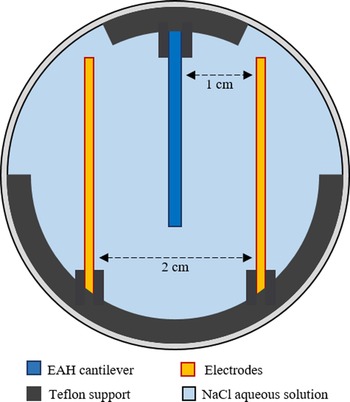
Electromechanical tests were carried out in the solution of NaCl 0.005 M. One millimeter-thick swollen samples were cut in a cantilever shape (18 mm × 3 mm) with a square basis (6 mm × 6 mm) to be fastened by a Teflon support, and they were immersed in the solution. The 35 mm × 10 mm × 0.3 mm brass-based foils were coated with gold using physical vapor deposition; they were put in the solution 1 cm apart from each side of the hydrogel and they were used as electrodes to apply an electric potential going from 0.25 to 3 V/cm. The equipment used for the metal deposition was an Edwards Coating System (model E306A). By using a camera connected to a personal computer, videos were captured for each test and then analyzed to calculate the maximum bending angle α (°) of the cantilevers, using an image processing software (ImageJ) and with the help of a millimetric grid. Since the speed of the actuation gradually decreases during the deformation, the average angular speed ω 1/2 (°/s) was calculated only considering the first half of the displacement. All the experiments were conducted at room temperature. Figure 1 shows a schematic representation of the described experimental set up.
Schematic representation describing the setup used for the electromechanical characterization of the cellulose electroactive hydrogel.[Reference Migliorini, Santaniello, Yan, Lenardi and Milani21]

Algae forest simulation experiment
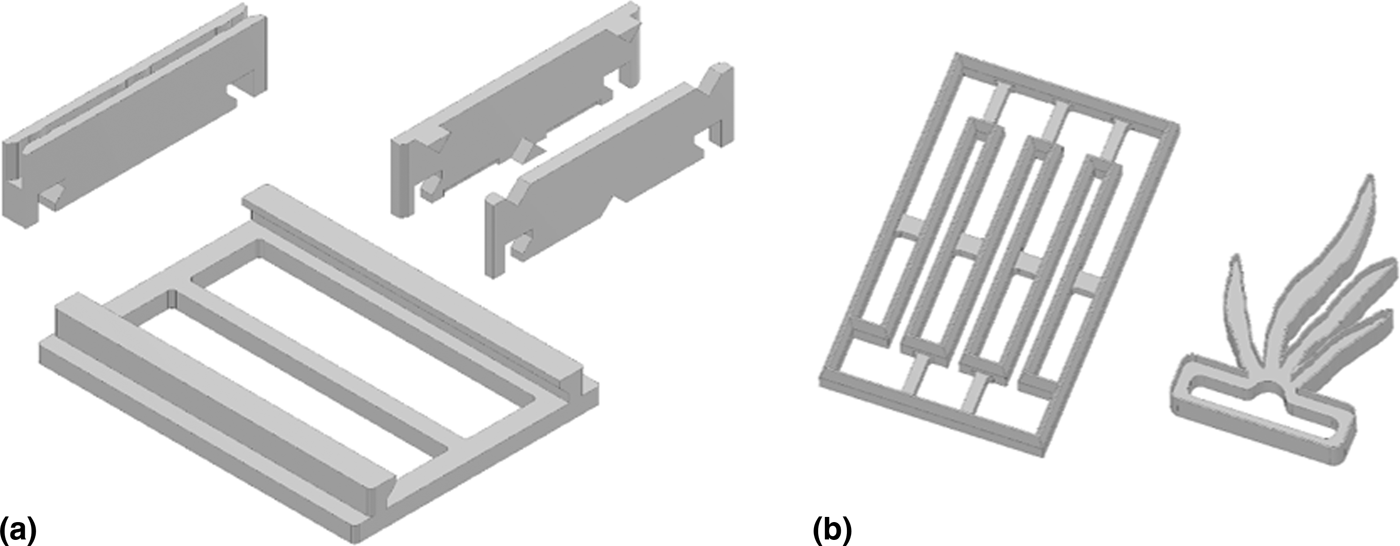
A testing system was custom-designed and 3D-modeled (using Autodesk Inventor software) to properly fit few arrays of hydrogel samples and two metallic electrodes in a modular system composed of multiple parts. In the system layout, a base frame with two rails (80 mm × 62 mm × 10 mm) acts as a positioning support for both the electrode clamps (6 mm × 60 mm × 16 mm) and the hydrogels clamps (6 mm × 60 mm × 16 mm, detachable into two interlocking parts). The clamps were designed with equal hollows fitting the rails profile, so that they can be freely positioned along the base frame to lay out different configurations of the testing elements. All of the setup parts were manufactured by 3D printing through FFF technique in Acrylonitrile Butadiene Styrene (ABS) polymer material (using a 3Dline Zeus 3DL printer). Two aluminum plates (60 mm × 60 mm × 1 mm) were coated with gold using physical vapor deposition and they were used as electrodes. To give to the hydrogel samples a specific precise shape, custom die cutters were modeled and 3D printed by using the same aforementioned solutions. Figures 2(a) and 2(b) show the design of all the components described above. Then samples of various thickness (from about 0.3 to 1 mm), already swollen in the 0.005 M NaCl test solution, were cut in three (4 mm × 40 mm) or four (6 mm × 40 mm) arms cantilevers or in an algae-like shape, according to the used die cutter. The 3D-printed testing system was used to clamp multiple arrays of samples (from two to five) between the electrodes placed at a variable distance (from 3 to 8 cm). With the same instrumentation described before, potentials from 0.25 to 1 V/cm were applied in continuous and also within a frequency range from 0.1 to 0.5 Hz.
Three-dimensional (3D) design of the components 3D-printed through Fused Filament Fabrication technique. (a) Base frame with two rails that acts as a positioning support for both the electrode clamps and the hydrogels clamps (detachable into two interlocking parts). (b) Custom die cutters used to give specific shapes to hydrogels films.

Results and discussion
The adopted synthesis process is water-based, focused on the use of natural-derived polymers and lacking harmful reagents. Considering also that it does not require high temperatures or advanced instrumentation, we believe it to be in line with green chemistry philosophy and with the requests of our contemporary society. In this way, we could obtain thin and transparent films of hydrogel that swell and absorb water when immersed in aqueous solutions.
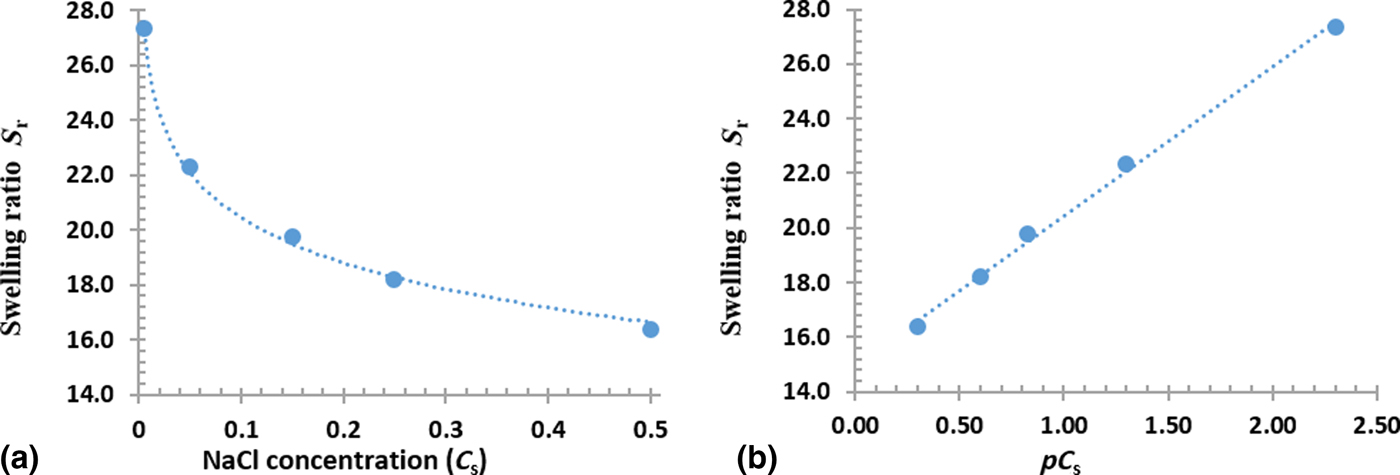
The swelling behavior and the electroactivity of the samples were tested and studied in order to obtain a fingerprint of this novel cellulose-based EAH. The water uptake of these class of electroactive polymers derives from their hydrophilicity, but there is also the influence of the osmotic pressure that arises from the difference in the ionic concentration inside the hydrogel (C g) and in the surrounding solution (C s). Figure 3(a) shows a graph reporting the swelling ratio S r of the hydrogel samples after soaking them in NaCl solution at different salt concentration (C s).[Reference Migliorini, Santaniello, Yan, Lenardi and Milani21] As can be seen, the theoretical behavior is confirmed, since the water uptake increased in the more diluted solution, reaching a peak value of 27.4 in the solution of NaCl 0.005 M. Figure 3(b) reports the values of S r plotted against pC s and it can be seen how they are almost interpolated by a straight line of equation S r = (σ × pCs) + Sr,0. In this case, σ is equal to 5.45 and it indicates how much the water uptake is sensitive to variations in the solution's salt concentration. S r,0 is equal to 15.00 and it represents the virtual value that S r would have in a 1 M NaCl solution. The gathered information on the hydrogel's swelling are essential in order to understand and even to predict its electroactivity. In fact, the S r trend suggests that the ionic concentration inside the gel (C g) is higher than in the outside solution (C s), and as a consequence, the dominant driving electromechanical mechanisms should be the dynamic enrichment/depletion model proposed by Doi et al.[Reference Doi, Matsumoto and Hirose16] Briefly, the mechanical deformation of these class of hydrogels derives from an asymmetric change in the osmotic pressure between the two sides of the hydrogel and the surrounding solution, which is caused by the ionic migration under the application of an electric field. Since the swelling curve shows at which value of C s the swelling variation is more pronounced, then it provides information about the electroactivity at different salt concentration in the surrounding environment. In our case, the curve's slope is higher in diluted salt solutions, meaning that at those concentrations, the electromechanical deformation will be more pronounced than in more concentrated ones. The 0.005 M NaCl solution was then selected for this reason and also because it is similar to natural sweet water.
Graphs reporting the values of the hydrogel's swelling coefficient S r plotted against (a) NaCl concentration (C s) in the soaking solution and (b) the negative logarithmic value of C s.

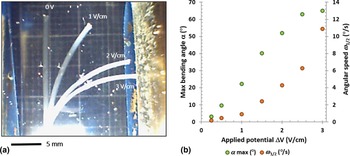
Under the application of an electric potential ΔV, the samples showed a reversible bending toward the cathode. Figure 4(a) shows the overlaying of different pictures taken during the tests, while Fig. 4(b) shows a graph reporting the values of the bending angle α and the average angular speed ω 1/2 at different applied potentials. As can be seen, the samples are sensitive even for low applied potentials of 0.25 V/cm, with α = 3.1° and ω 1/2 = 0.16°/s. Both parameters increase at higher applied potential, reaching maximum values of α = 65.1° and ω 1/2 = 10.9°/s at 3 V/cm. Under the application of 1 V/cm, a value under the potential of water electrolysis and then of great interest for real underwater applications, α = 22.3° and ω 1/2 = 0.89°/s at 3 V/cm. A captured video can be found in online Supplementary material (VID. S1.).
(a) Overlaying of pictures taken during the electromechanical characterization of a single cantilever-shaped hydrogel immersed in an aqueous solution of NaCl 0.005 M. (b) Graph reporting the values of the bending angle α (green spots, left axis) and the average angular speed ω 1/2 (orange spots, right axis) of the cantilever actuator at different applied potentials.

For what concerns the mechanical, thermal, and electrical properties of these hydrogels, many tests could be carried out to study their thermal diffusivity, elastic modulus, mechanical strength, ion exchange capability, and other parameters in order to have an in-depth knowledge of the material in view of applications. However, all of these properties will be examined and characterized in future studies, since the current work is primarily focused on the hydrogel's electroactive properties and on the possibility to remotely control its underwater motion with electric signals.
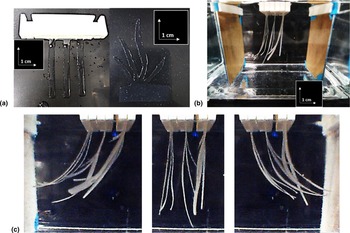
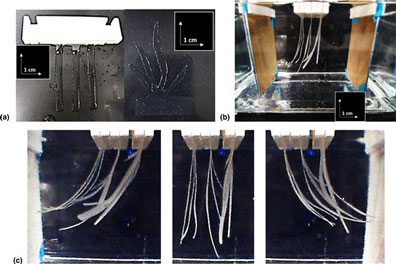
A further step in our investigation was achieved by developing a system which combines several actuators of different shapes (multi-arm cantilevers and algae-like) and controls their motion with the application of an alternating potential, in an attempt to mimic the undulatory behavior of a small forest of algae moved by water flow. FFF 3D printing was selected as a rapid and versatile technique to manufacture a modular testing apparatus and custom-shaped die cutters for the hydrogel samples. The testing apparatus was solely composed of ABS 3D-printed components which could be assembled by either sliding or interlocking connections. By suppressing the need for external joints among the parts (e.g., screws and bolts), we could significantly improve the compactness of the apparatus and also avoid the presence of conductive elements which could perturb the electric field configuration in the testing region. Moreover, this design allowed to freely deploy the various elements on the system in different number and positions. As for the hydrogel cutters, we assessed the possibility to design and 3D print a die which replicates the profile of arbitrary-shaped multi-arm cantilevers and even realistic algae starting from a vector image or non-uniform rational basis-splines curves. The fabricated cutters were effectively used to shape hydrogel films in a single punching operation preventing any longitudinal stress on the samples, which is a considerable advantage with respect to other cutting techniques. The resulting custom-shaped actuators can be seen in Fig. 5(a).
(a) Custom-shaped hydrogel actuators. (b) Picture showing one of the experimental setup, with three arrays of actuators and the electrodes placed at a distance of 8 cm. (c) Pictures showing the simultaneous bending of the actuators under an applied potential of 1 V/cm (both opposite polarities) compared with the rest position with no applied potential (the picture in the middle).

With the aid of this experimental system, it was possible to successfully deploy and control the motion of multiple arrays of actuators in several configurations: from two to five arrays of different shape, with the electrodes placed at distances from 3 to 8 cm and with potentials ranging from 0.25 to 1.0 V/cm. We could state that even for low applied potentials of 0.25 V/cm, all the actuators simultaneously bended toward the cathode, and under the effect of an alternating potential, they displayed an undulatory motion that resembled the one typical of real algae (few videos can be found in Supplementary material, VID. S2., VID. S3., and VID. S4.). Figure 5(b) shows one of the experimental setup, with three arrays of actuators and the electrodes placed at a distance of 8 cm. Figure 5(c) includes three pictures showing the simultaneous bending of the actuators under an applied potential of 1 V/cm (both opposite polarities) compared with the rest position with no applied potential (the picture in the middle). Such results assess the suitability of this novel cellulose-based EAH to be dynamically and remotely controlled with low electric signals in underwater environments similar to natural-occurring sweet water, mimicking the cooperative mechanical motion or real algae forests.
Conclusions
We presented the synthesis and the characterization of a novel natural-derived EAH using cellulose derivatives as building blocks and obtained through a simple water-based process. Its swelling properties and electromechanical actuation have been studied and interpreted in the context of the dynamic enrichment/depletion model, showing a reversible bending actuation even for low applied potentials of 0.25 V/cm in diluted saline aqueous solutions similar to natural sweet water. Then a testing system was custom-designed and manufactured using a FFF technique that was chosen because of its speed, versatility, and reproducibility. Several arrays of actuators of different shape (multi-arm cantilevers and algae-like) have been tested together in a configuration resembling a small forest of natural algae, whose motion was remotely controlled by means of electric signals in order to mimic seaweeds spontaneous fluctuations under a water flow. By the combination of natural polymers, smart materials science, and 3D printing technique, it was possible to move a first step toward the design and the realization of hybrid habitats where one day artificial and controllable algae could cohabit with real living organisms or microorganisms typical of aquatic natural environments.
Supplementary material
The supplementary material for this article can be found at https://doi.org/10.1557/mrc.2018.163