Introduction
Intrauterine growth restriction (IUGR) is one leading cause of neonatal morbidity and mortality, affecting 5–7% of all pregnancies worldwide.Reference Zhang, Merialdi, Platt and Kramer 1 IUGR babies are predisposed to adult disorders such as obesity, diabetes, hypertrigyceridemia and hypertension, which contribute to the ‘metabolic syndrome’.Reference McMullen, Langley-Evans and Gambling 2 Many epidemiologic and animal studies have confirmed that this predisposition is programmed in utero.Reference McMullen, Langley-Evans and Gambling 2 – Reference Nuyt 4 Under suboptimal intrauterine conditions (e.g. hypoxia, malnourishment), a fetus modulates its metabolism to guarantee immediate survival and to preserve vital functions at the expense of those less critical. However, while these changes may be beneficial prenatally, the altered physiologic functions appear to have detrimental metabolic consequences later in life,Reference Ozanne, Fernandez-Twinn and Hales 5 often in a sex specific manner.Reference Baum 6 , Reference Woods, Ingelfinger and Rasch 7 These metabolic adaptations coincide with impaired organ development related to metabolic syndrome, including the liver,Reference Sohi, Marchand, Revesz, Arany and Hardy 8 pancreas,Reference Chamson-Reig, Thyssen, Hill and Arany 9 adipose tissueReference Guan, Arany and van Beek 10 and heart,Reference Rueda-Clausen, Morton, Lopaschuk and Davidge 11 and of particular interest for our studies, the fetal kidney.Reference Vehaskari 12
Altered renal development in utero, including changes in nephron number and in the renin-angiotensin system (RAS), are contributing factors in the development of high blood pressure in rats exposed to a low protein (LP) diet during gestation.Reference Vehaskari, Aviles and Manning 3 , Reference Harrison and Langley-Evans 13 The RAS exerts many physiologic effects through the actions of angiotensin II and its G-protein coupled receptors: AT1R and its co-factor Gqα/11α increases intracellular calcium signaling and smooth muscle constriction while AT2R through GαS, leads to nitric oxide-dependent effects.Reference Padia and Carey 14 – Reference Mogi, Iwai and Horiuchi 16 Prenatally, AT1R and AT2R signaling are critical for nephrogenesis and glomerular formation,Reference Chen, Lasaitiene and Friberg 17 and these pathways have been shown to be aberrant in animal models of IUGR.Reference Alwasel, Kaleem, Sahajpal and Ashton 18 , Reference Vehaskari, Stewart and Lafont 19 Imbalances in these pathways contribute to adult hypertension and diabetic-induced renal dysfunction,Reference Brinks and Eckhart 20 although their role in IUGR has not been fully elucidated.
Recently, an orphan G-protein coupled receptor 91 (GPR91) was discovered to have a role in the pathogenesis of adult hypertension, through a RAS-dependent pathway.Reference He, Miao and Lin 21 Infusion of succinate (the endogenous ligand for GPR91) into mice caused an elevation in blood pressure, an effect that was eliminated by pre-treating mice with angiotensin converting enzyme (ACE) inhibitors, supporting activation of the RAS through GPR91.Reference He, Miao and Lin 21 Furthermore, recent reports highlight the succinate-GPR91 pathway in the pathophysiology of both diabetes and hypertension.Reference He, Miao and Lin 21 , Reference Toma, Kang and Sipos 22 However, the role of GPR91, in conjunction with the classical RAS pathway, including renin, AT1R and AT2R, in fetal life and specifically in models of IUGR, has not been investigated.
Therefore, the purpose of this study was to characterize the novel GPR91 as well as renin, ACE, AT1R, AT2R and their downstream modifiers Gqα/11α and GαS in a maternal LP rat model of IUGR, during fetal life and following birth. We postulate that there will be sex-specific alterations in the GPR91 and RAS pathways both in utero and postnatally.
Materials and methods
Animals, diets and tissue collection
All procedures were performed in accordance with the guidelines set by the Canadian Council of Animal Care and approval of the Animal Use Sub Committee of Western University, Canada. Female and male Wistar rats at breeding age (8 weeks) were purchased from Charles River (La Salle, St-Constant, Quebec, Canada). These rats were housed in individual cages and maintained at room temperature on a 12:12 hour light-dark cycle. For 3 days, these rats were left to acclimatize at the animal care facility and their reproductive cycles were followed. At the onset of pro-estrous, rats were mated. Impregnation was confirmed by the presence of sperm in the vaginal smear the next morning (gestation day 1). At this point pregnant dams were separated into two groups and fed with a control diet containing 20% protein (C) or a LP diet containing 8% protein (Hope Farms rat chow diets prepared by Bio-Serv, Frenchtown, NJ, USA). The LP diet contained a similar fat content and was made isocaloric by the addition of carbohydrates.
At embryonic day 19 (E19), 2 days before birth, a subset of LP and control pregnant dams were sacrificed, and the weight of the fetus recorded and kidneys and livers collected (n⩾6 per group). The rest of the rats were allowed to deliver spontaneously. At birth, the litter size was reduced to eight animals (four females and four males), with weights closest to the litter mean. This ensured a standard litter size for all mothers. Offspring from both groups were fed with their corresponding diets until weaning. Food and water were provided ad libitum. At weaning on postnatal day 21 (d21) male and female offspring were sacrificed (n⩾6 per group) kidneys were removed, weighed and snap frozen in liquid nitrogen until later preparation for mRNA and protein quantification. Therefore, the animals were grouped for the studies in the following manner: maternal control diet offspring at E19 and d21 (males and females) and maternal LP diet at E19 and d21 (males and females).
Real time PCR analysis of AT 1 R, AT 2 R, ACE, renin GPR91 and GPR99 in kidneys
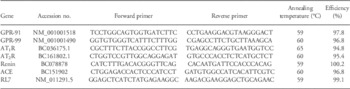
Kidney or liver total RNA, was prepared with TRIzol reagent (Invitrogen Life Technologies Inc., Burlington, ON, Canada); 2.5 μg of RNA template was used for cDNA generation using superscript and oligo dT primer (Invitrogen Life Technologies Inc.). Real-time PCR was performed using 20 ng of diluted cDNA, 200 nM of each primer, and SYBR Green PCR mix (BioRad, Hercules, CA, USA) on the CFX384 Real-Time PCR Detection System (Bio-Rad). Specific primer sets were used for renin, ACE, GPR91, GPR99 (a homologous receptor to GPR91 but not linked to hypertension, measured as an external control), AT1R, AT2R or RL7 (housekeeping gene; Table 1). A relative standard curve of pooled kidney cDNA was generated (six standards prepared as four-fold serial dilutions) and used for primer efficiency calculations and quantification of unknown sample expression. All primer sets demonstrated good linear correlation (slope=−3.4) and equal priming efficiency for the different dilutions compared with their C t values (Table 1). Dissociation curves were constructed to verify quality of a single PCR product, followed by a gel to confirm that the size of the product was correct and specific PCR products were sequenced to confirm identity. Target cDNA levels were quantified utilizing iQ SYBR Green Master Mix (Bio-Rad, Mississauga, ON, Canada) and all results were normalized to renal RL7 RNA. The relative expression of each gene was expressed as a fold change of the target gene to zero using the Pfaffl equation.Reference Pfaffl, Horgan and Dempfle 23 RNA extracted from livers, was used for sex-determination by the presence or absence of the SRY gene.
Gene, accession number, forward and reverse primer sequences and calculated efficiencies used for real-time PCR analysis

ACE, angiotensin converting enzyme; RL7, ribosomal protein L7.
Western blot analysis
Kidney whole cell and tissue membrane extracts were prepared using modifications of previously published methods.Reference Fanger 24 Kidney membrane preparations were isolated for AT1R, AT2R, GPR91 and GPR99 and whole cell lysate was used for Gαq/11α and GαS. Briefly, a piece of snap frozen kidney tissue was homogenized in a 1.2 ml of buffer A solution (250 mM sucrose, 2 mM MgCl2, 20 mM Tris-HCl at overall pH 7.5) with protease inhibitor cocktail (Roche, Mississauga, ON, Canada). The homogenate was centrifuged at 2000 g for 10 min at 4°C. The supernatant was retained and buffer A was added. This was centrifuged at 120,000 g for 45 min at 4°C and the pellet was retained as the membrane fraction which was resuspended in 200 μl of buffer B (80 mM NaCl, 2 mM CaCl2, 1% Triton X-100, 50 mM Tris-HCl at overall pH 8) with protease inhibitor cocktail (Roche). Protein quantity was determined using a Detergent Compatible Protein Assay kit (BioRad). Equal amount (20 μg) of membrane proteins were fractionated on a 4–12% SDS-PAGE gradient gel and transferred onto PVDF membrane (Millipore, Bedford, MA, USA). Equality of protein loading on PVDF membrane was confirmed by staining with Amido Black, per manufacturer’s instructions, before incubation with primary antibody.
AT1R and AT2R protein levels were determined with antibodies purchased from Santa Cruz (AT1; SC-1173, 1:1000, AT2; SC-9040, 1:1000) as well as GPR99 (SC-1234, 1:2000) and antibodies from Millipore were used to detect GPR91 (AB9475, 1:500). Membrane blots from whole cell lysates were incubated with antibodies purchased from Santa Cruz Biotechnology (Santa Cruz, CA, USA), to determine the levels of GαS (SC-9040, 1:500), or from Calbiochem (EMD Chemicals, Gibbstown, USA) for Gqα/11α (371,730, 1:1000). For all samples, β-actin was used an internal standard, as previously published by others (Sigma-Aldrich, 1:50,000).Reference Ferguson, Carroll and Harris 25 , Reference Westenfelder, Biddle and Baranowski 26
After an overnight incubation at 4ºC, blots were incubated for 1 hour at room temperature with a horseradish peroxidase conjugated donkey-anti rabbit secondary antibody (711-035-152, 1:10,000; Jackson ImmunoResearch Laboratories Inc., West Grove, PA, USA) and specific proteins were detected using ECL chemiluminescence substrate (Thermo Fisher Scientific, Rockford, IL, USA). Western blot analyses were performed by standard methods using enhanced chemiluminescence, as per manufacturer’s instructions (Thermo Fisher Scientific), and quantification carried out using Quantity One software (Bio-Rad).
Statistical analysis
All data are presented as mean±s.e.m. mRNA data is expressed as fold differences of relative expression of mRNA (normalized to RL7 mRNA) compared with controls for each sex. Protein data were analyzed with BioRad Quantity One software and expressed as percent of protein content relative to control (after normalization to β-actin protein levels for each sample). Normalcy of the data were tested with a two-tailed F test and then analyzed using Student’s t-test or one-way ANOVA. A P-value<0.05 was considered significant.
Results
Body and kidney weights
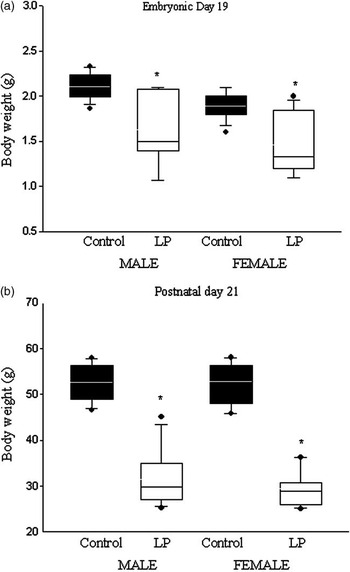
A maternal LP model of IUGR was used in these studies, for which growth parameters and phenotype (e.g. altered glucose homeostasis, hypertension) have been well characterized.Reference Chamson-Reig, Thyssen, Hill and Arany 9 , Reference Langley-Evans, Phillips and Jackson 27 – Reference Zhang, Guan, Arany, Hill and Yang 29 At E19, both male and female embryos were significantly smaller in the LP litters compared with controls (Fig. 1a, P<0.05 v. same gender controls). At postnatal day 21 both male and female offspring from LP fed dams continued to be significantly smaller (Fig. 1b, P<0.05 v. same gender controls). Absolute kidney weight from both males and females were significantly smaller than controls at d21. However, when kidney weight was normalized to body weight, only the male LP group showed a significant decrease in relative kidney mass (kidney/body weight ratio: control male=1.2±0.09; LP male=0.9±0.03, P<0.05).
Box-plot representation of animal whole body weight in low protein (LP) and control offspring. (a) At E19 both male and female LP animals weighted less than sex-matched controls. (b) At d21 animal body weight continued to be less in both male and female LP offspring. Control, ■; low protein, □; n=6 per group; *P<0.05.

Effect of LP diet on AT 1 R, AT 2 R, and downstream modulators of RAS at E19 and d21
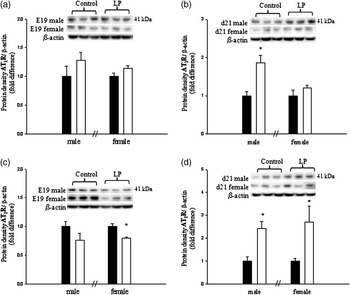
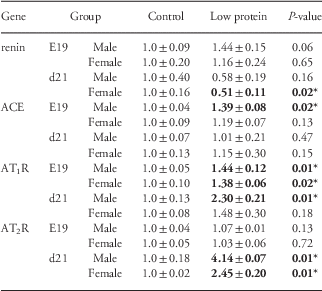
Renal AT1R mRNA expression was increased in kidneys from both LP male and female offspring at E19. At d21, only male LP offspring showed increased AT1R expression (Table 2). Conversely, protein levels of AT1R at E19 were not altered in kidneys from either male or female LP offspring (Fig. 2a). However, at d21, AT1R protein levels demonstrated a significant increase in kidneys from male but not female LP offspring, similar to patterns observed in AT1R mRNA (Fig. 2b).
Western blot analysis of renal AT1R and AT2R at E19 and d21. (a) AT1R protein was not altered by LP diet at E19. (b) However, at d21, AT1R levels were significantly elevated only in LP male offspring (P<0.05). (c) AT2R protein density was decreased only in female LP offspring at E19 (P<0.05). (d) On d21, AT2R protein density was significantly increased in both male and female LP offspring (P<0.05). Control, ■; low protein, □; n=6 per group; *P<0.05.

Summary of quantitative real-time PCR data for renin, ACE, AT1R and AT2R at E19 and d21 in kidneys from LP and control male and female offspring

ACE, angiotensin converting enzyme; LP, low protein.
Data are presented as fold difference, after normalization to a housekeeping gene RL7, compared with gender-matched controls for each group. n⩾6 per group, *P<0.05 was considered significant.
AT2R mRNA expression was increased in male and female LP offspring at d21, but not at E19 (Table 2). AT2R protein levels were significantly reduced in LP female kidneys at E19, with no effect observed in males (Fig. 2c). However, at d21, AT2R protein was increased in kidneys from male and female LP offspring (Fig. 2d).
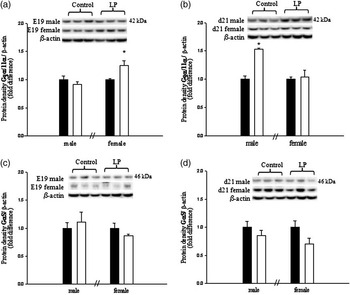
Gqα/11α and GαS are important co-regulators of AT1R and AT2R, respectively. At E19, our data demonstrate that protein levels of AT1R receptor co-regulator, Gqα/11α was significantly increased in kidneys from LP female embryos compared with controls, while no change was observed in male LP animals Fig. 3a. At d21, while Gqα/11α protein levels returned to normal in LP female offspring, kidneys from LP males had significantly elevated protein levels of Gqα/11α v. controls (Fig. 3b). However, at both E19 and d21, the AT2R co-regulator, GαS protein levels were not significantly different among groups (Fig. 3c and 3d).
Westen blot analysis of renal Gqα/11α and GαS at E19 and d21. (a) At E19, Gqα/11α protein was increased in kidneys from female LP offspring compared with controls (P<0.05). (b) However, at d21, Gqα/11α levels were significantly elevated only in LP make offspring (P<0.05). GαS protein density was not different in male or female LP offspring compared with control at either E19 (c) or d21 (d). Control, ■; low protein, □; n=6 per group; *P<0.05.

Effect of LP diet on renin and ACE at E19 and d21
Renin mRNA expression was not altered in female LP offspring at E19, although there was a trend toward increased expression in kidneys from male LP offspring (Table 2). At d21, renin mRNA expression was decreased in female LP offspring, with no difference in LP males compared with controls (Table 2). Similarly, ACE expression was increased only in kidneys from male LP offspring at E19, while at d21 there was no difference in ACE mRNA expression between LP and control animals (Table 2).
Effect of LP diet on renal GPR91 at E19 and d21
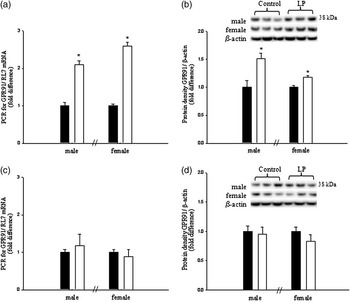
We investigated the effect of LP-induced IUGR on renal expression of GPR91, a G-protein coupled receptor recently implicated in adult hypertension,Reference He, Miao and Lin 21 as well as the closely related GPR99, in order to determine the effect of the LP diet during gestation and lactation. GPR91 mRNA expression was significantly elevated in both LP male and females at E19 (Fig. 4a). GPR91 protein density was also elevated at E19 in kidneys from LP male and female embryos compared with controls (Fig. 4b). On postnatal day 21 there was no significant difference in GPR91 mRNA expression (Fig. 4c) or protein levels (Fig. 4d) between LP and control male and female offspring. Renal mRNA expression of GPR99 was not different in control v. LP-treated animals at either E19 or d21 (data not shown).
Real time PCR and Western blot analysis of renal GPR91 at E19 and d21. (a) At E19, GPR91 mRNA expression and (b) protein density were significantly elevated in both male and female LP offspring (P <0.05). On d21, there were no significant differences in GPR91 RNA expression (c) or protein density (d) in LP offspring compared with controls for either gender. Control, ■; low protein, □; n=6 per group; *P<0.05. LP, low protein.

Discussion
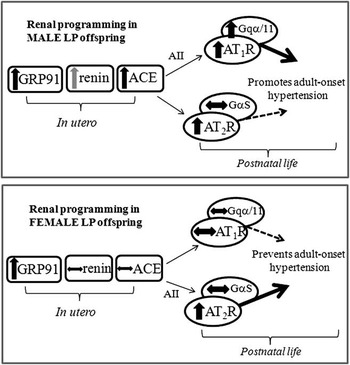
This paper demonstrates that the novel GPR91 pathway and the traditional RAS G-protein coupled pathway are modulated by maternal protein restriction in a sex-specific manner. We found that at E19, GPR91 mRNA and protein were increased in both male and female LP offspring. On postnatal d21, AT1R and Gqα/11α were significantly elevated only in male LP offspring. These data suggest that in kidneys from LP males, angiotensin II is likely predominantly signaling through AT1R-Gqα/11α, thus potentially contributing to renal dysfunction, a phenomenon that has been observed in other rodent models of hypertension.Reference Mogi, Iwai and Horiuchi 16 Renal AT2R was increased in both male and female LP offspring at d21, although renin was reduced only in LP females. Together, these observations highlight that GPR91 and RAS may play an integrative, sex-dependent role in fetal renal programming (Fig. 5).
Potential sex-specific mechanisms of fetal programming of hypertension. In utero, renal GPR91 is elevated in both male and female LP offspring. However, only in the males is a corresponding increase in renin and ACE observed, and combined with sex specific postnatal increase in AT1R/Gqα/11α, may in part contribute ro the LP-IUGR hypertensive male phenotype. LP, low protein; ACE, angiotensin converting enzyme.

The concept that GPR91 has an important pathophysiologic role in fetal programming is supported by other models of hypoxia and metabolic stress in which the succinate-GPR91 pathway is activated. For example, in rabbit kidneys exposed to an environment of hypoxia and hyperglycemia, GPR91 mediates renal dysfunction via calcium-dependent activation of ERK1/2 and cyclooxygenase-2, which culminates in increased renin release.Reference Peti-Peterdi 30 , Reference Vargas, Toma, Kang, Meer and Peti-Peterdi 31 In rodent hypoxic-retina models of prematurity, GPR91 mediates neovascularization via VEGF-dependent pathways.Reference Sapieha, Sirinyan and Hamel 32 Further, succinate activation of GPR91 in adult mice results in enhanced renin activity, increased angiotensin sensitivity and elevated blood pressure.Reference He, Miao and Lin 21 Our data demonstrate that, during gestation, there is increased GPR91 in kidneys from both male and female LP embryos compared with controls. These findings lend additional support for a role for GPR91 in pathophysiologic processes traditionally thought to be RAS mediated (hypertension, diabetes) and that these systems may indeed be impacted in utero, in a sex-independent manner. Thus, the GPR91 pathway may serve as prenatal ‘stress-sensor’, providing a link between a poor in utero environment (characterized by hypoxia and nutrient imbalanceReference Langley-Evans, Welham, Sherman and Jackson 33 ) and the programmed renal dysfunction observed postnatally in LP-induced IUGR rats.Reference Baum 6 Quantification of succinate levels in utero would support this theory and is an interesting area of future research.
Sex-specific development of hypertension has been well documented in a variety of animal models of IUGR.Reference Woods, Ingelfinger and Rasch 7 , Reference Grigore, Ojeda and Alexander 34 Indeed, although both sexes are exposed to the same adverse environment in utero, after birth (and completion of sexual development) male IUGR offspring are more sensitive to alterations in renal function.Reference Woods, Ingelfinger and Rasch 7 Moreover, others have shown that LP male rats had elevated blood pressure at 5 months of age, whereas LP female blood pressure remained unchanged.Reference Woods, Weeks and Rasch 35 In our study, the data demonstrate that at postnatal d21, male LP offspring have increased expression of renal AT1R-Gqα/11α and AT2R, while LP females have an increase in AT2R and reduced expression of renin. These observations support sex-specific programming of renal RAS by in utero exposure to an LP diet and may help explain why female IUGR offspring appear resistant to developing a hypertensive phenotype.
Controversy does exist in the literature regarding temporal and sex effects on AT1R and AT2R expression patterns. Vehaskari et al.Reference Vehaskari, Stewart and Lafont 19 found that at four weeks of age, AT1R expression is elevated in kidneys from IUGR male rats, consistent with our data. Conversely, others have shown that AT1R mRNA was unaffected by prenatal treatment with a LP diet,Reference McMullen, Gardner and Langley-Evans 36 , Reference McMullen and Langley-Evans 37 while AT2R mRNA was significantly reduced.Reference McMullen, Gardner and Langley-Evans 36 We speculate that differences in diet protocols, (specifically the timing of initiation and composition of the LP diet), may be confounding data between these studies and our own, a subject which has been previously reviewed.Reference Langley-Evans 38
In utero, kidney development is dependent on appropriate temporal expression and function of angiotensin receptor subtypes. Indeed, AT2R, the most abundant angiotensin receptor in fetal life, regulates cell proliferation and early differentiation of the nephron, where it enhances apoptosis, a prerequisite for normal renal development.Reference Chen, Lasaitiene and Friberg 17 The role of AT1R during development is primarily after nephron differentiation, when it helps regulate renal function, via stimulation of glomerular endothelial cells, mesangial cells and vascular smooth muscle cells.Reference Chen, Lasaitiene and Friberg 17 Our data illustrates that at E19, AT2R levels are reduced only in LP females. Interestingly, AT1R mRNA was increased in both male and female LP kidneys at E19, although this was not statistically significant at the level of protein, suggesting a post-transcriptional regulation of AT1R expression. Awasal et al. Reference Alwasel, Kaleem, Sahajpal and Ashton 18 also showed reduced AT2R at E19, while AT1R was increased on the embryonic day 18, although sex was not specified in their studyReference Alwasel, Kaleem, Sahajpal and Ashton 18 and may help explain differences in results. Our results also demonstrate that at E19, LP females had increased Gqα/11α, which may enhance AT1R signaling in utero, possibly maintaining a more physiologic balance of the angiotensin receptor signaling. Indeed, it is hypothesized that neonatal suppression of renal RAS may contribute to altered renal development in animal models, with males being more severely affected,Reference Woods, Ingelfinger and Rasch 7 , Reference Woods and Rasch 39 , Reference Kett and Denton 40 although altered expression of G-coupled regulatory proteins has not been reported before in any other model of fetal programming.
Overall, the data presented in this paper show that prenatally, GPR91 levels are increased in both male and female LP offspring, emphasizing that (together with in utero programmed changes in the RAS), GPR91 likely plays an integral role in the molecular signature of later life renal dysfunction in these offspring. These data provide insight into a novel role for the succinate-GPR91 pathway in fetal programming, a pathway which is rapidly becoming a major player in the pathophysiology of hypertension,Reference He, Miao and Lin 21 diabetic nephropathyReference Peti-Peterdi 30 and ischemic retinopathy.Reference Sapieha, Sirinyan and Hamel 32 Moreover, in utero-programmed alterations in renal RAS may predispose male offspring to enhanced angiotensin sensitivity after birth, through increased levels of AT1R-Gqα/11α. In females, RAS expression patterns include increased Gqα/11α at E19 and reduced renin and increased AT2R at d21, which may provide a protective role. Elucidating the specific mechanism by which GPR91, together with RAS, contributes to renal dysfunction in fetal programming is an exciting area of ongoing research, as it provides a novel pathway which may become a potential target for therapeutic intervention.Reference Ariza, Deen and Robben 41
Acknowledgments
The authors wish to thank Drs P. Chidiac, R. Gros and J. Thompson for their generous assistance with the preparation of this manuscript. Additionally we would like to thank Dr D Hardy for supplies and Mr A Revesz for his technical assistance.
Financial Support
This work was supported through the Department of Obstetrics and Gynecology, University of Western Ontario, Academic Enrichment Fund (2007) and by The Association of Professors in Obstetrics and Gynecology – President’s Award for Resident Research Grant (2008), the Dairy Farmers of Canada (research support for Dr E Arany) and Canadian Institutes of Health Research (CIHR).
Conflicts of Interest
None.
Ethical Standards
The authors assert that all procedures were performed in accordance with the ethical guidelines set by Canadian Council of Animal Care and has been approved by the Animal Use Subcommittee of Western University, London, Ontario.