Much of the most influential existing work on the relationship between globalization and sport has either ignored or, at best, failed to highlight the resistant role that can be played by individual nation states and by national sports-governing bodies.Footnote 1 The emphasis has tended to be on the spread of Western practices and values and on the possibility of resistance in the cultural and economic realms. Thus, Manzenreiter and Horne have provided a valuable service in terms of demonstrating how Western sport, especially football, has impacted on Asian societies and has in turn itself been affected by this diffusion. Unfortunately, the focus on the cultural and economic aspects on modern sport has arguably created the impression that national governments are now more or less helpless when it comes to influencing the ways in which sport is played in their respective countries. Bairner has argued, however, that “despite all the changes that have taken place in football, it is still possible for national governing bodies to act in a quasi-autonomous fashion in an attempt to confront particular problems.”Footnote 2 Their capacity to do so is, of course, greatly enhanced if they are supported in their efforts by a strong, centralized state.
The aim of this article is to analyse China's engagement with global sport through an examination of the case of elite football. There are several reasons for identifying this particular research aim: the political, economic, cultural and academic importance of this process of engagement in the global context. Considering first the political aspect, which is the main focus of this article, the PRC is one of the five permanent members of the UN Security Council and the world's largest developing country under a communist regime.Footnote 3 Any decision the Chinese government makes in relation to global affairs will undeniably have some impact on the rest of the world. Noting the increasing number of governmental and non-governmental organizations in the global context,Footnote 4 it is important to investigate the role and importance of the Chinese state within these organizations in general and those concerned with global sport, such as FIFA, in particular. Indeed, this research echoes Houlihan's argument which highlights that, in addition to the economic and cultural dimensions, a third, less commonly explored, dimension of globalization is the development of a global organizational infrastructure for sport, evident in both the governmental and non-governmental spheres.Footnote 5
Second, with reference to the economic aspect, China's economy has maintained an average annual growth rate of 9.4 per cent since it adopted the open-door policy in 1978. Since 1993 it has ranked first in attracting foreign direct investment. The total value of its imports and exports rose from US$20.6 billion in 1978 to US$1,150 billion in 2004, ranking third in the world, and of this over half was from foreign investments.Footnote 6 With the movement of goods, capital and labour across borders, we are interested in the role of the national government in dealing with the challenge from foreign investment (multi-national companies) in the Chinese elite sport system. Quoting Jackson et al., a possibility exists that “these MNCs are contributing to the advancement of post-industrial capitalism – a political, economic and cultural system that is fundamentally changing the nature of the nation state and the international flow of people, products and ideas.”Footnote 7 Furthermore, other authors such as Hall and Soskice,Footnote 8 Garrett,Footnote 9 WeissFootnote 10 and ScharpfFootnote 11 also remind us to “bring institutions back in” to the study of globalization and, indeed, into capitalism more generally. It is argued that while nations may experience common pressures, the existence of different institutional and cultural environments means that they respond in different ways and achieve different outcomes. For this reason, Weiss argues that “domestic institutions, depending on their characteristics, can hinder or enable states to respond to new challenges and accomplish new tasks, thus softening, neutralizing, or exaggerating the potentially constraining effect of the global market.”Footnote 12 The arguments of these authors suggest the need to focus on Chinese domestic sport institutions, such as the General Administration of Sport and the Chinese Football Association.
Third, in relation to the cultural element, when Communist China under the leadership of Mao Zedong initiated the Cultural Revolution (1966–76), Western cultural products, such as competitive sports, were regarded as “evil capitalism” which could contaminate the ideological purity of Chinese Communism.Footnote 13 After the Cultural Revolution, China practised the open-door policy and embraced world capitalism by joining the World Trade Organization and bidding to host the 2008 Olympic Games in Beijing. As we regard sport as an important cultural practice,Footnote 14 we are interested in the process whereby these Western cultural flows of elite sport have extended into China and how the Chinese government has responded to them. Tomlinson claims that “the de facto common denominator of both the process and the experience of globalisation is the global capitalist economic system.”Footnote 15 He also reminds us that “the issue of the increasing general commodification of culture deserves most attention.”Footnote 16 Houlihan raises the same issue as Tomlinson and advises us to refocus on the issue of “the spread of particular cultural practices” or “the recognition of global commercial interests in major sports events such as the Olympics and the soccer World Cup” when carrying out research in relation to sport globalization.Footnote 17
Finally, and most importantly, we attempt to develop the arguments of HoulihanFootnote 18 and MaguireFootnote 19 which propose the need to develop criteria by which to judge the “reach” and “response” of global flows in local cultures. In relation to these concepts, HoulihanFootnote 20 highlights the failing identified above that, although many studies of globalization exhibit a quite proper concern with the extent to which the deep structure of culture is affected by sports globalization and vice versa, they generally fail to give significant consideration to the role of the state, because they give too great an emphasis on what some might regard as the shallower consequences of globalization such as commercialization, commodification and cultural homogenization. In this article, we attempt to redirect attention to the role of the state and to investigate its relationship with global sport by asking two key research questions: to what extent did or does the Chinese government have choices in its relationship with sport globalization; and in what ways does the Chinese government seek to manage its relationship with sport globalization?
Globalization Framework and Methodological Issue
The frameworks of Held et al. are important analytical tools for this study.Footnote 21 They have strong theoretical implications but do not identify clear causal drivers or a sense of a causal process.Footnote 22 Schlager argues that “frameworks provide a foundation for inquiry by specifying classes of variables and general relationships among them.”Footnote 23 Held's framework was adopted to compare three main schools of globalization theory, to target the emphasis of the state-centred focus and to highlight certain questions, such as the three key theoretical research questions and the debate over the state's role in the global process. As Ostrom argues, “frameworks bind inquiry and direct the attention of the analyst to critical features of the social and physical landscape.”Footnote 24 This is the rationale for adopting Held's framework: to help maintain a focus on an analysis of the state's role in the global process.
Held et al. summarize three main schools of globalization theory: hyperglobalism, scepticism and transformationalism. This tripartite schema is intended as a preliminary way of understanding the general contours of scholarly debates, rather than as a rigid template into which all writers must be neatly located. What is at stake in the debates between these three positions is not simply what globalization means, but whether, and in what senses, it is present at all.Footnote 25 According to the hyperglobalists, cross-border economic relationships, engendered by free trade and the increased mobility of capital and labour, render national economies outmoded and undermine the role of national governance.Footnote 26 A number of influential scholars, including Wallerstein and the world-system theorists, are also interested in cross-border inter-dependencies, and have helped to stimulate the hyperglobalists and worked in parallel with them.Footnote 27 Indeed, Ohmae argues that globalization has led to the “end of the nation-state.”Footnote 28
Sceptics, such as Hirst and Thompson,Footnote 29 Weiss,Footnote 30 VogelFootnote 31 and Gilpin,Footnote 32 argue that theories of hyper-globalization have mistakenly concluded that cross-border activity is intrinsically trans-national. Instead, they consider that nations remain alive and well.Footnote 33 Even if some functions are lost, others are gained.Footnote 34 National markets and policies in domains such as education, training and infrastructural planning remain of considerable importance, thereby casting doubt on theories of the imminent decline of the nation-state.Footnote 35 Indeed, sceptics have had a good deal of success in scrutinizing and evaluating speculative propositions in the light of more considered accounts which are better grounded in evidence than those of the hyperglobalists. They usually take an “approach” in order to begin a process of seeking out clearer and more plausible concepts in an effort to avoid the pitfall of applying simplistic theories to very complex social changes. This has required a measure of scepticism towards propositions that are regarded as self-evident by many and cherished as articles of faith by some.Footnote 36
The view taken by the transformationalists, such as Held et al. and Held and McGrew,Footnote 37 is that the world of nation-states cannot contain within its structure all the many significant elements of global life, including the ordering of territory. The case for using the term “globalization” is that it enables us to understand the extent to which many forms of transformation are no longer containable within or fully controlled by inter-national arrangements. These include mobility of finance and technology which create and re-create complex spatial divisions of labour, global communications technology, and the operation of global social movements.Footnote 38 The transformationalists' line of argument is critical of certain aspects of both the hyperglobalist and the sceptical approach. Put simply, their position is twofold. First, they agree with the hyperglobalists' contention that the world is undergoing a fundamental transformation, but they disagree with their claims for “the end of the state” because of the state's important role during the globalizing process.Footnote 39 Secondly, transformationalists consider that the sceptics' thinking is too “sceptical.” The power of national governments is not necessarily diminished by globalization, but, on the contrary is being reconstituted and restructured in response to the growing complexity of the process of governance in a more interconnected world.Footnote 40
Finally, as far as this research is concerned, we are in sympathy with the definition of globalization advanced by Hay and Marsh.Footnote 41 Their version of the concept requires thinking of globalization as something other than a singular and inexorable process causing change, a juggernaut beyond human control. Rather they see it as a trend, the consequence of a range of processes such as cross-border interconnection and inter-dependence, but a trend which is nevertheless reversible by counter-trends. Globalization is the explanandum, “that to be explained,” not the explanans, “the explanation of change.” It is, in short, an effect not a cause.Footnote 42
Methods
With the framework of Held et al. in mind, this analysis includes an interrogation of empirical data from semi-structured interviews with 32 officials involved in various organizational roles within China's administrative system for sport. The organizations include the General Administration of Sport (GAS), the Chinese Olympic Committee (COC), the Beijing Organizing Committee for the Olympic Games (BOCOG) and the Chinese Football Association (CFA). In addition, 14 interviews were conducted with Chinese sports academics working in China and elsewhere. The interviewees were selected on the basis that they were, or had been, in senior positions; were involved at a strategic level of decision making; and had been involved in sport policy/management deliberations for several years. The interview schedules were organized around a series of questions to allow for triangulation (of response) between interviewees from the sports organizations, government agencies and sports analysts. The questions asked were derived from the work of the three main schools of globalization theory as discussed above, and focused on the debate over the state's role in the global process (see Appendix).
At the beginning of the data-gathering process, the first author attempted to record interviews with the sport officials. However, several of the GAS and CFA officials told him that they regarded him as a friend and would tell him more about what he wanted to know if he switched off his recorder. They also reminded him that it is almost impossible for Chinese sport officials to give their real opinions by putting a digital recorder in front of them. In these circumstances, the researcher had no choice but to give up tape-recording in favour of writing notes during the interview. In order to keep these officials' accounts as accurate as possible, the researcher attempted to rebuild their key accounts by recording his own voice according to the notes taken and the memories recalled immediately following the end of each interview. He was aware that it was impossible to reconstruct the interview exactly, but at least the key issues and the essence of their account could be retrieved.
Although the political structure of the PRC discouraged the researcher from using a recorder, the unique propaganda mechanism embedded in the political system in general and the sport system in particular allowed him to access these high ranking sport leaders' accounts from documents and articles. These included: yearbooks, such as The Yearbook of Sport and Physical Education of the PRC (1949–2005) (Zhongguo tiyu nianjian 中国体育年鉴), The Yearbook of Chinese Football (1992–1998) (Zhongguo zuqiu shiye nianjian 中国足球事业年鉴) and China Football Encyclopedia (Zhongguo zuqiu dadian 中国足球大典); reminiscences, such as He Zhenliang and Olympics (He Zhenliang wuhuan zhi lu 何振梁五环之路), Think and Practice: the History of The Olympic Strategy (Xing yu si: shishi Aoyun zhanlüe de lishi henji 行与思:: 实施奥运战略的历史痕迹) and The Chinese Football under My Understanding: the Reminiscences of Wang Junsheng (Wang Junsheng huiyi lu: wo zhidao de Zhongguo zuqiao 王俊生回忆录:: 我知道的中国足球); official websites, such as GAS, COC, BOCOG and CFA; databases, such as sportinfo.net.cn (Zhongguo tiyu xinxi wang 中国体育信息网) and China National Knowledge Infrastructure (Zhongguo zhi wang 中国知网); and newspapers, such as China Sport News (Zhongguo tiyu bao 中国体育报), Sina Sport News (Xinlang tiyu wang 新浪体育网), Titan Sport News (Tiyun zhoubao 体坛周报), Tom Sport News (Shaowei titan 鲨威体坛), Sohu Sport News (Huti yyuwang 搜狐体育网) and Xinhuanet News (Xinhua wang 新华网).
By supplementing and triangulating accounts provided by high-ranking officials with the official regulations – The Compilation of Chinese Sport Regulation (1949–2004) (Zhongguo renmin gongheguotiyu fagui hyuibian 1949–2004 中华人民共和国体育法规汇编1949–2004) and The Handbook of Chinese Football Competition (Zhongguo zuqiu liansai gongzuo zhouce 中国足球联赛工作手册) – official statistics – Statistical Yearbook of Sport by GAS (NSC) (Tiyun shiye tongji nianjian 体育事业统计年鉴) – and internal statistics in CFA, it was possible to limit the disadvantages of not tape-recording the interviews with sport officials. Indeed, we quote these high-ranking sport leaders' accounts more than those of our interviewees (middle-ranking sport officials) because we found that their values and attitudes towards global football were very similar, as a result of the hierarchical political structure in the Chinese sport system. Nevertheless, there were some differences, particularly in the interests of GAS and CFA.
In order to achieve the aim of this article – to analyse China's engagement in global football and to answer two research questions – we examine this case study in relation to the political, economic and cultural spheres.
China's Response to Global Football in the Political Sphere
Taking more seriously the aim of securing a leadership role in the Asian Football Confederation and desiring to have more influence in FIFA
In 1952 Communist China was accepted by FIFA as a member, with the name “All-China Sports Federation” (Zhonghu quanguo tiyu zonghui 中华全国体育总会). Three years later, the Chinese government set up the Chinese Football Association which claimed jurisdiction over all Chinese football activities and required FIFA to revoke Taiwan's membership. Disappointed over representation issues, and specifically the IOC's “two Chinas” policy, the PRC not only resigned its membership of the IOC in 1958 but also withdrew from nine other international sporting organizations including that of football. After withdrawing from FIFA, the PRC supported GANEFO to combat so-called Western imperialism and capitalism, and, by implication, FIFA. The PRC did not contact FIFA again until the success of China's “ping pong diplomacy” contributed towards improving the Sino-US bilateral relationship. This to some extent helped the PRC acquire a seat on the UN Security Council in the early 1970s. The PRC wanted to insist on its “one China” policy when rejoining FIFA, and the Chinese government needed someone who had power within FIFA to help them achieve this goal. A Hong Kong tycoon, Fok Ying Tung 霍英东, who was then the President of the Hong Kong Football Association and one of the FIFA executive members (1978–98), took the key role of helping the PRC to regain its membership of FIFA and also in forcing Taiwan to adopt a different national anthem and flag in 1979. Fok Ying Tung was a very good friend of FIFA president João Havelange who visited Beijing twice, in 1974 and 1978, and helped the PRC resolve the “two Chinas” problem within FIFA. Because of Fok Ying Tung's extraordinary contribution to Chinese sport in the international regime, he was selected as a Standing Committee member at the Seventh National People's Congress in 1988 and has been vice-chairman of the National Committee of the Chinese People's Political Consultative Conference since March 1993.
Following the PRC's re-engagement with global football, the Chinese government aimed to have its own voice and exert more influence within FIFA, according to a 1992 CFA document,Footnote 43 but because of the weak performances of Chinese national football squads, it could only take very limited steps towards raising its global profile. The first step was to take advantage of hosting the 1991 and 2007 Women's World Cup tournaments and the 2008 Beijing Olympic Games in order to impress FIFA. In addition, Zhang Jilong, a CFA vice-president, was selected as one of the members of the organizing committee for the 2006 and 2010 World Cups and the 2008 Olympic football tournament. The next step was for the PRC to secure strong representation in the Asian Football Confederation (AFC) in order to gain membership and have its own representative in FIFA.
After becoming an AFC member in the late 1970s, the PRC took an active part in the organization, especially on the executive board. The Chinese government nominated Chen Chengda 陈成达, the director of the football division in the NSC and the secretary of the CFA, for selection as an executive member of the AFC in 1984. In 1993, Chen was selected as an AFC vice-president. His successor, Xu Fang 许放, a CFA vice-president and one of the key architects of the Chinese professional football club system, became the second Chinese AFC vice-president. Unfortunately, Xu died of a heart attack in 1996 and Zhang Jilong 张吉龙, who was also a CFA vice-president, became the third Chinese AFC vice-president. As a result of Zhang's diplomatic skill, China successfully won the right to host the 2003 Women's World Cup and the 2004 Asian Cup. Zhang was promoted to director of the BOCOG sports department and was fully supported by GAS and CFA in competing yet again for the important position of AFC First Vice-President and chairman of the sports committee of the Asian Olympic Committee in 2009.Footnote 44
Transforming the administrative structure
In an effort to achieve the goal of qualifying as one of the Top 12 teams in the football World Cup before 1985, the document “The Request Instruction for Raising China's Elite Football Performance from the NSC”Footnote 45 issued by the State Council in 1979 enabled the NSC to restore the football administrative structure to what it had been before the Cultural Revolution. Unfortunately, under this administrative structure the PRC was not only defeated by Hong Kong in Beijing on 19 May 1985 and excluded from the World Cup, but also suffered the so-called “519 football hooligan event” when Chinese football fans could not accept this result and rioted.Footnote 46 In order to expedite improvement in the Chinese football team's performance, the government then adopted a Western approach to reform its football administrative structure.
China took dramatic steps to reform its administrative structure, using a Western and specifically a European approach. The three key transformations in contrast to the original structure were: setting up a highly institutionalized and rationalized Chinese football system; introducing the club system; and establishing football companies as commercial agents. As regards the first point, GAS not only established more specialized departments in the CFA, such as the Technical Department, National Squad Department, Competition Department and Comprehensive Department, but also recruited CFA staff with more varied backgrounds, such as sport science, finance, law and management, in order to run the system more effectively.Footnote 47
As for the second point, introducing a Western club system prompted very strong debate at the 1992 National Football Conference. Most officials rejected the idea of this new system because they were worried about ceding power to capitalist-owned clubs.Footnote 48 However, after intervention by Li Tieying 李铁映, a member of the Politburo Standing Committee and a State Councillor (1988–98) with a second job as a director of the Government Reform Commission, opposition voices were suppressed and the capitalist experiment was approved.Footnote 49 The club system replaced the Soviet system, to create a more competitive and material-oriented framework.Footnote 50
Regarding the final point, in order to survive without government financial support, two football companies, the Chinese Super League Company (for the super league) and the Chinese Football Company (for the rest of the professional football league), were established, and one multi-national sport management company (Infront Sports & Media) was introduced.Footnote 51 The Chinese Football Management Centre was created in 1994, but its leadership and general functions were exactly the same as those of the CFA. The CFA title was used to connect with international organizations and the Football Management Centre title was used to interact with the domestic political system.Footnote 52
Intervention in the transfer of footballers
The attitude of the Chinese government towards the transfer of Chinese footballers was directly linked to the issue of Team China's international performance. To ensure that the PRC could take advantage of the introduction of global football resources to facilitate its elite football development and also to prevent an adverse impact from global football, several strategies were adopted by the CFA. First, it set an age limit to prevent top players from going abroad. One document issued by the CFA in 1993 noted that “national athletes cannot go abroad until either the male athletes are over the age of 28 and female athletes over 26 or the footballers are dispatched by the CFA.”Footnote 53 Constrained by these regulations, very few Chinese footballers were able to play abroad unless they were sent by the Chinese government, as in the case of the youth national teams sent to be trained in Brazil and Russia in 1994. In 1998, CFA transfer regulations were relaxed and the age limit reduced to 26 for male players.Footnote 54
From 2002, the age limit regulation was replaced by a system of special permission by which Chinese players could not play for any foreign club or other country unless dispatched by the CFA or agreed by the CFA.Footnote 55 Under the new regulations, the CFA still appeared to hold the ultimate power to decide who could or could not play abroad. For example, the Chinese football superstar Hao Haidong 郝海东 was unable to play for any foreign club until he was 35 years old and obtained permission from the CFA to be transferred to Sheffield United Football Club in England's Premier League in 2005. However, in 2006 the GAS announced that “the government encourages and supports international transfers from Chinese professional clubs” in its guiding document “The Project for Sport Industry 2006–2010.”Footnote 56 After this, more and more elite Chinese footballers were permitted to move to foreign clubs to earn money and learn skills at the same time.Footnote 57 However, it should be noted that the relaxed policy towards domestic players going abroad is not necessarily evidence that China is becoming a more liberal country. The main priority for this shift in policy was the production of a strong national team, and China was under strong pressure to perform well in the 2008 Beijing Games. As the former director of the Chinese Football Management Centre, Wang Junsheng, wrote in 2002: “I am sure that the dream of breaking out of Asia and advancing to become a world football power will come true when the young generation of Chinese elite footballers continuously and frequently appear in European and South American football matches. I am sure that we won't wait too long for that day.”Footnote 58
Finally, in order to protect domestic goalkeepers, who, it was considered, would have more chance if they were trained in their own clubs and in Chinese Football Association Super League (CSL) competitions, the CFA not only prohibited clubs from introducing a foreign goalkeeper after 2000, but also required them to recruit a specialist goalkeeping coach from 2003.Footnote 59 In short, the initial policy of the Chinese government towards footballer transfers was to seek to take advantage of international football resources, through bringing in foreign expertise in order to raise the profile of Chinese elite football while at the same time keeping native players in China. But due to poor coaching, low-level domestic professional competition and the tension between national and commercial interest, the Chinese government was forced to alter its policy in an attempt to manage the relationship with globalization whilst retaining as its main priority the building of a strong national team.
China's Response to Global Football in the Economic Sphere: Updating Regulations
In his speech in 1993 at the All States Sports Minister Conference, Li Tieying stated that “following the development of Chinese sport, the problem of investing more in the national sport budget and generating more extra sport income is a highly critical issue.” He went on to argue that “the sport system has to transform the ideas, and ways of thinking and working which were formed by the structure of the planned economy, into the objective requirements of a market economy in which we should reform boldly in order to explore new ways to facilitate Chinese sport development.”Footnote 60 Following Li Tieying's speech, an internal official document, “Suggestions of the NSC On Deepening Sport Reform” which was issued by the NSC in 1993, highlighted that “we have to learn how they govern and run sport in other countries of the world, including advanced capitalist countries, so that we can go ahead and seek a variety of forms and ways to reform.”Footnote 61 In an affiliated document, “Suggestions in Relation to Promoting Sport Marketing and Speeding Up the Process of Sport Industrialization,” the NSC also emphasized that “national sport associations have to look for multiple channels to generate income, and some associations with commercial potential should establish ‘economic bodies’ (jingji shiti 经济实体) to generate income in order to subsidize the sport system.”Footnote 62 From then on, the Chinese government established two different “economic bodies” (companies) and signed contracts with international sport management companies to generate multiple incomes from the football market.
There were three sources of income in the Chinese men's elite football system in 2006: the national sport budget, the provincial sport budget and commercial income/sponsorship. The national football budget was 9 million yuan in 1992, but according to a senior staff member in the CFA Comprehensive Department, following the establishment of the Chinese Professional Soccer League (CPSL) in 1994 it was reduced substantially.Footnote 63 In the provincial budget, there was about 2 million yuan for each key football province or city in 1993,Footnote 64 but this also decreased substantially after the formation of CPSL. For commercial income and sponsorship, there are three different types of companies, including the China Football Industry Development Corporation (CFIDC), a sport management company (Infront Sports & Media), and the China Football Association Super League Company (CSLC) which work as commercial agents to help the CFA generate multiple incomes.
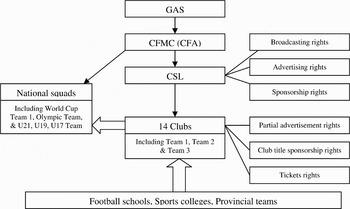
The “One Protocol and Two Licences” policy was one approach the Chinese government adopted to attempt to force the Jia A and Jia BFootnote 65 clubs not only to put more resources into their reserve teams instead of recruiting talent from other domestic clubs, but also to give up their league's main commercial rights, including broadcasting, advertising and sponsorship. According to Wang Junsheng, a major reason for the failure to qualify for the World Cup and Olympic Games between 1992 and 2000, and the low profile of domestic football leagues, was the professional clubs seeking quick success and instant benefits, and ignoring the CFA regulation that each league club must set up three reserve teams. Indeed, most professional clubs tackled the CFA requirement by temporarily borrowing a whole team from football schools or amateur clubs to participate in the required matches.Footnote 66 In order to manage clubs' uncooperative behaviour, the CFA set up the “One Protocol and Two Licences” policy by which any club who wanted to stay in Jia A or Jia B must receive both a club qualification licence and a match participation licence. They also had to sign a contract with the CFA (the “Protocol for Jia A and Jia B”). For the club qualification licence, clubs had to prove their capacity to be members of the Jia A and Jia B leagues. The main requirements were to have 20–30 million yuan, to own at least 18 players and to have at least three reserve teams, including U19, U17 and U15. Having satisfied these requirements, a club could register to receive the first CFA licence to become a professional football club.Footnote 67 To give itself the power to distribute the commercial income of domestic football leagues, in early 2000 the CFA issued the “Temporary Commercial Regulation of National Football Matches,” which highlighted that “the CFA not only owns the exclusive commercial rights, including broadcasting, advertising and sponsorship, but also has the right to distribute the commercial income.”Footnote 68
To prevent domestic professional football clubs from resisting this commercial regulation, all clubs had to register every year and sign the “Protocol for Jia A and Jia B.” They also had to pay a deposit of 1–2 million yuan to the CFA. The key points in the Protocol were to agree that the CFA could recruit any club player unconditionally, to comply with the “Temporary Commercial Regulation of National Football Matches,” to accept CFA arbitration and promise that they would not take their case to the courts.Footnote 69 Only after signing this unconditional agreement could clubs receive the second licence, the “match participation licence” and be accepted as a member of the Jia A or the Jia B.Footnote 70
Finally, the Chinese government prevented the seven big clubs from organizing a new super league by carrying out a series of tough policies towards professional clubs and demonstrating that, although European models had been influential, unilateral decisions such as those which had led to the formation of the premier leagues in England and Scotland would not be tolerated. According to a senior manager in the Beijing Guoan Football Club, “in the past, the CFA always made its own decisions and asked our clubs to follow its policy without listening to our voice, which made most clubs unhappy about CFA policy.” He went on to say that “we supposed that after the Jia A League was renamed the Chinese Football Association Super League, the CFA would keep its promise to establish an independent commercial company, the China Football Association Super League Company, and an independent commission, the Commission of China Football Association Super League, which could be in charge of the CSL from 2004. Unfortunately, the CFA breached its promise to do so.”Footnote 71 In fact, according to the “One Protocol and Two Licences” policy and the official document, “The Regulation of Commercial Management for Jia A League and the CFA Cup” issued by the CFA in 2002, the CFA not only controlled most of the commercial rights but also arbitrarily recruited any club player they wanted into seven national squads without any compensation (see Figure 1).
The Relationship between the Chinese Government and Football Clubs in the Chinese Super League (CSL)

Although the CFA registered CSLC (composed of 14 CSL clubs and the CFA) with the State Administration for Industry and Commerce in 2006, it seemed reluctant to allow it to be a really independent commercial agency for the CSL. According to regulations 1–4, 6–0 and 6–27 of CSLC, respectively, “the CSLC is authorized to exploit the various football commercial operations and business developments of CSL by the CFA, who is the initial owner of CSL,” “the CFA is the biggest stakeholder and owns a 36 per cent share in CSLC,” and “the chairman of CSLC is nominated by the CFA.”Footnote 72 Indeed, according to a senior member of staff in charge of establishing the CSLC, control of this company is still tightly held by the CFA because the chairman of CSLC, Nan Yong 南勇, is not only the CFA vice-president but is also in charge of CFIDC. In addition, decision-making regarding the distribution of surplus resources of the CSLC is steered by the Commission of China Football Association Super League, in which CFA, its affiliated associations and provincial sport bureaus, rather than CSL clubs, have the dominant voice.Footnote 73 In fact, most of the CSLC's staff come from CFIDC and the general manager of the CSLC, Qu Yuming 瞿郁明, is the former vice general manager of the CFIDC.Footnote 74 At present, it is still difficult to see the real connection between the CFIDC and the CSLC, but one thing that is clear is that these two companies have been dominated by the CFA and the GAS.
China's Response to Global Football in the Cultural/Ideological Sphere
“Ideological education” has been used to reduce the negative impact of commercialization, particularly among elite athletes. Although China is embracing principles of Western capitalism, Chinese patriotism, nationalism and a specific political ideology remain important expressions of national distinctiveness which can be realized through international elite sport success. In order to encourage Chinese athletes to compete wholeheartedly for their country, patriotism and nationalism are constant themes in the “education” of elite athletes. According to the vice-president of the Chinese Olympic Committee, who was one of the architects of the “Olympic glory” project, “the fundamental mission for Chinese athletes is to actively participate in international competition for the sake of the nation's pride.”Footnote 75 The vice-president also maintained that “our job is to help athletes to establish their highest value in life, which is to be fervent patriots whose responsibility is to raise the national flag and to play the national anthem in the international sport arenas.”Footnote 76 The depth of feeling associated with elite sport success in China was also highlighted: “The value of the lives of Chinese athletes would be nothing if it was not linked to national pride.”Footnote 77
To achieve such intense indoctrination, responsibility for “ideological education” was given to a senior manager of each national squad. Generally speaking, this education took the form of instruction in patriotism, collectivism and revolutionary heroism, in order to dilute and reduce the allure of materialism and money.Footnote 78 In addition, according to the GAS's new policy,Footnote 79 one to two weeks' military training with the People's Liberation Army (PLA) has become a new form of training strategy to “discipline” and “inspire” these highly-paid footballers to work harder in order to fight wholeheartedly for their country in international matches, especially at the 2008 Olympic Games. Indeed, according to the sports minister, Liu Peng 刘鹏, the whole purpose of “ideological education” is to implant the value of “national pride first and personal interest second” in the minds of Chinese footballers in order to prevent star players or “peculiar men” from having a negative impact by adopting the individualistic and commercial values of global capitalist sport.Footnote 80
Conclusion
To what extent did/does the Chinese government have choices in its relationship with sport globalization?
We are interested here in assessing the extent to which the Chinese government retains the capacity to have a choice in its relationship with sport globalization. According to this case study, China has demonstrated the range of its choices in three distinct spheres. First, the Chinese government “chose” to have more influence in FIFA by centralizing China's diplomatic power in its sport leaders, such as Zhang Jilong being selected for the organizing committee for the 2006 and 2010 World Cups and the 2008 Olympic football tournament. Secondly, the Chinese government “chose” Western market-oriented approaches to vitalize its out-of-date Soviet models. In so doing, it revealed that it was not immune from global processes. Yet it remained firmly in control of how far such influences would be allowed to spread and with what consequences. Thirdly, the government has regularly “chosen” to exercise its administrative authority to respond to the problems raised by globalization and commercialization. The view of hyperglobalists such as Ohmae that “in a borderless world traditional national interest has no meaningful place”Footnote 81 is not supported by the example of Chinese elite football. Indeed, to invoke the perspective of sceptics such as Gilpin, “states continue to use their power to implement policies to channel economic forces in ways favourable to their own national interests and to secure … a favourable share of the gains from international economic activities.”Footnote 82 The evidence of this study suggests that the Chinese government has been able to exercise a considerable degree of choice to deal with the problems of commercialization (organizing a new super league) and globalization (player transfer) when these issues could possibly have endangered the national interest.
In what ways does the Chinese government seek to manage its relationship with sport globalization?
By taking strategic approaches in the political, economic and cultural/ideological spheres, the Chinese government has ably demonstrated its capacity to find effective ways of managing its relationship with global football. This was shown particularly by the setting up of new governmental commercial agencies such as the CFA Competition Division, CFIDC and CSLC, updating sport and football regulations, and strengthening Chinese communist ideological education.
From the perspective of the transformationalists, these strategic approaches, or adjustment strategies, have meant that instead of globalization bringing about the “end of the state,” it has in certain respects produced a more activist state. In this respect the sceptics share a similar viewpoint to the transformationalists. Vogel contends that “regulatory reform by definition involves reformulating the mechanisms of policy implementation” which is amply illustrated by the updating of sport and football regulations and the influence of the policies of “One Protocol and Two Licences” for football. Modification of implementation mechanisms in turn, affects the very ability of state actors (GAS, CFA Competition Division, CFIDC and CSLC) to perform their functions, which is why they insist on giving their own needs and preferences high priority (Olympic and World Cup glory) as they pursue regulatory reform.Footnote 83 Moreover, sceptics such as Hirst and Thompson note that “it is virtually impossible to continue to operate in the various world markets and, at the same time, to ignore the internationalised cultures that go along with that.”Footnote 84 Indeed, the way in which the Chinese government decided to give its elite athletes intense ideological indoctrination, particularly in nationalism, was a clear attempt to challenge the individualism, commercialism and cosmopolitanism of global capitalist sport. For how much longer and with what degree of success these values can continue to be resisted remains to be seen. It is certain, however, that sport will remain an important battleground for the struggles that lie ahead.
Horne and Manzenreiter have argued that “the role of the state in safeguarding the production of football is the largest in Japan and the smallest in China.”Footnote 85 We would suggest, however, that this claim may originate from a particular definition of “safeguarding” which we would not necessarily share and from a specifically Western appraisal of the Chinese state. As Martin Jacques suggests, the state occupies a very different position in Chinese society from that in the West and we should avoid conflating democracy with competence. The Chinese state is highly competent, especially when one considers that China is still very much a developing country.Footnote 86 It will be ironic indeed if in the course of becoming more democratic it becomes less competent and, consequently, less able to influence cultural and sporting developments such as the globalization of football.
Appendix: Interview Questions
1 Does China have representatives on the FIFA and the Asian Football Confederation?
*How long have these representatives been on the FIFA and the Asian Football Confederation?
*Is there a strategy the government takes to raise the profile of the Chinese representatives on the FIFA and the Asian Football Confederation?
2 Under what circumstances was the football management centre set up? Is the football management centre the same organization as the Chinese Football Association?
*Where is the member of the governing board of the football management centre from? (Elected from lower levels or nominated by the General Administration of Sport?)
*Which countries do you think are good examples of good practice in management, talent identification and elite training?
*Have you used any ideas from those countries?
3 What were the reasons for promoting commercial football in China?
*Was there a demand from big companies who wanted to have their own football teams?
*Did the government think that establishing professional football clubs is a way to improve the standard of football?
4 Was it difficult to get an agreement with football clubs to release their players?
*I heard that there was a proposal to set up a new professional football league. Was it an idea from the government?
*I understand that clubs are now allowed to bringing in some foreign players to replace the players who are in the national squad. Was this the government's idea? Or did the clubs ask the government if they can do that?
5 How much of the national sports budget is invested in football development? Has the budget increased?
6 Does the government pay for coach developing programmes for football?
*What resources are devoted to the training and development of elite football coaches?
*Where does the money come from to improve the quality of coaching (from the government or commercial sectors)?
*Does the government bring foreign coaches into the football coach developing programme?
*Does the government send lots of Chinese coaches to be trained abroad?
7 Do you think that it is a good idea to adopt foreign coaches, players and referees with high salaries to promote Chinese football?
8 Would the government like to see more football role models?
*Is it a danger that they are too rich? Or they might go abroad? Or their lifestyles set a bad example for young people?
9 What are the attitudes and values of the Chinese government and Chinese professional football clubs in relation to the rights of elite athletes (for example the transfer of players)?
10 What are the attitudes and values of football players towards material rewards?
*Is the government happy to see Chinese players as rich national superstars or does the government disapprove (are there cases of Chinese professional football players who think material concerns override national pride)?
11 Is there any tension between the professional football clubs and the Chinese Football Association (CFA) or General Administrative of Sport (GAS)? If any, how does CFA or GAS deal with these tensions?
12 Is there any tension between the commercial football sponsors and CFA or GAS? If any, how does CFA or GAS deal with these tensions?