Introduction
The nature of the relationship between the prevalence of mental disorders and age according to standardized diagnostic instruments such as the CIDI (Kessler & Üstün, Reference Kessler and Üstün2004) continues to generate debate. Studies conducted among community-dwelling adults have often reported relatively low levels of mood and anxiety disorders among the oldest adults surveyed in Western Europe (Alonso et al. Reference Alonso, Angermeyer, Bernert, Bruffaerts, Brugha, Bryson, de Girolamo, Graaf, Demyttenaere, Gasquet, Haro, Katz, Kessler, Kovess, Lépine, Ormel, Polidori, Russo, Vilagut, Almansa, Arbabzadeh-Bouchez, Autonell, Bernal, Buist-Bouwman, Codony, Domingo-Salvany, Ferrer, Joo, Martínez-Alonso, Matschinger, Mazzi, Morgan, Morosini, Palacín, Romera, Taub and Vollebergh2004b ), North America (Kessler et al. Reference Kessler, Birnbaum, Bromet, Hwang, Sampson and Shahly2010) and Australasia (Andrews et al. Reference Andrews, Henderson and Hall2001), although the same trend has not always been identified in Eastern Europe (Bromet et al. Reference Bromet, Gluzman, Paniotto, Webb, Tintle, Zakhozha, Havenaar, Gutkovich, Kostyuchenko and Schwartz2005). Consequently, some authors suggest that mental disorders are relatively uncommon in later life, attributable to factors such as an increased ability to deal with negative life experiences and greater emotional resilience and stability (Ernst & Angst, Reference Ernst and Angst1995). Other commentators assert that this conclusion is erroneous and does not correspond with the experience of the medical profession (Snowdon, Reference Snowdon2001; O'Connor, Reference O'Connor2006).
The literature identifies several areas that could potentially distort the results obtained from community-based surveys in an age-related way, namely design, measurement and analysis. Design issues include the inability of cross-sectional studies to tease out ageing from cohort effects, along with when, where and among whom the study took place. Measurement issues are concerned with how the quality of the data obtained from participants could be affected by age, such as deteriorating memory (Rogler et al. Reference Rogler, Malgady and Tryon1992), lack of understanding (Wetherell et al. Reference Wetherell, Petkus, McChesney, Stein, Judd, Rockwell, Sewell and Patterson2009) and stigma (Aromaa et al. Reference Aromaa, Tolvanen, Tuulari and Wahlbeck2011), resulting in unintentional or deliberate under-reporting of mental illness among older adults (Woodal et al. Reference Woodal, Morgan, Sloan and Howard2010). They also concern the suitability of the instrument and outcome measures used across the lifespan (Fuentes & Cox, Reference Fuentes and Cox1997). Analysis issues include the inclusion or omission of control variables and the categorization of continuous variables such as age, as this has the potential at best to obscure detail and at worst to lead to residual confounding (Weinberg, Reference Weinberg1995; MacCallum et al. Reference MacCallum, Zhang, Preacher and Rucker2002). For these reasons, studies of mental illness that are restricted to older adults sometimes use instruments specifically designed for use with this age group, such as the Geriatric Mental State-Automated Geriatric Examination for Computer Assisted Taxonomy (GMS-AGECAT; Copeland et al. Reference Copeland, Dewey and Griffiths-Jones1986). These instruments focus on current morbidity rather than lifetime recall and sometimes report higher levels of mental illness among older adults than those generated using the CIDI (Newman et al. Reference Newman, Sheldon and Bland1998; Schaub et al. Reference Schaub, Linden and Copeland2003) and a constant association between age and mental illness in later life (McDougall et al. Reference McDougall, Kvaal, Matthews, Paykel, Jones, Dewey and Brayne2007; Guerra et al. Reference Guerra, Ferri, Sosa, Salas, Gaona, Gonzales, de la Torre and Prince2009; Prina et al. Reference Prina, Ferri, Guerra, Brayne and Prince2011).
Issues relating to age and mental illness are highly relevant to the European Union (EU) with its growing and ageing population (Giannakouris, Reference Giannakouris2008), and for whom 38.2% of the population (164.8 million people) are estimated to suffer from some form of mental disorder within a 12-month period (Wittchen et al. Reference Wittchen, Jacobi, Rehm, Gustavsson, Svensson, Jonsson, Olesen, Allgulander, Alonso, Faravelli, Fratiglioni, Jennum, Lieb, Maercker, van Os, Preisig, Salvador-Carulla, Simon and Steinhausen2011). Although the body of cross-national literature examining the association between age and mental illness is considerable, the majority comprises systematic reviews (Riedel-Heller et al. Reference Riedel-Heller, Busse and Angermeyer2006), meta-analyses (Wittchen et al. Reference Wittchen, Jacobi, Rehm, Gustavsson, Svensson, Jonsson, Olesen, Allgulander, Alonso, Faravelli, Fratiglioni, Jennum, Lieb, Maercker, van Os, Preisig, Salvador-Carulla, Simon and Steinhausen2011), pooled analyses (Scott et al. Reference Scott, Von Korff, Alonso, Angermeyer, Bromet, Bruffaert, de Girolamo, de Graaf, Fernandez, Gureje, He, Kessler, Kovess, Levinson, Medina-Mora, Mneimneh, Browne, Posada-Villa, Tachimori and Williams2008) or results obtained from analysing each country independently (Bromet et al. Reference Bromet, Andrade, Hwang, Sampson, Alonso, de Girolamo, de Graaf, Demyttenaere, Hu, Iwata, Karam, Kaur, Kostyuchenko, Lepine, Levinson, Matschinger, Mora, Browne, Posada-Villa, Viana, Williams and Kessler2011). Examples of hierarchical modelling that allow for comparisons between countries to be made along the lifespan exist, but these tend to be limited to measures derived from symptom scales (Van de Velde et al. Reference Van de Velde, Bracke and Levecque2010). Consequently, the focus of this study was twofold: methodological and epidemiological. From a methodological perspective we wished to explore the use of multigroup methods to simultaneously model the 12-month prevalence of mood and anxiety disorders across the adult lifespan in the 10 EU countries participating in the World Mental Health Survey Initiative (EU-WMH). These methods are often used when working within a latent variable framework but their potential to provide parsimonious solutions to the modelling of observed data has not been fully explored, at least within cross-national psychiatric epidemiology. From an epidemiological perspective there were three issues we wished to explore: first, whether the low levels of mental disorders reported among older adults are relatively uniform in later life; second, whether there is a geographical pattern to summarize the relationship between the prevalence of mental disorders and age across the EU; and third, whether the effects associated with well-known risk factors and correlates of mental disorders such as gender (Kessler, Reference Kessler, Keyes and Goodman2006), marital status (Rotermann, Reference Rotermann2007; Gibb et al. Reference Gibb, Fergusson and Horwood2011) and employment status (Honkonen et al. Reference Honkonen, Virtanen, Ahola, Kivimaki, Pirkola, Isometsa, Aromaa and Lonnqvist2007) are relatively homogeneous between countries and across the lifespan.
Method
The 10 countries participating in the EU-WMH project are Belgium, Bulgaria, France, Germany, Italy, Northern Ireland, The Netherlands, Portugal, Romania and Spain. The design and methods used in these studies have been documented extensively elsewhere (Alonso et al. Reference Alonso, Angermeyer, Bernert, Bruffaerts, Brugha, Bryson, de Girolamo, Graaf, Demyttenaere, Gasquet, Haro, Katz, Kessler, Kovess, Lépine, Ormel, Polidori, Russo, Vilagut, Almansa, Arbabzadeh-Bouchez, Autonell, Bernal, Buist-Bouwman, Codony, Domingo-Salvany, Ferrer, Joo, Martínez-Alonso, Matschinger, Mazzi, Morgan, Morosini, Palacín, Romera, Taub and Vollebergh2004a ; Ferry et al. Reference Ferry, Bolton, Bunting, Devine, McCann and Murphy2008; Tomov et al. Reference Tomov, Hinkov, Zarkov, Mladenova, Vasilev and Okolyiski2008; Florescu et al. Reference Florescu, Ciutan, Popovici, Galaon, Ladea, Pethukova and Hoffnagle2009) and are only outlined here.
Selection of participants
Each country implemented a stratified multistage random sample without replacement strategy to select participants with the sampling frame and number of sampling stages used varying between countries. There were a total of 37289 participants aged ⩾18 years across the 10 countries, with sample sizes ranging from 2357 in Romania to 5473 in Spain. Response rates varied from 45.9% in France to 78.6% in Spain, with an overall response rate of 63.4%. Adults living in institutions were excluded. Interviews were conducted between 2001 and 2009. Data on the characteristics of the non-respondents were unavailable.
Instrument
Each country used the CIDI version 3.0 (Kessler & Üstün, Reference Kessler and Üstün2004), a fully standardized lay-administered diagnostic interview that generates diagnoses of mental disorders based on self-report and also obtains information such as sociodemographic variables and use of services. The CIDI is divided into two parts, with Part 1 assessing the core mental disorders, and it is these that are addressed in this study. Part 2 assesses other disorders among participants who meet the lifetime diagnostic criteria for any Part 1 disorder plus a random sample of all others. The CIDI has been validated with the SCID (First et al. Reference First, Spitzer, Gibbon and Williams1995) in the USA, France, Italy and Spain, although the age distributions of these participants have not been reported (Kessler et al. Reference Kessler, Abelson, Demler, Escobar, Gibbon, Guyer, Howes, Jin, Vega, Walters, Wang, Zaslavsky and Zheng2004; Haro et al. Reference Haro, Arbabzadeh-Bouchez, Brugha, Girolamo, Guyer, Jin, Lepine, Mazzi, Reneses, Vilagut, Sampson and Kessler2006).
Diagnostic criteria
DSM-IV diagnostic criteria (APA, 1994) were used. A diagnosis of ‘any mood disorder’ was given to respondents who satisfied the diagnostic criteria for at least one of major depressive episode (MDE) and dysthymia (DYS). Mania was excluded as it was only assessed in Bulgaria, Northern Ireland, Portugal and Romania. A diagnosis of ‘any anxiety disorder’ was given to participants who satisfied the diagnostic criteria for at least one of generalized anxiety disorder (GAD), social phobia (SO), specific phobia (SP), panic disorder (PD) and agoraphobia (AGO) with or without panic. Organic exclusion rules were imposed in the formulation of all diagnoses, and diagnoses without hierarchy were used to allow for consideration of psychiatric co-morbidity.
Other variables
In addition to age (years) and country, we incorporated gender, marital status, urbanicity and employment status into our analyses. Because employment status was only assessed in Part 2 of the CIDI in Portugal, this necessitated using their Part 2 sample (n = 2060), giving a total of 35500 participants. It was not possible to include further variables without using the Part 2 sample in additional countries or removing some countries entirely from the analyses.
Statistical analysis
The multigroup approach
Multigroup methods comprise a common and convenient strategy for comparing models that incorporate latent variables in different populations but have not yet been fully explored for modelling the cross-national period prevalence of mood and anxiety disorders. Modelling was conducted in three stages: unadjusted models, where age was the only predictor of mental disorder; adjusted models, where other covariates were added; and models that incorporated interactions between age and the other variables that were of statistical significance. At each stage we modified models on the basis of measures such as the information criteria, the modification index (MI) and the associated expected parameter change (EPC). To facilitate comparisons between predictor variables measured on different scales, the EPCs were YX standardized (STDYX-EPC) by multiplying each EPC by its standard error (s.e.) as calculated across the entire sample (Greenland et al. Reference Greenland, Maclure, Schlesselman, Poole and Morgenstern1991) and dividing by the s.e. of the fitted values again calculated across the entire sample. Differences between models in the latter were negligible. We also considered whether there was sufficient statistical power to detect misspecifications of size 0.1 in the STDYX-EPC and based model modification on the associated guidelines reported in the literature (Saris et al. Reference Saris, Satorra and van der Veld2009). MIs were determined to be large in respect of their relative size to each other (Byrne, Reference Byrne2011), with a fully standardized EPC considered to be large if it was approximately 0.2 or greater (Saris et al. Reference Saris, Satorra and van der Veld2009). Preliminary country-specific analyses showed that a second-degree polynomial for age would be a satisfactory functional form of age in most instances, hence logistic regression analyses were limited to quadratic models in an attempt to control for wave effects at either extreme of the age distribution and the potential for anomalous results that can arise when incorporating unnecessary higher-order terms (Aiken & West, Reference Aiken and West1991). Age was centred to reduce collinearity and aid interpretation.
Other details
All descriptive and modelling analyses took account of the survey design using the appropriate weighting and stratification measures (Alonso et al. Reference Alonso, Angermeyer, Bernert, Bruffaerts, Brugha, Bryson, de Girolamo, Graaf, Demyttenaere, Gasquet, Haro, Katz, Kessler, Kovess, Lépine, Ormel, Polidori, Russo, Vilagut, Almansa, Arbabzadeh-Bouchez, Autonell, Bernal, Buist-Bouwman, Codony, Domingo-Salvany, Ferrer, Joo, Martínez-Alonso, Matschinger, Mazzi, Morgan, Morosini, Palacín, Romera, Taub and Vollebergh2004a ). Standard errors of the descriptive statistics were estimated using the Taylor series method (Wolter, Reference Wolter2007). Pooled Part 1 weights were used to generate descriptive statistics for the EU-WMH region as a whole, with country-specific Part 1 weights used for the multigroup analyses in all countries except Portugal. MLR estimation was used to generate estimates on the odds scale. Only univariate model modifications were considered because multivariate MIs (Kaplan & Wenger, Reference Kaplan and Wenger1993) are not available in M-plus (Muthén & Muthén, Reference Muthén and Muthén1998–2013). We considered whether the lower numbers of older adults surveyed distorted our results by examining influence values (Cook & Weisberg, Reference Cook and Weisberg1982) and standardized Pearson residuals (Weng, Reference Weng2010), and also through sensitivity analysis, but their inclusion made no substantive impact on the results and hence all participants were retained (for further details see Supplementary Figs A1, A2, and Supplementary Tables A1, A2). The results are held to be significant if they refer to statistical significance on a two-sided design-based test evaluated at the 5% level. The analyses were performed using M-Plus 6.2 (Muthén & Muthén, Reference Muthén and Muthén1998–2013) and Stata 11 SE (StataCorp, 2009); J-Rule (van der Veld et al. Reference van der Veld, Saris and Satorra2008; Oberski, Reference Oberski2009) was used to calculate the power values.
Results
Descriptive statistics
Table 1 details the 12-month prevalence of DSM-IV/CIDI mood and anxiety disorders across the EU-WMH region; 4.2% and 7.8% of participants were diagnosed as having at least one mood or anxiety disorder respectively within the past 12 months. The most prevalent mood disorder in each country was MDE, with prevalence varying from 1.8% (s.e. = 0.3) in Romania to 8.9% (s.e. = 0.5) in Northern Ireland. The most prevalent anxiety disorder in each country was SP, with the 12-month prevalence varying from 3.3% (s.e. = 0.4) in Romania to 8.6% (s.e. = 0.5) in Portugal. Northern Ireland and Portugal had the highest levels of all mood and anxiety disorders.
Unadjusted 12-month prevalence of mood and anxiety disorders (without hierarchy): the EU-WMH project

EU-WMH, European Union World Mental Health; n, number of cases (unweighted);%, percentage of cases (weighted); s.e., standard error.
a Part 1 country specific weights.
b Part 1 pooled sample weights.
c Six countries (Belgium, France, Germany, Italy, The Netherlands, Spain) completed a specialized Dysthymia module. The prevalence reported here is that generated from the Depression module as completed by all 10 countries.
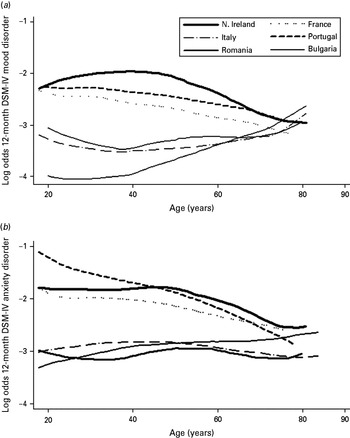
Figure 1 a plots the unweighted log odds of any 12-month mood disorder across the adult lifespan for selected countries (see online Supplementary Fig. A3 for log odds for all 10 countries), restricted to ages where there were at least 20 participants to minimize wave effects at the upper end of the age distribution. Although the log odds of any mood disorder varies widely with age and country, levels converge in later life. Of note is the relatively high log odds of any 12-month mood disorder in Northern Ireland for most of the adult life, and a steady increase in the log odds of any mood disorder with age in Bulgaria. In all countries apart from Bulgaria, the log odds of any 12-month anxiety disorder declines with age (with particularly high levels among younger Portuguese adults; Fig. 1 b and online Supplementary Fig. A4).
Log odds 12-month Part 1 DSM-IV (a) mood disorder (without hierarchy) and (b) anxiety disorder (without hierarchy) by age.

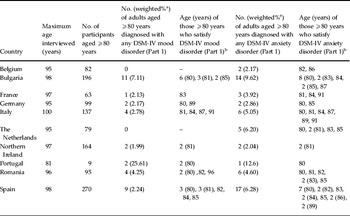
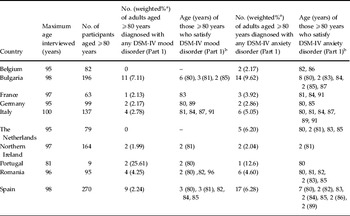
Table 2 details sampling and disorder levels among adults aged ⩾80 years, data that we were not able to fully incorporate into the plots. Levels of mood and anxiety disorders among these adults are approximately half those of all adults. With the exception of Portugal (whose oldest participants were 81 years), a maximum of 2.8% of participants over the age of 80 years satisfied the diagnostic criteria for any 12-month mood disorder in Western European countries, whereas in Bulgaria and Romania the percentages were higher (4.3% and 7.1% respectively). Those over 80 years who met the diagnostic criteria tended to be younger rather than older.
Number of participants aged ⩾80 years diagnosed with 12-month mood or anxiety disorder (without hierarchy): the EU-WMH project
EU-WMH, European Union World Mental Health.
a Part 1 country-specific weights.
b 2 (80) means two participants aged 80 years, etc.
Any mood disorder
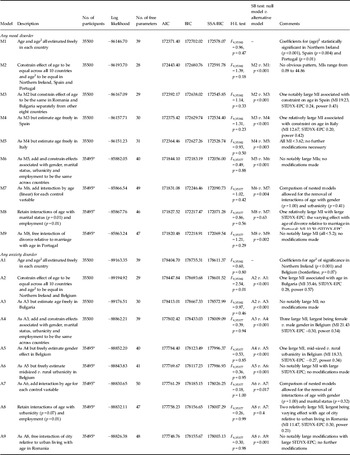
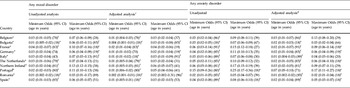
The steps for model fitting and the rationale for model modification at each step are detailed in Table 3, with the results listed in Tables 4 and 5. In the majority of countries prevalence is lowest among the oldest adults but it is only possible to estimate a non-zero odds of a disorder up to the maximum age at which the diagnostic criteria are met. In Belgium, France, Germany and The Netherlands, the odds of any 12-month mood disorder declines steadily for most, if not all, of the adult lifespan. Although the odds of any mood disorder is also lowest among the oldest adults in Northern Ireland, Portugal and Spain, there is a notable peak in Northern Ireland and Portugal at 38 years, and at 51 years in Spain. In Bulgaria and Romania, prevalence increases with age whereas in Italy prevalence declines with age until 43 years, at which point it increases. Prevalence increases with age in Italy along the entire lifespan after the relevant adjustments are made.
Modelling the log odds of a diagnosis of any 12-month mood and anxiety disorder (without hierarchy): the EU-WMH project

EU-WMH, European Union World Mental Health; AIC, Aikake information criteria; BIC, Bayesian information criteria; SSA-BIC, sample size-adjusted BIC; H-L test, Hosmer–Lemeshow test; S-B test, Satorra–Bentler scaled χ 2 difference test; MI, modification index; STDYX-EPC, YX standardized expected parameter change.
a Five participants in Bulgaria had no urbanicity recorded.
Minimum and maximum odds of any mood and anxiety disorder with age of attainment by country: the EU-WMH project

EU-WMH, European Union World Mental Health; CI, confidence interval.
a Part 1 weights.
b Part 2 weights.
c Model M9: adjusted for gender, marital status, urbanicity and employment status (i.e. married, employed, rural-dwelling males).
d Model A9: adjusted for gender, marital status, urbanicity and employment status (i.e. married, employed, rural-dwelling males).
e Lower age limit of participants diagnosed with disorder (country specific).
f Upper age limit of participants diagnosed with disorder (country specific).
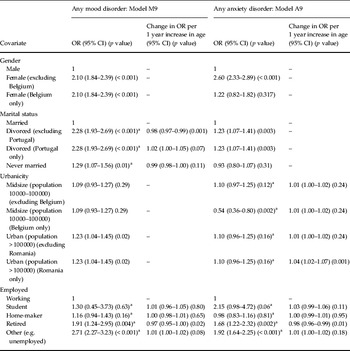
Estimated effects associated with determinants of mood and anxiety disorders: the EU-WMH project

EU-WMH, European Union World Mental Health; OR, odds ratio; CI, confidence interval.
a An individual of average age (46.9 years).
The effects associated with gender, marital status, urbanicity and employment on any 12-month mood disorder are relatively homogeneous across countries after taking account of the differential effects of ageing. The odds of any 12-month mood disorder are more than twice as high in females as in males [odds ratio (OR) 2.1, 95% confidence interval (CI) 1.8–2.4, p < 0.001], with urban living relative to rural living associated with an increased odds of any 12-month mood disorder (OR 1.2, 95% CI 1.0–1.5, p = 0.02). Being divorced or never married as opposed to being married or in a marriage-like relationship is also associated with an increased odds of any 12-month mood disorder for an individual of average age (46.9 years) (OR 2.3, 95% CI 1.9–2.7, p < 0.001 and OR 1.3, 95% CI 1.1–1.6, p = 0.01 respectively). The effect of divorce is associated with a fall in the odds of any 12-month mood disorder of 2% annually (p = 0.001) in each country apart from Portugal, where there is borderline evidence of an increasing effect with age of 2% annually (p = 0.07). An individual of average age is nearly three times as likely to have any 12-month mood disorder if they are unemployed rather than employed (OR 2.7, 95% CI 2.3–3.2, p < 0.001). The interaction of employment status with age (Satorra–Bentler test, p = 0.01) seems to have been driven by the declining effect associated with retirement on mood disorders with age; this is not surprising given that most retired adults are older rather than younger.
Any anxiety disorder
In Spain and Portugal the odds of any 12-month anxiety disorder declines steadily with age; in all other countries with the exception of Bulgaria, it peaks between the ages of 27 and 39 years. In Bulgaria the prevalence of any 12-month anxiety disorder increases with age until 67 years, and only declines slightly thereafter. Levels of anxiety disorders are particularly high among the youngest adults in both Portugal and Belgium when the relevant adjustments are made.
The effects associated with gender, marital status, urbanicity and employment on any 12-month anxiety disorder are relatively homogeneous across countries after taking account of the differential effects of ageing. Being divorced relative to being married is associated with an increase in the odds of any anxiety disorder of 23% (OR 1.2, 95% CI 1.1–1.4, p = 0.003), and female gender is associated with an increase in the odds of any 12-month anxiety disorder of 160% (OR 2.6, 95% CI 2.3–2.9, p < 0.001) in all countries except Belgium, where there is no significant gender effect (OR 1.2, 95% CI 0.8–1.8, p = 0.3). In Belgium, living in a midsize area relative to a rural area is associated with a reduction in the odds of any 12-month anxiety disorder by almost 50% for an individual of average age (OR 0.5, 95% CI 0.4–0.8, p = 0.002). The effect of city living instead of rural living is associated with an increase in the odds of a 12-month anxiety disorder by 4% annually in Romania (OR 1.0, 95% CI 1.0–1.1, p = 0.001). An individual of average age is nearly twice as likely to have a 12-month anxiety disorder if they are unemployed rather than employed (OR 1.9, 95% CI 1.6–2.3, p < 0.001).
Discussion
Methodological discussion
This study used a multigroup strategy to explore the relationship between age and mental disorders in a cross-national context. Multigroup analysis is a useful modelling strategy when the number of groups is relatively small (e.g. ⩽20) and the researcher is interested in exploring specific differences between countries (Selig et al. Reference Selig, Card, Little, van de Vijver, van Hemert and Poortinga2008), whereas hierarchical modelling can be used when the number of groups is larger and knowledge of specific differences between groups is of lesser importance (Bou & Satorra, Reference Bou and Satorra2010).
We are aware of several limitations to our analyses. The use of cross-sectional data does not allow for the distinction between ageing and cohort effects. Diagnostic measures have been based on retrospective self-report, which may lead to an underestimation of the levels of mood and anxiety disorders in later life. Diagnostic criteria are invariant with age and whether this is appropriate is debated (Jeste et al. Reference Jeste, Blazer, First, William, First, Sirovatka and Regier2007). We grouped the disorders according to the DSM-IV metastructure but other combinations are possible. The number of sociodemographic variables included is relatively small because of the lack of comparable data collected from the Part 1 samples in the different countries.
Although we set out in advance criteria that guided the extent to which model modification would be permitted, there is the possibility of overfitting or underfitting when using a structural equation modelling approach because of sampling error (Green & Babyak, Reference Green and Babyak1997). This could be explored further using techniques such as cross-validation. Treating age as a continuous variable helped us to explore the effects associated with age in detail, in addition to when to stop extrapolating results. Being able to estimate residuals and influence values meant we were satisfied to report results from models fitted across the entire age distribution of the sample.
Epidemiological discussion
Low numbers of older adults meeting 12-month DSM-IV/CIDI diagnostic criteria for mood and anxiety disorders
It is relatively uncommon for adults aged over 80 years to meet DSM-IV diagnostic criteria for mood disorders, and to a certain degree anxiety disorders, in each country despite the modest number of adults sampled above this age. Consequently, some argue that this observation, in conjunction with the general decline in the prevalence of mood and anxiety disorders with age noted in the majority of countries, mirrors reality and that the oldest community-dwelling adults rarely, if ever, experience depression or anxiety in any 12-month period. Theories of stress-related growth are sometimes cited in support of this (Kuwert et al. Reference Kuwert, Knaevelsrud, Rosenthal, Dudeck, Freyberger and Spitzer2008; Ardelt et al. Reference Ardelt, Landes and Vaillant2010); other factors such as psychiatric morbidity or movement into residential care facilities may have removed these adults from the community. However, neither of the latter are likely to be deciding factors. Simulation studies have shown that death rates attributable to the reduced life-expectancy associated with mental disorders would have to be implausibly high among older adults to account for a decline in the prevalence of depression with age (Kruijshaar et al. Reference Kruijshaar, Barendregt, Vos, de Graaf, Spijker and Andrews2005; Patten, Reference Patten2007). Furthermore, the number of older adults in residential care facilities considered as a proportion of their peers is relatively small in most countries (2.17% of adults in Northern Ireland over 65 years were in residential or nursing care in 2008; DHSSPSNI, 2008).
Overall, we remain unconvinced that estimates of the burden of mood and anxiety disorders according to standardized interviews across many countries are realistic and that older adults rarely, if ever, experience depression or anxiety. The Department of Health in England estimates that around 40% of older adults attending their doctor have a mental health difficulty (NIMHE, 2005). Figures from Northern Ireland show that, between 2007 and 2008, of the 13980 adults aged ⩾25 years who were designated mentally ill (excluding those with dementia) and in contact with their Health Care Trust, 10.2% were aged ⩾75 years. Rates of death officially recorded as deaths by suicide per 100000 across Europe remain stubbornly high in older adults (EUROPA, 2008; Scowcroft, Reference Scowcroft2012).
There may be reasons for this discrepancy: older adults with prior or current mental illness may simply be opting out of the interview process. Research has shown that standardized diagnostic interviews may exceed the cognitive capacity of older adults (Knauper & Wittchen, Reference Knauper and Wittchen1994), who are likely to give different answers to CIDI questions compared to similar questions posed using other instruments (O'Connor & Parslow, Reference O'Connor and Parslow2009). Given the increasing number of countries participating in cross-national research and increases in life expectancy, it seems appropriate that the validity of the CIDI as an instrument for assessing mental disorders among older adults be addressed more fully.
Differing relationships between prevalence and age across countries
We noted wide differences in the prevalence levels of individual disorders across the EU-WMH. This may be due in part to the lack of established validity of the instrument in all these countries, particularly in Eastern Europe, and also to the fact that genuine cross-cultural differences exist. Northern Ireland and Portugal account for the highest prevalence of all Part 1 mood and anxiety disorders in the EU-WMH. There may be several possible reasons for this: these surveys, the last EU-WMH studies to be completed, were undertaken at a time of increasing economic uncertainty. The high levels of mood and anxiety disorders in these countries may reflect an association between deprivation and mental illness (Kuruvilla & Jacob, Reference Kuruvilla and Jacob2007); in 2009 both Portugal and Northern Ireland reported the lowest GDP per capita of all Western European countries participating in the EU-WMH (EUROPA, 2012). The particularly high levels of mood disorders in Northern Ireland are likely to be associated with the civil conflict of the second half of the twentieth century known as ‘the troubles’ (Davidson & Leavey, Reference Davidson and Leavey2010).
No simple geographical pattern exists that summarizes the relationship between prevalence and age for all disorders. The lowest levels of mental disorders are reported in Italy, Romania and Bulgaria, with the prevalence of both mood and anxiety disorders increasing with age in Bulgaria. It has been suggested that the increasing prevalence of mood disorders with age in some Eastern European countries is associated with the breakdown of communist governments in the 1990s and the declining economic circumstances, which have affected the oldest adults most severely (Tomov et al. Reference Tomov, Mladenova, Lazarova, Sotirov and Okoliyski2004). Lack of research prior to the EU-WMH means that it is not possible to determine whether this is true or not. In Romania there is a lack of active ageing strategies and older adults retire early, face feelings of futility and have low levels of social engagement. Mental illness in Bulgaria has been described as ‘an irreversible condition, which strips the sufferer of all their mental faculties' (Coleman et al. Reference Coleman, Carare, Petrov, Forbes, Saigal, Spreadbury, Yap and Kendrick2011). The relatively low levels of mental disorders among the youngest adults here may be genuine or a reflection of stigma or low mental health literacy.
We have also noted the very high levels of anxiety disorders in adults in Portugal and Belgium among younger adults. Portugal has experienced economic difficulties consistently throughout the first decade of the twenty-first century, with increasing levels of youth unemployment, and this may be reflected in our results. Alternatively, younger adults may have a more keenly developed sense of mental health literacy.
Effects associated with gender, marital status, urbanicity and employment status across the lifespan
As noted previously, similarities in individual mental health determinants across countries have been observed. We have now tested this observation formally and noted that effects associated with variables such as gender, marital status, employment and urbanicity on the odds of mood or anxiety disorders are generally homogeneous across the EU-WMH. Not only are these effects similar but also the ways in which they vary with age are similar. This may be in part a result of the multigroup strategy; in a multilevel analysis of data gathered from 23 countries participating in the European Social Survey (ESS-3), random slopes models reported significant variation across countries in the effects of gender, education and employment after adjusting for age in depression as measured by the Centre for Epidemiologic Studies Depression Scale (CES-D; Van de Velde et al. Reference Van de Velde, Bracke and Levecque2010). To explore this matter further, the analyses could be repeated across a wider selection of countries and a greater variety of control variables incorporated.
There were some exceptions to the above result. There was no significant gender effect on the odds of any anxiety disorder in Belgium (OR 1.2, 95% CI 0.8–1.8, p = 0.4). This contrasts with another Belgian study (LaPierre, Reference LaPierre2009) that reported a strong statistical association of female gender with pure depression, pure anxiety disorder and co-morbid depression/generalized anxiety in the adult population (p < 0.0001 in all cases). The effect associated with divorce on mood disorders decreased with age in all countries (p < 0.001) apart from Portugal. It may be that younger adults experience more undesirable life events than older adults and have fewer coping resources (Jang et al. Reference Jang, Kawachi, Chang, Boo, Shin, Lee and Cho2009). The Portuguese observation tallies with longitudinal studies that suggest that the association of divorce with mental illness increases rather than decreases with age (Breslau et al. Reference Breslau, Miller, Jin, Sampson, Alonso, Andrade, Bromet, de Girolamo, Demyttenaere, Fayyad, Fukao, Galaon, Gureje, He, Hinkov, Hu, Kovess-Masfety, Matschinger, Medina-Mora, Ormel, Posada-Villa, Sagar, Scott and Kessler2011).
The odds of any anxiety disorder in Belgium for adults of average age was significantly lower in mid-sized regions (10 000–100 000 inhabitants) regions compared to rural regions (<10 000 inhabitants). Although noted elsewhere in the EU-WMH literature (Kovess-Masfety et al. Reference Kovess-Masfety, Lecoutour and Delavelle2005), this result sits outside the general body of literature, which suggests that as population density increases so does the odds of mental illness (Dekker et al. Reference Dekker, Peen, Koelen, Smit and Schoevers2008), or that urbanicity effects disappear once other variables such as age and socio-economic status are taken into account (Kovess-Masfety et al. Reference Kovess-Masfety, Lecoutour and Delavelle2005). It is possible that this result is an artefact of constraining the urbanicity categories to be the same across countries and this may change when a more country-sensitive measure of urbanicity is used.
Conclusions
In this study we have used multigroup methods to explore the distribution of several determinants of mental disorders across the adult lifespan within selected EU countries. Effects associated with common determinants such as gender and marital status are relatively homogeneous across countries. Mental disorders are relatively uncommon among the oldest adults surveyed, at least in Western Europe. We contend that this result is unlikely to be realistic and warrants formal validity studies of the CIDI among this age group. The lack of validation in older adults is a concern that does not always seem to be fully appreciated; furthermore, it is a concern that is not limited to one country but may apply to many. We believe it would be erroneous for policy makers, at times of economic restraint, to conclude on the basis of our results that there was little need to invest in the mental well-being of older adults in Western Europe or in younger adults in the East and to concentrate resources elsewhere. This would make it even more difficult for adults who required such help to seek and receive it. Conversely, in countries where prevalence is genuinely low at certain stages in the lifespan, such information could aid the development of positive mental health strategies seeking to reduce the burden associated with these illnesses in other countries.
Supplementary material
For supplementary material accompanying this paper visit http://dx.doi.org/10.1017/S0033291713001116.
Acknowledgements
This work was supported by the EU Contribution to the World Mental Health (WMH) Surveys Initiative (EU-WMH) project (EAHC 20081308) and by the European Study of the Epidemiology of Mental Disorders (ESEMeD) project (QLG5–1999–01042; SANCO 2004123); the Piedmont Region (Italy), Fondo de Investigación Sanitaria, Instituto de Salud Carlos III, Spain (FIS 00/ 0028), Ministerio de Ciencia y Tecnología, Spain (SAF 2000-158-CE), Departament de Salut, Generalitat de Catalunya, Spain, Instituto de Salud Carlos III (CIBER CB06/02/0046, RETICS RD06/0011 REM-TAP), and other local agencies and by an unrestricted educational grant from GlaxoSmithKline. The primary author was funded by the Department of Education and Learning for Northern Ireland (DELNI). This project is carried out in conjunction with the World Health Organization World Mental Health (WMH) Survey initiative. We thank the WMH staff for assistance with instrumentation fieldwork, and data analysis. A complete list of WMH publications can be found at http://www.hcp.med.harvard.edu/wmh/.
Declaration of Interest
None.