

Introduction
In the heyday of incrementalism, scholars elaborated theories to explain why public programmes were slowly but almost continuously being expanded. Nowadays, in the era of constrained public finance, shedding light on how expenditures are limited is perhaps the most obvious concern for both scholars and practitioners. To understand the political dynamics of retrenchment we focus on the role of three factors: the rules of the game, political actors, and external constraints. Budgetary institutions are fundamental drivers of policy change in all modern democracies (Wildavsky, Reference Wildavsky1986), but their institutionalization has followed rather different paths from one case to another. Italy is an example of late consolidation of a solid budgetary process: indeed, the first attempt to provide the executive with planning capabilities and powers of control over legislative action took place only in 1978. Since then, new procedures have been gradually introduced to diminish the strict control of the legislature over the annual budgetary package of measures, and to strengthen the role of the executive. In the early nineties, the collapse of the old party system and the start of the age of political alternation opened the possibility for a more direct link between voters’ choices and the direction of public policies. However, the possibility to implement comprehensive reforms was somewhat hindered for both the centre-right and the centre-left coalitions, though to a different degree, by their internal heterogeneity.
This work covers the last 30 years and, in particular, the phase of retrenchment following the signing of the Maastricht treaty and the launch of the European Monetary Union (EMU), which worked as a vincolo esterno, obliging the government to produce tight budgets (Dyson and Featherston, Reference Dyson and Featherstone1996). By analyzing cases in which the political and economic conditions required the cutting of expenditures, our main aim is to assess the nature of the cuts – whether they were evenly distributed among several programmes (linear cuts) or disproportionately concentrated on just a few (selective) ones – and explain what determined each outcome.
This article contributes to the literature of budgetary politics by shedding light on why it is difficult to make selective cuts, a phenomenon already noted by quantitative studies. However, we also show how selective cuts can emerge from a combination of factors. After describing the evolution of the budgetary process, we devote a section to elaborating three propositions on why the necessity to cut expenditures often leads to across-the-board cuts. The next section presents our data and research strategy, combining a quantitative measurement of the dependent variable and a qualitative approach to assess the applicability of our propositions. We then proceed to the study of four cases of retrenchment through a theory testing process tracing, in its minimalist version (Bennet and Checkel, Reference Bennett and Checkel2014). Overall, findings suggest that a high level of friction leads the Italian budget session to introduce mainly linear cuts. However, selective cuts may emerge along with a logic of urgency triggered by the so-called ‘external constraint’, which plays a key role in the Italian budgetary process.
Budget institutions and budgetary performance in Italy: 1992–2016
As already mentioned, a proper budgetary process has existed in Italy since 1978, when the annual Financial Bill was introduced (Della Sala, Reference Della1988). However, this normative frame designed during the golden age of consensualism (Cotta and Verzichelli, Reference Cotta and Verzichelli2007) transformed the instrument of the financial bill into a sort of omnibus legislation whose distributive content could easily be increased by parliament, while the government had a limited role in drafting the text. To have a more rational design, we had to wait until the 1988 reform.
Indeed, this last modification profoundly changed the budgetary process, thanks to the introduction of three important novelties: (1) the standardization of the content of the financial bill, with the consequent reduction of room for micro-sectional dispositions; (2) a multi-annual budget plan to be included in the budget law, as a result of the application of a new programming technique; (3) the strengthening of executive control over the budgetary figures, thanks to the establishment of a staff of experts under the Prime Minister’s office, and to the introduction of a compulsory Economic and Financial Plan to be presented in parliament a few months before the adoption of the financial bill.
The years following the 1988 reform saw the emergence of the vincolo esterno. After the launch of the Delors plan for a EMU (Dyson and Featherstone, Reference Dyson and Featherstone1996), and more evidently after the signing of the Maastricht Treaty (1991), which introduced strict rules for public finance convergence of the EU member states, the prospect of an unavoidable policy of retrenchment which aimed to meet the supranational target was shared by most of the decision makers. It is no coincidence that since that year the financial and budget bills have been regularly approved within the parliamentary session deadline of 31 December, thus avoiding the provisional budget, which used to be a frequent outcome. Nor is it a coincidence that the trend of overall financial figures has been reversed since then, with a drastic reduction of the deficit and, over the years, a remarkable series of positive primary balances.
In the early 1990s, the approval of the budget package (the financial law, the formal budget law, and other connected legislative items) became the most relevant decisional process of the year. To be more precise, under the new budgetary procedure the government firstly set the budgetary targets, then presented the budget bill to parliament, describing the budget trends determined by the legislation in force, and finally proposed a set of substantive measures to correct the budget trends according to the targets indicated in the financial bill. Other governmental proposals – bills or even urgent decrees – could have a ‘priority lane’ in parliament after the vote on the budget law, thus forming the manovra finanziaria, an annual financial package whose overall effect should fit the budgetary targets set by the executive months before.
The strengthening of executive authority was not balanced by a significant reform of parliamentary rules of procedures: the budget session remained highly uncertain and open to a number of amendments from a plethoric bicameral legislature, where MPs tend to accommodate their constituency’s requests while leaving the topic of financial rigour aside. As a matter of fact, the Italian general frame of budgetary process has always resembled the model of a ‘contract’ between different institutional and social actors, rather than a ‘delegation’ to a dedicated governmental actor (Hallerberg et al., Reference Hallerberg, Strauch and Hagen2007).
Therefore, the most important determinants of the virtuous trend of Italian public finances since the mid-1990s have been, according to most observers, the external constraint of the EMU requirements and the political weakness of Italy in the European scenario. Such constraints were somehow internalized with the adoption of the Stability and Growth Pact (SGP) and with the following reform established by the Prodi government, which marked another relevant step in the direction of executive ‘rationalization’, by centralizing the authorities of three ministers (treasury, budget, and finance) in one superminister of the economy.Footnote 1 During the same legislative term, the parliamentary rules of procedures introduced a preventive vote on the overall figure of the expected budget deficit, before opening the amendment session. However, the centrality of legislature was confirmed. Indeed, the content of the Financial Law was stretched again, allowing the introduction of a number of expenditure measures during the parliamentary session.
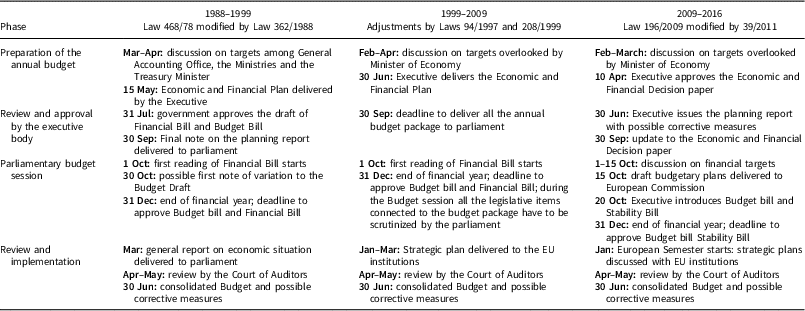
Table 1 summarizes the main variations in the structure of the Italian budgetary process. One can notice that the simplification of the budget structure (1997), the tighter schedule imposed on the parliament (1999) and the concentration of the formulation power between the Prime Minister and the Minister for the Economy created the conditions for a greater centralization of the process. As a matter of fact, the following years, dominated by a powerful and stable centre-right government, marked a new period of mild expansive policies which were, however, committed to respecting the stability pact rules, now internalized within the process.
The evolution of budgetary process in Italy (1988–2016)

A new reform, in 2009, redesigned the whole process, providing a new normative which would reinforce the trend of centralization: in particular, the legislator reshaped the phase of governmental preparation, substituting the old economic and financial plan with a slimmer document called Public Finance Decisions. Its guidelines would be published before the summer and the full document, issued in September, would include the complete list of measures formalized by the Stability Law (which in turn replaced the Financial Law). The timeline of the budgetary process would therefore be more compacted, and the whole process more transparent. In the following 2 years, when the global crisis had already seriously hit the Italian economy, other normative corrections were made: the decision to amend art. 81 of the Italian Constitution, introducing the ‘balanced budget’ in order to internalize the principle already fixed at the supranational level by the Fiscal Compact treaty, and the decision to unify (after 2016) the stability bill and the formal budget bill in a unique piece of legislation.
In brief, the budgetary process at work in Italy has always confirmed its parliamentary nature but, at the same time, it has improved its effectiveness, providing both the formulation phase and the parliamentary session with adequate timing and clear rules about the different institutional roles. The steering capability of the core executive (the Prime Minister and the Minister for the Economy) now looks consistent with the idea – very often recalled during the period of the left–right alternation (1996–2011) – to reduce the parliamentary prerogatives over this process, thus introducing another element of the ‘majoritarian model’ (Morlino, Reference Morlino2011). Indeed, the efforts of the last decades have determined the conditions for an appropriate institutional design, introducing some optimistic expectations about the reduction of a long-standing problem like that of fiscal irresponsibility (Damonte, Reference Damonte2013).
However, the economic crisis has opened a new phase of political instability, clearly showing that the battle for a more effective role of the executive in the Italian policy-making process is not over. This has evident consequences for the future of the budgetary process: the persistence of a symmetrical bicameralism clearly affects the probability of institutional veto points during the process. Moreover, the undeniable role of external constraint (Pavolini et al., Reference Pavolini, León, Guillénc and Ascoli2015; Moschella, Reference Moschella2017) does not always correspond to a clear re-alignment of domestic procedures, and the introduction of invasive principles like the ‘constitutional balanced budget’ cannot be pursued without new and adequate parliamentary rules of procedure (Lupo and Piccirilli, Reference Lupo and Piccirilli2017). In a nutshell, we must not forget that the rationalization of the budgetary process gradually implemented in the last decades did not alter the polycentric character of the political system. The frequent necessity to meet the target determined by exogenous factors through a policy of retrenchment challenged the government to find cutting alternatives that could be acceptable to several actors.
The dynamics of budgetary contractions
In the period under analysis there were several years when the Italian government was constrained to adopt a tight budget and cut expenditures. Very often, this happened to satisfy the requirements of the EMU or to reassure the financial markets. In most cases, cuts were evenly distributed across the different functions of government: as a result, the allocation of public expenditure was not significantly altered. The aim of this article is to make sense of these outcomes, shedding light on why and how they have been produced. Quantitative studies analyzing the distribution of budget changes in several political systems have revealed that substantial budgetary changes are few and far between (i.e. change is punctuated), and that budget retrenchments are less punctuated than expansions. Although the first finding was substantively interpreted as proof that the standard incremental model had to be amended, these studies did not provide theoretically-based answers on why substantive cuts tend to be less frequent than sizable expansions. The aim of this paper is to shed light on the factors hindering the emergence of selective cuts. To do so, we develop several propositions, hypothesizing mechanisms through which selective or linear outcomes can be generated. Before doing so, we briefly summarize the major findings of the literature to which we aim to contribute.
Quantitative studies on the distribution of budgetary changes prove that budgets are characterized by a long period of stability punctuated by a few dramatic changes. Starting from the 1980s, a burgeoning amount of empirical evidence showed that budget changes do not follow the normal distribution, as would be the case if policy-making followed the incremental model.Footnote 2 Rather, they are better approximated by leptokurtic distributions. While this finding is sufficient to reject incrementalism, it cannot be taken as compelling proof to support a particular alternative: in fact, several decision-making models are compatible with such an outcome. For instance, Padgett (Reference Padgett1980, Reference Padgett1981), by departing from incrementalism assumptions, elaborated the serial choice model (SCM), characterized by a great deal of continuity and a few significant changes. According to this model, when policymakers decide to reduce expenditures in a specific sector, they start negotiations with bureaucrats which tend to result in the concentration of cuts to those programmes that are both low priority and controllable (whose costs are not mainly determined by compulsory obligations). Jones and Baumgartner (Reference Jones and Baumgartner2005) hypothesized that the departure from incrementalism is due to a more general tendency of political systems to treat information disproportionally, either ignoring or over-reacting to changing external conditions. Their model, known as the punctuated equilibrium theory (PET), is built around the notion that institutions and humans’ cognitive limitations hinder the capacity of political systems to gradually adapt public expenditures to the necessities of society, and only do so abruptly when great pressure for change has been accumulated.Footnote 3 In general, systems characterized by a high level of friction (i.e. resistance to change) are more likely to exhibit a high level of stability broken by a few sizable changes.
Reviewing these well-known theories is beyond the scope of this article. Rather, we note that despite the fact that both the SCM and the PET models treat cuts and expansions symmetrically, empirical studies inspired by these models have found that expansions are not only more common than cuts, but also characterized by more extreme changes (Jones and Baumgartner, Reference Jones and Baumgartner2005). Several comparative empirical researches strengthen the idea that spending cuts and expansions obey different logics (Breunig, Reference Breunig2006, Reference Breunig2011; Jones et al., Reference Jones, Baumgartner, Breunig, Wlezien, Soroka, Foucault, François, Green-Pedersen, Koski, John, Mortensen, Varone and Walgrave2009). In an attempt to make sense of this empirical regularity, scholars have advanced several ad hoc explanations.
A rather general conjecture to explain why substantive cuts are infrequent has to do with the impact of the interests affected, which can prevent the possibility of operating selective cuts. Cutting existing programmes is always more difficult than creating new ones, because proposals to reduce allocations for a programme are likely to be met with fierce opposition from several places. It is the counter-mobilization of social and political actors which makes it extremely difficult for governments to redesign budget allocations selectively. This idea is much in line with the basic tenets of the literature on fiscal institutions. According to the so-called law of 1/n formulated by Weingast et al. (Reference Weingast, Shepsle and Johnsen1981), each decision maker involved in the formulation of the budget finds it useful to increase the allocations to programmes favouring his/her constituents, as long as the corresponding costs are distributed among all taxpayers. However, the same argument can easily be extended to a situation in which the government proposes to decrease expenditures. Political actors who represent a specific interest will be inclined to oppose the cuts affecting only their constituency but whose benefits would be widespread. This leads to a basic expectation: in a fiscal context imposing retrenchment, across-the-board cuts emerge as a result of the conflict that would be triggered by selective cuts. At the current stage, two causal mechanisms seem more likely to connect the decision to cut expenditures with the absence of selectivity. In the first scenario, the government has an agenda of selective cuts, but it cannot resist the opposition of the affected interests. Several factors can hinder the ability of the government to pursue its own agenda. The most obvious is the lack of a cohesive coalition, or a fragmented institutional context. In line with the tenets of the minimalist version of the process tracing method (Beach and Rohlfing, Reference Beach and Rohlfing2018), the first proposition specifies the sequence of events we should be able to observe if the government had a selective agenda but its plans are undermined by the resistance of the affected interests:
Proposition 1a: A conflict within the governing coalition arises after the government expresses its intention to implement selective cuts; the plan of the government is eventually abandoned.
This proposition is built on the assumption that governments have transformative agendas. However, this is not necessarily the case. Krause (Reference Krause2015) noted that in periods of austerity decision makers are not willing to change the status quo, at least in relative terms. This is a natural consequence of their being loss averse (Kahneman and Tversky, Reference Kahneman and Tversky1979; Brumby, Reference Brumby2007: 165): when cuts need to be made, every line ministry tries to block claims on their budget that might benefit other ministers. This would explain why several fiscal retrenchments, both in European countries and in the United States, have been managed with a strategy of ‘shared pain’ in which cuts are evenly distributed. This choice is usually loudly advertised. In the Italian case, scholars and practitioners have often observed that the necessity to meet stringent fiscal targets has led to linear cuts touching all departments in a similar way. This probably happened in order to prevent excessive conflict between the members of the coalition governments, which would have been very unlikely to give consent to cuts hitting only their own constituencies. According to this argument, the reason why linear/diffused cuts are the norm rather than the exception has to do with a strategic calculation of the government, and not with its relative strength.
Proposition 1b: The government proposes across-the-board cuts to avoid coalitional conflicts, anticipating the reactions of the affected interests.
The preceding propositions spell out two plausible mechanisms that may lead to linear cuts under difficult fiscal conditions. Although we know that this is the most common outcome (positive cases), our data show that in some cases retrenchments can be selective (deviant cases). Understanding why this happens sheds a light on those omitted explanations and/or different external conditions – to which mechanism-based causal assertions are extremely sensitive (Kurki, Reference Kurki2008: 231; Falletti and Lynch, Reference Falletti and Lynch2009: 1152) – that prevent the mechanism from acting as in the positive cases (Beach, Reference Beach2017).
Indeed, governments facing the challenge of austerity can strategically use external pressures to overcome the resistance put up by domestic actors and eventually implement their preferences. To a certain extent, this happened when the Italian government negotiated the conditions of the EMU (Dyson and Featherstone, Reference Dyson and Featherstone1996). The necessity to respect its rules could have been used to justify the adoption of some structural but unpopular reforms. For instance, several studies have highlighted that during the great crisis not all austerity measures implemented in the countries on the periphery of the Eurozone were actually imposed from above. Rather, governments used the urgency of the crisis to pass some of the reforms that they would have liked to introduce before but for which they lacked the necessary strength [see e.g., Dukelow (Reference Dukelow2015), Hick (Reference Hick2017) for Ireland; Cioffi and Dubin (Reference Cioffi and Dubin2016) for Spain; Moury and Standring (Reference Moury and Standring2015) for Portugal].
If this mechanism has been in action during the last decades we should be able to observe the following sequence of phenomena.
Proposition 2a: The government undertaking selective cuts can ultimately overcome conflicts within the governing coalition making a strategic use of contextual conditions.
This proposition assumes that selective cuts can be produced by actors rationally utilizing the contextual conditions to achieve their purposes. However, it has also been argued that fiscal targets, and in particular the necessity to suddenly cut expenditures, can lead to selective cuts notwithstanding the original intentions of the actors involves. For Padgett (Reference Padgett1981), when the fiscal climate requires immediate and severe cuts, the central authority responsible for the main fiscal aggregates (in his study on the US system this was the Office of Management and Budget) asks the sectoral bureaucracies to operate cuts. According to his Serial Processing Model, when the decision to cut spending in a certain area is taken (for instance, housing), negotiations begin on which specific programmes need to be cut to meet the spending target. Under the assumption of bounded rationality, policymakers cannot consider all possible cutting alternatives simultaneously. Rather, they run through different alternatives, accepting the first that is acceptable at least to all the actors involved. The set of acceptable cutting alternatives include only those which are feasible (some programmes are difficult or impossible to cut in the short term) and do not affect high priority programmes. This means that only a few programmes are required to bear the burden of sudden adjustments: those which are at the same time controllable and have low priority. While Padgett developed his model by studying the negotiations between a single administrative department and the central budgeting authority, the basic logic can be extended to the overall budget. Fiscal constraints determined by external conditions, especially those which emerge suddenly, work as perturbators of the system and favour the emergence of selective cuts.
Proposition 2b: When a sudden need to reduce expenditure arises, the government reacts by concentrating its attention on controllable and low-priority programmes for all actors involved.
Data and methods
The explanandum of this article is the transformative or linear nature of the annual manovra, that is, the change in the distribution of spending authorizations among different programmes resulting from the approval of the budget law. In order to measure it, we compare the content of the budget bill originally introduced in parliament with that of the budget law that is finally approved. By doing so, we exploit the formal nature of the budget bill in the Italian budgetary process: the authorizations written there mostly reflect the status quo determined by the legislation in force at the time. By contrast, the budget law is the final result shaped by the interactions between parliament and government. Comparing the budget bill with the budget law has two advantages over comparing the budget law with that of the previous year. First, public expenditures are sometimes categorized in different ways in different years, according to the changing interpretations of the administrative department responsible for the coding. This may cause major changes that are only methodological artefacts.Footnote 4 Second, yearly changes are not only a function of deliberate decisions, but also depend on changing economic and social conditions. By focusing solely on the correction of the spending trends that would result from the existing legislation we have the unique opportunity to disentangle the role of deliberate choices on budgetary changes.
Our data set covers 23 years (budget laws for the period 1993–2016, with a gap in 2003 for which detailed data are unavailable on the parliamentary website) and 14 categories of public spending.Footnote 5 To build the data set we looked at the official documents published on the parliamentary website.Footnote 6 To assess the nature of the fiscal package we compare the distribution of expenditures among several categories of spending in the budget bill and in the budget law. There are different ways of comparing changes, all legitimate but with different implications. Here we decided to focus on the change in the relative weight of each programme on the total amount of (programmatic) public spending. For each year, we calculated the proportion of the total spending constituted by each function in both the budget bill and the budget law, and then calculated the percentage change score. Next, we squared these values and summed them together for each year. Finally, we calculate the average dividing the sum by the total number of functions. In more formal terms our measure of the transformative nature of the manovra is as follows:
 $${\rm Index}\,{\rm of}\,{\rm change}\,{\rm in}\,{\rm authorizations}\left( {{\rm year }\, j} \right){\equals}{1 \over {14}}\sum \left( {x_{{ij}} {\minus}z_{{ij}} } \right)^{2} ,$$
where x is the percentage of expenditures devoted to programme i in the year j according to the budget bill and z the corresponding amount authorized in the budget law. By doing so we deliberately ignore the size of the budget to focus solely on its composition. We could also have chosen to focus on the absolute difference between authorizations in the budget bill and in the budget laws, comparing their amounts as a fraction of the GDP. However, the rationale for focusing on a relative measure is that we want to consider linear cuts as non-transformative: if the yearly manovra cuts all programmes to a comparable degree it means that the government did not transform the composition of public expenditures, but only its size. Cuts have not been selective. It is worth noting that, in adopting a relative measure of change, we do not directly measure budgetary punctuations. However, Pearson’s correlation between our index and an index based on absolute changes is quite high (ρ=0.67).
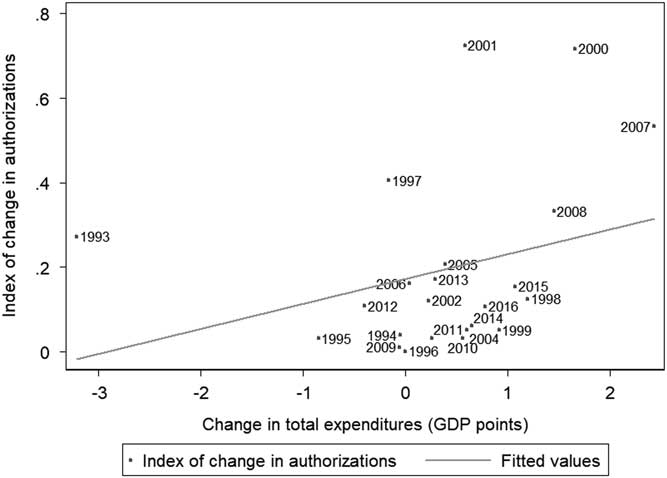
Figure 1 graphically represents the relation between the expansionary or contractionary nature of the yearly manovra and the degree to which it is transformative. It must be noted that we denoted the manovre according to their official names: the 1993 budget bill (and budget law) was introduced (and approved) in 1992. Only in a few cases did the final authorizations stated in the budget law reduce the overall amount of expenditure included in the original draft of the budget bill. A first look at this graph is already sufficient to confirm two findings of the literature: first, retrenchments are far less common than expansions; second, expansions are more transformative than cuts (the relation is clearer if we exclude 1993). The budget bill for the year 1993 is a clear outlier with regard to the magnitude of the retrenchment, and it is also moderately transformative, at least if compared with other budgets introducing cuts (1994, 1995, 1997, 2009, 2012).Footnote 7
Relation between change in total expenditures and the index of change in authorizations.

In order to reach a robust set of plausibility probes of the processes we have supposed, we will illustrate three confirmatory cases of decision-making – where the hypothesized causal mechanisms are theoretically possible because both causes, outcome and the necessary contextual conditions are present (Beach, Reference Beach2017) – and a deviant one. In 1995, expenditures were cut by almost 1 GDP point, while in the other years the level of retrenchment was more moderate. Regarding the degree of change in the allocation of authorizations, the budget law for the year 1997 is a clear outlier, producing a level of change that is higher than in many expansionary years. Selecting these cases, we cover most of the contractionary budgets in the period under analysis while still focusing on a number of cases which are possible to analyze in depth.
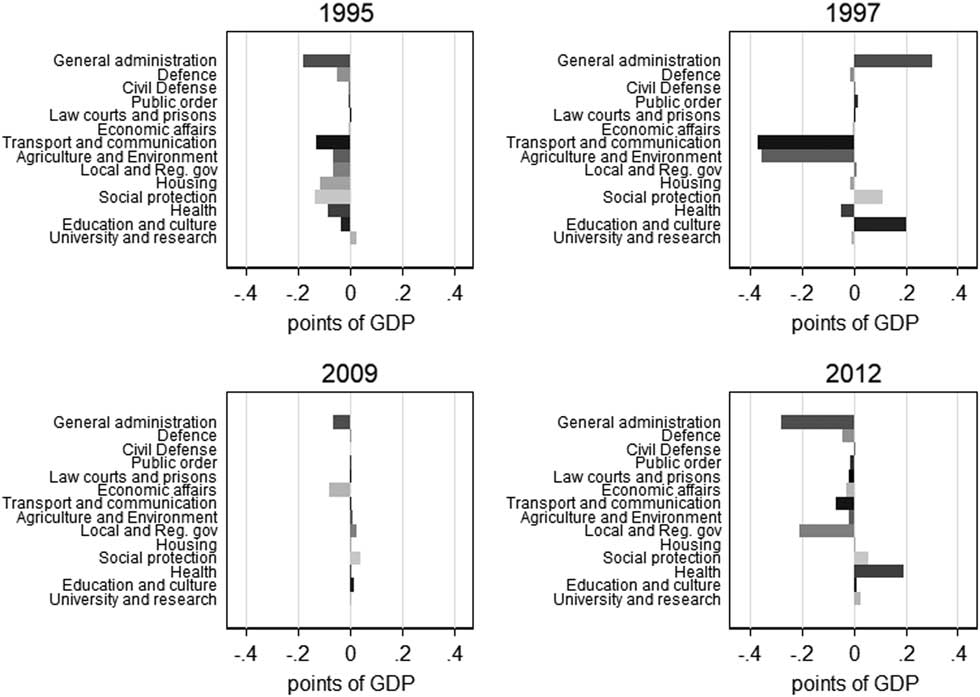
As evident from Figure 2 showing the absolute change in authorizations for each category of spending in terms of GDP points,Footnote 8 the four fiscal packages under analysis are characterized by a different nature of budget curtailments. Our classification based on 14 categories is sufficiently detailed to understand which functions of government carried the burden of the adjustment. In the budget for 1995 about half of the categories suffered comparable cuts, and all the others were left untouched: a substantive correction of the spending trend was operated, avoiding selective cuts. The manovra for 1997 is very different: overall, the level of expenditures was cut only slightly, but all the burden was carried by two sectors: ‘Transport and Communications’ and ‘Agriculture and Environment’. In fact, this was the most selective contraction observed during the 23 years covered by our analysis. The budget for 2009 had a similarly small effect on the overall level of spending, which was slightly contracted cutting the sectors ‘General Administration’ and ‘Economic Affairs’ and leaving all the others substantially unaltered. Finally, the manovra for 2012 was characterized by important cuts in the sectors ‘General Administration’ and ‘Local and Regional Level of Government’, partially counterbalanced by an increase in ‘Health’. Overall, the budget bill for 2012 was only mildly selective (more than 1995 and 2009, but much less than 1997).
Change in authorizations in terms of GDP.

Qualitative analysis: tracing the roots of budgetary cuts
The study of within-case causal processes is carried out engaging in a theory testing process tracing, through the so-called ‘minimalist understanding’ of mechanisms. Specifically, we look for those ‘diagnostic evidences’ (Bennett and Checkel, Reference Bennett and Checkel2014)Footnote 9 of the causal mechanism between the cause and the outcome, though the potentially causal mechanism remains implicit (see George and Bennett, Reference George and Bennett2005; Mahoney, Reference Mahoney2015). The use of this specific approach is justified by the fact that multiple plausible mechanisms could link the cause to the outcome, which also depends on different contextual factors (Gerring, Reference Gerring2010; Beach and Rohlfing, Reference Beach and Rohlfing2018), thus we are not sure yet about which is the explanatory causal mechanisms.
Testing the hypothesized causal mechanisms acting in the three positive cases gives evidences about the potential link between causes and outcome, leading us to cautiously infer about the presence of the causal mechanism in the population (Beach, Reference Beach2017). At the same time, analyzing the deviant case and comparing it to the most similar positive case helps to ‘trace the mechanism until it breaks down’ (Andresen, Reference Andresen2012: 421–442).
1995: when the government surrenders to infightings
The first positive case is the fiscal adjustment for 1995: this is the first budget bill written after the introduction of a new majoritarian electoral law, and the first one formulated by the new right-wing government led by the former TV tycoon Silvio Berlusconi. However, despite the bold stances of the Rivoluzione Liberale Footnote 10 and the promises of public sector dismantlement – which characterized the electoral campaign and was also recalled in his first official economic policy plan as Prime MinisterFootnote 11 – the new government was unable to take advantage of its electoral consensus, and the high fragmentation among the coalition partners produced linear cuts. The inter-governmental conflict between the neo-liberal hawks and the defenders of state participation emerged already during the draft of the budget bill, in particular on pensions and the health system, and a fierce confrontation within the parliamentary majority marked the whole phase of policy formulation (Verzichelli, Reference Verzichelli1999: 200). Even more evidently, the limited cohesion of the coalition appeared during the month of December: the budget package was approved while the government crisis had already been triggered by the decision of the Northern League (LN) leader, Umberto Bossi, to leave the majority.Footnote 12 The relevant adjustments imposed by the circumstances had actually been greatly changed during the parliamentary session: the Chief Executive resigned on the same day of the final vote on the budgetary bills (22 December 1994), after reaching a technical agreement with his (former) allies to make the financial package safe. The words of the parliamentary leader of the LN, pronounced before these approvals in the Lower Chamber, are highly illustrative of that political climate.Footnote 13 It is worth recalling that a large part of the substantive content of the 1995 adjustment was then delegated to a corrective intervention carried out by the subsequent caretaker technocratic government, by means of an urgent decree inspired by an incremental logic.
The diffused nature of the cuts evidenced by our analysis is therefore the result of a political stalemate caused by conflicts among coalition partners, which prevailed on the government’s initial intentions to cut selectively. As a matter of fact, the events occurred during the approval phase constitute a persuasive evidence of the causal mechanism stated in our first proposition (Proposition 1a). At the very beginning of the discussion phase, the newly appointed Berlusconi government had the clear target to selectively reduce expenditure, focusing only on pensions and healthcare. However, this decision activated a dramatic conflict among coalition’s members, resulting in the government crisis opened by the LN. The strong opposition conducted by Bossi, unwilling to give up on pensions and also supported by massive protests of the trade unions against the financial bill, determined the new nature of curtailments. Evidently, the LN’s success in defending its constituency’s interests and in avoiding cuts on pensions, proves that the coalitional conflict in this case prevailed on the government’s intentions, leading to linear cuts.
2009: when the government prevents coalitional conflicts
The second confirmatory case of the hypothesized causal mechanisms is the manovra for 2009. This was the first one of the XVI legislative term, made by the newly appointed Berlusconi IV government. Since the issue of the DPEF, approved on 18 July, it was clear that the government had no specific policy target to impose, but rather a broad intention to reduce the overall public expenditure, confirming the arguments used during the electoral campaign to re-launch the ‘liberal revolution’ based on the reduction of the public sector and on a number of development measures.Footnote 14 Moreover, the necessity to meet both the supranational requirements and the electoral promises was clearly and repeatedly maintained within the DPEF, as evidence of the coalition’s responsibility towards the European commitments. However, the purely financial measurements to keep to European commitments were anticipated by issuing an urgent decree before the introduction of the annual financial bill in parliament. The structural interventions were simply planned and postponed to subsequent years, announcing a governmental initiative for a new relevant reform of the whole budgetary process. Postponing these measures is a clear sign that the government did not find advisable to implement selective choices in a contractionary context. However, we acknowledge that the link between this decision and the necessity to avoid conflicts among coalition partners remains speculative. Although the budgetary bill was voted by a rather consistent majority, this does not support the idea of a strong and homogenous governing coalition, since a number of internal disputes occurred during the whole period of discussion and approval of the manovra.Footnote 15 As a matter of fact, the main element of the new policy approach of the centre-right government was to respond to the widespread fear gripping Italian public opinion (Baldini and Bull, Reference Baldini and Bull2009). In the end, this was just the first sign of a long story of ‘party abdication’ which would dominate the rest of the legislative term, marking the progressive lack of institutional capability of the executive (Marangoni and Verzichelli, Reference Marangoni and Verzichelli2014).
Overall, the cuts implemented in the bill for 2009 obeyed a clear linear logic. The linear nature of cutbacks seems to arise from the implementation of a ‘shared pain’ logic – probably a consequence of a learning process from the 1995 experience – which allowed to avoid coalitional conflicts by anticipating the reactions of the affected interests, in line with the Proposition 1b.
2012: when the government yields to external pressures
The last positive case is the fiscal package for 2012, whose decisional process has a peculiar story: the manovra had been planned and voted by the government Berlusconi IV which had also anticipated a relevant set of measures by issuing an urgent decree in the summer of 2011, but it was terminated after the birth of the technocratic government guided by Mario Monti (Fusaro, Reference Fusaro2012).
In the DEF, issued on 13 April, the government decisively stated its main goal, namely the stabilization of public finance on the basis of the SGP.Footnote 16 Overall, the entire programme did not highlight any specific sector to which the government would address its action. Rather, it touched a number of budgetary categories, subject to reform, adopting the ‘usual mechanism of linear cuts’.Footnote 17 However, the budgetary process for the 2012 bill was marked by an extremely troublesome political and economic situation which needs to be briefly summarized.
Starting from the summer of 2011, Italy was hit by the financial storm, and its credit default swaps tripled in few months (Sacchi, Reference Sacchi2015). On 5 August, the alarming conditions of the Italian public finance forced the European Central Bank (ECB) to send a confidential letter, urging the Berlusconi government to make drastic structural reforms.Footnote 18 At the same time, the ECB started making purchases on the secondary market, hoping to ease the pressure on Italian bonds (European Central Bank, 2011). Despite Berlusconi’s intention to speed up the reform process, the governing coalition was trapped into heavy intra-coalition divergences, which contributed to an increase in the interests of the sovereign debt. The leader of the Northern League, Umberto Bossi, repeatedly and strongly affirmed his party’s unwillingness to intervene on pensions, while Berlusconi and the Minister of Economic Affairs, Giulio Tremonti, conflicted on a number of policy issues. This forced the President of the Republic, Giorgio Napolitano, to sometimes indirectly setting the course of the government’s political activities, by pushing it to undertake the necessary reforms. An urgent decree approved in September introduced an emergency package following the ECB’s request which, however, failed to reassure the international investors (Sacchi, Reference Sacchi2015). In this context, with a great fear of contagion and under the attack of the financial markets, Italy became the ‘most important focus for concern in the Eurozone’ (Jones, Reference Jones2012: 93). After a downgrading by the international rating agencies and pressured by two European Council summits in late October, Berlusconi sent a letter to Brussels listing what had been done until then and the goals for the following months. Again, because the government failed to relieve the financial markets and the EU institutions, the EC asked for ‘a detailed assessment of all the measures’ and a timely monitoring of their implementation (Council of the European Union, 2011). On 4 November, the Commission submitted a document including 39 questions about various policies, demanding the adoption of other austerity measures. During the G-20 summit, Italy refused the IMF’s offer to enter into a precautionary credit line; however, it accepted its surveillance without a formal conditional lending programme. The domestic political situation, characterized also by massive protests, became equally worrying when the Chamber of Deputies rejected the first article of the Rendiconto generale dello Stato on 8 November and the government lost the majority. After Berlusconi won the confidence vote, the government decided to adopt a maxi-amendment to be added to the Stability Bill. Eventually, the Stability Bill passed, and Berlusconi resigned on 11 November.Footnote 19
The international context in which the manovra for 2012 was drafted persuaded the government that diffused cuts were not sufficient to reassure either the markets or European institutions. Both required structural reforms capable of producing substantial savings in a relatively short period of time. When European pressure convinced Berlusconi of the necessity of selective cuts, the high coalitional fragmentation made them unfeasible and eventually led to the collapse of the government. The sequence in which events unfolded provides decisive evidence in favour of Proposition 1a.
Up to now we have presented the three positive cases supporting the hypothesized causal mechanisms. However, the quantitative analysis highlighted the presence of a deviant case, detailed below.
1997: gaining momentum for selective cuts
Differently from the previous cases, the cuts implemented with the 1997 fiscal package were rather selective: in the theoretical part we have advanced two propositions that may explain this deviant case. The purpose of the following analytical reconstruction is to show how and why the mechanism producing linear cuts failed.
The 1997 budget package was approved by the newly appointed centre-left government headed by Romano Prodi, who had to translate some of the electoral campaign slogans into actions. This fiscal package was decisive in keeping Italy within the first group of EU member states included in the single currency area (Della Sala, Reference Della Sala1997; Quaglia and Radaelli, Reference Quaglia and Radaelli2007). The adjustment provoked by the budgetary decision during that year was the second in absolute number (almost 63 billion Lire), but the result was mainly obtained by raising taxes rather than by cutting expenditures.
A closer look at the archival documents and the chronicles portrays a process where the steering capacity of the government actually emerges, though in a context which remains uncertain. In June, when the DPEF was introduced, the position of the executive seemed to be extremely cautious. The road to the EMU had to be secured, stated the Prime Minister and the Treasury MinisterFootnote 20 using the same discursive points raised by Giuliano Amato a few years before, but the content of the same plan was not as severe as many European institutional leaders and stakeholders were asking for. Moreover, between his appointment as Prime Minister and the phase of policy formulation, Prodi stressed, in a number of public statements and interviews, that Italy should reach the EMU alive and not dead. At that time, the total amount of the correction was estimated at about 33 billion Lire, two-thirds of which would come from spending cuts.
A mix of structural political conditions and contingent factors was at the core of a clear acceleration in the strategies of the Italian government. The unfortunate situation determined by the decision of the Spanish Chief executive Aznar to run to the EMU’s first class of member states without consulting Italy,Footnote 21 forced the government to increase the fiscal adjustment using both the leverage of the structural reform and that of the una tantum measures. The urgency marked by the meeting explicitly emerges from the inspection of parliamentary discussions, when members of the government explained the necessity to speed up the correction of the fiscal aggregates, employing considerable effort through a revision of the bill.Footnote 22 Nevertheless, the diktat imposed by Rifondazione Comunista which was firmly against cutting pensions, led the government to intervene mainly on revenues, with the introduction of the so-called tax for Europe. This concession given by the government is the litmus test of the weak capacity of the government to implement its own policy agenda. Indeed, the selectivity of cuts is only partially derived from the deliberate choice to reduce certain programmes. While in the DPEF the government had already declared its intention to redefine its relations with the big public service providers (postal and train services), the text of the Finance Bill reveals that a large part of the cuts was obtained by postponing some measures to the following years. The government proved to be strong enough to achieve its main aim, which was to enter the EMU, but its decision to consolidate the fiscal aggregates by introducing ad hoc taxes suggests that operating additional cuts would have been politically unfeasible. The intra-coalitional conflict over the types of cuts and the veto posed by Rifondazione Comunista to cut on pensions signal that the ordinary mechanism opposing selective cuts was at work even in this year. The selective cuts eventually implemented regarded two sectors with low priority as ‘Transports’ and ‘Environment and Agriculture’, for which authorizations were mainly procrastinated rather than structurally reduced. The evidence suggests that the selective nature of curtailments was the by-product of a sudden necessity to reduce expenditure, as stated in the second proposition (Proposition 2b).
Conclusion
This article provides the first attempt to assess the weight of several factors leading to selective or evenly distributed cuts in times of unavoidable retrenchment. Along with several cases of linear cuts, we had the opportunity to observe a rather unusual outcome of the budgetary process – the decision to operate relatively selective cuts – in the context of a paradigmatic example of a polycentric, power-sharing parliamentary system traditionally characterized by high levels of fiscal irresponsibility. Although the results of this exploration cannot be taken as comprehensive accounts of all the negotiations and conflicts shaping the outcome of any particular annual policy package, the study confirms the validity of some of our working propositions, by plausibly linking a cause to an effect and thus ringing support for a given model (Lieberman, Reference Lieberman2005: 448).
In particular, engaging in a within-case process tracing analysis, we reach a ‘minimalistic understanding’ of the link between the necessity to cut expenditures (cause) and the decision to implement linear cuts (effect), as well as of the conditions under which this relation does not materialize.
We can briefly summarize our findings as follows: our study confirms that selective retrenchment policies are likely to be met with fierce opposition or avoided altogether, especially in those systems where the rate of political fragmentation and the prerogatives of parliamentary actors are strong limits to the logic of centralization. The chief executives and their economy ministers often try to pre-empt conflicts and policy stalemates, proposing to ‘share the pain’. And when the decision to cut the budget proves to be more selective, the role of urgency seems more important than the deliberate will of the government to implement its own agenda. The extreme difficulty in adopting selective adjustments in a polycentric system and the occasional necessity to adjust the budget under extreme pressure is obviously consistent with the idea that political systems exhibiting a high level of frictions (resistance to change) are more likely to produce punctuated change. However, it is also a specific mechanism whose applicability to other cases should be tested in future research.
Concerning the interpretation of the long-term transformation of budgetary policies in Italy, we argue that the increasing degree of centralization of the process has determined a relevant condition for limiting frictions and increasing the effectiveness of fiscal corrections. Nevertheless, a favourable procedure seems to be a necessary but not certainly a sufficient condition to open the possibility of selective cuts. Heterogenous coalitions such as those emerged since the early 1990s are inherently exposed to conflict because the governing partners represent different constituencies.
The common denominator behind all the episodes we have traced in this study is the exogenous factor usually called ‘external constraint’. In future research, this aspect needs to be better delineated distinguishing the cases when the formalization of European pressure and the urgency of a policy change (to avoid a demotion to the ‘second division’ of the EMU) have favoured some decisions partially agreed (if not definitively preferred) by the government, from the cases when a pure external constraint has occupied the political agenda in a situation of political stalemate (the cases of the two failures of the Berlusconi governments in 1994 and 2011). As already shown by the evolution of the manovra for 1997 and much more evidently after the establishment of the technocratic government of Mario Monti – whose story starts in 2012, when we end our explorative analysis – the complete subordination of domestic budget strategies to a policy agenda somehow ‘inspired’ from above leads us to think that the explanations of budget changes should consider not only the policy preferences of domestic actors but also the explicit or implicit conditionality imposed by a multi-level system of governance, whose leverage on the choices made at national level has been further reinforced by the crisis.
While this article probed the plausibility of the mechanism linking contractionary budgets to linear cuts, future researches should go beyond a minimalistic understanding of this phenomenon and analyze more in detail all the intermediate steps linking the cause to the effect. On methodological level, such greater comprehension of the ways in which the causal mechanism works can be achieved through applying a systems-understanding variant of process tracing (Beach, Reference Beach2017).
Acknowledgements
The authors want to thank the anonymous reviewers for their valuable comments and suggestions. All authors contributed equally to this work.
Financial Support. The research received no grants from public, commercial or non-profit funding agency.
Data. The replication data set is available at http://thedata.harvard.edu/dvn/dv/ipsr-risp