INTRODUCTION
Estrogens not only have specific effects in the gonadal axis, they also affect cerebral functions; they also exert neurotrophic and neuroprotective effects, which are mediated by non-genomic as well as by direct and indirect genomic pathways (McEwen & Alvers, Reference McEwen and Alvers1999; Garcia-Segura et al. Reference Garcia-Segura, Azcoitia and DonCarlos2001; Lee & McEwen, Reference Lee and McEwen2001; Behl, Reference Behl2001, Reference Behl and Häfner2003). Furthermore, estrogens have been shown to affect the major neurotransmitter systems such as the dopaminergic, serotonergic, gamma-aminobutyric acid (GABA)-ergic, noradrenergic, and cholinergic systems of the brain regions responsible for cognitive, emotional, and vegetative functions (Gordon et al. Reference Gordon, Borison and Diamond1980; DiPaolo, Reference DiPaolo1994; Morissette & DiPaolo, Reference Morissette and DiPaolo1993; Halbreich et al. Reference Halbreich, Rojansky, Palter, Tworek, Hissin and Wang1995; Fink et al. Reference Fink, Sumner, Rosie, Grace and Quinn1996, Reference Fink, Sumner, McQueen, Wilson and Rosie1998). In addition, there is evidence for an influence of estrogens on the course of various diseases of the nervous system such as Parkinson's disease, Alzheimer's disease, stroke, depression, and schizophrenia.
In schizophrenia research the estrogen hypothesis assumes, in particular, a protective effect of estrogen in women vulnerable to schizophrenia. Evidence for this hypothesis has been derived from animal, epidemiological, and clinical studies (see Bergemann & Riecher-Rössler, Reference Bergemann and Riecher-Rössler2005). Compared with men, the later onset of schizophrenia and the relatively high incidence of late-onset schizophrenia in women have been attributed to the protective effect of higher estrogen plasma concentrations between menarche and menopause.
Several case reports and case series show a correlation between low estrogen plasma concentrations and increased risk for psychotic symptoms in women (Mahé & Dumaine, Reference Mahé and Dumaine2001). This occurs physiologically postnatally or after the menopause (Seeman, Reference Seeman1997). During pregnancy, when estrogen plasma levels are high (especially the estrogen metabolite estriol), low rates of relapse have been observed in women with schizophrenia (Chang & Renshaw, Reference Chang and Renshaw1986; Kendell et al. Reference Kendell, Chalmers and Platz1987).
Some studies focused on the correlation between the menstrual cycle phase and the exacerbation of schizophrenia or hospitalization of acutely ill women with schizophrenia (Bergemann et al. Reference Bergemann, Parzer, Nagl, Salbach, Runnebaum, Mundt and Resch2002). However, the observation of a potential relationship between phases of the menstrual cycle and psychotic illness dates back many years and was discussed as early as in the nineteenth century (Schroeter, Reference Schroeter1874; Krafft-Ebing, Reference Krafft-Ebing1878; Schaefer, Reference Schaefer1894; Jolly, Reference Jolly1915).
More recent clinical observations and research provide some evidence for an inverse correlation between the estrogen plasma concentration throughout the menstrual cycle and psychopathological symptoms in women with schizophrenia. Hendrick et al. (Reference Hendrick, Altshuler and Burt1996) reviewed the literature on the course of psychotic illnesses during phases of the menstrual cycle. Several case reports are cited describing psychoses that recur before or during menstruation, with complete remission of symptoms following cessation of menses (Altschule & Brem, Reference Altschule and Brem1963; Teja, Reference Teja1976; Endo et al. Reference Endo, Daiguji, Asano, Yamashita and Takahashi1978; Felthous et al. Reference Felthous, Robinson and Conroy1980; Berlin et al. Reference Berlin, Bergey and Money1982; Dennerstein et al. Reference Dennerstein, Judd and Davies1983; Gerada & Reveley, Reference Gerada and Reveley1988; Lovestone, Reference Lovestone1993; Severino & Yonkers, Reference Severino and Yonkers1993). Severino & Yonkers (Reference Severino and Yonkers1993) provide a list of the various diagnoses given to this condition (‘recurrent premenstrual psychosis’, ‘periodic insanity’, ‘remitting schizophrenia’, for example). Further case reports were published by Hopker & Brockington (Reference Hopker and Brockington1991), Stein and co-workers (Reference Stein, Hanukoglu, Blank and Elizur1993), Ambelas (Reference Ambelas1994), and Abe & Ohta (Reference Seeman1998). There have also been reports of women who, after remission from postpartum psychosis, had premenstrual relapses of schizophrenic symptoms over a period of up to three years after delivery (Dennerstein et al. Reference Dennerstein, Judd and Davies1983; Brockington et al. Reference Brockington, Kelly and Hall1988).
Glick & Stewart (Reference Glick and Stewart1980), Swanson and colleagues (Reference Swanson, Barron, Floren and Smith1964), and Hallonquist and colleagues (Reference Hallonquist, Seeman, Lang and Rector1993) report on cases or small case series of women with schizophrenia treated with antipsychotics whose psychopathological condition worsened during the low-estrogen phase of the menstrual cycle. However, the estrogen plasma levels were not controlled in any of these studies, and psychopathology was assessed by clinical observation only, except in the five cases presented by Hallonquist and co-workers (Reference Hallonquist, Seeman, Lang and Rector1993).
Riecher-Rössler and colleagues (Reference Riecher-Rössler, Häfner, Stumbaum, Maurer and Schmidt1994) investi-gated the relation between the extent of schizophrenic symptoms at different estrogen plasma levels and during different phases of the menstrual cycle in 32 women with schizophrenia. Despite slight fluctuations across the menstrual cycle and the small sample size, a negative correlation was observed between the plasma levels of 17β-estradiol, the most potent form of estrogen, and all symptom ratings except for the depression score. This means that schizophrenic symptoms improved when estradiol plasma concentrations increased, and vice versa. Findings from previous studies (Swanson et al. Reference Swanson, Barron, Floren and Smith1964; Glick & Stewart, Reference Glick and Stewart1980; Hallonquist et al. Reference Hallonquist, Seeman, Lang and Rector1993; Gattaz et al. Reference Gattaz, Vogel, Riecher-Rössler and Soddu1994) regarding the correlation between the different phases of the menstrual cycle and psychopathology were verified by Riecher-Rössler and colleagues (Reference Riecher-Rössler, Häfner, Stumbaum, Maurer and Schmidt1994) who took estradiol plasma levels into account and assessed the psychopathology using standardized rating scales. In a group of patients without schizophrenia who were suffering mainly from depressive disorders, this correlation between estradiol plasma concentration and psychopathology was not observed (Riecher-Rössler et al. Reference Riecher-Rössler, Häfner, Dütsch-Strobel and Stumbaum1998).
In contrast to the results of Riecher-Rössler and colleagues (Reference Riecher-Rössler, Häfner, Stumbaum, Maurer and Schmidt1994), Harris (Reference Harris1997) did not find an increase in psychotic symptoms across the menstrual cycle in 39 acutely ill, hospitalized women suffering from schizophrenia; however, he found an increase in affective and somatic symptoms in the premenstrual phase.
Gattaz and co-workers (Reference Gattaz, Vogel, Riecher-Rössler and Soddu1994) showed a significant correlation between the estradiol plasma concentration and the therapeutically required dose of antipsychotics in the different phases of the menstrual cycle (Seeman, Reference Seeman1983, Reference Seeman1997; Magharious et al. Reference Magharious, Goff and Amico1998).
In summary, the association between estrogen and psychotic symptoms across the menstrual cycle has received attention in the past but few systematic investigations have been conducted. The studies on the course of schizophrenic symptoms across the menstrual cycle are limited because of small numbers of subjects, unreliable methods of determining menstrual cycle phases, or because hormone levels were not analyzed. Therefore, the aim of the present study was to determine whether the assumed correlation between menstrual cycle and/or estrogen levels across the menstrual cycle and psychotic symptoms in women with schizophrenia can be confirmed in a larger sample.
METHOD
Procedure and subjects
In a multi-center study, a total of 702 women suffering from schizophrenia consecutively admitted to the hospital were examined. They were hospitalized at the Psychiatric University Hospitals of Heidelberg and Mannheim and at the Psychiatric Hospitals of Heppenheim and Wiesloch, both located in the Heidelberg area. Of the women examined, 79 had previously been hospitalized in the study period in one of the participating hospitals so that the resulting sample contained 623 patients who were examined in more detail. Patients were included in the study after a diagnosis of schizophrenia was confirmed in accordance with DSM-IV and ICD-10. In addition, the gynecological history was assessed according to a structured interview adapted from Leidenberger (Reference Leidenberger1992).
A total of 125 women met the inclusion criteria – regular menses and a diagnosis of schizophrenia according to DSM-IV (chapters 295.0–295.9) and ICD-10 (chapters F20.0–F20.9) – and did not meet the following exclusion criteria: patients currently receiving hormone replacement therapy (n=22) or hormonal contraceptives (n=53) were excluded from the study, as were postmenopausal women (n=122). Women who had undergone hysterectomy or surgery affecting gonadal function were also excluded from the study (n=20), as were women with amenorrhea or irregular menses for any other reason (n=46). None of the patients included in the study was pregnant or breastfeeding, or had given birth immediately before hospitalization (n=10). Furthermore, women with relevant co-morbidity (n=33) and language difficulties (n=4) were excluded from the study, as were women showing non-compliance for any reason (n=109) or when there was a change in the diagnosis (n=12). Another 67 patients were excluded because the available data were not sufficient.
All patients were receiving some kind of antipsychotic medication, and most of them were also taking other psychotropic substances such as anticholinergic medication, antidepressants, mood stabilizer, benzodiazepines, or a second antipsychotic drug. Thirty-six patients (28·8%) were receiving clozapine, 32 (25·6%) haloperidol, 27 (21·6%) flupentixol, 25 (20·0%) olanzapine, 18 (14·4%) benperidol, 12 (12·0%) perazine, 14 (11·2%) fluphenazine, another 14 (11·2%) levomepromazine, and 13 (10·4%) chlorprothixene. Some of the patients were receiving more than one antipsychotic medication. In less than 10% of the patients, perphenazine, pipamperone, sulpiride, prothipendyle, zotepine, clopenthixole, bromperidole, melperone, pimozide, or thioridazine were administered. No patient received a depot medication. Six patients were receiving no antipsychotic medication at least at one of the points in time of measurement.
All participants were Caucasian. The mean age of the sample differs significantly from the mean age of the women excluded from the sample [mean±standard deviation (s.d.)=35·0±8·3 years v. 41·3±12·2 years, p<0·001, t test], which might be attributed to the difference in the age at onset in the two groups (mean±s.d.=26·2±8·3 years v. 29·3±11·2 years, p=0·005). The duration of illness was also different (8·8±7·7 years v. 11·7±10·5 years, p=0·004). No significant differences could be detected in the number of hospitalizations (3·8±4·6 v. 4·9±6·3, p=0·076) between included and excluded patients.
Patients' menstrual cycles were monitored and hormone levels were assessed three times during the menstrual cycle after admission to the hospital: at the follicular (proliferative) phase at days 2–4 (t 1), at the peri-ovulatory phase at days 10–12 (t 2), and at the luteal phase at days 20–22 (t 3). After an average time period of 4·2 weeks (s.d.=6·7 weeks) after admission the first measurement was carried out. The mean observation period was 4·3 weeks (s.d.=4·8 weeks); hormone levels were measured twice in 46 women, three times in 47 women, four times in 22 women, and five or more times in 10 women; women in whom hormone levels were only measured once were not included in the study. Altogether, 381 measurements were included in the analyses.
The psychopathology was assessed by applying the Positive and Negative Syndrome Scale (PANSS; Overall & Gorham, Reference Overall and Gorham1962) and the Brief Psychiatric Rating Scale (BPRS; Kay et al. Reference Kay, Fiszbein and Opler1987) simultaneously to the assessment of the hormones. Besides the PANSS total score the subscores Positive Scale, Negative Scale, and General Psychopathology were calculated. In the same way, in addition to the BPRS total score, the BPRS subscores Anxiety/Depression, Anergia, Thought Disturbance, Activation, and Hostile/Suspiciousness were calculated and used for the statistical analyses.
The ratings were carried out by trained raters who were blind to the phase of the menstrual cycle. It was ensured that a patient was evaluated and rated by the same rater throughout the study.
The patients participating in the study gave their informed consent before inclusion. The study protocol was approved by the local ethics committee at the University of Heidelberg.
Blood specimens and laboratory analysis
Blood specimens were taken between 08:00 and 09:00 hours, that is, at least 12 h after taking the last oral dose of antipsychotic. Blood levels of 17β-estradiol, prolactin, luteinizing hormone (LH), follicle-stimulating hormone (FSH), progesterone, and testosterone were assessed. For the laboratory analysis of all parameters, an automated immunoassay analyzer based on electrochemiluminescence (ECL) detection technology has been used (Roche Elecsys 2010 immunoassay analyzer, Roche Diagnostics, Mannheim, Germany; Erler, Reference Erler1998). The electrochemiluminescent quality of this immunoassay analyzer is integrated with conventional antigen and antibody reactions which take place on the surface of a streptavidin-coated paramagnetic microparticle during two incubations.
Statistical analyses
Besides standard descriptive statistics, t tests were applied to test for the differences between the sample and the group of women who were excluded from the study. Furthermore, the effects of the menstrual cycle phases and/or the estradiol levels on psychopathological symptoms were evaluated by means of random-effect regression analyses. This method allows analyzing data with unbalanced repeated measurements and time-dependent covariates by including a random effect for each subject in the regression equation (Rabe-Hesketh & Skrondal, Reference Rabe-Hesketh and Skrondal2005). To estimate the effect of the cycle phases on hormone levels, the within-subject factor ‘cycle phase’ was dummy-variable-coded. To estimate the effect of the cycle phases on PANSS scores we included time (weeks since first assessment) and dose of antipsychotic medication as time-dependent covariates in addition to the factor ‘cycle phase’. The time was included to model the effect of standard treatment. This implies the assumption of a linear effect of standard treatment with time, but since start of treatment and start of assessment did not coincide for most subjects, we had no reason to assume a more complex relation between time and treatment. To estimate the effect of estradiol on PANSS scores we used estradiol level as explanatory variable with time and dose of medication as covariates. To estimate the therapeutic dose equivalences across various antipsychotic medications, chlorpromazine equivalent doses were calculated (Rey et al. Reference Rey, Schulz, Costa, Dick and Tissot1989; Woods, Reference Woods2003). The statistical analyses were calculated with Stata 9.1. (Stata Corporation, 2005).
RESULTS
Hormone levels in the course of the menstrual cycle
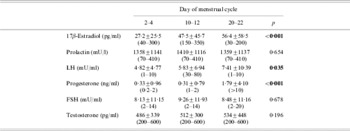
Hormone levels of 17β-estradiol, prolactin, LH, FSH, progesterone, and testosterone observed during the three phases of the menstrual cycle – days 2–4, 10–12 and 20–22 – are listed in Table 1 along with the normal reference values (cf. Klinga, Reference Klinga, Runnebaum and Rabe1997; Rabe & Runnebaum, Reference Klinga, Runnebaum and Rabe1997). The data are very similar to the results of an earlier study (Bergemann et al. Reference Bergemann, Mundt, Parzer, Nagl, Eckstein-Mannsperger, Haisch, Salbach, Runnebaum and Resch2005a).
Mean values and standard deviations (s.d.) of 17β-estradiol, prolactin, luteinizing hormone (LH), follicle-stimulating hormone (FSH), progesterone, and testosterone during the menstrual cycle in women with schizophrenia (n=125)

Normal reference values for the various phases of the menstrual cycle in parentheses (cf. Klinga, Reference Klinga, Runnebaum and Rabe1997; Rabe & Runnebaum, Reference Klinga, Runnebaum and Rabe1997); p values refer to the hypothesis of no change in plasma level over the course of the cycle (random-effect regression analysis).
The serum levels of 17β-estradiol were generally reduced during the entire menstrual cycle although there were significant changes in the estradiol serum levels between the three phases of the menstrual cycle investigated (p<0·001, random-effects regression analysis). According to the normal reference range, one would expect estradiol plasma levels of between 40 pg/ml and a maximum of 100 pg/ml in the follicular phase (cycle days 2–4) and values of above at least 150 pg/ml and up to 350 pg/ml during the periovulatory phase (cycle days 10–12).
The levels of LH were also low throughout the entire cycle with a small but statistically significant increase in the luteal phase (cycle days 20–22; p=0·035). With a mean progesterone level of 1·79 ng/ml in the luteal phase, it was assumed that ovulation had not occurred and/or that the follicles had not matured sufficiently (normal reference value: >10 ng/ml). As expected, the progesterone levels in the follicular and periovulatory phase of the menstrual cycle were significantly lower (p<0·001).
The prolactin levels were significantly elevated throughout the entire menstrual cycle, as could be expected under medication with predominantly conventional antipsychotics, but no difference between the mean values and deviation between the three phases could be detected. The mean FSH levels were within the normal range throughout the menstrual cycle, and the mean testosterone levels were in the upper normal range during all phases of the cycle.
Psychopathology and menstrual cycle phases
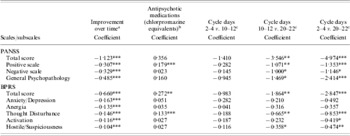
In a random-effect regression analysis, we evaluated the effect of the phases of the menstrual cycle on the psychopathology as assessed by means of the PANSS and BPRS. Improvement in psychopathological symptoms under regular treatment over time was considered as a covariable and showed a significant effect (Table 2). To rule out a possible fluctuation of antipsychotic medication affecting the results, chlorpromazine equivalents were considered as an additional covariable; significant effects could be seen on the PANSS positive scale, the BPRS total score, and the BPRS thought disturbance scale.
Random-effect regression analysis: the effects of menstrual cycle phase on psychopathological symptoms measured applying the Positive and Negative Syndrome Scale (PANSS) and the Brief Psychiatric Rating Scale (BPRS) in consideration of the improvement over time under standard treatment and antipsychotic medication (chlorpromazine equivalents) as covariables (n=125)

a The coefficient represents the change in the scale values per week.
b The coefficient represents the change in the scale for each 100 mg chlorpromazine equivalent.
c The coefficient represents the differences in scale values assessed in the cycle periods referred to.
* p<0·05
** p<0·01
*** p<0·001.
Concerning the effects of the cycle phases on the psychopathology scores, no significant improvement was seen between cycle days 2–4 (t 1, follicular phase) and cycle days 10–12 (t 2, peri-ovulatory phase); this is in contrast to what has been hypothesized, as the highest estrogen levels are expected in the peri-ovulatory phase. However, a significant improvement in the psychopathology scores could be observed between cycle days 10–12 (t 2) and cycle days 20–22 (t 3, luteal phase) for all PANSS and BPRS subscales except the BPRS subscales Anxiety/Depression, Anergia, and Activation, subscales which are more likely to describe symptoms of depression (Table 2). A significant improvement between cycle days 2–4 (t 1,) and cycle days 20–22 (t 3) could be shown for all PANSS and BPRS subscales, except for the subscales Anxiety/Depression and Anergia.
Psychopathology and estradiol levels during the menstrual cycle
During the follicular phase (cycle days 2–4) mean estradiol plasma levels were 27·2 pg/ml (s.d.=25·5 pg/ml), which is significantly lower (p<0·001) than the mean plasma levels of estradiol in the peri-ovulatory phase (cycle days 10–12: mean±s.d.=47·5±45·7 pg/ml) and/or those determined in the luteal phase (cycle days 20–22: mean±s.d.=56·4±58·5 pg/ml, p<0·001). No significant difference could be detected between the estradiol plasma levels measured during the peri-ovulatory phase and the luteal phase (p=0·111).
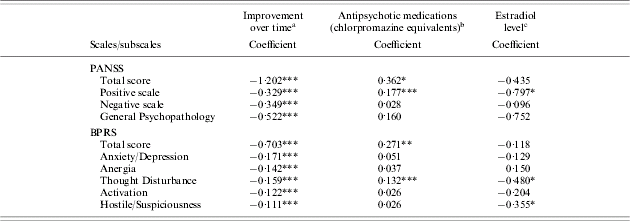
A random-effect regression analysis was carried out to evaluate the effects of estradiol on the PANSS and BPRS scores in consideration of the improvement in psychopathological symptoms due to regular treatment over time and an additional effect of antipsychotic medication (Table 3).
Random-effect regression analysis: the effects of 17β-estradiol on psychopathological symptoms measured applying the Positive and Negative Syndrome Scale (PANSS) and the Brief Psychiatric Rating Scale (BPRS) in consideration of the improvement over time under standard treatment and antipsychotic medication (chlorpromazine equivalents) as covariables (n=125)

a Coefficient represents the change in the scale values per week.
b Coefficient represents the change in the scale for each 100 mg chlorpromazine equivalents.
c Coefficient represents the change in the scale values per pg 17β-estradiol.
* p<0·05
** p<0·01
*** p<0·001.
A significant effect of estradiol could be shown for the PANSS Positive Scale, the BPRS scale Thought Disturbance and the BPRS scale Hostile/Suspiciousness – the subscales which are most representative of acute psychotic symptoms (Table 3). As could be observed in the regression analysis using the cycle phases as independent variables, the improvement over time (change in the subscale values per week) showed significant effects on all PANSS and BPRS subscales, whereas the antipsychotic medication showed a significant effect on the PANSS total score, the PANSS positive scale, the BPRS total score, and the BPRS thought disturbance scale.
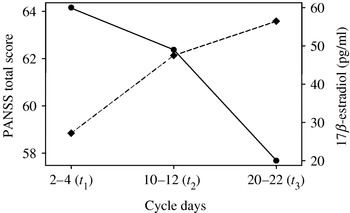
Fig. 1 shows the inverse relation between the estradiol plasma concentrations in the follicular phase (t 1: cycle days 2–4), the peri-ovulatory phase (t 2: cycle days 10–12), and the luteal phase (t 3: cycle days 20–22), and the psychopathological symptoms represented by the PANSS total score at these three measurement points.
Inverse relation between the estradiol plasma concentrations in the follicular phase (t 1: cycle days 2–4), the peri-ovulatory phase (t 2: cycle days 10–12), and the luteal phase (t 3: cycle days 20–22), and the psychopathological symptoms represented by the PANSS total score; the PANSS score was adjusted for treatment effects over time (random-effect regression analysis). —●—, Adjusted mean PANSS; - - - -, mean 17β-estradiol.

Discussion
The present data provide evidence that 17β-estradiol plasma levels affect psychopathological symptoms in women suffering from schizophrenia across the menstrual cycle measured by means of the PANSS and the BPRS. A significant improvement could be observed in the psychotic symptoms in the cycle phase displaying the highest plasma levels. However, scores did not improve in those BPRS subscales that measure symptoms of depression – a result which is in line with data from Riecher-Rössler and colleagues (Reference Riecher-Rössler, Häfner, Stumbaum, Maurer and Schmidt1994).
Therefore, the present findings support the hypothesis that estrogen has a specifically antipsychotic-like effect on the schizophrenic symptoms in women suffering from psychosis. However, the impact of this effect on the course of the disease in different groups of patients remains to be evaluated.
Notably, various aspects of these results need to be discussed in detail. First, it should be pointed out that estradiol levels were higher in the luteal phase (cycle days 20–22) than in the peri-ovulatory phase (cycle days 10–12), which is in contrast to the expectation that the mid-ovulatory estradiol peak has a high likelihood of occurrence at cycle days 10–12. However, an elevated rate of menstrual dysfunction, such as irregular menstruation and/or oligomenorrhoea due to hypoestrogenemia, which might be the reason for this result, has been described in women suffering from schizophrenia. The high rate of hypoestrogenemia has often been attributed to antipsychotic-induced hyperprolactinemia, but also a primary hypoestrogenemia in women with schizophrenia is discussed (Bergemann et al. Reference Bergemann, Mundt, Parzer, Nagl, Eckstein-Mannsperger, Haisch, Salbach, Runnebaum and Resch2005a).
Regarding the results of the random-effect regression analysis, which calculates the effect of menstrual cycle phases on psychopathological symptoms, it is remarkable that a significant improvement in schizophrenic symptoms can be observed only in the luteal phase (t 3: cycle days 20–22), whereas a significant increase in the estradiol plasma level can be observed between t 1 (cycle days 2–4) and t 2 (cycle days 10–12) from 27·2 pg/ml to 47·5 pg/ml; between t 2 and t 3 only a minor increase in the estradiol level of up to 56·4 pg/ml is evident. This may be explained by a delay in the efficacy of estradiol; the alternative assumption of a threshold for the efficacy of estradiol of about 50 pg/ml does not seem plausible. A delayed efficacy also better explains the difference between the relatively high effect of cycle phase on improvement in psychopathological symptoms and, indeed, the significant but relatively minor effect of estrogen on psychopathology scores, as shown in Table 2.
In this context it should be noted that in association with ovulation there are profound changes in progesterone levels which are known to be important in determining mood and mental functioning (Hammarback et al. Reference Hammarback, Backstrom, Holst, von Schoultz and Lyrenas1985). The progesterone peak also usually occurs around day 22 – at the same time as the estradiol luteal peak occurs in the present sample (see Table 1). Furthermore, there is increasing evidence that progesterone metabolites are of considerable importance in mental functioning since several of them (e.g. pregnanolone and allopregnanolone) affect gamma-aminobutyric acid (GABA; Majewska, Reference Majewska1992). Thus, it cannot completely be ruled out that progesterone and its metabolites have an effect on the improvement of the psychopathological symptoms in the luteal phase. However, it must be considered that in the patients studied the plasma levels of progesterone are very low compared with normal reference values in the luteal phase (1·79 ng/ml v. >10 ng/ml; see Table 1).
From a therapeutic point of view the present results may be of particular interest. As already stated, evidence was found in previous studies for a protective effect of estrogen in schizophrenia, which may suggest using it for treatment and prophylaxis. An estrogen supplement might be particularly effective in women suffering from hypoestrogenemia and/or from late-onset schizophrenia (Bergemann et al. in press). However, very few studies addressing this issue have been conducted to date, and the data are still controversial (Kulkarni et al. Reference Kulkarni, deCastella, Smith, Taffe, Keks and Copolov1996, Reference Kulkarni, deCastella, Riedel, Taffe, Fitzgerald and Burger2001; Kulkarni, Reference Kulkarni, Bergemann and Riecher-Rössler2005; Good et al. Reference Good, Kopola, Martzke, Fluker, Seeman, Parish, Shapiro and Whitehorne1999; Lindamer et al. Reference Lindamer, Buse, Lohr and Jeste2001; Akhondzadeh et al. Reference Akhondzadeh, Nejatisafa, Amini, Mohammadi, Larijani and Kashani2003; Louzã et al. Reference Louzã, Marques, Elkis, Bassitt, Diegoli and Gattaz2004; Bergemann et al. Reference Bergemann, Mundt, Parzer, Nagl, Eckstein-Mannsperger, Haisch, Salbach, Runnebaum and Resch2005b; Chua et al. Reference Chua, Izquierdo de Santiago, Kulkarni and Mortimer2005). More interventional trials which consider the estrogen status of patients should be carried out, ideally with a double-blinded and placebo-controlled design, in which the potential risks of estrogen therapy should be taken into account in an individual risk-benefit assessment (Notman & Nadelson, Reference Notman and Nadelson2002; Writing Group for the Women's Health Initiative Investigators, 2002; North American Menopause Society, 2003; Writing Group of the International Menopause Society Executive Committee, 2004). With respect to possible side-effects, there is hope that compounds with more specific and potent estrogenic activity in the brain than in other tissues, such as selective estrogen receptor modulators (SERMs), will become available as an alternative to conventional estrogens in the near future (Halbreich, Reference Halbreich2002; Riecher-Rössler, Reference Riecher-Rössler, Bergemann and Riecher-Rössler2005). The effects of existing SERMs on cerebral function, however, remain to be clarified (Cyr et al. Reference Cyr, Calon, Morissette and Di Paolo2002).
Acknowledgments
This research was supported by the Deutsche Forschungsgemeinschaft (German Research Council) as part of the Sonderforschungsbereich 258: Indikatoren und Riskomodelle für Entstehung und Verlauf psychischer Störungen (Indications and risk models for the development and course of mental disorders) at the University of Heidelberg. The support of the patients, colleagues, and medical directors of the participating clinics is gratefully acknowledged.
Declaration of Interest
None.