Introduction
Mild cognitive impairment (MCI) describes individuals who display cognitive deficits beyond what is expected for normal aging but who do not satisfy the diagnostic criteria for dementia (Winblad et al., Reference Winblad2004). Initially, MCI was conceptualized as an amnestic condition that was diagnosed on the basis of an objective memory impairment, a subjective memory impairment (preferably substantiated by an informant), intact activities of daily living (ADL), and an absence of dementia (Petersen et al., Reference Petersen2001). However, longitudinal studies reveal that adults classified with MCI have highly inconsistent rates of conversion to Alzheimer's disease (AD; 1.85%–60.5% per year; Morris et al., Reference Morris2001; Wahlund et al., Reference Wahlund, Pihlstrand and Jonhagen2003; Solfrizzi et al., Reference Solfrizzi2004) and that a variety of other outcomes are also associated with MCI classification. These include transition to other forms of dementia (Wahlund et al., Reference Wahlund, Pihlstrand and Jonhagen2003), stability of deficits, and recovery to normal cognitive function (Wahlund et al., Reference Wahlund, Pihlstrand and Jonhagen2003; Solfrizzi et al., Reference Solfrizzi2004). This coincides with research indicating that the cognitive deficits associated with MCI are not limited to the domain of memory, but rather may include deficits in other cognitive areas including attentional processing, working memory capacity, language, and orientation (Wahlund et al., Reference Wahlund, Pihlstrand and Jonhagen2003; Saunders and Summers, Reference Saunders and Summers2010; Reference Saunders and Summers2011).
Classification criteria for MCI have undergone periodic revision since the original critiera published by Petersen et al. (Reference Petersen, Smith, Waring, Ivnik, Kokmen and Tangelos1997; Reference Petersen, Smith, Waring, Ivnik, Tangalos and Kokmen1999; Reference Petersen2001). The original criteria for classification of MCI stipulate: (1) a memory complaint (as evidenced by a concern by the patient or the patient's family regarding the patient's cognitive function); (2) normal ADL; (3) normal general cognitive functioning; (4) abnormal memory for age; and (5) no evidence of dementia (Petersen et al., Reference Petersen, Smith, Waring, Ivnik, Kokmen and Tangelos1997; Reference Petersen, Smith, Waring, Ivnik, Tangalos and Kokmen1999; Reference Petersen2001). The original MCI criteria failed to quantify what constitutes a subjective cognitive complaint of significance, nor was a threshold for abnormal memory impairment specified, although the studies by Petersen et al. (Reference Petersen, Smith, Waring, Ivnik, Kokmen and Tangelos1997; Reference Petersen, Smith, Waring, Ivnik, Tangalos and Kokmen1999; Reference Petersen2001) utilize a threshold of 1.5 SD below age-based normative referents. Revisions to the MCI classification criteria by Winblad et al. (Reference Winblad2004) varied the criteria for objective and subjective complaints of cognitive impairment, removing the specific requirement for memory complaint. The revised criteria specify that the person should have evidence of cognitive decline as assessed by: self and/or informant corroborated report and impairment on objective cognitive tasks; and/or evidence of decline over time on objective neuropsychological tests (Winblad et al., Reference Winblad2004). Having met these three criteria, the clinical presentation of MCI can then be classified as one of the four specific subtypes of MCI based on the pattern of cognitive impairment present: single-domain amnestic-MCI (a-MCI); multiple-domain amnestic-MCI (a-MCI+); single-domain non-amnestic-MCI (na-MCI); and multiple-domain non-amnestic-MCI (na-MCI+; Winblad et al., Reference Winblad2004). Recently, Albert et al. (Reference Albert2011) recommended revisions to the MCI diagnostic criteria – including differential criteria for core clinical criteria as opposed to clinical research criteria. The first core clinical criterion is that “there should be evidence of concern about a change in cognition . . .. This concern can be obtained from the patient, from an informant who knows the patient well, or from a skilled clinician observing the patient” (Albert et al., Reference Albert2011, p. 271). This revision further broadens the notion of subjective experience of impairment to a concern about a change in cognition and removes a restriction to a single cognitive domain such as memory. Another key revision to the MCI criteria is the requirement for objective evidence of impairment to one or more cognitive domains, with the indication that individuals with MCI perform “typically 1 to 1.5 standard deviations below the mean for their age and education matched peers” (Albert et al., Reference Albert2011, p. 272). The variation over time in the clinical criteria for MCI reflects differing influences including the conceptualization of MCI as either a prodromal phase to dementia or as a risk factor for dementia and variation in research methodology (Ward et al., Reference Ward, Arrighi, Michels and Cedarbaum2012).
Although the MCI concept has conceptually advanced, the diagnostic criteria have attracted criticism, in particular the requirement for subjective cognitive impairment. The subjective memory complaint required to meet the original amnestic MCI classification is ill-defined but is considered an important criterion because it enables the assessment of everyday perceptions of change in memory performance (Petersen, Reference Petersen2004). Research indicates that memory decline emerges years prior to a clinical diagnosis of AD (Grober et al., Reference Grober, Hall, Lipton, Zonderman, Resnick and Kawas2008). As such, subjective memory complaints are considered critical in identifying subtle memory decline at the earliest possible stages of AD.
Studies of healthy adults aged 18–85 years indicate that subjective memory complaints are not uncommon, with more than 20% complaining of poor memory (Bassett and Folstein, Reference Bassett and Folstein1993). Reports of memory complaint increase with age, which may reflect underlying age-related cognitive changes associated with slowing of information processing speed (Verhaeghen and Salthouse, Reference Verhaeghen and Salthouse1997) rather than the emergence of neurodegenerative processes. However, subjective rating of memory performance can be influenced by personality factors, depression, anxiety, and misattribution of other cognitive deficits such as attention (Bassett and Folstein, Reference Bassett and Folstein1993; Pearman and Storandt, Reference Pearman and Storandt2004). It is estimated that approximately 50% of community-residing adults over 50 years of age subjectively report memory problems (Bassett and Folstein, Reference Bassett and Folstein1993). Some studies report a relationship between self-rated memory performance and objectively assessed memory performance (Hohman et al., Reference Hohman, Beason-Held, Lamar and Resnick2011), whereas other studies do not (Mendes et al., Reference Mendes2008).
Few studies have rigorously examined the relationship between subjective memory complaints and objective cognitive impairment in MCI populations. The research that exists suggests that subjective memory complaints correspond to impaired memory functions (Reisberg and Gauthier, Reference Reisberg and Gauthier2008); are associated with objective memory problems independent of depression in amnestic MCI but not healthy older adults (Cook and Marsiske, Reference Cook and Marsiske2006); and predict MCI incidence (Luck et al., Reference Luck2010). Taken together, these studies suggest that subjective memory complaints may be an important criterion in classifying individuals with MCI. Conversely, Jungwirth et al. (Reference Jungwirth, Fischer, Weissgram, Kirchmeyr, Bauer and Tragl2004) found that 94% of elderly participants with an objective memory impairment did not complain about their memory. Furthermore, only 3% of those people who did complain about their memory had objective memory impairment. Purser et al. (Reference Purser, Fillenbaum, Pieper and Wallace2005) report that the majority of objectively classified MCI participants do not complain of a memory problem. This is consistent with the findings of Chung and Man (Reference Chung and Man2009) that self-ratings of memory satisfaction and memory ability did not correlate with objective memory impairment, suggesting that individuals with MCI may show signs of diminished awareness towards their subtle memory and cognitive deficits. These studies question the utility of subjective memory complaints as an indicator of genuine cognitive impairment.
Whether subjective memory complaint corresponds to objective memory impairment in MCI populations remains uncertain. Accordingly, the reliability and validity of memory complaint as an indicator of memory impairment is questionable. It is unclear whether subjective memory complaints enhance the detection of individuals with MCI, or even if it is a necessary criterion for MCI diagnosis. Due to a lack of research investigating this relationship across MCI subtypes, it is possible that subjective memory complaint might be a relevant criterion for classifying amnestic variants of MCI, but less suitable for classifying non-amnestic variants.
The aim of the present study was to examine the utility of subjective memory complaints in accurately identifying older adults with subtypes of MCI. Given the rationale of Petersen (Reference Petersen2004) for the inclusion of subjective report of memory deterioration in MCI classification criteria, it is hypothesized that subjective memory complaint will be associated with the level of objectively assessed memory impairment in older adults. Further, it is hypothesized that subjective memory complaint will predict a-MCI classification, but not na-MCI or healthy control classification.
Methods
Participants
A total of 139 participants (56 males and 83 females) aged between 60 and 90 years (M = 70.29, SD = 6.58) currently participating in a longitudinal MCI study at the University of Tasmania (UTAS) took part in this study. Participants were screened into the study using a two-phase process previously described (Saunders and Summers, Reference Saunders and Summers2010; Reference Saunders and Summers2011). Briefly, all volunteers completed a telephone screening that assessed self- and informant-corroborated reports of: (1) cognitive impairment with a history of decline; (2) preserved cognitive functioning; (3) intact ADLs; (4) no history of significant medical, neurological, or psychiatric condition; (5) no history of major risk factors for vascular disease; and (6) no history of alcohol abuse, sensory impairment, or impairment to hand mobility (Saunders and Summers, Reference Saunders and Summers2010; Reference Saunders and Summers2011). Those who successfully met this initial screening then underwent a battery of neuropsychological tests: Wechsler Test of Adult Reading (WTAR); Hospital Anxiety and Depression Scale (HADS); Dementia Rating Scale, 2nd edition (DRS-2); Digit-Symbol Coding (DSC); Logical Memory (LM); Rey Complex Figure Test (RCFT); Digit Span (DSP); Spatial Span (SSP); Letter–Number Sequencing (LNS); Trail Making Test (TMT); Stroop test; and Vocabulary subtest. Performance on these neuropsychological tests was then used to classify each participant as either a healthy control or one of three MCI subtypes (Saunders and Summers, Reference Saunders and Summers2010; Reference Saunders and Summers2011). Participants provided informed consent prior to the commencement of the study, in accordance with the requirements of the Human Research Ethics Committee (Tasmania) Network and NHMRC (Australia) Human Research guidelines.
On the basis of the initial neuropsychological assessment 75 participants were classified as meeting the criteria for MCI in accordance with the following criteria, where mild impairment was defined as a performance below the 10th percentile (or 1.28 SD below the mean) against age- or age and education-based norms (Saunders and Summers, Reference Saunders and Summers2010; Reference Saunders and Summers2011).
Single domain amnestic-MCI (a-MCI; n = 24)
1. Subjective memory complaint (assessed through a single verbal statement, preferably confirmed by an informant).
2. Objective visual and/or verbal memory impairment (defined by performances <10th percentile for age-based norms on the LM (LMI and LMII; Wechsler, Reference Wechsler1997b) test and/or the RCFT (Strauss et al., Reference Strauss, Sherman and Spreen2006)).
3. No objective attention, working memory, and/or language-processing impairment.
Multi-domain amnestic-MCI (a-MCI+; n = 24)
1. Subjective memory complaint (assessed through a single verbal statement, preferably confirmed by an informant).
2. Objective visual and/or verbal memory impairment (defined by performances <10th percentile for age-based norms on the LM (LMI and LMII; Wechsler, Reference Wechsler1997b) test and/or the RCFT (Strauss et al., Reference Strauss, Sherman and Spreen2006)).
3. Objective attention, working memory, and/or language-processing impairment (defined by performances <10th percentile for age-based norms on the DSC, DSP, SSP, LNS, or Vocabulary subtests of the Wechsler Adult Intelligence Scale (WAIS-III) and Wechsler Memory Scale (WMS-III; Wechsler, Reference Wechsler1997a; Reference Wechsler1997b) or TMT (Strauss et al., Reference Strauss, Sherman and Spreen2006) or Stroop Test (Strauss et al., Reference Strauss, Sherman and Spreen2006)).
Non-amnestic-MCI (na-MCI; n = 27)
1. Subjective memory complaint (assessed through a single verbal statement, preferably confirmed by an informant).
2. No objective visual or verbal memory impairment.
3. Objective attention, working memory, and/or language-processing impairment (defined by performances <10th percentile for age-based norms on the DSC, DSP, SSP, LNS, or Vocabulary subtests of the WAIS-III and WMS-III (Wechsler, Reference Wechsler1997a; Reference Wechsler1997b) or TMT (Strauss et al., Reference Strauss, Sherman and Spreen2006) or Stroop Test (Strauss et al., Reference Strauss, Sherman and Spreen2006)).
No participants displayed any evidence of dementia (DRS-2 AEMSS score ≥ 9) and all had intact ADL. A healthy control group (n = 64) consisted of adults with no cognitive complaints or medical history of significance and was recruited to approximately match age and level of education of the MCI groups. Given that memory performance was the primary focus of the present study, single-domain and multi-domain amnestic subgroups were collapsed into a single amnestic-MCI group (a-MCI; n = 48).
Materials
A standardized battery of normative-referenced neuropsychological tests was used for screening tests into MCI subgroups or to confirm status as a healthy control. The test battery comprised: the WTAR (Psychological Corporation, 2001), to estimate premorbid full-scale intelligence; the DRS-2 (Mattis, Reference Mattis2001), to assess global cognitive functioning and dementia severity; the HADS (Snaith and Zigmond, Reference Snaith and Zigmond1994), to screen for symptoms of anxiety and depression; the LM immediate and delayed recall subtest of WMS-III (Wechsler, Reference Wechsler1997b), to assess verbal episodic memory; three-minute delayed recall of the RCFT (Strauss et al., Reference Strauss, Sherman and Spreen2006), to assess visual episodic memory; the DSP subtest of WAIS-III (Wechsler, Reference Wechsler1997a), to assess auditory-verbal short-term memory span; the SSP subtest of the WMS-III (Wechsler, Reference Wechsler1997b), to assess visual short-term memory span; the LNS subtest of the WAIS-III (Wechsler, Reference Wechsler1997a), to assess verbal working memory capacity; the Vocabulary (VOC) subtests of the WAIS-III (Wechsler, Reference Wechsler1997a), to assess language capacity; the DSC of the WAIS-III (Wechsler, Reference Wechsler1997a), to assess visuo-motor information processing speed and attention; the TMT (Strauss et al., Reference Strauss, Sherman and Spreen2006), to assess visuo-motor speed, attention, and mental flexibility; and the Stroop test, Victoria version (Strauss et al., Reference Strauss, Sherman and Spreen2006), to assess verbal selective attention and mental flexibility.
Subjective memory complaint was assessed using the Multifactorial Memory Questionnaire (MMQ; Troyer and Rich, Reference Troyer and Rich2002), which requires participants to appraise three dimensions of self-reported memory including: overall contentment and satisfaction with one's own memory ability (MMQ-contentment), perception of everyday memory ability (MMQ-ability), and use of everyday memory strategies and aids (MMQ-strategy) over the previous two weeks. The MMQ-contentment scale contains 18 items that address the emotions and perceptions participants have about their current memory ability. Items address positive emotions (i.e. confidence, satisfaction), negative emotions (embarrassment, fear), and subjective ability ratings (comparison to peers). Subjects rate on a five-point Likert scale how strongly they agree or disagree with each statement. For each item, 0–4 points are scored on the basis of level of agreement such that higher scores indicate a greater level of contentment (i.e. fewer memory problems). The MMQ-ability subscale contains 20 items that address the frequency of forgetting in various everyday situations. Items address situations such as forgetting phone numbers, appointments, and names. Participants rate on a five-point Likert scale the frequency with which each mistake had occurred (all of the time, often, sometimes, rarely, never). For each item, 0–4 points are scored on the basis of self-reported frequency, with higher scores indicating fewer memory mistakes (i.e. fewer memory problems). The MMQ-strategy subscale contains 19 items that address the use of different memory aids and strategies in every memory tasks. Items address strategies such as using diaries and timers and repeating information to oneself. Participants rate on a five-point Likert scale the frequency with which they had used each strategy (all of the time, often, sometimes, rarely, never). For each item, 0–4 points are scored on the basis of self-reported frequency, with higher scores indicating more frequent use of memory strategies (i.e. a greater number of memory problems).
Procedure
All participants completed a telephone screening. A total of 139 participants successfully passed the telephone screening stage and were then individually assessed on the neuropsychological screening battery. The results of each individual's test performance were assessed blind to identifying information with each participant being assigned to the MCI or healthy control group according to established criteria and protocols (Saunders and Summers, Reference Saunders and Summers2010; Reference Saunders and Summers2011). In order to minimize any potential confound between subjective and objective assessments of memory performance, all participants completed the MMQ at a separate session following completion of the neuropsychological screening battery. The MMQ administrator was blind to the classification of each participant. Participants were instructed to consider their memory over the previous two weeks and rate their memory on the MMQ accordingly.
Results
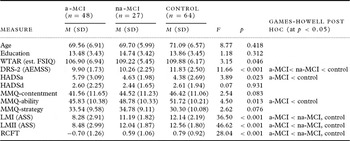
The neuropsychological tests used in this study are differentially affected by age. To ensure that any artifact produced by this covariate was removed, individual neuropsychological test scores were transformed against appropriate normative data. For the WTAR, LMI, and LMII, raw scores were converted to age scale score equivalents (ASS) according to standardized Australian normative reference data (Wechsler, Reference Wechsler1997b; Psychological Corporation, 2001). The RCFT three-minute delayed recall raw scores were transformed to a z-score against age-based normative reference data (Strauss et al., Reference Strauss, Sherman and Spreen2006). For the DRS-2, raw scores were converted to Age and Education Mayo Scale Score equivalents (AEMSS; Mattis, Reference Mattis2001). As a result, these neuropsychological scores are expressed with the removal of age as the major source of variance in performance. Demographic data as well as the results of the three groups on the neuropsychological measures are shown in Table 1.
Group differences in age, education, estimated premorbid FSIQ, HADS, MMQ, LM, and RCFT scores

Note: WTAR = Wechsler Test of Adult Reading; DRS-2 = Dementia Rating Scale-2; HADSa = Hospital Anxiety and Depression Scale (anxiety score); HADSd = Hospital Anxiety and Depression Scale (depression score); MMQ = Multifactorial Memory Questionnaire; LMI = Logical Memory (immediate recall score); LMII = Logical Memory (delayed recall score); RCFT = Rey Complex Figure Test (three-minute delayed recall z-score); AEMSS = Age and Education Mayo Scaled Score; ASS = Age Scaled Score; FSIQ = Full Scale Intelligence Quotient.
A chi-square analysis revealed no significant gender differences between the three groups (χ 2(2) = 3.03, p = 0.22), with one-way ANOVAs identifying no significant group differences in age, years of education, or HADSd (Table 1). One-way ANOVA identified significant group differences in HADSa, WTAR, and DRS-2 (Table 1). No group displayed mean estimated Full Scale Intelligence Quotient (FSIQ) scores below the average range (FSIQ < 90) indicating the estimated FSIQ for all groups are within an acceptable range. Further, while significant differences on the dementia screening test were identified, no group displayed an AEMSS score below the cut-off for dementia (AEMSS < 9). One-way ANOVA identified group differences in MMQ-ability, LMI, LMII, and RCFT (Table 1). Post hoc analyses indicated that group differences on these tests were in expected directions for memory impaired and non-memory impaired groups.
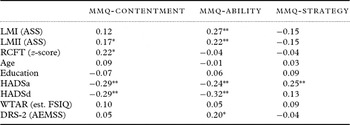
Correlational analyses revealed significant weak, positive correlations between: MMQ-contentment and LMII; MMQ-contentment and RCFT; MMQ-ability and LMI; and between MMQ-ability and LMII (Table 2). No significant correlations were found between MMQ-strategy and any of the objective memory measures. Of the other variables examined for a relationship with level of subjective memory complaint, HADSa and HADSd displayed the strongest correlations (Table 2).
Correlations of the MMQ with neuropsychological tests and screening variables across the full sample

*Correlation is significant at the 0.05 level (two-tailed); **Correlation is significant at the 0.01 level (two-tailed).
Note: WTAR = Wechsler Test of Adult Reading; DRS-2 = Dementia Rating Scale-2; HADSa = Hospital Anxiety and Depression Scale (anxiety score); HADSd = Hospital Anxiety and Depression Scale (depression score); MMQ = Multifactorial Memory Questionnaire; LMI = Logical Memory (immediate recall score); LMII = Logical Memory (delayed recall score); RCFT = Rey Complex Figure Test (three-minute delayed recall z-score); AEMSS = Age and Education Mayo Scaled Score; ASS = Age Scaled Score; FSIQ = Full Scale Intelligence Quotient.
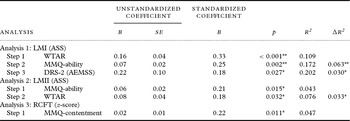
Though there was some evidence of an association between subjective memory complaint and objective memory performance, the relationship detected was weak and not consistently evident across the multiple domains of subjective memory, nor was it consistent across the various tests of objective memory. In order to determine whether subjective memory impairment combined with premorbid variables (education, HADSa, HADSd, WTAR, DRS-2) predicted objective memory impairment, a series of stepwise multiple regression analyses were performed for each of the three objective tests of memory function (Table 3). Significant regression models were produced for prediction of LMI by WTAR estimated FSIQ, MMQ-ability, and DRS-2 (F (3,135) = 12.17, p < 0.001); prediction of LMII by MMQ-ability and WTAR (F (2,136) = 7.12, p = 0.001); and, prediction of RCFT by MMQ-contentment (F (1,135) = 6.70, p = 0.011).
Stepwise linear regression analyses predicting objective memory impairment

*p < 0.05; **p < 0.01.
Note: LMI = Logical Memory (immediate recall); LMII = Logical Memory (delayed recall); RCFT = Rey Complex Figure Test; DRS-2 = Dementia Rating Scale-2; WTAR = Wechsler Test of Adult Reading; ASS = Age Scaled Score; AEMSS = Age and Education Mayo Scaled Score.
The results of the stepwise linear regression for Analysis 1 indicate that including WTAR accounted for 10.9% of the variance in LMI score, with MMQ-ability accounting for an additional 6.3% of variance, and with the inclusion of DRS-2 score in Step 3 accounting for a further 3.0% of the variance in LMI score (Table 3). The results of the stepwise linear regression for Analysis 2 indicate that MMQ-ability accounted for 4.3% of variance in LMII score, with WTAR accounting for a further 3.2% of variance (Table 3). The results of the stepwise linear regression for Analysis 3 indicate that MMQ-contentment accounted for 4.7% of variance in RCFT score, with no other variables contributing to the regression model for RCFT score (Table 3).
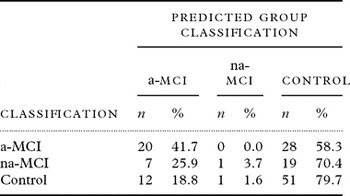
To further explore the capacity of subjective memory score to determine MCI classification, a direct discriminant function analysis (DFA) was used to examine the predictors of MMQ-contentment, MMQ-ability, and MMQ-strategy for the three outcome groups (a-MCI, na-MCI, Control). Participants’ scores on these measures were entered into a multiple DFA, which revealed two non-significant discriminant functions (DF; DF1: Λ = 0.92, χ 2(6) = 11.64, π = 0.071; and DF2: Λ = 0.984, χ2(2) = 2.25, π = 0.325) indicating that no discriminant function could be generated for MMQ to predict group classifications. The resulting classification table (Table 4) indicates that the use of MMQ variables as predictors resulted in only 50.7% of cases being correctly classified, with 62.6% of the MCI cases being given a false negative classification (incorrectly classified as Control) and 20.3% of control cases being given a false positive classification (incorrectly classified as a-MCI or na-MCI). Although this exceeds the value for classification based on chance (36.69%), it is less than the recommended minimum classification ratio of 25% greater than that due to chance (Hair et al., Reference Hair, Anderson, Tatham and Black1998).
Classification predicted from subjective memory complaint scores

Note: 50.7% of all cases correctly classified.
Discussion
Subjective memory complaints are a requirement for classification of MCI because they are believed to indicate a decline in objective memory performance (Petersen, Reference Petersen2004). However, due to the uncertain relationship between subjective memory complaint and objective memory impairment it remains possible that many people with mild impairments in cognitive function could be excluded from MCI classification (Reisberg and Gauthier, Reference Reisberg and Gauthier2008). The present study investigated the role and utility of subjective memory complaints in accurately identifying older adults with MCI. Measures of subjective memory complaint and objective memory function were examined in a group of 75 participants identified as meeting the criteria for one of two MCI subtypes (a-MCI or na-MCI) and 64 age- and education-matched healthy participants.
The results of the present study indicate that subjective memory complaints are not related to the level of objective impairment in older adults. Of the three domains of subjective memory assessed, only the reported frequency of memory mistakes (MMQ-ability) had a significant weak, positive correlation with level of objective verbal memory impairment (LMI and LMII). However, this relationship was not evident in other domains of subjective memory (i.e. MMQ-contentment or MMQ-strategy) and was not evident on measures of visual memory impairment (RCFT). Multiple regression analysis revealed that subjective memory complaints were not a strong or reliable predictor of level of objective memory impairment. While MMQ-ability was found to be a statistically significant predictor of level of verbal memory impairment, it explained less variance than was explained by estimated premorbid FSIQ and therefore lacked explanatory power. Similarly, MMQ-contentment was a statistically significant predictor of level of visual memory impairment (RCFT) but only accounted for a small amount of variance and lacked explanatory power. Finally, the results of the present study also failed to support the capacity of subjective memory complaints to predict diagnostic criteria for MCI. DFA revealed that scores on MMQ-contentment, MMQ-ability, and MMQ-strategy did not adequately discriminate between MCI subtypes and healthy controls. It was found that the use of MMQ subscores resulted in high rates of false positive (20.3%) classification of healthy controls and false negative (62%) classifications for MCI subtypes. The results indicate that subjective memory complaint does not predict membership of amnestic or non-amnestic MCI subtypes.
The absence of a strong relationship between subjective memory complaint and objective memory impairment is consistent with prior research (Mendes et al., Reference Mendes2008), but at odds with others (Bassett and Folstein, Reference Bassett and Folstein1993; Jorm et al., Reference Jorm, Christensen, Korten, Jacomb and Henderson2001; Jessen et al., Reference Jessen2007). The present findings are consistent with those of Jungwirth et al. (Reference Jungwirth, Fischer, Weissgram, Kirchmeyr, Bauer and Tragl2004) who also revealed that a classification model including subjective memory complaint results in a high rate of false negative classifications.
A number of explanations exist for the perception that subjective memory complaints are related to or predict objectively assessed memory impairments. The results of the present study indicate that increasing subjective memory complaint was correlated with increasing level of anxiety (HADSa) and level of depression (HADSd). That is, individuals reporting more symptomatology of anxiety or depression reported more subjective memory problems independent of whether they had been classified as MCI or healthy control. An association between negative affect (levels of depression and anxiety) and self-reported memory complaints has also been found in previous studies (Bassett and Folstein, Reference Bassett and Folstein1993; Jorm et al., Reference Jorm, Christensen, Korten, Jacomb and Henderson2001; Jungwirth et al., Reference Jungwirth, Fischer, Weissgram, Kirchmeyr, Bauer and Tragl2004; Mendes et al., Reference Mendes2008). It is also possible that individuals with MCI may lack awareness or insight into their declining memory problems, hence the lack of a relationship between subjective memory complaint and objective memory performance. Previous research using the MMQ found that MCI subjects and control subjects rate their own memory ability similarly across the three domains, suggesting that individuals with MCI are unaware of their declining memory status (Chung and Man, Reference Chung and Man2009).
The key implication of the present research is that subjective memory complaint should not be a diagnostic criterion for MCI as it lacks accuracy. The requirement of memory complaint does not enhance the MCI diagnosis, but rather increases the probability that an individual at an increased risk of progression to dementia is excluded a priori from diagnosis (false negatives) and increases the probability of a healthy individual being misdiagnosed as having MCI (false positives). The potential adverse effects of false negative results and false positive results on an individual in screening for cognitive impairment or dementia have yet to be systematically examined. In the case of screening for probable prodromal AD, screening measures with a higher rate of false positive results may be more concerning than false negative results. A person incorrectly identified as at risk for AD could make various financial, legal, occupational, and social decisions that have serious implications for their future. Conversely, a person incorrectly classified as healthy may experience false reassurance and a delay in diagnosis, although with progression of cognitive decline one would assume correct diagnosis to eventuate. There are currently no effective treatments for dementia. Therefore, it could be argued that it is preferable to have a lower rate of false positive diagnoses as the potential negative consequences of a false positive diagnosis of prodromal dementia outweigh any potential negative consequence of false negative diagnosis leading to a delay in effective treatment.
The results of the present study indicate that an MCI diagnostic criterion of subjective experience of cognitive impairment or cognitive change in the clinical evaluation of MCI may be inherently problematic. The recent revisions to MCI criteria from a criterion of subjective experience of cognitive impairment (Winblad et al., Reference Winblad2004) to a subjective experience of cognitive change (Albert et al., Reference Albert2011) lack empirical validation. If, as the present study indicates, older adults are not reliable in self-evaluating memory performance, then the capacity of an individual to differentiate reliably between a change in cognitive performance due to an underlying disease process and a change associated with normal aging is questionable. The limited studies available report a lack of relationship between subjective experiences of memory impairment with objective measures of memory performance (Jungwirth et al., Reference Jungwirth, Fischer, Weissgram, Kirchmeyr, Bauer and Tragl2004; Purser et al., Reference Purser, Fillenbaum, Pieper and Wallace2005; Mendes et al., Reference Mendes2008; Chung and Man, Reference Chung and Man2009). To the best of our knowledge, there are no studies examining the reliability and validity of self-assessment of subjective experience of cognitive change in aging adults. Therefore, clinical MCI diagnostic criteria specifying subjective experience of cognitive change (Albert et al., Reference Albert2011) lacks evidence of reliability and validity.
The potential impact of excluding the subjective cognitive complaint criterion from MCI classification is under-researched. Busse et al. (Reference Busse, Bischkopf, Riedel-Heller and Angermeyer2003) found that modifying the original Petersen MCI classification criteria to exclude the report of subjective memory complaint across three MCI subtypes (amnestic MCI, multiple-domain MCI, and single non-memory domain MCI) was associated with higher diagnostic sensitivity, but a reduction in diagnostic specificity. Thus, while a greater number of individuals with MCI would be correctly identified, there would also be a greater number of healthy individuals classified with MCI. One possible solution is to require objective evidence of stability of or worsening of cognitive impairment over time as a diagnostic criterion. A test–retest protocol of the diagnostic criteria for MCI may result in increased sensitivity and specificity, as the probability of recurrent false negative or false positive diagnoses in the same individual is lower than the probability of a single false positive/negative diagnosis. To date, MCI criteria specify a single-time point assessment from which a diagnosis is then made.
In conclusion, the use of subjective memory complaint as a diagnostic criterion does not improve diagnostic accuracy of MCI and may contribute to a high number of false positive and false negative diagnoses. The results of the present study add to the emerging literature suggesting that a diagnostic criterion of subjective memory complaints reduces the sensitivity and specificity of the MCI diagnosis and should be abandoned.
Conflict of interest
None.
Description of authors' roles
M. Lenehan collected and analyzed the data, and prepared the paper. S. Klekociuk collected the data and revised the paper. M. Summers designed the study and its statistical formulation, analyzed the data, and revised the paper.
Acknowledgments
We thank the various General Practice Surgeries in northern Tasmania for their assistance in recruitment of participants in this study. We also thank the participants and their families for their enthusiasm in taking part in this study. M. Lenehan and S. Klekociuk received research scholarships from the Wicking Dementia Research and Education Centre.