Research on resilience in the workplace is currently limited by at least two issues: an inconsistent documentation and choice of the stress-producing events and a singular construct of what constitutes resilience (Britt, Shen, Sinclair, Grossman, & Klieger, Reference Britt, Shen, Sinclair, Grossman and Klieger2016). This commentary summarizes some recent experimental research that was possibly too new to have been included in the review and that offers some insights to both concerns. The research is predicated on a theoretical model that explains the role of resilience in either work-related or clinical outcomes and the temporal dynamics of work performance.
The theoretical model was developed in response to unresolved problems in cognitive workload and fatigue (Guastello, Reference Guastello2003, Reference Guastello2014a, Reference Guastello2014b, Reference Guastello2016; Guastello, Boeh, et al., Reference Guastello, Boeh, Gorin, Huschen, Peters, Fabisch and Poston2013; Guastello, Boeh, Shumaker, & Schimmels, Reference Guastello, Boeh, Shumaker and Schimmels2012; Guastello et al., Reference Guastello, Malon, Timm, Weinberger, Gorin, Fabisch and Poston2014; Guastello, Reiter, et al., Reference Guastello, Reiter, Malon, Timm, Shircel and Shaline2015; Guastello, Shircel, Malon, & Timm, Reference Guastello, Shircel, Malon and Timm2015; Stamovlasis, Reference Stamovlasis2006, Reference Stamovlasis2011; Stamovlasis & Tsaparlis, Reference Stamovlasis and Tsaparlis2012). Only the workload portion of the theory is considered here because it is the part that contains the resilience elements. The workload model also has extensions to clinical phenomena (Pincus & Metten, Reference Pincus and Metten2010; Ribeiro & Lourenço, Reference Ribeiro and Lourenço2016) and longer-term managerial performance (Thompson, Reference Thompson2010).
Buckling Model for Workload
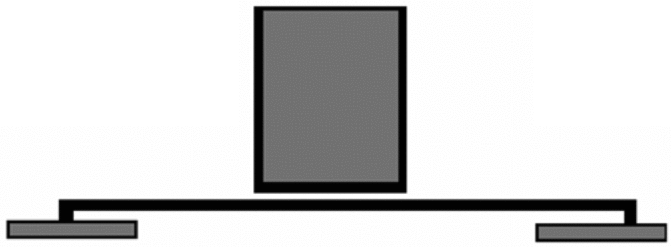
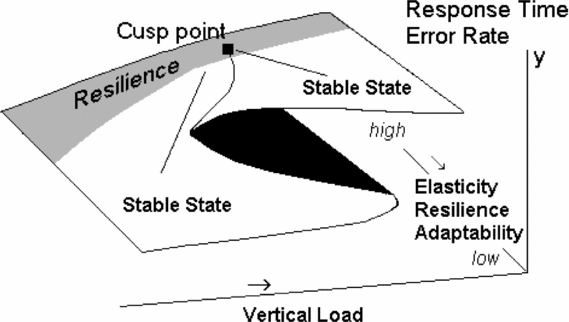
The model for cognitive workload invokes the concept of Euler buckling (Guastello, Reference Guastello1985; Zeeman, Reference Zeeman1977). A piece of material that is subjected to sufficient amounts of stress in the form of repeated stretching will show a certain amount of deformity, or strain. Rigid materials break, whereas flexible materials rebound. Similarly, if we took a rigid piece of material and applied weights (see Figure 1), nothing happens to it until too much weight is placed on top. The relationships between load, elasticity, and (performance) outcomes are captured by the cusp catastrophe model (see Figure 2). For background on the cusp catastrophe model, means of data analysis, and its other applications in industrial–organizational (I-O) psychology, see Guastello (Reference Guastello, Gorin, Huschen, Peters, Fabisch, Poston and Weinberger2013) and Guastello and Gregson (Reference Guastello and Gregson2011).
Figure 1.Weight placed on a rigid beam.
Figure 2.Cusp catastrophe model for cognitive workload and resilience.
In the case of the workload studies, nearly one third of the performance variance that was accounted for by the statistical models was associated with the nonlinear properties of the relationships among the variables (Guastello, Reference Guastello2014a). The nonlinearities explain how performance responses to load can be sudden (high bifurcation or catastrophic), gradual and flexible (low bifurcation), or not apparent at all. The latter would occur when the load remains below a person's threshold for sudden change (Hancock & Warm, Reference Hancock and Warm1989) and elements of rigidity are relatively high.
The tasks that have been studied were chosen to capture an array of cognitive processes that placed a strong demand on working memory and to find what was generalizable about the control variables: an episodic memory task (Guastello, Boeh, Shumaker, & Schimmels, Reference Guastello, Boeh, Shumaker and Schimmels2012), a pictorial memory task that required verbal retrieval cues (Guastello, Boeh, Schimmels, et al., Reference Guastello, Boeh, Schimmels, Gorin, Huschen, Davis and Poston2012), perceptual-motor multitasking (Guastello, Boeh, et al., Reference Guastello, Boeh, Gorin, Huschen, Peters, Fabisch and Poston2013), a vigilance dual task (Guastello et al., Reference Guastello, Malon, Timm, Weinberger, Gorin, Fabisch and Poston2014; Guastello, Shircel, et al., Reference Guastello, Reiter, Malon, Timm, Shircel and Shaline2015), a financial decision making task that captured both optimizing and risk taking behavior (Guastello, Reference Guastello2016), and an N-back task (Guastello, Reiter, et al., Reference Guastello, Reiter, Malon, Timm, Shircel and Shaline2015). One insight from the experimentation was that some tasks were producing greater amounts of workload effects than fatigue effects, whereas the opposite happened for some other tasks. The relative amounts of workload and fatigue effects are traceable to the demands on channel capacity in the case of workload and the executive function of working memory in the case of fatigue.
Variables related to resilience are defined as rigidity versus elasticity, with resilience being a matter of degree and associated with a high level of elasticity. Variables that qualify as elasticity–rigidity constructs have supporting rationales and empirical validity as bifurcation variables. One pole is associated with positive and negative discontinuities, whereas the other pole may be associated with gradual change or no change in performance at all. Five groups of constructs evolved as the project progressed, all of which except one were measured at the start of the experimental session.
Anxiety Group
Trait anxiety can interfere with lucid decision making, but it can also focus attention on details that others might miss. Anxiety is operative most often in contexts with interpersonal challenges or physical hazards. Anxiety in this context was measured using a variation of the Taylor Manifest Anxiety Scale (Taylor, Reference Taylor1953), which is centered on psychosomatic symptoms that could reflect an alternative medical diagnosis when they appear alone but indicate anxiety when they appear in relatively large numbers.
Emotional intelligence (EI) facilitates understanding one's own emotions and the emotional messages from other people and forming appropriate actions in response. Low EI denotes rigidity in the form of indifference, which could be a buffer against stress effects. When stress gets too high, however, the system buckles and snaps if the individual is not aware of his or her own emotional level or those of other people (Thompson, Reference Thompson2010). EI was measured in the experiments with the Schutte et al. (Reference Schutte, Malouf, Hall, Haggerty, Cooper, Golden and Dornheirn1998) scale, which favors the alexithymia construct more than it does cognitive judgment.
Frustration can have a negative impact on performance, making tough situations worse, but it can also spur the individual onward to work harder or differently. Frustration was the one variable that was measured as part of the NASA Task Load Index (Hart & Staveland, Reference Hart, Staveland, Hancoke and Meshkati1988). Frustration has also been correlated with neuroticism (Rose, Murphy, Byard, & Nikzad, Reference Rose, Murphy, Byard and Nikzad2002) and manifest anxiety (Guastello, Shircel, et al., Reference Guastello, Reiter, Malon, Timm, Shircel and Shaline2015).
Conscientiousness Group
Conscientiousness is a trait that predisposes one to attention to details, rules, and task orientation and to a broader proclivity to focus attention, and this trait thus implies a type of rigidity (MacLean & Arnell, Reference MacLean and Arnell2010). Flexibility or adaptiveness is not expected. Conscientiousness has been measured as a broad trait in the sense of the five-factor model in some of the workload experiments. In others it was broken down into a narrower trait in the sense of Factor G on the 16PF (Cattell, Reference Cattell, Conn and Rieke1994) plus a separate trait for impulsivity, which would be similar to Factor Q3 on the 16PF. In principle it is possible for people to be rigid in the sense of Factor G and flexible in the sense of Q3, and sometimes they are so (Guastello, Reference Guastello2016).
Coping
One construct of coping flexibility is centered on emotional adjustments in the clinical sense of long-term life issues (Kato, Reference Kato2012). People who have a broader repertoire of coping strategies are likely to be more resilient to stress and emotional hardship. This variable is currently under investigation in the workload context.
Another construct of coping is oriented toward cognitive strategies such as planning, monitoring, decisiveness, and inflexible responses to changing work situations (Cantwell & Moore, Reference Cantwell and Moore1996). These aspects of coping all denote contributions from the executive function of working memory. So far, Cantwell and Moore's variables were more directly related to cognitive workload dynamics than coping flexibility.
Field Independence
Field independence is a cognitive style that separates perceptions of a figure from a background. It was also proposed that the field independent people, who can separate the figure from the background more readily, use more of their working memory capacity (Pascual-Leone, Reference Pascual-Leone1970). As such it worked well as a bifurcation variable in studies of problem solving in chemistry (Stamovlasis & Tsaparlis, Reference Stamovlasis and Tsaparlis2012) and financial decision making (Guastello, Reference Guastello2016).
Situational Variables
Other degrees of elasticity are inherent in the task structure, such as whether operators can choose how to sequence subtasks (Guastello, Gorin, et al., Reference Guastello, Boeh, Gorin, Huschen, Peters, Fabisch and Poston2013). Although it is too early to make generalizations, it is plausible that the trait-based constructs of resilience described above and in Britt et al. interact with the number of type of degrees of freedom one has in the work environment for producing an individual's coping strategy.
Clinical Applications
The I-O literature has imported constructs of resilience from clinical and counseling contexts. Thus one should venture further to the intersection where nonlinear dynamical systems theory meets medical practice (Katerndahl, Reference Katerndahl2010). Resilience should not be confused with medical wellness or psychological well-being. In light of the broader range of situations that it addresses, the construct of resilience is upgraded from a group of variables to a process by which the human system exhibits the phase shift from wellness to illness states and back again (Pincus & Metten, Reference Pincus and Metten2010).
The individual is viewed as a complex adaptive system that responds to disease, acute stress, or emerging medical conditions. Resilience against those conditions results from a nexus of biological, psychological, and social influences, resources, and preexisting characteristics that self-organize to meet, and negate, the unwanted influences (Pincus & Metten, Reference Pincus and Metten2010). The resources and characteristics are multifaceted and could include neurological characteristics, family and social network conditions, learning orientation, regulation of emotions (p. 358), and other variables mentioned already. Resources aggregate, disaggregate, and reconfigure in response to different threats to well-being.
A person could be resilient in some respects but not in others. People who have preexisting affective disorders show a smaller amount of mood change in response to changes in the number of “bad days at work” or “bad days at life” compared with people who are not so diagnosed. Normal-range people can adapt to the situation (somehow) and “get over it” more quickly, whereas those with mood disorders tend to be stuck in the negative mood for longer periods of time (Ribeiro & Lourenço, Reference Ribeiro and Lourenço2016).
Health, medical or psychological, is not always a simple matter of making an ailment go away with a prescription of antibiotics; those would be simple illnesses (Pincus & Metten, Reference Pincus and Metten2010). Complex illnesses arise from multiple interacting subsystems that have self-organized in an unwanted manner. Conditions of pseudo-wellness and resilient wellness are also possible. The latter would characterize the people who seem to show positive outcomes after challenging psychological and physical events after the events have been emotionally processed.
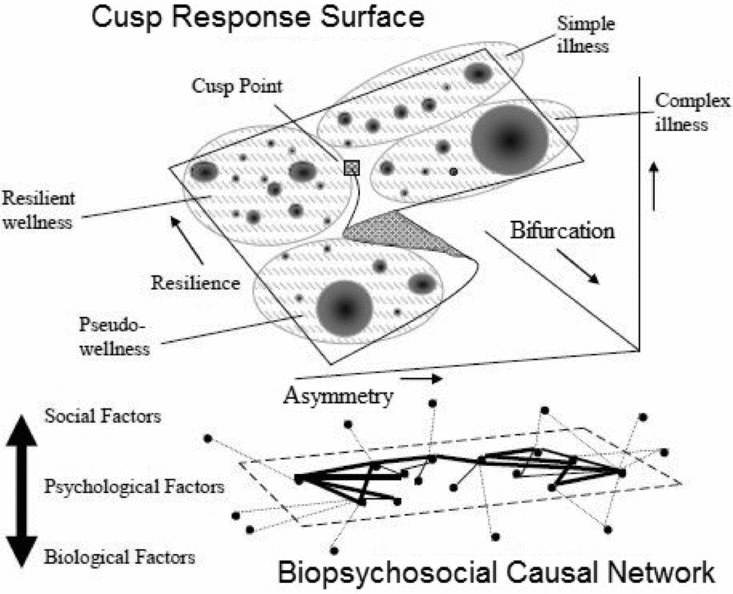
The array of health outcomes is shown in Figure 3. The asymmetry variable is the level of biological or psychological load placed on the individual, analogous to vertical load on the beam in Figure 1. Resilience is the rigidity or flexibility of the biopsychosocial system. In the case of pseudo-wellness, the system appears healthy but only because its internal rigidity has been successful at holding back the negative influences, not because of any demonstrated adaptive response. The complex illness situations require a significant reorganization of internal resources in order for the individuals and health professionals to regain control.
Figure 3.Superimposition of the different models for self-organization, networks, and the cusp catastrophe. Reprinted from “Nonlinear Dynamics in Biopsychosocial Resilience,” by D. Pincus and A. Metten, Reference Pincus and Metten2010, Nonlinear Dynamics, Psychology, and Life Science, 14, p. 372. Copyright 2010 by the Society for Chaos Theory in Psychology & Life Sciences. Reprinted with permission.
An important rule of systems applies here and elsewhere: The controller of a system must be at least as complex as the system it intends to control (Ashby, Reference Ashby1956; Guastello, Gorin, et al., Reference Guastello, Boeh, Gorin, Huschen, Peters, Fabisch and Poston2013). The self-organization–disaggregation–reconfiguration process is often known as “the edge of chaos”: The healthy system is positioned on the edge, ready to adapt in any necessary direction. Healthy systems thus display optimum levels of variability for doing so (Guastello, Reference Guastello2015; Navarro & Rueff-Lopes, Reference Navarro and Rueff-Lopes2015; Schuldberg, Reference Schuldberg2015). In fact, a portion of the resilience area of the cusp surface in both Figures 1 and 3 is located around the cusp point, which is the most unstable point on the response surface where outcomes could be highly variable in any direction. A successful act of resilience would need to lock in the benefits by increasing rigidity to some extent so that the system resides closer to the center of the attractor on the lower sheet of the surface.
Final Thoughts
Britt et al.’s Recommendation 2 regarding the need for sophisticated models of resilience and the importance of temporal dynamics was well taken. Such thinking has been developing. The most salient temporal dynamics include formal constructs such as attractors, bifurcations, self-organization, entropy, and catastrophe functions. Methods of analysis are available for testing these dynamics literally, and they are already in use for resilience-related problems. The nonlinear constructs are not simply metaphors.





Research on resilience in the workplace is currently limited by at least two issues: an inconsistent documentation and choice of the stress-producing events and a singular construct of what constitutes resilience (Britt, Shen, Sinclair, Grossman, & Klieger, Reference Britt, Shen, Sinclair, Grossman and Klieger2016). This commentary summarizes some recent experimental research that was possibly too new to have been included in the review and that offers some insights to both concerns. The research is predicated on a theoretical model that explains the role of resilience in either work-related or clinical outcomes and the temporal dynamics of work performance.
The theoretical model was developed in response to unresolved problems in cognitive workload and fatigue (Guastello, Reference Guastello2003, Reference Guastello2014a, Reference Guastello2014b, Reference Guastello2016; Guastello, Boeh, et al., Reference Guastello, Boeh, Gorin, Huschen, Peters, Fabisch and Poston2013; Guastello, Boeh, Shumaker, & Schimmels, Reference Guastello, Boeh, Shumaker and Schimmels2012; Guastello et al., Reference Guastello, Malon, Timm, Weinberger, Gorin, Fabisch and Poston2014; Guastello, Reiter, et al., Reference Guastello, Reiter, Malon, Timm, Shircel and Shaline2015; Guastello, Shircel, Malon, & Timm, Reference Guastello, Shircel, Malon and Timm2015; Stamovlasis, Reference Stamovlasis2006, Reference Stamovlasis2011; Stamovlasis & Tsaparlis, Reference Stamovlasis and Tsaparlis2012). Only the workload portion of the theory is considered here because it is the part that contains the resilience elements. The workload model also has extensions to clinical phenomena (Pincus & Metten, Reference Pincus and Metten2010; Ribeiro & Lourenço, Reference Ribeiro and Lourenço2016) and longer-term managerial performance (Thompson, Reference Thompson2010).
Buckling Model for Workload
The model for cognitive workload invokes the concept of Euler buckling (Guastello, Reference Guastello1985; Zeeman, Reference Zeeman1977). A piece of material that is subjected to sufficient amounts of stress in the form of repeated stretching will show a certain amount of deformity, or strain. Rigid materials break, whereas flexible materials rebound. Similarly, if we took a rigid piece of material and applied weights (see Figure 1), nothing happens to it until too much weight is placed on top. The relationships between load, elasticity, and (performance) outcomes are captured by the cusp catastrophe model (see Figure 2). For background on the cusp catastrophe model, means of data analysis, and its other applications in industrial–organizational (I-O) psychology, see Guastello (Reference Guastello, Gorin, Huschen, Peters, Fabisch, Poston and Weinberger2013) and Guastello and Gregson (Reference Guastello and Gregson2011).
Weight placed on a rigid beam.
Cusp catastrophe model for cognitive workload and resilience.
In the case of the workload studies, nearly one third of the performance variance that was accounted for by the statistical models was associated with the nonlinear properties of the relationships among the variables (Guastello, Reference Guastello2014a). The nonlinearities explain how performance responses to load can be sudden (high bifurcation or catastrophic), gradual and flexible (low bifurcation), or not apparent at all. The latter would occur when the load remains below a person's threshold for sudden change (Hancock & Warm, Reference Hancock and Warm1989) and elements of rigidity are relatively high.
The tasks that have been studied were chosen to capture an array of cognitive processes that placed a strong demand on working memory and to find what was generalizable about the control variables: an episodic memory task (Guastello, Boeh, Shumaker, & Schimmels, Reference Guastello, Boeh, Shumaker and Schimmels2012), a pictorial memory task that required verbal retrieval cues (Guastello, Boeh, Schimmels, et al., Reference Guastello, Boeh, Schimmels, Gorin, Huschen, Davis and Poston2012), perceptual-motor multitasking (Guastello, Boeh, et al., Reference Guastello, Boeh, Gorin, Huschen, Peters, Fabisch and Poston2013), a vigilance dual task (Guastello et al., Reference Guastello, Malon, Timm, Weinberger, Gorin, Fabisch and Poston2014; Guastello, Shircel, et al., Reference Guastello, Reiter, Malon, Timm, Shircel and Shaline2015), a financial decision making task that captured both optimizing and risk taking behavior (Guastello, Reference Guastello2016), and an N-back task (Guastello, Reiter, et al., Reference Guastello, Reiter, Malon, Timm, Shircel and Shaline2015). One insight from the experimentation was that some tasks were producing greater amounts of workload effects than fatigue effects, whereas the opposite happened for some other tasks. The relative amounts of workload and fatigue effects are traceable to the demands on channel capacity in the case of workload and the executive function of working memory in the case of fatigue.
Variables related to resilience are defined as rigidity versus elasticity, with resilience being a matter of degree and associated with a high level of elasticity. Variables that qualify as elasticity–rigidity constructs have supporting rationales and empirical validity as bifurcation variables. One pole is associated with positive and negative discontinuities, whereas the other pole may be associated with gradual change or no change in performance at all. Five groups of constructs evolved as the project progressed, all of which except one were measured at the start of the experimental session.
Anxiety Group
Trait anxiety can interfere with lucid decision making, but it can also focus attention on details that others might miss. Anxiety is operative most often in contexts with interpersonal challenges or physical hazards. Anxiety in this context was measured using a variation of the Taylor Manifest Anxiety Scale (Taylor, Reference Taylor1953), which is centered on psychosomatic symptoms that could reflect an alternative medical diagnosis when they appear alone but indicate anxiety when they appear in relatively large numbers.
Emotional intelligence (EI) facilitates understanding one's own emotions and the emotional messages from other people and forming appropriate actions in response. Low EI denotes rigidity in the form of indifference, which could be a buffer against stress effects. When stress gets too high, however, the system buckles and snaps if the individual is not aware of his or her own emotional level or those of other people (Thompson, Reference Thompson2010). EI was measured in the experiments with the Schutte et al. (Reference Schutte, Malouf, Hall, Haggerty, Cooper, Golden and Dornheirn1998) scale, which favors the alexithymia construct more than it does cognitive judgment.
Frustration can have a negative impact on performance, making tough situations worse, but it can also spur the individual onward to work harder or differently. Frustration was the one variable that was measured as part of the NASA Task Load Index (Hart & Staveland, Reference Hart, Staveland, Hancoke and Meshkati1988). Frustration has also been correlated with neuroticism (Rose, Murphy, Byard, & Nikzad, Reference Rose, Murphy, Byard and Nikzad2002) and manifest anxiety (Guastello, Shircel, et al., Reference Guastello, Reiter, Malon, Timm, Shircel and Shaline2015).
Conscientiousness Group
Conscientiousness is a trait that predisposes one to attention to details, rules, and task orientation and to a broader proclivity to focus attention, and this trait thus implies a type of rigidity (MacLean & Arnell, Reference MacLean and Arnell2010). Flexibility or adaptiveness is not expected. Conscientiousness has been measured as a broad trait in the sense of the five-factor model in some of the workload experiments. In others it was broken down into a narrower trait in the sense of Factor G on the 16PF (Cattell, Reference Cattell, Conn and Rieke1994) plus a separate trait for impulsivity, which would be similar to Factor Q3 on the 16PF. In principle it is possible for people to be rigid in the sense of Factor G and flexible in the sense of Q3, and sometimes they are so (Guastello, Reference Guastello2016).
Coping
One construct of coping flexibility is centered on emotional adjustments in the clinical sense of long-term life issues (Kato, Reference Kato2012). People who have a broader repertoire of coping strategies are likely to be more resilient to stress and emotional hardship. This variable is currently under investigation in the workload context.
Another construct of coping is oriented toward cognitive strategies such as planning, monitoring, decisiveness, and inflexible responses to changing work situations (Cantwell & Moore, Reference Cantwell and Moore1996). These aspects of coping all denote contributions from the executive function of working memory. So far, Cantwell and Moore's variables were more directly related to cognitive workload dynamics than coping flexibility.
Field Independence
Field independence is a cognitive style that separates perceptions of a figure from a background. It was also proposed that the field independent people, who can separate the figure from the background more readily, use more of their working memory capacity (Pascual-Leone, Reference Pascual-Leone1970). As such it worked well as a bifurcation variable in studies of problem solving in chemistry (Stamovlasis & Tsaparlis, Reference Stamovlasis and Tsaparlis2012) and financial decision making (Guastello, Reference Guastello2016).
Situational Variables
Other degrees of elasticity are inherent in the task structure, such as whether operators can choose how to sequence subtasks (Guastello, Gorin, et al., Reference Guastello, Boeh, Gorin, Huschen, Peters, Fabisch and Poston2013). Although it is too early to make generalizations, it is plausible that the trait-based constructs of resilience described above and in Britt et al. interact with the number of type of degrees of freedom one has in the work environment for producing an individual's coping strategy.
Clinical Applications
The I-O literature has imported constructs of resilience from clinical and counseling contexts. Thus one should venture further to the intersection where nonlinear dynamical systems theory meets medical practice (Katerndahl, Reference Katerndahl2010). Resilience should not be confused with medical wellness or psychological well-being. In light of the broader range of situations that it addresses, the construct of resilience is upgraded from a group of variables to a process by which the human system exhibits the phase shift from wellness to illness states and back again (Pincus & Metten, Reference Pincus and Metten2010).
The individual is viewed as a complex adaptive system that responds to disease, acute stress, or emerging medical conditions. Resilience against those conditions results from a nexus of biological, psychological, and social influences, resources, and preexisting characteristics that self-organize to meet, and negate, the unwanted influences (Pincus & Metten, Reference Pincus and Metten2010). The resources and characteristics are multifaceted and could include neurological characteristics, family and social network conditions, learning orientation, regulation of emotions (p. 358), and other variables mentioned already. Resources aggregate, disaggregate, and reconfigure in response to different threats to well-being.
A person could be resilient in some respects but not in others. People who have preexisting affective disorders show a smaller amount of mood change in response to changes in the number of “bad days at work” or “bad days at life” compared with people who are not so diagnosed. Normal-range people can adapt to the situation (somehow) and “get over it” more quickly, whereas those with mood disorders tend to be stuck in the negative mood for longer periods of time (Ribeiro & Lourenço, Reference Ribeiro and Lourenço2016).
Health, medical or psychological, is not always a simple matter of making an ailment go away with a prescription of antibiotics; those would be simple illnesses (Pincus & Metten, Reference Pincus and Metten2010). Complex illnesses arise from multiple interacting subsystems that have self-organized in an unwanted manner. Conditions of pseudo-wellness and resilient wellness are also possible. The latter would characterize the people who seem to show positive outcomes after challenging psychological and physical events after the events have been emotionally processed.
The array of health outcomes is shown in Figure 3. The asymmetry variable is the level of biological or psychological load placed on the individual, analogous to vertical load on the beam in Figure 1. Resilience is the rigidity or flexibility of the biopsychosocial system. In the case of pseudo-wellness, the system appears healthy but only because its internal rigidity has been successful at holding back the negative influences, not because of any demonstrated adaptive response. The complex illness situations require a significant reorganization of internal resources in order for the individuals and health professionals to regain control.
Superimposition of the different models for self-organization, networks, and the cusp catastrophe. Reprinted from “Nonlinear Dynamics in Biopsychosocial Resilience,” by D. Pincus and A. Metten, Reference Pincus and Metten2010, Nonlinear Dynamics, Psychology, and Life Science, 14, p. 372. Copyright 2010 by the Society for Chaos Theory in Psychology & Life Sciences. Reprinted with permission.
An important rule of systems applies here and elsewhere: The controller of a system must be at least as complex as the system it intends to control (Ashby, Reference Ashby1956; Guastello, Gorin, et al., Reference Guastello, Boeh, Gorin, Huschen, Peters, Fabisch and Poston2013). The self-organization–disaggregation–reconfiguration process is often known as “the edge of chaos”: The healthy system is positioned on the edge, ready to adapt in any necessary direction. Healthy systems thus display optimum levels of variability for doing so (Guastello, Reference Guastello2015; Navarro & Rueff-Lopes, Reference Navarro and Rueff-Lopes2015; Schuldberg, Reference Schuldberg2015). In fact, a portion of the resilience area of the cusp surface in both Figures 1 and 3 is located around the cusp point, which is the most unstable point on the response surface where outcomes could be highly variable in any direction. A successful act of resilience would need to lock in the benefits by increasing rigidity to some extent so that the system resides closer to the center of the attractor on the lower sheet of the surface.
Final Thoughts
Britt et al.’s Recommendation 2 regarding the need for sophisticated models of resilience and the importance of temporal dynamics was well taken. Such thinking has been developing. The most salient temporal dynamics include formal constructs such as attractors, bifurcations, self-organization, entropy, and catastrophe functions. Methods of analysis are available for testing these dynamics literally, and they are already in use for resilience-related problems. The nonlinear constructs are not simply metaphors.