Psychiatric disorders tend to co-occur in the same individual (Angold, Costello, & Erkanli, Reference Angold, Costello and Erkanli1999). Towards this end, recent efforts to understand comorbidity among psychiatric disorders have focused on examining the common and unique variation among psychiatric symptoms using continuous dimensions rather than categorical measures of psychopathology. These studies have revealed the presence of a general psychopathology factor, also called the “p factor,” which captures the shared variance among all psychopathology symptoms; residual variance is further clustered into orthogonal internalizing and externalizing factors (Caspi et al., Reference Caspi, Houts, Belsky, Goldman-Mellor, Harrington, Israel and Poulton2014). Although there has been considerable interest in utilizing this transdiagnostic approach to study psychopathology, relatively little longitudinal work has examined early predictors that may serve as transdiagnostic risk factors for general psychopathology (Caspi & Moffitt, Reference Caspi and Moffitt2018). In the current study, we examined whether infant temperament prospectively predicts general psychopathology as well as specific psychopathology dimensions (e.g., internalizing and externalizing) in childhood. Specifically, we employed a multimethod approach to examine whether dimensions of temperament, including individual differences in activity and affectivity (positive and negative affect), in early infancy are longitudinally associated with general or specific psychopathology factors.
In addition to better characterizing the structure of psychopathology, utilizing a transdiagnostic approach to measure psychopathology allows researchers to identify whether risk factors predict commonalities shared across all domains of psychopathology or more specific domains of psychopathology such as internalizing and externalizing problems. Importantly, the general psychopathology factor is unlikely to be the result of methodological artifacts (e.g., measurement bias) as it is associated with substantive and measurement-independent outcomes. For example, the general psychopathology factor exhibits significant genetic contributions (Allegrini et al., Reference Allegrini, Cheesman, Rimfeld, Selzam, Pingault, Eley and Plomin2020; Grotzinger, Cheung, Patterson, Harden, & Tucker-Drob, Reference Grotzinger, Cheung, Patterson, Harden and Tucker-Drob2019; Harden et al., Reference Harden, Engelhardt, Mann, Patterson, Grotzinger, Savicki and Tucker-Drob2020; Selzam, Coleman, Caspi, Moffitt, & Plomin, Reference Selzam, Coleman, Caspi, Moffitt and Plomin2018). Moreover, the general psychopathology factor has been related to familial psychiatric risk (Martel et al., Reference Martel, Pan, Hoffmann, Gadelha, do Rosário, Mari and Bressan2017), impaired school functioning (Lahey et al., Reference Lahey, Rathouz, Keenan, Stepp, Loeber and Hipwell2015), IQ (Caspi et al., Reference Caspi, Houts, Belsky, Goldman-Mellor, Harrington, Israel and Poulton2014), and lower executive functions (Huang-Pollock, Shapiro, Galloway-Long, & Weigard, Reference Huang-Pollock, Shapiro, Galloway-Long and Weigard2017; Martel et al., Reference Martel, Pan, Hoffmann, Gadelha, do Rosário, Mari and Bressan2017), as well as functional and structural differences in domain-general brain areas underlying the regulation of behavior, thoughts, and emotions (Snyder, Hankin, Sandman, Head, & Davis, Reference Snyder, Hankin, Sandman, Head and Davis2017). Moreover, the presence of a general psychopathology factor, along with specific factors for internalizing and externalizing, has been reported in studies across childhood, adolescence, and adulthood (Allegrini et al., Reference Allegrini, Cheesman, Rimfeld, Selzam, Pingault, Eley and Plomin2020; Caspi et al., Reference Caspi, Houts, Belsky, Goldman-Mellor, Harrington, Israel and Poulton2014; Hankin et al., Reference Hankin, Davis, Snyder, Young, Glynn and Sandman2017; McElroy, Belsky, Carragher, Fearon, & Patalay, Reference McElroy, Belsky, Carragher, Fearon and Patalay2018; Olino, Dougherty, Bufferd, Carlson, & Klein, Reference Olino, Dougherty, Bufferd, Carlson and Klein2014, Reference Olino, Bufferd, Dougherty, Dyson, Carlson and Klein2018). However, most of the work examining the characteristics associated with the general psychopathology factor in pediatric samples is based on cross-sectional data; much less is known about how early characteristics in infancy and early childhood longitudinally relate to either general psychopathology or specific internalizing and externalizing factors. An improved understanding of how early infant or childhood characteristics predict transdiagnostic risk could inform the etiology of the general psychopathology factor and aid efforts to identify children who might benefit most from interventions.
Temperament in infancy and early childhood is an important early predictor of later psychopathology (Kagan & Fox, Reference Kagan, Fox, Damon and Lerner2006; Rothbart & Bates, Reference Rothbart, Bates, Damon and Lerner2006). While theoretical perspectives on early temperament vary, there is general agreement that temperamental traits are constitutionally based individual differences in activity, affectivity, and self-regulation (or effortful control) that are relatively stable across time (Kagan & Fox, Reference Kagan, Fox, Damon and Lerner2006; Rothbart & Bates, Reference Rothbart, Bates, Damon and Lerner2006). Traditionally, specific temperament classifications have been associated with specific psychiatric disorders, such as attention-deficit/hyperactivity disorder (ADHD) (Miller, Degnan, Hane, Fox, & Chronis-Tuscano, Reference Miller, Degnan, Hane, Fox and Chronis-Tuscano2019), depression (Dougherty, Klein, Durbin, Hayden, & Olino, Reference Dougherty, Klein, Durbin, Hayden and Olino2010), and social anxiety disorder (Chronis-Tuscano et al., Reference Chronis-Tuscano, Degnan, Pine, Perez-Edgar, Henderson, Diaz and Fox2009). Taking an initial step towards a transdiagnostic approach to psychopathology, prior studies have also examined how temperament relates to the broader classifications of “externalizing” and “internalizing” psychopathology. In general, these studies have found that traits associated with withdrawal in infancy or toddlerhood, such as fear and sadness, are predictive of increased internalizing problems in later childhood (Eisenberg et al., Reference Eisenberg, Valiente, Spinrad, Cumberland, Liew, Reiser and Losoya2009; Morales, Beekman, Blandon, Stifter, & Buss, Reference Morales, Beekman, Blandon, Stifter and Buss2015; Stifter, Putnam, & Jahromi, Reference Stifter, Putnam and Jahromi2008). In contrast, higher levels of approach-related traits, such as activity level, positive affect, impulsivity, and low effortful control, are longitudinally associated with externalizing problems (Eisenberg et al., Reference Eisenberg, Valiente, Spinrad, Cumberland, Liew, Reiser and Losoya2009; Stifter et al., Reference Stifter, Putnam and Jahromi2008). Interestingly, some studies have also found that high activity level, high impulsivity, and low effortful control are not only related to externalizing but also to internalizing (Eisenberg et al., Reference Eisenberg, Valiente, Spinrad, Cumberland, Liew, Reiser and Losoya2009; Stifter et al., Reference Stifter, Putnam and Jahromi2008) or overall behavior problems (De Pauw, Mervielde, & Van Leeuwen, Reference De Pauw, Mervielde and Van Leeuwen2009). This suggests that these temperamental dimensions may act as early transdiagnostic risk factors for the development of general psychopathology, as opposed to internalizing or externalizing specifically.
To date, minimal work has directly studied the relations between childhood temperament and latent dimensions of psychopathology, including general psychopathology. Like most other research on general psychopathology in children, existing temperament–psychopathology work has mostly relied on cross-sectional designs and single-method assessments of temperament (most often parent reports). Existing studies find similar relations across childhood (3–17 years), such that general psychopathology is associated with lower effortful control, higher negative affect, and a composite measure of surgency that consists of high activity level, positive affect, impulsivity, and low shyness (Hankin et al., Reference Hankin, Davis, Snyder, Young, Glynn and Sandman2017; Olino et al., Reference Olino, Dougherty, Bufferd, Carlson and Klein2014). Moreover, these studies have also found specific links between temperament and internalizing or externalizing factors. Internalizing factors have been related to higher negative affect and lower surgency, whereas externalizing factors were related to lower effortful control and higher surgency. The only study examining longitudinal associations between socioemotional dispositions and general psychopathology found that parent-rated negative affect in childhood and adolescence (10–17 years) predicted the general psychopathology factor in early adulthood (23–31 years) (Class et al., Reference Class, Van Hulle, Rathouz, Applegate, Zald and Lahey2019). In contrast, the only study using behavioral observations of temperament for preschool-age children yielded null concurrent relations with general psychopathology (Olino et al., Reference Olino, Dougherty, Bufferd, Carlson and Klein2014). Thus, existing work investigating the role of early temperament on later transdiagnostic risk is inconsistent and relations to general psychopathology are limited to parent reports of temperament. This suggests that some of the relations linked to general psychopathology might be due to common-method variance. In the current study, we utilize a multimethod approach, including behavioral observations of temperament to avoid the issue of common-method variance.
Moreover, most previous studies linking temperament and general psychopathology have focused on broader temperament factors such as negative affectivity or surgency. Although these temperament factors are validated and widely used, the combination of multiple temperament dimensions might mask relations with psychopathology. For example, surgency and related temperament factors often include scales that index high levels of activity and impulsivity as well as positive affect and sociability (Degnan et al., Reference Degnan, Hane, Henderson, Moas, Reeb-Sutherland and Fox2011; Rothbart, Ahadi, Hershey, & Fisher, Reference Rothbart, Ahadi, Hershey and Fisher2001). These combined temperament factors might conceal the effects of specific dimensions that predict psychopathology or mask temperamental dimensions that relate to psychopathology in opposite directions (Buss, Kiel, Morales, & Robinson, Reference Buss, Kiel, Morales and Robinson2014). As such, in the current study, we examined relations with fine-grained dimensions of temperament (i.e., negative affect, positive affect, and activity levels) rather than broader temperament factors.
We examined whether infant temperament at 4 months of age prospectively predicted general psychopathology as well as specific psychopathology factors capturing internalizing and externalizing during mid to late childhood. We focused on the temperament of infants aged 4 months in an attempt to identify the earliest behavioral transdiagnostic risk factor to date. Longitudinal studies have found considerable developmental stability in the general psychopathology factor from early childhood to adulthood (Class et al., Reference Class, Van Hulle, Rathouz, Applegate, Zald and Lahey2019; Greene & Eaton, Reference Greene and Eaton2017; McElroy et al., Reference McElroy, Belsky, Carragher, Fearon and Patalay2018; Murray, Eisner, & Ribeaud, Reference Murray, Eisner and Ribeaud2016; Olino et al., Reference Olino, Bufferd, Dougherty, Dyson, Carlson and Klein2018; Snyder, Young, & Hankin, Reference Snyder, Young and Hankin2017), highlighting the importance of identifying early factors that may predict increased transdiagnostic risk across development.
The temperament dimensions of motor activity, positive affect, and negative affect can be reliably characterized in young infants via parent reports and behavioral observations (Fox, Henderson, Rubin, Calkins, & Schmidt, Reference Fox, Henderson, Rubin, Calkins and Schmidt2001; Kagan & Snidman, Reference Kagan and Snidman1991; Miller et al., Reference Miller, Degnan, Hane, Fox and Chronis-Tuscano2019; Rothbart, Reference Rothbart1981). Importantly, behavioral observations reduce recall and reporting biases and avoid common-method variance as they are independent measures from parent reports of psychopathology (Kagan & Fox, Reference Kagan, Fox, Damon and Lerner2006), whereas parent reports provide an efficient and scalable way to assess temperament, which also provides a broader perspective that includes a variety of naturally occurring situations (Rothbart & Bates, Reference Rothbart, Bates, Damon and Lerner2006). Therefore, in the current study, we combined these approaches to obtain a robust multimethod measure of temperament.
Moreover, we focused on psychopathology during school age, as opposed to earlier ages, since the behavioral manifestation of psychopathology may be most evident during school years, with an average age of onset around 7 years (Jones, Reference Jones2013; Kessler et al., Reference Kessler, Amminger, Aguilar-Gaxiola, Alonso, Lee and Ustun2007). For instance, many children display moderate to high levels of externalizing and internalizing problems during toddlerhood and preschool. Although many children “outgrow” these behaviors, for some, these problems persist into school age and adolescence, leading to socioemotional problems (Bufferd, Dougherty, Carlson, & Klein, Reference Bufferd, Dougherty, Carlson and Klein2011, Reference Bufferd, Dougherty, Carlson, Rose and Klein2012; Campbell, Spieker, Burchinal, & Poe, Reference Campbell, Spieker, Burchinal and Poe2006; Egger & Angold, Reference Egger and Angold2006).
Based on the above literature review, we predicted that higher infant motor activity, negative affect, or positive affect would all be associated with the general psychopathology factor later in life. Based on the findings of past studies, we further hypothesized that higher negative affect and lower positive affect would be associated with the internalizing-specific factor, whereas higher positive affect and motor activity (i.e., temperament dimensions falling under surgency) would be associated with the externalizing-specific factor. Finally, because there are important differences by gender in both the incidence of psychopathology (Seedat et al., Reference Seedat, Scott, Angermeyer, Berglund, Bromet, Brugha and Kessler2009) and the developmental pathways from early temperament to later psychopathology (Miller et al., Reference Miller, Degnan, Hane, Fox and Chronis-Tuscano2019; Morales et al., Reference Morales, Beekman, Blandon, Stifter and Buss2015, Reference Morales, Miller, Troller-Renfree, White, Degnan, Henderson and Fox2019; Rubin, Burgess, Dwyer, & Hastings, Reference Rubin, Burgess, Dwyer and Hastings2003), we also explored whether prospective relations between infant temperament and later psychopathology differed by gender. The reason we do not propose specific gender hypotheses is because none of the previous studies examining gender differences in the temperament–psychopathology relation have accounted for the shared variance across disorders.
Method
Participants
In total, 291 participants (135 male, 156 female) were recruited in infancy and screened for infant temperament. To achieve this sample, 779 infants aged 4 months underwent temperament screening in the laboratory. Infants were selected based on their affect (positive and negative) and motor responses to novel visual and auditory stimuli, oversampling for high levels of reactivity to produce a wider range of reactivity compared with a randomly selected community sample. More details on the recruitment and screening procedures are provided elsewhere (Hane, Fox, Henderson, & Marshall, Reference Hane, Fox, Henderson and Marshall2008). Based on the initial sample demographics, the mothers were 69.4% Caucasian, 16.5% African American, 7.2% Hispanic, 3.1% Asian, and 3.4% other, with 0.3% missing demographic information. Information on family income was not collected for the sample, but mothers in the sample reported on their level of education: 35.7% were graduate school graduates, 41.9% were college graduates, 16.2% were high school graduates, and 5.5% reported other forms of education; education information was missing for 0.7%. Families continued to participate in multiple assessments of their children's socioemotional development between the ages of 4 months and 12 years. The current study focused on temperament assessments at age 4 months and parent reports of child psychopathology at school age (7, 9, and 12 years). All families consented to participate in the study, all the procedures of which were approved by the Institutional Review Boards of the University of Maryland and the University of Miami.
Measures
Temperament
Observed infant temperament
At age 4 months, infants were assessed for their degree of reactivity to visual and auditory stimuli, including live presentations of novel toys and auditory presentations of novel sounds (Fox et al., Reference Fox, Henderson, Rubin, Calkins and Schmidt2001). Infant behavioral reactions to the stimuli were video recorded and coded offline. The videos were coded in 5-s epochs for three main behaviors: motor activity, positive affect, and negative affect. A motor activity score was obtained by summing the frequencies of arm waves, arm wave bursts, leg kicks, leg kick bursts, back arches, and hyperextensions throughout the paradigm. A positive affect score was calculated by summing the frequencies of smiling and positive vocalizations. A negative affect score was obtained by summing the frequencies of fussing and crying. Codes were prorated based on the number of 5-s epochs coded. All coding was completed by four reliable coders, with intraclass correlation coefficients ranging from .80 to .92 (see Hane et al. (Reference Hane, Fox, Henderson and Marshall2008) for more details). Given that the observed temperament dimensions were non-normally distributed (skewrange = 1.18, 2.51; kurtosisrange = 2.51, –8.87), the scores were log-transformed [log(x + 1)] to improve normality (skewrange = −0.43, −1.68; kurtosisrange = −1.17, 3.57).
Parent-reported infant temperament
At age 4 months, parents completed the Infant Behavior Questionnaire (IBQ; Rothbart, Reference Rothbart1981) to report the temperament of their infants. The IBQ is composed of items that describe the frequency of specific concrete behaviors of infants on a 7-point scale. Items are composited on six temperament dimensions: activity level, smiling and laughter, fear (distress to novelty), distress to limitations, soothability, and duration of orienting. In line with the original report of the IBQ (Rothbart, Reference Rothbart1981), all six temperament dimensions demonstrated adequate internal consistency, with Cronbach's alpha ranging from .73 to .84. The distributions of the parent-reported temperament dimensions were normally distributed (skewrange = −0.08, 0.87; kurtosisrange = −0.69, 0.59).
Temperament composite
In order to provide a more comprehensive multimethod measure of temperament, composite measures of temperament were created for positive affect, negative affect, and activity levels by combining behavioral observations and parent reports. Specifically, we first standardized each temperament dimension and then averaged them. We combined observed motor activity and parent reports of activity levels to create a motor activity levels composite; we combined observed positive affect and parent reports of smiling and laughter to create a composite of positive affect; likewise, we combined observed negative affect and parent reports of distress to limitations and fear to create a negative affect composite. We did not use soothability and duration of orienting from the IBQ as they did not have clear parallels with the behavioral observations of temperament. Previous studies have combined behavioral observations and parent reports of temperament to provide a more comprehensive measure of temperament (Penela, Walker, Degnan, Fox, & Henderson, Reference Penela, Walker, Degnan, Fox and Henderson2015; Troller-Renfree, Buzzell, Pine, Henderson, & Fox, Reference Troller-Renfree, Buzzell, Pine, Henderson and Fox2019). In addition, as sensitivity analyses, we examined the relations to psychopathology separately for observed and parent reports of temperament, yielding similar results (see Tables S1 and S2 and Figure S1 in the Supplementary Material).
Psychopathology
Children's problem behaviors were rated by their parents at assessments at age 7 years (meanage = 7.65; SD age = 0.23), 9 years (meanage = 10.14; SD age = 0.38), and 12 years (meanage = 13.14; SD age = 0.63) using the Child Behavior Checklist (CBCL) – a well-validated parent-report questionnaire used to assess the socioemotional functioning of young children – with Cronbach's alpha ranging from .78 to .94 (Achenbach & Rescorla, Reference Achenbach and Rescorla2001). As in previous studies modeling the latent dimensions of psychopathology with the CBCL (e.g., McElroy et al., Reference McElroy, Belsky, Carragher, Fearon and Patalay2018), we used the scales from the broad externalizing and internalizing dimensions of the CBCL (i.e., Anxious/Depressed, Withdrawn/Depressed, Somatic Complaints, Rule-Breaking Behavior, and Aggressive Behavior) as well as the Attention Problems scale. Because the distributions of most scales were positively skewed at all ages (skewrange = 0.93, 2.86; kurtosisrange = 0.11, 13.35), scores were transformed by taking the square root to improve normality (skewrange = −0.19, 0.67; kurtosisrange = −1.19, −0.06).
Analyses
As in previous studies examining the structure of psychopathology, we compared a confirmatory correlated factors model and a confirmatory bifactor model across ages 7, 9, and 12 years. The correlated factors model consisted of two latent factors: (a) scores of the Anxious/Depressed, Withdrawn/Depressed, and Somatic Complaints scales loaded onto an internalizing factor; (b) the Attention Problems, Rule-Breaking Behavior, and Aggressive Behavior scales loaded onto an externalizing factor. The bifactor model expanded on the correlated factors model with the specific internalizing and externalizing factors to include an additional general psychopathology factor with loadings from all scales.
Previous developmental studies suggest a high degree of stability in psychopathology factors across age, including the age range of the current study (Greene & Eaton, Reference Greene and Eaton2017; McElroy et al., Reference McElroy, Belsky, Carragher, Fearon and Patalay2018; Murray et al., Reference Murray, Eisner and Ribeaud2016; Olino et al., Reference Olino, Bufferd, Dougherty, Dyson, Carlson and Klein2018; Snyder, Young, et al., Reference Snyder, Young and Hankin2017). As shown in the Supplementary Material (Figure S2), we also observed a high degree of stability in the general psychopathology factor across ages (β > .70) and stability in the relations between temperament and psychopathology factors, which did not differ across age. Thus, as in previous studies examining general psychopathology (Caspi et al., Reference Caspi, Houts, Belsky, Goldman-Mellor, Harrington, Israel and Poulton2014; Lahey et al., Reference Lahey, Rathouz, Keenan, Stepp, Loeber and Hipwell2015), the structure of psychopathology was evaluated across age (i.e., the assessments at 7, 9, and 12 years of age). To account for the age-specific variance that was uncorrelated with the psychopathology factors, the residual covariances within assessments were estimated across all scales for that timepoint. Moreover, in order to account for the repeated measurement of each scale across age, the residual covariances between assessments were estimated for each scale across all timepoints. In order to examine the impact of modeling the variance associated with the different assessments in different ways, we also modeled the age-specific variance that was uncorrelated with trait psychopathology as age factors (i.e., ages 7, 9, and 12 years), as also done by Caspi et al. (Reference Caspi, Houts, Belsky, Goldman-Mellor, Harrington, Israel and Poulton2014). The results presented below, accounting for age-specific variance by estimating the residual covariances within assessments, did not change when modeling the age-specific variance as separate “Age” factors (see Table S3 in the Supplementary Material). However, not accounting for the age-specific variance (i.e., ignoring the different age assessments) led to a poor model fit.
Models were estimated using the software package Lavaan (Rosseel, Reference Rosseel2012) in R using full information maximum likelihood estimation (FIML) to reduce potential bias in the parameter estimates due to missing data (Enders & Bandalos, Reference Enders and Bandalos2001). This approach allowed the inclusion of all participants with data on one or more variables (as opposed to listwise deletion). To account for departures from multivariate normality in the presence of missing data, models were fit using a maximum likelihood with a robust variance estimator (MLR) (Yuan & Bentler, Reference Yuan and Bentler2000). A chi-square difference test was used to compare the correlated factors model and the bifactor model using the values of the scaled Satorra–Bentler chi-square statistic appropriate for the MLR (Satorra & Bentler, Reference Satorra and Bentler2001). Because fit statistics can be biased in favor of bifactor models (Greene et al., Reference Greene, Eaton, Li, Forbes, Krueger, Markon and Docherty2019) and to help interpret novel relations with general psychopathology by placing them in the same context of previous studies utilizing the correlated factors model, further analyses with temperament were performed with both the correlated factor model and bifactor model.
To examine the relations between the temperament dimensions and psychopathology, we added the temperament dimensions as predictors of the psychopathology factors to the correlated factor model and the bifactor model. Moreover, in line with previous studies with this sample (Miller et al., Reference Miller, Degnan, Hane, Fox and Chronis-Tuscano2019; Morales et al., Reference Morales, Miller, Troller-Renfree, White, Degnan, Henderson and Fox2019), we included gender, maternal education, and maternal ethnicity as covariates to help better estimate missing patterns and because they were associated with some scales of psychopathology (see Table S4 in the Supplementary Material). Gender was coded as males = 0 and females = 1. Maternal ethnicity was coded as non-Hispanic Caucasian = 1 and other = 0 and maternal education was coded as high school graduate = 0, college graduate = 1, graduate school graduate = 2, and other = missing. These covariates were added by also modeling gender, maternal education, and maternal ethnicity as predictors of the psychopathology factors.
For the bifactor model, we estimated the models following the recommendations of Koch, Holtmann, Bohn, & Eid (Reference Koch, Holtmann, Bohn and Eid2018) to provide unbiased prediction estimates of the orthogonal latent factors. Although this was done in two steps (estimating the prediction to the general factor and the specific factors in separate analyses), the results are presented together to simplify their presentation. All exogenous variables (temperament dimensions and covariates) were allowed to covary with each other. To control for the inflation of Type I error rate due to multiple comparisons, we applied the Benjamini–Hochberg procedure (Benjamini & Hochberg, Reference Benjamini and Hochberg1995) with a 0.05 false positive discovery rate (FDR).
To explore gender differences, we further examined each model separately for males and females to evaluate the potential moderating role of gender in the structure of psychopathology as well as gender differences in the relations between infant temperament and childhood psychopathology. Chi-square difference tests were used to compare the models between males and females; if a significant difference across models was found, we conducted follow-up analyses to systematically compare each regression path to determine which path significantly differed between males and females (Satorra & Bentler, Reference Satorra and Bentler2001).
Results
Preliminary analyses
Of the total sample (N = 291), 230 participants had at least one timepoint with a parent report of psychopathology; 191 had data at age 7 years, 186 had data at age 9 years, and 175 had data at age 12 years. Of these, 83.0% of children had data from at least two ages. As such, we utilized an analytic approach (i.e., FIML) that reduced the potential biases associated with missing data. Finally, children included in the bifactor model (n = 230) did not differ from the rest of the sample in gender (p = .82), maternal education (p = .33), or any of the temperamental dimensions (p values > .08). The only exception was maternal ethnicity (p = .05), such that children with data on these measures of psychopathology were more likely to have non-Hispanic Caucasian mothers than children with missing data. As such, this variable was included in the models (see below). The descriptive statistics and correlations among all the study variables are provided in Table S4 in the Supplementary Material.
Comparison of the bifactor model and correlated factors model
The correlated factors model and the bifactor model were fit as confirmatory factor analyses to examine the structure of psychopathology. The fit indices and factor loadings for both models are presented in the Supplementary Material (Table S5).
The correlated factors model had an adequate fit (comparative fit index (CFI) = 0.99, Tucker–Lewis index (TLI) = 0.98, root mean square error of approximation (RMSEA) = 0.03, standardized root mean square residual (SRMR) = 0.04). All symptoms loaded significantly onto the externalizing and internalizing factors. Moreover, the externalizing and internalizing factors were significantly related (b = 0.708, SE = 0.064, p < .001), implying considerable shared variance.
The bifactor model also demonstrated adequate fit (CFI = 1.00, TLI = 0.99, RMSEA = 0.02, SRMR = 0.04). All symptoms loaded significantly onto the general psychopathology factor. The remaining variance of all symptoms loaded significantly onto the specific internalizing and externalizing factors – the only exceptions were aggression at all ages and attention problems at age 12, which did not significantly load onto the externalizing factor while significantly loading onto the general psychopathology factor (Table S5). Of note, the general psychopathology factor demonstrated good reliability (omega = .90 and omega hierarchical = .71). Moreover, the general psychopathology factor explained the majority of the variance, as indicated by the explained common variance (ECV = .65). The specific factors, internalizing and externalizing, explained similar amounts of variance (ECVinternalizing = .19 and ECVexternalizing = .17) and exhibited lower reliability after accounting for the general psychopathology factor (omegainternalizing = .77 and omegaexternalizing = .90; omega hierarchicalinternalizing = .42 and omega hierarchicalexternalizing = .18).
Although both the correlated factors model and the bifactor model demonstrated adequate fit, comparisons of the two models revealed that the bifactor model was a better reflection of the factor structure of psychopathology than the correlated factors model (Δχ2 (11) = 25.34, p = .008). These results support previous literature and the a priori decision to examine temperament differences in psychopathology based on the three factors from the bifactor model (general psychopathology, internalizing, and externalizing). However, we examined the predictive relations of temperament and psychopathology factors using both the bifactor model and the correlated factors model because fit statistics can be biased in favor of bifactor models (Greene et al., Reference Greene, Eaton, Li, Forbes, Krueger, Markon and Docherty2019). Moreover, showing relations with the correlated factors model as in previous studies can aid the interpretation of novel relations with general psychopathology. Finally, we evaluated potential gender differences in the structure of psychopathology by testing if the models significantly differed by gender. To do this, we fitted a multigroup model where all the parameters were estimated separately for males and females and tested whether constraining the factor loadings to be equal across groups significantly worsened the model fit. We did this separately for each model of psychopathology (i.e., correlated factors model and bifactor model) and did not observe a significant difference across models (p values > .074), indicating that the factor structure did not differ between males and females.
The impact of infant temperament on the bifactor model
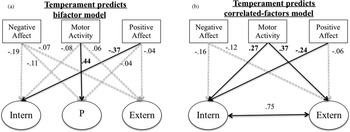
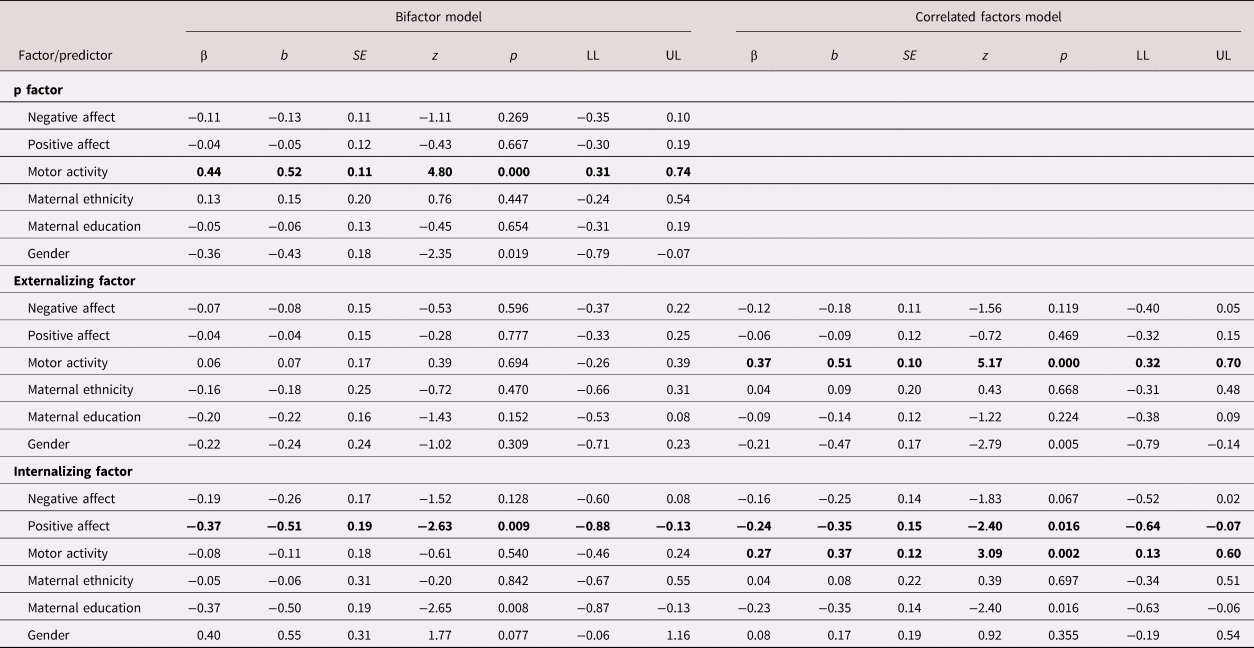
In order to examine the relations between the temperament dimensions and psychopathology, we added the three temperament dimensions (motor activity, positive affect, and negative affect) as predictors of the three psychopathology factors (general psychopathology, internalizing, and externalizing) within the bifactor model. Moreover, we also included child gender, maternal ethnicity, and maternal education as covariates. As shown in Table 1 and Figure 1a, motor activity levels significantly predicted the general psychopathology factor (β = .44, p < .001), such that increased motor activity levels in infancy predicted increased general psychopathology in childhood. Infant positive affect also significantly predicted the internalizing-specific factor (β = −.37, p = .009), such that increased positive affect in infancy predicted lower scores in the internalizing-specific factor. Importantly, these relations survived multiple comparison correction. No other relations between infant temperament and the latent psychopathology factors were statistically significant (Table 1 and Figure 1a). When examining for a potential moderation by gender in these relations, a chi-square difference test revealed a nonsignificant difference (Δχ2 (9) = 13.83, p = .129), indicating the relations between temperament and psychopathology factors did not significantly differ between males and females.
Standardized regression coefficients for the regression models for temperament dimensions predicting latent psychopathology factor scores in the bifactor model (a) and the correlated factors model (b), along with parent-reported predicting latent psychopathology factor scores in the bifactor model (c) and the correlated factors model (d). Black solid arrows indicate statistically significant relations after correction for multiple comparisons (false discovery rate; FDR). Gray dotted arrows represent nonsignificant regression paths. Albeit the analysis with the bifactor model was performed following the recommended methods from Koch et al. (Reference Koch, Holtmann, Bohn and Eid2018), the data are presented as traditional regression analyses to simplify the presentation. The effects of the covariates are not displayed in the figure, but are shown in Table 1.

Regression paths from the path model of temperament composites predicting psychopathology factors

Note: p factor = general psychopathology factor, β = standardized estimates, b = unstandardized estimates, LL = lower limit of 95% confidence interval, UL = upper limit of 95% confidence interval. Bold estimates and p values showed statistical significance with adjustment for multiple comparisons (q < .05; FDR). Albeit the analysis with the bifactor model was performed following the methods recommended by Koch et al. (Reference Koch, Holtmann, Bohn and Eid2018), the table is presented as a traditional regression analysis to simplify its presentation.
The effects of infant temperament on the correlated factors model
In order to examine the relations between the temperament dimensions and the more traditional factors of psychopathology, we added the three temperament dimensions (motor activity, positive affect, and negative affect) as predictors of the psychopathology factors (internalizing and externalizing) within the correlated factors model. We also included child gender, maternal ethnicity, and maternal education as covariates. As shown in Table 1 and Figure 1b, motor activity levels significantly predicted the externalizing and internalizing factors (β = .37, p < .001 and β = .27, p = .002, respectively), such that increased motor activity levels in infancy predicted increased externalizing and internalizing psychopathology in childhood. Moreover, positive affect negatively predicted internalizing problems (β = −.24, p = .016). Importantly, these relations with activity levels and positive affect survived multiple comparison correction. No other relations between infant temperament and the latent psychopathology factors were statistically significant (Table 1 and Figure 1b).
In exploratory analyses examining the potential moderation by gender in these relations, the results revealed a significant difference (Δχ2 (6) = 20.76, p = .002), indicating that some of the relations between temperament and general psychopathology factors significantly differed between males and females. However, follow-up analyses comparing each regression path between males and females indicated that none of the paths significantly differed on their own – albeit several were marginally significant. Given the lack of a priori gender-specific hypotheses and absence of robust gender differences – particularly in the bifactor model, which is the focus of the current study – we did not explore gender differences further.
Discussion
The current study examined, for the first time, the specificity of longitudinal relations from infant temperament to general psychopathology and specific internalizing/externalizing psychopathology factors in childhood. This was achieved by examining whether a composite of observed and parent-reported motor activity and affective (positive and negative) characteristics in infancy predicted latent dimensions of psychopathology in mid and late childhood. The results converged across models of psychopathology to suggest that infant motor activity serves as a transdiagnostic risk factor, which longitudinally predicts a general psychopathology factor measured 7–12 years later. In addition, we found that low levels of positive affect in infancy predicted the internalizing-specific factor. This study is the first to examine individual differences in temperamental reactivity – comprehensively measured at 4 months of age – as transdiagnostic risk factors for psychopathology. The results have implications for the early identification of children at risk for a general liability for psychopathology.
Although some temperamental qualities in childhood have been related to latent dimensions of psychopathology in some studies, most have been concurrent, few have examined observed temperament, and not one has tested prospective relations from infancy to general psychopathology during mid to late childhood using a multimethod approach. In support of our hypotheses, we found that observed and parent-reported motor activity at age 4 months was a significant longitudinal predictor of the general psychopathology factor. This finding converges with a previous report showing associations between general psychopathology and parent-reported surgency – a temperament dimension for which activity level is an important indicator (Olino et al., Reference Olino, Dougherty, Bufferd, Carlson and Klein2014). Importantly, in the current study, we found that this effect was specific to motor activity levels and not to positive affect by examining these temperament dimensions separately, as opposed to examining a combined temperament factor that includes several temperament dimensions (e.g., surgency).
Even though most of the previously documented relations between motor activity and behavioral problems involve the externalizing domain, including hyperactivity and attention problems (De Pauw et al., Reference De Pauw, Mervielde and Van Leeuwen2009; Fagot & O'Brien, Reference Fagot and O'Brien1994; Miller et al., Reference Miller, Degnan, Hane, Fox and Chronis-Tuscano2019; Schaughency & Fagot, Reference Schaughency and Fagot1993), these studies did not measure the shared variance among all behavioral problems. Moreover, other studies have found that activity level is related to other general outcomes such as overall behavioral problems (De Pauw et al., Reference De Pauw, Mervielde and Van Leeuwen2009), poor school adjustment (Jewsuwan, Luster, & Kostelnik, Reference Jewsuwan, Luster and Kostelnik1993; Zajdeman & Minnes, Reference Zajdeman and Minnes1991), and increased conflict with parents and peers (Laible, Panfile, & Makariev, Reference Laible, Panfile and Makariev2008). Similarly, studies have reported early surgency predicts both externalizing and internalizing problems (Stifter et al., Reference Stifter, Putnam and Jahromi2008). In line with these studies, when examining the correlated factors model, we found that motor activity was predictive of both externalizing and internalizing problems. Importantly, these results replicated in the sensitivity analyses that separated the contributions of observed and parent-reported temperament, suggesting that these findings were not driven by common-method variance (see Tables S1 and S2 and Figure S1 in the Supplementary Material).
Theoretically, early motor activity may act as an expressional component of all emotions, regardless of emotional valence (Strelau & Zawadzki, Reference Strelau, Zawadzki, Zenter and Shiner2012). As such, motor activity, especially in response to novelty, may reflect overall arousal rather than a particular emotional valence such as negative or positive affect. In line with this, infant motor activity is not predictive of specific diagnoses or psychopathology dimension (i.e., internalizing or externalizing), rather it is longitudinally predictive of psychopathology across diagnoses and dimensions. One possible mediator of this effect is self-regulation. Previous studies examining older children and adults suggest that general psychopathology is associated with lower executive functions as well as reports of effortful control (Hankin et al., Reference Hankin, Davis, Snyder, Young, Glynn and Sandman2017; Huang-Pollock et al., Reference Huang-Pollock, Shapiro, Galloway-Long and Weigard2017; Martel et al., Reference Martel, Pan, Hoffmann, Gadelha, do Rosário, Mari and Bressan2017; Olino et al., Reference Olino, Dougherty, Bufferd, Carlson and Klein2014). Similarly, early motor activity levels have been related to impulsivity and low levels of self-regulation (e.g., effortful control) (Abe, Reference Abe2005; Buss, Block, & Block, Reference Buss, Block and Block1980; Putnam & Rothbart, Reference Putnam and Rothbart2006; Shephard et al., Reference Shephard, Bedford, Milosavljevic, Gliga, Jones, Pickles and Baron-Cohen2019). As such, future studies should examine the role of self-regulation in childhood on the developmental pathways from early activity levels to general psychopathology along with testing the specificity of these potential differences by accounting for comorbidity in psychopathology.
In addition to the findings with motor activity, we found that low levels of positive affect predicted higher levels of internalizing. This was evident across both models of psychopathology (correlated factors and bifactor models). This finding is in line with previous studies that suggest that low levels of positive affect are associated with higher risk for internalizing problems (Durbin, Klein, Hayden, Buckley, & Moerk, Reference Durbin, Klein, Hayden, Buckley and Moerk2005; Hankin et al., Reference Hankin, Davis, Snyder, Young, Glynn and Sandman2017; Olino et al., Reference Olino, Dougherty, Bufferd, Carlson and Klein2014; Watson, Gamez, & Simms, Reference Watson, Gamez and Simms2005). However, to our knowledge, this is one of the first studies to show this relation longitudinally from early infancy to later childhood. Contrary to our other predictions, we failed to find other significant relations between other temperament dimensions and general, externalizing, or internalizing psychopathology. Previous studies examining the relations between temperament and general psychopathology have mostly relied on parent reports for both temperament and psychopathology and have only evaluated concurrent associations (Hankin et al., Reference Hankin, Davis, Snyder, Young, Glynn and Sandman2017; Olino et al., Reference Olino, Dougherty, Bufferd, Carlson and Klein2014), increasing shared-method variance. Given that we examined the prospective relations of infant temperament from such a young age (4 months), it is possible that other processes, intrinsic and extrinsic to the child, moderate the effects of early temperament across childhood.
Our results also highlight the benefit of examining fine-grained dimensions based on scales or aspects of temperament rather than broad higher-order domains. Higher-order domains combine multiple aspects that, albeit related to each other, may have different relations to psychopathology. For example, surgency as a higher-order domain often combines several aspects, including activity level and positive affect. In the current study, only activity level was a significant predictor of general psychopathology. Positive affect, in addition to not being significantly related to general psychopathology, had effects that were consistently in the opposite direction to those of motor activity – this was most evident in the correlated factors model for internalizing. Similar effects have been found with children when differentiating positive affect and approach behaviors (Buss et al., Reference Buss, Kiel, Morales and Robinson2014) as well as with adults distinguishing among communal extraversion and agentic extraversion (Watson et al., Reference Watson, Ellickson-Larew, Stanton, Levin-Aspenson, Khoo, Stasik-O'Brien and Clark2019). Together, these findings suggest that a broader temperament of factors like surgency (or extraversion) may mask the effects of fine-grained temperament dimensions like motor activity. As such, future studies should continue to examine subcomponents or aspects of temperament to provide a more comprehensive perspective of the relations between early temperament and its relation to later psychopathology.
We did not observe robust gender differences. We examined measurement invariance for the measurement model, finding evidence for factorial invariance across gender. This is in line with other studies that did not find gender differences in the structure of psychopathology (Huang-Pollock et al., Reference Huang-Pollock, Shapiro, Galloway-Long and Weigard2017; Lahey et al., Reference Lahey, Zald, Perkins, Villalta-Gil, Werts, Van Hulle and Poore2018) or studies including only one gender (Lahey et al., Reference Lahey, Rathouz, Keenan, Stepp, Loeber and Hipwell2015). As expected, we found some gender differences in the mean levels of the psychopathology latent factors. However, we did not find significant gender differences in the longitudinal relations from early temperament to later psychopathology in the bifactor model or the correlated factors model. This is contrary to previous studies that have found gender differences in the relations between temperament and psychopathology (Miller et al., Reference Miller, Degnan, Hane, Fox and Chronis-Tuscano2019; Morales et al., Reference Morales, Beekman, Blandon, Stifter and Buss2015, Reference Morales, Miller, Troller-Renfree, White, Degnan, Henderson and Fox2019; Rubin et al., Reference Rubin, Burgess, Dwyer and Hastings2003). However, to our knowledge, none of the previous temperament studies examined specific psychopathology factors modeled simultaneously or while accounting for the general psychopathology factor. Given the significant gender differences in the incidence of psychopathology, future studies should continue to explore potential gender differences in the developmental pathways from early temperament to specific psychopathology factors.
In line with an emerging literature of transdiagnostic risk (Caspi & Moffitt, Reference Caspi and Moffitt2018; Kotov et al., Reference Kotov, Krueger, Watson, Achenbach, Althoff, Bagby and Clark2017), the results of the current study revealed that the general psychopathology factor was a better representation of the structure of psychopathology, capturing comorbidity across disorders. This result has important clinical implications as it implies that greater consideration should be taken in characterizing the origins of general psychopathology to help create transdiagnostic early indicators and interventions. The current study contributes to these efforts by expanding our knowledge of the etiology of general psychopathology and identifying an early individual-level characteristic, observed in the first months of life, to prospectively predict general psychopathology across childhood. This early characterization may help identify infants who are at the greatest risk for psychopathology later in life and could benefit the most from prevention efforts.
The current study has several strengths, including a prospective longitudinal design in a well-characterized cohort of children and a multimethod approach to assess infant temperament. Moreover, given recent concerns regarding the psychometric and conceptual properties of bifactor models (Burns, Geiser, Servera, Becker, & Beauchaine, Reference Burns, Geiser, Servera, Becker and Beauchaine2020; Greene et al., Reference Greene, Eaton, Li, Forbes, Krueger, Markon and Docherty2019), we also estimated the correlated factors model, finding analogous longitudinal relations between infant temperament and psychopathology. However, our results should be interpreted in light of several limitations. Our community sample comprised mostly well-educated non-Hispanic Caucasian families. Future research using larger and more diverse samples is needed to determine how other contextual variables contribute or interact with the longitudinal relations between early temperament and later psychopathology. Even with the limited range of maternal education in our sample, we observed that children of less educated mothers displayed higher levels of internalizing problems. Moreover, future work should examine these relations in clinical samples with higher rates and more varied forms of psychopathology. Finally, the fact that our sample was oversampled for high levels of infant temperamental reactivity should also be considered when generalizing the current findings to other populations. This sampling strategy might impact the findings since some of the relations may manifest differently in the context of high levels of infant temperamental reactivity. However, the sampling strategy likely also increased our power to detect the effects of temperament by providing us with a broader range of temperament variability in the sample.
Conclusion
Data from a longitudinal sample of children supported recent theoretical conceptualizations and empirical findings that suggest behavioral and emotional problems are organized with a general psychopathology dimension that captures overall levels of psychopathology, along with specific internalizing and externalizing dimensions. The current study also tested, for the first time, if infant temperament predicted later general and specific latent psychopathology dimensions. The results revealed that infant motor activity serves as an indicator of transdiagnostic risk that is longitudinally associated with general psychopathology, whereas low levels of positive affect in infancy predicted higher levels of the internalizing-specific factor. Clinically, better understanding of the links between early temperament and childhood psychopathology aids in both early identification and intervention efforts to support at-risk infants.
Supplementary Material
The Supplementary Material for this article can be found at https://doi.org/10.1017/S0954579420001996
Acknowledgments
We thank the participating families, without whom this study would not have been possible.
Financial Statement
This research was supported by the National Institutes of Health (MH093349 and HD017899) to NAF.
Conflicts of Interest
None.