INTRODUCTION
Marine fouling is a serious problem causing huge economic loss and technical difficulties in the world, and is a major factor contributing to the increasing operation costs and affecting safety and service life of marine engineering installations. At present, environmental problems posed by metal-based antifouling coatings, in particular those containing organotins, have serious environmental consequences and as a result have been banned from use. An increasing interest in the development of non-toxic alternatives has shown some promising results (Clare, Reference Clare1996, Reference Clare1998).
In marine environments, although some sessile organisms are heavily fouled, other species in the same habitat are rarely epiphytized because of their natural products repelling the colonizing of other organisms on them. This antifouling or allelopathy mechanism will be helpful to develop novel, non-toxic or non-polluting and effective fouling control means (Qian et al., Reference Qian, Xu and Fusetani2010).
Gorgonians are a major source of unusual secondary metabolites that play important roles in protecting their colonies against grazing and fouling. In the Chinese waters, there are 44 species from six families of gorgonian corals and these are mostly distributed in the South China Sea. Many of these species are apparently free of visible epibiosis, and may possess mechanisms to prevent fouling by other organisms.
To date antifouling studies of the Suberogorgia gorgonians, which are widely distributed in Asian tropical waters, have focused mainly on their inhibition to fungi and barnacle (Balanus (=Amphibalanus) amphitrite) and bryozoan (Bugula neritina) settlement (Koh et al., Reference Koh, Tan, Chou and Goh2002; Qi et al., Reference Qi, Zhang, Yang and Qian2008). Other common epizoic organisms, such as macroalgae, bivalves and other barnacles, have not been studied so far.
Balanus (=Amphibalanus) reticulatus is a widely distributed barnacle species and its cypris larvae (cyprids) colonize any hard surface in the intertidal and subtidal zones of tropical and subtropical seas (Ren & Liu, Reference Ren and Liu1978); it is also a very important dominant species in established macrofouling communities in the South China Sea (Liu & Yan, 2006). Cyprids of B. reticulatus are therefore obvious and appropriate test organisms for antifouling bioassays.
Except for acorn barnacles, pearl oysters Pteria penguin, P. brevialata, P. coturnix and Pinctada margaritifera are also common species in fouling communities in the South China Sea (Wang et al., Reference Wang, Yan, Dong, Yan, Yan and Liang2000). Based on the reason that the pearl oyster Pinctada martensii is an important aquaculture species and the pediveliger larvae are easily raised and obtained, in this study it was selected as the representative of bivalve molluscs for the antifouling test.
The green algae Enteromorpha spp. are common inhabitants of the upper intertidal zone on shores, estuaries, and a variety of man-made structures throughout the world (Callow & Callow, Reference Callow and Callow1997). The Enteromorpha genus was subsumed by the Ulva genus some years ago (Hayden et al., Reference Hayden, Bloomster, Maggs, Silva, Stanhope and Waaland2003). Of them, U. linza is a common macrofouling species in the coastal waters of China in autumn, winter and spring, particularly from January to May (Yan et al., Reference Yan, Liu and Cao2008).
Another green alga U. lactuca is very common in the littoral and sublittoral zones, and its distribution is worldwide. In China, it mainly occurs in the coastal waters of the East and South China Seas, and is also a major dominant fouling species (Yan et al., Reference Yan, Liu and Cao2008). Its luxuriant growth period is from February to June.
Red algae are a major fouling group. Their morphology ranges from simple unicellular to unbranched and branched filaments to complex multiaxial uprights and crusts. Unlike green algae, no zoospores occur in their life cycle. Thus, it is very important to learn the effects of potential antifoulants on their spore germination when an antifouling assay is conducted.
The genus Gracilaria is common on rocks, gravels, shells, netting and ropes in mid and upper intertidal zones. There is abundant growth of the alga Gracilaria tenuistipitata in the coastal waters of Guangdong, Guangxi, Hainan and Fujiang of China, particularly in the inner bay where there is a freshwater discharge. The breeding climax is in the spring from March to April (Liu & Li, Reference Liu and Li1979). Compared with other red algae, the species and its carpospores are very easily collected on the southern China Coast. Moreover, the observation of spore germination is also convenient.
To provide a basis for further study, the effects of ethylacetate extract from gorgonian coral Subergorgia reticulata on invertebrate larval settlement and algal spore germination were studied. Acorn barnacle B. reticulatus and pearl oyster P. martensii were used as fouling invertebrate representatives, and green algae U. linza and U. lactuca and red alga G. tenuistipitata as fouling algal representatives.
MATERIALS AND METHODS
Preparation of crude extract
Freshly collected specimens of gorgonian coral S. reticulata by SCUBA divers from a coral reef at a depth of 10 m in Sanya, Hainan Province of China were minced and extracted with ethanol:dichloromethane (2:1) three times successively at room temperature. The solvent was evaporated in vacuo to dryness at 35°C (Qi et al., Reference Qi, Zhang, Yang and Qian2008). The residue was partitioned in H2O, extracted with ethylacetate three times and the extractants were combined. The resulting extract was dried in vacuo and stored at 5°C for antifouling assays.
Larval culture and algal spore collection
The seawater used for the larval culture and spore germination was passed through sand-filter and then membrane filtered (0.2 µm pore size) before use. All glasswares were sterilized prior to use.
ACORN BARNACLE B. RETICULATUS
The acorn barnacle B. reticulatus were collected from the marine aquaculture facilities at the Daya Bay, Shenzhen, China. By dissecting the adult barnacles, the fertilized egg lamellae containing late stage developing embryos were obtained and placed in a glass beaker with 500 ml filtered seawater. The barnacle nauplii were released within a few minutes and were reared at an initial density of 1–2 larvae ml−1 in 1000 ml glass beakers at 30°C on a diet of Platymonas subcordiformis (2.5–3.0 × 10⁵ cell ml−1) in complete darkness for 5 days. During the larval culture, a natural light illumination was provided for 30–60 minutes in the morning and late afternoon to maintain a continuous suspension of the alga P. subcordiformis. Seawater may be changed after 4 days, and more P. subcordiformis were added if necessary (Pang et al., Reference Pang, Yang, Yan and Chen1980). The readily recognized bivalved fusiform cyprids were collected and stored at 4°C for the antifouling assays.
PEARL OYSTER P. MARTENSII
The adult P. martensii for the artificial fertilization were collected from the pearl oyster farm at the Daya Bay, Shenzhen, China. Gametes were obtained by dissecting mature gonads. Eggs were fertilized in the filtered seawater containing 0.06‰ (v/v) ammonia seawater for 30 minutes. After that the zygotes were rinsed with filtered seawater for 2 to 3 times and incubated at 24°C. Approximately 24 hours later, straight-hinged veligers or D-shaped larvae started to feed. The larvae were reared at an initial density of 1–2 larvae ml−1 and fed on diet of alga Isochrysis zhanjingensis at 1.0–5.0 × 10³ cells ml−1 in the tank filled with 10,000 l filtered seawater (He et al., Reference He, Guan, Yuan and Zhang2008). After the umbo stage was reached, the larvae were fed on P. subcordiformis at 2.0–3.0 × 10³ cells ml−1 (He et al., Reference He, Guan, Yuan and Zhang2008). Seawater was changed about 1/3 volume daily. After culturing for 23 days or more, majority of the larvae reached the pediveliger stage with two dark eyespots and were competent to settle. They were collected and used for subsequent anti-settlement test.
GREEN ALGAE U. LINZA AND U. LACTUCA
For the algal spore germination bioassay, the fresh green algae U. linza and U. lactuca were collected from the intertidal on the west coast of Techengdao Island, Zhanjiang, China. After rinsing in seawater to remove associated debris and sand grains, the thalli were placed in a sampling cabinet without seawater and brought back to the laboratory within a few hours. Spore release was induced when a piece (2–3 cm) of fertile thallus (tawny edge) was immersed in filtered seawater on a glass slide and placed on the stage of a Nikon MD-TS100 microscope under 64 µmol m−2 s−1 light intensity. Released zoospores were collected by pipette.
RED ALGA G. TENUISTIPITATA
For the spore germination bioassay, the fresh red alga G. tenuistipitata was also collected from the intertidal zone on the western coast of Techengdao Island, Zhanjiang. To induce the release of the carpospores from the carposporangiums, the fertile thalli were placed in the shade to dry for 3–5 hours at room temperature, and then moved into glass Petri dishes containing filtered seawater. After incubation for about 20–30 minutes, carpospores were released and collected for antifouling assays.
Antifouling assay
The extract of various amounts was dissolved in 1 ml chloroform and transferred to Petri dishes (diameter of 6 cm) resulting in doses of approximately 100 µg cm−2, 10 µg cm−2, 1 µg cm−2, 0.1 µg cm−2 and 0.01 µg cm−2. Two controls were included: one with filtered seawater alone (Control 1) and the other with 1 ml chloroform before addition of filtered seawater (Control 2), similar to the treatment groups. The Petri dishes were dried on a shaker prior to the addition of filtered seawater, larvae or spores. The tests for effects of the extract on larval settlement and spore germination development were carried out in four replicates.
Data obtained from replicated experimental runs were subjected to analysis of variance using the computer software of Zhang & Qi (Reference Zhang and Qi2005). The mean values of different treatments were compared with the Fisher's least significant difference test.
INHIBITION OF CYPRID SETTLEMENT OF ACORN BARNACLE B. RETICULATUS
Each Petri dish mentioned above received 10 ml filtered seawater and 30 cyprids. Incubation was conducted at 30°C in darkness. The settlement and metamorphosis of individuals were counted every 12 hours for 108 hours under a Leica dissecting microscope. In similar way, the two controls were also executed.
INHIBITION OF LARVAL SETTLEMENT OF PEARL OYSTER P. MARTENSII
Each Petri dish received 10 ml filtered seawater and about 30 pediveliger larvae. Incubation was conducted for 108 hours at 24°C in the dark and observations were made under the YSZ-HF Nikon microscope at an interval of 12 hours. The two controls were carried out. Larvae were assigned into two categories: settlement (firmly attached to the bottom) or no settlement.
INHIBITION OF SPORE GERMINATION OF GREEN ALGAE U. LINZA AND U. LACTUCA
The collected zoospore suspension was placed in a 50 ml beaker. The zoospore concentration was measured by haemocytometer and adjusted to 1.0 × 10⁴ spores ml−1. To each prepared Petri dish was added 10 ml of the resulting zoospore suspension and this was placed in the dark for 2 hours to allow for even settlement of spores, then incubated for 4 days at room temperature (21–26°C) with 14–21 µmol m−2 s−1 light intensity on a cycle of 12 hours light:12 hours dark. After four days, seawater was removed and the number of spore germination was counted. About 20 view fields were counted for each dish under the light microscope. The two controls were carried out in each run in parallel with treatments.
INHIBITION OF SPORE GERMINATION OF RED ALGA G. TENUISTIPITATA
Thirty carpospores were pipetted into Petri dishes containing 10 ml filtered seawater, and all dishes were incubated at room temperature (18–23°C) with 14–21 µmol m−2 s−1 light intensity on a cycle of 12 hours light:12 hours dark. After 48 hours of incubation, the number of settled spores (including both the spores which had attached and germinated) and unsettled spores were counted under a dissecting microscope. The two controls were conducted in similar way as mentioned above.
RESULTS
Inhibition of cyprid settlement of acorn barnacle B. reticulatus
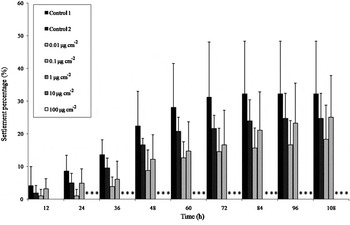
Figure 1 presents the larval settlement in percentage of acorn barnacle B. reticulatus treated by the extract from gorgonian coral S. reticulata at the doses of 0.01 µg cm−2, 0.1 µg cm−2, 1 µg cm−2, 10 µg cm−2 and 100 µg cm−2 for a period of 108 hours. No larvae were settled at the doses >1 µg cm−2, and there was a significant difference between the extract treatment groups and the control treated with chloroform before addition of seawater (P < 0.05). The larval settlement percentages in the Control 1, Control 2, 0.01 µg cm−2 and 0.1 µg cm−2 treatment groups were 32.2%, 24.7%, 18.4% and 25.1%, respectively, and there were no significant differences between them (P > 0.05).
Larval settlement percentage of acorn barnacle Balanus reticulatus treated by the ethylacetate extract from the gorgonian coral Subergorgia reticulata at five doses. All data were presented as mean ± SD of four replicates. An asterisk (*) above the bar indicates the data were significantly different from the control treated with chloroform before addition of seawater in the Fisher's least significant difference test (P < 0.05, one-way analysis of variance). Control 1, control with seawater alone; Control 2, control treated with chloroform before addition of seawater.

Inhibition of larval settlement of pearl oyster P. martensii
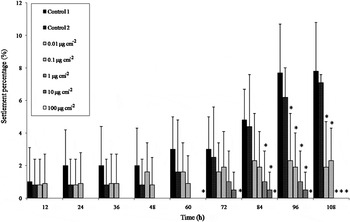
Figure 2 shows the larval settlement percentage of pearl oyster P. martensii treated by the extract from gorgonian coral S. reticulata at the doses of 0.01 µg cm−2, 0.1 µg cm−2, 1 µg cm−2, 10 µg cm−2 and 100 µg cm−2 for a period of 108 hours. There is no significant difference between the controls. After being incubated for 108 hours, the larval settlement percentages in the control with filtered seawater alone, control treated with chloroform before addition of filtered seawater, 0.01 µg cm−2 and 0.1 µg cm−2 treatment groups were 7.8%, 7.1%, 1.9% and 2.3%, respectively. No larvae were settled when the extract doses were >1 µg cm−2. There was a significant difference between the extract treatment groups and the control treated with chloroform before addition of seawater (P < 0.05).
Larval settlement percentage of pearl oyster Pinctada martensii treated by the ethylacetate extract from the gorgonian coral Subergorgia reticulata at five doses. All data were presented as mean ± SD of four replicates. An asterisk (*) above the bar indicates the data were significantly different from the control treated with chloroform before addition of seawater in the Fisher's least significant difference test (P < 0.05, one-way analysis of variance). Control 1, control with seawater alone; Control 2, control treated with chloroform before addition of seawater.

Inhibition of spore germination of green alga U. linza
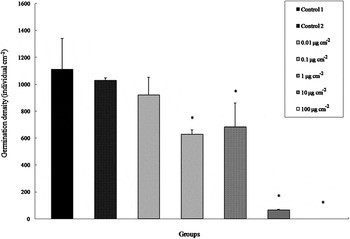
Figure 3 shows the germination density of the green alga U. linza in the control with filtered seawater alone, control treated with chloroform before addition of filtered seawater and extract treated groups after the zoospores were incubated for 4 days at room temperature with 14–21 µmol m−2 s−1 light intensity in a 12:12 hours light–dark cycle. Of them, the spore germination densities of the control with seawater alone and the control treated with chloroform before addition of seawater were 1111 and 1029 individual cm−2, respectively, and there was no significant difference between them (P > 0.05). In the group treated by the extract at the dose of 0.01 µg cm−2, the algal germination density was 921 individual cm−2, and the extract at the dosage had no significant effect on spore germination (P > 0.05). At the dosage of 100 µg cm−2, the spore germination was completely inhibited. The spore germination densities of the groups treated at the doses of 0.1 µg cm−2, 1 µg cm−2 and 10 µg cm−2 were 628 individuals cm−2, 680 individuals cm−2 and 65 individuals cm−2, respectively. The spore germination was significantly inhibited by the extract from gorgonian coral S. reticulata at the doses mentioned above (P < 0.05).
Spore germination density of green alga Ulva linza treated by the ethylacetate extract from the gorgonian coral Subergorgia reticulata at five doses. All data were presented as mean ± SD of four replicates. An asterisk (*) above the bar indicates the data were significantly different from the control treated with chloroform before addition of seawater in the Fisher's least significant difference test (P < 0.05, one-way analysis of variance). Control 1, control with seawater alone; Control 2, control treated with chloroform before addition of seawater.

Inhibition of spore germination of green alga U. lactuca
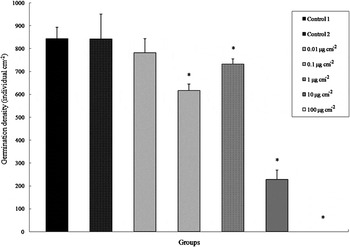
Figure 4 shows the spore germination density of the green alga U. lactuca in the control and extract treated groups after the zoospores were incubated for 4 days at room temperature with 14–21 µmol m−2 s−1 light intensity in a 12:12 hours light–dark cycle. Of them, the germination densities of the control groups were 843 and 841 individuals cm−2, respectively, and there was no significant difference between them (P > 0.05). In the group treated with the extract at the dose of 0.01 µg cm−2, the spore germination density was 782 individuals cm−2, and no significant effect on spore germination was observed (P > 0.05). The germination densities of the treated groups at the doses of 0.1 µg cm−2, 1 µg cm−2, 10 µg cm−2 and 100 µg cm−2 were 617 individuals cm−2, 732 individuals cm−2 and 228 individuals cm−2 and 0, respectively. The spore germination was significantly inhibited by the extract from gorgonian coral S. reticulata at the doses above 0.1 µg cm−2 (P < 0.05).
Spore germination density of green alga Ulva lactuca treated by the ethylacetate extract from the gorgonian coral Subergorgia reticulata at five doses. All data were presented as mean ± SD of four replicates. An asterisk (*) above the bar indicates the data were significantly different from the control treated with chloroform before addition of seawater in the Fisher's least significant difference test (P < 0.05, one-way analysis of variance). Control 1, control with seawater alone; Control 2, control treated with chloroform before addition of seawater.

Inhibition of spore germination of red alga G. tenuistipitata
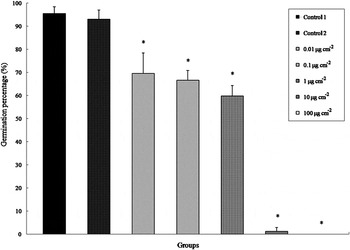
Figure 5 shows the spore germination percentage of the red alga G. tenuistipitata in the control and extract treated groups after the carpospores were incubated for 48 hours at room temperature with 14–21 µmol m−2 s−1 light intensity in a 12:12 hours light–dark cycle. Of them, the spore germination percentages of the control with filtered seawater alone and the control treated with chloroform before addition of filtered seawater were 95.5% and 93%, respectively, and there was no significant difference between them (P > 0.05). No carpospores germinated at the dose of 100 µg cm−2. The carpospore germination percentages treated by the extract at the doses of 0.01 µg cm−2, 0.1 µg cm−2, 1 µg cm−2 and 10 µg cm−2 were 69.6%, 66.6%, 59.8% and 1.3%, respectively. The spore germination was significantly inhibited by the extract from gorgonian coral S. reticulata (P < 0.05).
Spore germination percentage of red alga Gracilaria tenuistipitata treated by the ethylacetate extract from the gorgonian coral Subergorgia reticulata at five doses. All data were presented as mean ± SD of four replicates. An asterisk (*) above the bar indicates the data were significantly different from the control treated with chloroform before addition of seawater in the Fisher's least significant difference test (P < 0.05, one-way analysis of variance). Control 1, control with seawater alone; Control 2, control treated with chloroform before addition of seawater

DISCUSSION
The marine organisms such as acorn barnacle B. reticulatus, pearl oyster P. martensii, green algae U. linza and U. lactuca and red alga G. tenuistipitata are well known for their life histories and the culture conditions required in the laboratory. Among them except for pearl oyster P. martensii, they are dominant fouling organisms in the Southern China coastal waters (Liu & Yan, Reference Liu and Yan2006). Therefore, as examples or representatives of marine fouling organisms, they can be used as candidates for antifouling tests.
To avoid potential influences of solvents (chloroform here) dissolving the extract for tests, both the control (solvent) and seawater groups were included simultaneously (de Nys et al., Reference de Nys, Steinberg, Willemsen, Dworjanyn, Gabelish and King1995). In the tests, there is no significant difference between the control with seawater alone and the control treated with chloroform before addition of seawater. It means that no deleterious effect on the larval settlement and spore germination occurs after the solvent was evaporated, and the inhibitory activity exhibited must be due to the presence of extract.
The test results indicate that the ethylacetate extracts from the gorgonian coral S. reticulata were very active against the larval settlement of the acorn barnacle B. reticulatus and pearl oyster P. martensii, as well as the spore germination of the macroalgae U. linza, U. lactuca and G. tenuistipitata. It therefore can be concluded that the extract of gorgonian S. reticulata possesses a broad spectrum inhibitory effect on marine organisms from macroalgae to sessile invertebrates, implying this species may produce potent broad spectrum bioactive compounds against fouling.
In the previous studies on the Subergorgia gorgonians against microorganisms and macrofouling organisms, the crude extract from S. suberosa possessed inhibitory effects on fungi and no effects from S. mollis were observed at the tested concentrations (Koh et al., Reference Koh, Tan, Chou and Goh2002). Further work showed that subergorgic acid, thymine and N-hexadecanoyl-2-amino-1,3-dihydroxyoctadec-4-ene isolated from the gorgonian S. suberosa exhibited antibacterial and antifungal activities (Subrahmanyam et al., Reference Subrahmanyam, Ratna Kumar and Damodar Reddy2005). Moreover, the effective inhibition of subergorgic acid and progesterone on larval settlement of B. amphitrite and B. neritina were observed (Qi et al., Reference Qi, Zhang, Yang and Qian2008).
The work conducted by Jensen et al. (Reference Jensen, Harvell, Wirtz and Fenical1996) indicated that extracts of gorgonian species were variable in their antibiotic activity, even in the same family. Based on this information, it is therefore important to elucidate the mechanism of the chemical defence against fouling on the gorgonian S. reticulata and further work should be focused on the isolation, purification and identification of antifouling compounds from the extract. Moreover, considering biofouling is a complex colonization process in marine ecosystem, study on the potential application and the environmental impact of the newly identified antifouling compounds can be further conducted to develop effective commercial antifoulants.
ACKNOWLEDGEMENTS
We are grateful to Dr Graham Walker (University of Wales, Bangor) for valuable comments and suggestions on the manuscript and to the anonymous referees for providing important comments which improved the final text. This research was supported by a special grant of Guangdong Provincial Ocean and Fishery and a research grant of National Natural Science Foundation of China (No. 40706046).