Introduction
Palliative care is specialized medical care for people living with a serious illness. This type of care is focused on providing relief from the symptoms and stress of the illness. The goal of pediatric palliative care is to ease the physical, emotional, and psychosocial suffering of children with life-threatening and life-limiting illnesses. When successfully implemented in a timely fashion, children receive palliative services such as pain and symptom management, support, counseling, massage, expressive therapies, and nursing care. Pediatric palliative care programs typically help children and families with decision making, communication, psychosocial support, pain and symptom management, and bereavement care (Weaver et al., Reference Weaver, Heinze and Bell2016).
Pediatric palliative care should be adopted from diagnosis to the grief stage, when it is present, being concomitant with curative assistance and covering the physical, mental, and spiritual dimensions of the children and their families, thus guaranteeing their autonomy and dignity (WHO, 2015). Palliative care in pediatric oncology should not be limited to performing procedures, but should also cover the emotional component, reciprocity, good communication, dialogue, authentic presence, the cognitive aspect of perception, knowledge, and even intuition, developing the ability to help children and their families to find their potential and recognize their needs related to human well-being and values and helping them to cope with the existential situation being experienced (França et al., Reference França, Costa and Lopes2013).
Families of children receiving palliative care are profoundly affected by the challenges of illness. They must manage daily caregiving expectations, alterations to their roles, and changing responsibilities within the family. They also confront shifts in their understanding of the meaning of life and relationships as they come to recognize the terminal end point of patients' illness. Family members manage physical care changes and practical difficulties with daily living while they handle their emotional distress about patients' care and concerns about the future (Anteneh and Kassa, Reference Anteneh and Kassa2016).
Cancer occurs not only in adults but also in children. According to the World Health Organization (WHO, 2017), the incidence of cancer in children increases every year. The number reaches 110–130 cases per one million children. In Egypt, the mean age of cancer patients is 48 years, which is two decades younger than the mean age of American cancer patients. This is a reflection of the young age structure of the Egyptian population, with 33% below the age of 15 and 50% below the age of 20 years (El Malla et al., Reference El Malla, Kreicbergs and Steineck2017).
There are many barriers to pediatric palliative care. It is categorized into children–family-related factors, and care providers affirm that barriers may occur when healthcare providers are prevented from acting according to their professional standards. The determination of these barriers must be achieved to maintain appropriate child care (Friedrichsdorf and Bruera, Reference Friedrichsdorf and Bruera2018).
In Egypt, after communicating with patients and their families, in December 2010, The Children's Cancer Hospital Egypt 57357 (C.C.H.E.) launched the first pediatric palliative care program (P.P.C.) in the East Mediterranean Region. Family care providers who were unable to participate in making significant decisions regarding the management of children with cancer identified important aspects of perceived barriers, including the lack of family support and uncomfortable caring for terminal children with cancer (Maria et al., Reference Maria, Evanthia and Petros2016). In addition, family care providers often find it difficult to discuss changes in the goals of treatment and referral to palliative care, and there are no guidelines for pediatric palliative care in Egypt yet (Egypt's Fakkous Center, 2016).
Nurses help family care providers provide care to children with cancer. Before such care is provided, nurses and care providers must have a better understanding of the impact of providing palliative care on pediatric care oncology. Clarity of roles and distribution of responsibilities are important in coordinated care (O'Shea et al., Reference O'Shea, Campbell and Engler2015). Also, the barriers in palliative care for childhood cancer must be overcome, and without any assessment of family care providers’ perception of these barriers, care in the field of pediatric oncology will become a futile exercise. Therefore, this study aimed to assess the level of knowledge, attitude, and practice of family care providers and the perceived barriers faced by them while providing palliative care to children.
Aim of the study
As stated earlier, this study aimed to assess the perception of pediatric oncology family care providers toward palliative care and its perceived barriers, in Egypt.
Research questions
To fulfill the aim of this study, the following research questions were formulated:
1. What is the level of knowledge, attitude, and practice of family care providers among oncology children towards palliative care?
2. What are the perceived barriers faced by family care providers among oncology children in palliative care?
Methods
The descriptive study design was utilized to achieve the aim of the current study. The study was conducted from 10th May 2019 to 10th Feb 2020 at outpatient cancer clinics for treatment at the El-Nasr Children's Specialized Hospital located in Port Said. This hospital is located in the middle of the city, surrounded by two main streets easy to reach, on the area of 2,500 m2. It has two buildings with a total of eight floors and 78 beds containing health emergency and care units.
Participants
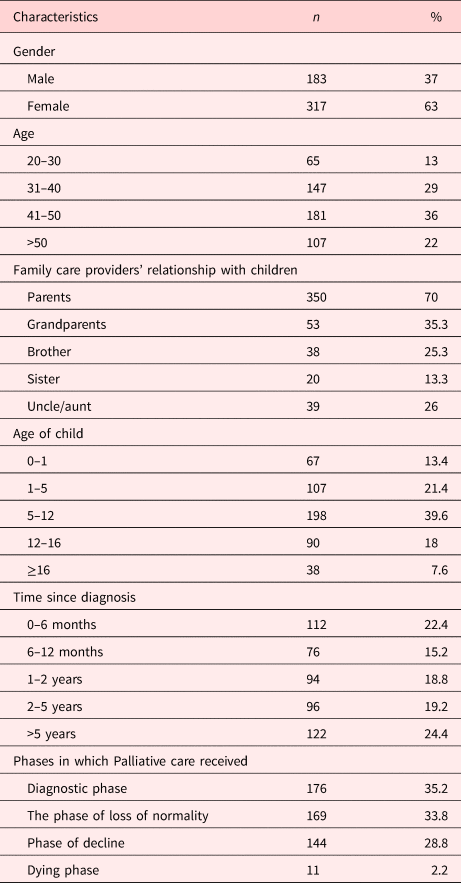
A systematic random sample was utilized to select 535 pediatric oncology family care providers who meet the inclusion criteria of (a) having a minimum of 1-year experience in caring for patients at home and (b) providing direct care to their patients. Thirty-five care providers refused to participate in the study, so the total sample reduced to 500 providers. A total of 63% of the providers were female out of which 36% were aged 41–50 years old. With regard to the family care providers’ relationships with children, the results indicated that 70% were parents. With regard to the age of children, the findings revealed that they were aged between 5 and 12 years, and 39.6% were interviewed. About 24.4% of the children were diagnosed more than 5 years ago. Eventually, 35.2% of the children received palliative care in the diagnostic phase (Table 1).
Distribution of demographic characteristics of pediatric oncology care providers toward palliative care (n = 500)

Tools: three tools used to collect the data
1st tool: A structured interview Questionnaire: This tool was adopted from (Muleme, et al., Reference Muleme, Kankya and Ssempebwa2017) and modified by the researchers. It is divided into three parts.
1st part: Characteristics of subjects' participants: age, gender, time since diagnosis, age of the child, family care providers' relationship with children, and palliative phase at the first interview.
2nd part: Questionnaire sheet to assess the subjects' participants’ knowledge: It consists of six questions such as “Awareness of the side effects of the type of treatment provided to the child”, "Advise on the type of food the child needs to take …etc." The correct answer was given one score, while the wrong answer was given zero scores. Based on the scoring system utilized, the knowledge level was categorized as follows: insufficient for scores <75% and sufficient for scores ≥75%.
3rd part: Barriers Assessment Likert scale: it was adapted from Smith et al. (Reference Smith, Temin and Alesi2012). It was consisted of 12 open-ended questions to elicit barriers such as perceived barriers for palliative care, including "lack of family care providers' training in pediatric palliative care, lack of knowledge about pediatric palliative care, improper communication between the health team and the family care providers, and differences of opinion among family care providers about pediatric palliative care, etc."
2nd tool: Attitude toward palliative care Likert scale: it was adapted from Mastroianni et al. (Reference Mastroianni, Piredda and Taboga2015). It was used to assess attitude toward palliative care. It comprised five statements, including “Do you agree that family care providers are the best persons to coordinate on the palliative care of children with advanced cancer and do you agree that you feel emotionally burned out by having to deal with your children with advanced cancer…etc.” The tool was measured by a 5-point Likert scale ranging from strongly agree, agree, neutral, disagree, and strongly disagree. All the statements had 5-point Likert scale answers ranging from +2 (strongly agree) to −2 (strongly disagree) for positive statements and from +2 (strongly disagree) to −2 (strongly agree) for negative statements. The score for the total was evaluated as positive for a score of ≥75% and negative for a score of <75%.
3rd tool: Reported practices checklist: an observational checklist was adopted from (Nakazawa., et al Reference Nakazawa, Miyashita, Morita, Umeda, Oyagi and Ogasawara2009) and modified by the researchers. It included eight questions, including the number of years of palliative care experience in caring for terminally ill pediatric cancer patients, Family members informed no experience palliative care training and presence as a health practitioner when a patient has died, etc. Each point of practice was categorized as the following: done for correct practices and a score of one point (1), not done for incorrect practices and a score of zero (0). The reported practices were considered appropriate if the practice score was ≥75% and inappropriate if the practice score was <75%.
The tools were translated and their validity checked by seven experts in different fields of family and community health nursing and pediatric nursing specialty. Researchers depended on the Cronbach alpha test to assess the reliability of the tool (the Cronbach alpha test score for the 1st tool was 0.788, for the 2nd tool, it was 0.791, and for the 3rd tool, it was 0.802).
Procedure
Once permission was granted to proceed with the current study from responsible and authoritative parties at the El-Nasr Children's specialized hospital, the researchers initiated data collection and contacted each potential pediatric oncology family care provider to explain the purpose and nature of the study. The tools of data collection were distributed to the subjects participants after explaining the purpose, the time limit for each participant was 45–60 minutes.
Statistical analysis
SPSS version 23 was used to analyze the data. Percentages and frequencies were used to summarize all of the category data. A one-sample Kolmogorov–Smirnov test was used to determine the data's normality. The chi-square test was used to compare qualitative variables. To compare continuous and non-parametric data, the Spearman correlation test was used. Results were considered significant when the probability of error was less than 5% (P < 0.05), non-significant when the probability of error was more than 5% (P > 0.05) and highly significant when the probability of error was less than 0.1% (P < 0.01). The smaller the P value obtained, the more significant were the results.
Ethical consideration
The Research Ethics Committee approved this study. This approval granted permission for the investigators to utilize the targeted hospitals. Approval was obtained (written and oral consent) from the pediatric oncology family care provider. The researchers emphasized that participation in the study was entirely voluntary, and the anonymity and the confidentiality of the responses of the participants were assured. Also, they had the right to withdraw from the study at any time they wished to do.
Results
The demographic data of the participants in Table 1 reveal that 63% of the family care providers are female and 36% are aged 41–50 years old. With regard to family care providers' relationships with children, the results indicate that 70% are parents. Regarding the age of children, the finding reveals that they are aged between 5 and 12 years, and 39.6% are interviewed. About 24.4% of the children were diagnosed more than 5 years ago. Eventually, the table shows that 35.2% of the children received palliative care in the diagnostic phase.
According knowledge about palliative care, Table 2 clarified that 51.8% of the pediatric oncology family care providers had sufficient knowledge of palliative care, while 48.2% of them had insufficient knowledge.
Total knowledge scores of pediatric oncology family care providers in palliative care (n = 500)

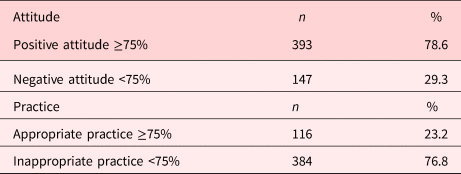
With regard to attitude toward and practice in palliative care, Table 3 reveals that 78.6% of the pediatric oncology family care providers have a positive attitude toward palliative care, while 21.4% of them have a negative attitude. Also, it shows that 76.8% of pediatric oncology family care providers have inappropriate practice, while 23.2% of them have appropriate practice.
Total attitude and practice scores of pediatric oncology family care providers in palliative care (n = 500)

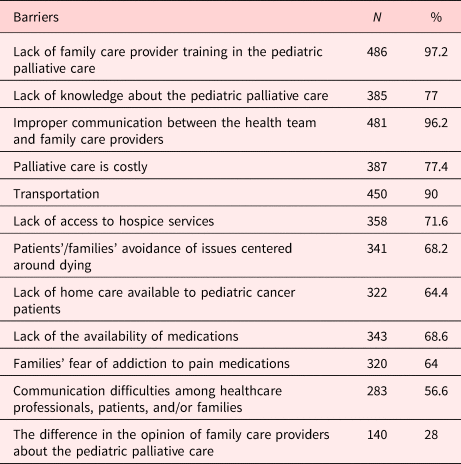
According barriers about palliative care, Table 4: indicates that 97.2% of the pediatric oncology family care providers reported that the most remarkable perceived barriers against palliative care was “Lack of family care providers training in pediatric palliative care”, 96.2% of them reported one barrier to be “improper communication between the health team and family care providers”, and 90% of them reported “Transportation” as another barrier.
Perceived barriers among pediatric oncology family care providers towards palliative care (n = 500)

On the correlation between studied variables, there was a highly statistically significant association between the total knowledge of the pediatric oncology family care providers with their total attitudes and total practices as displayed in Table 5.
Correlation between knowledge, attitudes, and practices among pediatric oncology family care providers toward palliative care (n = 500)

*Statistically significant at p ≤ 0.05.
**Statistically significant at p ≤ 0.01.
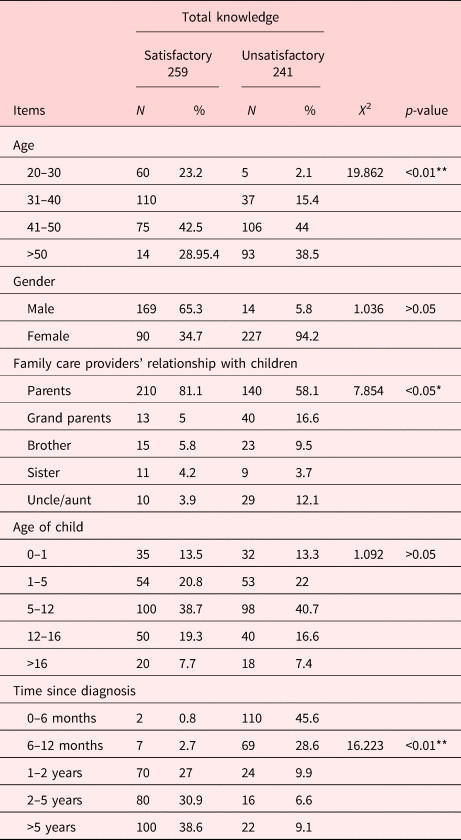
On the relation between the characteristics of the participants of the study and their total knowledge, Table 6 presents that there was a highly statistically significant difference between the total knowledge among the study subjects and their age of the study subjects and time since diagnosis at p-value (<0.01**). Moreover, there was a statistically significant difference between the total knowledge among the study subjects and their family care providers' relationship with p-value (<0.05*). On the other hand, there was no statistically significant difference between the total knowledge among the study subjects and their gender and the age of children.
Relation between the characteristics of study participants and their total knowledge (n = 500)

* Slightly significant <0.05.
** Highly significant <0.01.
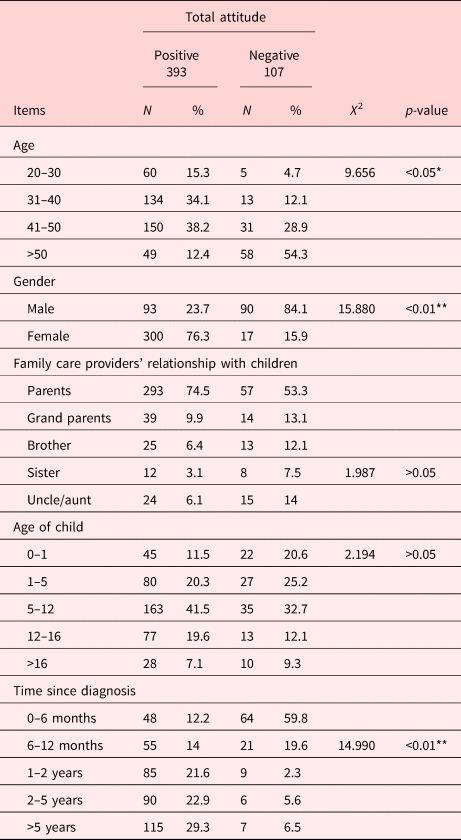
With regard to the relation between the characteristics of the study participants and their total attitudes, Table 7 shows that there was a highly statistically significant difference between the total attitudes among the study subjects and their gender and time since diagnosis at p-value (<0.01**). Moreover, there was a statistically significant difference between the total attitudes among the study subjects and their age with p-value (<0.05*). On the other hand, there was no statistically significant difference between the total attitudes among the study subjects and their family care provider's relationship and age of children.
Relation between the characteristics of the study participants and their total attitudes (n = 500)

* Slightly significant <0.05.
** Highly significant <0.01.
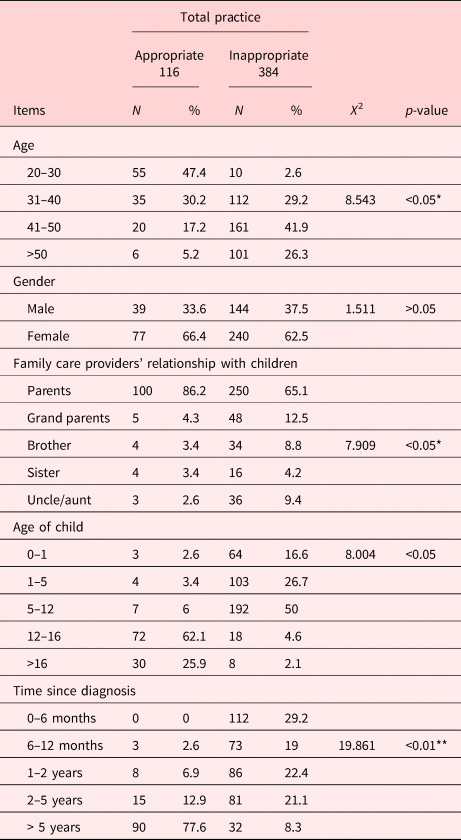
On the relation between the characteristics of the study participants and their total practices, Table 8 shows that there was a highly statistically significant difference between the total practices among the study subjects and their time since diagnosis at p-value (<0.01**). Moreover, there was a statistically significant difference between the total practices among the study subjects and their age and family care provider's relationship with p-value (<0.05*). On the other hand, there was no statistically significant difference between the total practices among the study subjects and the gender and age of children.
Relation between the characteristics of the study participants and their total practices (n = 500)

* Slightly significant <0.05.
** Highly significant <0.01.
Discussion
Children with advancing cancer frequently experience considerable symptoms and suffering at the end of life. Many parents of children who die of cancer report wishing that they had received more support and palliative care during their illness. Some report that they never discuss the end-of-life treatment with clinicians or regret the type of cancer treatments their children received at the end of life, while others report wishing that clinicians had better prepare them for the possibility of their child's death (Ferrell et al., Reference Ferrell, Coyne and Dahlin2016).
As pediatric palliative care services become more common in children's hospitals all over the world, and as new programs are developed, there is a need to better understand how specific “end users”, understanding perceptions of the pediatric oncology family care providers perceptions can also generate valuable information on referral timing for this patient population (Szymczak et al., Reference Szymczak, Schall and Hill2018).
The objective of this study was to assess perception of pediatric oncology family care providers towards palliative care and its barriers in Egypt. Results of the current study showed that slightly more than half of the total family care providers in pediatric oncology had sufficient knowledge towards palliative care, and more than three-quarters had a positive attitude toward palliative care. However, slightly more than three-quarters of them had inappropriate practice.
From the researchers' point of view, oncology family care providers' sufficient knowledge and the positive attitude toward palliative care might be due to the updating of knowledge on palliative care and better awareness among parents and relatives about such care through education, mass media, and the Internet. Also to the satisfaction with the judiciary and destiny and the teachings of religions that urge patience, perseverance, and correct conduct which more common among the Egyptian people. With regard to inappropriate practice, a lack of in-health educational programs about palliative care is a possible reason.
This result was in agreement with that of Pasaol (Reference Pasaol2019), who stated that more than half of the respondents had a positive attitude, and the level of practice showed that the majority of family care providers in pediatric oncology had inappropriate practice in palliative care. Furthermore, Spruit et al. (Reference Spruit, Bell and Toly2018) who conducted a study clarified that the parents in the study had unsatisfactory practice levels. This was in line with the study conducted by Zeru et al. (Reference Zeru, Berihu and Gerensea2020), who elaborated that slightly less than two-thirds of the study group had sufficient knowledge about palliative care and more than half had a favorable attitude toward it.
In contrast to these findings, Fadare et al. (Reference Fadare, Obimakinde and Afolayan2014) demonstrated that there are plausible gaps in the knowledge of the pediatric oncology family care providers in the area of palliative care, and, therefore, interventions are needed to fill these gaps. Another study conducted in China by Gu and Cheng (Reference Gu and Cheng2016) revealed insufficient knowledge about palliative care and related issues displayed by the Chinese families, necessitating paying more attention to educating them about such issues by family care providers in Mainland China.
With regard to the barriers to palliative care perceived by family care providers in pediatric oncology, the findings elaborated that nearly all of the family care providers reported that the most perceived barriers to palliative care were “lack of family care provider training in pediatric palliative care and improper communication between the health team and family care providers”.
This result was supported by Pasaol (Reference Pasaol2019), who stated that the lack of knowledge about pediatric palliative care and improper communication between the health team and family care providers were the major barriers in providing palliative care to patients by cancer centers. On the contrary, all of the pediatric oncology healthcare providers affirmed that the ignorance and lack of awareness about the existing programs and resources of palliative care were the major factors that limit the patients to receive such care.
Another study about “Barriers to Palliative Care in Pediatric Oncology in Switzerland” by Rost et al. (Reference Rost, De Clercq and Rakic2020) showed that the perceived barriers to palliative care were costly, and, therefore, unaffordable families’ avoidance of issues around dying, lack of homecare available to pediatric cancer patient, and lack of availability of medications. Besides, Davies et al. (Reference Davies, Sehring and Partridge2008) indicated that approximately one-half of the respondents reported 4 of 26 barriers listed in the study questionnaire as frequently or almost always occurring, and these are uncertain prognosis, families not ready to acknowledge barriers to treat incurable conditions, and time constraints.
Besides, the results of the current study demonstrated that there was a highly statistically significant association between the total knowledge of the pediatric oncology family care providers and their total attitudes and total practices. These findings are in agreement with those of Friedrichsdorf and Bruera (Reference Friedrichsdorf and Bruera2018), who found significant statistical correlations between palliative care understanding to the knowledge, attitudes, practices, and other associated factors of palliative care to the pediatric oncology patients for the development of a more effective palliative care for cancer children.
Awareness of palliative care is limited, and several challenges need to be addressed, including the following: deficient medical and psychosocial support to address patients’ complaints like severe pain, anorexia, and anxiety, necessitating in a holistic approach to address this inadequacy, lack of support for palliative care providers, and caregivers to cope with their emotionally challenging task, lack of collaboration between stakeholders, thus pointing to a need to define roles and responsibilities, and creating awareness and ownership at the community, healthcare, and policy levels to make palliative care a priority (Kaba et al., Reference Kaba, de Fouw and Deribe2021).
The current study showed that there was a highly statistically significant difference between total knowledge and the age of the study subjects. This finding is in line with a study by Maria et al. (Reference Maria, Evanthia and Petros2016), who carried out an “Assessment of knowledge and associated factors toward palliative care among Greek nurses”. This result is also supported by Elmelegy et al. (Reference Elmelegy, Ahmed and Elkazeh2016), who conducted an “Impact of Palliative Care Educational Program on Nursing Students’ Knowledge and Attitudes toward Care of Dying Patients”, and proved that there was a highly statistically significant difference between the total knowledge and the age of the study subjects.
Furthermore, the present study showed that there was no statistically significant difference between the total knowledge among the study subjects and their gender and the age of children. This finding is in agreement with a study by Alkhudairi (Reference Alkhudairi2019) titled “General public awareness, knowledge, and beliefs toward palliative care in a Saudi population”, and found that there was no significant difference in the level of knowledge between genders.
The present study demonstrated that there was a statistically significant difference between the total attitudes among the study subjects and their age. This finding is in line with a study by Collins et al. (Reference Collins, McLachlan and Philip2020) titled “Community knowledge of and attitudes to palliative care: A descriptive study”.
The present study also demonstrated that there was a statistically significant difference between the total practices among the study subjects and their age. This finding is in agreement with a study by Tesfaye et al. (Reference Tesfaye, Anbessie and Gizaw2018) titled “Palliative Care Practice and Associated Factors among Nurses Working in Jimma University Medical Center South-West Ethiopia”.
Conclusion
The oncology pediatrics' family care providers had sufficient knowledge and a positive attitude towards palliative care, but their practices were inappropriate. Also, the majority of participants identified that lack of family care providers training in pediatric palliative care and improper communication between the health team and family care providers were the main barriers to providing palliative care. Besides, there was a highly statistically significant association between the total knowledge of the pediatric oncology family care providers and their total attitudes and total practices.
Recommendations
Based on the results of the current study, it is recommended that the oncology pediatric's family care providers should be provided with standard palliative care guidelines that lay out a framework for the care needed for children with cancer and life-threatening conditions. Furthermore, the oncology pediatric's family care providers should receive adequate training on the provision of palliative care for children with cancer through a health education program so as to enhance their knowledge and raise awareness about pediatric palliative care.