



1 Introduction
The theory of transcendental numbers began with Liouville’s celebrated construction of numbers admitting exceptionally good rational approximations, providing the first explicit examples of transcendental numbers [Reference Liouville9]. Since then, Liouville-type constructions have played a central role in transcendence theory and Diophantine approximation.
A landmark result in this direction was established by Adams [Reference Adams2]. He proved that if
$b_1,\ldots ,b_k$
 are multiplicatively independent integers greater than
$1$
 and
$(a_n)_{n\ge 1}$
 satisfies

then the Liouville series

are algebraically independent over
$\mathbb {Q}$
 .
Motivated by this theorem, we study analogous questions in two non-Archimedean settings. Building on the work of Mahler [Reference Mahler10, Reference Mahler11], Adams [Reference Adams1], Clark [Reference Clark5], Nishioka [Reference Nishioka12], Uchiyama [Reference Uchiyama14], Chaichana et al. [Reference Chaichana, Laohakosol and Komatsu3, Reference Chitmung, Chaichana and Chaopraknoi4], Lelis and Marques [Reference Lelis and Marques8], and others, we establish p-adic and function field analogues of Adam’s theorem by proving the algebraic independence of suitable families of Liouville series.
The notion of a p-adic Liouville number was introduced by Clark [Reference Clark5] in the study of p-adic differential equations. A p-adic integer
$\lambda $
 is called a p-adic Liouville number if

Clark showed that this condition determines the convergence of the solutions of certain p-adic differential equations, while Schikhof [Reference Schikhof13] later characterised such numbers through arbitrarily long gaps in their p-adic expansions. Lelis and Marques [Reference Lelis and Marques8] introduced the broader class of weak p-adic Liouville numbers. A p-adic integer
$\gamma $
 is called a weak p-adic Liouville number if, for every positive integer k, there exists a positive integer
$n_k$
 such that

where
$(\omega _k)$
 is a sequence of positive real numbers with
$\omega _k\to \infty $
 .
The paper is organised as follows. In Section 2, we present the p-adic analogue of Adam’s theorem and provide its proof. In Section 3, we establish the corresponding analogue of Adam’s theorem over function fields.
2 Results in the p-adic setting
Throughout this section, let p be a fixed prime. Every nonzero
$x\in \mathbb {Q}^{\times }$
 can be written as

where
$a,b$
 and n are integers such that
$p\nmid ab$
 . The p-adic valuation is defined by

and the corresponding absolute value by

The p-adic absolute value satisfies the non-Archimedean inequality

Following the standard construction (see [Reference Gouvêa6]), the field
$\mathbb {Q}_p$
 of p-adic numbers is the completion of
$\mathbb {Q}$
 with respect to the metric
$ d_p(x,y)=|x-y|_p. $
 The valuation extends uniquely to
$\mathbb {Q}_p$
 with
$v_p(p)=1$
 , and the ring of p-adic integers is

Finally, a series
$\sum _{n=0}^{\infty }a_n$
 in
$\mathbb {Q}_p$
 converges if and only if
$ |a_n|_p\to 0, \ \text {as}~ n\to \infty. $

We now state our first result, which is an analogue of Adam’s theorem in the p-adic setting.
Theorem 2.1. Let p be a prime number. Let
$q_1,\ldots ,q_k$
 be positive integers greater than
$1$
 such that
$v_p(q_1)<\cdots <v_p(q_k)$
 and let
$\{a_n\}_n$
 be a sequence of positive integers such that

Then, the weak p-adic Liouville numbers

are algebraically independent over
$\mathbb Q$
 .
The proof of the theorem depends on the following technical lemma.
Lemma 2.2. Let p be a prime, k a positive integer and
$P\in \mathbb {Z}[t_1,\ldots ,t_k]$
 a nonzero polynomial of degree
$d_i$
 in the variable
$t_i$
 . Suppose that
$P(\xi _1,\ldots ,\xi _k)=0$
 for some
$(\xi _1,\ldots ,\xi _k)\in \mathbb {Z}_p^k$
 . Then, there exists a constant
$C = C(P)> 0$
 such that for any
$(\ell _1,\ldots ,\ell _k)\in \mathbb {Z}^k$
 , either
$ P(\ell _1,\ldots ,\ell _k)=0 $
 or

where
$|\ell |$
 denotes the usual absolute value of
$\ell \in \mathbb {Z}$
 .
Proof. Since
$P(\xi _1,\ldots ,\xi _k)=0,$
 we write

where
$i_j\le d_j$
 for
$1\leq j\leq k$
 ,
$b_I\in \mathbb {Z}_p$
 , the
$b_I$
 are zero for all except finitely many I and
$b_{(0,\ldots ,0)}=0$
 . Therefore,

for some
$c_1,\ldots, c_k\in \mathbb {Z}_p$
 . Observe that if
$P(\ell _1,\ldots, \ell _k)\neq 0$
 , then there exists i such that
$c_i\neq 0$
 . By the ultrametric inequality,

If
$P(\ell _1,\ldots ,\ell _k)\neq 0$
 , by writing

where the
$a_I\in \mathbb {Z}$
 are nonzero for only finitely many
$I=(i_1,\ldots ,i_k)$
 , we see that

for some positive constant
$c'$
 that depends only on P. Since
$\ell ^{-1}\leq |\ell |_p$
 for every nonzero integer
$\ell $
 , from (2.1) and (2.2),

for some positive constant C that depends only on P.
Proof of Theorem 2.1.
Let
$\alpha _{i,n}=\sum _{m=1}^{n}q_i^{a_m}\in \mathbb Z$
 . Then,
$|\alpha _i|\leq q_i^{2a_n}$
 . Now, we shall use induction on k.
First, consider
$k=1$
 . If the result is not true, then
$\alpha _1$
 is algebraic over
$\mathbb Q$
 . Let
$P(t)$
 be the minimal polynomial of
$\alpha _1$
 over
$\mathbb Z$
 with degree d. Then, for all large n,
$P(\alpha _{1,n})\neq 0$
 . By Lemma 2.2,

However,

Hence,
$p^{a_{n+1}}\leq Cq_1^{2da_n}$
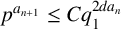 , which gives a contradiction, since
$\liminf _{n\to \infty }(a_{n+1}/{a_n})=\infty $
 .
Now, assume that the result holds for
$k-1$
 , but does not hold for k. Then,
$\alpha _1,\ldots ,\alpha _k$
 are algebraically dependent. Let
$P(t_1,\ldots ,t_k)\in \mathbb Z[t_1,\ldots ,t_k]$
 be a nonzero polynomial with degree
$d_i$
 in
$t_i$
 such that
$P(\alpha _1,\ldots ,\alpha _k)=0.$
 Assume P has minimal total degree.
Consider the Taylor expansion of P about
$(\alpha _1,\ldots ,\alpha _k)$
 , that is,

where
$I=(i_1,\ldots ,i_k)$
 with
$i_j\leq d_j$
 for
$1\leq j \leq k$
 ,
$C_I\in \mathbb Z_p$
 and
$C_{I_0}=0$
 , where
${I_{0}=(0,\ldots ,0)}$
 . Let
$C_i=C_{I_i}$
 for
$i=1,\ldots ,k$
 , where
$I_i$
 has 1 in the ith position and zero elsewhere. Note that for
$i=1,\ldots ,k$
 ,

If
$C_i=0$
 , then either
${\partial P}/{\partial t_i}\equiv 0$
 or
$({\partial P}/{\partial t_i})(\alpha _1,\ldots ,\alpha _k)=0$
 . In the first case,
$t_i$
 is absent in P and, hence,
$\alpha _1,\ldots ,\alpha _{i-1}, \alpha _{i+1},\ldots ,\alpha _k$
 are algebraically dependent, which contradicts the induction hypothesis. Otherwise, the second case gives a nonzero polynomial of smaller degree vanishing at
$(\alpha _1,\ldots ,\alpha _k)$
 , which violates our assumption on the degree of P. Thus, we conclude that
$C_i\neq 0$
 for
$i=1,\ldots ,k.$
 Hence, we can write

where

Now,
$v_p(H_n)=v_p(C_1)+a_{n+1} v_p(q_1)$
 and
$v_p(R_n)\geq a_{n+1}(v_p( q_1)+1)-c_0$
 , where
$c_0\geq 0$
 depends only on the
$C_I$
 . Since,
$a_{n+1}/a_n\to \infty $
 as
$n\to \infty $
 , there exists a positive integer
$N_0$
 such that

Hence, by the ultrametric inequality,
$H_n+R_n\neq 0$
 . Put
$q=q_1^{d_1}\cdots q_k^{d_k}$
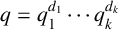 and
$d=d_1+\cdots +d_k$
 . By Lemma 2.2,

However,

Equations (2.3) and (2.4) are incompatible for large n, since
$a_{n+1}/a_n\to \infty $
 as
$n\to \infty $
 .
3 Results in function fields
Throughout this section, let K be a field of characteristic
$0$
 and let

denote the field of Laurent series over K. For a nonzero element

where
$n\in \mathbb {Z}$
 ,
$c_i\in K$
 and
$c_n\neq 0$
 , define

We also set
$v_{\infty }(0)=+\infty $
 . The associated non-Archimedean absolute value on
$\mathbb {K}_{\infty }$
 is defined by setting
$|0|_{\infty }=0$
 and

We next introduce the notion of Liouville numbers in
$\mathbb {K}_\infty $
 .
Definition 3.1 [Reference Chaichana, Laohakosol and Komatsu3, Definition 1].
An element
$\alpha \in \mathbb {K}_\infty $
 is called a
$\mathbb {K}_\infty $
 -Liouville number if, for every
$n \in \mathbb {N}$
 , there exist nonzero polynomials
$p_n, q_n \in K[x]$
 with
${|q_n|_\infty> 1}$
 such that

The following theorem is the main tool for proving the transcendence of elements in
$\mathbb {K}_\infty $
 .
Theorem 3.2 (Roth’s theorem, see [Reference Uchiyama14]).
Let K be a field of characteristic
$0$
 . If
${\alpha \in \mathbb {K}_\infty \setminus K(x)}$
 is algebraic over
$K(x)$
 , then for every
$\varepsilon>0$
 , the inequality

has only finitely many solutions
$P,Q\in K[x]$
 with
$Q\neq 0$
 and
$\gcd (P,Q)=1$
 .
Theorem 3.3. Let
$\{q_n\}_n$
 be a sequence of polynomials over K and let
$\kappa>2$
 be a fixed real number such that

Then,

is transcendental over
$K(x)$
 .
Theorem 3.4. Let
$\{q_n\}_n$
 be a sequence of polynomials over K satisfying

for some
$\kappa>2$
 , and suppose that

for all sufficiently large n. Then,

is transcendental over
$K(x)$
 .
The final theorem is an analogue of Adam’s theorem in the function field setting.
Theorem 3.5. Let
$q_1,\ldots ,q_k\in K[x]$
 be nonconstant polynomials with
$\deg q_1<\cdots <\deg q_k$
 and let
$\{a_n\}_n$
 be a sequence of positive integers such that

Then, the
$\mathbb {K}_\infty $
 -Liouville numbers

are algebraically independent over
$K(x)$
 .
3.1 Auxiliary results
Lemma 3.6. Let
$P(t_1,\ldots ,t_k) \in K[x][t_1,\ldots ,t_k]$
 be a polynomial of degree
$d_i$
 in the variable
$t_i$
 and
$q_1,\ldots , q_k\in K[x]$
 . Let
$(\ell _1,\ldots ,\ell _k) \in (K[1/q_1]\times \cdots \times K[1/q_k])$
 and set
$e_i=v_\infty (l_i)$
 . Then, either
$P(\ell _1,\ldots ,\ell _k)=0$
 or

for some constant C that depends only on P.
Proof. Suppose
$P(\ell _1,\ldots ,\ell _k)\neq 0$
 . Then,

where
$i_j\leq d_j$
 for
$1\leq j\leq k$
 and
$a_I\in K[x]$
 . Hence,
$P(\ell _1,\ldots ,\ell _k)\in K(x)$
 and
$v_{\infty }(P(\ell _1,\ldots ,\ell _k))\leq d_1e_1+\cdots +d_ke_k-c$
 , where
$c\geq 0$
 depends on the coefficients of P in
$K[x]$
 . Thus,

for some constant
$C=C(P)$
 .
Lemma 3.7. With the notation as in Lemma 3.6, let
$P(t_1,\ldots ,t_k)\in K[x][t_1,\ldots ,t_k]$
 be a nonzero polynomial of degree
$d_i$
 in
$t_i$
 such that
$P(\alpha _1,\ldots ,\alpha _k)=0$
 for some
$(\alpha _1,\ldots ,\alpha _k)\in \mathbb {K}_\infty ^k$
 satisfying
$|\alpha _i|_\infty \leq 1$
 for
$1\leq i\leq k$
 . Then, there exists a constant
${C=C(P)>0}$
 such that, for all
$(\ell _1,\ldots ,\ell _k)\in K[1/q_1]\times \cdots \times K[1/q_k]$
 , either

or

Proof. Since
$P(\alpha _1,\ldots ,\alpha _k)=0,$
 we write

where
$i_j\leq d_j$
 for
$1\leq j\leq k$
 and
$b_v\in \mathbb {K}_\infty $
 are nonzero for finitely many
$I=(i_1,\ldots ,i_k)$
 . This gives

where
$c_i\in \mathbb {K}_\infty $
 and
$|c_i|_\infty \leq \displaystyle \max _I|b_I|_\infty $
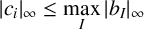 . Observe that if
$P(\ell _1,\ldots ,\ell _k)\neq 0$
 , then there exists i such that
$c_i\neq 0$
 . By the ultrametric inequality,

where
$C'$
 is a positive constant depending only on P. Suppose
$P(\ell _1,\ldots ,\ell _k)\neq 0$
 and write

where
$a_I\in K[x]$
 are nonzero for finitely many
$I=(i_1,\ldots ,i_k)$
 . By Lemma 3.6,

where
$C">0$
 depends only on P. From (3.1) and (3.2),

for some constant
$C>0$
 that depends only on P.
Lemma 3.8. Let
$\{a_n\}_{n\ge 1}$
 be a sequence of positive integers such that

Then, for sufficiently large n, we have
$ (c-1)(a_1+\cdots +a_n)<a_{n+1}. $

Proof. Suppose that

Then, there exist
$\delta>0$
 and an integer
$N_0$
 such that

Equivalently,

By repeated application of this inequality, we obtain

or, equivalently,

Let

say, where C is independent of n. Using the estimates above,

Hence,

Since
$ a_{n+1}>(c+\delta )a_n, $
 we have
$ a_n<{a_{n+1}}/({c+\delta )} $
 and, therefore,

Equivalently,

Since C is a fixed constant whereas
$N\to \infty $
 , we have
$ {C}/{N}\to 0. $
 Choose n sufficiently large so that

Then,

Consequently,

This completes the proof.
Lemma 3.9 [Reference Hančl, Kolouch, Pulcerová and Štěpnička7, Lemma 1].
Let c be a positive real number and let
$\{a_n\}_{n=1}^{\infty }$
 be a nondecreasing sequence of positive real numbers such that

Then,

3.2 Proofs of the theorems
The proofs of Theorems 3.3 and 3.4 are based on constructing suitable rational approximations from the partial sums of the corresponding series and applying Uchiyama’s function field analogue of Roth’s theorem (Theorem 3.2). These results can be viewed as function field analogues of classical transcendence results for lacunary expansions.
Proof of Theorem 3.3.
For each
$n\geq 1$
 , let
$q_n$
 be polynomial of degree
$a_n$
 . Put

and

where
$r_n,s_n\in K[x]$
 , with
$(r_n,s_n)=1$
 . Since
$|{1}/{q_n}|_\infty =e^{-a_{n}}\to 0$
 as
$n\to \infty $
 , the series (3.3) is convergent. Now,

Observe that
$|s_n|_\infty \leq |q_1\cdots q_n|_\infty =e^{a_1+\cdots +a_n}$
 and
$a_{n+1}\geq \kappa (a_1+\cdots +a_n)$
 by Lemma 3.8. Therefore,

Since
$\kappa>2$
 , Theorem 3.2 shows that
$\theta $
 is transcendental over
$K(x)$
 .
Proof of Theorem 3.4.
For each
$n\geq 1$
 , let
$q_n$
 be polynomial of degree
$a_n$
 . Then,

By Lemma 3.9, there is a subsequence
$(a_{n_k})_k$
 of
$(a_n)_n$
 such that

Put

and

where
$r_{n_k},s_{n_k}\in K[x]$
 , with
$(r_{n_k},s_{n_k})=1$
 . Observe that
$|s_{n_k-1}|_\infty \leq |q_1\cdots q_{n_k-1}|_\infty $
 . By (3.4), for all k sufficiently large,

By Theorem 3.2,
$\theta $
 is transcendental over
$K(x)$
 .
Proof of Theorem 3.5.
We shall prove the result by using induction on k.
For
$k=1$
 , Theorem 3.3 shows that
$\alpha _1$
 is transcendental giving the result in this case.
Assume that the result is true for
$k-1$
 and does not hold for k. Then, there exists a nonzero polynomial
$P(t_1,\ldots ,t_k)$
 over
$K[x]$
 such that
$P(\alpha _1,\ldots ,\alpha _k)=0.$
 Suppose P has minimal total degree. Put,

Claim. For all sufficiently large n, we have
$P(\alpha _{1,n},\ldots ,\alpha _{k,n})\neq 0$
 .
Since
$P(\alpha _1,\ldots ,\alpha _k)=0$
 , we write

where
$I=(i_1,\ldots ,i_k)$
 satisfies
$i_r\leq d_r$
 for
$1\leq r\leq k$
 ,
$C_I\in \mathbb {K}_\infty $
 and
$C_{(0,\ldots ,0)}=0$
 . Let
${C_i=C_{I_i}}$
 for
$i=1,\ldots ,k$
 , where
$I_i$
 has 1 in the ith position and zero elsewhere. Note that for
$i=1,\ldots ,k$
 ,

Thus,
$C_i=0$
 implies
$({\partial P}/{\partial t_i})(\alpha _1,\ldots ,\alpha _k)=0$
 . If
${\partial P}/{\partial t_i}\equiv 0$
 , then
$t_i$
 is absent in P and, hence,
$\alpha _1,\ldots ,\alpha _{i-1}, \alpha _{i+1},\ldots ,\alpha _k$
 are algebraically dependent over
$\mathbb {K}(x)$
 , which is a contradiction to the induction hypothesis. Otherwise, there is a nonzero polynomial of total degree less than that of P that vanishes at
$(\alpha _1,\ldots ,\alpha _k)$
 and this violates our assumption on the degree of P. Thus, we conclude that
$C_i\neq 0$
 for all
$i=1,\ldots ,k$
 . Hence,

where
$H_n=C_1(\alpha _{1,n}-\alpha _1)$
 and

Now,
$v_\infty (H_n)=v_\infty (C_1)+a_{n+1}\deg q_1$
 and

Therefore, there exists a positive integer
$N_0$
 such that

By the ultrametric inequality,
$H_n+R_n\neq 0$
 . This establishes our claim.
Now, by Lemma 3.7,

However,


This leads to a contradiction when n is sufficiently large, because

Acknowledgements
I would like to express my sincere gratitude to my supervisor, R. Thangadurai, for his constant support, encouragement and friendly guidance. I am also grateful to the referee for carefully reading the manuscript and for providing useful suggestions.



