Introduction
Although micro-evolutionary mechanisms are basically the same in all species, they show a special peculiarity in Homo sapiens because cultural factors that are exclusively human interact with biological determinants reducing and sometimes eliminating their influence (e.g. Lasker & Crews, Reference Lasker and Crews1996). The demographic analysis of several fertility and mortality aspects can be used to investigate the diverse evolutionary models in human populations. Genetic drift (Lasker & Kaplan, Reference Lasker and Kaplan1964) and natural selection (Crow, Reference Crow1958) are evolutionary mechanisms that can be studied using demographic data. Thus, from demographic data it is possible to analyse and compare the genetic structure of populations, inferring evolutionary changes and genetic differentiation (Albeza et al., Reference Albeza, Acreche and Caruso2002).
Regarding the mechanism of genetic drift, the degree of deviation of gene frequencies by the action of this evolutionary process is calculated through the initial gene frequency and the size of the reproductive population. However, there are two demographic conditions that have to exist in order to determine whether genetic drift action is effective. First, the number of reproductive couples must be small to allow random action in gene transmission. Second, it is necessary for the population to be isolated, since immigration could neutralize the changes in the genetic pool caused by genetic drift. This is the main difference in the action of genetic drift in human species. The development of communication has brought about a breaking up of reproductive isolation (Lasker & Crews, Reference Lasker and Crews1996), causing genetic drift to be an exceptional evolutionary mechanism in current human populations (Masaki & Koizumi, Reference Masaki and Koizumi1988). As well as immigration, natural selection also acts as a genetic factor that decreases the genetic drift action (Kimura, Reference Kimura1983).
As for the evolutionary process of natural selection, this can be analysed using demographic data and expressed in terms of differential mortality and fertility. The transmission of genes from individuals to succeeding generations depends on the total number of newborns, and on the number attaining the age of effective reproduction. From the results obtained by studies on natural selection in human populations, it is possible to discern, in general, three evolutionary models (Luna & Moral, Reference Luna and Moral1990a). The first is represented by developing populations, such as isolated indigenous communities, where natural selection operates almost exclusively through high infant mortality, since fertility is very elevated. It is the characteristic evolutionary model of human populations that have not begun the process of demographic transition. The second model corresponds to technologically well-developed populations, where the selective processes act almost only through low fertility caused by birth control, since infant mortality has drastically reduced as the result of improved health conditions. This second model corresponds to populations that have finished the demographic transition. The third model is fitting for rural populations of developed countries. These communities also show a substantial reduction in infant mortality because of public health programmes, and exhibit the high fertility of the past as a result of the persistence of the cultural pattern defined by a large number of offspring (Tarskaia et al., Reference Tarskaia, Elchinova, Varzar and Shabrova2002). That is, they are societies that are experiencing the demographic transition. Hence natural selection action is significantly obstructed in comparison with the two models previously mentioned, and shows a high biological fitness, since gene transmission is assured by the population's high fertility and low mortality.
The Alpujarran population is a clear example of this third evolutionary model (Luna & Moral, Reference Luna and Moral1990a), because its stillbirth and infant mortality rates decreased significantly throughout the twentieth century (Luna & Moral, Reference Luna and Moral1990b; Luna et al., Reference Luna, Polo, Fernández-Santander and Moral2001; Luna et al., Reference Luna, Moral, Alonso and Fernandez-Santander2007), while its fertility rate remained high (Luna & Fuster, Reference Luna and Fuster1990). In addition, due to the high endogamy rate of the population's couples (Luna, Reference Luna1984), the action opportunity of genetic drift was also analysed (Gil-Frias & Luna, Reference Gil-Frias and Luna1998). Because of its geographical isolation, La Alpujarra has been a natural refuge during different invasions of the Iberian Peninsula throughout its history, causing noticeable changes in the socioeconomic and environmental characteristics of this region. From the viewpoint of human biology, the last settlement of a population to be expelled from the region was the Muslims.
Although its population showed great cultural and demographical homogeneity among its villages during the first half of the twentieth century, Bayárcal municipality was the clearest example of a geographically isolated community, like Tristan da Cunha (Bailit et al., Reference Bailit, Damon and Amon1966), the Spanish population of La Cabrera (Boattini et al., Reference Boattini, Blanco Villegas and Pettener2007) and the French Pyrenees populations (Serre et al., Reference Serre, Jakobi and Babron1985). In terms of cultural isolation, Bayárcal is a good example, similar to Samaritan society (Bonné, Reference Bonné1963). The aim of this paper is to analyse the natural selection model and the action opportunity of genetic drift in this community and compare the possible differences in these mechanisms between Bayárcal and the whole of the Alpujarran region.
Methods
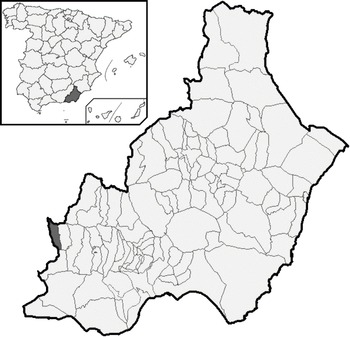
Bayárcal is a municipality (an administrative area of Spain) of the province of Almeria, in the south-east of the Iberian Peninsula, which belongs to La Alta Alpujarra Oriental (286.4 km2), the most eastern part of the La Alpujarra region (2000 km2), located on the Mediterranean slope of the Sierra Nevada, between the Andalusian provinces of Granada and Almeria (Fig. 1). Bayárcal municipality is populated by one small village, which is also called Bayárcal. When data were colleted (1978), La Alta Alpujarra Oriental was the most isolated area of all La Alpujarra, and its population (with an average total of 8734.9 inhabitants between 1900 and 1950) was concentrated in small villages, scattered in various valleys, at about 1000 m altitude, with a very rugged topography. Among all these villages, Bayárcal has been noted for its highest geographic isolation. Located in a ravine, this Almerian village bordering with the province of Granada is the highest in the province (1258 m altitude). This location increased its isolation, since the interior roads of La Alpujarra, built after the Spanish Civil War (Bosque, Reference Bosque1969), did not connect with villages and towns of other provinces. Like the rest of eastern Alpujarra, Bayárcal was almost exclusively a farming community devoted to agriculture with a typical family economy. Similar to many other Spanish rural populations, many of its inhabitants had to migrate to industrialized regions, with the consequent decrease in demographic size.
Location of Bayárcal municipality in the Almerian province (south-east Spain).

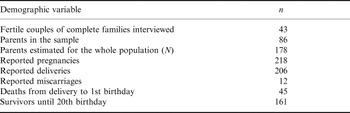
Family data were obtained by personal interviews in the summer of 1978, without any previous criteria for sampling selection. Consequently, depending only on willingness to collaborate, a total of 77 families with 265 persons were questioned, including not only parents and offspring but also the rest of the members of the family. These 265 inhabitants represented 48.45% of the Bayárcal population (547 individuals in the census of 1978). However, only complete families, with wife's reproductive period ended and family size definitive, were taken into account in the analyses, and therefore only women born before 1933 were selected. According to this information, this paper is a retrospective study referring to a period of about 50 years around the middle of the twentieth century. Demographic data collected in the sample for each couple were: birth date and place of parents, number of pregnancies, miscarriages and deliveries, and number of newborns and of pre-reproductive deaths of offspring, considering the reproductive age in La Alpujarra to be 20 years (Luna & Fuster, Reference Luna and Fuster1990). The number of fertile couples with at least one offspring corresponding to complete families was 43 in the sample, and the parent number was 86. Consequently, regarding the number of interviews (48.45% of population), the real reproductive population size (N) consists of 178 parents.
The action possibility of genetic drift was evaluated using the Coefficient of Breeding Isolation (CBI) defined by Lasker & Kaplan (Reference Lasker and Kaplan1964). This index depends on the size and the degree of isolation of the reproductive population:

where N E is the effective size of the reproductive population and M E is the effective immigration rate. According to Lasker & Kaplan (Reference Lasker and Kaplan1964), the genetic drift action is negligible when CBI is greater than 50, and it has high possibilities only when it is below 5. Regarding the isolation component, since the immigrants adopt the reproductive pattern of the natives, as in La Alpujarra (Luna, Reference Luna1984), M E calculation is determined exclusively by the non-native proportion of parents, which is obtained from the proportion of married foreigners.
To assess the action opportunity of natural selection of a population from demographic data, Crow (Reference Crow1958) proposed the Index of Total Selection, which takes into account the mortality and fertility patterns and is defined as a function of two demographic components. First, the ‘index of selection potential due to differential mortality’ (I m) takes into account the probability of death and survival during the first twenty years of post-delivery life; and second, the ‘index of selection potential due to differential fertility’ (I f) depends on the variance and the average of living newborns.
From these two parameters, the Index of Total Selection (I) is established by the following expression:

Furthermore, since embryonic mortality is usually high in developing communities and these deaths are not taken into account by Crow's methods, the ‘Index of Total Selection corrected’ (I′) was also calculated in order to evaluate the effect of this early mortality on the natural selection action. This parameter allows the study of the entire pre-reproductive period, from embryonic stages until the twentieth anniversary, through the expression:

where P b is the proportion of embryos that survive until birth and P bP s yields the probability of survival from early embryonic stages until reproductive age.
Results and Discussion
Table 1 shows the absolute fertility frequencies of Bayárcal women interviewed in the sample, as well as the frequencies of deaths and survivors until various ages of pre-reproductive life. A quarter (0.261) of embryos died before reproductive age, a mortality rate higher than the rate (0.237) observed for the rest of the Alpujarran population (Luna & Moral, Reference Luna and Moral1990a). But while most of these deaths took place after delivery (0.218) and the lowest proportion occurred during the embryonic stages (0.055), the opposite occurred in the rest of region (0.097 and 0.140, respectively).
Demographic data for the Bayárcal study population

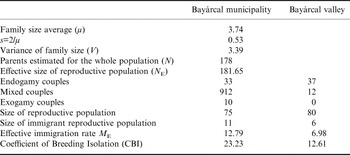
The parameters calculated in order to analyse the action possibility of genetic drift in Bayárcal are shown in Table 2. Besides the effective size of the reproductive population (N E) and the effective immigration rate (M E), the average and the variance of the family size were calculated, as well as the distribution of the parents by origin from the endogamy/exogamy statistics of fertile couples of complete families. Because Bayárcal is a village located in the Bayárcal valley clearly isolated from the other Alpujarran valleys, this analysis was carried out from two points of view. First, the action opportunity of genetic drift in the population of the Bayárcal municipality was studied; and second, the analysis considered the population in the whole of the Bayárcal valley. Apart from the Bayárcal municipality, two Granada villages (Laroles and Picena) and another Almerian province (Paterna del Río) are located in this valley within 5 km of Bayárcal.
Parameters used to calculate the Coefficient of Breeding Isolation (CBI) in the Bayárcal population

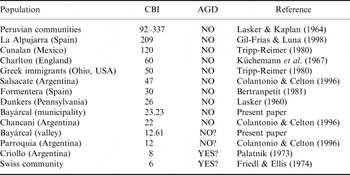
In the first analysis, the action possibility of genetic drift is virtually nil or very low, in spite of its reduced demographic size, because its reproductive isolation was not so great. Due to its low population size and the short distances to other villages within the valley, Bayárcal singles had to look for mates in the rest of the valley. Only when marital migration from the rest of valley is not considered as foreign immigration but as native population does the second analysis, carried out within Bayárcal valley, suggest that genetic drift has more possibilities to act (Table 2). In this case, all the valley is equivalent to a unique geographical unit and heavy gene flow took place among its populations. These results are comparable with those of European, North and South American populations, including the rest of Alpujarra, which are characterized by a reduced demographic size and geographic isolation (Table 3). From them, it can be inferred that this evolutionary mechanism has action opportunity only in very particular situations, such as in communities where the low population size is enclosed with a great degree of reproductive isolation, defined often by its cultural characteristics (Masaki & Koizumi, Reference Masaki and Koizumi1988).
Coefficient of Breeding Isolation (CBI) and action opportunity of genetic drift (AGD) in some human populations

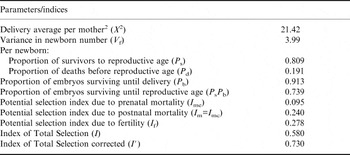
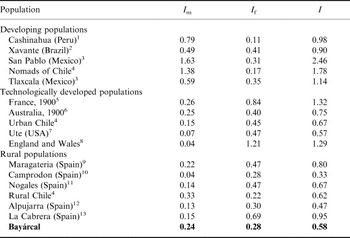
As for natural selection (Table 4), the potential selection index due to differential fertility of Bayárcal (0.28) is low and near the lowest limit of the world variability, which varies from 0.15 to 1.34. Similar results are obtained when the potential selection index due to differential mortality is analysed, since its value (0.24) approaches the lowest level of human population variability, from 0.01 to 1.78 (Puzyrev et al., Reference Puzyrev, Erdynieva, Kucher and Nazarenko1999). When both Bayárcal parameters are compared with those obtained in the rest of Alpujarra (Luna & Moral, Reference Luna and Moral1990a), there are two notable observations. First, the natural selection index due to differential fertility of Bayárcal is similar to, and slightly lower than, the index of the rest of the region population (0.30), indicating similar fertility patterns. And second, natural selection due to postnatal mortality is clearly higher in Bayárcal than in the rest of Alpujarra (0.13), because pre-reproductive mortality is higher in the village. For this reason, though fertility always contributes more than mortality to the total selection for both Bayárcal (59% vs 41%) and the rest of Alpujarra (73% vs 27%), the relative contribution of mortality is higher in the municipality than in the rest of the region. The evolutionary model by natural selection of Bayárcal corresponds to the same model observed in La Alpujarra and in the rural communities of developed countries (Table 5), but a consequence of the higher mortality of Bayárcal can be emphasized. Its total selection index separates from that observed in the rest of the Alpujarra, moving towards the evolutionary model of developing populations. This particular movement can be explained by accepting the possibility that the Bayárcal community was experiencing an earlier stage of the demographic transition than the rest of the Alpujarran population.
Parameters and indices of potential selection in the Bayárcal population

Indices of potential selection in several populations

1 Johnston & Kensinger (Reference Johnston and Kensinger1971);
2 Neel & Cagnon (Reference Neel and Changnon1968);
3 Halberstein & Crawford (Reference Halberstein and Crawford1972);
4 Crow (Reference Crow1966);
5 Jacquard (Reference Jacquard1974);
6 Cavalli-Sforza & Bodmer (Reference Cavalli-Sforza and Bodmer1971);
7 Tyzzer (Reference Tyzzer1974);
8 Sphuler (1963);
9 Bernis (Reference Bernis1974);
10 Torrejon & Bertranpetit (Reference Torrejon and Bertranpetit1987);
11 Fuster (Reference Fuster1982);
12 Luna & Moral (Reference Luna and Moral1990);
13 Blanco & Fuster (2Reference Blanco Villegas and Fuster007).
Although the corrected Crow's index of total selection corresponding to Bayárcal (Table 4) is similar to that of the rest of the Alpujarra (I′ =0.709: Luna & Moral, Reference Luna and Moral1990a), the potential selection index due to prenatal mortality of the village (Table 4) is lower than that obtained for the rest of the region (I me=0.095 vs I me=0.163). This result is surprising considering the poor health conditions of the studied population, and it would suggest an unexpectedly high biological fitness for embryonic mortality. However, Alpujarran women displayed a strong prejudice in the interviews when answering questions about miscarriages, and it is possible that this prejudice was greater in more isolated populations, such as those of Bayárcal. The suppression of this information would explain the lower than expected prenatal mortality found in Bayárcal. Consequently, the corrected Crow's index of total selection would have to be significantly higher than the index obtained and would corroborate that the evolutionary model of Bayárcal tends to move towards the pattern of developing populations. When the different contributions of the partial selection indices to the total selection index in Bayárcal are analysed, including all pre-reproductive mortality (miscarriages and postnatal deaths), the mortality contribution increases (45%: 13% I me, 32% I m), but fertility continues to be the most important component (55%) due to the low miscarriage number.
Two conclusions can be drawn from this retrospective study, leading to a better understanding of the genetic structure of the current Bayárcal population in light of the past action of the two evolution forces analysed in this paper. First, cultural factors have led to genetic drift not currently being the determining evolutionary mechanism in this population, which it was in the past. Despite the great geographic isolation of Bayárcal, its reproductive isolation was not effective enough for genetic drift to act, as observed in other populations, though the action opportunity was higher than in the rest of the region. This evolutionary mechanism was a determinant process in the diversification of human species, explaining some differences among current human populations, such as molecular blood differences (Cavalli-Sforza & Bodmer, Reference Cavalli-Sforza and Bodmer1981; Ayala & Kiger, Reference Ayala and Kiger1984; Lewontin, Reference Lewontin1984; Cavalli-Sforza et al., Reference Cavalli-Sforza, Menozzi and Piazza1994), and even differences in other groups of primates, such as macaques (Selander, Reference Selander and Ayala1980). However, today the geographical barriers in Bayárcal have little effect on genetic isolation because of the development of a transport network, which has made human migration easier and broken down reproductive isolation (Lewontin, Reference Lewontin1984; Caro-Dobón & Santo-Tomás, Reference Caro-Dobón and Santo-Tomás1994; Lasker & Crews, Reference Lasker and Crews1996).
The second conclusion is that the biological fitness of Bayárcal is separated from that of the rest of La Alpujarra, despite its similarity to rural communities of developed countries. The action opportunity of natural selection is higher in Bayárcal than in the rest of La Alpujarra because, although fertility is similar, mortality is clearly higher. This evolutionary difference can be explained by the fact that the Bayárcal community underwent the demographic transition later than the rest of the La Alpujarran population. These results are attributed to the great reproductive isolation of Bayárcal observed in the analysis of genetic drift, which had two demographic effects – the maintenance of a high fertility and high mortality – due to lack of birth control and poor health conditions.
Acknowledgments
This work was supported partially by the project CGL2006-02978 of the Spanish Ministerio de Ciencia y Tecnología. Thanks are expressed to Erik Lundin for reviewing the manuscript.